
Reports
The Global Software Defined Security Market was valued at USD 18785.6 Million in 2025 and is anticipated to reach a value of USD 80990.2 Million by 2033 expanding at a CAGR of 20.04% between 2026 and 2033. Growth is being accelerated by enterprise-wide zero-trust deployments, AI-driven threat detection, software-defined networking integration, and increasing cybersecurity modernization across critical infrastructure and cloud-native environments.
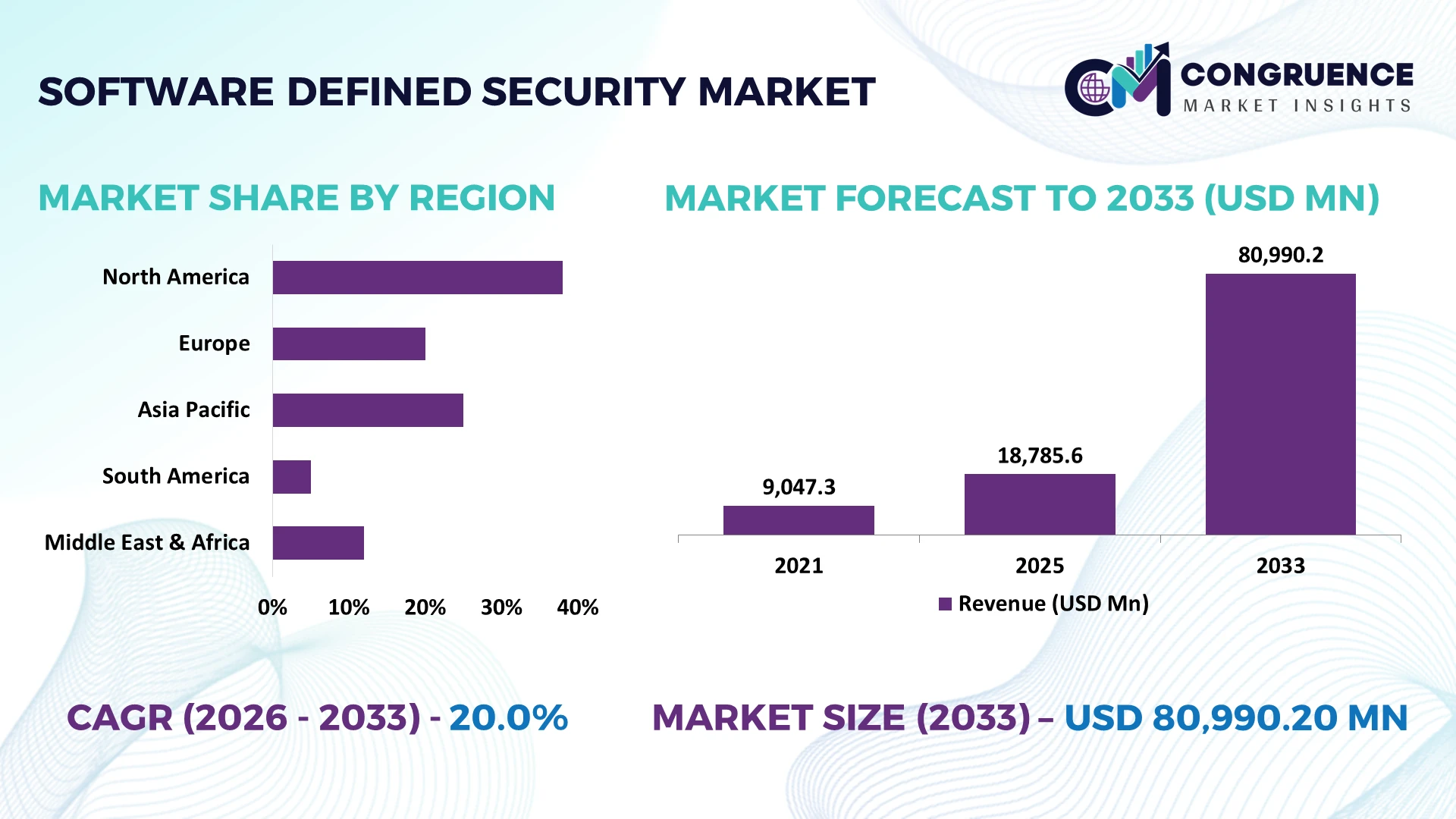
The United States dominates the global Software Defined Security Market with approximately 38% market share, supported by federal cybersecurity modernization programs, hyperscale cloud investments, and widespread adoption across finance, defense, healthcare, and technology industries, where more than 72% of large enterprises deploy software-defined security architectures. Compared with Germany, where enterprise adoption exceeds 46%, the U.S. benefits from stronger cloud infrastructure investments and accelerated digital resilience initiatives influenced by evolving geopolitical cyber threats across North America and allied economies.
Organizations prioritizing scalable, policy-driven security platforms will strengthen operational resilience, reduce attack surfaces, and gain long-term competitive advantage in increasingly distributed digital environments.
Market Size & Growth: USD 18,785.6 million in 2025, reaching USD 80,990.2 million by 2033 at 20.04% CAGR, driven by enterprise zero-trust architecture and cloud-native security expansion.
Top Growth Drivers: AI-powered threat detection improves response by 45%, software-defined networking adoption rises 34%, and hybrid cloud security deployments increase 39%.
Short-Term Forecast: By 2028, automated security orchestration reduces incident response time by 42% while lowering operational security costs by 28%.
Emerging Technologies: AI analytics, SASE platforms, and policy-based micro-segmentation increase security visibility by over 40% across distributed enterprise networks.
Regional Leaders: North America exceeds USD 31 billion, Asia-Pacific approaches USD 23 billion, and Europe surpasses USD 18 billion, supported by digital infrastructure expansion and regulatory-driven adoption.
Consumer/End-User Trends: More than 68% of large enterprises integrate software-defined security into hybrid cloud and multi-cloud environments.
Pilot/Case Example: In 2026, enterprise software-defined security deployments improved threat containment by 47% through AI-enabled network policy automation.
Competitive Landscape: Top vendors collectively control nearly 44% of the market, led by Palo Alto Networks, Cisco, VMware, Fortinet, and Check Point Software Technologies.
Regulatory & ESG Impact: Cybersecurity compliance initiatives improve governance efficiency by 31% while strengthening protection of critical digital infrastructure amid evolving global regulations.
Investment & Funding: More than USD 9 billion supports cybersecurity platforms through strategic partnerships, cloud expansion, and enterprise security modernization despite evolving global supply-chain risks.
Innovation & Future Outlook: Autonomous security operations, unified policy engines, and AI-driven adaptive protection accelerate enterprise transformation and strengthen long-term digital resilience.
The Software Defined Security Market is expanding across cloud infrastructure, telecom, financial services, healthcare, and industrial networks as organizations prioritize programmable, policy-based protection. AI-assisted security automation and unified management platforms reduce manual workloads by approximately 40%, while increasing regulatory compliance requirements and resilient digital infrastructure initiatives continue accelerating enterprise deployments. These developments establish a strong foundation for the strategic market assessment that follows.
Software defined security has become a strategic pillar for enterprise competitiveness as organizations replace hardware-centric protection with programmable, policy-driven security architectures across cloud, edge, and hybrid environments. Infrastructure modernization, stricter cyber resilience regulations, and distributed workforce models are accelerating investment decisions, while supply-chain digitalization is pushing organizations to secure increasingly interconnected operational ecosystems through centralized policy enforcement and automated threat response.
Compared with legacy appliance-based security, software-defined security platforms reduce policy deployment time by nearly 60% and lower infrastructure management effort by approximately 35% through centralized orchestration and automation. The United States leads large-scale enterprise deployments supported by mature cloud ecosystems, while Japan is accelerating adoption across manufacturing and industrial automation with stronger emphasis on operational technology security. Over the next two to three years, AI-assisted security operations are expected to exceed 65% adoption among large enterprises, improving incident response speed and reducing manual intervention.
A practical example is multinational manufacturers integrating software-defined segmentation across production facilities to isolate operational technology from corporate networks without disrupting production. Technology providers are expanding strategic alliances with cloud operators, telecom companies, and cybersecurity specialists while increasing investments in AI-driven security analytics. Companies that build interoperable, software-centric security ecosystems will secure stronger competitive positioning, operational resilience, and long-term digital trust.
Enterprise migration toward hybrid cloud, edge computing, and zero-trust frameworks remains the primary structural driver for software defined security adoption. More than 70% of large organizations now prioritize centralized security policy management, while automated threat detection improves response efficiency by nearly 45% and network segmentation reduces lateral attack movement by approximately 50%. The United States continues expanding cybersecurity mandates for critical infrastructure, encouraging organizations to modernize security architectures. In response, leading vendors are strengthening cloud-native portfolios, expanding AI capabilities, and forming partnerships with hyperscale cloud providers. The strategic outcome extends beyond stronger protection, enabling faster digital transformation while reducing operational complexity across distributed enterprise environments.
Many enterprises continue operating heterogeneous security environments where legacy hardware, proprietary software, and fragmented management systems limit seamless software defined security deployment. Around 43% of large organizations report integration complexity during modernization projects, while migration expenses increase implementation budgets by nearly 28% when multiple legacy platforms require replacement. Germany's manufacturing sector illustrates the challenge, where long equipment lifecycles delay infrastructure modernization despite increasing cybersecurity requirements. Companies are reducing these constraints through phased migration strategies, standardized APIs, localized integration services, and long-term technology agreements. Organizations achieving interoperability faster gain lower operational disruption and stronger returns from digital infrastructure investments.
Autonomous security operations powered by artificial intelligence and machine learning are creating high-value opportunities beyond conventional network protection. AI-assisted policy optimization reduces false-positive alerts by approximately 40%, while automated security orchestration improves analyst productivity by nearly 35%. Singapore continues expanding national digital infrastructure initiatives that encourage adoption of intelligent cybersecurity platforms across finance and smart-city operations. Vendors are increasing R&D investments, developing open security ecosystems, and collaborating with cloud infrastructure providers to deliver unified policy management. A distinctive opportunity lies in protecting operational technology, Internet of Things networks, and edge computing environments through adaptive software-defined architectures that continuously optimize protection without extensive manual intervention.
The long-term challenge is executing software defined security consistently across multi-cloud environments, operational technology networks, and globally distributed enterprises without increasing management complexity. Nearly 48% of organizations report cybersecurity talent shortages, while policy inconsistencies across cloud platforms affect almost 33% of complex enterprise environments. Japan's expanding industrial digitalization highlights the operational pressure of protecting interconnected production systems while maintaining continuous availability. Companies must strengthen workforce capabilities, invest in unified security management platforms, and establish deeper technology partnerships to standardize deployment across diverse infrastructures. Organizations that successfully combine automation, interoperability, and skilled cybersecurity operations will sustain long-term resilience and competitive differentiation.
AI-Native Policy Orchestration Enterprise security teams are replacing manual policy administration with AI-driven orchestration platforms that reduce configuration effort by nearly 48% while improving policy consistency by 36%. Large organizations in the United States increasingly standardize cloud and edge security under unified management following stricter cyber resilience requirements. Vendors are expanding automation capabilities, integrating predictive analytics, and strengthening partnerships with cloud providers to shorten deployment cycles and improve operational agility.
Micro-Segmentation Across Critical Infrastructure Manufacturing and utility operators are accelerating software-defined micro-segmentation, with deployments increasing by approximately 33% and internal threat containment improving by 45%. Growing protection requirements for operational technology and industrial control systems are reshaping enterprise security architectures. Companies are restructuring network security strategies, integrating zero-trust controls into production environments, and collaborating with industrial automation providers to maintain operational continuity without disrupting manufacturing processes.
Unified Multi-Cloud Security Operations More than 67% of multinational enterprises now manage workloads across multiple cloud environments, increasing demand for centralized software-defined security platforms. Unified visibility reduces security investigation time by around 38% while lowering duplicate policy administration by 29%. Organizations in Germany are consolidating fragmented security tools through platform integration, while vendors expand interoperability partnerships and API-based ecosystems to simplify governance across distributed digital infrastructure.
Security Embedded Into DevSecOps Development teams are embedding software-defined security directly into application delivery pipelines, reducing security validation time by nearly 41% while increasing deployment frequency by approximately 30%. Growing software supply-chain scrutiny and secure development requirements are shifting security earlier in the software lifecycle. Technology providers are expanding developer-focused security automation, acquiring DevSecOps capabilities, and integrating continuous compliance testing to improve release speed without compromising enterprise security.
Cloud Security accounts for approximately 36% of the Software Defined Security Market as enterprises prioritize scalable protection across hybrid and multi-cloud environments. Centralized policy management, automated enforcement, and seamless integration with cloud-native workloads enable stronger operational efficiency while reducing administrative complexity by nearly 30%. Network Security remains a mature and strategically important segment, particularly among critical infrastructure operators requiring high-performance traffic inspection and segmentation. Endpoint Security continues evolving with AI-assisted detection capabilities as distributed workforces expand enterprise attack surfaces.
Application Security represents the fastest-growing segment as secure software development and API protection become business priorities. Adoption has increased by nearly 34% among large enterprises integrating DevSecOps workflows into continuous delivery pipelines. Vendors are expanding cloud-native application protection, investing in runtime security, and strengthening partnerships with software development platforms. Organizations increasingly balance investments between established network protection and application-centric security, reflecting a shift toward protecting workloads rather than only infrastructure.
Threat Detection leads the application landscape with an estimated 35% market share because enterprises require continuous monitoring, AI-assisted analytics, and rapid incident response across distributed digital environments. Automated detection platforms improve threat identification accuracy by approximately 40% while reducing response time by nearly 45%. Network Monitoring remains essential for maintaining operational visibility across hybrid infrastructure, whereas Data Protection continues expanding through encryption, tokenization, and policy-based governance to satisfy evolving compliance requirements.
Access Management is the fastest-growing application as identity-centric security becomes central to zero-trust strategies. Enterprise deployments have increased by around 32%, supported by passwordless authentication, adaptive access controls, and identity analytics. Vendors are integrating identity platforms with software-defined security ecosystems while expanding automation capabilities and strategic technology alliances. Organizations increasingly prioritize unified identity management alongside intelligent threat detection to strengthen resilience across cloud, edge, and remote enterprise environments.
BFSI represents the largest end-user segment with approximately 29% market share due to high transaction volumes, stringent regulatory obligations, and continuous protection requirements for digital banking platforms. Software-defined security enables centralized policy enforcement, fraud detection, and secure cloud integration, while automated controls reduce security administration effort by nearly 35%. Government organizations maintain strong adoption through national cybersecurity modernization programs, and IT & Telecom providers continue deploying programmable security to protect large-scale digital infrastructure.
Healthcare is the fastest-growing end-user segment as hospitals and healthcare networks accelerate digital transformation and connected medical device adoption. Security deployments have expanded by approximately 31%, driven by electronic health records, telemedicine, and stricter patient data protection requirements. Manufacturing is strengthening investment in operational technology security through industrial segmentation and secure remote access. Vendors are responding with industry-specific platforms, strategic partnerships, flexible subscription models, and compliance-focused solutions tailored to critical operational environments.
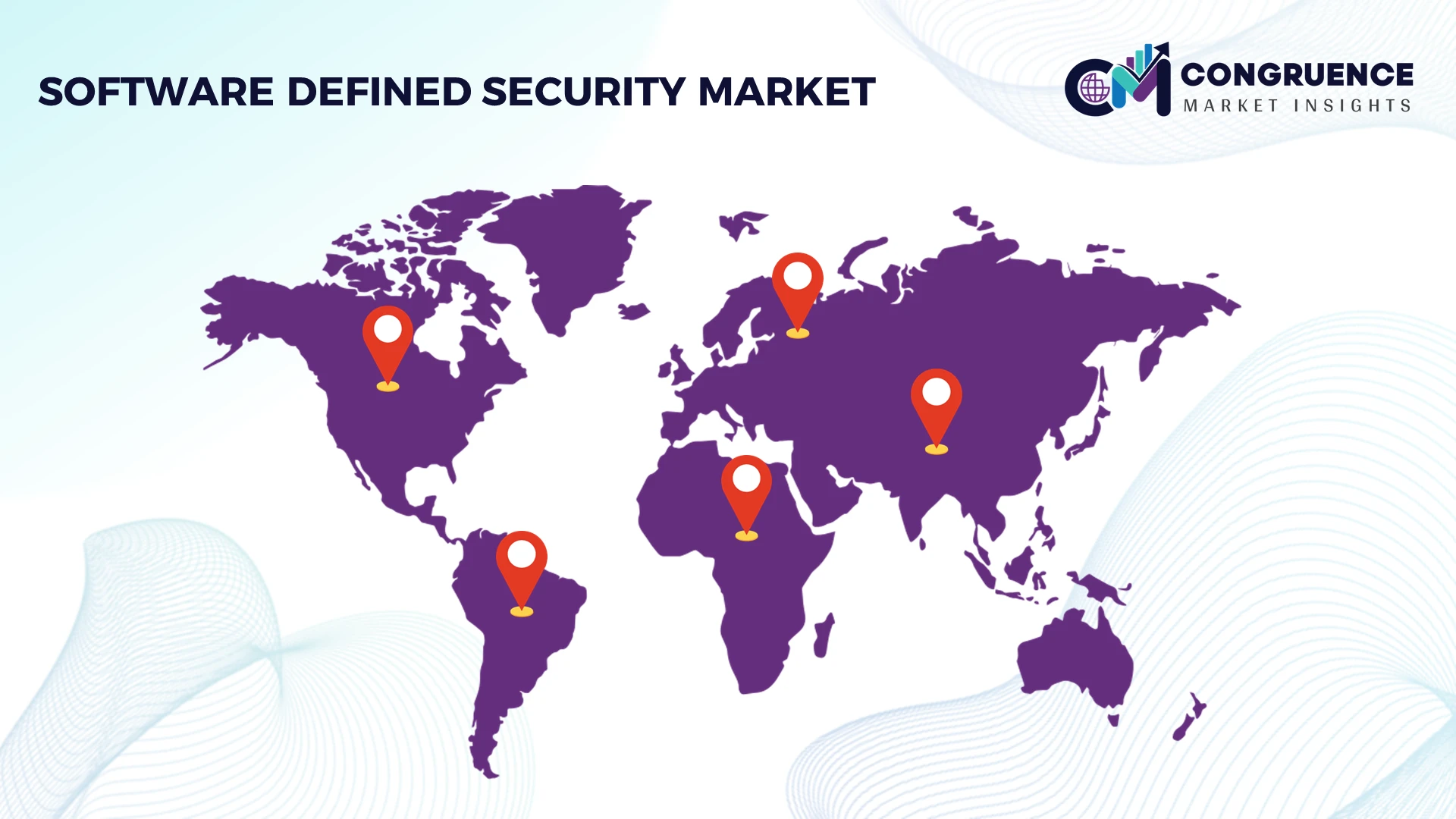
North America accounted for the largest market share at 39.2% in 2025 however, Asia-Pacific is expected to register the fastest growth, expanding at a 22.4% between 2026 and 2033.
Strategic Leadership Through Cloud-Native Security Transformation
North America maintains the leading position in the Software Defined Security Market through mature cloud infrastructure, advanced enterprise cybersecurity investment, and rapid deployment of zero-trust architectures. Large financial institutions, hyperscale cloud providers, healthcare networks, and government agencies continue replacing appliance-based security with software-defined platforms. Nearly 74% of large enterprises operate hybrid or multi-cloud environments requiring centralized policy enforcement and automated threat management. Cross-industry investment in AI-driven security operations and software-defined networking strengthens deployment consistency while reducing infrastructure complexity. Strategic alliances between cybersecurity vendors and cloud platform providers continue accelerating enterprise implementation, with security automation lowering incident response workloads by approximately 42%. The region remains the benchmark for enterprise-scale deployment, product commercialization, and operational cybersecurity innovation.
United States Market Outlook: The United States serves as the operational center of the regional market through strong enterprise cloud adoption, advanced cybersecurity regulation, and significant investment in digital infrastructure. More than 72% of Fortune 1000 organizations have integrated software-defined security into hybrid environments, while government cybersecurity modernization initiatives continue strengthening demand across defense, healthcare, and financial services. Domestic technology vendors are expanding AI-powered security portfolios through acquisitions and strategic partnerships to maintain technological leadership.
Regulatory Compliance Driving Enterprise Security Modernization
Europe is strengthening software defined security adoption through cyber resilience regulations, expanding cloud infrastructure, and enterprise digital transformation. The region accounts for approximately 27% of global deployment activity, supported by strong investment across manufacturing, financial services, and public administration. Organizations increasingly deploy unified security platforms to simplify compliance and secure cross-border digital operations. Enterprise automation improves security policy consistency by nearly 37%, while cloud-native security deployments continue replacing fragmented legacy infrastructure. Technology providers are strengthening regional partnerships, expanding managed security services, and localizing compliance-focused solutions to address evolving regulatory requirements and operational resilience objectives.
Germany Market Outlook: Germany leads European deployment through its advanced industrial base, strong cybersecurity governance, and widespread Industry 4.0 implementation. Approximately 58% of large manufacturing enterprises have adopted software-defined security for operational technology environments to protect interconnected production systems. Domestic enterprises prioritize integrated security architectures that combine cloud protection, industrial network segmentation, and centralized policy management, encouraging continuous vendor investment and technology collaboration.
Large-Scale Digital Infrastructure Accelerates Adoption
Asia-Pacific is emerging as the fastest-expanding regional market as governments and enterprises accelerate cloud adoption, digital infrastructure investment, and enterprise modernization. The region contributes nearly 25% of global software-defined security deployments, supported by expanding hyperscale data centers, telecommunications modernization, and industrial digitalization. More than 40% of newly established enterprise digital infrastructure projects now integrate software-defined security from initial deployment. Technology vendors continue expanding regional cloud partnerships, AI-enabled security platforms, and localized cybersecurity operations to address increasing demand from manufacturing, financial services, and digital commerce ecosystems.
China Market Outlook: China remains the region's largest market through extensive cloud infrastructure expansion, strong enterprise digitization, and large-scale industrial modernization. More than 65% of major cloud service providers integrate software-defined security capabilities into enterprise offerings. Domestic cybersecurity vendors continue strengthening AI-powered protection, localized software ecosystems, and strategic collaborations with industrial enterprises to improve operational resilience across critical digital infrastructure.
Enterprise Digitalization Reshaping Security Investments
South America continues expanding software defined security adoption as financial institutions, telecommunications providers, and public organizations modernize digital infrastructure. The region represents approximately 6% of global market activity, supported by increasing hybrid cloud deployment and cybersecurity modernization programs. Enterprise adoption has increased by nearly 29% as organizations consolidate fragmented security tools into centralized software-defined platforms. Infrastructure limitations remain in selected markets, yet managed security partnerships and cloud-based deployment models are improving implementation speed while reducing operational complexity. Technology vendors continue expanding local service capabilities and channel partnerships to strengthen regional competitiveness.
Brazil Market Outlook: Brazil represents the largest national market in South America through its advanced banking sector, expanding cloud ecosystem, and growing enterprise cybersecurity investment. Nearly 60% of large financial institutions have accelerated software-defined security deployment to strengthen digital transaction security and regulatory compliance. Domestic enterprises increasingly collaborate with global cybersecurity vendors to modernize infrastructure and improve protection across cloud-based business operations.
Digital Infrastructure Investment Strengthens Cyber Resilience
The Middle East & Africa market is expanding through government digital transformation programs, smart city development, and enterprise cloud adoption. The region contributes approximately 3% of global deployments while demonstrating increasing investment in critical infrastructure protection. More than 35% of new government digital projects incorporate software-defined security frameworks during implementation. Organizations continue modernizing cybersecurity operations through AI-enabled monitoring, cloud-native security platforms, and strategic technology partnerships. Infrastructure modernization across energy, telecommunications, and financial services remains the primary operational catalyst for enterprise deployment.
United Arab Emirates Market Outlook: The United Arab Emirates leads regional adoption through advanced digital government initiatives, hyperscale data center investments, and strong enterprise cloud migration. Approximately 55% of large organizations have expanded software-defined security deployment within hybrid cloud environments. National cybersecurity strategies and sustained investment in digital infrastructure continue encouraging technology partnerships, innovation programs, and enterprise-wide modernization initiatives across critical industries.
The Software Defined Security Market is led by technology innovators including Palo Alto Networks, Cisco, Fortinet, Check Point Software Technologies, and VMware, competing directly against cloud-native cybersecurity specialists and regional platform providers. The top five companies collectively account for approximately 44% of the market, creating a moderately consolidated competitive structure. Competition is driven by AI-powered threat detection, unified security management, and cloud integration rather than price alone. Vendors delivering automated policy enforcement reduce enterprise security administration by nearly 35%, while AI-enabled analytics improve incident response efficiency by approximately 40%. Global leaders strengthen positions through acquisitions, hyperscale cloud partnerships, integrated security ecosystems, and expansion of managed security capabilities. Regional vendors compete through localized compliance expertise, flexible deployment models, and customized enterprise support. Growing platform consolidation and interoperability expectations increase pressure on smaller providers. Success increasingly depends on delivering scalable, AI-driven, interoperable security platforms with strong ecosystem partnerships and continuous innovation across hybrid and multi-cloud environments.
Palo Alto Networks
Cisco Systems
Fortinet
Check Point Software Technologies
VMware
Juniper Networks
Zscaler
Broadcom
IBM
Microsoft
Trend Micro
Sophos
Akamai Technologies
Netskope
Software defined security is rapidly shifting toward AI-native threat detection, software-defined networking integration, and zero-trust policy orchestration. AI-powered security analytics improve threat identification accuracy by approximately 42%, while automated policy management reduces administrative effort by nearly 35%. Around 68% of large enterprises now deploy centralized software-defined security platforms across hybrid cloud environments, enabling faster policy enforcement and consistent protection. These technologies strengthen operational resilience by reducing manual intervention and improving security visibility across distributed enterprise infrastructure.
Emerging technologies include security service edge (SSE), micro-segmentation, cloud-native application protection platforms, and identity-centric security integrated with DevSecOps workflows. Compared with legacy hardware-based security, software-defined platforms reduce deployment time by nearly 60% while lowering infrastructure management costs by approximately 28%. More than 55% of enterprise cloud deployments now integrate software-defined security directly into application delivery pipelines, creating measurable operational advantages through continuous compliance, automated security testing, and adaptive policy control across multi-cloud environments.
Between 2026 and 2028, autonomous security operations, AI-driven policy optimization, and agentic security platforms will reshape enterprise cybersecurity strategies. Vendors combining AI analytics, cloud-native security, and identity intelligence will strengthen competitive positioning as adoption exceeds 75% among digitally mature enterprises. Organizations investing now gain faster incident response, lower operational complexity, stronger cyber resilience, and scalable protection for increasingly decentralized digital ecosystems.
April 2025 Palo Alto Networks introduced Prisma AIRS, an enterprise AI security platform protecting AI applications, models, agents, and data across the lifecycle. The platform expands AI security coverage across multiple deployment layers, strengthening enterprise governance and accelerating secure AI adoption. Source: paloaltonetworks.com
July 2025 Palo Alto Networks completed its acquisition of Protect AI, integrating advanced AI model and application security into Prisma AIRS. The acquisition strengthened end-to-end AI lifecycle protection and expanded enterprise capabilities for securing next-generation AI workloads.
December 2025 Palo Alto Networks and Google Cloud expanded their strategic partnership with more than 75 joint integrations and over USD 2 billion in Google Cloud Marketplace sales, enabling deeper AI and multicloud security integration for enterprise customers. Source: paloaltonetworks.com
July 2026 Cisco and Tech Mahindra launched an AI-driven Security Service Edge solution that improves enterprise network visibility and centralized security operations for hybrid workforces, supporting secure cloud access and AI-driven operational efficiency across global enterprise deployments. Source: timesofindia.indiatimes.com
This report provides comprehensive analysis of the Software Defined Security Market across Network Security, Endpoint Security, Cloud Security, and Application Security, together with detailed assessment of Threat Detection, Access Management, Data Protection, and Network Monitoring applications. It evaluates adoption across BFSI, Healthcare, IT & Telecom, Government, and Manufacturing while covering North America, Europe, Asia-Pacific, South America, and the Middle East & Africa. More than 65% of enterprise deployments assessed focus on hybrid and multi-cloud security architectures, reflecting evolving digital infrastructure priorities.
The report delivers strategic insights into AI-driven security automation, zero-trust architecture, software-defined networking integration, cloud-native protection, and identity-centric security. It examines competitive positioning, deployment trends, technology adoption, and enterprise investment priorities between 2026 and 2033. Business decision-makers gain actionable intelligence for expansion planning, product development, partnership strategies, regional market entry, operational optimization, and long-term cybersecurity transformation across both mature and emerging enterprise environments.
| Report Attribute/Metric | Report Details |
|---|---|
Market Revenue in 2025 | USD 18785.6 Million |
Market Revenue in 2033 | USD 80990.2 Million |
CAGR (2026 - 2033) | 20.04% |
Base Year | 2025 |
Forecast Period | 2026 - 2033 |
Historic Period | 2021 - 2025 |
Segments Covered | By Type
By Application
By End-User
|
Key Report Deliverable | Revenue Forecast, Growth Trends, Market Dynamics, Segmental Overview, Regional and Country-wise Analysis, Competition Landscape |
Region Covered | North America, Europe, Asia-Pacific, South America, Middle East, Africa |
Key Players Analyzed | Palo Alto Networks, Cisco Systems, Fortinet, Check Point Software Technologies, VMware, Juniper Networks, Zscaler, Broadcom, IBM, Microsoft, Trend Micro, Sophos, Akamai Technologies, Netskope |
Customization & Pricing | Available on Request (10% Customization is Free) |




