
Reports
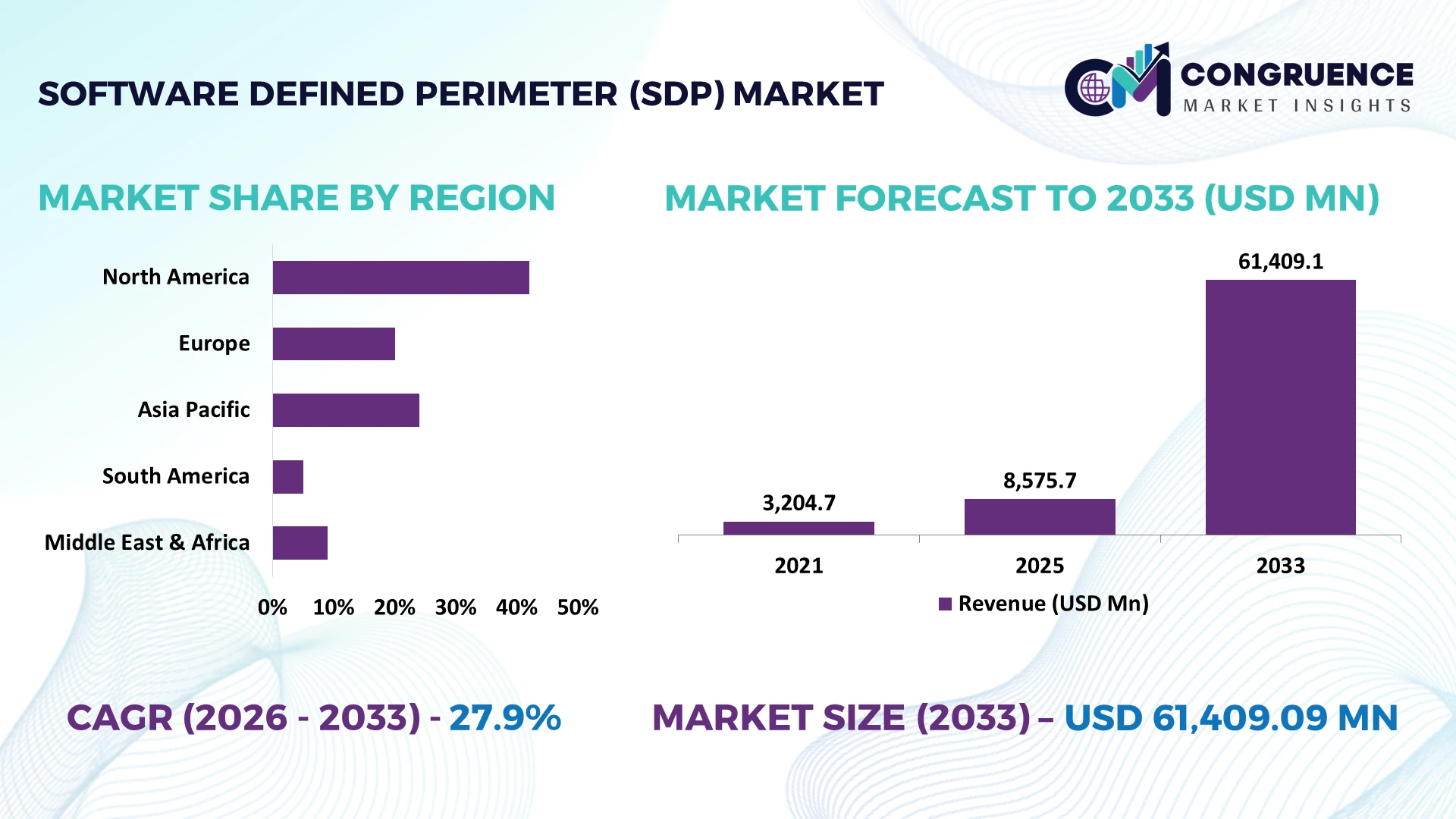
The Global Software-Defined Perimeter (SDP) Market was valued at USD 8575.67 Million in 2025 and is anticipated to reach a value of USD 61409.09 Million by 2033 expanding at a CAGR of 27.9% between 2026 and 2033. Growth is driven by zero-trust migration, hybrid-cloud workload expansion, identity-centric access, VPN replacement, and enterprises reducing internet-visible attack surfaces through application-level segmentation.
The United States represents the dominant country market with approximately 36% of global SDP deployment, supported by hyperscale cloud infrastructure and intensive adoption across government, banking, healthcare, defense, and technology enterprises. More than 80% of organizations operate hybrid-cloud environments, strengthening demand for identity-aware access and microsegmentation. U.S. federal zero-trust mandates reinforce SDP deployment across public infrastructure. Compared with Germany, U.S. enterprises maintain broader hyperscaler integration and security-platform penetration, while Germany’s NIS2-driven modernization accelerates zero-trust adoption across regulated industries.
Strategically, vendors combining identity verification, application segmentation, cloud-native enforcement, and unified zero-trust access are best positioned for enterprise security consolidation.
Market Size & Growth: USD 8,575.67 million in 2025 advances to USD 61,409.09 million by 2033 at 27.9% CAGR, driven by zero-trust and VPN replacement.
Top Growth Drivers: Hybrid-cloud penetration exceeds 80%, multi-cloud adoption surpasses 75%, and zero-trust implementation has reached approximately 60% among large enterprises.
Short-Term Forecast: By 2028, SDP-led access automation is positioned to reduce manual access-policy administration by approximately 30% through identity-aware policy orchestration.
Emerging Technologies: AI-based access analytics, microsegmentation, and continuous authentication are converging as more than 70% of organizations deploy AI-enabled cybersecurity capabilities.
Regional Leaders: By 2033, North America approaches USD 22.7 billion, Europe USD 16.6 billion, and Asia-Pacific USD 15.4 billion as cloud-native access deployment expands.
Consumer/End-User Trends: More than 80% of enterprises operate hybrid environments, increasing requirements for consistent application access across employees, contractors, devices, and cloud workloads.
Pilot/Case Example: Google’s BeyondCorp zero-trust architecture eliminated traditional VPN dependence for more than 100,000 employees, validating identity-centric access at enterprise scale.
Competitive Landscape: Zscaler holds an estimated 15%–18% share, competing with Palo Alto Networks, Cisco, Cloudflare, and Fortinet across zero-trust network access and secure connectivity.
Regulatory & ESG Impact: NIS2 applies cybersecurity requirements across 18 critical EU sectors, strengthening procurement of segmented access, continuous authentication, and policy-based network controls.
Investment & Funding: Global cybersecurity venture investment exceeded USD 9 billion in 2024, with zero-trust, identity, cloud security, and automated policy enforcement attracting strategic capital.
Innovation & Future Outlook: Identity-aware segmentation and AI policy engines are replacing static perimeter controls, with automated access management capable of reducing selected provisioning workflows by over 50%.
The Software-Defined Perimeter (SDP) Market is shifting enterprise access architecture from network-level trust toward identity, device posture, application context, and continuously evaluated policy. Demand is concentrated across hybrid-cloud enterprises, financial institutions, government networks, healthcare systems, and distributed workforces replacing legacy VPN infrastructure. More than 80% of enterprises now operate hybrid environments, increasing the operational value of application-specific connectivity and microsegmentation. U.S. federal zero-trust modernization and Europe’s NIS2 requirements further reinforce controlled-access architectures, while AI-driven policy engines are emerging as the next layer of automated security enforcement and strategic differentiation.
Software-defined perimeter is becoming strategic enterprise infrastructure as cloud migration, distributed workforces, and machine identities weaken network-location-based trust. More than 80% of enterprises operate hybrid environments, making application-level access control critical for reducing exposed infrastructure. U.S. federal zero-trust modernization and Europe’s NIS2 implementation are accelerating the structural transition from perimeter-centric security toward identity, device posture, workload context, and continuously evaluated access policies.
SDP architectures hide applications from unauthorized discovery and establish authenticated connections only after policy validation. Compared with legacy VPNs that provide broad network access, zero-trust application access can reduce access-related attack surfaces by over 50% while lowering selected provisioning workloads by approximately 30%. U.S. deployment benefits from hyperscale cloud integration; Germany emphasizes regulated, policy-controlled access. Through 2026–2028, enterprises will increasingly converge SDP, identity security, microsegmentation, and secure access service edge architectures.
A multinational deployment can replace separate VPN gateways with policy-driven access connecting employees and contractors directly to authorized applications across multiple clouds. Vendors are expanding cloud integrations, identity partnerships, AI policy engines, and managed services. Competitive advantage will center on enforcing granular access consistently without increasing user friction or administrative complexity.
Hybrid-cloud architecture is fundamentally changing enterprise connectivity because applications now span private data centers, SaaS environments, public clouds, and edge locations. More than 80% of enterprises operate hybrid environments, multi-cloud penetration exceeds 75% among large organizations, and approximately 60% have implemented elements of zero-trust security. U.S. federal zero-trust modernization provides an additional institutional trigger by replacing implicit network trust with identity and device-based verification. This shift increases demand for SDP platforms that conceal applications and authorize connections individually rather than exposing entire networks through VPN tunnels. Vendors are expanding integrations with identity providers, hyperscalers, endpoint security, and SASE platforms. The operational advantage is reduced lateral-movement exposure: compromised credentials no longer automatically provide broad network visibility when application access is segmented by policy.
SDP adoption is constrained by heterogeneous enterprise infrastructure containing legacy applications, proprietary protocols, unmanaged devices, and authentication systems not designed for continuous policy enforcement. More than 70% of organizations maintain legacy applications within hybrid estates, while multi-cloud adoption above 75% introduces additional policy and configuration complexity. Approximately 60% of security teams also report difficulty managing fragmented security tooling. Germany’s manufacturing sector illustrates the constraint: modern identity-based access must coexist with long-lived industrial systems where aggressive network changes can interrupt production. Enterprises therefore face connector development, application discovery, policy mapping, and migration costs before retiring VPN infrastructure. Vendors are mitigating these barriers through agentless access, application connectors, phased migration tools, and identity partnerships. Strategically, backward compatibility remains essential because enterprises cannot justify zero-trust modernization that destabilizes business-critical legacy workloads.
AI-driven policy orchestration creates an opportunity to move SDP from static access rules toward continuously adaptive authorization based on identity, device posture, behavior, location, and workload risk. Approximately 70% of organizations use AI-enabled cybersecurity capabilities, while automated access workflows can reduce selected provisioning tasks by more than 50% and administrative effort by roughly 30%. India provides a strong deployment opportunity as cloud services, digital banking, IT outsourcing, and distributed technology workforces require secure application access at large scale. Between 2026 and 2028, AI engines will increasingly identify excessive privileges, recommend microsegmentation policies, and revoke anomalous sessions automatically. Vendors are investing in behavioral analytics, identity integrations, cloud partnerships, and unified SASE ecosystems. A non-obvious opportunity lies in machine-to-machine access, where rapidly multiplying APIs and workloads require SDP principles without human authentication workflows.
Scaling SDP across thousands of users, contractors, devices, workloads, and applications creates a policy-governance challenge distinct from initial migration complexity. More than 75% of large enterprises use multiple clouds, approximately 60% have implemented zero-trust components, and cybersecurity workforce shortages affect roughly 70% of organizations. These conditions increase the probability of conflicting rules, excessive privileges, configuration drift, and inconsistent application access. U.S. multinational enterprises face additional complexity when policies must span cloud platforms, subsidiaries, acquired businesses, and third-party suppliers while maintaining low-latency connectivity. Providers must improve policy analytics, automated discovery, configuration validation, and cross-cloud orchestration while strengthening administrator training and managed services. The critical execution issue is policy accuracy at scale: excessive restrictions disrupt productivity, while permissive exceptions recreate the lateral-movement exposure SDP architectures are designed to eliminate.
VPN Replacement Moves Into Production: Enterprises are retiring broad network-level remote access as more than 80% operate hybrid environments and over 60% have implemented zero-trust components. SDP deployments now connect authenticated users directly to authorized applications, reducing exposed network resources by over 50%. U.S. enterprises are scaling ZTNA gateways, identity integrations, and phased VPN retirement programs, lowering infrastructure complexity while limiting lateral movement after credential compromise.
SASE Absorbs Standalone SDP Functions: SDP capabilities are increasingly embedded within SASE and security-service-edge platforms rather than procured independently. Multi-cloud usage exceeds 75% among large enterprises, while approximately 70% operate distributed workloads requiring unified access enforcement. Vendors are integrating ZTNA, secure web gateways, CASB, and firewall services through common policy engines. Consolidation reduces duplicated administration by roughly 20–30% and shifts purchasing power toward vendors offering globally distributed security infrastructure.
Third-Party Access Gets Segmented: Enterprises are restructuring supplier and contractor connectivity following persistent supply-chain attacks. Third parties contribute to roughly 30% of breaches, while compromised credentials remain involved in approximately 22%. Organizations increasingly replace shared VPN credentials with application-specific, time-limited access governed by identity and device posture. Providers are expanding agentless access and privileged-session capabilities, reducing onboarding friction while preventing suppliers from receiving unnecessary network visibility.
Compliance Drives Policy Observability: NIS2 coverage across 18 critical EU sectors and 24-hour early-warning requirements are making access-policy evidence operationally important. Enterprises are centralizing authentication logs, session histories, and policy decisions to demonstrate controlled access during audits. Vendors are adding automated reporting, continuous configuration assessment, and policy analytics. The non-obvious shift is that SDP telemetry now supports compliance operations alongside security, improving audit preparation without duplicating evidence-collection workflows.
Controller-Based SDP represents approximately 30% of type-level demand, supported by centralized policy orchestration, identity integration, application discovery, and consistent enforcement across complex enterprise environments. Central controllers give large organizations standardized visibility while reducing fragmented access policies across branches and cloud workloads. Gateway-Based SDP remains important where enterprises need controlled access to legacy applications without modifying underlying systems, while Client-Initiated SDP provides granular user-to-application connectivity for distributed workforces. Server-Initiated SDP serves specialized environments where protected resources initiate secure communication after authorization.
Cloud-Based SDP is the fastest-growing type as more than 80% of enterprises operate hybrid environments and multi-cloud adoption exceeds 75% among large organizations. Cloud delivery reduces dependence on physical gateways and improves deployment across geographically dispersed users. Vendors are consequently prioritizing cloud-native policy engines, identity-provider integrations, globally distributed enforcement points, and consumption-based deployment. Investment is shifting from appliance-centric architecture toward elastic SDP services that follow users, applications, and workloads across infrastructure boundaries.
Zero Trust Security accounts for approximately 32% of application demand because SDP provides a practical enforcement layer for replacing implicit network trust with identity, device, and application-level authorization. Remote Access remains an established application as enterprises replace VPN connectivity for employees and contractors, while Application Access increasingly restricts users to specific resources rather than complete network segments. Network Segmentation maintains strategic importance for limiting lateral movement across sensitive environments and separating privileged workloads.
Cloud Security is the fastest-growing application as more than 80% of enterprises maintain hybrid infrastructure and over 75% of large organizations use multiple clouds. Companies need access policies that remain consistent when applications move between SaaS, private clouds, and hyperscalers. Vendors are integrating SDP with cloud security, identity platforms, microsegmentation, and SASE architectures while expanding distributed enforcement infrastructure. Business investment is therefore moving toward unified access layers capable of supporting Remote Access, Cloud Security, Network Segmentation, Application Access, and Zero Trust Security without separate policy frameworks.
Banking and Finance represents approximately 29% of end-user demand, reflecting extensive digital transaction infrastructure, privileged-user requirements, third-party connectivity, regulatory scrutiny, and highly distributed application estates. Financial institutions increasingly use SDP to restrict administrators, employees, contractors, and partners to authorized applications without exposing broader networks. Government remains an established buyer as zero-trust mandates reshape agency architecture, while Healthcare applies segmented access to clinical systems and sensitive information. Manufacturing adoption centers on controlled connectivity between enterprise IT, remote engineers, suppliers, and industrial environments.
IT and Telecom is the fastest-growing end-user segment as cloud infrastructure, distributed development, edge computing, and machine identities multiply access relationships. More than 80% of enterprises operate hybrid environments, while multi-cloud penetration exceeds 75% among large organizations, increasing reliance on scalable application-level controls. Providers are targeting these buyers through API integrations, managed SDP, flexible enterprise licensing, and hyperscaler partnerships. Competitive positioning increasingly depends on supporting human and workload identities through one policy architecture.
North America accounted for the largest market share at 37.8% in 2025 however, Asia-Pacific is expected to register the fastest growth, expanding at a CAGR of 31.2% between 2026 and 2033.
Zero-Trust Architecture Replaces Network Trust
North America represents approximately 37.8% of global SDP demand, supported by hyperscale cloud infrastructure, mature identity ecosystems, extensive hybrid work, and federal zero-trust modernization. U.S. enterprises increasingly replace VPN-centric connectivity with application-specific access incorporating identity, device posture, and continuous authorization. More than 80% of large organizations operate hybrid environments, creating substantial demand for policy enforcement spanning SaaS, private data centers, and public clouds. Federal agencies are modernizing access architectures around zero-trust principles, accelerating enterprise adoption among contractors and regulated industries. Canada contributes through banking, government, telecommunications, and healthcare modernization. Vendors are expanding distributed enforcement points, identity integrations, SASE capabilities, and managed zero-trust services. Operationally, SDP reduces unnecessary network visibility and allows security teams to standardize remote access without extending broad internal-network privileges.
United States Market Outlook: The United States remains the region’s primary deployment center through its concentration of hyperscalers, cybersecurity vendors, federal agencies, financial institutions, and technology enterprises. Federal zero-trust requirements explicitly prioritize identity, devices, networks, applications, and data. Enterprises are increasingly consolidating ZTNA, identity security, and cloud access controls, favoring vendors with extensive integrations and globally distributed enforcement infrastructure.
Regulation Accelerates Identity-Based Segmentation
Europe accounts for approximately 27.1% of global SDP demand, with Germany, the United Kingdom, France, the Netherlands, and Italy concentrating enterprise deployment. NIS2 requirements covering 18 critical sectors are increasing emphasis on controlled access, risk management, incident accountability, and supply-chain security. GDPR further reinforces least-privilege access where applications process personal information. Enterprises are therefore replacing flat remote-access architectures with identity-aware connectivity, microsegmentation, and continuous authentication. Financial services, manufacturing, healthcare, government, and telecommunications represent important deployment environments because distributed users frequently access sensitive applications across hybrid infrastructure. Vendors are adding EU-hosted enforcement, localized compliance functionality, identity integrations, and automated policy reporting. The procurement shift favors platforms that demonstrate application-level segmentation while preserving user productivity and supporting existing enterprise identity and cloud investments.
Germany Market Outlook: Germany combines industrial digitalization with stringent cybersecurity and privacy requirements, making it strategically important for SDP deployment. Manufacturing enterprises require secure connectivity for employees, suppliers, engineers, and remote maintenance without exposing broader operational networks. NIS2 implementation strengthens access-governance requirements, favoring SDP platforms capable of integrating identity controls with complex IT and industrial environments.
Cloud Scale Drives Distributed Access Control
Asia-Pacific represents approximately 24.2% of global SDP demand, with India, Japan, Australia, Singapore, South Korea, and China supporting large-scale cloud and enterprise connectivity requirements. Rapid migration toward SaaS, public cloud, digital banking, and distributed development environments is making conventional network boundaries increasingly ineffective. Multi-cloud penetration exceeds 75% among large enterprises, strengthening demand for application-specific access independent of physical location. Australia’s critical-infrastructure security reforms and India’s expanding digital economy reinforce enterprise investment in identity-aware connectivity. Technology providers are establishing distributed points of presence, regional cloud integrations, managed security operations, and partnerships with telecommunications carriers. SDP deployment is particularly valuable for outsourcing and technology organizations managing employees and contractors across multiple jurisdictions because centralized policy engines can enforce consistent access without replicating traditional VPN infrastructure in every operating location.
India Market Outlook: India offers strong deployment momentum through its extensive IT-services industry, digital banking infrastructure, cloud migration, and geographically distributed technology workforce. CERT-In’s six-hour incident-reporting requirement places additional emphasis on access visibility and centralized logging. Large enterprises increasingly integrate identity providers, ZTNA, endpoint posture assessment, and cloud access controls to secure employees, contractors, and outsourced development environments.
Cloud Adoption Modernizes Enterprise Connectivity
South America accounts for approximately 6.0% of global SDP demand, led by Brazil and supported by Colombia, Chile, and Argentina. Banking digitization, cloud migration, telecommunications modernization, and distributed enterprise operations are creating demand for identity-controlled application connectivity. Brazil’s extensive instant-payment ecosystem raises requirements for secure access to always-on financial infrastructure, while multinational organizations increasingly need consistent policies across branch offices and remote employees. Adoption remains constrained among smaller enterprises by cybersecurity skills shortages, legacy applications, and limited integration budgets. This favors cloud-delivered SDP and managed zero-trust offerings that reduce dependence on internal security engineering. Vendors are partnering with telecommunications operators, cloud providers, and managed security firms while expanding Portuguese and Spanish support. The commercial advantage increasingly comes from simplified deployment rather than feature density alone.
Brazil Market Outlook: Brazil represents the region’s primary SDP opportunity through its large financial sector, cloud ecosystem, telecommunications infrastructure, and expanding digital-service economy. Pix has made real-time digital transactions operationally critical, strengthening access-security requirements around financial applications. Banks and large enterprises increasingly favor identity-based segmentation and cloud-delivered access that can support distributed workforces without exposing internal networks.
Digital Infrastructure Investment Accelerates Zero Trust
Middle East & Africa represents approximately 4.9% of global SDP demand, concentrated in Saudi Arabia, the UAE, Israel, and South Africa. Gulf governments are expanding cloud computing, smart-city infrastructure, digital public services, financial technology, and connected healthcare, requiring security models designed for distributed applications rather than fixed enterprise boundaries. Saudi cybersecurity requirements and national digital-transformation initiatives encourage identity-centric security across government and critical infrastructure. UAE enterprises similarly deploy cloud-delivered access controls across aviation, banking, energy, and public services. African markets remain more fragmented because cybersecurity staffing and cloud maturity vary substantially, strengthening the case for managed SDP services. Vendors are establishing regional cloud infrastructure, telecommunications partnerships, Arabic-language support, and managed security capabilities. Cloud-native deployment allows organizations to modernize access without large investments in physical security appliances.
Saudi Arabia Market Outlook: Saudi Arabia combines rapid cloud adoption with substantial modernization across government, energy, healthcare, banking, and smart infrastructure. National cybersecurity controls emphasize identity management, access governance, and protection of critical systems. New digital environments can adopt SDP architectures without extensive legacy VPN dependence, creating favorable conditions for cloud-native enforcement, centralized policy management, and managed zero-trust services.
Zscaler, Palo Alto Networks, Cisco, Cloudflare, and Fortinet compete for enterprise SDP workloads through ZTNA, SASE, identity-aware access, and cloud-delivered enforcement. The top five collectively represent approximately 48% of market demand, giving platform leaders advantages in telemetry, infrastructure scale, and enterprise integrations. Zscaler emphasizes cloud-native access, while Palo Alto Networks and Fortinet integrate SDP with broader security platforms; Cisco leverages networking incumbency, and Cloudflare competes through distributed edge infrastructure. Automated policy orchestration can reduce access administration by roughly 30%, VPN replacement can cut exposed network resources by over 50%, and platform consolidation lowers selected security-management workloads by 20–30%. Vendors compete through hyperscaler partnerships, identity integrations, acquisitions, distributed points of presence, and unified SASE architectures. Competition is shifting from standalone SDP toward consolidated security-service-edge platforms. Integration complexity, global infrastructure, policy intelligence, and enterprise trust remain substantial entry barriers. Winning requires low-latency enforcement, seamless identity interoperability, automated policy management, and demonstrable application-level segmentation across hybrid environments.
Zscaler
Palo Alto Networks
Cisco
Cloudflare
Fortinet
Check Point Software Technologies
Akamai Technologies
Broadcom
Forcepoint
Appgate
F5
Netskope
Versa Networks
Proofpoint
Current SDP technology combines identity-aware ZTNA, device-posture assessment, microsegmentation, and cloud-delivered policy enforcement. Cloud-native access can reduce remote-access support tickets by 80% versus VPNs, while unified policy administration can cut access-management effort by roughly 30%. Adoption is moving beyond pilots as hybrid-cloud usage exceeds 80% among enterprises, pushing SDP controls into SASE, identity, endpoint, and workload-security architectures.
Emerging capabilities include AI-driven risk scoring, continuous session evaluation, clientless ZTNA, and post-quantum cryptography. Risk engines correlate identity, endpoint health, location, and threat telemetry to adjust privileges automatically, reducing manual policy intervention by about 25%. Compared with legacy VPN access, application-specific SDP can shrink exposed network resources by over 50%. Enterprises with contractors, multi-cloud estates, and regulated workloads gain the strongest operational advantage because one policy layer replaces broad network-level trust.
Disruptive development through 2026–2028 will extend SDP principles from human users to AI agents, APIs, industrial systems, and machine identities. Agentic access controls will continuously evaluate autonomous connections, while quantum-safe encryption protects sensitive traffic. Integration with SASE and security-service-edge platforms can reduce overlapping security administration by 20–30%. Vendors with distributed enforcement infrastructure, identity ecosystems, and automated policy intelligence will benefit most as buyers prioritize low-latency access, fewer consoles, and consistent least-privilege enforcement.
May 2024 Cloudflare acquired BastionZero, extending Cloudflare One with Zero Trust access for servers, Kubernetes clusters, and databases while eliminating long-lived credentials through passwordless infrastructure access, strengthening privileged-access control and reducing dependence on jump-host workarounds across enterprise environments. Source: SecurityWeek
July 2024 Appgate released SDP 6.3 with an AI-based risk engine and performance improvements, strengthening dynamic Zero Trust policy decisions across enterprise and federal deployments while supporting faster, more resilient secure access for distributed users and protected applications. Source: Appgate
March 2025 Cloudflare expanded post-quantum cryptography across Zero Trust Network Access, immediately protecting browser-to-corporate web application connections and scheduling support for all IP protocols by mid-2025, positioning enterprises to modernize encrypted access before emerging quantum-era migration deadlines. Source: Cloudflare
June 2026 Zscaler extended Zero Trust Exchange to secure agentic AI, adding prompt extraction across 250+ GenAI applications alongside AI-agent and MCP-server discovery, expanding granular policy enforcement as autonomous identities increasingly access enterprise applications, infrastructure, and sensitive data. Source: Zscaler
The report assesses Controller-Based SDP, Gateway-Based SDP, Client-Initiated SDP, Server-Initiated SDP, and Cloud-Based SDP across Remote Access, Cloud Security, Network Segmentation, Application Access, and Zero Trust Security. End-user coverage includes Banking and Finance, Healthcare, Government, IT and Telecom, and Manufacturing. Regional analysis spans North America, Europe, Asia-Pacific, South America, and Middle East & Africa, with North America representing approximately 37.8% of 2025 deployment.
Technology coverage examines ZTNA, microsegmentation, identity-aware policy, continuous authentication, AI risk scoring, clientless access, post-quantum cryptography, SASE integration, and machine-identity security. The analysis tracks VPN replacement, cloud-native enforcement, third-party connectivity, OT access, and emerging agentic-AI security requirements. Competitive benchmarking and country-level deployment patterns support investment planning, partnership selection, geographic expansion, product differentiation, and technology positioning between 2026 and 2033.
| Report Attribute/Metric | Report Details |
|---|---|
Market Revenue in 2025 | USD 8575.67 Million |
Market Revenue in 2033 | USD 61409.09 Million |
CAGR (2026 - 2033) | 27.9% |
Base Year | 2025 |
Forecast Period | 2026 - 2033 |
Historic Period | 2021 - 2025 |
Segments Covered | By Type
By Application
By End-User
|
Key Report Deliverable | Revenue Forecast, Growth Trends, Market Dynamics, Segmental Overview, Regional and Country-wise Analysis, Competition Landscape |
Region Covered | North America, Europe, Asia-Pacific, South America, Middle East, Africa |
Key Players Analyzed | Zscaler, Palo Alto Networks, Cisco, Cloudflare, Fortinet, Check Point Software Technologies, Akamai Technologies, Broadcom, Forcepoint, Appgate, F5, Netskope, Versa Networks, Proofpoint |
Customization & Pricing | Available on Request (10% Customization is Free) |




