
Reports
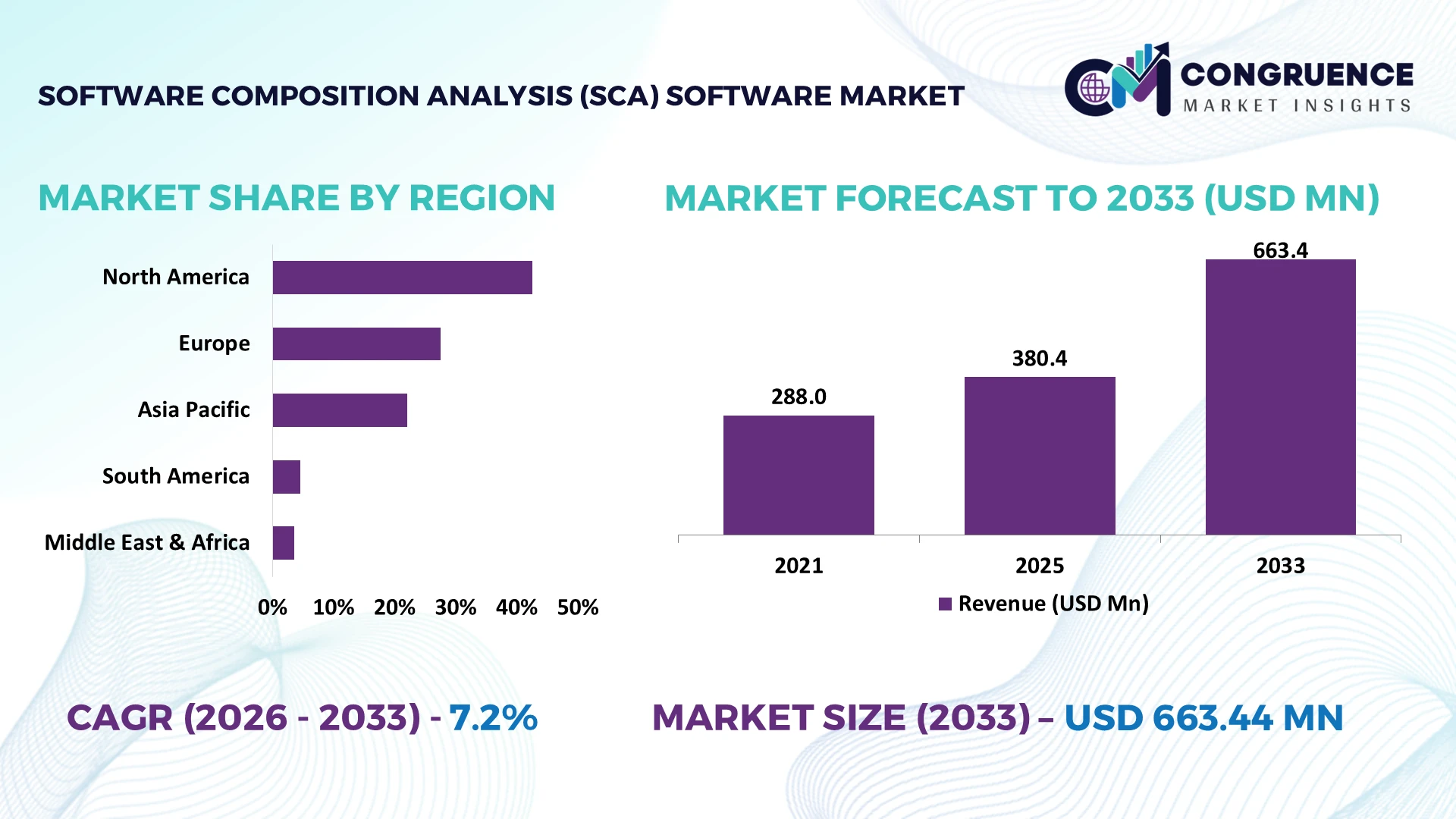
The Global Software Composition Analysis (SCA) Software Market was valued at USD 380.4 Million in 2025 and is anticipated to reach a value of USD 663.4 Million by 2033 expanding at a CAGR of 7.2% between 2026 and 2033. Increasing open-source software dependencies, mandatory Software Bill of Materials (SBOM) requirements, and automated vulnerability detection across DevSecOps pipelines are driving market growth.
The United States dominates the global Software Composition Analysis (SCA) Software Market, with an estimated 35.8% share in 2025, supported by cybersecurity investments across BFSI, healthcare, defense, and technology enterprises. With open-source components present in approximately 96% of commercial codebases, U.S. organizations are advancing automated dependency monitoring faster than Germany, reinforced by Executive Order 14028 and federal software supply-chain security requirements.
Strategic investments in automated vulnerability remediation, continuous dependency monitoring, and regulatory compliance integration are becoming essential for competitive differentiation.
Market Size & Growth: USD 380.4 million in 2025, reaching USD 663.4 million by 2033 at 7.2% CAGR, driven by software supply-chain security requirements.
Top Growth Drivers: Open-source dependency management (96%), vulnerability exposure (84%), and high-risk vulnerability identification (74%).
Short-Term Forecast: By 2028, automated dependency remediation targets a 30% reduction in vulnerability resolution time.
Emerging Technologies: Three core innovations include AI-powered remediation, automated SBOM generation, and contextual vulnerability prioritization.
Regional Leaders: Estimated 2033 values include North America (USD 267.4 million; DevSecOps), Europe (USD 178.5 million; compliance), and Asia Pacific (USD 164.5 million; cloud adoption).
Consumer/End-User Trends: Approximately 96% of audited codebases contain open-source components, reinforcing continuous enterprise security scanning.
Pilot/Case Example: The 2024 GitHub Copilot Autofix rollout demonstrated vulnerability remediation more than 3 times faster than manual workflows.
Competitive Landscape: Synopsys-origin Black Duck holds an estimated 18.5% share, competing with Snyk, Sonatype, Mend.io, and JFrog.
Regulatory & ESG Impact: EU Cyber Resilience Act reporting obligations introduce 24-hour early-warning requirements for actively exploited vulnerabilities.
Investment & Funding: Snyk secured USD 196.5 million in Series G financing, supporting developer-centric security platform expansion.
Innovation & Future Outlook: Two strategic priorities dominate innovation: exploitability-based vulnerability assessment and autonomous dependency remediation.
The Software Composition Analysis (SCA) Software Market is expanding across financial services, cloud computing, healthcare, automotive software, and enterprise application development. Approximately 84% of audited codebases contain known open-source vulnerabilities, strengthening demand for continuous security assessment. AI-enabled remediation, reachability analysis, and automated license compliance are transforming dependency management, while European software security regulations are accelerating the integration of compliance-driven development workflows.
Software Composition Analysis (SCA) software is becoming strategically important as enterprises recognize software dependencies as critical operational assets requiring continuous security governance. The transition toward cloud-native architectures, microservices, and open-source development has expanded software supply-chain exposure. With approximately 96% of audited commercial codebases incorporating open-source components, organizations are shifting cybersecurity investments from periodic application assessments toward continuous dependency intelligence embedded within development pipelines.
Automated composition analysis offers substantial operational advantages over manual dependency reviews, targeting 25–40% reductions in vulnerability assessment and remediation workloads. The United States leads developer-centric security platform deployment, while Germany emphasizes regulatory compliance, industrial software integrity, and product lifecycle transparency. Between 2026 and 2028, enterprise security modernization programs are expected to prioritize automated SBOM generation and contextual vulnerability assessment, targeting remediation efficiency improvements exceeding 30%.
A practical deployment involves financial institutions integrating SCA scanning into CI/CD pipelines to identify vulnerable transitive dependencies before production releases. Vendors including Black Duck, Snyk, and Sonatype are expanding integrations with cloud platforms, artifact repositories, and developer environments. Competitive advantage increasingly depends on delivering actionable dependency intelligence without disrupting release velocity, positioning SCA as foundational infrastructure for secure software development.
Increasing reliance on open-source software is strengthening demand for automated composition analysis across enterprise development environments. Approximately 96% of audited commercial codebases contain open-source components, while 84% contain known vulnerabilities and 74% contain high-risk vulnerabilities. In the United States, Executive Order 14028 has reinforced software supply-chain transparency and secure development requirements across federal procurement ecosystems. Enterprises are consequently integrating automated dependency scanning, SBOM generation, and license compliance verification into CI/CD pipelines. Black Duck, Snyk, and Sonatype are expanding developer-centric security capabilities through platform integrations and automated remediation technologies. Early-stage dependency validation reduces downstream security exposure while preventing costly application release delays and emergency patching requirements.
Complex legacy application environments restrict the effectiveness of Software Composition Analysis (SCA) software, particularly across banking, manufacturing, and government institutions. Approximately 91% of audited codebases contain open-source components with no development activity during the preceding two years, while 49% contain components without recent development activity over longer periods, according to historical audit findings. German industrial enterprises face additional difficulties identifying dependencies embedded within proprietary and operational technology applications. Incomplete component inventories increase implementation costs, generate inaccurate vulnerability alerts, and limit automated remediation effectiveness. Vendors are addressing these limitations through binary analysis, repository-level integrations, and hybrid deployment architectures. Accurate dependency identification remains a prerequisite for achieving meaningful security automation returns.
Artificial intelligence and automated software supply-chain governance are creating new opportunities for advanced Software Composition Analysis (SCA) platforms. With approximately 74% of audited codebases containing high-risk vulnerabilities, contextual prioritization offers significant operational value. AI-enabled remediation solutions are targeting 30–40% reductions in manual vulnerability resolution workloads and approximately 25% improvements in security assessment efficiency. The European Union’s Cyber Resilience Act is expanding demand for machine-readable component inventories, particularly across connected devices and industrial software. Snyk, Mend.io, and JFrog are strengthening automated dependency upgrades, exploitability assessment, and artifact-level security capabilities. Continuous SBOM lifecycle management creates recurring commercial opportunities beyond traditional vulnerability scanning, extending vendor relevance into product security and regulatory governance.
Managing vulnerability volumes without disrupting software release schedules represents a significant execution challenge for Software Composition Analysis (SCA) providers. Approximately 84% of audited codebases contain known vulnerabilities, while 74% contain high-risk vulnerabilities, creating substantial remediation backlogs. Enterprise security teams increasingly require contextual filtering capable of reducing non-actionable alerts by 30–50%, an operational target rather than an established industry-wide outcome. U.S. technology companies deploying distributed microservices face additional complexity from rapidly changing transitive dependencies and inconsistent package versions. Vendors must invest in reachability analysis, exploitability intelligence, automated patch validation, and developer workflow integration. Long-term competitiveness depends on converting vulnerability detection into verified remediation without compromising application stability or deployment frequency.
Container-Level Security Scanning Expansion: Enterprise security teams are extending composition analysis from source-code repositories to container images and production artifacts. With approximately 80% of organizations adopting cloud-native technologies and 90% of container users utilizing Kubernetes, dependency visibility across deployment environments is becoming operationally critical. JFrog and Black Duck are expanding container-level scanning and artifact security integrations.
Centralized Open-Source Package Governance: Enterprises are establishing approved package repositories and centralized dependency policies to prevent unauthorized component usage. With open-source software representing approximately 77% of audited code and 96% of audited codebases containing open-source components, repository-level controls are gaining importance. Sonatype and JFrog are strengthening automated package quarantine and policy enforcement before components enter development environments.
Software License Compliance Modernization: Organizations are replacing spreadsheet-based license inventories with continuous compliance monitoring across distributed development teams. Approximately 56% of audited codebases contain license conflicts, while 33% contain components with no identifiable license or customized licenses. Black Duck and Mend.io are expanding automated license classification and approval workflows, reducing intellectual property exposure during acquisitions and commercial software distribution.
Security Platform Consolidation Accelerates: Enterprises are consolidating standalone composition analysis, static application testing, and container security into unified platforms. Consolidating three or more security workflows creates opportunities to reduce duplicated scanning and administrative workloads. Snyk and Checkmarx are expanding integrated application security portfolios, enabling centralized policy management while reducing tool-switching requirements across development teams.
Cloud-Based SCA Software accounted for an estimated 68.5% of the market in 2025, supported by scalable vulnerability databases, centralized security policies, and seamless integration with distributed development environments. Cloud deployment enables enterprises to conduct continuous dependency assessments without maintaining dedicated scanning infrastructure. Subscription-based licensing and automated security updates further strengthen adoption among technology companies and resource-constrained enterprises. Cloud-based architectures also support operational targets of 20–30% lower infrastructure administration workloads compared with internally managed deployments.
Cloud-Based SCA Software represents the fastest-growing type, benefiting from expanding DevSecOps adoption and distributed software engineering operations. On-Premises SCA Software accounts for the remaining 31.5%, maintaining strategic importance across defense, financial services, and government organizations requiring strict source-code confidentiality. U.S. technology companies increasingly prioritize cloud-native security platforms, while German industrial enterprises retain on-premises deployment options for sensitive applications. Snyk, Black Duck, and Mend.io are strengthening flexible deployment architectures, enterprise integrations, and centralized policy controls. Investment priorities increasingly favor scalable platforms that accommodate both developer productivity and data sovereignty requirements.
Vulnerability Detection & Management accounted for an estimated 39.5% of the market in 2025, driven by continuous security assessments across enterprise applications, third-party libraries, and open-source dependencies. With 81% of audited codebases containing high-risk or critical vulnerabilities, organizations are prioritizing automated identification, severity classification, and remediation workflows. Open-Source License Compliance remains an established application, particularly across commercial software development, intellectual property management, and acquisition-related technical assessments.
Software Supply Chain Security represents the fastest-growing application, supported by increasing malicious package activity and tighter third-party software governance. Software Bill of Materials (SBOM) Management accounts for an estimated 15.5% of market demand, benefiting from standardized component documentation and regulatory reporting requirements. Other Applications include dependency lifecycle assessments and software acquisition due diligence. Sonatype, JFrog, and Black Duck are expanding repository-level security controls, continuous component monitoring, and automated compliance documentation. Enterprise investment is shifting from isolated vulnerability detection toward integrated software supply-chain governance, enabling security teams to manage component risks throughout application development and distribution.
IT & Telecommunications accounted for an estimated 34.5% of the market in 2025, supported by extensive software development operations, continuous application releases, and widespread integration of open-source components. Telecommunications operators and software companies require scalable dependency monitoring across distributed engineering environments and cloud-native infrastructure. BFSI represents another significant buyer group, accounting for an estimated 22.5%, driven by stringent cybersecurity requirements, digital banking modernization, and third-party application risk management. Healthcare organizations prioritize software integrity across patient management platforms and connected medical systems.
Manufacturing represents the anticipated fastest-growing end-user segment, supported by industrial automation, connected equipment, and increasingly software-defined products. Retail & E-commerce enterprises are expanding dependency scanning across digital payment systems, while Government & Defense organizations emphasize secure procurement and component traceability. Other End-Users are adopting subscription-based security tools to manage development risks economically. Snyk, Black Duck, and Checkmarx are strengthening industry-specific compliance capabilities, flexible licensing models, and enterprise security integrations. Future demand is shifting toward embedding composition analysis within product engineering and operational technology environments.
North America accounted for the largest market share at 42.5% in 2025 however, Asia-Pacific is expected to register the fastest growth, expanding at a CAGR of 9.3% between 2026 and 2033.
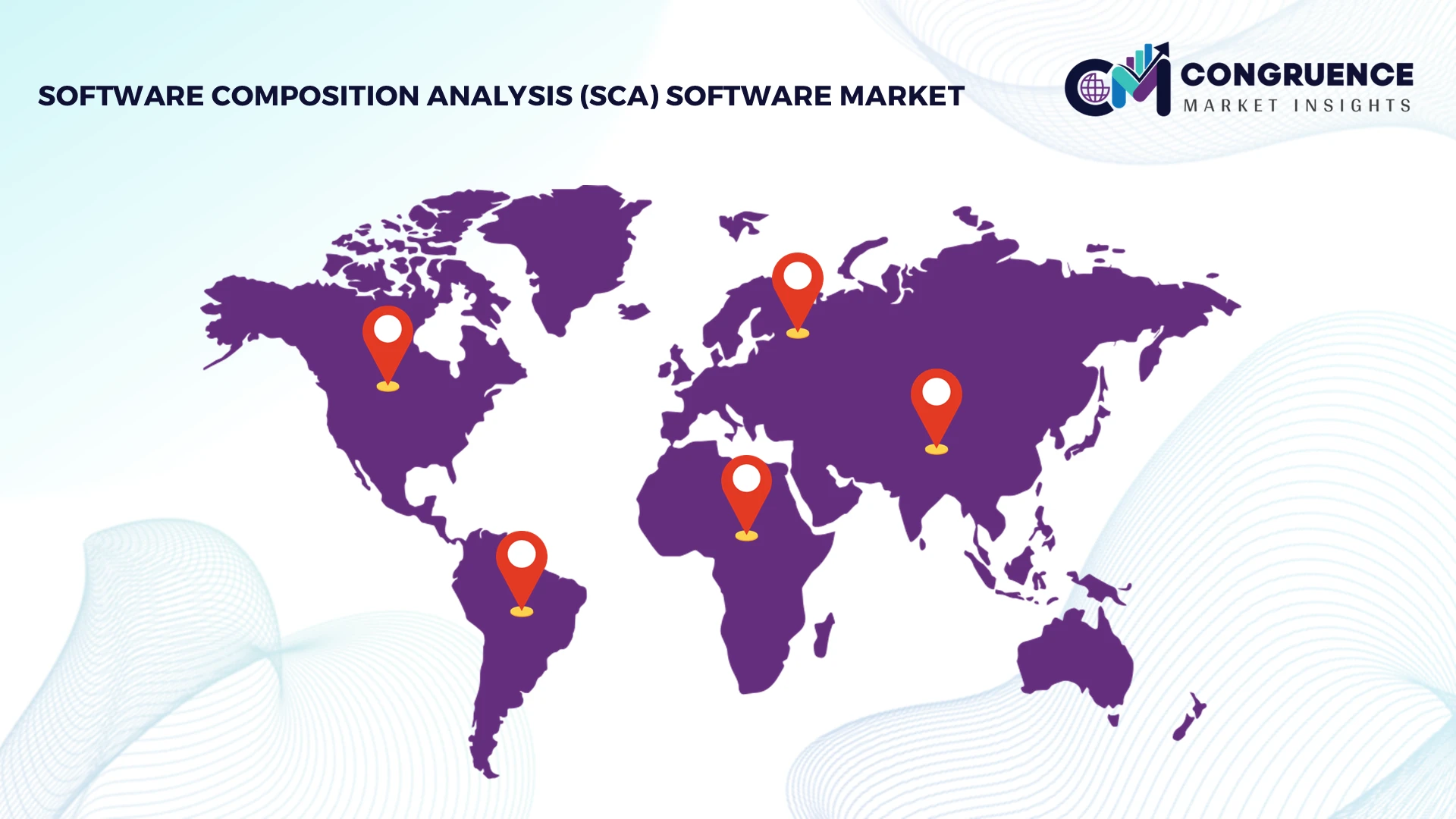
North America accounted for 42.5% of the global Software Composition Analysis (SCA) Software Market in 2025, supported by mature cybersecurity infrastructure, extensive cloud-native application development, and established enterprise security practices. The presence of leading application security vendors, including Black Duck, Sonatype, and JFrog, strengthens regional technology development and commercial deployment. Financial institutions, healthcare organizations, and software developers are integrating automated dependency scanning into continuous integration and delivery pipelines. The U.S. federal secure software development framework, incorporating four core practice groups under NIST's Secure Software Development Framework, reinforces component-level security governance. Canadian enterprises are expanding cloud-based security adoption across banking and telecommunications infrastructure. Regional investment increasingly favors integrated application security platforms that combine vulnerability identification, license compliance, and dependency intelligence, reducing fragmented security operations across distributed development environments.
United States Market Outlook: The United States accounted for an estimated 84.2% of the North American market in 2025. Its extensive software engineering ecosystem, federal technology procurement requirements, and concentration of cybersecurity developers strengthen demand for advanced SCA solutions. Enterprises operating across defense, financial services, and enterprise software increasingly require automated component traceability, positioning continuous dependency governance as an essential element of application lifecycle management.
Europe accounted for 27.5% of the global Software Composition Analysis (SCA) Software Market in 2025, supported by stringent cybersecurity regulations, industrial digitalization, and increasing software component transparency requirements. The European Union's Cyber Resilience Act is transforming product security obligations across connected devices, enterprise applications, and industrial software. Vulnerability reporting requirements introduce a 24-hour early-warning window and a subsequent 72-hour notification requirement, increasing demand for continuous component monitoring. Germany, France, and the United Kingdom represent significant deployment centers, with enterprises prioritizing automated license compliance and software supply-chain documentation. Automotive manufacturers and industrial technology providers are incorporating composition analysis into embedded software development processes. Vendors are strengthening regulatory reporting capabilities, localized deployment architectures, and integration with enterprise governance systems, making compliance automation a central competitive differentiator.
Germany Market Outlook: Germany's industrial software ecosystem and automotive engineering capabilities support extensive demand for component-level security assessment. The country accounted for an estimated 25.8% of the European market in 2025. Manufacturers developing connected vehicles, industrial automation platforms, and intelligent machinery increasingly require traceable software dependencies throughout product lifecycles. Integration with embedded development environments represents a particularly attractive opportunity for specialized SCA providers.
Asia-Pacific accounted for 22.0% of the global Software Composition Analysis (SCA) Software Market in 2025, supported by expanding software development ecosystems, digital infrastructure investments, and increasing adoption of cloud-native applications. China, India, Japan, and South Korea are strengthening software security capabilities across telecommunications, financial technology, electronics manufacturing, and enterprise IT services. India's technology workforce exceeded 5.8 million professionals during FY2025, providing a substantial operational foundation for developer-centric security deployment. Japanese manufacturers are incorporating component security assessments into industrial automation and embedded software engineering, while South Korean technology companies prioritize dependency visibility across connected products. Regional enterprises increasingly favor subscription-based SCA platforms offering automated scanning and flexible integration. Vendors are expanding localized technical support, cloud partnerships, and developer-oriented pricing models to address diverse enterprise security requirements.
China Market Outlook: China accounted for an estimated 32.5% of the Asia-Pacific market in 2025, supported by its extensive software development infrastructure, electronics manufacturing ecosystem, and domestic cloud computing industry. Enterprises increasingly prioritize locally deployed composition analysis tools compatible with domestic technology platforms and data governance requirements. Connected-device manufacturers and telecommunications equipment developers represent strategically important buyers requiring scalable component inventories and continuous vulnerability assessment.
South America accounted for 4.5% of the global Software Composition Analysis (SCA) Software Market in 2025, driven by digital banking expansion, cloud infrastructure modernization, and increasing enterprise cybersecurity awareness. Brazil, Argentina, and Chile are strengthening software development capabilities across financial services, retail, and technology outsourcing. In Brazil, the Pix instant payment ecosystem surpassed 60 billion transactions during 2024, demonstrating the operational scale of software-dependent financial infrastructure. Banks and financial technology companies are integrating automated dependency assessment into application development workflows to strengthen service reliability and third-party component governance. Limited cybersecurity budgets and shortages of specialized security professionals constrain deployment among smaller enterprises. SCA vendors are responding through subscription-based licensing, managed security partnerships, and simplified implementation models, making automated software security more accessible across developing enterprise environments.
Brazil Market Outlook: Brazil accounted for an estimated 48.5% of the South American market in 2025, supported by its established banking sector, expanding financial technology ecosystem, and growing enterprise software industry. The country's General Data Protection Law strengthens organizational emphasis on application security and information governance. Domestic software developers increasingly require automated vulnerability identification and license compliance capabilities to support commercial software distribution and international outsourcing contracts.
Middle East & Africa accounted for 3.5% of the global Software Composition Analysis (SCA) Software Market in 2025, supported by government-led digital transformation, cloud infrastructure expansion, and enterprise cybersecurity modernization. Saudi Arabia, the United Arab Emirates, and South Africa represent important deployment centers across financial services, telecommunications, energy, and public-sector technology. Saudi Arabia's National Cybersecurity Authority introduced Essential Cybersecurity Controls 2-2024, comprising 108 main controls, reinforcing organizational security governance requirements. Enterprises developing digital government platforms and connected industrial infrastructure are increasingly incorporating third-party software assessments into procurement and application development processes. Uneven technical expertise and infrastructure maturity constrain adoption across smaller African economies. International SCA providers are expanding regional distribution partnerships, localized cloud deployment capabilities, and managed security offerings to address enterprise compliance and implementation requirements.
Saudi Arabia Market Outlook: Saudi Arabia accounted for an estimated 30.5% of the Middle East & Africa market in 2025. Vision 2030 initiatives are accelerating software-intensive infrastructure development across government services, smart cities, energy, and financial technology. Organizations increasingly prioritize secure software procurement and continuous application security assessments. Domestic technology partnerships and data-residency-compatible deployment models are becoming important competitive requirements for international SCA software providers.
The Software Composition Analysis (SCA) Software Market exhibits moderate concentration, with Black Duck, Snyk, Sonatype, Mend.io, and JFrog collectively accounting for an estimated 61.5% market share. Black Duck competes through comprehensive component intelligence and license compliance, while Snyk and Mend.io emphasize developer-centric security automation. Sonatype and JFrog differentiate through repository-level governance and artifact security. Cloud-based solutions represent approximately 68.5% of deployment demand, intensifying competition around subscription pricing, scalability, and integration capabilities. Automated remediation platforms target 30% reductions in vulnerability resolution workloads, strengthening operational differentiation. Vendors are expanding cloud partnerships, proprietary vulnerability databases, and integrated application security portfolios. Competition is shifting from standalone dependency scanning toward unified software supply-chain governance and contextual risk prioritization. Maintaining accurate component intelligence across evolving open-source ecosystems creates substantial entry barriers. Winning requires comprehensive dependency coverage, actionable remediation capabilities, flexible deployment architectures, and seamless integration with enterprise development workflows without compromising software release velocity or stability.
Black Duck Software, Inc.
Snyk Limited
Sonatype, Inc.
Mend.io
JFrog Ltd.
Checkmarx Ltd.
Veracode, Inc.
FOSSA, Inc.
Anchore, Inc.
Revenera
GitLab Inc.
Microsoft Corporation (GitHub)
OpenText Corporation
Contrast Security, Inc.
Modern Software Composition Analysis platforms utilize dependency graph mapping, binary fingerprinting, and continuous vulnerability intelligence to identify direct and transitive open-source components. Cloud-based deployment represents an estimated 68.5% of market demand, reflecting enterprise preference for centralized scanning infrastructure. Automated dependency assessment targets 25% lower administrative workloads than manual component inventories, improving security coverage across distributed development environments. Integration with CI/CD pipelines enables earlier identification of vulnerable packages before production deployment.
Emerging technologies include reachability analysis, AI-assisted remediation, and machine-readable Software Bills of Materials. Contextual vulnerability prioritization targets 30–50% reductions in non-actionable alerts compared with conventional severity-based assessment. Automated dependency upgrades support operational targets of 30% faster remediation, reducing developer intervention and application maintenance requirements. Vendors possessing extensive vulnerability intelligence databases and established repository integrations benefit from stronger enterprise adoption and differentiated security capabilities.
Between 2026 and 2028, disruptive technologies will increasingly incorporate autonomous remediation agents, continuous artifact verification, and policy-driven package selection. Integration with software provenance frameworks strengthens component traceability across development and distribution environments. Enterprises are prioritizing automated security validation within existing engineering workflows rather than introducing additional standalone tools. Competitive advantage increasingly depends on combining accurate vulnerability intelligence, automated compliance documentation, and verified remediation without disrupting application release schedules or performance.
March 2026, GitLab expanded its SBOM-based dependency scanning functionality in version 18.10 to self-managed deployments. The enhancement delivers vulnerability findings during CI/CD execution instead of after pipeline completion, enabling faster security assessments and strengthening enterprise control over development workflows. Source: docs.gitlab.com
July 2025, Sonatype announced that its automated malware detection systems blocked 234 malicious packages associated with the Lazarus Group across npm and PyPI. The achievement demonstrated repository-level security effectiveness, strengthening preventive software supply-chain protection for enterprises using open-source components. Source: sonatype.com
June 2025, Snyk acquired Invariant Labs, expanding its AI Trust Platform through three security capabilities: Invariant Guardrails, Explorer, and mcp-scan. The acquisition strengthened Snyk's agentic AI security portfolio, extending application security coverage beyond conventional development environments into autonomous systems. Source: snyk.io
April 2025, JFrog released its Software Supply Chain report, revealing that only 43% of surveyed IT professionals conducted both code-level and binary-level security scanning. The findings highlighted enterprise security gaps, reinforcing demand for integrated artifact inspection and contextual vulnerability assessment. Source: jfrog.com
The Software Composition Analysis (SCA) Software Market Report provides comprehensive analysis across two deployment types, five application categories, and seven end-user segments. The report examines cloud-based and on-premises solutions across vulnerability management, license compliance, software supply-chain security, and SBOM management. End-user coverage includes IT & telecommunications, BFSI, healthcare, retail & e-commerce, government & defense, manufacturing, and other industries across North America, Europe, Asia-Pacific, South America, and Middle East & Africa.
The study evaluates automated dependency scanning, AI-enabled remediation, reachability analysis, and continuous component intelligence alongside competitive strategies, regulatory developments, and emerging deployment models. With cloud-based solutions representing an estimated 68.5% of market demand, the analysis highlights evolving enterprise purchasing priorities. The report supports investment planning, geographical expansion, product differentiation, strategic partnerships, and competitive positioning between 2026 and 2033.
| Report Attribute / Metric | Details |
|---|---|
| Market Revenue (2025) | USD 380.4 Million |
| Market Revenue (2033) | USD 663.4 Million |
| CAGR (2026–2033) | 7.2% |
| Base Year | 2025 |
| Forecast Period | 2026–2033 |
| Historic Period | 2021–2025 |
| Segments Covered |
By Type
By Application
By End-User
|
| Key Report Deliverables | Revenue Forecast; Market Trends; Growth Drivers & Restraints; Technology Insights; Segmentation Analysis; Regional Insights; Competitive Landscape; Regulatory & ESG Overview; Recent Developments |
| Regions Covered | North America; Europe; Asia-Pacific; South America; Middle East & Africa |
| Key Players Analyzed | Black Duck Software, Inc.; Snyk Limited; Sonatype, Inc.; Mend.io; JFrog Ltd.; Checkmarx Ltd.; Veracode, Inc.; FOSSA, Inc.; Anchore, Inc.; Revenera; GitLab Inc.; Microsoft Corporation (GitHub); OpenText Corporation; Contrast Security, Inc. |
| Customization & Pricing | Available on Request (10% Customization Free) |




