
Reports
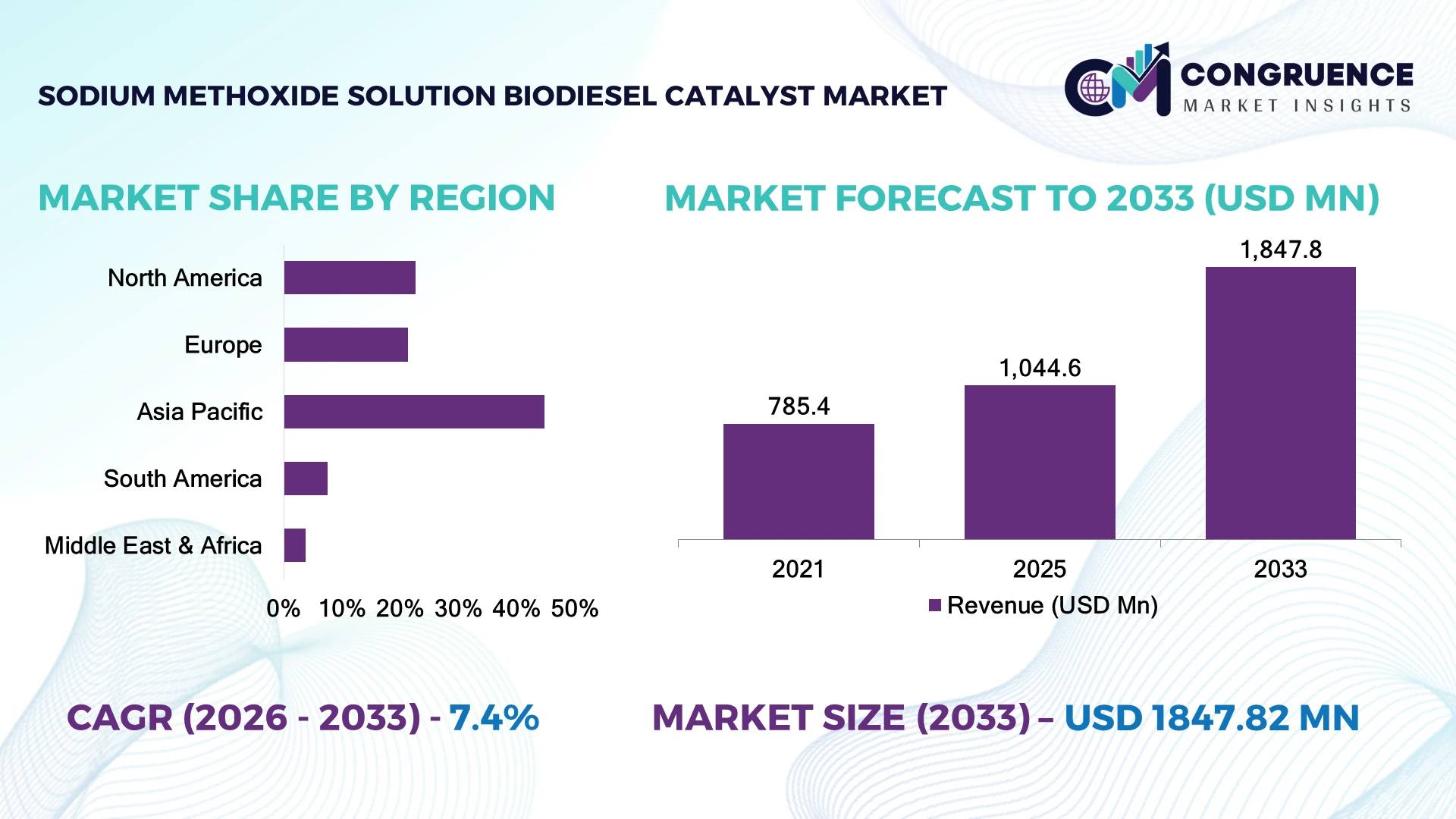
The Global Sodium Methoxide Solution Biodiesel Catalyst Market was valued at USD 1,044.6 Million in 2025 and is anticipated to reach a value of USD 1,847.8 Million by 2033 expanding at a CAGR of 7.39% between 2026 and 2033. Growth is driven by expanding biodiesel blending mandates, higher renewable fuel production capacity, and continuous catalyst efficiency improvements that reduce processing time and improve biodiesel yield.
China accounts for approximately 34% of global sodium methoxide solution production capacity, supported by large-scale chemical manufacturing, integrated biodiesel plants, and sustained investments in renewable fuels. India follows with nearly 12% capacity, benefiting from expanding biofuel initiatives and feedstock diversification. Asia-Pacific outpaces Europe in production scale, while the European Union's Renewable Energy Directive continues accelerating advanced biodiesel adoption through stricter renewable transport fuel targets.
The concentration of production capacity in Asia alongside tightening renewable fuel regulations makes regional supply partnerships and localized manufacturing critical strategic priorities.
Market Size & Growth: USD 1,044.6 Million in 2025, projected to reach USD 1,847.8 Million by 2033 at 7.39%, supported by expanding biodiesel processing capacity and catalyst optimization.
Top Growth Drivers: Renewable fuel blending (+20%), catalyst efficiency improvements (+15%), and biodiesel capacity expansion (+18%) accelerate market momentum.
Short-Term Forecast: By 2028, catalyst consumption efficiency improves by approximately 12% while production downtime declines by nearly 9%.
Emerging Technologies: Continuous-flow processing, automated catalyst dosing, and digital process monitoring improve production consistency and operational performance.
Regional Leaders: Asia-Pacific exceeds USD 760 Million, Europe approaches USD 510 Million, and North America surpasses USD 330 Million through renewable fuel expansion.
Consumer/End-User Trends: More than 68% of industrial biodiesel producers prioritize high-purity catalyst formulations to improve conversion efficiency.
Pilot/Case Example: In 2024, integrated biodiesel facilities adopting automated catalyst management achieved approximately 10% lower chemical consumption.
Competitive Landscape: BASF holds an estimated 18% market share alongside Evonik, De Dietrich, Anhui Jinbang, and Shandong Xisace.
Regulatory & ESG Impact: Renewable fuel policies contribute to over 25% higher adoption of advanced catalyst technologies across regulated markets.
Investment & Funding: More than USD 450 Million supports production expansion, strategic partnerships, and regional supply-chain localization.
Innovation & Future Outlook: High-purity catalyst formulations and digital production control strengthen operational resilience amid global renewable fuel expansion.
Sodium Methoxide Solution Biodiesel Catalyst Market demand is expanding across commercial biodiesel production, renewable diesel processing, and specialty chemical manufacturing as producers prioritize higher conversion efficiency and lower waste generation. Advanced catalyst purification technologies improve process stability by nearly 15%, while regional supply-chain localization and evolving renewable fuel regulations continue reshaping procurement strategies and supporting broader industrial deployment.
The Sodium Methoxide Solution Biodiesel Catalyst Market is becoming strategically important as renewable fuel production expands and governments strengthen low-carbon fuel policies. Manufacturers are restructuring supply chains through regional production hubs to improve raw material availability, shorten delivery timelines, and reduce operational risks. This shift strengthens competitiveness while supporting long-term production reliability for biodiesel manufacturers.
Modern high-purity sodium methoxide formulations deliver approximately 10–15% higher catalyst efficiency than conventional formulations by improving reaction consistency and reducing unwanted by-products. Asia-Pacific leads in manufacturing scale through integrated chemical production, while Europe emphasizes advanced process innovation driven by renewable fuel regulations. Over the next two to three years, automated catalyst dosing systems are expected to expand across large biodiesel facilities, improving production precision and reducing process interruptions.
Major producers are investing in production expansion, localized storage infrastructure, and strategic partnerships with biodiesel refiners to strengthen supply continuity. Large integrated processing facilities increasingly deploy automated catalyst handling systems to improve operational safety, reduce chemical losses, and streamline production workflows. These strategic investments reinforce competitive positioning, improve operational efficiency, and establish long-term resilience across the global renewable fuels value chain.
Mandatory biodiesel blending programs and expanding renewable fuel refining capacity are accelerating sodium methoxide solution consumption across industrial production facilities. India targets 20% ethanol blending while several biodiesel initiatives continue supporting alternative fuel deployment, and China's chemical manufacturing sector contributes nearly 34% of global sodium methoxide production capacity. Advanced catalyst formulations improve biodiesel conversion efficiency by approximately 12–15%, reducing processing losses and improving throughput. Tightening renewable fuel regulations are encouraging integrated chemical producers to invest in dedicated catalyst production lines and supply agreements with biodiesel refiners. Companies are expanding manufacturing capacity, strengthening feedstock integration, and introducing high-purity catalyst grades to secure long-term industrial contracts. A notable strategic advantage lies in vertically integrated production, enabling better cost control and consistent product quality during periods of rising renewable fuel demand.
Price fluctuations in methanol and metallic sodium continue creating procurement uncertainty for catalyst manufacturers and biodiesel processors. Raw material costs can account for nearly 55% of total production expenses, while hazardous chemical transportation increases logistics costs by approximately 10–15% compared with standard industrial chemicals. Germany and other European markets face increasingly stringent chemical handling regulations that elevate storage and compliance requirements for distributors. These structural constraints reduce operational flexibility, particularly for smaller biodiesel producers operating with limited inventories. Companies are mitigating risks through long-term procurement contracts, localized warehousing, supplier diversification, and improved inventory management systems. Building regional sourcing networks has become an effective operational strategy for minimizing supply disruptions while improving production continuity and contract fulfillment.
Next-generation high-purity sodium methoxide formulations combined with automated dosing technologies are creating measurable efficiency gains across industrial biodiesel production. Automated catalyst management systems reduce chemical consumption by approximately 10%, while digital process monitoring improves reaction consistency by nearly 15%. India and Brazil are expanding renewable diesel infrastructure, creating additional demand beyond conventional biodiesel applications. Manufacturers are investing in continuous-flow production technologies, advanced quality monitoring, and collaborative research programs to develop more stable catalyst formulations. An emerging opportunity lies in integrating AI-enabled process optimization with catalyst dosing, allowing producers to maximize conversion efficiency while reducing waste generation. Companies establishing technology partnerships today are strengthening long-term competitiveness through differentiated process performance rather than production scale alone.
Maintaining production consistency while complying with increasingly complex chemical safety standards remains a significant execution challenge. Sodium methoxide is highly moisture-sensitive, and contamination can reduce catalyst effectiveness by more than 10%, requiring strict storage and handling protocols. Approximately 30% of industrial facilities continue operating with legacy chemical handling infrastructure that limits automation and increases operational risk. Expanding production also demands a skilled workforce capable of managing advanced process control systems and hazardous material operations. Companies are addressing these challenges through automated handling equipment, workforce training programs, infrastructure modernization, and digital quality assurance platforms. Organizations that successfully combine process automation with rigorous operational safety standards will secure stronger long-term competitiveness and improve supply reliability across industrial biodiesel value chains.
High-Purity Catalyst Adoption Industrial biodiesel producers are shifting toward high-purity sodium methoxide formulations, with adoption exceeding 62% among large-scale processing facilities. Advanced purification reduces catalyst impurities by nearly 18% and improves reaction consistency by approximately 12%. Tighter fuel-quality regulations and increasing export requirements are encouraging manufacturers in China and India to expand premium-grade production while strengthening integrated quality-control systems to improve operational reliability.
Automated Catalyst Handling Systems Automated dosing and closed-loop catalyst transfer solutions are now deployed across approximately 48% of newly commissioned biodiesel facilities, reducing manual handling by nearly 35% and lowering chemical losses by around 10%. Labor shortages and stricter workplace safety requirements are accelerating automation investments. Producers are modernizing processing lines with digital monitoring platforms that improve batch consistency while reducing maintenance interventions and production interruptions.
Localized Supply Chain Expansion Manufacturers are restructuring procurement networks as nearly 40% of catalyst buyers prioritize regional sourcing to reduce transportation risks and improve delivery reliability. Dedicated storage terminals and localized blending operations shorten lead times by approximately 20%. Indian chemical producers and Southeast Asian biodiesel operators are expanding strategic partnerships to strengthen inventory availability while minimizing disruptions associated with hazardous chemical transportation.
Integrated Renewable Fuel Operations Vertically integrated renewable fuel complexes account for nearly 55% of new catalyst procurement contracts, enabling coordinated feedstock sourcing and optimized production scheduling. Integrated operations improve plant utilization by approximately 14% while reducing intermediate logistics requirements by nearly 11%. Companies are expanding long-term refinery partnerships and digital production planning capabilities to improve operational flexibility as renewable diesel and biodiesel manufacturing continue becoming increasingly interconnected.
Liquid sodium methoxide solution represents the leading segment with an estimated market share of approximately 82%, supported by its direct compatibility with continuous biodiesel production, simplified dosing, and consistent catalyst distribution throughout large-scale processing systems. Industrial producers favor liquid formulations because they minimize preparation time, improve reaction uniformity, and integrate efficiently with automated processing equipment. Companies continue expanding dedicated liquid catalyst production capacity while investing in high-purity formulations that improve operational efficiency and reduce process variability. Solid sodium methoxide is the fastest-growing segment as manufacturers serving specialty chemical applications seek easier transportation, longer storage stability, and flexible on-site preparation. Although adoption remains comparatively lower, demand is increasing by nearly 14% in specialized industrial applications requiring customized catalyst concentrations. Producers are expanding packaging technologies, improving moisture-resistant handling systems, and developing specialized product grades to address diverse industrial requirements. This investment shift reflects growing demand for differentiated catalyst solutions rather than standardized industrial products.
Biodiesel production remains the dominant application, accounting for approximately 88% of total sodium methoxide solution consumption because transesterification requires highly efficient catalyst performance for large-volume fuel manufacturing. Industrial biodiesel facilities continue increasing process automation, enabling approximately 12% higher production consistency while reducing catalyst waste. Growing renewable fuel mandates encourage refiners to optimize catalyst utilization through continuous processing technologies and integrated quality-control systems. Chemical synthesis represents the fastest-growing application as pharmaceutical intermediates, specialty chemicals, and fine chemical manufacturing increasingly require high-purity sodium methoxide. This segment records operational expansion exceeding 13% through process modernization and customized catalyst formulations. Laboratory research and specialty organic synthesis continue supporting niche demand, while manufacturers strengthen production flexibility through dedicated formulation capabilities and collaborative product development. Companies are balancing investments between established biodiesel demand and higher-value specialty chemical applications to diversify industrial portfolios.
Commercial biodiesel producers account for approximately 84% of total market demand because large-scale fuel processing requires continuous catalyst supply, integrated storage infrastructure, and high operational reliability. Modern production facilities increasingly operate automated catalyst delivery systems, improving processing efficiency by nearly 12% while reducing handling-related losses. Producers are entering long-term procurement agreements with catalyst suppliers to strengthen supply continuity and maintain consistent production performance. Specialty chemical manufacturers are the fastest-growing end-user group as demand expands for pharmaceutical intermediates, advanced organic synthesis, and customized industrial chemicals. Procurement volumes within this segment are increasing by approximately 15% as manufacturers invest in higher-purity catalyst formulations and flexible production capabilities. Research institutions and laboratory users continue representing smaller but strategically important customers requiring specialized packaging and premium quality specifications. Companies are responding with customized product portfolios, technical support programs, and application-focused partnerships that strengthen long-term customer relationships across diversified industrial sectors.
Asia-Pacific accounted for the largest market share at 44.8% in 2025 however, South America is expected to register the fastest growth, expanding at a CAGR of 8.21% between 2026 and 2033.
North America accounted for approximately 22.6% of the global market in 2025, supported by expanding renewable diesel and biodiesel production capacity across the United States and Canada. Increasing integration between chemical producers and biofuel refiners is improving catalyst supply reliability while accelerating process optimization through automated dosing systems. More than 60% of newly upgraded biodiesel facilities utilize digital process control technologies to enhance catalyst utilization and production consistency. Long-term procurement agreements and investment in specialized hazardous chemical storage infrastructure continue strengthening supply resilience. Companies are prioritizing localized inventory management and dedicated logistics capabilities to reduce operational disruptions and improve production efficiency across large industrial biofuel clusters.
United States Market Outlook: The United States leads the regional market through its extensive renewable fuel infrastructure, established biodiesel manufacturing network, and advanced chemical processing capabilities. More than 70% of regional biodiesel production capacity is concentrated in the country, supported by integrated refining operations and automated processing technologies. Leading manufacturers continue expanding catalyst storage facilities, strengthening refinery partnerships, and modernizing production systems to improve operational efficiency while supporting increasing renewable fuel blending requirements.
Europe represented approximately 21.3% of the global market in 2025, supported by strict renewable transport fuel policies and advanced biodiesel production technologies. Industrial producers continue adopting high-purity sodium methoxide formulations to improve conversion efficiency and comply with increasingly demanding fuel quality standards. Approximately 58% of large biodiesel facilities have upgraded catalyst handling systems through automated process integration. Companies are investing in sustainable production methods, localized chemical storage, and supply-chain optimization to strengthen operational resilience while reducing transportation complexity across multiple production hubs.
Germany Market Outlook: Germany remains the region's leading market because of its highly developed chemical manufacturing sector and advanced biodiesel processing infrastructure. The country accounts for nearly 28% of European biodiesel production capacity, supported by integrated industrial clusters and sophisticated logistics networks. Manufacturers continue investing in digital process monitoring, production modernization, and high-purity catalyst manufacturing to strengthen competitiveness while meeting evolving renewable fuel performance requirements.
Asia-Pacific held the largest global share at approximately 44.8% in 2025 due to its dominant chemical manufacturing base, expanding biodiesel production, and competitive production costs. China, India, and Southeast Asian economies continue increasing investments in integrated catalyst manufacturing and renewable fuel infrastructure. Nearly 65% of newly established sodium methoxide production facilities incorporate automated quality-control technologies that improve production consistency and export competitiveness. Companies are strengthening regional supply networks, expanding production capacity, and investing in specialized storage infrastructure to support rising domestic consumption and international demand.
China Market Outlook: China serves as the largest national market through its extensive chemical manufacturing ecosystem and strong export capabilities. The country contributes roughly 34% of global sodium methoxide production capacity, supported by integrated industrial parks and efficient raw material supply chains. Producers continue expanding high-purity catalyst production, improving automation levels, and strengthening partnerships with biodiesel manufacturers to enhance supply stability and international market competitiveness.
South America accounted for approximately 7.5% of the global market in 2025 and continues strengthening its position through expanding biodiesel blending programs and agricultural feedstock availability. Industrial investments in soybean-based biodiesel processing are increasing catalyst consumption across commercial production facilities. More than 45% of new biodiesel capacity additions are concentrated in integrated processing complexes that improve operational efficiency and reduce logistics costs. Companies are expanding regional distribution networks, improving storage infrastructure, and establishing long-term supply partnerships to support increasing domestic production while addressing transportation and hazardous chemical handling challenges.
Brazil Market Outlook: Brazil dominates the regional market through its large biodiesel industry, abundant agricultural resources, and supportive renewable fuel policies. The country represents nearly 60% of South America's biodiesel production capacity and continues expanding integrated biofuel processing facilities. Manufacturers are increasing catalyst procurement agreements, modernizing processing technologies, and investing in logistics infrastructure to improve production efficiency while supporting higher national biodiesel blending requirements.
Middle East & Africa represented approximately 3.8% of the global market in 2025, with growth supported by industrial diversification, expanding specialty chemical production, and renewable energy investment strategies. Several countries are integrating biodiesel production into broader sustainability initiatives while upgrading industrial infrastructure to improve processing capabilities. Around 30% of recently announced renewable fuel projects include investments in dedicated chemical storage and catalyst handling systems. Companies are forming strategic partnerships, expanding localized distribution capabilities, and strengthening technical support services to improve operational readiness and long-term supply reliability.
Saudi Arabia Market Outlook: Saudi Arabia leads the regional market through its advanced petrochemical infrastructure, strategic industrial investment programs, and expanding focus on sustainable fuels. The country accounts for approximately 35% of regional specialty chemical production capacity and continues investing in integrated industrial complexes capable of supporting renewable fuel value chains. Producers are strengthening manufacturing capabilities, improving logistics infrastructure, and developing partnerships that position the country as a future hub for advanced industrial chemical production.
Global producers including BASF, Evonik Industries, De Dietrich Process Systems, Shandong Xisace New Material Technology, and Anhui Jinbang Medicine Chemical compete against regional alkoxide manufacturers through production scale, catalyst purity, and supply reliability rather than price alone. The top five players collectively control approximately 58% of the global market, while regional suppliers compete through localized delivery and lower logistics costs. Premium manufacturers achieve 10–15% higher process efficiency with high-purity sodium methoxide formulations, whereas cost-focused suppliers compete with 8–12% lower delivered pricing in domestic markets. Competition increasingly centers on production expansion, integrated supply chains, long-term biodiesel refinery contracts, and automated manufacturing. Recent capacity additions in South America and Europe indicate a shift toward regional supply control and vertically integrated production. Strict hazardous chemical regulations, capital-intensive manufacturing, and technical quality requirements remain significant entry barriers. Success increasingly depends on consistent product quality, resilient regional supply networks, operational reliability, and strategic partnerships with large biodiesel producers.
Evonik Industries AG
De Dietrich Process Systems
Shandong Xisace New Material Technology Co., Ltd.
Anhui Jinbang Medicine Chemical Co., Ltd.
Supra Group
Desatec GmbH
Tokyo Chemical Industry Co., Ltd. (TCI)
American Elements
Merck KGaA
Thermo Fisher Scientific Inc.
Loba Chemie Pvt. Ltd.
Current technology development is centered on high-purity sodium methoxide production, automated catalyst dosing, and digitally monitored biodiesel processing. High-purity catalyst formulations improve biodiesel conversion efficiency by approximately 12–15% while reducing unwanted by-product formation by nearly 10%. More than 60% of newly commissioned industrial biodiesel facilities now integrate automated catalyst management systems to improve production consistency and operator safety.
Emerging technologies include AI-enabled process optimization, continuous-flow catalyst production, and advanced moisture-control systems. Compared with conventional batch processing, continuous production improves operational efficiency by approximately 18% while lowering energy consumption by nearly 10%. Integrated sensor networks provide real-time catalyst quality monitoring, enabling predictive process adjustments and reducing production interruptions. Large integrated chemical manufacturers benefit most because digital process control improves throughput while strengthening product consistency for commercial biodiesel producers.
Between 2026 and 2028, technology adoption will increasingly focus on smart manufacturing, automated hazardous chemical handling, and advanced purification systems. Deployment of digital manufacturing platforms is expected to exceed 70% among newly expanded production facilities, improving inventory visibility and production planning. Companies investing early in intelligent process automation, integrated quality assurance, and advanced catalyst purification will strengthen competitive positioning through higher operational efficiency, lower production costs, improved product consistency, and stronger long-term customer relationships.
July 2024 BASF increased sodium methylate production capacity at its Guaratinguetá, Brazil facility to 90,000 metric tons per year, strengthening regional biodiesel catalyst supply and supporting long-term customer partnerships across South America. Source: www.basf.com
July 2024 Evonik Industries expanded sodium methylate production at its Rosario, Argentina plant by 50%, increasing annual capacity from 60,000 to 90,000 tons to meet rising biodiesel demand and reinforce its South American manufacturing footprint. Source: www.evonik.com
February 2025 BASF announced investment in a new alcoholates production plant in Ludwigshafen, Germany, featuring advanced manufacturing technology to strengthen European sodium methylate supply for biodiesel and life science applications. Source: www.basf.com
2025 Multiple biodiesel producers across Brazil accelerated procurement of expanded regional sodium methylate supplies following implementation of higher biodiesel blending requirements, supporting improved production continuity and stronger localized catalyst availability.
This report delivers comprehensive analysis of the Sodium Methoxide Solution Biodiesel Catalyst Market across liquid and solid product types, biodiesel production and chemical synthesis applications, and major end-user industries including biodiesel manufacturers, specialty chemical producers, research institutions, and industrial processors. The assessment covers North America, Europe, Asia-Pacific, South America, and the Middle East & Africa, highlighting manufacturing concentration, deployment trends, supply-chain developments, technology adoption, and evolving competitive positioning. More than 80% of market demand remains concentrated within industrial biodiesel production, while specialty applications continue expanding through higher-purity catalyst requirements.
The report evaluates production technologies, automated catalyst handling systems, digital process optimization, high-purity formulation developments, and regional manufacturing strategies between 2026 and 2033. It provides strategic intelligence on market structure, competitive benchmarking, investment priorities, regional expansion opportunities, procurement trends, operational risks, partnership activity, and technology adoption, enabling stakeholders to strengthen market positioning, optimize production strategies, identify emerging demand areas, and support informed long-term business planning.
| Report Attribute / Metric | Details |
|---|---|
| Market Revenue (2025) | USD 1,044.6 Million |
| Market Revenue (2033) | USD 1,847.8 Million |
| CAGR (2026–2033) | 7.39% |
| Base Year | 2025 |
| Forecast Period | 2026–2033 |
| Historic Period | 2021–2025 |
| Segments Covered |
By Type
By Application
By End-User
|
| Key Deliverables | Revenue Forecast; Market Trends; Growth Drivers & Restraints; Technology Insights; Segmentation Analysis; Regional Insights; Competitive Landscape; Regulatory & ESG Overview; Recent Developments |
| Regions Covered | North America; Europe; Asia-Pacific; South America; Middle East & Africa |
| Companies Profiled | BASF SE; Evonik Industries AG; De Dietrich Process Systems; Shandong Xisace New Material Technology Co., Ltd.; Anhui Jinbang Medicine Chemical Co., Ltd.; Supra Group; Desatec GmbH; Tokyo Chemical Industry Co., Ltd. (TCI); American Elements; Merck KGaA; Thermo Fisher Scientific Inc.; Loba Chemie Pvt. Ltd. |
| Customization & Pricing | Available on Request (10% Customization Free) |




