
Reports
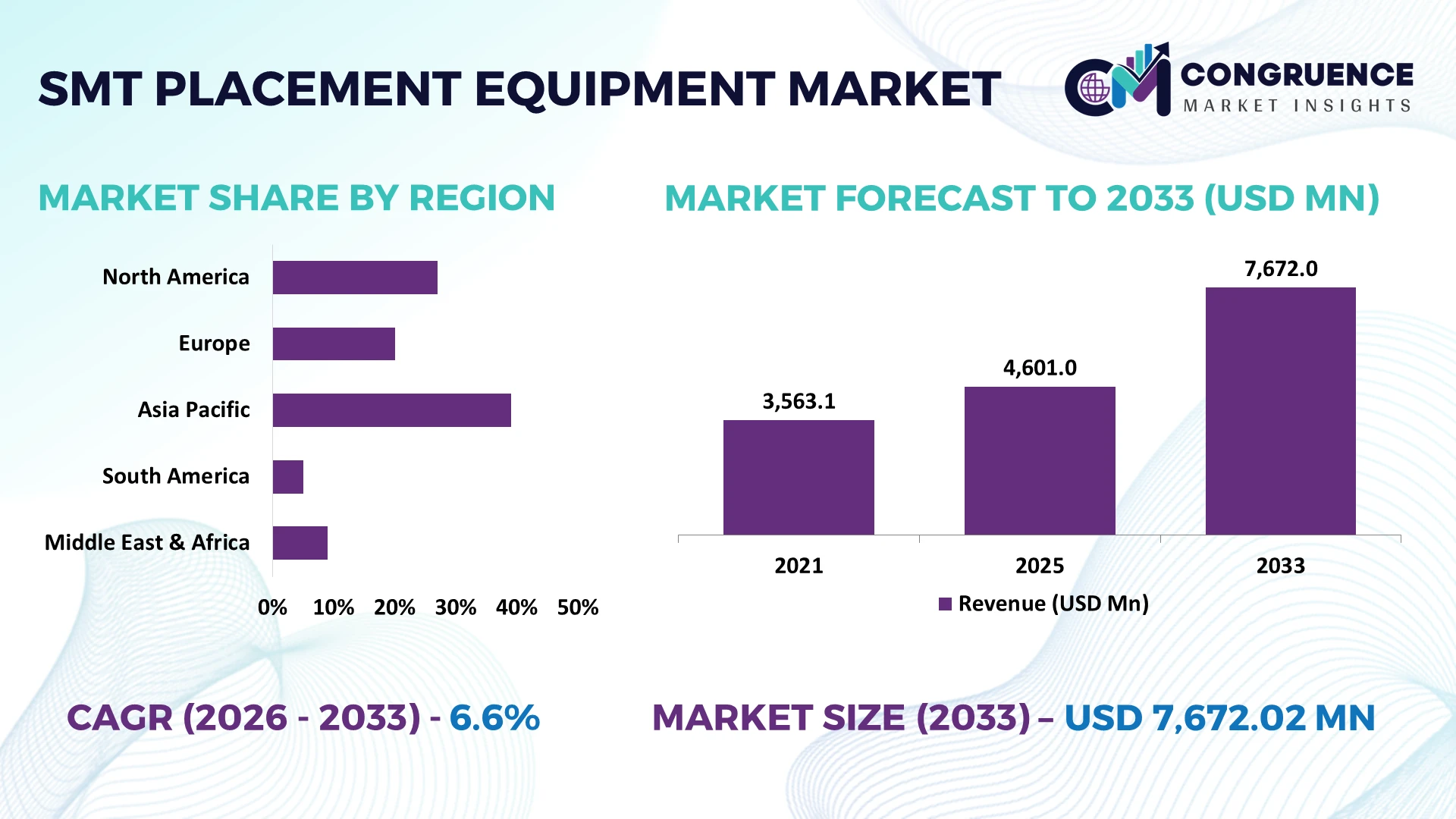
The Global SMT Placement Equipment Market was valued at USD 4601 Million in 2025 and is anticipated to reach a value of USD 7672.02 Million by 2033 expanding at a CAGR of 6.6% between 2026 and 2033. Growth is driven by PCB miniaturization, increasing semiconductor content in electric vehicles, AI-server manufacturing, and electronics factories replacing conventional placement lines with high-speed, vision-guided modular SMT systems.
China remains the dominant SMT placement equipment market, supported by approximately 56% of global PCB production and a manufacturing ecosystem spanning smartphones, telecom equipment, EV electronics, servers, and industrial controls. High-volume factories increasingly deploy placement platforms exceeding 100,000 components per hour with automated feeders and optical alignment. Japan accounts for roughly 8% of PCB production, leaving China approximately seven times larger by manufacturing share amid ongoing U.S.–China electronics supply-chain diversification.
Equipment suppliers combining high-throughput platforms, flexible component handling, local service networks, and intelligent factory integration are positioned to capture the strongest Asian capacity-expansion and replacement opportunities.
Market Size & Growth: USD 4.60 billion in 2025 is projected to reach USD 7.67 billion by 2033 at 6.6%, driven by high-density PCB assembly, EV electronics, AI infrastructure, and factory automation.
Top Growth Drivers: PCB miniaturization influences roughly 35% of advanced equipment upgrades, automotive electronics about 25%, and high-speed automation nearly 20%, strengthening demand for flexible, precision placement platforms.
Short-Term Forecast: By 2027, intelligent feeder management, automated changeovers, and predictive maintenance are expected to increase effective SMT line efficiency by 10–15% while reducing operator intervention by approximately 8%.
Emerging Technologies: AI-enabled component recognition, 3D vision, digital twins, adaptive motion control, and smart feeders are supporting ±25–50-micron placement accuracy and advanced machines exceeding 100,000 components per hour.
Regional Leaders: Asia-Pacific represents approximately 70% of equipment demand, equivalent to about USD 3.2 billion in 2025; North America approaches USD 0.7 billion, while Europe nears USD 0.6 billion as automotive-electronics automation expands.
Consumer/End-User Trends: Electronics manufacturing services, automotive, communications, and computing manufacturers increasingly specify flexible lines; advanced automated placement penetration exceeds 80% across high-volume smartphone, server, and automotive PCB assembly environments.
Pilot/Case Example: In 2025, smart-factory SMT deployments integrating automated material handling, placement, inspection, and traceability demonstrated approximately 15–20% productivity improvement compared with fragmented production-line configurations.
Competitive Landscape: Yamaha Motor holds an estimated 15% global equipment position, while ASMPT, Fuji Corporation, Panasonic Connect, and JUKI form the principal competitive group across high-speed, flexible, and precision placement platforms.
Regulatory & ESG Impact: Energy-efficient servo systems, optimized compressed-air consumption, and automated defect prevention can reduce placement-line electricity and material losses by approximately 5–10%, strengthening electronics manufacturers’ factory-level carbon and waste-reduction programs.
Investment & Funding: More than USD 100 billion in announced semiconductor and electronics manufacturing investments across the United States, Europe, Japan, and India are expanding the addressable ecosystem for advanced PCB assembly and SMT equipment.
Innovation & Future Outlook: By 2028, AI-controlled optimization, autonomous material replenishment, digital-twin production planning, and closed-loop inspection feedback are positioned to improve overall SMT equipment utilization by approximately 10–20%.
The SMT Placement Equipment Market is increasingly concentrated around automotive electronics, AI servers, telecom hardware, industrial controls, and high-density consumer devices. Advanced vision, intelligent feeders, predictive maintenance, and closed-loop inspection are raising line utilization by 10–20%. Electronics supply-chain localization across India, Southeast Asia, North America, and Europe is simultaneously creating new greenfield equipment opportunities, strengthening the strategic importance of flexible automated placement platforms.
The SMT Placement Equipment Market is gaining strategic relevance as electronics manufacturing shifts toward high-density assemblies, shorter product cycles, and geographically diversified production. Automotive electronics, AI servers, smartphones, industrial automation, and telecom equipment increasingly require accurate placement of smaller components at higher throughput. Supply-chain restructuring is accelerating new electronics manufacturing capacity in India, Vietnam, Mexico, and the United States, creating demand for flexible SMT lines beyond established Chinese production clusters.
Technology is simultaneously changing equipment economics. Advanced multi-head, vision-guided placement systems exceeding 100,000 components per hour provide approximately 15–20% higher effective productivity than legacy fixed-platform equipment through automated feeder verification, faster changeovers, and closed-loop process control. China accounts for roughly 56% of global PCB production, providing unmatched deployment scale, while Japan remains influential in precision placement engineering. India is expanding faster from a smaller base as smartphone, automotive-electronics, and EMS investments deepen domestic assembly.
Operationally, manufacturers are connecting placement machines with SPI, AOI, automated material handling, and MES software to identify defects and material shortages before they disrupt production. During 2026–2028, investment will increasingly target modular machines, predictive maintenance, AI-assisted programming, and localized technical support. Suppliers combining equipment speed, process intelligence, uptime, and flexible component handling will secure stronger competitive positioning.
PCB miniaturization, automotive electrification, and AI computing are accelerating demand for high-speed SMT placement systems. China represents approximately 56% of global PCB production, while electronic systems can account for around 40% of modern vehicle value, increasing placement requirements across ADAS, infotainment, battery-management, and power-control boards. Advanced production lines increasingly require ±25–50 micron placement accuracy as component packages shrink. The global shift toward AI servers and high-performance computing further raises board complexity and component density. Equipment manufacturers are responding with multi-head architectures, intelligent feeders, automated nozzle management, and integrated vision inspection. Yamaha Motor, Fuji, ASMPT, Panasonic Connect, and JUKI continue strengthening high-mix platforms and software integration. The operational advantage increasingly comes from sustaining high utilization across frequent product changeovers rather than maximizing nominal placement speed alone.
Capital intensity remains a structural restraint because advanced SMT deployment requires placement machines, printers, inspection systems, feeders, conveyors, software, and environmental controls as an integrated investment. Automated lines can carry approximately 15–25% higher initial equipment costs than less-integrated configurations, while feeder inventories and specialized tooling can add another 10–15% to deployment requirements. Japan continues supplying significant precision placement equipment, motion-control technology, and machine components, creating exposure to currency fluctuations and international equipment lead times. Smaller EMS companies face greater pressure because frequent package changes require additional tooling and engineering resources. Manufacturers are responding through modular equipment purchases, standardized feeders, preventive-maintenance contracts, localized spare-parts inventories, and supplier diversification. The strategic constraint is therefore total lifecycle economics: insufficient machine utilization can outweigh the productivity advantage of advanced automation.
Connected SMT production creates a significant opportunity as manufacturers integrate placement equipment with SPI, AOI, MES, automated storage, and material-transport systems. Closed-loop production control can raise line utilization by approximately 10–20%, while automated material verification can materially reduce feeder-loading and component-traceability errors. India presents a particularly important opportunity as electronics production has expanded more than sixfold over the past decade, supported by smartphone, telecom, semiconductor, and automotive manufacturing programs. Vietnam and Mexico are also attracting assembly capacity through supply-chain diversification. Through 2026–2028, AI-assisted programming, predictive maintenance, digital twins, and autonomous material replenishment will become stronger equipment-selection criteria. Suppliers are expanding application centers, distributor partnerships, software capabilities, and local service networks. Retrofitting installed placement lines with analytics and intelligent material management provides an additional opportunity without requiring complete equipment replacement.
Execution complexity is increasing as SMT factories combine smaller components, larger power devices, multiple PCB formats, and shorter production runs on common lines. High-mix facilities can manage hundreds of component references per production cycle, while poorly optimized feeder preparation and product changeovers can consume approximately 5–15% of available production time. India, Vietnam, and Mexico are expanding electronics assembly capacity, but experienced SMT process engineers, automation programmers, and precision-equipment maintenance specialists remain harder to scale than production labor. Greater machine connectivity also increases requirements for secure MES integration, equipment interoperability, production-data management, and remote diagnostics. Equipment companies must strengthen training centers, standardized communication interfaces, simulation software, remote service, and automated process optimization. Long-term competitiveness depends on replicating consistent placement accuracy, uptime, and yield across geographically distributed factories without proportionally increasing engineering headcount.
Automation Offsets Factory Cost Pressure: Electronics manufacturers are accelerating automation as labor and material costs remain elevated. In 2025, 31% of electronics manufacturers invested in automation or process optimization, while 52% reported rising labor costs and 51% faced higher material costs. SMT suppliers are responding with autonomous feeder management, predictive maintenance, and integrated material logistics that reduce operator dependency and improve line utilization.
High-Speed Modular Lines Gain Share: Placement platforms are shifting from fixed-function equipment toward modular systems combining high throughput and component flexibility. Current premium machines reach 115,000–200,000 components per hour with placement accuracy near ±25–35 microns. Manufacturers are consolidating chip shooters and flexible placers into fewer platforms, reducing floor-space requirements while supporting faster product changeovers and mixed-model electronics production.
Supply Chains Drive Localized Deployment: Tariff exposure and geopolitical restructuring are changing equipment deployment patterns. Around 29% of surveyed electronics manufacturers remained dependent on Chinese suppliers in 2025, while 28% had already shifted toward non-tariffed suppliers. EMS companies are expanding assembly capacity in India, Vietnam, Mexico, and the United States, prompting equipment vendors to strengthen local distribution, spare-parts inventories, application engineering, and technical-service networks.
Closed-Loop Production Becomes Standard: SMT placement machines are increasingly integrated with SPI, AOI, MES, and automated material handling rather than operated as isolated assets. More than 80% of new electronic products use SMT-based assembly, while advanced connected lines can improve effective utilization by approximately 10–20%. Equipment suppliers are expanding software interoperability, machine-vision analytics, traceability, and automated process correction to capture higher-value smart-factory deployments.
Modular Placement Systems account for approximately 30% of the SMT placement equipment market, supported by their ability to combine high-speed chip mounting, precision IC placement, flexible feeder configurations, and scalable production capacity within a common equipment architecture. Their dominance reflects electronics manufacturers’ preference for expanding line capability without replacing complete production cells. High-Speed Placement Machines represent roughly 24% of demand and remain important in smartphones, computing hardware, communication devices, and other high-volume applications where throughput above 100,000 components per hour directly influences unit economics.
Flexible Placement Machines are the fastest-growing type as automotive, industrial, medical, and EMS facilities shift toward high-mix manufacturing and shorter production runs. These systems increasingly handle component ranges from microscopic passives to large connectors while maintaining placement accuracy around ±25–40 microns. Pick-and-Place Machines retain importance in lower-volume and cost-sensitive assembly, while Multi-Function Placers are gaining relevance where manufacturers need one platform for chips, ICs, connectors, and irregular components. Suppliers are prioritizing modular heads, intelligent feeders, dual-lane architectures, and software-controlled changeovers, shifting investment toward equipment capable of balancing utilization, flexibility, and throughput.
Consumer Electronics represents approximately 35% of SMT placement equipment demand, supported by large-volume production of smartphones, wearables, computers, smart-home devices, and connected consumer hardware. High board density and continuous device miniaturization favor placement systems capable of exceeding 100,000 components per hour while handling 0201-class components and fine-pitch packages. Telecommunications accounts for approximately 18% of demand, supported by networking equipment, data infrastructure, optical systems, and 5G hardware requiring high-density multilayer PCB assembly.
Automotive Electronics is the fastest-growing application, driven by ADAS, infotainment, battery-management systems, power electronics, connectivity modules, and vehicle-control architectures. Electronics can represent around 40% of the value of advanced vehicles, increasing SMT intensity per vehicle and shifting demand toward flexible high-accuracy placement. Industrial Electronics remains important for robotics, automation controllers, drives, and power systems, while Medical Electronics requires lower-volume, high-reliability production with stringent traceability. Equipment suppliers are consequently expanding vision inspection, traceability, flexible component handling, and closed-loop process control, enabling manufacturers to move efficiently between high-volume consumer production and complex automotive or industrial assemblies.
Electronics Manufacturers hold approximately 38% of SMT placement equipment demand because vertically integrated producers operate high-volume assembly lines requiring dedicated placement capacity, process control, material traceability, and continuous equipment availability. Contract Manufacturers represent approximately 27% and are the fastest-expanding buyer group as OEMs outsource increasingly complex PCB assembly while expecting rapid product transitions, global manufacturing coverage, and consistent quality. These EMS operators favor modular machines capable of combining high-volume throughput with flexible changeovers across multiple customer programs.
Automotive Suppliers are increasing investment in specialized placement equipment for ADAS, power electronics, battery systems, and connected-vehicle modules, while Semiconductor Assemblers require high-precision systems for advanced modules and increasingly complex package integration. Appliance Manufacturers retain a stable role as smart appliances add connectivity, sensors, displays, and power-control electronics. Equipment suppliers are targeting these end-users with configurable placement heads, financing options, software platforms, localized service networks, and line-integration partnerships. Competitive positioning is shifting toward lifecycle support because contract manufacturers increasingly evaluate equipment using utilization, changeover time, service response, and cost per assembled board rather than headline placement speed alone.
Asia-Pacific accounted for the largest market share at 75.2% in 2025 however, Asia-Pacific is expected to register the fastest growth, expanding at a CAGR of 7.3% between 2026 and 2033.
Reshoring Accelerates Advanced Electronics Assembly
North America accounted for approximately 8.6% of SMT placement equipment demand in 2025, with deployment concentrated across automotive electronics, aerospace and defense systems, medical devices, AI infrastructure, and high-reliability industrial assemblies. U.S. manufacturing policy is strengthening domestic semiconductor and electronics ecosystems, encouraging manufacturers to install flexible, highly automated SMT capacity closer to component production. In 2025, computer and electronics manufacturing attracted approximately USD 2 billion in new U.S. greenfield foreign investment. Production strategies increasingly emphasize traceability, rapid product changeovers, automated optical verification, and lower dependence on manual material handling. Arizona, Texas, California, and several Midwest manufacturing clusters are gaining strategic importance as semiconductor fabrication and electronics assembly investments converge. Equipment vendors are responding with local application engineering, automation partnerships, service infrastructure, and modular platforms optimized for high-mix production rather than purely high-volume consumer-electronics assembly.
United States Market Outlook: The United States leads regional adoption through semiconductor localization, defense electronics, automotive systems, medical technology, and AI hardware investment. More than 160 semiconductor ecosystem projects representing over USD 820 billion in announced investment since 2020 are strengthening domestic manufacturing infrastructure. This expanding component ecosystem supports downstream demand for precision PCB assembly, intelligent material handling, automated inspection, and flexible SMT placement capacity.
Automotive Electronics Reshape Placement Requirements
Europe represented approximately 6.9% of global SMT placement equipment demand in 2025, with Germany, Italy, France, the Czech Republic, and Hungary supporting substantial automotive, industrial automation, power-electronics, and medical-device assembly. Production economics differ from Asia because European manufacturers prioritize high-mix flexibility, traceability, energy efficiency, and process automation over maximum-volume consumer-electronics throughput. Automotive electrification is particularly important as inverter controls, ADAS modules, battery-management systems, and connectivity hardware increase PCB complexity. Germany’s electrical and digital industry employed approximately 880,000 people in 2025, demonstrating the scale of the region’s advanced manufacturing base. European manufacturers are integrating placement machines with MES, automated material storage, SPI, and AOI to improve utilization while controlling labor exposure. Equipment suppliers increasingly compete through software interoperability, precision placement, energy-efficient operation, lifecycle service, and adaptable production cells capable of handling shorter industrial product runs.
Germany Market Outlook: Germany remains Europe’s strategically strongest SMT placement equipment market because its electronics sector combines automotive engineering, industrial automation, medical technology, semiconductor development, and export-oriented manufacturing. Electrical and electronic industries account for approximately 23% of national industrial R&D spending, while roughly half of sector output is exported. This innovation intensity favors advanced placement platforms supporting high-reliability, high-mix production and digitally connected factories.
Manufacturing Scale Reinforces Automation Leadership
Asia-Pacific controlled approximately 75.2% of global SMT placement equipment demand in 2025, reflecting unmatched concentration of PCB fabrication, semiconductor packaging, smartphones, computers, telecom equipment, automotive electronics, and EMS operations. China anchors production scale, while Japan remains influential in precision placement technology and South Korea supports semiconductor, display, automotive, and consumer-device manufacturing. India and Vietnam are becoming important incremental deployment markets as electronics supply chains diversify. China alone accounts for approximately 56% of worldwide PCB manufacturing, creating a dense installed base for high-speed placement machines, feeders, inspection systems, and factory automation. Production lines increasingly exceed 100,000 placements per hour as assemblers pursue greater throughput per square meter. Equipment manufacturers are expanding intelligent feeder systems, dual-lane platforms, automated material logistics, and localized technical support while strengthening production and distribution networks across emerging electronics clusters.
China Market Outlook: China remains the central global deployment market because Shenzhen, Dongguan, Suzhou, Shanghai, Chongqing, and other electronics clusters combine PCB production with smartphones, computing, telecom, EV, and industrial-electronics assembly. Its approximately 56% share of global PCB production substantially exceeds Japan’s single-digit share. Manufacturers increasingly prioritize highly automated placement lines to protect productivity as wages rise and product complexity intensifies.
Electronics Localization Supports Selective Automation
South America accounted for approximately 5.0% of SMT placement equipment demand in 2025, with Brazil providing the principal manufacturing base and Argentina supporting smaller electronics and automotive assembly operations. Demand centers on consumer devices, automotive electronics, telecommunications equipment, industrial controls, appliances, and power systems rather than extremely high-volume semiconductor-linked production. Brazil’s Manaus Free Trade Zone remains particularly important for domestic electronics manufacturing, creating recurring requirements for PCB assembly modernization and flexible placement machinery. Manufacturers increasingly favor modular systems that can accommodate multiple product families because production volumes are lower and model diversity is higher than in major Asian hubs. Currency volatility, imported machinery dependence, and specialist maintenance availability continue constraining rapid automation. Suppliers are addressing these limitations through distributor partnerships, regional technical support, refurbished equipment programs, modular upgrades, and production platforms designed to maximize utilization across diversified assembly workloads.
Brazil Market Outlook: Brazil dominates South American SMT deployment through its established electronics, appliance, telecommunications, and automotive manufacturing infrastructure. The Manaus industrial ecosystem contains hundreds of manufacturing operations and remains a critical location for domestic electronics production. Local assemblers increasingly require flexible SMT systems capable of serving televisions, smartphones, connectivity products, industrial electronics, and appliance-control boards without dedicated lines for every product category.
Industrial Diversification Creates New Assembly Capacity
Middle East & Africa represented approximately 4.2% of SMT placement equipment demand in 2025, with deployment concentrated in Israel, Saudi Arabia, the United Arab Emirates, South Africa, and emerging North African manufacturing hubs. The market is shifting from predominantly imported finished electronics toward selective localization of defense electronics, telecommunications equipment, automotive components, smart meters, industrial controls, and consumer devices. Saudi Arabia’s Vision 2030 industrialization agenda and UAE technology investments are encouraging domestic advanced-manufacturing ecosystems, while Morocco is strengthening electronics demand through automotive and aerospace supply chains. Production volumes remain below Asian levels, favoring flexible multi-function placement systems rather than dedicated ultra-high-speed lines. Vendors are developing distributor networks, training capabilities, turnkey line partnerships, and remote maintenance services. The strongest equipment opportunities occur where governments combine industrial localization incentives with established downstream automotive, defense, energy, or telecommunications demand.
Saudi Arabia Market Outlook: Saudi Arabia offers strong long-term positioning through industrial localization, defense manufacturing, telecommunications infrastructure, and digitally enabled factories. Vision 2030 targets substantial expansion of non-oil industrial activity, while domestic manufacturing programs increasingly emphasize local technology content. SMT suppliers can benefit by pairing flexible placement platforms with training, maintenance, process engineering, and turnkey electronics-assembly capabilities.
The SMT placement equipment market is led by Fuji Corporation, Yamaha Motor, Panasonic Connect, ASMPT, and JUKI, which compete against Mycronic, Hanwha Semitech, and specialized flexible-equipment suppliers. The top five control approximately 35% of global demand, creating a moderately fragmented structure where Japanese suppliers retain strong positioning. Competition centers on placement speed, accuracy, flexibility, software integration, and lifecycle support. Premium systems achieve over 100,000 components per hour, while advanced modular architectures can improve effective utilization by 10–20% and reduce changeover losses by approximately 15%. Fuji and Yamaha emphasize high-speed modular platforms; ASMPT and Panasonic compete through integrated smart-factory ecosystems, while JUKI strengthens intelligent material management and flexible automation. Competition is shifting from standalone machine performance toward autonomous line orchestration, predictive maintenance, and closed-loop process optimization. Precision engineering, feeder ecosystems, installed service networks, and customer qualification create substantial entry barriers. Winning requires combining throughput, flexibility, software intelligence, rapid service, and demonstrably lower lifecycle production costs.
Fuji Corporation
ASMPT
Yamaha Motor Co., Ltd.
Panasonic Connect Co., Ltd.
JUKI Corporation
Mycronic AB
Hanwha Semitech
Kulicke & Soffa Industries, Inc.
Universal Instruments Corporation
Europlacer
Mirae Corporation
Evest Corporation
Essemtec AG
Shenzhen ETON Automation Equipment Co., Ltd.
Current SMT placement technology centers on high-speed modular architectures, machine vision, intelligent feeders, and closed-loop line control. Modern platforms exceed 100,000 components per hour, while vision-guided alignment supports ±25-micron precision. Integrated software and automated material handling can raise effective utilization 10–20%, giving high-volume electronics manufacturers stronger throughput, traceability, and production consistency across factories.
Emerging systems combine AI-assisted programming, predictive maintenance, digital twins, and adaptive placement heads for high-mix production. ASMPT’s SIPLACE V demonstrates up to 30% higher real-world performance, while Yamaha platforms integrate placement, printing, inspection, and material workflows. Compared with older fixed-function machines, connected modular systems can deliver roughly 15–30% higher operational productivity through faster changeovers and reduced intervention.
Disruptive development is moving toward autonomous replenishment, wafer-to-board hybrid placement, and ultra-miniature component handling. Fuji has demonstrated placement of 0.16 × 0.08 mm components, signaling readiness for edge-AI, wearables, and advanced medical electronics. Through 2026–2028, deployment will increasingly favor AI-ready platforms integrating MES, SPI, AOI, and automated logistics. Suppliers with compatible feeder ecosystems, software intelligence, and precision engineering benefit most because customers can expand automation without replacing entire lines. Acting now protects equipment utilization, factory-space productivity, and next-generation assembly capability as component diversity and density accelerate across global electronics manufacturing.
January 2024 Yamaha Motor launched the YRM10 compact modular mounter, delivering 52,000 CPH and ±35-micron accuracy while handling 0201 components. The platform strengthens cost-efficient, high-density production for manufacturers balancing speed, versatility, factory space, and workforce constraints globally. Source: Yamaha
January 2025 JUKI launched the RS-2 smart modular mounter, increasing placement speed 6% to 50,000 CPH through optimized software and TAKUMI-head control. The upgrade improves mixed-production productivity while supporting 112 feeders and components up to 25 mm high. Source: JUKI
October 2025 ASMPT unveiled SIPLACE V, delivering up to 30% higher real production performance and 105,000 CPH within a 1.1-by-2.4-meter footprint. The platform strengthens automotive, smartphone, IT, and network-equipment productivity without requiring additional costly manufacturing floorspace globally. Source: elektroniknet
January 2026 Fuji achieved world-first placement of 0.16 × 0.08 mm components using its NXTR SMT machine. The breakthrough extends placement capability toward ultra-miniaturized edge-AI, wearable, smartphone, and medical electronics, strengthening Fuji’s position in next-generation high-density assembly. Source: SMT Today
The SMT Placement Equipment Market Report evaluates Pick-and-Place Machines, High-Speed Placement Machines, Flexible Placement Machines, Modular Placement Systems, and Multi-Function Placers across Consumer Electronics, Automotive Electronics, Telecommunications, Industrial Electronics, and Medical Electronics. Coverage extends to Electronics Manufacturers, Contract Manufacturers, Semiconductor Assemblers, Automotive Suppliers, and Appliance Manufacturers, with Asia-Pacific representing approximately 75% of current equipment deployment and China anchoring global PCB assembly scale.
Regional analysis covers North America, Europe, Asia-Pacific, South America, and Middle East & Africa while examining AI-assisted programming, machine vision, intelligent feeders, predictive maintenance, digital twins, closed-loop inspection, and autonomous material handling. The report also tracks emerging high-mix production, ultra-miniature component placement, AI-server assembly, automotive power electronics, and localized electronics manufacturing. Strategic analysis supports 2026–2033 investment planning, capacity expansion, technology selection, competitive benchmarking, partnership development, and identification of markets where automation intensity and equipment replacement requirements are strengthening.
| Report Attribute/Metric | Report Details |
|---|---|
Market Revenue in 2025 | USD 4601 Million |
Market Revenue in 2033 | USD 7672.02 Million |
CAGR (2026 - 2033) | 6.6% |
Base Year | 2025 |
Forecast Period | 2026 - 2033 |
Historic Period | 2021 - 2025 |
Segments Covered | By Type
By Application
By End-User
|
Key Report Deliverable | Revenue Forecast, Growth Trends, Market Dynamics, Segmental Overview, Regional and Country-wise Analysis, Competition Landscape |
Region Covered | North America, Europe, Asia-Pacific, South America, Middle East, Africa |
Key Players Analyzed | Fuji Corporation, ASMPT, Yamaha Motor Co., Ltd., Panasonic Connect Co., Ltd., JUKI Corporation, Mycronic AB, Hanwha Semitech, Kulicke & Soffa Industries, Inc., Universal Instruments Corporation, Europlacer, Mirae Corporation, Evest Corporation, Essemtec AG, Shenzhen ETON Automation Equipment Co., Ltd. |
Customization & Pricing | Available on Request (10% Customization is Free) |




