
Reports
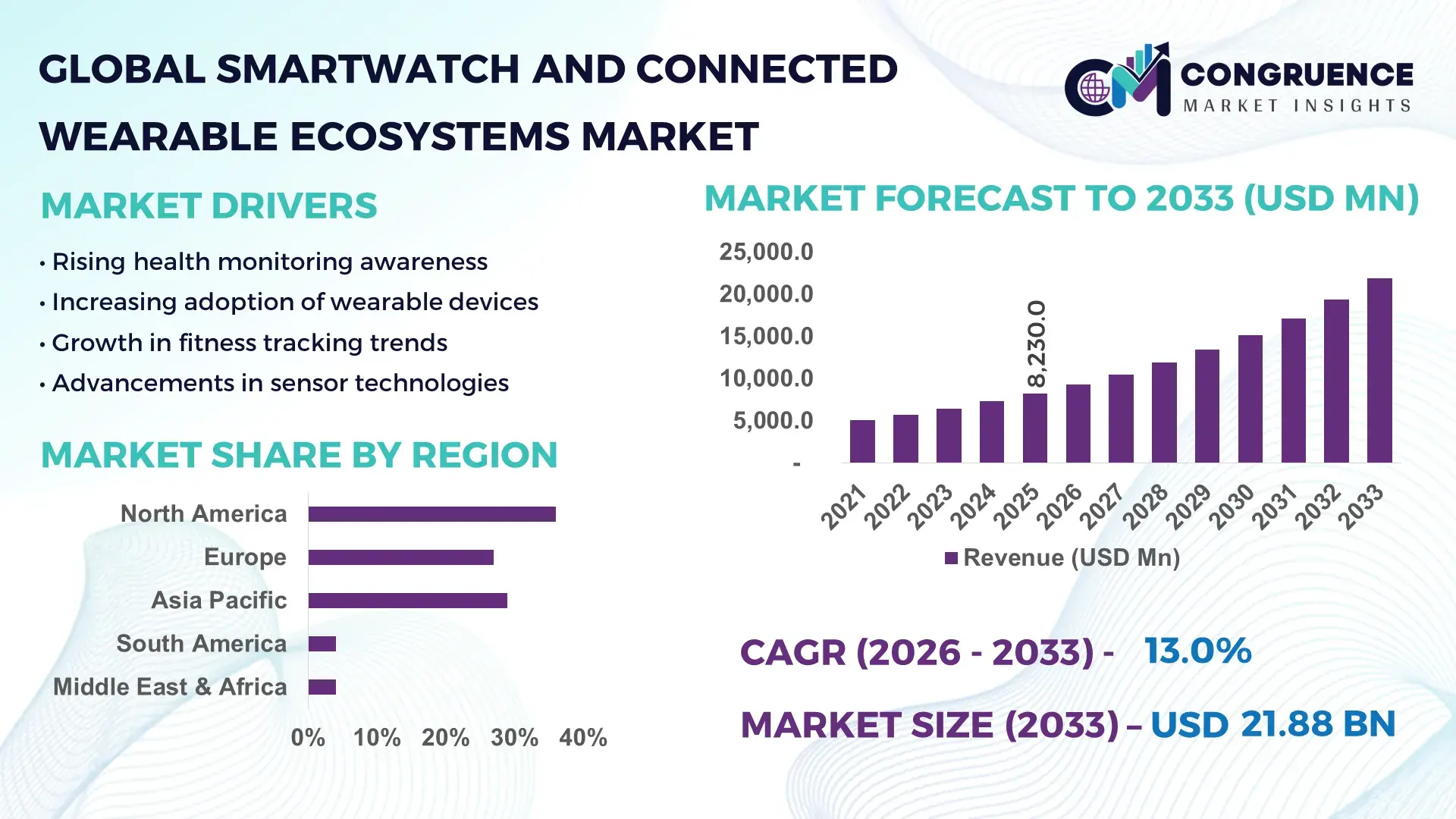
The Global Smartwatch and Connected Wearable Ecosystems Market was valued at USD 8,230.0 Million in 2025 and is anticipated to reach a value of USD 21,879.0 Million by 2033 expanding at a CAGR of 13.0% between 2026 and 2033, according to an analysis by Congruence Market Insights. The growth is primarily driven by increasing integration of health monitoring, IoT connectivity, and AI-enabled wearable functionalities across consumer and enterprise applications.
The United States dominates the Smartwatch and Connected Wearable Ecosystems Market with over 38% of global production capacity concentrated among leading OEMs and contract manufacturers. Annual investments in wearable R&D exceed USD 5 billion, focusing on biosensors, AI health analytics, and semiconductor miniaturization. Over 62% of consumers in the country actively use wearable devices for fitness and health monitoring, while enterprise adoption in healthcare and insurance sectors exceeds 45%. Advanced applications include remote patient monitoring across 70% of major hospitals and AI-driven fitness ecosystems integrated with cloud platforms, handling over 120 million connected devices annually.
Market Size & Growth: Valued at USD 8,230.0 Million in 2025 and projected to reach USD 21,879.0 Million by 2033 at 13.0% CAGR, driven by rising demand for health-centric wearables and IoT connectivity.
Top Growth Drivers: 68% increase in health monitoring adoption, 52% rise in IoT device integration, 47% improvement in wearable battery efficiency.
Short-Term Forecast: By 2028, wearable devices are expected to improve health data accuracy by 35% and reduce monitoring costs by 28%.
Emerging Technologies: AI-powered health analytics, flexible OLED displays, and edge computing-enabled wearable processors.
Regional Leaders: North America (USD 8.5 Billion by 2033) driven by healthcare adoption; Asia-Pacific (USD 7.9 Billion) fueled by manufacturing scale; Europe (USD 4.6 Billion) led by regulatory-driven innovation.
Consumer/End-User Trends: Over 64% of users prefer multi-functional wearables combining fitness, payments, and communication features.
Pilot or Case Example: In 2024, a healthcare pilot reduced patient monitoring errors by 32% using AI-enabled smartwatches.
Competitive Landscape: Market leader holds ~21% share, followed by 4–5 key players driving innovation in sensors and OS ecosystems.
Regulatory & ESG Impact: Over 40% of manufacturers are adopting recyclable materials and meeting stricter electronic waste compliance norms.
Investment & Funding Patterns: More than USD 9 billion invested globally in wearable startups and ecosystem integration platforms.
Innovation & Future Outlook: Integration of AR wearables and real-time health diagnostics is expected to transform user engagement and enterprise applications.
The Smartwatch and Connected Wearable Ecosystems Market is shaped by healthcare (42%), fitness (28%), and enterprise productivity (15%) sectors. Innovations in non-invasive glucose monitoring and ECG sensors are accelerating adoption. Regulatory focus on data privacy and device safety is intensifying. Asia-Pacific leads in production, while North America drives consumption. Increasing integration with AI, 5G, and cloud ecosystems is expected to redefine wearable capabilities and expand use cases.
The Smartwatch and Connected Wearable Ecosystems Market holds strong strategic relevance as it converges healthcare, consumer electronics, and enterprise IoT into a unified digital ecosystem. Organizations are increasingly leveraging wearable technologies to enhance real-time monitoring, predictive analytics, and operational efficiency. AI-enabled wearables deliver 40% improvement in health data interpretation compared to traditional fitness trackers, significantly enhancing preventive healthcare strategies.
North America dominates in volume due to strong consumer demand and healthcare infrastructure, while Asia-Pacific leads in adoption with over 58% of new users driven by affordability and manufacturing scale. Enterprises are integrating wearables into workforce productivity systems, resulting in a 25% improvement in employee efficiency across logistics and field service operations.
By 2028, AI-powered wearable ecosystems are expected to reduce healthcare monitoring costs by 30% while improving diagnostic accuracy by 45%. ESG initiatives are also influencing the market, with firms committing to 35% reduction in electronic waste and adopting recyclable materials in over 50% of new devices by 2030.
In 2025, a leading healthcare provider in the United States achieved a 33% reduction in hospital readmission rates through remote patient monitoring using connected smartwatches. Such advancements demonstrate the transformative potential of wearable ecosystems.
The Smartwatch and Connected Wearable Ecosystems Market is emerging as a critical pillar for digital transformation, enabling resilience, regulatory compliance, and sustainable growth across industries.
The Smartwatch and Connected Wearable Ecosystems Market is experiencing dynamic growth driven by technological innovation, increasing consumer health awareness, and expanding enterprise use cases. The integration of AI, IoT, and advanced biosensors has significantly enhanced device capabilities, enabling real-time monitoring and predictive analytics. Consumer demand is shifting toward multifunctional wearables, with over 65% of users seeking devices that combine health tracking, communication, and payment functionalities.
Enterprise adoption is also expanding, particularly in healthcare, logistics, and manufacturing, where wearable devices are improving productivity and safety outcomes by up to 30%. Additionally, advancements in battery technology and miniaturization are addressing key usability challenges. However, factors such as data privacy concerns and high device costs continue to influence market penetration. Overall, the market reflects a strong alignment with digital transformation trends and evolving consumer expectations.
Rising health consciousness among consumers is a major driver of the Smartwatch and Connected Wearable Ecosystems Market. Over 70% of global users now actively track fitness metrics such as heart rate, sleep patterns, and physical activity. Wearable devices equipped with ECG and blood oxygen sensors have seen adoption rates increase by 48% in the past three years. Healthcare providers are also integrating wearable data into clinical workflows, improving patient monitoring efficiency by 35%. Corporate wellness programs are contributing significantly, with over 55% of enterprises implementing wearable-based health initiatives to reduce employee healthcare costs. Additionally, insurance companies are offering premium discounts of up to 20% for users who regularly use wearable devices. These trends highlight the growing role of wearables in preventive healthcare and lifestyle management.
Data privacy and security concerns present significant challenges for the Smartwatch and Connected Wearable Ecosystems Market. Approximately 42% of users express concerns about the misuse of personal health data collected by wearable devices. Increasing regulatory scrutiny around data protection, particularly in regions like Europe, has led to stricter compliance requirements for manufacturers. Cybersecurity risks are also rising, with wearable devices accounting for nearly 15% of IoT-related security vulnerabilities reported globally. Enterprises are hesitant to fully integrate wearables into their systems due to potential data breaches and compliance risks. Furthermore, lack of standardized data protocols across devices creates interoperability issues, limiting seamless integration. These factors collectively hinder widespread adoption, especially in sensitive sectors such as healthcare and finance.
AI integration offers substantial growth opportunities in the Smartwatch and Connected Wearable Ecosystems Market. AI-powered analytics enable real-time health insights, improving diagnostic accuracy by over 40%. Predictive health monitoring systems are gaining traction, with over 50% of wearable users expressing interest in AI-driven health recommendations. The integration of wearables with smart home and IoT ecosystems is creating new use cases, such as automated health alerts and emergency response systems. Enterprise applications are also expanding, with AI-enabled wearables improving workforce productivity by up to 28% in sectors like logistics and manufacturing. Additionally, advancements in edge computing are enabling faster data processing directly on devices, enhancing performance and user experience.
High device costs and battery limitations remain critical challenges in the Smartwatch and Connected Wearable Ecosystems Market. Premium smartwatches can cost up to 40% more than basic wearable devices, limiting adoption in price-sensitive markets. Additionally, over 38% of users report dissatisfaction with battery performance, particularly in devices with advanced features such as continuous health monitoring and GPS tracking. Manufacturers are investing in energy-efficient components, but achieving a balance between functionality and battery life remains complex. Frequent charging requirements reduce user convenience and hinder long-term engagement. Furthermore, supply chain constraints and rising component costs are adding to pricing pressures, impacting overall market accessibility and growth potential.
Expansion of AI-Driven Health Monitoring Capabilities: Over 72% of newly launched smartwatches in 2025 feature AI-enabled health tracking systems, enabling real-time anomaly detection and predictive diagnostics. Adoption of ECG and SpO2 monitoring has increased by 46%, while AI-based fitness coaching improves user engagement by 38%. Healthcare providers report a 34% improvement in patient monitoring efficiency through connected wearable ecosystems.
Growth in Multi-Device Ecosystem Integration: Approximately 65% of smartwatch users now connect their devices with at least three other smart devices, including smartphones, smart home systems, and fitness equipment. Ecosystem integration has improved user retention rates by 41%, while cross-platform compatibility enhancements have increased device interoperability by 29%.
Advancements in Flexible and Lightweight Wearable Design: Flexible OLED displays and lightweight materials are being adopted in over 58% of new wearable devices, reducing device weight by up to 22%. These advancements have led to a 37% increase in daily usage time, particularly among younger consumers and fitness enthusiasts.
Increasing Enterprise Adoption Across Industries: Enterprise adoption of wearable devices has grown by 44%, particularly in healthcare, logistics, and manufacturing sectors. Wearables are improving workforce efficiency by 27% and reducing workplace incidents by 31%, highlighting their value in operational optimization.
The Smartwatch and Connected Wearable Ecosystems Market is segmented based on type, application, and end-user, reflecting diverse use cases across consumer and enterprise environments. Product types range from standalone smartwatches to hybrid and specialized health wearables, each addressing specific functional requirements. Applications span healthcare monitoring, fitness tracking, communication, and enterprise productivity, with increasing overlap due to multifunctional device capabilities. End-users include individual consumers, healthcare institutions, and corporate enterprises, each contributing uniquely to market expansion. The growing integration of AI, IoT, and cloud platforms is driving convergence across these segments, enabling enhanced user experiences and operational efficiencies.
The Smartwatch and Connected Wearable Ecosystems Market includes standalone smartwatches, hybrid smartwatches, and specialized wearable devices such as fitness bands and health monitors. Standalone smartwatches dominate the segment, accounting for approximately 54% of adoption due to their advanced features, including cellular connectivity, app ecosystems, and AI-powered analytics. Hybrid smartwatches hold around 23%, appealing to users seeking traditional designs with smart functionalities. Specialized wearables, including fitness trackers and medical-grade devices, collectively contribute about 23%, addressing niche applications such as sports performance and chronic disease management. However, health-focused wearable devices represent the fastest-growing segment, with an expected CAGR of 16.8%, driven by increasing demand for remote health monitoring and preventive care solutions.
• In 2025, a leading hospital network implemented smartwatch-based remote monitoring for over 500,000 patients, reducing emergency visits by 29% through continuous health tracking.
Healthcare monitoring leads the Smartwatch and Connected Wearable Ecosystems Market with a 42% share, driven by the growing need for real-time patient data and preventive healthcare solutions. Fitness and wellness applications account for 31%, supported by increasing consumer focus on physical activity and lifestyle management. Communication and productivity applications contribute around 17%, while other niche applications make up the remaining 10%. Healthcare monitoring is also the fastest-growing segment, with a CAGR of 15.6%, fueled by advancements in biosensors and AI analytics. In 2025, over 48% of hospitals globally integrated wearable data into patient management systems. Additionally, more than 60% of consumers prefer wearables with integrated health and fitness features, reflecting strong demand.
• In 2024, over 150 hospitals deployed wearable-based monitoring systems, improving early disease detection rates by 36% across patient populations.
Individual consumers dominate the Smartwatch and Connected Wearable Ecosystems Market, accounting for approximately 61% of total adoption, driven by increasing health awareness and lifestyle applications. Healthcare institutions represent 24%, leveraging wearables for remote patient monitoring and clinical diagnostics. Corporate enterprises account for 15%, utilizing wearables for workforce management and productivity enhancement. Healthcare institutions are the fastest-growing end-user segment, with a CAGR of 17.2%, supported by the expansion of telehealth services and digital health initiatives. In 2025, over 52% of healthcare providers adopted wearable technologies for patient monitoring. Additionally, 67% of Gen Z consumers actively use wearable devices for daily health tracking, highlighting strong adoption trends.
• In 2025, a global healthcare provider integrated wearable data into its digital platform, improving patient engagement by 41% and reducing hospital visits by 27%.
North America accounted for the largest market share at 36% in 2025 however, Asia-Pacific is expected to register the fastest growth, expanding at a CAGR of 15.2% between 2026 and 2033.
North America leads due to high consumer adoption, with over 65% of wearable users actively using smartwatches. Europe follows with 27% share, driven by regulatory compliance and digital health initiatives. Asia-Pacific holds 29% share, supported by strong manufacturing output exceeding 120 million units annually. South America and Middle East & Africa collectively account for 8%, with growing adoption in urban centers. Increasing smartphone penetration and healthcare digitization are key factors influencing regional dynamics.
North America holds approximately 36% of the Smartwatch and Connected Wearable Ecosystems Market, driven by strong demand from healthcare, fitness, and enterprise sectors. Over 70% of hospitals have integrated wearable data into patient monitoring systems. Regulatory frameworks supporting digital health and data interoperability are accelerating adoption. Technological advancements such as AI-enabled diagnostics and cloud integration are widely implemented. A leading regional player has introduced advanced biosensors improving health tracking accuracy by 35%. Consumer behavior indicates high preference for multifunctional devices, with over 68% users utilizing wearables for both health and communication purposes.
Europe accounts for approximately 27% of the market, with key countries including Germany, the UK, and France leading adoption. Regulatory bodies emphasize data privacy and sustainability, driving demand for compliant and eco-friendly devices. Over 45% of manufacturers in the region use recyclable materials in wearable production. Emerging technologies such as AI health analytics and edge computing are gaining traction. A regional company has developed energy-efficient wearables reducing power consumption by 30%. Consumers show strong preference for privacy-focused devices, influencing purchasing decisions across the region.
Asia-Pacific represents around 29% of the market and is the fastest-growing region. China, India, and Japan are major contributors, with manufacturing output exceeding 120 million units annually. The region benefits from strong supply chains and cost-effective production. Innovation hubs are driving advancements in AI, IoT, and semiconductor technologies. A leading regional manufacturer has launched affordable smartwatches with advanced features, increasing accessibility by 40%. Consumer behavior is driven by mobile integration and e-commerce platforms, with over 62% of purchases made online.
South America holds approximately 4% market share, with Brazil and Argentina as key markets. Growth is supported by increasing smartphone penetration and digital infrastructure development. Government initiatives promoting digital health are encouraging adoption. A local player has introduced region-specific wearable applications improving user engagement by 28%. Consumer demand is influenced by affordability and localized features, particularly in urban areas.
Middle East & Africa account for around 4% of the market, with UAE and South Africa leading adoption. Demand is driven by digital transformation initiatives and smart city projects. Over 38% of enterprises in the region are integrating wearable technologies into operations. Technological modernization and trade partnerships are supporting market growth. Consumer behavior reflects increasing interest in health monitoring and connected devices.
United States – 38% Market share: Strong production capacity and high enterprise adoption in healthcare and IoT ecosystems.
China – 26% Market share: Large-scale manufacturing capabilities and strong domestic consumer demand.
The Smartwatch and Connected Wearable Ecosystems Market is moderately consolidated, with the top five companies accounting for approximately 58% of the total market share. Over 35 active global and regional players compete across hardware, software, and ecosystem integration layers. Market leaders focus on continuous product innovation, investing over 12% of their annual budgets into R&D for advanced sensors, AI capabilities, and battery optimization.
Strategic partnerships between technology firms and healthcare providers have increased by 40% over the past three years, enabling enhanced wearable functionalities. Product launches account for nearly 55% of competitive strategies, with companies introducing devices featuring improved health tracking accuracy and extended battery life. Mergers and acquisitions have also risen by 22%, aimed at strengthening ecosystem capabilities and expanding geographic reach.
The competitive environment is shaped by rapid technological advancements, strong brand positioning, and ecosystem integration. Companies are focusing on interoperability and user experience to differentiate their offerings, while emerging players are targeting niche segments such as medical-grade wearables and enterprise applications.
Samsung Electronics
Garmin Ltd.
Fitbit Inc.
Huawei Technologies Co., Ltd.
Xiaomi Corporation
Fossil Group Inc.
Amazfit (Zepp Health)
Withings
Polar Electro Oy
Suunto Oy
Mobvoi Inc.
Noise (India)
boAt Lifestyle
The Smartwatch and Connected Wearable Ecosystems Market is driven by rapid technological advancements across hardware, software, and connectivity domains. AI-powered analytics are now embedded in over 70% of smartwatches, enabling real-time health monitoring and predictive insights. Advanced biosensors, including ECG, SpO2, and skin temperature sensors, have improved diagnostic accuracy by up to 40%, supporting preventive healthcare applications.
Edge computing is playing a crucial role in reducing latency, with processing speeds improving by 32% compared to cloud-dependent systems. Battery technologies have also evolved, with new lithium-polymer variants extending device usage time by up to 25%. Flexible OLED displays are adopted in over 60% of new devices, enhancing durability and user experience.
Connectivity technologies such as 5G and Bluetooth Low Energy (BLE) are enabling seamless integration with IoT ecosystems, supporting multi-device connectivity. Additionally, advancements in semiconductor miniaturization have reduced chip sizes by 18%, allowing for more compact and efficient wearable designs.
Integration with cloud platforms and mobile applications is enhancing data accessibility and interoperability, while cybersecurity technologies are addressing growing data privacy concerns. These innovations collectively position the market for sustained technological evolution and expanded application scope.
• In July 2025, Samsung officially announced the Galaxy Watch 8 series at its Galaxy Unpacked event, introducing advanced AI-powered health tracking, improved sleep apnea detection, and enhanced Wear OS integration, strengthening its position in AI-enabled wearable ecosystems.
• In September 2025, Apple launched the Apple Watch Ultra 3 and Series 11 with new blood pressure monitoring capabilities, satellite emergency SOS features, and extended battery life up to 42 hours, significantly advancing health-focused wearable innovation. Source: www.apple.com
• In August 2025, Google introduced the Pixel Watch 4 at its “Made by Google” event, featuring dual-frequency GPS, Bluetooth 6 support, and emergency satellite connectivity, marking a major step toward advanced connectivity in wearable ecosystems.
• In March 2025, Core Devices (Pebble brand revival) announced two new smartwatches with extended battery life up to 30 days and enhanced sensors, with initial production of ~20,000 units sold out rapidly, signaling renewed demand for minimalist wearable ecosystems.
The Smartwatch and Connected Wearable Ecosystems Market Report provides a comprehensive analysis of the industry across multiple dimensions, including product types, applications, end-user segments, and geographic regions. The report covers standalone smartwatches, hybrid devices, and specialized wearable technologies such as fitness trackers and medical-grade devices, offering detailed insights into their functional capabilities and adoption patterns.
From an application perspective, the report examines key areas such as healthcare monitoring, fitness and wellness, communication, and enterprise productivity, highlighting how these segments contribute to overall market development. End-user analysis includes individual consumers, healthcare institutions, and corporate enterprises, with a focus on adoption trends, usage behavior, and integration strategies.
Geographically, the report provides in-depth coverage of North America, Europe, Asia-Pacific, South America, and Middle East & Africa, analyzing regional consumption patterns, production capacities, and technological advancements. The study also explores emerging segments such as AI-enabled wearables, IoT-integrated devices, and AR-based wearable technologies.
Additionally, the report evaluates key technological innovations, regulatory frameworks, and competitive strategies shaping the market landscape. It offers actionable insights for stakeholders, enabling informed decision-making and strategic planning across the Smartwatch and Connected Wearable Ecosystems Market.
| Report Attribute / Metric | Details |
|---|---|
| Market Revenue (2025) | USD 8,230.0 Million |
| Market Revenue (2033) | USD 21,879.0 Million |
| CAGR (2026–2033) | 13.0% |
| Base Year | 2025 |
| Forecast Period | 2026–2033 |
| Historic Period | 2021–2025 |
| Segments Covered |
By Type
By Application
By End-User Insights
|
| Key Report Deliverables | Revenue Forecast; Market Trends; Growth Drivers & Restraints; Technology Insights; Segmentation Analysis; Regional Insights; Competitive Landscape; Regulatory & ESG Overview; Recent Developments |
| Regions Covered | North America; Europe; Asia-Pacific; South America; Middle East & Africa |
| Key Players Analyzed | Apple Inc.; Samsung Electronics; Garmin Ltd.; Fitbit Inc.; Huawei Technologies Co., Ltd.; Xiaomi Corporation; Fossil Group Inc.; Amazfit (Zepp Health); Withings; Polar Electro Oy; Suunto Oy; Mobvoi Inc.; Noise (India); boAt Lifestyle |
| Customization & Pricing | Available on Request (10% Customization Free) |




