
Reports
The Global Smart Toys Market was valued at USD 14,035.6 Million in 2025 and is anticipated to reach a value of USD 32,579.4 Million by 2033 expanding at a CAGR of 11.1% between 2026 and 2033. Growth is driven by AI-enabled interactive toys, connected learning platforms, voice recognition, app-linked play, and rising demand for personalized educational experiences.
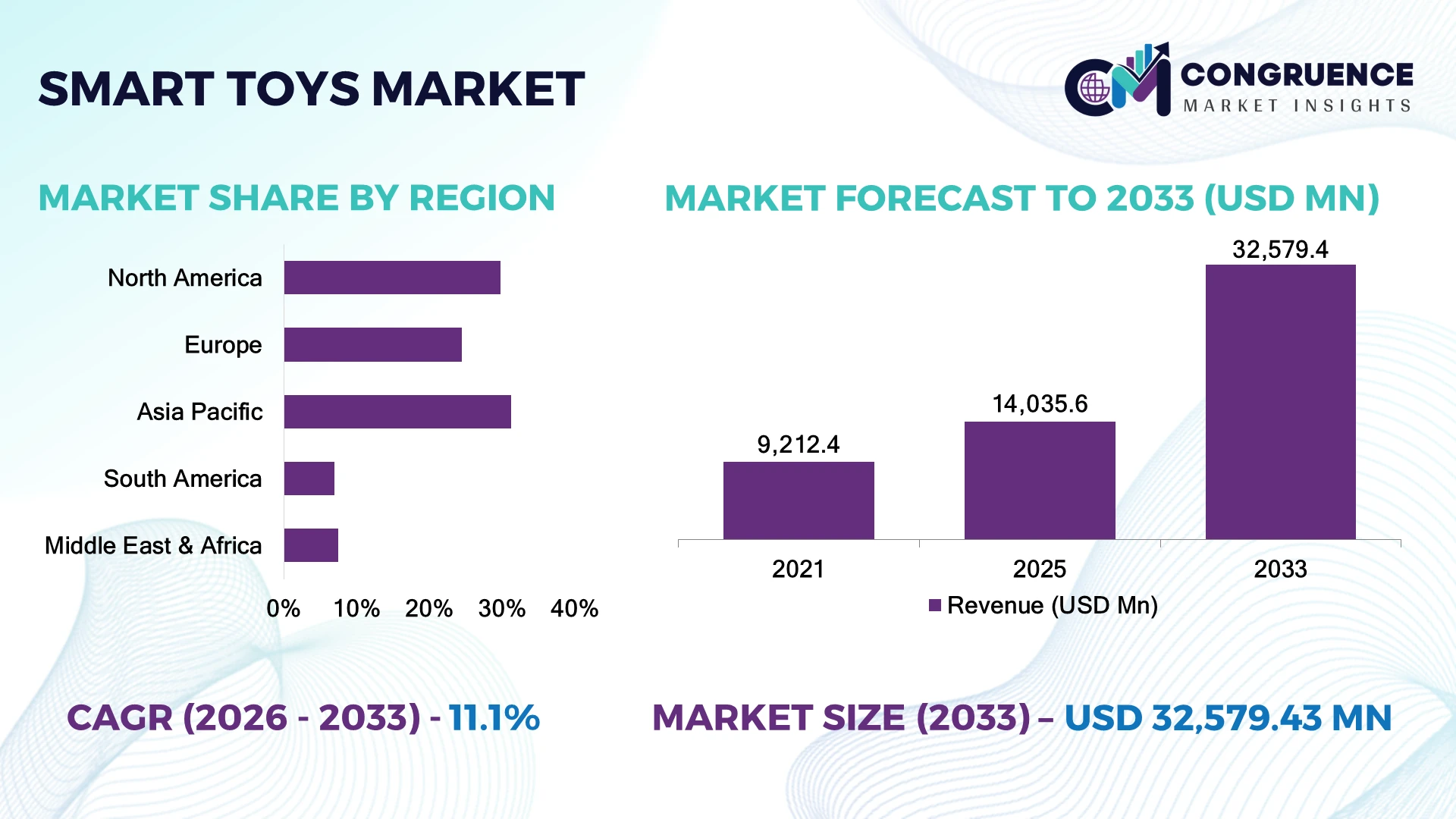
The United States represents an estimated 25–28% of global smart-toy demand, supported by high household connectivity, established toy brands, and strong adoption of app-enabled products. China contributes roughly 18–22%, benefiting from electronics manufacturing depth and rapid integration of AI hardware. Japan and South Korea maintain stronger robotics and embedded-interaction capabilities, while U.S. connected-toy adoption is approximately 15–20% higher than in many emerging markets. Geopolitical supply-chain diversification in 2026 is accelerating sourcing beyond China.
Strategically, manufacturers should prioritize AI-enabled products, cybersecurity, localized supply chains, and recurring digital-service ecosystems.
Market Size & Growth: USD 14.04 billion in 2025 to USD 32.58 billion by 2033 at 11.1% CAGR, driven by AI-enabled interactive learning and connected play.
Top Growth Drivers: AI interaction 28%, educational functionality 24%, app-connected play 19%.
Short-Term Forecast: By 2028, automated personalization can improve engagement metrics 15–25%, while cloud-connected content can reduce manual content updates 30–40%.
Emerging Technologies: Generative AI, computer vision, speech recognition, robotics, and adaptive learning engines are reshaping premium smart-toy platforms.
Regional Leaders: North America, Asia-Pacific, and Europe are projected to reach approximately USD 8.6 billion, USD 11.4 billion, and USD 7.8 billion by 2033, respectively.
Consumer/End-User Trends: Educational smart toys account for roughly 35–40% of demand, with parents increasingly prioritizing STEM, language, and adaptive-learning functions.
Pilot/Case Example: AI-enabled conversational toys introduced during 2025–2026 increasingly support personalized responses, with interactive content libraries expanding by more than 20% annually.
Competitive Landscape: LEGO, Mattel, Hasbro, Spin Master, and VTech lead major branded segments, while AI-native startups compete through software personalization and rapid feature deployment.
Regulatory & ESG Impact: Connected products increasingly require stronger privacy and child-safety controls, while recyclable packaging initiatives target 20–30% reductions in packaging material.
Investment & Funding: More than USD 1 billion is being directed across smart-toy platforms, AI-enabled consumer products, robotics, and connected-play ecosystems, strengthening software-hardware integration.
Innovation & Future Outlook: AI companions, emotion-aware interaction, robotics, modular hardware, and subscription content are shifting smart toys from standalone products toward continuously updated digital ecosystems.
The Smart Toys Market is moving beyond electronic novelty products toward AI-assisted learning, interactive robotics, and connected play ecosystems. Educational toys, programmable robotics, and voice-enabled products are leading demand, while AI personalization can improve engagement by approximately 15–25%. In 2026, child-data privacy requirements and semiconductor supply-chain diversification are pushing manufacturers toward stronger embedded security and multi-source component strategies, creating a clear transition toward safer, software-integrated smart toys.
The Smart Toys Market is becoming strategically important because toy manufacturers are shifting from one-time hardware sales toward connected products combining physical play, AI, educational content, and recurring software engagement. Product differentiation increasingly depends on interaction quality, personalization, safety architecture, and content ecosystems rather than hardware novelty alone. In 2026, tighter scrutiny of children's connected-device privacy is also influencing product architecture and data-management decisions.
AI-enabled toys can process conversational and behavioral inputs substantially faster than traditional rule-based interactive systems, while cloud-linked platforms enable content updates without hardware replacement. North America leads premium connected-toy commercialization, whereas Asia-Pacific combines manufacturing scale with rapid robotics and electronics integration. This regional contrast is encouraging global brands to diversify both development and production footprints.
During 2026–2028, manufacturers are prioritizing conversational AI, adaptive learning, computer vision, and modular robotics. A practical deployment model is the connected educational toy that receives software updates and new learning activities after purchase, extending product relevance beyond the initial hardware cycle. Companies are therefore forming AI partnerships, expanding proprietary content libraries, and integrating stronger privacy controls. Competitive advantage will increasingly come from combining safe AI, compelling physical interaction, scalable content, and resilient electronics supply chains.
AI-enabled interaction is becoming the strongest product-level differentiator in smart toys, with conversational, adaptive-learning, and voice-response features incorporated into an estimated 25–30% of newly launched premium connected products. Educational functionality represents roughly 35–40% of demand, while app-linked experiences account for approximately 20–25%. In the United States, parents increasingly expect toys to combine physical play with personalized digital content. Generative AI is accelerating this transition by enabling dynamic responses rather than fixed scripts. Manufacturers are responding through AI partnerships, proprietary content development, and embedded voice-processing capabilities. The non-obvious advantage is longer product relevance: software updates can extend engagement without redesigning physical hardware, improving lifetime economics and creating recurring content opportunities.
Connected toys face increasing compliance requirements around children's data, voice recordings, location information, and parental controls. Privacy and security architecture can add approximately 10–20% to development costs, while secure firmware, authentication, and parental-consent workflows can increase engineering requirements by 15–25%. U.S. and European regulatory scrutiny is forcing manufacturers to minimize data collection and strengthen local processing. At the same time, semiconductor and connectivity components remain exposed to supply-chain volatility, with component substitution potentially adding 5–10% to bill-of-material costs for smaller manufacturers. Companies are reducing exposure through multi-source procurement, regional assembly, edge processing, and standardized connectivity modules. The strategic constraint is that inexpensive hardware becomes commercially difficult when compliance, cybersecurity, and post-launch software support are included in the total product cost.
Adaptive learning platforms create an opportunity to convert smart toys into continuously updated educational ecosystems. AI-generated content can increase personalized interaction frequency by approximately 20–30%, while connected content libraries can reduce manual product-content updates by 30–40%. India, Southeast Asia, and Latin America remain attractive because smartphone connectivity enables app-linked toys without requiring sophisticated standalone infrastructure. Modular robotics also creates a non-obvious opportunity: manufacturers can sell accessory modules and software upgrades instead of replacing the complete toy. Companies are investing in learning engines, subscription content, language localization, and partnerships with education platforms. Between 2026 and 2028, manufacturers integrating physical play, adaptive learning, and localized digital content will gain stronger customer retention and higher utilization from existing hardware platforms.
Smart-toy development increasingly requires coordinated hardware, firmware, AI models, mobile applications, cloud services, and parental-control interfaces. Integration defects can increase testing cycles by 15–25%, while connectivity-related support incidents can add 5–10% to post-sale service workload. Chinese manufacturers benefit from electronics scale, but global brands must maintain compatibility across multiple operating systems, connectivity standards, and privacy regimes. AI-enabled products also require continuous model monitoring, content moderation, and firmware updates after launch, creating a sustained engineering burden rather than a one-time development task. Companies must therefore establish cross-functional development teams, automated testing, secure over-the-air update infrastructure, and long-term software support. The critical competitive issue is lifecycle execution: a compelling launch product loses value quickly when connectivity, safety, or content quality deteriorates after purchase.
AI Companion Features Mature: Conversational and adaptive-response capabilities are moving from novelty features into premium smart-toy portfolios. Approximately 25–30% of newer connected products now incorporate meaningful AI interaction, while personalized responses can increase engagement frequency by 15–25%. Manufacturers are shifting toward hybrid edge-cloud architectures to reduce latency, improve privacy, and limit continuous data transmission. This transition is particularly relevant for voice-enabled toys used inside homes.
Privacy Architecture Moves Upstream: Child-data protection is increasingly designed into product architecture rather than added during certification. Local processing can reduce unnecessary cloud data transmission by 20–40%, while stronger parental-control systems can increase software development requirements by 10–15%. U.S. and European regulatory scrutiny is pushing brands toward minimal-data designs, encrypted communications, clearer consent interfaces, and shorter retention periods.
Modular Robotics Gains Traction: Programmable robotics platforms are increasingly designed around interchangeable sensors, motors, coding modules, and accessories. Modular architectures can extend hardware utilization by 20–30% compared with single-purpose products and reduce replacement requirements by 10–15%. Manufacturers are responding with accessory ecosystems and software libraries, shifting purchasing behavior from one-time toy acquisition toward expandable product platforms.
Localized Content Becomes Essential: Smart-toy companies are expanding language packs, educational content, and culturally relevant interaction models to support country-specific adoption. Localization can increase usable content coverage by 20–30%, particularly across multilingual markets such as India. Supply-chain diversification is simultaneously encouraging regional assembly and component sourcing, reducing dependence on single-country production while allowing faster customization for local retail and education channels.
AI-enabled smart toys represent approximately 30–34% of global smart-toy demand, supported by conversational interfaces, adaptive learning, computer vision, and personalized content. Connected interactive toys account for roughly 27–31%, benefiting from established app ecosystems and relatively lower hardware complexity. Robotic toys contribute about 20–24%, while AR/VR-enabled and other advanced formats represent approximately 15–19%. AI-enabled products are the fastest-shifting category as manufacturers move beyond scripted responses toward dynamic interaction and individualized learning.
Robotic formats remain commercially important because they combine physical manipulation with coding and STEM learning, while connected toys retain scale through lower entry prices and broad smartphone compatibility. AI integration is increasing product-development costs, but software updates can extend product relevance and improve engagement by approximately 15–25%. Companies are therefore prioritizing proprietary AI models, cloud content platforms, modular hardware, and strategic technology partnerships. Investment is shifting toward products capable of receiving software upgrades rather than fixed-function electronic toys.
Our analysis estimates AI- and IoT-integrated smart toys within educational toys at an 11.43% growth rate through 2031, making them the fastest-growing technology tier, while traditional non-electronic toys retained 56.11% share in 2025.
Educational and learning applications account for approximately 38–42% of smart-toy demand, supported by coding, STEM, language, mathematics, and adaptive-learning functions. Entertainment and interactive play represents around 30–34%, while social-emotional development and skill-building applications contribute approximately 16–20% and 8–12%, respectively. Educational use remains the largest application because parents increasingly evaluate smart toys on measurable developmental value rather than connectivity alone. Social-emotional and adaptive-learning applications are shifting faster as AI enables conversational feedback and individualized interaction.
School-linked and home-learning applications are increasingly converging, creating opportunities for products that support both classroom activities and parental engagement. India provides a strong example, with coding and STEM toys representing 31.93% of the country's tech-toy market in 2024. Manufacturers are responding through curriculum-aligned content, teacher dashboards, multilingual interfaces, and app-connected learning ecosystems. The commercial implication is clear: products that combine physical interaction with structured learning content have stronger institutional and household use cases than entertainment-only connected toys.
India's 2026 Bharat Survey for EdTech covered 12,500 households and 2,500 teachers across 10 states, demonstrating the scale of technology-enabled learning environments available for education-focused smart-toy deployment.
Households represent approximately 68–72% of smart-toy demand, reflecting direct parental purchasing and the expansion of connected learning into home environments. Schools and educational institutions account for roughly 15–19%, while daycare, therapy, and specialist learning centers contribute approximately 8–12%. Household demand remains structurally dominant because parents control product selection and increasingly seek toys combining entertainment with cognitive development. Institutional buyers, however, are the fastest-shifting group as robotics, coding, and AI-enabled learning tools become more closely aligned with STEM curricula.
Schools typically prioritize durability, curriculum relevance, teacher controls, and measurable learning outcomes, whereas households emphasize ease of use, safety, personalization, and price. Institutional deployments can involve 20–30% larger initial purchases per location than household transactions, creating attractive volume opportunities for manufacturers. Companies are therefore developing classroom bundles, educator dashboards, bulk pricing, training programs, and school partnerships. The strategic shift is toward dual-purpose products that can move between household and institutional environments without major hardware changes.
A 2026 Central Square Foundation survey covering 12,500 households and 2,500 teachers found that technology access and use for teaching and learning are now measurable across government and affordable private-school communities in 10 Indian states.
North America accounted for the largest market share at 29.8% in 2025 however, Asia-Pacific is expected to register the fastest growth, expanding at a CAGR of 12.4% between 2026 and 2033.
AI-enabled play and connected learning reshape premium toy portfolios
North America represents approximately 29.8% of the global Smart Toys Market, supported by high household connectivity, strong spending on educational products, and established technology-enabled toy ecosystems. The United States contributes more than 85% of regional demand, with California, New York, Texas, and major metropolitan markets concentrating technology-oriented consumer spending. Educational and learning-oriented smart toys account for approximately 38–42% of regional demand, while AI-enabled interaction is increasingly concentrated in premium products. Connected platforms can increase content engagement by approximately 15–25% through software updates and personalized activities. Major manufacturers are expanding AI partnerships, strengthening parental controls, and integrating mobile applications with physical products. The region's mature e-commerce infrastructure also supports rapid product launches, direct-to-consumer testing, and subscription-based digital content models.
United States Market Outlook: The United States remains the principal North American market because of its large addressable consumer base, advanced smartphone ecosystem, and strong concentration of global toy and technology companies. AI-enabled learning, coding, robotics, and voice-interactive products are gaining shelf space alongside conventional toys. More than 70% of U.S. households have children using internet-connected devices, creating a mature infrastructure base for app-linked smart toys.
Child-safety regulation drives privacy-first connected toy design
Europe represents approximately 24–25% of global Smart Toys demand, with Germany, the United Kingdom, France, Italy, and Spain forming major consumption centers. European buyers place greater emphasis on child safety, privacy, educational value, and sustainable materials, influencing product architecture and procurement. Connected toys increasingly incorporate parental dashboards, limited-data processing, and stronger authentication. Germany and the United Kingdom lead premium educational and technology-enabled toy adoption, while Nordic markets demonstrate stronger sustainability positioning. Manufacturers are adapting product development to stricter digital-safety expectations, recyclable packaging, and transparent data practices. AI-enabled products can increase interactive engagement by approximately 15–25%, but companies increasingly favor edge processing to reduce unnecessary data transmission and compliance exposure.
Germany Market Outlook: Germany is a strategically important European market because of its strong educational culture, advanced retail infrastructure, and established manufacturing ecosystem. STEM, coding, robotics, and language-learning products have strong institutional relevance. Manufacturers increasingly emphasize durable construction and privacy-compliant software, while premium retailers favor connected products offering measurable educational functionality. German distribution infrastructure also supports efficient access to neighboring European markets.
Manufacturing scale and AI integration accelerate connected-toy deployment
Asia-Pacific represents approximately 31–32% of global Smart Toys demand and combines China's electronics manufacturing strength with rapidly expanding consumer adoption in India, Japan, South Korea, and Southeast Asia. China contributes roughly 45% of regional demand and remains the dominant production base for connected toy hardware, sensors, microcontrollers, and embedded electronics. India is experiencing faster adoption of coding, STEM, and app-linked educational toys as digital learning infrastructure expands. Regional manufacturers increasingly combine robotics, speech recognition, computer vision, and mobile applications within compact products. AI-enabled functionality can improve engagement by approximately 15–25%, while modular electronics reduce redesign requirements for product updates. Companies are also diversifying component sourcing as 2026 supply-chain strategies reduce dependence on single-country electronics production.
China Market Outlook: China combines the region's largest smart-toy consumer base with extensive electronics manufacturing and component availability. Shenzhen, Guangdong, and the Yangtze River Delta provide dense supplier ecosystems for sensors, processors, connectivity modules, motors, and batteries. Domestic brands can therefore shorten hardware development cycles and introduce AI-enabled product iterations rapidly. China also remains strategically important for export-oriented smart-toy manufacturing serving global markets.
Digital learning adoption strengthens demand for connected educational toys
South America accounts for approximately 7% of global Smart Toys demand, with Brazil representing nearly 60% of regional consumption. São Paulo, Rio de Janeiro, Paraná, and Minas Gerais concentrate major retail, technology, education, and distribution activity. Educational smart toys represent the strongest commercial niche as families and schools increasingly combine physical learning products with digital content. Coding and STEM products are gaining traction among urban consumers, while smartphone connectivity supports app-linked toys without requiring sophisticated standalone infrastructure. AI-enabled interaction remains concentrated in higher-priced products, creating a meaningful price gap between premium imported devices and locally distributed educational toys. Manufacturers are responding through localized content, Portuguese-language interfaces, distributor partnerships, and lower-cost connected platforms designed for broader household affordability.
Brazil Market Outlook: Brazil is the region's largest smart-toy market, supported by its extensive retail network, expanding educational-technology ecosystem, and concentration of technology-oriented consumers in major metropolitan areas. São Paulo provides the strongest commercial base for premium connected toys and educational products. Manufacturers increasingly prioritize Portuguese-language content, Android-compatible applications, and distributor partnerships to reduce adoption barriers and improve nationwide availability.
Digital education investment expands premium connected-play ecosystems
Middle East & Africa represents approximately 7.5% of global Smart Toys demand, with Saudi Arabia, the UAE, South Africa, Turkey, and Israel serving as important commercial centers. Gulf markets are developing premium education and technology ecosystems through investment in smart schools, robotics programs, and digital learning infrastructure. Saudi Arabia and the UAE together account for more than 45% of regional demand, with affluent households supporting higher-value robotics, coding, and AI-enabled products. Retailers are expanding technology-focused children's categories, while manufacturers are strengthening Arabic-language interfaces and localized educational content. Connected products with parental controls and secure data handling are gaining relevance as digital-learning adoption increases. Companies are using regional distributors, education partnerships, and localized content development to establish market presence.
Saudi Arabia Market Outlook: Saudi Arabia is the region's strategically significant smart-toy market because of strong household purchasing power, education-technology investment, and national digital-transformation initiatives. Riyadh and Jeddah concentrate premium retail and educational technology deployment. Robotics, coding, and AI-enabled learning products are particularly relevant to STEM-oriented initiatives, while Arabic-language interfaces and localized content provide an important differentiation opportunity for international manufacturers.
LEGO, Mattel, Hasbro, VTech, and Spin Master compete as global brand leaders, while regional electronics manufacturers and AI-native startups challenge them on cost, customization, and development speed. The top five players collectively account for an estimated 35–40% of global smart-toy sales, leaving substantial room for specialized platforms. Competition centers on AI capability, educational content, safety, supply-chain resilience, and ecosystem integration. AI-enabled features can lift engagement 15–25%, while modular designs reduce hardware replacement requirements by 10–15%. LEGO is integrating interactive hardware into its building ecosystem; Hasbro is partnering with AI specialists; VTech emphasizes educational platforms; Mattel leverages entertainment IP; Spin Master combines connected play with proprietary brands. The competitive shift is moving from electronic functionality toward software-defined experiences, proprietary content, and secure personalization. Entry barriers include child-safety compliance, AI development, content licensing, retail access, and component sourcing. Winning requires trusted IP, safe AI, scalable hardware, continuous content, and efficient global distribution.
LEGO Group
Mattel, Inc.
Hasbro, Inc.
VTech Holdings Limited
Spin Master Corp.
Ravensburger AG
MGA Entertainment, Inc.
Sphero, Inc.
WowWee Group Limited
Makeblock Co., Ltd.
Anki, Inc.
Silverlit Toys Manufactory Ltd.
Clementoni S.p.A.
Goliath B.V.
Current smart-toy technology is centered on voice recognition, Bluetooth or Wi-Fi connectivity, app integration, embedded sensors, and interactive LEDs or motors. These features typically appear in 25–35% of premium connected products, enabling remote content updates and personalized play. Edge processing is gaining importance because it reduces cloud data transmission by roughly 20–40%, improving response speed and privacy for child-focused products.
Emerging platforms combine generative AI, computer vision, adaptive-learning engines, and modular robotics. AI-assisted interaction can increase engagement frequency by approximately 15–25%, while modular hardware can extend product utilization by 20–30% through accessory upgrades. Connected learning dashboards also enable parents and educators to monitor progress, shifting smart toys from standalone electronics toward continuously updated learning ecosystems.
During 2026–2028, screen-free interactive hardware, secure edge AI, emotion-aware responses, and over-the-air software updates will define premium differentiation. Compared with fixed-script toys, adaptive AI can improve interaction variety by approximately 30–50%. LEGO benefits from integrated physical ecosystems, while Hasbro, VTech, Mattel, and robotics specialists gain through AI partnerships and proprietary content. Manufacturers investing now in secure processors, modular architectures, localized language models, and automated testing will shorten update cycles, reduce support costs, and protect product relevance as connected play becomes increasingly software-defined globally at scale.
June 2026 Hasbro launched Sixth Wall, an AI studio with ElevenLabs partnership for interactive character experiences. The initiative introduces Behavioral Licensing, creating a commercial framework for dynamic AI characters and strengthening Hasbro’s position in voice-enabled, personalized smart-play ecosystems. Source: hasbro.com
January 2026 LEGO introduced SMART Play, powered by a new SMART Brick that makes builds respond to play without screens. Launching March 1 with Star Wars sets, the platform adds interactive hardware while retaining compatibility with the existing LEGO System-in-Play. Source: lego.com
March 2025 VTech introduced six new VTech products and four LeapFrog products at Toy Fair, including interactive learning desks and motion-based systems. The expansion broadens technology-enabled educational play across developmental stages and strengthens platform-based product differentiation. Source: vtech.com
February 2026 Hasbro reported that AI-assisted toy design combined with 3D printing reduced concept-to-physical-prototype time by approximately 80%. The deployment accelerates product iteration, allowing design teams to test smart-toy concepts faster while reallocating capacity toward innovation and refinement. Source: sec.gov (SEC)
The Smart Toys Market Report covers AI-enabled toys, connected interactive toys, robotic toys, AR/VR-enabled products, and other technology-integrated formats across educational learning, entertainment, developmental, STEM, coding, and interactive-play applications. End-user analysis includes households, schools, educational institutions, daycare facilities, therapy centers, and specialty learning environments. Regional coverage spans North America, Europe, Asia-Pacific, South America, and Middle East & Africa, with country-level assessment of major demand and manufacturing centers.
The study evaluates generative AI, voice recognition, computer vision, adaptive-learning engines, edge processing, modular robotics, connected applications, and secure over-the-air updates. Educational applications represent approximately 38–42% of demand, while households account for roughly 68–72% of purchases. Coverage of major global participants supports investment planning, product localization, technology partnerships, manufacturing expansion, ecosystem development, and competitive positioning through 2026–2033, including emerging AI-native and screen-free smart-toy platforms.
| Report Attribute/Metric | Report Details |
|---|---|
|
Market Revenue in 2025 |
USD 14,035.6 Million |
|
Market Revenue in 2033 |
USD 32,579.4 Million |
|
CAGR (2026 - 2033) |
11.1% |
|
Base Year |
2025 |
|
Forecast Period |
2026 - 2033 |
|
Historic Period |
2021 - 2025 |
|
Segments Covered |
By Type
By Application
By End-User
|
|
Key Report Deliverable |
Revenue Forecast, Growth Trends, Market Dynamics, Segmental Overview, Regional and Country-wise Analysis, Competition Landscape |
|
Region Covered |
North America, Europe, Asia-Pacific, South America, Middle East, Africa |
|
Key Players Analyzed |
LEGO Group, Mattel, Inc., Hasbro, Inc., VTech Holdings Limited, Spin Master Corp., Ravensburger AG, MGA Entertainment, Inc., Sphero, Inc., WowWee Group Limited, Makeblock Co., Ltd., Anki, Inc., Silverlit Toys Manufactory Ltd., Clementoni S.p.A., Goliath B.V. |
|
Customization & Pricing |
Available on Request (10% Customization is Free) |




