
Reports
The Global Smart Thermostats Market was valued at USD 2921 Million in 2025 and is anticipated to reach a value of USD 7875.95 Million by 2033 expanding at a CAGR of 13.2% between 2026 and 2033. Growth is driven by heat-pump electrification, utility demand-response programs, AI-based HVAC optimization, smart-home interoperability, and building-efficiency regulations that convert thermostats into grid-responsive energy-management devices.
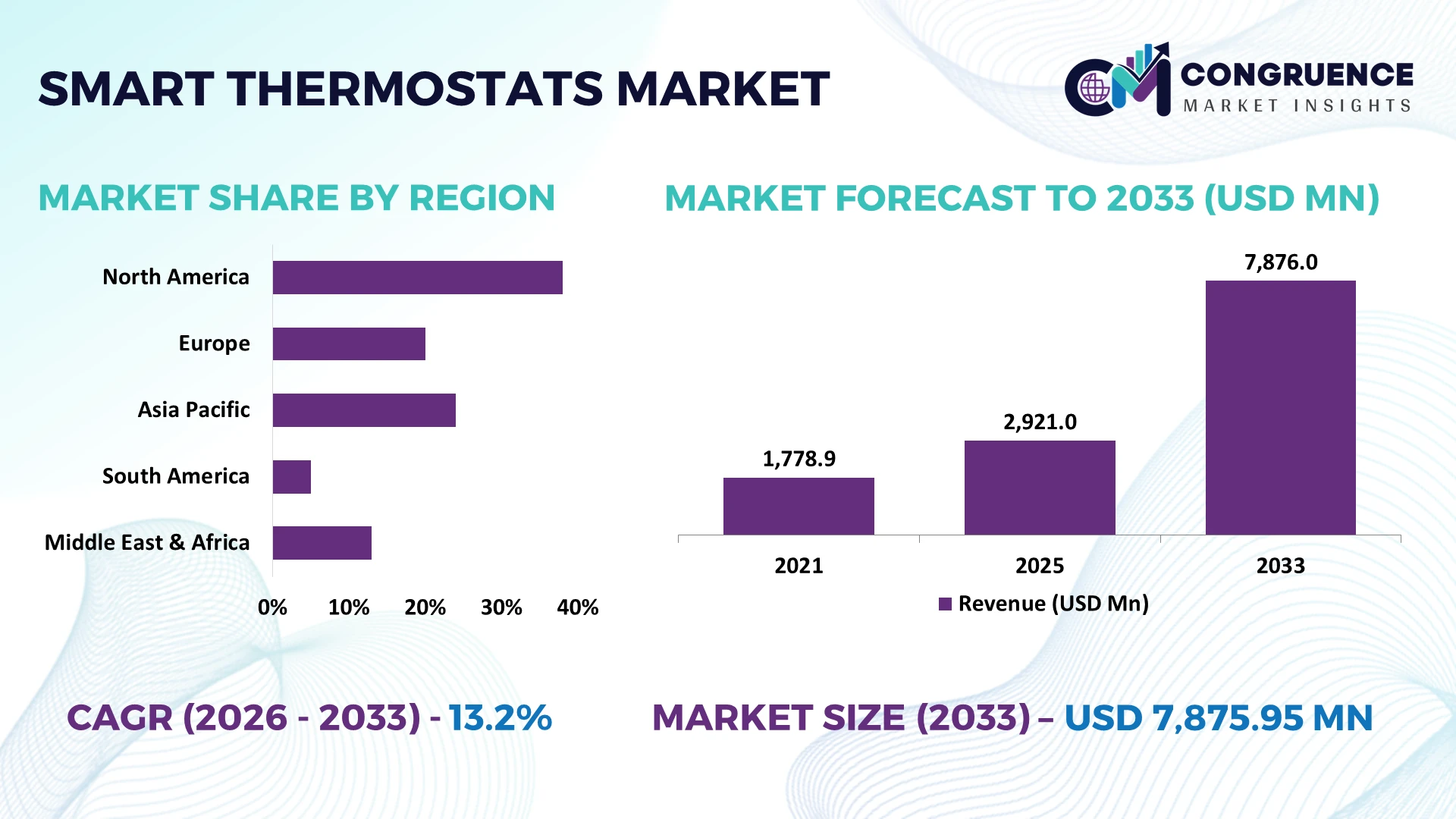
The United States commands an estimated 40% of global smart thermostat demand, supported by roughly 130 million households, widespread central HVAC infrastructure, and utility incentive programs offering rebates commonly between USD 50 and USD 100 per device. ENERGY STAR-certified smart thermostats can deliver approximately 8% heating-and-cooling savings. Canada has lower deployment scale but comparable HVAC automation requirements. U.S. grid pressure from extreme summer heat and rising electricity loads is strengthening thermostat participation in demand-response and virtual power plant programs.
Manufacturers integrating HVAC control, utility connectivity, open smart-home protocols, and predictive automation are positioned to capture the strongest replacement and energy-flexibility opportunities.
Market Size & Growth: USD 2,921 million in 2025 reaches USD 7,875.95 million by 2033 at 13.2% CAGR, driven by connected HVAC and heat-pump adoption.
Top Growth Drivers: Energy optimization contributes approximately 35%, smart-home integration 25%, and utility demand response 20% to incremental demand.
Short-Term Forecast: By 2028, AI scheduling and occupancy automation can reduce residential HVAC energy consumption by approximately 8–15%.
Emerging Technologies: AI learning, geofencing, Matter interoperability, and remote sensors are targeting 10–20% improvement in HVAC control efficiency.
Regional Leaders: North America approaches USD 3.2 billion, Europe USD 2.2 billion, and Asia-Pacific USD 1.8 billion by 2033 as connected HVAC expands.
Consumer/End-User Trends: ENERGY STAR smart thermostats deliver approximately 8% average heating-and-cooling savings, strengthening household replacement economics.
Pilot/Case Example: Utility demand-response programs can adjust connected thermostats by 2–4°F during peak events, aggregating residential flexibility without manual intervention.
Competitive Landscape: Google Nest holds an estimated 25%+ position, competing with ecobee, Resideo, Emerson, Schneider Electric, and smart-home specialists.
Regulatory & ESG Impact: Building-efficiency policies increasingly target HVAC, which represents approximately 50% of typical U.S. household energy consumption.
Investment & Funding: U.S. federal home-energy programs allocate billions of dollars toward efficiency upgrades, strengthening connected HVAC and electrification ecosystems.
Innovation & Future Outlook: Grid-interactive thermostats can shift 10–20% of controllable HVAC load during peak periods, linking smart homes directly with VPP platforms.
Smart Thermostats are evolving from programmable HVAC controllers into intelligent energy-management endpoints connecting heat pumps, air conditioners, occupancy sensors, utility tariffs, and virtual power plants. Residential replacement remains the core demand area, while commercial buildings increasingly use connected controls for multi-zone optimization. ENERGY STAR-certified devices deliver approximately 8% average heating-and-cooling savings, strengthening measurable payback. AI learning, remote room sensors, geofencing, and Matter interoperability are improving automation. As extreme-temperature events intensify grid peaks, utility-controlled demand response is turning thermostat fleets into valuable distributed flexibility resources.
Smart thermostats are becoming strategic energy-control assets as HVAC electrification, heat-pump deployment, dynamic electricity tariffs, and grid flexibility reshape building operations. HVAC represents roughly 50% of typical U.S. household energy consumption, making connected temperature control commercially significant for utilities, equipment manufacturers, and smart-home platforms. Building-efficiency policies and utility demand-response programs are shifting thermostats from consumer accessories toward grid-interactive infrastructure.
ENERGY STAR-certified smart thermostats deliver approximately 8% average heating-and-cooling savings versus conventional controls, while occupancy sensing and predictive scheduling further reduce unnecessary runtime. The United States leads utility-connected deployments; Europe emphasizes heat-pump optimization and energy-efficiency regulation, while Japan combines advanced HVAC controls with compact residential systems. Through 2028, Matter interoperability, variable-speed HVAC integration, and automated tariff response will strengthen replacement economics.
A utility can aggregate thousands of connected thermostats and temporarily adjust cooling setpoints during peak demand without disconnecting customer equipment. Manufacturers are expanding utility partnerships, remote sensors, heat-pump compatibility, and AI control algorithms. Competitive advantage will increasingly depend on combining measurable HVAC efficiency with interoperable smart-home functionality and monetizable grid flexibility.
Heat-pump adoption is strengthening smart thermostat demand because electrified HVAC requires precise staging, scheduling, and load management. Space heating and cooling represent approximately 50% of household energy use in the United States, while ENERGY STAR-certified smart thermostats save around 8% on heating and cooling. Connected controls can shift 10–20% of flexible HVAC load during selected peak periods without compromising normal comfort requirements. U.S. electrification incentives and utility rebate programs are accelerating replacement of legacy controls alongside heat-pump installations. Manufacturers are responding with variable-speed equipment integration, equipment-health monitoring, utility connectivity, and adaptive algorithms. Strategically, attaching smart controls during HVAC replacement lowers customer-acquisition friction and gives manufacturers continuing software relationships after physical equipment installation.
Installed HVAC diversity limits standardized smart thermostat deployment. Older U.S. homes frequently lack dedicated C-wire power, while heat pumps, multi-stage furnaces, boilers, proprietary communicating systems, and zoned equipment require different control configurations. Professional installation can add 20–40% to total acquisition cost, and compatibility limitations can exclude 10–15% of targeted retrofit environments for specific devices. Europe adds complexity through radiator-based heating and manufacturer-specific boiler interfaces. Suppliers are reducing friction with power-extension kits, broader equipment libraries, wireless sensors, installation diagnostics, and partnerships with HVAC contractors. The non-obvious commercial constraint is return-related cost: inaccurate compatibility screening creates failed installations, support calls, and product returns, making pre-purchase equipment identification as important as thermostat functionality.
Time-of-use pricing and virtual power plants create a new value layer beyond household energy savings. Smart thermostats can pre-cool or pre-heat buildings before expensive periods and shift approximately 10–20% of controllable HVAC demand during grid events. California provides a strong opportunity because extreme summer peaks, widespread connected devices, and expanding dynamic-rate programs increase the value of automated load shaping. Through 2028, AI forecasting will increasingly combine weather, occupancy, tariff, and grid signals to optimize comfort against electricity cost. Manufacturers are integrating utility APIs, automated demand response, home-energy management, and customer incentive platforms. The unique opportunity is recurring grid-service participation: installed thermostats can generate operational value repeatedly without requiring customers to purchase batteries or export electricity.
Smart thermostats continuously exchange occupancy, temperature, location-linked, account, and equipment data while providing remote access to physical HVAC systems. Large utility programs can connect tens or hundreds of thousands of devices, increasing authentication and software-update complexity. A 1% device communication failure across a 100,000-unit fleet removes 1,000 endpoints from coordinated dispatch, directly weakening demand-response predictability. Matter and expanding smart-home interoperability increase connectivity but also enlarge the number of software interfaces requiring protection. U.S. manufacturers face rising consumer-IoT cybersecurity expectations alongside utility security requirements. Companies must invest in encrypted communications, secure boot, multifactor account protection, signed firmware, vulnerability management, and long-duration update support. Competitive durability depends on maintaining secure connectivity throughout thermostat lifecycles that commonly exceed five years.
Matter Integration Simplifies Device Ecosystems: Smart thermostat manufacturers are adopting Matter-compatible architectures to reduce dependence on proprietary smart-home integrations. Unified commissioning can cut device setup steps by 20–30% and reduce integration engineering across multiple ecosystems. As Matter expands across Apple, Google, Amazon, and Samsung environments, manufacturers are redesigning connectivity stacks, improving over-the-air updates, and consolidating certification work to lower support complexity.
Remote Sensors Improve Room-Level Control: Multi-sensor thermostat systems increasingly use occupancy and temperature readings from 2–5 rooms instead of relying on one hallway-mounted controller. Better room-level visibility can reduce temperature imbalances by 15–25% and limit unnecessary HVAC runtime. Manufacturers are expanding wireless sensor portfolios, occupancy algorithms, and zone-aware controls, creating higher-value hardware ecosystems while increasing attachment sales beyond the primary thermostat.
Predictive Maintenance Enters Thermostat Platforms: Connected thermostats increasingly analyze runtime, temperature recovery, cycling frequency, and equipment behavior to identify HVAC deterioration before failure. Automated diagnostics can reduce unnecessary service investigation by 10–20% and provide contractors with operating data before arrival. U.S. HVAC labor shortages are accelerating this transition. Suppliers are integrating equipment-health alerts, contractor dashboards, and remote diagnostics to strengthen aftermarket relationships and reduce service friction.
Privacy Controls Reshape Cloud Architecture: Continuous occupancy and behavioral data are forcing manufacturers to strengthen consumer privacy as connected-home regulation tightens. Local processing can reduce selected cloud data transfers by 20–40%, while configurable retention controls limit unnecessary storage. Companies are expanding edge intelligence, encrypted telemetry, consent management, and security-update programs. The non-obvious advantage is lower cloud-processing dependency alongside stronger customer trust and regulatory readiness.
Learning Thermostats account for approximately 35–40% of smart thermostat demand, supported by automatic scheduling, occupancy recognition, behavioral learning, and premium smart-home integration. Their ability to adjust HVAC operation without continuous user programming creates stronger energy-management value than conventional connected controls. Wi-Fi Thermostats remain widely deployed because remote access and app-based scheduling provide straightforward connectivity at lower acquisition costs. Programmable Thermostats retain relevance among cost-sensitive users seeking scheduled control without advanced intelligence.
Voice-Controlled Thermostats represent the fastest-growing type as households increasingly connect HVAC with broader voice-assistant and smart-home ecosystems. Voice and automation functionality can reduce manual thermostat interactions by 20–30% in highly connected households. Z-Wave Thermostats retain strategic value in security, home-automation, and professionally installed networks requiring low-power mesh connectivity. Manufacturers are concentrating investment on embedded intelligence, interoperability, remote sensors, and simplified commissioning, shifting competitive differentiation from basic connectivity toward autonomous comfort management.
HVAC Control represents approximately 40–45% of smart thermostat application demand because heating and cooling equipment remains the primary operating interface for connected thermostats. Temperature Control forms the foundational use case, while Remote Monitoring increasingly supports homeowners, facility teams, and service contractors through app-based visibility and alerts. Energy Management is strengthening as electricity prices, equipment efficiency, and building-performance requirements push users toward runtime analytics and automated scheduling. Smart controls can deliver approximately 8% average heating-and-cooling savings in qualifying residential environments.
Demand Response is the fastest-growing application as utilities aggregate connected thermostats for peak-load management. Coordinated programs can shift approximately 10–20% of controllable HVAC demand during selected events without disconnecting equipment. Manufacturers are therefore integrating utility APIs, automated enrollment, event notifications, and customer override controls. Competitive investment is moving beyond temperature adjustment toward platforms that combine comfort, energy analytics, remote equipment visibility, and grid-responsive control within one connected interface.
Residential Buildings account for approximately 60–65% of smart thermostat demand because single-family homes combine large installed HVAC fleets with consumer smart-home adoption and utility rebate availability. Office Buildings represent a more operationally intensive segment where occupancy scheduling, multi-zone control, and remote monitoring support facilities management. Hotels prioritize guest comfort and room-level vacancy controls, while Retail Stores use centralized temperature management across distributed locations. Healthcare Facilities require tighter environmental reliability and controlled access to HVAC settings.
Commercial Buildings represent the fastest-growing end-user segment as portfolio operators connect thermostats with building-management and energy-analytics systems. Automated scheduling can reduce HVAC runtime by approximately 10–20% in intermittently occupied spaces, while centralized monitoring reduces manual site visits across multi-location estates. Manufacturers are responding with enterprise dashboards, API integration, role-based permissions, sensor networks, and volume pricing. Competitive opportunity is shifting toward fleet-level management rather than isolated device sales, particularly across offices, retail portfolios, hotels, and healthcare facilities.
North America accounted for the largest market share at 42% in 2025 however, Asia-Pacific is expected to register the fastest growth, expanding at a CAGR of 15.8% between 2026 and 2033.

Utility Integration Converts Thermostats Into Grid Assets
North America represents approximately 42% of global smart thermostat demand, supported by extensive central HVAC infrastructure, high broadband availability, utility rebates, and mature smart-home ecosystems. The United States has roughly 130 million households, creating a substantial replacement base for connected HVAC controls. ENERGY STAR-certified devices deliver approximately 8% average heating-and-cooling savings, strengthening measurable consumer economics. Utilities increasingly aggregate connected thermostats for peak-load management, particularly during California and Texas summer demand events. Matter adoption is also simplifying interoperability across major smart-home ecosystems. Manufacturers are responding with demand-response enrollment, remote room sensors, equipment diagnostics, heat-pump optimization, and utility partnerships. The operational shift is clear: thermostat value increasingly depends on recurring energy optimization and grid participation rather than one-time hardware functionality.
United States Market Outlook: U.S. adoption benefits from widespread forced-air HVAC, mature Wi-Fi infrastructure, and established utility efficiency programs. Residential heating and cooling represents approximately half of household energy consumption, giving automated controls substantial optimization leverage. California’s grid-responsive programs and accelerating heat-pump installations are strengthening demand for thermostats combining equipment compatibility, automated scheduling, and remote energy management.
Heating Electrification Reshapes Connected Controls
Europe accounts for approximately 26% of global smart thermostat demand, with the United Kingdom, Germany, Netherlands, France, and Nordic countries providing strong connected-heating adoption. Unlike North America’s cooling-intensive market, European deployments increasingly focus on boilers, radiators, hydronic systems, and heat pumps. EU building-efficiency policies are strengthening requirements for controllable heating systems, while smart-meter expansion supports time-variable electricity pricing. Heat pumps sold across Europe number in the millions annually, creating a growing installed base requiring intelligent scheduling and temperature optimization. Manufacturers are adapting through boiler interfaces, radiator controls, weather compensation, multi-zone management, and dynamic-tariff integration. Privacy regulation additionally favors stronger local processing and transparent data controls. Competitive advantage increasingly comes from supporting heterogeneous European heating infrastructure rather than offering standardized forced-air thermostat architectures.
Germany Market Outlook: Germany combines more than 40 million households with accelerating heat-pump electrification and strict building-efficiency requirements. Variable electricity tariffs and high household energy costs strengthen the economics of weather-responsive heating control. Suppliers integrating thermostats with heat pumps, smart meters, photovoltaic systems, and home-energy management platforms gain access to broader household electrification spending rather than competing solely for thermostat replacements.
HVAC Scale Accelerates Connected Control Adoption
Asia-Pacific represents approximately 23% of global smart thermostat demand, supported by expanding air-conditioning ownership, smart-home adoption, residential construction, and connected-appliance manufacturing. China, Japan, South Korea, Australia, and India have markedly different HVAC architectures, encouraging localized product strategies. China provides enormous air-conditioner manufacturing and installed-unit scale, while Japan emphasizes high-efficiency room systems and integrated appliance controls. Australia’s high cooling requirements and rooftop-solar penetration support energy-aware scheduling. India adds substantial long-term potential as residential air-conditioner penetration remains below mature-market levels despite rising cooling demand. Manufacturers are prioritizing mobile-first interfaces, appliance-level connectivity, AI temperature optimization, and integration with proprietary smart-home ecosystems. Regional manufacturing depth also shortens hardware supply chains and supports lower-cost connected-control development for mass-market deployment.
China Market Outlook: China is the world’s largest room-air-conditioner manufacturing and consumption base, giving connected HVAC suppliers exceptional ecosystem scale. Domestic smart-home platforms increasingly link air conditioning, sensors, voice assistants, and energy monitoring through unified applications. Manufacturers able to embed thermostat intelligence directly into HVAC equipment can bypass standalone-device installation barriers and reach consumers during appliance replacement cycles.
Connected Cooling Drives Urban Adoption
South America represents approximately 5% of global smart thermostat demand, led by Brazil, Chile, Argentina, and Colombia. Brazil provides the largest addressable HVAC base, supported by warm-climate cooling demand, expanding residential connectivity, and substantial commercial building stock. Internet penetration exceeds 80% in several major urban markets, creating a viable foundation for app-controlled temperature management. However, split air conditioners are more prevalent than centralized HVAC in many households, limiting direct transfer of North American thermostat architectures. Commercial offices, hotels, retail facilities, and premium residences therefore provide stronger near-term deployment economics. Manufacturers are adapting through connected HVAC controllers, Wi-Fi integration, mobile applications, and partnerships with air-conditioning brands. Success depends on compatibility with installed cooling equipment and localized pricing rather than premium smart-home functionality alone.
Brazil Market Outlook: Brazil combines more than 200 million residents with high smartphone usage and substantial cooling requirements across major urban centers. São Paulo, Rio de Janeiro, and warmer northern states provide distinct residential and commercial HVAC opportunities. Suppliers integrating smart controls directly with mini-split systems can address a substantially broader installed base than vendors focused exclusively on wired central-HVAC thermostats.
Cooling Intensity Accelerates Building Automation
Middle East & Africa represents approximately 4% of global smart thermostat demand, with adoption concentrated in the UAE, Saudi Arabia, Israel, South Africa, and premium urban developments. Gulf countries provide particularly strong economics because air conditioning can account for more than 60% of peak electricity demand during extreme summer conditions. Smart-building programs, large hospitality portfolios, and high cooling intensity favor centralized temperature monitoring and occupancy-based control. Saudi Arabia’s smart-meter rollout exceeding 10 million units strengthens the digital infrastructure supporting energy-responsive buildings. Manufacturers are targeting hotels, offices, malls, compounds, and premium residences through building-management integration, occupancy sensors, centralized dashboards, and remote maintenance. Africa remains more infrastructure-constrained, making commercial properties and high-end residential projects the principal connected-thermostat entry points.
United Arab Emirates Market Outlook: The UAE combines year-round cooling requirements with concentrated high-rise, hotel, retail, and premium residential infrastructure. Dubai’s extensive smart-building ecosystem creates strong demand for occupancy-linked temperature control and centralized facility monitoring. Commercial operators can achieve greater value by connecting thermostats with room sensors and building-management platforms, reducing cooling during vacant periods without affecting occupant comfort.
The smart thermostats market pits Google Nest, ecobee, Resideo, Emerson, and Schneider Electric against HVAC OEMs and lower-cost connected-control specialists. The top five capture approximately 55–60% of global demand, supported by installed ecosystems, distribution reach, and smart-home integration. Google and ecobee compete through AI learning and consumer experience, while Resideo and HVAC-focused suppliers emphasize equipment compatibility and professional channels. Learning algorithms can reduce selected HVAC consumption by 8–15%, while remote diagnostics cut service investigation requirements by roughly 10–20%. Players are expanding Matter interoperability, utility partnerships, room sensors, heat-pump controls, and enterprise dashboards. Competition is shifting from standalone temperature control toward integrated home-energy and grid-interactive platforms. HVAC compatibility, cybersecurity, installer relationships, certification, and ecosystem lock-in create substantial entry barriers. Winning requires broad equipment support, intuitive automation, measurable energy savings, secure connectivity, reliable utility integration, and distribution capable of reaching both consumers and professional installers at scale globally.
ecobee
Resideo Technologies
Emerson Electric
Schneider Electric
Siemens
Bosch
tado°
Netatmo
Johnson Controls
Carrier
Trane Technologies
Alarm.com
Sinope Technologies
Current smart thermostat technology combines Wi-Fi connectivity, occupancy sensing, remote room sensors, mobile control, Matter interoperability, and equipment diagnostics. ENERGY STAR-certified controls can reduce heating-and-cooling consumption by about 8%, while multi-room sensing can cut temperature imbalance by 15–25%. Adoption is strongest in connected U.S. households, where utilities increasingly enroll thermostats into demand-response programs and manufacturers integrate HVAC health monitoring.
Emerging platforms apply AI scheduling, weather-responsive control, indoor-air-quality sensing, and heat-pump optimization. AI learns occupancy and temperature preferences, reducing unnecessary HVAC runtime by 10–20%. Compared with legacy programmable thermostats requiring fixed schedules, learning models can improve control efficiency by approximately 15% through automatic adjustment. Manufacturers with established HVAC, smart-home, and utility ecosystems benefit because integrated software increases device engagement while lowering service and energy-management friction.
From 2026–2028, edge AI, dynamic-tariff automation, grid-interactive controls, and deeper home-energy integration will become disruptive differentiators. Thermostats coordinating HVAC with batteries, solar, generators, and EV charging can shift 10–20% of controllable household load during peak periods. Matter and Thread will accelerate cross-platform deployment, while local processing strengthens privacy and response speed. Companies investing now in interoperability, predictive diagnostics, heat-pump compatibility, and utility APIs gain durable advantage as thermostats evolve from temperature controllers into intelligent building-energy endpoints.
August 2024 Google launched its fourth-generation Nest Learning Thermostat with a display 60% larger than its predecessor, improved AI scheduling, Matter support, and a temperature sensor. The redesign strengthened multi-room comfort, HVAC compatibility, energy optimization, and cross-platform smart-home integration. Source: google.com
January 2025 Resideo introduced the Honeywell Home X2S Smart Thermostat at CES, adding Matter compatibility and ENERGY STAR certification at $79.99. Supporting 2.4 and 5 GHz routers, the product broadened affordable connected-HVAC access while simplifying smart-home integration for households. Source: resideo.com
May 2025 Generac launched ecobee Smart Thermostat Enhanced integration with generators and PWRcell 2 storage, targeting savings of up to 26% on annual heating and cooling. The platform coordinates HVAC loads during outages, strengthening integrated residential energy management. Source: prnewswire.com
September 2026 tado launched Smart Thermostat X second generation, measuring 17.8 mm thick and supporting Matter and Thread. The redesigned model adds AI Assist and a rechargeable battery exceeding one year, strengthening intelligent European heating automation and interoperability. Source: tado.com
The Smart Thermostats Market Report evaluates Learning Thermostats, Programmable Thermostats, Wi-Fi Thermostats, Voice-Controlled Thermostats, and Z-Wave Thermostats across HVAC Control, Energy Management, Temperature Control, Remote Monitoring, and Demand Response. Coverage spans Residential Buildings, Commercial Buildings, Hotels, Retail Stores, Office Buildings, and Healthcare Facilities. Learning Thermostats represent approximately 35–40% of type demand, while Residential Buildings account for roughly 60–65% of deployments.
Regional analysis covers North America, Europe, Asia-Pacific, South America, and Middle East & Africa, examining HVAC architecture, electrification, smart-home penetration, and utility programs. Technology coverage includes AI scheduling, Matter and Thread interoperability, occupancy sensing, predictive diagnostics, dynamic tariffs, heat-pump optimization, and grid-interactive control. The 2026–2033 framework supports investment planning, geographic expansion, product positioning, utility partnerships, ecosystem development, and competitive strategy across connected residential and commercial HVAC markets.
| Report Attribute/Metric | Report Details |
|---|---|
Market Revenue in 2025 | USD 2921 Million |
Market Revenue in 2033 | USD 7875.95 Million |
CAGR (2026 - 2033) | 13.2% |
Base Year | 2025 |
Forecast Period | 2026 - 2033 |
Historic Period | 2021 - 2025 |
Segments Covered | By Type
By Application
By End-User
|
Key Report Deliverable | Revenue Forecast, Growth Trends, Market Dynamics, Segmental Overview, Regional and Country-wise Analysis, Competition Landscape |
Region Covered | North America, Europe, Asia-Pacific, South America, Middle East, Africa |
Key Players Analyzed | Google, ecobee, Resideo Technologies, Emerson Electric, Schneider Electric, Siemens, Bosch, tado°, Netatmo, Johnson Controls, Carrier, Trane Technologies, Alarm.com, Sinope Technologies |
Customization & Pricing | Available on Request (10% Customization is Free) |




