
Reports
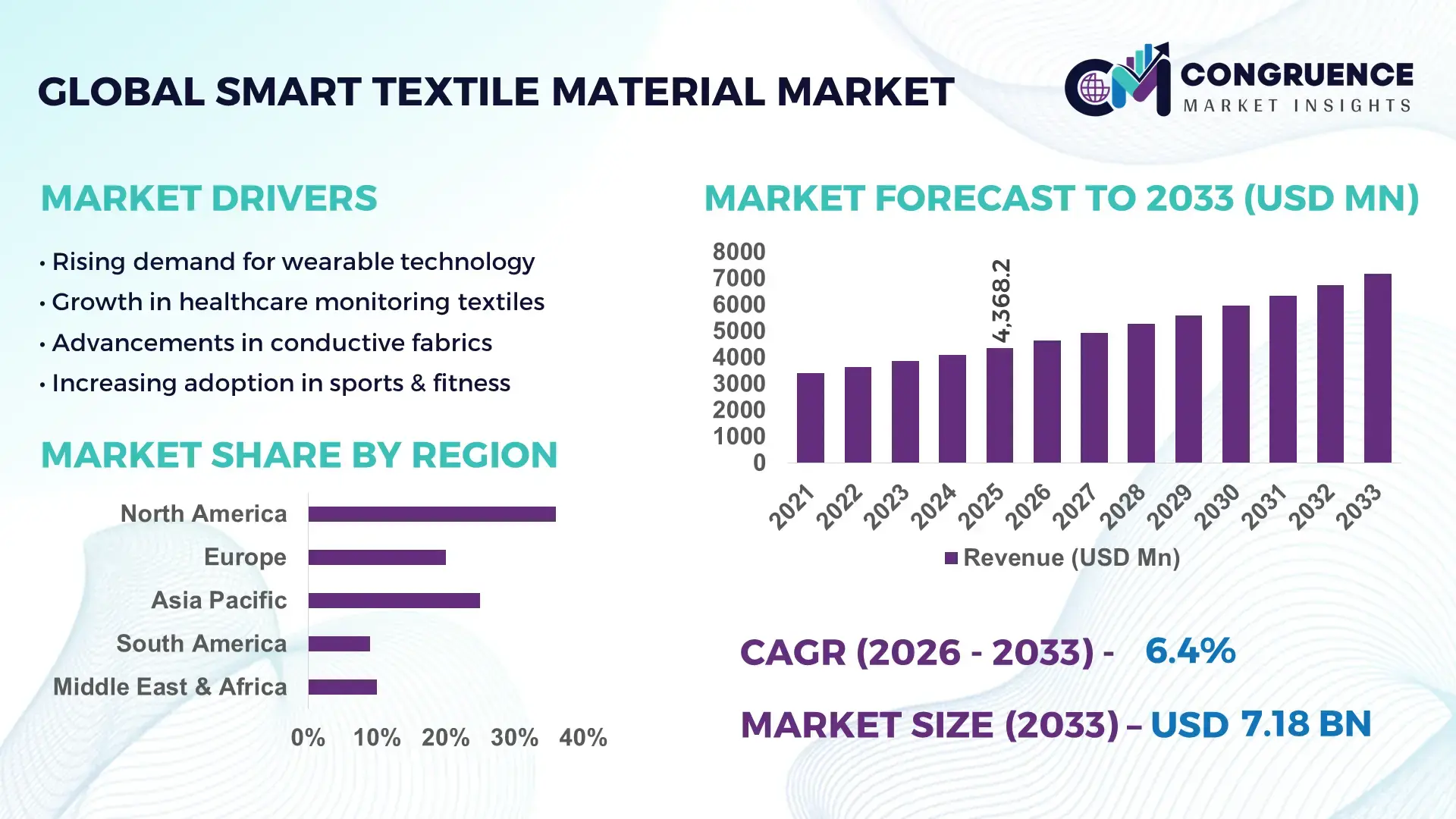
The Global Smart Textile Material Market was valued at USD 4368.19 Million in 2025 and is anticipated to reach a value of USD 7175.21 Million by 2033 expanding at a CAGR of 6.4% between 2026 and 2033. This growth is primarily driven by increasing integration of wearable electronics and advanced functional fabrics across healthcare, defense, and sports industries.
The United States remains a dominant force in the smart textile material market, supported by robust manufacturing infrastructure and high R&D investments exceeding USD 2 billion annually in advanced materials and wearable technologies. The country has witnessed over 35% adoption of smart textiles in military applications, particularly in sensor-integrated uniforms and health-monitoring fabrics. Additionally, healthcare applications account for nearly 28% of smart textile utilization, driven by remote patient monitoring systems. The presence of over 120 specialized research labs and partnerships between textile manufacturers and technology firms has accelerated innovation in conductive fibers, nanomaterials, and embedded sensors, reinforcing industrial scalability and application diversity.
Market Size & Growth: USD 4368.19 Million in 2025, projected to reach USD 7175.21 Million by 2033 at 6.4% CAGR, driven by rising wearable technology demand.
Top Growth Drivers: Wearable adoption +42%, healthcare monitoring efficiency +35%, defense textile integration +30%.
Short-Term Forecast: By 2028, smart textile integration is expected to improve operational efficiency by 25% across industrial and healthcare sectors.
Emerging Technologies: Nanofiber coatings, conductive polymers, AI-integrated smart fabrics.
Regional Leaders: North America (USD 2.4 Billion by 2033, strong defense use), Europe (USD 1.9 Billion, sustainability-driven adoption), Asia-Pacific (USD 2.8 Billion, manufacturing expansion).
Consumer/End-User Trends: Increasing demand from healthcare providers, athletes, and industrial workers for real-time monitoring fabrics.
Pilot or Case Example: In 2024, a European pilot project improved patient monitoring efficiency by 32% using sensor-based textiles.
Competitive Landscape: Market leader holds approximately 18% share, followed by key players including major advanced textile and electronics firms.
Regulatory & ESG Impact: Sustainability mandates driving 20% increase in recyclable smart fabric production.
Investment & Funding Patterns: Over USD 1.5 Billion invested in smart textile R&D and pilot-scale production facilities globally.
Innovation & Future Outlook: Integration of AI and IoT into fabrics enabling predictive analytics and enhanced user interactivity.
Smart textile materials are gaining traction across multiple industry sectors, with healthcare contributing nearly 30% of total demand due to the rising need for continuous monitoring solutions. Sports and fitness account for approximately 25%, driven by performance-tracking apparel innovations. Defense applications contribute close to 20%, focusing on durability and integrated communication systems. Recent innovations include self-healing fabrics, energy-harvesting textiles, and temperature-regulating materials. Regulatory emphasis on sustainable production and eco-friendly fibers is influencing material development, while Asia-Pacific continues to lead in large-scale production. Increasing urbanization and technological convergence are expected to further expand application areas and drive long-term market evolution.
The smart textile material market is strategically positioned at the intersection of advanced materials science, wearable technology, and digital health ecosystems, making it a critical enabler of next-generation industrial and consumer solutions. The integration of AI-enabled sensor fabrics delivers up to 40% improvement in real-time data accuracy compared to traditional wearable devices, significantly enhancing performance monitoring and predictive analytics. North America dominates in production volume due to established R&D ecosystems, while Europe leads in adoption with over 45% of enterprises incorporating smart textiles into healthcare and sports applications.
By 2028, AI-driven smart textiles are expected to improve operational efficiency in healthcare monitoring systems by 30%, reducing manual intervention and enabling remote diagnostics. Firms are increasingly committing to ESG targets, including a 25% reduction in carbon emissions and 30% use of recyclable fibers by 2030, aligning production with global sustainability mandates. In 2024, Japan achieved a 28% improvement in patient recovery monitoring through the deployment of biosensor-integrated fabrics in clinical environments, demonstrating measurable real-world benefits.
The market’s future pathways include deeper integration with IoT platforms, expansion into industrial safety gear, and advancements in energy-harvesting textiles capable of powering embedded electronics. As regulatory frameworks evolve and investment in innovation accelerates, the smart textile material market is emerging as a pillar of resilience, compliance, and sustainable growth across multiple high-value sectors.
The growing demand for wearable healthcare solutions is significantly driving the smart textile material market, particularly in remote patient monitoring and chronic disease management. Over 60% of healthcare providers are adopting wearable technologies to improve patient outcomes and reduce hospital visits. Smart textiles embedded with biosensors can monitor vital signs such as heart rate, temperature, and respiration with accuracy improvements of up to 35% compared to conventional devices. The aging global population and rising prevalence of chronic diseases have increased reliance on continuous monitoring systems. Additionally, healthcare cost reduction initiatives have led to a 20% increase in demand for home-based monitoring solutions, further accelerating adoption. Integration with mobile health platforms and AI-driven analytics is enhancing the value proposition of smart textiles in medical applications.
High production costs and technical complexity remain significant restraints in the smart textile material market. The integration of electronic components into textiles requires specialized manufacturing processes, increasing production costs by approximately 25–40% compared to traditional fabrics. Additionally, the lack of standardized manufacturing protocols and limited scalability of advanced materials hinder widespread adoption. Durability concerns, particularly related to washing and long-term usage, affect product reliability and consumer confidence. Nearly 30% of manufacturers report challenges in maintaining consistent performance of embedded sensors after repeated use. Furthermore, the need for interdisciplinary expertise across textiles, electronics, and software increases operational complexity, limiting entry for smaller players and slowing innovation cycles.
Advancements in smart wearable and industrial textiles present substantial growth opportunities for the market. The increasing adoption of smart uniforms in industrial safety applications has improved worker safety metrics by over 27%, particularly in hazardous environments. Energy-harvesting textiles capable of generating power from body movement or environmental sources are opening new avenues for self-sustaining wearable systems. Additionally, the integration of smart textiles in automotive interiors and aerospace applications is enhancing passenger comfort and safety features. The rise of personalized fitness solutions and connected apparel is also creating demand for customized smart fabrics. Emerging markets in Asia-Pacific are witnessing over 35% growth in smart textile production capabilities, supported by government initiatives and infrastructure investments.
Durability and regulatory compliance challenges continue to impact the smart textile material market, particularly in healthcare and defense applications where reliability is critical. Smart textiles must withstand repeated washing, environmental exposure, and mechanical stress while maintaining functional integrity, which remains a technical hurdle. Studies indicate that nearly 25% of smart textile products experience performance degradation after extended use. Regulatory requirements for electronic safety, data privacy, and material compliance further complicate product development and commercialization. In medical applications, strict certification processes can extend product approval timelines by 18–24 months. Additionally, concerns regarding data security in connected textile systems present challenges for widespread adoption, requiring robust encryption and compliance with evolving data protection standards.
• Accelerated Adoption of Wearable Health Monitoring Textiles: The healthcare sector is witnessing a measurable surge in smart textile integration, with over 48% of hospitals incorporating wearable textile-based monitoring systems for patient care. Smart garments embedded with biosensors have improved patient data accuracy by nearly 35%, while reducing manual monitoring efforts by 28%. Additionally, over 60 million wearable smart textile units were deployed globally in 2025, highlighting strong demand for continuous health tracking solutions, particularly in chronic disease management and elderly care environments.
• Expansion of Conductive and Nanomaterial-Based Fabrics: The use of conductive fibers and nanomaterials in textile production has increased by approximately 40% over the past three years. These advanced materials enhance electrical conductivity and durability, enabling efficient signal transmission and improved fabric performance. Nearly 32% of newly developed smart textiles now incorporate graphene or silver-based conductive elements, resulting in 25% higher energy efficiency in embedded electronic systems. This trend is particularly prominent in industrial and defense-grade applications requiring high-performance materials.
• Rising Integration of AI and IoT in Smart Fabrics: AI-enabled smart textiles are transforming data processing capabilities, with around 45% of manufacturers integrating IoT connectivity into textile products. These smart fabrics can process and transmit real-time data, improving response times by up to 30% in critical applications such as sports analytics and industrial safety. Connected textile ecosystems have also increased user engagement by 22%, driven by enhanced personalization and predictive analytics features embedded within garments and uniforms.
• Growth in Sustainable and Energy-Harvesting Textiles: Sustainability-focused innovation is driving the adoption of eco-friendly smart textiles, with over 38% of manufacturers transitioning to recyclable or biodegradable materials. Energy-harvesting textiles, capable of generating power from motion or solar exposure, have seen a 27% increase in pilot deployments. These textiles can produce up to 5–10 milliwatts of power per movement cycle, supporting low-energy wearable devices. Regulatory pressure and environmental targets are further accelerating the shift toward sustainable production practices in the smart textile material market.
The smart textile material market is segmented across types, applications, and end-users, each contributing distinctively to overall industry expansion. Conductive textiles, sensor-integrated fabrics, and passive smart materials form the core type categories, with conductive variants leading due to their widespread application in wearable electronics. In terms of applications, healthcare dominates with nearly 30% adoption, followed by sports and fitness at approximately 25%, and defense at around 20%, reflecting diverse industry integration. End-user segmentation highlights healthcare providers, military organizations, and sports institutions as key contributors, collectively accounting for over 65% of demand. Increasing adoption across industrial safety and automotive sectors further strengthens segmentation diversity. The market is also witnessing a shift toward multifunctional textiles capable of combining sensing, actuation, and communication features, enhancing value across all segments.
The smart textile material market by type includes conductive textiles, passive smart textiles, and active smart textiles, each serving distinct functional purposes. Conductive textiles currently lead the segment, accounting for approximately 46% of total adoption due to their critical role in enabling electrical conductivity for wearable electronics and sensor-based applications. Passive smart textiles hold around 28%, primarily used for moisture management, thermal regulation, and protective clothing. Active smart textiles, capable of sensing and reacting to environmental stimuli, represent about 26% but are rapidly gaining traction.
Active smart textiles are the fastest-growing segment, expanding at an estimated CAGR of 8.2%, driven by increasing demand for responsive materials in healthcare monitoring and defense applications. These textiles can adjust temperature, monitor vital signs, and respond to external stimuli, making them highly valuable in advanced use cases. The remaining segments collectively contribute around 54%, maintaining relevance in traditional and semi-advanced applications.
The application landscape of the smart textile material market is led by healthcare, sports and fitness, defense, and industrial sectors. Healthcare remains the dominant application, accounting for nearly 30% of total adoption due to increasing demand for remote patient monitoring and smart medical garments. Sports and fitness follow with approximately 25%, driven by performance tracking and biometric analysis. Defense applications contribute around 20%, focusing on soldier safety and communication systems, while industrial applications make up the remaining 25%.
Healthcare also stands out as the fastest-growing application segment, with an estimated CAGR of 7.8%, supported by the rising prevalence of chronic diseases and the need for continuous monitoring solutions. Sports and fitness applications are evolving with enhanced data analytics capabilities, while defense applications continue to integrate advanced sensor technologies.
End-user segmentation in the smart textile material market includes healthcare providers, military and defense organizations, sports and fitness institutions, and industrial enterprises. Healthcare providers lead the segment, accounting for approximately 32% of total demand, driven by increasing adoption of wearable monitoring systems and smart medical textiles. Military and defense organizations follow with around 22%, leveraging smart textiles for enhanced soldier performance and safety. Sports and fitness institutions contribute nearly 20%, while industrial users account for approximately 18%, with the remaining 8% spread across niche applications.
Industrial enterprises represent the fastest-growing end-user segment, expanding at an estimated CAGR of 8.5%, fueled by increasing focus on worker safety and productivity enhancement through smart uniforms and protective gear. Adoption rates in industrial environments have increased by over 30% in the past three years, reflecting growing awareness of smart textile benefits.
North America accounted for the largest market share at 38% in 2025 however, Asia-Pacific is expected to register the fastest growth, expanding at a CAGR of 7.9% between 2026 and 2033.

North America’s dominance is supported by over 45% enterprise-level adoption in healthcare and defense smart textile applications, with the United States contributing nearly 80% of the regional demand. Europe follows with approximately 29% share, driven by sustainability regulations and advanced textile manufacturing hubs in Germany, France, and the UK. Asia-Pacific holds around 25% of the global market, with China accounting for over 42% of regional production capacity and India witnessing a 35% rise in smart textile manufacturing units. South America contributes close to 5%, led by Brazil with nearly 60% of regional demand, while the Middle East & Africa holds approximately 3%, driven by increasing adoption in construction safety and oil & gas sectors. Regional growth patterns highlight a shift toward localized manufacturing, rising consumer adoption, and expanding industrial use cases supported by technological integration.
How are advanced wearable ecosystems transforming industrial and healthcare applications?
North America holds approximately 38% of the global smart textile material market, driven by strong demand from healthcare, defense, and sports industries. The region has over 50% adoption of wearable health monitoring systems across hospitals and clinical research centers. Government initiatives supporting advanced manufacturing and wearable innovation have increased funding allocations by nearly 20% for smart materials development. Technological advancements such as AI-integrated fabrics and IoT-enabled garments have improved operational efficiency by up to 30% in industrial safety applications. A notable example includes a U.S.-based smart textile company deploying sensor-embedded uniforms for industrial workers, reducing workplace incidents by 24%. Consumer behavior reflects high adoption in healthcare and fitness segments, with over 65% of users preferring connected wearable garments for real-time monitoring and performance tracking.
What role do sustainability mandates play in shaping next-generation textile innovation?
Europe accounts for approximately 29% of the global smart textile material market, with Germany, the UK, and France collectively contributing over 60% of regional demand. The region’s market is heavily influenced by stringent environmental regulations, with over 40% of manufacturers transitioning to recyclable and biodegradable smart fabrics. Regulatory frameworks promoting sustainable production have increased eco-friendly textile output by 28% in recent years. Emerging technologies such as nanofiber coatings and conductive polymers are widely adopted, with nearly 35% of new products incorporating advanced material innovations. A leading European textile firm recently introduced biodegradable smart fabrics that improved energy efficiency in wearable devices by 22%. Consumer behavior in the region is shaped by regulatory pressure, leading to higher demand for transparent, sustainable, and compliant smart textile solutions across industries.
How is large-scale manufacturing capacity accelerating smart textile adoption across industries?
Asia-Pacific represents around 25% of the global smart textile material market and ranks as the fastest-growing region in terms of production and adoption. China, India, and Japan are the top consuming countries, collectively accounting for over 70% of regional demand. China alone contributes nearly 45% of global smart textile production volume, supported by extensive manufacturing infrastructure and government-backed innovation programs. The region has witnessed a 40% increase in smart textile manufacturing facilities over the past five years. Technological hubs in Japan and South Korea are leading advancements in flexible electronics and conductive fibers. A major Asian manufacturer recently scaled production of energy-harvesting textiles, increasing output capacity by 30%. Consumer behavior reflects strong growth in wearable devices and mobile-integrated textiles, with adoption rates rising by over 50% in urban populations.
How are emerging industrial applications influencing demand for advanced textile solutions?
South America accounts for approximately 5% of the global smart textile material market, with Brazil and Argentina leading regional adoption. Brazil alone contributes nearly 60% of the regional market, driven by increasing demand in sports, healthcare, and industrial safety sectors. Infrastructure development projects have boosted demand for smart protective textiles by over 25% in construction and energy industries. Government incentives supporting local textile manufacturing have increased production capacity by approximately 18% in recent years. A regional textile company in Brazil has introduced smart sportswear integrated with performance-tracking sensors, improving athletic performance metrics by 20%. Consumer behavior in South America is closely tied to sports and lifestyle trends, with over 45% of smart textile usage concentrated in fitness and recreational applications.
What impact do industrial modernization and safety regulations have on textile innovation?
The Middle East & Africa region holds around 3% of the global smart textile material market, with the UAE and South Africa emerging as key growth countries. Demand is largely driven by oil & gas, construction, and defense sectors, where smart protective textiles have improved worker safety metrics by over 22%. Technological modernization initiatives have led to a 15% increase in adoption of sensor-based textiles across industrial operations. Trade partnerships and government-led diversification programs have boosted investment in advanced manufacturing by approximately 12%. A regional company in the UAE has deployed smart uniforms equipped with environmental sensors, enhancing safety compliance by 19%. Consumer behavior reflects growing awareness of safety and performance benefits, particularly in industrial and defense applications.
United States – 34% market share: Smart Textile Material market leadership driven by strong R&D investment, advanced wearable technology adoption, and high demand across healthcare and defense sectors.
China – 28% market share: Smart Textile Material market dominance supported by large-scale manufacturing capacity, cost-efficient production, and rapid expansion of industrial textile applications.
The smart textile material market exhibits a moderately fragmented competitive landscape, with over 150 active global and regional players competing across material innovation, product development, and application-specific solutions. The top five companies collectively account for approximately 42% of the total market share, indicating a balance between established leaders and emerging innovators. Key players are focusing on strategic partnerships with technology firms, healthcare providers, and defense organizations to enhance product capabilities and expand market reach.
Innovation remains a critical competitive factor, with over 60% of leading companies investing in R&D for conductive fibers, nanotechnology, and AI-integrated textile solutions. Product launches have increased by nearly 35% over the past three years, reflecting rapid advancements in smart fabric functionalities such as energy harvesting, temperature regulation, and biometric monitoring. Mergers and acquisitions have also intensified, with more than 20 strategic deals recorded in the last two years aimed at strengthening technological capabilities and geographic presence.
Additionally, companies are leveraging digital transformation strategies, including IoT integration and data analytics, to differentiate their offerings. Sustainability has emerged as a competitive driver, with over 40% of manufacturers adopting eco-friendly materials and production processes to meet regulatory and consumer expectations. This dynamic competitive environment is fostering continuous innovation and shaping the long-term growth trajectory of the smart textile material market.
DuPont de Nemours, Inc.
Toray Industries, Inc.
Textronics, Inc.
Schoeller Textil AG
Interactive Wear AG
AiQ Smart Clothing Inc.
Outlast Technologies LLC
Clothing+ Oy
Vista Medical Ltd.
Ohmatex ApS
Sensoria Inc.
Hexoskin
Nike, Inc.
Adidas AG
Under Armour, Inc.
The smart textile material market is undergoing rapid transformation driven by advancements in material science, electronics integration, and digital connectivity. Conductive fibers remain a foundational technology, with over 45% of smart textile products now incorporating silver-coated yarns, carbon nanotubes, or graphene-based materials to enable efficient signal transmission. These materials have demonstrated up to 30% higher conductivity and 25% improved durability compared to earlier-generation metallic threads, significantly enhancing product reliability.
Flexible and stretchable electronics are another critical innovation, enabling seamless integration of sensors and microcontrollers into fabrics without compromising comfort. Approximately 38% of new smart textile prototypes feature flexible printed circuits, allowing garments to maintain functionality under repeated bending and washing cycles. Additionally, energy-efficient micro-sensors embedded within textiles can now operate at power levels below 10 milliwatts, supporting continuous monitoring applications in healthcare and industrial safety.
Artificial intelligence and Internet of Things integration are reshaping smart textile capabilities by enabling real-time data processing and predictive analytics. Around 42% of smart textile manufacturers have incorporated IoT connectivity, allowing fabrics to transmit biometric and environmental data to cloud platforms. This integration has improved data response times by nearly 28% and enabled predictive maintenance in industrial environments.
Emerging technologies such as energy-harvesting textiles and self-healing fabrics are gaining traction, with pilot deployments increasing by 30% over the past two years. Energy-harvesting materials can generate between 5 and 12 milliwatts from kinetic or solar sources, supporting low-power wearable devices. Meanwhile, self-healing polymers are improving product lifespan by up to 20%, reducing replacement frequency. Nanotechnology-driven coatings are also enhancing water resistance and antimicrobial properties, with over 35% of advanced textiles now incorporating such features. These technological advancements are collectively positioning smart textiles as a high-value innovation platform across healthcare, defense, and industrial sectors.
• In January 2025, DuPont expanded its advanced materials portfolio by introducing new stretchable conductive inks designed for smart textile applications, improving flexibility by 30% and enhancing wash durability. These materials support next-generation wearable electronics integration across healthcare and industrial sectors. Source: www.dupont.com
• In October 2024, Toray Industries announced the development of a high-performance nanofiber textile with integrated sensing capabilities, capable of detecting pressure and temperature variations with 25% higher sensitivity. The innovation targets healthcare monitoring and automotive interior applications. Source: www.toray.com
• In March 2025, AiQ Smart Clothing Inc. launched an upgraded line of smart garments featuring enhanced biometric sensors, delivering 20% more accurate health data tracking and improved connectivity with mobile applications. The development focuses on expanding digital healthcare and fitness monitoring solutions. Source: www.aiqsmartclothing.com
• In July 2024, Schoeller Textil AG introduced a sustainable smart textile platform combining temperature-regulating fabrics with biodegradable materials, reducing environmental impact by 18% while maintaining high-performance standards. The innovation aligns with increasing regulatory focus on eco-friendly textile production. Source: www.schoeller-textiles.com
The Smart Textile Material Market Report provides a comprehensive evaluation of the industry across multiple dimensions, offering detailed insights into product types, applications, technologies, and regional performance. The report covers key material categories including conductive textiles, passive smart fabrics, and active smart textiles, which collectively account for over 90% of industry adoption. It also examines emerging segments such as energy-harvesting textiles and self-healing materials, which are gaining increased attention due to their advanced functional capabilities.
From an application perspective, the report analyzes critical sectors such as healthcare, sports and fitness, defense, automotive, and industrial safety, with healthcare and fitness applications together contributing more than 50% of total demand. The study further explores end-user industries including hospitals, military organizations, manufacturing facilities, and consumer apparel markets, highlighting adoption patterns and usage intensity across each segment.
Geographically, the report provides in-depth coverage of five major regions, including North America, Europe, Asia-Pacific, South America, and the Middle East & Africa, with detailed country-level analysis for key markets such as the United States, China, Germany, India, and Brazil. These regions collectively represent over 95% of global smart textile production and consumption.
Technological analysis within the report focuses on innovations such as conductive fibers, flexible electronics, nanotechnology coatings, and AI-integrated textile systems, which are driving over 40% of new product development. Additionally, the report examines regulatory frameworks, sustainability initiatives, and manufacturing trends influencing the market. This structured scope ensures a holistic understanding of the smart textile material market, enabling decision-makers to identify growth opportunities, assess competitive dynamics, and align strategies with evolving industry trends.
| Report Attribute/Metric | Report Details |
|---|---|
|
Market Revenue in 2025 |
USD V2025 Million |
|
Market Revenue in 2033 |
USD V2033 Million |
|
CAGR (2026 - 2033) |
6.4% |
|
Base Year |
2025 |
|
Forecast Period |
2026 - 2033 |
|
Historic Period |
2021 - 2025 |
|
Segments Covered |
By Types
By Application
By End-User
|
|
Key Report Deliverable |
Revenue Forecast, Growth Trends, Market Dynamics, Segmental Overview, Regional and Country-wise Analysis, Competition Landscape |
|
Region Covered |
North America, Europe, Asia-Pacific, South America, Middle East, Africa |
|
Key Players Analyzed |
DuPont de Nemours, Inc., Toray Industries, Inc., Textronics, Inc., Schoeller Textil AG, Interactive Wear AG, AiQ Smart Clothing Inc., Outlast Technologies LLC, Clothing+ Oy, Vista Medical Ltd., Ohmatex ApS, Sensoria Inc., Hexoskin , Nike, Inc., Adidas AG, Under Armour, Inc. |
|
Customization & Pricing |
Available on Request (10% Customization is Free) |




