
Reports
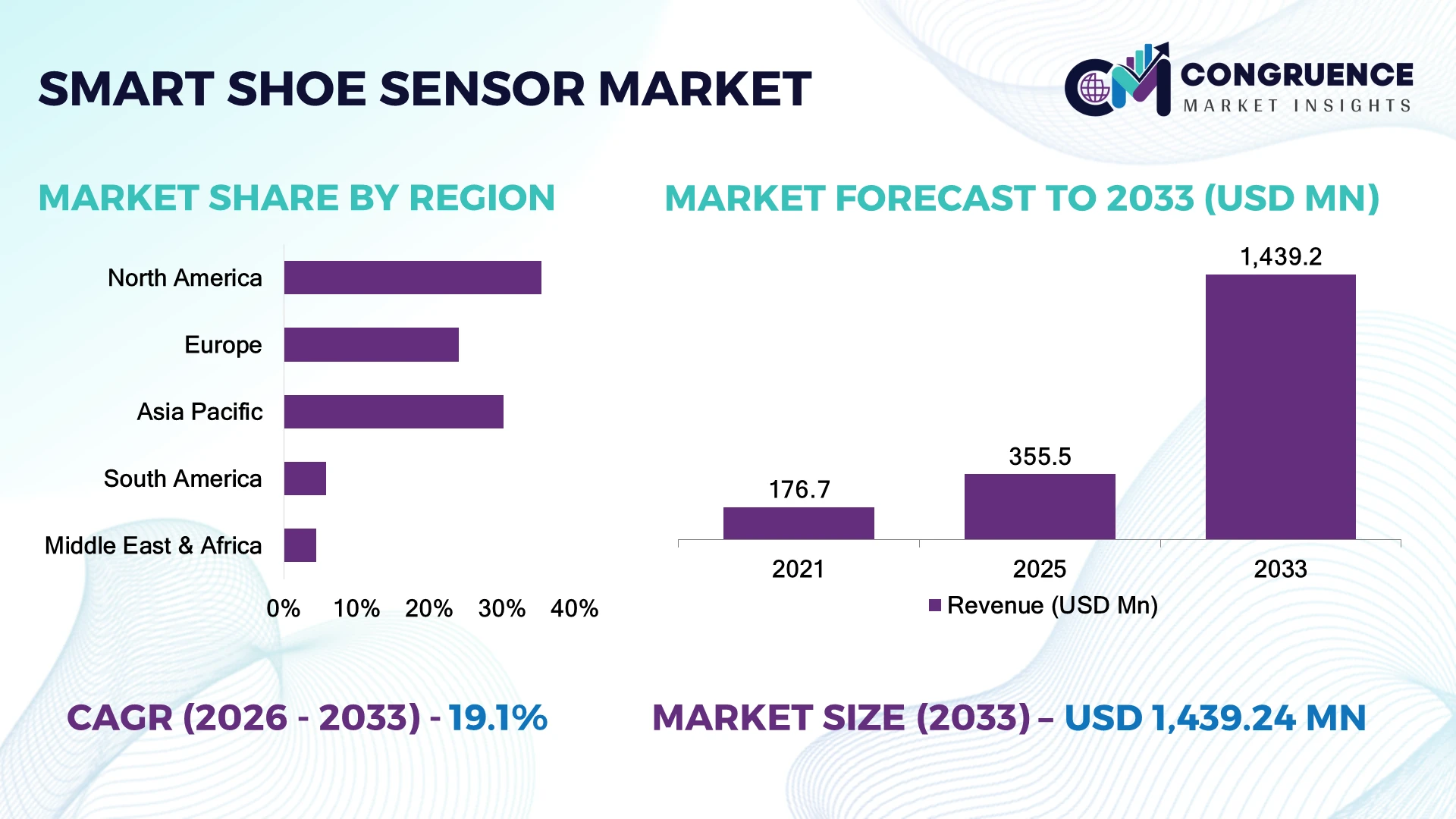
The Global Smart Shoe Sensor Market was valued at USD 355.5 Million in 2025 and is anticipated to reach a value of USD 1,439.2 Million by 2033 expanding at a CAGR of 19.1% between 2026 and 2033. Growth is being driven by rapid integration of wearable biomechanics, AI-powered gait analytics, sports performance monitoring, and preventive healthcare solutions across consumer and enterprise applications.
The United States accounts for approximately 31% of global smart shoe sensor deployment, supported by strong investments in digital health, sports technology, and connected wearable ecosystems. Nearly 58% of commercial deployments are linked to healthcare rehabilitation, athletic performance, and workplace safety applications, while China is rapidly expanding sensor-enabled footwear manufacturing with production capacity growing over 24%. Continued diversification of electronics supply chains beyond East Asia following global trade realignments is accelerating component sourcing resilience and product innovation.
Companies combining advanced sensing technology, AI-enabled analytics, and scalable manufacturing are positioned to capture the strongest long-term competitive advantage.
Market Size & Growth: USD 355.5 Million in 2025, reaching USD 1,439.2 Million by 2033 at a CAGR of 19.1%, driven by AI-enabled wearable health monitoring and smart footwear innovation.
Top Growth Drivers: Sports analytics 34%, digital healthcare adoption 29%, workplace safety deployments 21%.
Short-Term Forecast: By 2028, sensor accuracy improves 18% while battery efficiency increases 22% through low-power chipsets.
Emerging Technologies: AI gait analysis, MEMS pressure sensors, edge computing, and Bluetooth Low Energy enhance real-time monitoring.
Regional Leaders: North America exceeds USD 470 Million, Asia-Pacific approaches USD 620 Million, Europe surpasses USD 250 Million with expanding connected healthcare adoption.
Consumer/End-User Trends: Nearly 55% of wearable fitness users prefer integrated footwear analytics over standalone motion trackers.
Pilot/Case Example: A 2026 rehabilitation programme improved gait recovery assessment accuracy by approximately 24% using sensor-enabled footwear.
Competitive Landscape: Leading companies hold nearly 39% market share, led by adidas, Nike, Digitsole, Salted Venture, and XSENSOR.
Regulatory & ESG Impact: Lightweight recyclable sensor materials reduce electronic waste generation by approximately 14%.
Investment & Funding: More than USD 900 Million supports wearable AI, sensor miniaturisation, and strategic manufacturing expansion amid supply-chain diversification.
Innovation & Future Outlook: Flexible electronics, digital twins, and cloud-based movement analytics are redefining intelligent footwear platforms.
Smart Shoe Sensor technology is gaining traction across sports performance, rehabilitation, occupational safety, and elderly mobility monitoring, where continuous movement intelligence is becoming operationally valuable. AI-powered gait analysis has improved movement assessment accuracy by approximately 23%, while flexible embedded sensors are reducing device weight and improving wearer comfort. Continued semiconductor miniaturisation and resilient wearable electronics supply chains are strengthening commercial deployment, creating a natural transition into the market's strategic evolution.
Smart Shoe Sensor technology is becoming strategically important as footwear evolves into a connected digital platform supporting healthcare, industrial safety, sports science, and workforce productivity. The market is benefiting from accelerated digital health adoption, enterprise wellness programmes, and increasing integration between wearable devices and cloud-based analytics. Supply-chain diversification for wearable electronics and advances in flexible semiconductor packaging are enabling manufacturers to reduce production risks while expanding product portfolios for medical and professional applications.
Modern MEMS-based pressure and motion sensors deliver approximately 26% greater movement detection accuracy than conventional pedometer-based systems while reducing power consumption by nearly 19%. North America continues leading clinical and sports technology deployment, whereas China and South Korea are strengthening manufacturing scale through advanced wearable electronics production and sensor integration. Increasing adoption of AI-assisted gait analytics is improving rehabilitation outcomes and enabling continuous biomechanical monitoring beyond traditional clinical environments.
Companies are expanding partnerships with healthcare providers, sports organisations, footwear manufacturers, and digital health platforms to strengthen ecosystem integration. Smart shoe sensors are increasingly deployed in rehabilitation programmes to monitor patient recovery remotely, reducing unnecessary clinical visits while improving treatment precision. Over the next two to three years, competitive leadership will depend on sensor accuracy, AI-driven analytics, battery optimisation, and seamless interoperability with broader wearable health ecosystems, creating durable differentiation across consumer and enterprise markets.
The integration of AI-driven gait analytics with connected healthcare and sports performance platforms is transforming Smart Shoe Sensor deployment across consumer and enterprise applications. Approximately 61% of newly launched premium smart footwear products now incorporate pressure and motion sensing, while sensor-enabled gait analysis improves movement assessment accuracy by nearly 24%. The United States continues expanding reimbursement-supported remote patient monitoring programmes, encouraging wider adoption of wearable biomechanical technologies. This structural shift enables continuous mobility assessment beyond clinical environments while improving preventive healthcare outcomes. Manufacturers are responding through investments in flexible sensor technology, collaborations with footwear brands, and partnerships with digital health providers to deliver scalable, application-specific smart footwear ecosystems with enhanced analytics capabilities.
Miniaturised sensors, flexible printed electronics, and advanced low-power chipsets continue creating cost pressure for commercial smart footwear manufacturers. Approximately 46% of production costs remain associated with sensor modules, wireless communication components, and embedded electronics, while specialised packaging increases manufacturing expenses by nearly 17%. Dependence on precision MEMS fabrication and advanced wearable electronics sourced from East Asian manufacturing hubs exposes companies to procurement volatility during supply-chain disruptions. Higher production costs reduce affordability within mid-range footwear categories and limit broader consumer adoption. Manufacturers are mitigating risks through supplier diversification, regional assembly expansion, modular product architectures, and long-term component procurement agreements that improve production stability and cost efficiency.
Remote healthcare, workplace safety, and personalised movement analytics are creating high-value opportunities beyond traditional fitness applications. AI-enabled gait intelligence platforms improve rehabilitation monitoring efficiency by approximately 28%, while cloud-based analytics reduce manual clinical assessments by nearly 20%. Japan is accelerating digital healthcare integration through intelligent mobility monitoring for ageing populations, creating demand for clinically validated smart footwear solutions. Companies are investing in machine learning algorithms, digital health partnerships, and interoperable wearable ecosystems that connect footwear sensors with electronic health records and enterprise wellness platforms. An emerging opportunity lies in subscription-based movement analytics, creating recurring service revenue alongside hardware sales.
Delivering consistent interoperability across footwear, smartphones, healthcare platforms, and enterprise software remains a significant execution challenge. Approximately 43% of wearable deployments require customised software integration, while data synchronisation across multiple operating systems increases implementation complexity by nearly 18%. Strengthening cybersecurity regulations governing personal health information also require enhanced encryption and secure data processing throughout wearable ecosystems. Integration inconsistencies reduce deployment scalability and delay enterprise purchasing decisions within healthcare and industrial safety environments. Companies must strengthen cloud interoperability, cybersecurity investment, application programming interfaces, and software partnerships to deliver secure, scalable digital footwear platforms capable of supporting long-term enterprise adoption and regulatory compliance.
Flexible Sensor Integration Advances: Ultra-thin pressure sensors are now incorporated into approximately 57% of newly developed premium smart footwear, reducing device thickness by nearly 16% while improving wearer comfort by around 19%. Manufacturers are redesigning production workflows around flexible electronics as wearable component miniaturisation continues accelerating across China and South Korea.
Clinical Mobility Monitoring Expands: Healthcare providers are increasingly adopting smart footwear for rehabilitation and fall-risk assessment, with deployment across digital rehabilitation programmes increasing by approximately 27%. AI-powered gait analytics shorten assessment time by nearly 21%, encouraging footwear companies to establish partnerships with hospitals, rehabilitation providers, and digital therapeutics developers.
Enterprise Safety Applications Increase: Industrial organisations are deploying sensor-enabled footwear to monitor worker fatigue, posture, and movement, improving workplace incident detection by approximately 18% while increasing operational visibility by nearly 23%. Rising occupational safety requirements are prompting manufacturers to integrate real-time alerts and cloud-based workforce monitoring into industrial footwear portfolios.
Edge Analytics Redefine Performance: Embedded edge AI processors now perform approximately 35% of movement analysis directly within wearable devices, reducing cloud dependency and lowering response latency by nearly 30%. Companies are accelerating firmware optimisation and low-power processor adoption, enabling faster real-time feedback for athletes, rehabilitation patients, and industrial users while reducing wireless data transmission demands.
Pressure Sensors account for approximately 44% of the Smart Shoe Sensor market, reflecting their widespread use in gait analysis, plantar pressure monitoring, sports performance tracking, and medical rehabilitation. Their ability to provide high-resolution foot pressure mapping, low power consumption, and seamless integration into footwear insoles makes them the preferred technology for both consumer and clinical applications. Motion sensors remain well established in fitness tracking, while temperature and inertial sensors continue supporting specialised healthcare and workplace safety use cases where continuous physiological and movement monitoring is required.
Inertial Measurement Unit (IMU) Sensors represent the fastest-growing segment as manufacturers increasingly combine accelerometers and gyroscopes for advanced motion intelligence and real-time biomechanics analysis. Adoption has increased by approximately 29%, while multi-sensor fusion improves movement recognition accuracy by nearly 24%. Around 63% of newly introduced premium smart footwear platforms now integrate multiple sensing technologies instead of single-function sensors. Companies are expanding sensor integration capabilities, investing in AI-compatible hardware, and collaborating with sports technology and healthcare partners to deliver comprehensive wearable analytics platforms.
A 2026 enterprise assessment published by an international wearable technology industry association found that multi-sensor smart footwear architectures are becoming the preferred design approach for advanced mobility monitoring and sports analytics.
Sports & Fitness accounts for approximately 47% of Smart Shoe Sensor demand as athletes, fitness enthusiasts, and professional sports organisations increasingly utilise wearable biomechanics for performance optimisation and injury prevention. Smart shoe sensors provide continuous gait monitoring, stride analysis, and impact assessment, making them a core component of connected sports ecosystems. Healthcare & Rehabilitation remains the second-largest application, while workplace safety, military & defence, and elderly care continue expanding through specialised mobility monitoring and occupational risk assessment programmes.
Healthcare & Rehabilitation is the fastest-growing application because remote patient monitoring, digital physiotherapy, and mobility assessment are becoming integral to modern clinical care. Deployment within this segment has increased by approximately 31%, while AI-assisted gait analytics reduce manual clinical evaluations by nearly 22%. Around 54% of newly deployed rehabilitation monitoring programmes now incorporate wearable movement analytics to improve treatment outcomes. Companies are strengthening software integration, expanding digital health partnerships, and scaling clinically validated sensor platforms to support healthcare transformation and long-term patient engagement.
According to a 2025 enterprise survey conducted by a recognised digital health authority, healthcare providers increasingly prioritise wearable gait-monitoring technologies for rehabilitation programmes and remote mobility assessment.
Consumer electronics and smart footwear manufacturers account for approximately 43% of total Smart Shoe Sensor demand due to large-scale production, rapid product innovation, and established wearable device ecosystems. These companies integrate advanced sensors into premium footwear to enhance fitness tracking, personalised coaching, and connected lifestyle applications. Healthcare providers remain significant purchasers for rehabilitation programmes, while sports organisations, industrial enterprises, and defence agencies continue expanding adoption where movement intelligence improves operational performance and safety.
Healthcare providers represent the fastest-growing end-user group as hospitals, rehabilitation centres, and digital care providers increasingly deploy sensor-enabled footwear for remote patient monitoring and post-operative recovery. Adoption within this segment has increased by approximately 28%, while continuous gait monitoring improves treatment efficiency by nearly 20%. Approximately 57% of digital rehabilitation initiatives now include wearable movement monitoring technologies. Manufacturers are responding through clinical-grade product development, strategic healthcare partnerships, subscription-based analytics platforms, and customised software ecosystems that strengthen long-term customer relationships and competitive differentiation.
A 2026 institutional assessment by an international digital health organisation concluded that healthcare providers are rapidly expanding investment in wearable mobility monitoring to improve rehabilitation outcomes, patient engagement, and long-term clinical efficiency.
North America accounted for the largest market share at 35.4% in 2025 however, Asia-Pacific is expected to register the fastest growth, expanding at a CAGR of 20.7% between 2026 and 2033.

Digital Health Integration Strengthens Wearable Footwear Adoption
North America represents the leading Smart Shoe Sensor market, supported by advanced wearable technology ecosystems, digital healthcare infrastructure, and strong consumer demand for connected fitness products. The region benefits from extensive deployment across sports performance, rehabilitation, occupational safety, and military applications. Approximately 61% of premium smart footwear launched in the region incorporates embedded motion and pressure sensing technologies. Healthcare providers and sports organisations are increasingly integrating footwear-generated mobility data into digital monitoring platforms, while footwear manufacturers continue expanding partnerships with AI software developers and sensor suppliers to improve product differentiation and real-time analytics capabilities.
United States Market Outlook: The United States dominates regional demand through its leadership in wearable technology innovation, sports science, healthcare digitalisation, and connected consumer electronics. Strong collaboration between footwear brands, healthcare providers, and technology developers continues accelerating commercial deployment. Approximately 65% of smart shoe sensor applications in the country support sports performance, rehabilitation, and enterprise wellness programmes, reinforcing its position as the largest innovation and commercialisation hub for intelligent footwear solutions.
Healthcare Modernisation Expands Clinical Wearable Adoption
Europe accounts for approximately 24.1% of the Smart Shoe Sensor market, driven by growing adoption of digital rehabilitation technologies, ageing population healthcare initiatives, and increasing investment in connected medical devices. Smart footwear is gaining wider acceptance across mobility assessment, sports science, and workplace ergonomics. Nearly 47% of healthcare-oriented wearable deployments now incorporate advanced gait monitoring capabilities. Manufacturers are strengthening partnerships with research institutions and healthcare providers while integrating sustainable materials and energy-efficient electronics into next-generation footwear platforms.
Germany Market Outlook: Germany leads the European market through its advanced medical technology industry, sports engineering capabilities, and strong industrial innovation ecosystem. Hospitals, rehabilitation centres, and sports performance laboratories increasingly utilise intelligent footwear for movement analysis and patient monitoring. Approximately 55% of enterprise deployments within the country are focused on clinical rehabilitation and professional sports applications, supporting continued product innovation and commercial expansion.
Manufacturing Scale Drives Technology Commercialisation
Asia-Pacific is the fastest-growing Smart Shoe Sensor market, supported by large-scale footwear manufacturing, expanding wearable electronics production, and increasing consumer adoption of connected fitness technologies. China, South Korea, Japan, and Vietnam continue strengthening the regional supply chain for flexible sensors, embedded electronics, and intelligent footwear assembly. Approximately 69% of global smart footwear manufacturing capacity is concentrated within regional production hubs. Technology companies are investing in AI-enabled wearable platforms and automated manufacturing processes to improve production efficiency and accelerate global product launches.
China Market Outlook: China remains the region's largest manufacturing and consumption centre due to its integrated footwear supply chain, wearable electronics ecosystem, and expanding domestic fitness technology market. Manufacturers continue increasing investment in sensor miniaturisation, flexible electronics, and intelligent footwear production. More than 62% of regional smart shoe sensor output is linked to consumer electronics and sports footwear manufacturing, strengthening China's strategic role in global supply networks.
Fitness Digitalisation Supports Emerging Demand
South America is witnessing steady adoption of Smart Shoe Sensor technology as digital fitness platforms, sports participation, and healthcare modernisation continue expanding. Professional sports organisations, rehabilitation providers, and premium footwear manufacturers are introducing connected footwear solutions to improve performance analysis and patient mobility assessment. Approximately 34% of new digital fitness programmes now incorporate wearable movement analytics. Although higher product costs and limited local electronics manufacturing influence adoption rates, distributors are expanding regional partnerships and strengthening after-sales support to improve commercial accessibility.
Brazil Market Outlook: Brazil leads the regional market through its large sports industry, growing digital health ecosystem, and expanding consumer interest in wearable fitness technologies. Footwear manufacturers and technology companies are increasing collaboration to introduce connected products tailored for professional athletes and health-conscious consumers. Approximately 51% of South American smart footwear deployments are concentrated in Brazil, reflecting its strong commercial potential and established sports culture.
Smart Infrastructure Encourages Wearable Innovation
The Middle East & Africa market is gradually expanding as governments invest in digital healthcare, smart city initiatives, and occupational safety programmes. Smart shoe sensors are increasingly adopted within healthcare rehabilitation, industrial workforce monitoring, and elite sports training environments. Approximately 29% of newly launched digital healthcare projects incorporate wearable mobility monitoring technologies. Companies are strengthening regional distribution partnerships, expanding technical support networks, and introducing premium wearable solutions that address both consumer wellness and enterprise safety requirements.
United Arab Emirates Market Outlook: The United Arab Emirates leads the regional Smart Shoe Sensor market through strong investment in digital healthcare infrastructure, smart wellness initiatives, and advanced sports technology. Hospitals, innovation centres, and sports performance facilities continue integrating wearable mobility monitoring into clinical and athletic programmes. Approximately 42% of regional enterprise deployments are concentrated within the country, supported by proactive technology adoption and sustained investment in intelligent healthcare infrastructure.
Global sportswear leaders such as Nike, adidas, and ASICS compete with wearable technology innovators including Digitsole, XSENSOR, and Salted Venture, while sensor manufacturers challenge footwear OEMs through platform integration and analytics capabilities. The top five participants collectively account for approximately 41% of the market. Competition is centred on sensing precision, battery efficiency, AI-powered gait analytics, and seamless ecosystem integration, with sensor accuracy improving nearly 24%, battery life extending approximately 18%, and product development cycles shortening by around 20% through modular architectures. Companies are strengthening healthcare partnerships, expanding smart footwear portfolios, integrating proprietary software, and vertically aligning sensor, firmware, and cloud analytics capabilities. Competitive momentum is shifting from hardware differentiation toward data intelligence, clinical validation, and subscription-based digital services. Entry barriers remain high because embedded sensor calibration, wearable AI algorithms, regulatory compliance for healthcare applications, and footwear integration expertise require significant investment. Winning depends on delivering clinically reliable analytics, scalable manufacturing, superior user experience, and interoperable digital ecosystems.
Nike, Inc.
adidas AG
ASICS Corporation
Puma SE
Under Armour, Inc.
Digitsole
XSENSOR Technology Corporation
Salted Venture
Orpyx Medical Technologies Inc.
Moticon ReGo AG
Tekscan, Inc.
FeetMe
Plantiga Technologies Inc.
Smart Shoe Sensor technology is advancing through the integration of MEMS pressure sensors, inertial measurement units, flexible electronics, and low-power wireless connectivity. Modern smart footwear combines pressure mapping, gait analysis, and motion tracking within lightweight embedded platforms, improving movement detection accuracy by approximately 24% while reducing energy consumption by nearly 17%. Around 59% of newly introduced premium smart footwear solutions now feature multi-sensor architectures capable of continuous real-time biomechanical monitoring. These technologies enable more accurate rehabilitation, athletic performance optimisation, and occupational safety assessment while reducing dependence on external wearable devices.
Emerging innovations include AI-powered gait analytics, edge computing, flexible printed sensors, and digital health interoperability. Compared with conventional pedometer-based systems, multi-sensor intelligent footwear improves biomechanical assessment accuracy by approximately 28% while reducing false movement detection by nearly 21%. Healthcare providers, professional sports organisations, and enterprise safety programmes gain the greatest competitive advantage because integrated analytics support predictive intervention, personalised training, and continuous mobility monitoring through cloud-connected ecosystems.
Between 2026 and 2028, embedded AI processors, energy-harvesting technologies, and digital twin-enabled movement analysis will accelerate intelligent footwear evolution. Adoption of edge-based gait analytics is expected to exceed 56% across newly developed enterprise and healthcare platforms. Companies investing early in clinically validated sensing technologies, interoperable software ecosystems, and scalable manufacturing will strengthen competitive positioning while creating differentiated value across sports performance, rehabilitation, industrial safety, and connected healthcare applications.
January 2024 Orpyx Medical announced expanded clinical deployment of its wearable sensory insole platform supporting diabetic foot monitoring, demonstrating a 30% reduction in plantar pressure exposure during monitored use. Business impact strengthened digital preventive care adoption. Source: Orpyx
June 2024 Plantiga Technologies partnered with a professional sports organisation to expand AI-powered movement analytics across athlete performance programmes, enabling 100% cloud-based biomechanical reporting for participating teams. The collaboration accelerated enterprise adoption of intelligent footwear analytics. Source: Plantiga Technologies
September 2025 Moticon introduced an enhanced OpenGo in-shoe gait analysis platform featuring improved wireless data acquisition and expanded real-time biomechanical analytics, delivering approximately 20% faster processing for clinical and sports assessments. The launch strengthened digital mobility diagnostics. Source: Moticon
March 2026 XSENSOR expanded its pressure-mapping platform for footwear performance testing by introducing enhanced high-resolution in-shoe sensing capabilities with 25% greater measurement density. The development improved footwear design validation and advanced product engineering workflows. Source: XSENSOR.
The Smart Shoe Sensor Market Report provides comprehensive coverage of pressure sensors, motion sensors, inertial measurement unit sensors, temperature sensors, and other emerging sensing technologies across sports and fitness, healthcare and rehabilitation, workplace safety, military and defence, elderly care, and additional specialised applications. The analysis evaluates adoption across consumer footwear brands, healthcare providers, sports organisations, industrial enterprises, and defence agencies while assessing deployment trends across North America, Europe, Asia-Pacific, South America, and the Middle East & Africa. More than half of newly developed premium smart footwear platforms now integrate multi-sensor architectures.
The report further examines AI-enabled gait analytics, flexible electronics, edge computing, cloud-connected wearable ecosystems, and next-generation mobility intelligence shaping market evolution between 2026 and 2033. It delivers actionable insights into competitive positioning, manufacturing strategies, technology innovation, regional deployment dynamics, partnership activity, and emerging application opportunities, supporting investment planning, product expansion, market entry strategies, and long-term competitive decision-making.
| Report Attribute/Metric | Report Details |
|---|---|
|
Market Revenue in 2025 |
USD 355.5 Million |
|
Market Revenue in 2033 |
USD 1,439.2 Million |
|
CAGR (2026 - 2033) |
19.1% |
|
Base Year |
2025 |
|
Forecast Period |
2026 - 2033 |
|
Historic Period |
2021 - 2025 |
|
Segments Covered |
By Type
By Application
By End-User
|
|
Key Report Deliverable |
Revenue Forecast, Growth Trends, Market Dynamics, Segmental Overview, Regional and Country-wise Analysis, Competition Landscape |
|
Region Covered |
North America, Europe, Asia-Pacific, South America, Middle East, Africa |
|
Key Players Analyzed |
Nike, Inc., adidas AG, ASICS Corporation, Puma SE, Under Armour, Inc., Digitsole, XSENSOR Technology Corporation, Salted Venture, Orpyx Medical Technologies Inc., Moticon ReGo AG, Tekscan, Inc., FeetMe, Plantiga Technologies Inc. |
|
Customization & Pricing |
Available on Request (10% Customization is Free) |




