
Reports
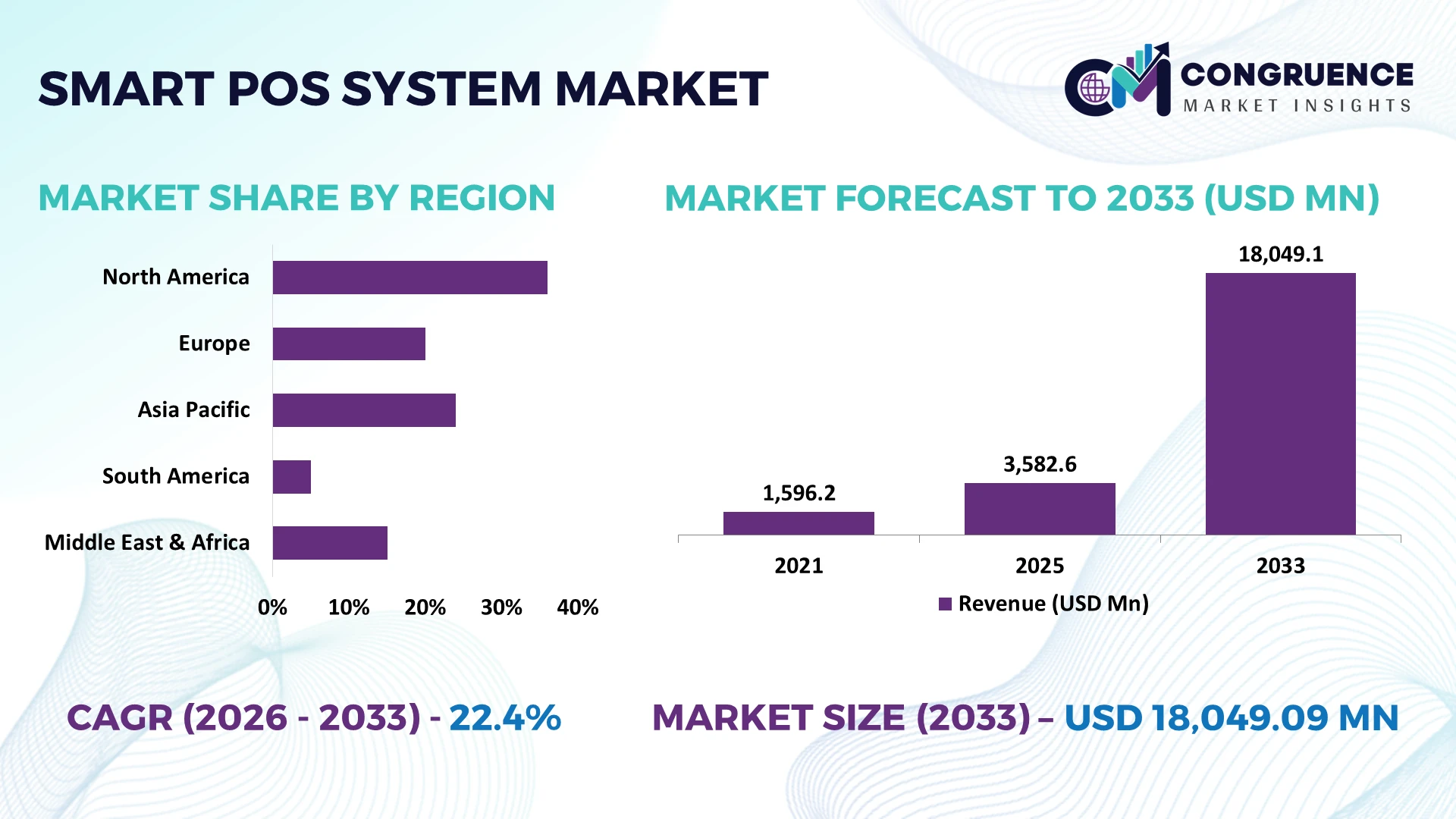
The Global Smart POS System Market was valued at USD 3582.64 Million in 2025 and is anticipated to reach a value of USD 18049.09 Million by 2033 expanding at a CAGR of 22.4% between 2026 and 2033. Growth is driven by cloud-native POS migration, contactless and QR payment integration, AI-enabled inventory automation, omnichannel commerce, and the replacement of legacy terminals with connected Android and tablet-based smart POS platforms.
The United States remains the dominant smart POS deployment hub, supported by roughly 730,000 restaurant locations and millions of retail merchants; Square alone serves an estimated 4 million U.S. merchants. In smaller U.S. restaurants, Clover controls about 20% of card-processing locations versus Toast at 17%, while 85% of restaurant leaders are investing in AI and automation technologies. India presents the strongest scale comparison: digital-payment volume reached 22,831 crore transactions in FY2024–25, while August 2025 UPI activity exceeded 19 billion transactions. Government support for low-value merchant UPI payments, alongside supply-chain digitization across retail and foodservice, is accelerating smart POS integration beyond traditional card acceptance.
Strategically, vendors combining payments, AI analytics, inventory, loyalty, and omnichannel software will capture substantially greater merchant value than hardware-focused terminal suppliers.
Market Size & Growth: USD 3,582.64 million in 2025 advances to USD 18,049.09 million by 2033 at 22.4% CAGR, propelled by cloud-connected payment and merchant-management platforms.
Top Growth Drivers: Contactless adoption, omnichannel retail, and automation dominate; 85% of restaurant leaders plan technology investment, 77% expect inventory automation benefits, and 76% identify payment automation gains.
Short-Term Forecast: By 2027, advanced smart POS deployments integrating AI, KDS, inventory, and handheld ordering are positioned to cut transaction or service-processing time by approximately 20–30%.
Emerging Technologies: AI-assisted checkout, computer vision, biometric authentication, IoT payments, and edge analytics are shifting POS from payment terminals toward intelligent commerce operating systems.
Regional Leaders: North America approaches USD 1.3 billion, Asia-Pacific approximately USD 1.1 billion, and Europe nearly USD 0.8 billion on a 2025 allocation basis, led respectively by cloud POS, QR/mobile payments, and contactless adoption.
Consumer/End-User Trends: POS penetration reached 74% among surveyed U.S. independent retailers, while 43% of single-location operators expect increased future AI use.
Pilot/Case Example: In 2025, Bluestone Lane’s Square platform integration across 65 locations delivered 50% faster ordering, demonstrating measurable throughput gains from unified smart POS infrastructure.
Competitive Landscape: Clover holds approximately 20% of smaller U.S. restaurant processing locations, with Toast at 17%; Square, Oracle, NCR Voyix, and Lightspeed intensify platform competition.
Regulatory & ESG Impact: India’s ₹1,500-crore low-value UPI incentive program supports merchant digitization, including a 0.15% incentive on eligible transactions up to ₹2,000 for small merchants.
Investment & Funding: Block allocated approximately USD 2.91 billion to product development in 2025, while Toast invested USD 374 million in R&D, reinforcing AI, integrated payments, software, and platform expansion.
Innovation & Future Outlook: Smart POS platforms are evolving toward AI-driven autonomous commerce, embedded finance, IoT payments, and unified customer data, shifting competitive advantage from terminal hardware to recurring software ecosystems.
Smart POS systems are becoming central operating platforms across restaurants, grocery, specialty retail, hospitality, and service businesses as merchants consolidate payments, inventory, loyalty, workforce management, and analytics. U.S. restaurant operators show particularly strong momentum, with 85% planning technology investment. Meanwhile, India’s UPI expansion and global contactless infrastructure are accelerating demand for cloud-native, AI-enabled, interoperable POS ecosystems, setting the stage for deeper strategic market shifts.
Smart POS systems are becoming strategic commerce infrastructure as merchants shift from standalone payment terminals toward unified platforms connecting payments, inventory, loyalty, workforce management, and analytics. In the United States, 85% of restaurant leaders plan technology investments, while India processed more than 22,800 crore digital-payment transactions during FY2024–25. This digital infrastructure modernization is forcing vendors to compete on software ecosystems rather than terminal specifications.
Cloud-connected smart POS platforms can reduce order-processing time by roughly 20–30% compared with legacy counter-based workflows by combining handheld ordering, automated payment routing, and real-time synchronization. North America leads in integrated restaurant and retail software, whereas India has greater transaction-scale momentum through UPI. China remains differentiated by QR-centric commerce and deeply embedded mobile-payment ecosystems, creating distinct localization requirements for global providers.
A practical example is Bluestone Lane, where Square-supported technology across 65 locations produced approximately 50% faster ordering. Providers are consequently increasing investment in AI analytics, embedded finance, handheld devices, and application integrations while partnering with processors and commerce platforms. Through 2028, AI-assisted operations and unified merchant data will become increasingly standard, making ecosystem depth, interoperability, and measurable operating efficiency decisive competitive advantages.
Merchant migration from isolated payment terminals to integrated commerce platforms is the strongest structural driver for smart POS adoption. Around 85% of U.S. restaurant leaders plan technology investment, while 76% identify payment automation as an operational opportunity and 77% see benefits from inventory automation. India reinforces this shift through UPI, which handled more than 19 billion transactions during August 2025. This nationwide digital-payment infrastructure is converting POS devices into connected operational endpoints supporting payments, stock visibility, loyalty, and analytics. Vendors including Square, Toast, and Clover are responding by expanding software modules, handheld terminals, AI capabilities, and third-party integrations. The strategic advantage increasingly comes from controlling merchant workflows and data, not merely processing transactions, strengthening recurring platform engagement and reducing merchant dependence on fragmented software stacks.
Interoperability remains a structural constraint because merchants frequently operate separate accounting, payment, inventory, e-commerce, and loyalty systems. Industry surveys indicate roughly 30% of small businesses identify integration complexity among barriers to technology adoption, while payment-processing charges commonly approach 2–3% of transaction value for card-based commerce. Hardware replacement can add another 10–20% to initial modernization costs when multiple terminals, peripherals, and kitchen systems require upgrades. In the United States, fragmented processor contracts and proprietary POS ecosystems further raise switching costs for multi-location operators. Providers are countering this through API marketplaces, bundled hardware-software subscriptions, migration tools, and processor partnerships. Vendors that support open integrations gain a structural advantage because interoperability lowers deployment friction while protecting merchants from costly technology lock-in.
The next opportunity extends beyond checkout into AI-assisted operating decisions. Approximately 43% of U.S. single-location restaurant operators expect greater AI use, while 77% of restaurant leaders identify inventory automation as valuable and 76% see potential in payment automation. Smart POS platforms can increasingly predict stock requirements, automate promotions, detect transaction anomalies, and optimize labor scheduling using transaction-level data. India offers an additional ecosystem opportunity as UPI processes billions of transactions monthly, creating demand for affordable cloud POS systems integrating QR acceptance with inventory and merchant analytics. Vendors are investing in AI copilots, embedded lending, automated reconciliation, and application marketplaces. The non-obvious advantage is data compounding: providers controlling payments plus operational datasets can generate increasingly precise merchant recommendations, strengthening retention while creating differentiated financial and software services.
Scaling connected POS infrastructure increases the number of endpoints exposed to credential theft, malware, payment fraud, and configuration errors. Human involvement remains associated with roughly 60% of security breaches globally, while organizations increasingly manage hundreds or thousands of connected payment and operational devices. For large U.S. restaurant and retail chains, even 99.9% platform availability still represents nearly nine hours of potential annual downtime, making resilience commercially significant. Cloud POS providers must simultaneously maintain PCI-aligned payment security, software updates, API reliability, and consistent device configurations across distributed locations. Companies are investing in tokenization, end-to-end encryption, multifactor authentication, automated patching, and centralized device management. Long-term leadership therefore depends on operational resilience: vendors unable to secure and remotely manage expanding endpoint fleets will struggle to win enterprise-scale deployments regardless of software functionality.
Handheld Ordering Moves Tableside: U.S. restaurants are shifting transaction capture from fixed counters to server-held devices, eliminating repeated trips to stationary terminals. About 52% of limited-service operators prioritized POS investment in 2025, 49% targeted contactless ordering/payment, and 30% planned self-order technology. Operators are expanding handheld fleets and kitchen-display integration to shorten order-to-fire cycles and improve table utilization.
Off-Premises Workflows Reshape POS: Nearly 75% of U.S. restaurant traffic occurred off-premises in 2025, while mobile ordering reached 57% of adults and 65% of limited-service operators offered delivery. POS providers are consequently consolidating delivery, pickup, loyalty, menu synchronization, and payment routing into one workflow, reducing reconciliation work and preventing channel-specific order fragmentation.
AI Enters Transaction Operations: POS-generated data is increasingly feeding operational AI rather than remaining limited to sales reporting. In 2025, 28% of U.S. restaurant operators planned AI investment, 47% targeted inventory software, and 51% prioritized workforce-management applications. Vendors are linking transaction histories with forecasting, scheduling, and exception management, turning POS databases into real-time operating intelligence.
Self-Service Becomes Format Specific: Kiosks are expanding selectively rather than replacing staffed checkout universally. About 65% of limited-service consumers accept kiosk ordering, versus 60% of full-service diners willing to order through tableside tablets; 65% of full-service customers accept tablet-based payment. Operators are therefore deploying self-service around high-throughput workflows while retaining employee interaction where hospitality remains commercially important.
Cloud-Based POS represents the leading type, accounting for an estimated 32% of smart POS deployments as merchants prioritize centralized updates, remote administration, multi-store reporting, and integration with e-commerce and payment services. Terminal POS remains strategically important in high-throughput grocery and established retail environments, representing roughly 25%, where reliability and peripheral compatibility outweigh mobility. Tablet POS occupies the middle ground, combining lower hardware requirements with flexible counter deployment for restaurants and specialty retailers.
Mobile POS is the fastest-growing type as merchants move transaction capture directly to customers, tables, queues, and temporary selling locations. Handheld ordering eliminates the traditional two-stage workflow of recording an order and subsequently entering it at a fixed station. Self-Service POS is simultaneously gaining relevance in quick-service restaurants and grocery stores, where throughput determines deployment economics. Vendors are consequently concentrating product investment on cloud orchestration, Android-based handhelds, kiosk integration, and unified device management, while mature terminal platforms increasingly serve as connected nodes within broader cloud ecosystems.
Payment Processing remains the largest application, representing approximately 38% of Smart POS System Market usage because transaction acceptance remains the primary deployment trigger across retail and foodservice. Contactless cards, mobile wallets, QR payments, and integrated acquiring are broadening functionality beyond conventional card authorization. Order Management follows strongly in restaurants, where digital, delivery, drive-thru, and counter orders increasingly require centralized routing to kitchens and fulfillment stations.
Sales Analytics is emerging as the fastest-growing application as merchants convert transaction histories into product-level forecasting, promotion optimization, location benchmarking, and labor decisions. Inventory Management is becoming more tightly synchronized with POS data; approximately 47% of limited-service restaurant operators identified inventory-management software as an investment area in 2025. Customer Management is likewise advancing through integrated loyalty profiles and personalized offers. Providers are responding by embedding analytics dashboards, automated replenishment, CRM functionality, and omnichannel order orchestration within core platforms. Investment is therefore shifting from isolated payment acceptance toward applications capable of translating transaction data into actionable operating decisions.
Retail Stores constitute the largest end-user group, representing an estimated 36% of smart POS demand because large store networks require high transaction availability, payment interoperability, SKU-level inventory synchronization, and omnichannel checkout. Grocery Stores maintain substantial terminal density because multiple checkout lanes, self-service stations, and high daily transaction volumes create intensive infrastructure requirements. Hotels and broader Hospitality Businesses use smart POS primarily to integrate foodservice, guest accounts, property systems, and contactless payment workflows.
Restaurants are the fastest-growing end-user group as ordering moves beyond fixed counters into handheld, kiosk, mobile, drive-thru, delivery, and tableside environments. Nearly 75% of U.S. restaurant traffic was off-premises in 2025, while 57% of adults had recently used mobile ordering and more than 60% of younger consumers reported increasing off-premises usage. POS vendors are responding with restaurant-specific bundles covering kitchen displays, menu management, handheld ordering, loyalty, and delivery aggregation. Competitive investment is therefore moving toward verticalized ecosystems rather than standardized terminals, with restaurant operators demanding greater workflow depth than traditional payment-centric installations.
North America accounted for the largest market share at 36% in 2025 however, Asia-Pacific is expected to register the fastest growth, expanding at a CAGR of 25.8% between 2026 and 2033.
Integrated Commerce Platforms Replace Standalone Terminals
North America accounts for approximately 36% of Smart POS System Market activity, supported by dense card infrastructure, cloud software adoption, and large restaurant and specialty-retail networks. U.S. merchants are increasingly consolidating payment acceptance, online ordering, loyalty, inventory, and workforce functions within unified POS environments. Contactless transactions now represent more than 60% of face-to-face Visa payments in the United States, strengthening demand for NFC-enabled terminals and mobile checkout. Restaurant digitization is particularly important: approximately 52% of limited-service operators planned POS investment during 2025. Providers are responding through handheld deployment, embedded payments, kitchen-display integration, and merchant-financing services. Canada adds strong contactless-payment penetration, while Mexico increasingly supports Android-based terminals. Competition is consequently shifting toward merchant operating ecosystems where software attachment, transaction data, and vertical-specific applications determine retention.
United States Market Outlook: The United States combines extensive merchant acquiring infrastructure with strong restaurant-tech and retail-software ecosystems. More than 730,000 restaurant locations create substantial deployment density, while platforms such as Toast, Square, Clover, and Oracle increasingly integrate payments with ordering and back-office workflows. Enterprise buyers prioritize uptime, cybersecurity, multi-location administration, and measurable labor productivity.
Contactless Infrastructure Accelerates POS Modernization
Europe represents approximately 25% of global smart POS deployment, supported by mature card acceptance, widespread contactless behavior, and regulatory pressure for secure digital transactions. Contactless usage exceeds 80% of in-person Visa transactions across several European markets, pushing retailers toward NFC-enabled terminals, mobile POS, and cloud-managed payment infrastructure. PSD2-driven authentication requirements and expanding digital-wallet usage have also increased demand for secure payment orchestration rather than basic transaction hardware. Retailers in France, Italy, Spain, and the Nordic economies are integrating POS with inventory, loyalty, tax reporting, and omnichannel fulfillment. Hospitality operators increasingly deploy portable terminals to move payment directly to tables. Vendors are responding with localized payment methods, subscription-based software, Android terminals, and processor partnerships. Europe’s competitive distinction is interoperability: merchants increasingly favor platforms capable of supporting multiple payment schemes and regulatory environments from one architecture.
United Kingdom Market Outlook: The United Kingdom remains a major European technology deployment hub, with contactless accounting for well above 60% of card transactions. Its concentrated hospitality, convenience-retail, and restaurant sectors support rapid adoption of cloud POS, handheld payments, and integrated commerce software. Providers increasingly compete through faster onboarding, open APIs, flexible acquiring, and vertical-specific applications.
QR Scale Reshapes Merchant Infrastructure
Asia-Pacific holds approximately 27% of global Smart POS System Market activity and exhibits the strongest transition from conventional terminals toward QR, mobile, Android, and cloud-connected commerce. China’s deeply embedded QR-payment ecosystem contrasts with Japan’s continuing modernization of cash-intensive merchant workflows, while Southeast Asian economies are expanding interoperable QR networks. India represents the most significant transaction-scale catalyst: UPI processed more than 19 billion transactions in August 2025, increasing demand for merchant devices combining QR acceptance, cards, inventory, invoicing, and analytics. Hardware manufacturing strength in China and Taiwan additionally supports competitively priced Android terminals and peripherals. Vendors are adapting through localized payment integrations, lightweight cloud applications, multilingual interfaces, and distributor partnerships. The strategic shift is especially important among micro and small merchants, where software-led POS can monetize operational services even when payment acceptance itself produces limited margins.
India Market Outlook: India combines extraordinary digital-payment scale with a large fragmented merchant base. UPI processed more than 22,800 crore transactions during FY2024–25, while government incentives continue supporting low-value merchant payments. Smart POS suppliers are therefore integrating UPI QR, cards, GST-compatible invoicing, inventory control, and merchant analytics into affordable Android and mobile platforms.
Instant Payments Redefine Merchant Acceptance
South America accounts for approximately 7% of global smart POS activity, with Brazil driving deployment through instant payments, fintech acquiring, Android terminals, and expanding digital commerce. Pix processed more than 60 billion transactions during 2024, fundamentally changing checkout economics by allowing merchants to combine QR-based account transfers with card acceptance. Argentina, Chile, and Colombia are also expanding digital merchant acceptance, although currency volatility, device affordability, and uneven connectivity constrain uniform deployment. Retailers and restaurants increasingly prefer multifunction terminals that combine payment, fiscal functionality, inventory, and digital receipts. Fintech-led acquiring has intensified pricing pressure on established processors, encouraging subscription bundles and merchant-service differentiation. Providers are consequently scaling through local banking partnerships, cloud software integration, and lower-cost Android hardware. The region’s non-obvious opportunity lies in replacing separate payment devices and business-management applications with one merchant operating endpoint.
Brazil Market Outlook: Brazil dominates South American deployment because Pix, extensive card usage, and strong fintech competition have transformed merchant acceptance infrastructure. Pix accounted for more than 40% of electronic payment transactions during 2024. Providers such as Stone, PagBank, and Mercado Pago increasingly compete through integrated acquiring, business software, credit, and merchant-management services rather than terminal pricing alone.
Cashless Programs Accelerate Payment Infrastructure
Middle East & Africa represents approximately 5% of global smart POS activity, but deployment patterns differ sharply by country. Saudi Arabia and the UAE are modernizing merchant infrastructure through cashless-economy initiatives, tourism expansion, and digitally integrated retail, while African markets increasingly combine mobile money with affordable Android POS devices. Saudi electronic payments represented approximately 79% of retail transactions in 2024, reinforcing demand for NFC terminals, cloud POS, and integrated merchant applications. UAE hospitality and premium retail deployments emphasize multilingual checkout, digital wallets, and omnichannel integration. By contrast, Kenya and Nigeria require lower-cost hardware, offline functionality, and mobile-money interoperability. Vendors are responding through bank partnerships, localized acquiring, portable terminals, and cloud subscriptions. Reliable connectivity and merchant economics remain uneven, making adaptable deployment architecture more strategically important than standardized global hardware configurations.
Saudi Arabia Market Outlook: Saudi Arabia offers the strongest structural modernization case, supported by Vision 2030, rapid tourism infrastructure expansion, and high electronic-payment penetration. With cashless payments representing roughly four-fifths of retail transactions, restaurants, hotels, entertainment venues, and retailers increasingly require integrated POS platforms connecting payments, loyalty, inventory, and enterprise reporting.
Block, Fiserv, Toast, NCR Voyix, Oracle, and Lightspeed compete across overlapping merchant segments, with fintech-led platforms challenging established enterprise POS suppliers through integrated payments and cloud software. The top five players collectively control approximately 35% of the addressable smart POS landscape, leaving substantial scope for vertical specialists and country-focused providers. Competition increasingly centers on software attachment, processing economics, interoperability, and deployment speed: integrated platforms can reduce order-processing time by 20–30%, while cloud administration can lower selected maintenance workloads by roughly 15–25%. Toast concentrates on restaurants, Block targets SMB commerce, Oracle emphasizes enterprise hospitality, while Fiserv leverages Clover across diversified merchants. Players are expanding handheld hardware, AI analytics, embedded finance, application marketplaces, and processor partnerships. The competitive shift is from terminal ownership toward merchant workflow control and recurring software engagement. High switching costs, payment certifications, security requirements, and ecosystem integration create barriers. Winning requires vertical specialization, open integrations, reliable payments, and demonstrable operating efficiency.
Block, Inc. (Square)
Fiserv, Inc. (Clover)
Toast, Inc.
NCR Voyix Corporation
Oracle Corporation
Lightspeed Commerce Inc.
Shopify Inc.
Shift4 Payments, Inc.
PAR Technology Corporation
PAX Global Technology Limited
Diebold Nixdorf, Incorporated
Toshiba Tec Corporation
Ingenico
Verifone
Cloud-native POS, integrated payments, Android terminals, and handheld devices define current technology investment. Centralized software updates can reduce POS administration workloads by about 20%, while tableside ordering can improve order-processing speed by 25%. Contactless acceptance is already mainstream across advanced markets, pushing merchants toward unified platforms connecting payments, inventory, loyalty, kitchen systems, and workforce tools rather than standalone checkout hardware.
Emerging architectures combine AI analytics, computer vision, biometric authentication, SoftPOS, and edge processing. AI-assisted forecasting can improve inventory accuracy by roughly 15%, while smartphone-based SoftPOS can cut dedicated acceptance-hardware costs by more than 90% for suitable small merchants. Compared with legacy fixed-terminal workflows, modern handheld and cloud POS deployments can deliver approximately 25% faster service while synchronizing orders and operational data across channels.
Disruptive development is shifting toward agentic AI, embedded finance, autonomous checkout, and API-led commerce orchestration. Adoption will favor restaurant chains, omnichannel retailers, and payment providers controlling high-quality transaction data; these operators gain stronger personalization and lower reconciliation effort than hardware-focused rivals. Between 2026 and 2028, AI-driven exception handling, predictive staffing, software-defined acceptance, and deeper reservation-delivery integration will move POS from transaction processing toward real-time operating control, making platform investment strategically urgent across increasingly complex multi-location merchant environments.
April 2026 Toast launched Toast Go 3 globally across the United Kingdom, Ireland, Canada, and Australia, expanding its handheld POS footprint beyond the United States. The device targets high-pressure hospitality workflows and billions of orders, and multi-location resilience. Source: toasttab.com
April 2025 Applebee’s selected Toast to replace legacy POS and back-of-house systems across all 1,500 U.S. restaurants, adding handhelds, kitchen displays, and management software. The nationwide migration modernizes operations and standardizes digital workflows across front and back operations. Source: restaurantbusinessonline.com
May 2025 DoorDash named 11 preferred POS and middleware integration partners, including Square, Toast, and PAR, requiring order and error rates below 1%. The program raises interoperability benchmarks and rewards vendors delivering reliable real-time restaurant connectivity at scale. Source: nrn.com
November 2024 FOMO Pay and Mastercard launched FOMO SoftPOS in Singapore, enabling smartphones to accept contactless cards without dedicated terminals. Tap on Phone can cut payment-hardware costs by over 90%, widening SME digital acceptance for smaller Singapore merchants. Source: mastercard.com
The Smart POS System Market report evaluates deployment across Mobile POS, Tablet POS, Terminal POS, Self-Service POS, and Cloud-Based POS, alongside applications covering payment processing, inventory management, customer management, order management, and sales analytics. It also assesses adoption across retail stores, restaurants, hotels, grocery stores, and hospitality businesses, with regional coverage spanning North America, Europe, Asia-Pacific, South America, and Middle East & Africa.
The study tracks cloud migration, handheld ordering, SoftPOS, AI-enabled analytics, contactless acceptance, kiosk automation, embedded payments, and API-led integration. It examines deployment concentration, platform interoperability, enterprise modernization, and emerging merchant ecosystems, including high-growth restaurant and omnichannel retail use cases. The report supports 2026–2033 investment planning, geographic expansion, partnership strategy, competitive benchmarking, technology prioritization, and long-term positioning by identifying where adoption intensity, operating efficiency, and platform differentiation are reshaping market direction.
| Report Attribute/Metric | Report Details |
|---|---|
Market Revenue in 2025 | USD 3582.64 Million |
Market Revenue in 2033 | USD 18049.09 Million |
CAGR (2026 - 2033) | 22.4% |
Base Year | 2025 |
Forecast Period | 2026 - 2033 |
Historic Period | 2021 - 2025 |
Segments Covered | By Type
By Application
By End-User
|
Key Report Deliverable | Revenue Forecast, Growth Trends, Market Dynamics, Segmental Overview, Regional and Country-wise Analysis, Competition Landscape |
Region Covered | North America, Europe, Asia-Pacific, South America, Middle East, Africa |
Key Players Analyzed | Block, Inc. (Square), Fiserv, Inc. (Clover), Toast, Inc., NCR Voyix Corporation, Oracle Corporation, Lightspeed Commerce Inc., Shopify Inc., Shift4 Payments, Inc., PAR Technology Corporation, PAX Global Technology Limited, Diebold Nixdorf, Incorporated, Toshiba Tec Corporation, Ingenico, Verifone |
Customization & Pricing | Available on Request (10% Customization is Free) |




