
Reports
The Global Smart Parking System Market was valued at USD 5,918.3 Million in 2025 and is anticipated to reach a value of USD 19,389.3 Million by 2033 expanding at a CAGR of 15.99% between 2026 and 2033. Growth is driven by the integration of IoT sensors, AI-enabled occupancy detection, automated payments, license-plate recognition, and cloud-based parking management with smart-city infrastructure.
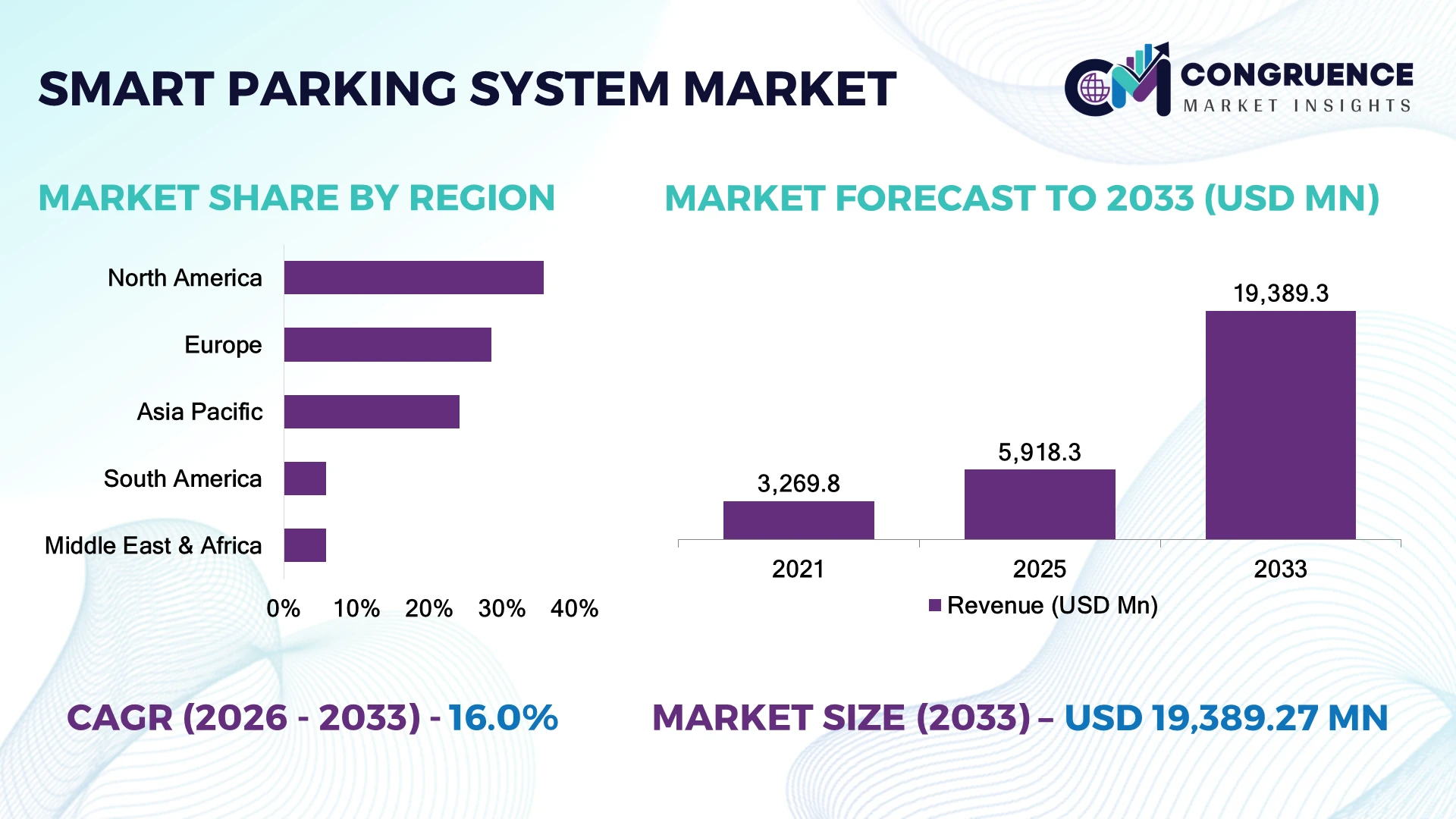
North America held the dominant position with more than 35% share in 2025, supported by high urban parking density, municipal digitization, and established IoT infrastructure. The U.S. accounted for the largest country-level demand, while India represented about 2.3% of global smart parking systems demand. Singapore is advancing barrier-free parking, digital payments, and real-time availability technologies, while its connected mobility infrastructure covers more than 75% of vehicles through ERP 2.0 adoption.
Strategically, vendors that combine parking hardware, AI analytics, digital payments, and mobility platforms are best positioned to capture multi-site deployments.
Market Size & Growth: Market value reached USD 5,918.3 million in 2025 and is projected at USD 19,389.3 million by 2033, expanding at 15.99%, supported by IoT, AI, and automated parking technologies.
Top Growth Drivers: IoT infrastructure contributes to adoption, AI-enabled parking analytics expands by 20%+, and smart-city modernization drives deployment across major urban centers.
Short-Term Forecast: By 2028, connected parking deployments are positioned to reduce parking-search time by around 20–30% while improving occupancy visibility and enforcement efficiency.
Emerging Technologies: AI-based occupancy detection, computer vision, license-plate recognition, cloud platforms, and digital payments are shifting parking from standalone meters toward integrated mobility systems.
Regional Leaders: North America is projected at about USD 6.87 billion by 2033, Europe at USD 5.84 billion, and Asia Pacific at USD 4.89 billion, with Asia Pacific showing the strongest smart-city deployment momentum.
Consumer/End-User Trends: More than 60% of commercial operators prioritize ecosystem integration, particularly connections between parking, payment, navigation, and EV-charging platforms.
Pilot/Case Example: A 2021 smart-parking-garage test reduced median parking-search time by 35 seconds, demonstrating measurable operational improvement over conventional parking workflows.
Competitive Landscape: Amano McGann leads with approximately 3% share, while Flowbird, HUB Parking Technology, SKIDATA, and SWARCO form a fragmented competitive group with the top five accounting for about 12%.
Regulatory & ESG Impact: Singapore's connected mobility framework is integrating parking availability into vehicle systems, while digital parking guidance reduces unnecessary vehicle circulation and supports lower urban emissions.
Investment & Funding: Smart-city and connected-mobility investment is increasingly shifting toward integrated platforms, with partnerships linking parking operators, municipalities, payment providers, EV networks, and technology vendors.
Innovation & Future Outlook: AI-driven dynamic pricing, predictive occupancy, barrier-free access, and EV-charging integration will shift competition toward unified mobility ecosystems rather than standalone parking hardware.
Smart Parking System Market demand is increasingly concentrated in commercial complexes, airports, hospitals, transportation hubs, residential developments, and digitally managed city centers. AI-enabled occupancy prediction and cloud-based payment platforms are strengthening operational visibility, while connected parking adoption is accelerating as municipalities modernize curb management and mobility infrastructure. This shift is creating a stronger strategic case for integrated parking ecosystems.
Smart parking is becoming strategically important because parking infrastructure is shifting from a physical asset-management function into a connected urban-mobility platform. Operators increasingly compete through occupancy intelligence, digital payments, automated enforcement, and real-time guidance rather than conventional meters and manual monitoring. This transition aligns parking investments with broader smart-city and infrastructure-modernization programs.
Technology economics are also changing deployment decisions. Sensor- and app-enabled systems can reduce parking-search time by measurable seconds per trip, while AI-based occupancy analytics improves utilization without requiring proportional expansion of physical parking capacity. North America retains the strongest installed base, whereas Asia Pacific is accelerating deployment through dense urban development and government-backed digital infrastructure programs.
Over the next 2–3 years, operators are expected to prioritize cloud migration, license-plate recognition, EV-charging integration, and predictive analytics. Singapore's integration of parking availability into connected vehicle infrastructure illustrates how parking is becoming part of wider transport management. Companies are responding through platform partnerships, software acquisitions, and multi-site expansion. Competitive advantage will increasingly depend on interoperability, data intelligence, and the ability to integrate parking with the broader mobility ecosystem.
The integration of IoT, AI, and cloud infrastructure is accelerating smart parking deployment across digitally managed urban environments. More than 60% of commercial operators increasingly prioritize ecosystem integration, while North America maintains more than 35% market share through mature connected infrastructure and municipal technology programs. Singapore's connected mobility rollout demonstrates how parking availability is being incorporated into broader transport systems. Companies are responding by combining sensors, license-plate recognition, payment platforms, and analytics within unified architectures. The resulting shift moves parking management from isolated infrastructure toward real-time mobility optimization, improving utilization and reducing manual intervention. The strongest strategic opportunity lies in converting parking data into recurring software and analytics services rather than relying solely on hardware installation.
Deployment costs and fragmented legacy infrastructure remain significant barriers to scalable smart parking modernization. Hardware, connectivity, installation, and system-integration requirements can materially increase project complexity, while interoperability concerns affect approximately 40% of technology-selection considerations across fragmented parking environments. Older meters and access-control systems often require customized interfaces before cloud platforms can be deployed. Data localization and privacy requirements further complicate cross-border implementations, particularly in tightly regulated markets. Companies are reducing exposure through modular architectures, standardized APIs, multi-year procurement contracts, and localized system integration. The operational priority is shifting from replacing entire parking networks to selectively upgrading sensors, payment systems, and software layers while preserving usable legacy assets.
AI-based occupancy prediction, dynamic pricing, computer vision, and EV-charging integration are opening higher-value opportunities beyond conventional parking management. Asia Pacific is expected to maintain the strongest deployment momentum, while India already represents approximately 2.3% of global smart parking systems demand. Predictive analytics can enable operators to optimize space allocation, pricing, enforcement, and maintenance using real-time utilization data. Singapore's planned sensor-based roadside parking trials demonstrate the transition toward automated detection and payment. Companies are positioning through R&D partnerships, cloud-platform expansion, and integration with navigation and charging ecosystems. The non-obvious opportunity is monetizing aggregated parking intelligence for urban planning, commercial property optimization, and mobility forecasting rather than treating occupancy data solely as an operational input.
Smart parking networks increasingly connect sensors, cameras, payment systems, cloud platforms, mobile applications, and vehicle interfaces, creating a larger cybersecurity and interoperability footprint. More than 60% of technology buyers prioritize ecosystem integration, making API compatibility a critical competitive requirement alongside hardware performance. License-plate recognition and payment systems also introduce sensitive data-management requirements, while connected infrastructure creates additional points for system disruption. Singapore's strict approach to anonymized and aggregated transport data illustrates the regulatory direction toward stronger privacy controls. Companies must therefore invest in encrypted communications, resilient edge processing, standardized APIs, and cybersecurity partnerships. Long-term competitiveness will depend on maintaining reliable service across heterogeneous infrastructure while meeting evolving privacy, security, and digital-governance requirements.
AI Camera Deployment Accelerates: AI-enabled cameras and license-plate recognition are replacing space-by-space sensing in new installations, with camera-based systems representing about 29% of technology deployment and 67% of surveyed transportation planners favoring AI cameras for new on-street projects. Vendors are scaling computer-vision platforms to combine occupancy detection, enforcement, and analytics within one infrastructure layer.
Barrier-Free Access Expands: Mobile credentials, LPR, and contactless payment are reshaping entry and exit workflows, with digital parking services already representing about 18% of service activity in established deployments. Operators are reducing dependence on physical tickets and manual gates, while technology providers are integrating payment, reservation, and access-control functions to shorten transaction times and improve throughput.
Commercial Sites Integrate Charging: Shopping centers, offices, airports, and hospitals are increasingly combining smart parking with EV charging, digital wayfinding, and occupancy analytics. Commercial institutions account for approximately 43% of demand, while integrated parking-and-charging projects are expanding as EV infrastructure becomes a core property-management requirement. Companies are responding with bundled platforms rather than separate parking and charging systems.
India Deployments Become Data-Led: Indian cities are moving from basic parking collection toward centralized, AI-supported management. In 2025, Cochin deployed an AI-based system across 30 locations covering about 2,000 parking spaces, while digital parking programs increasingly connect municipal enforcement with real-time occupancy data. This shift is pushing vendors toward cloud analytics, interoperable APIs, and local implementation partnerships rather than hardware-only contracts.
Off-street parking held the leading position in 2025, accounting for approximately 61% of global smart parking deployment value, supported by controlled infrastructure, centralized enforcement, and easier installation across garages and parking lots. Garage and lot environments allow operators to deploy sensors, cameras, LPR, signage, and payment systems within standardized footprints, improving scalability and reducing integration complexity. On-street systems represented about 39% of demand and remain strategically important for municipalities seeking real-time curb management. Companies are therefore prioritizing off-street platform expansion while developing lighter, camera-based solutions for streets where underground sensor installation is less economical.
The fastest-growing shift is toward intelligent on-street deployments using computer vision, mobile payments, and dynamic occupancy information. AI-LPR systems reduce dependence on individual bay sensors while supporting enforcement and utilization analytics. In India, smart-city deployments are increasingly combining off-street facilities with connected municipal parking management, while U.S. operators continue expanding curbside digitization. The business implication is a two-track investment strategy: standardized automation for garages and lots, alongside flexible vision-based infrastructure for dense streets.
Commercial applications represented the leading demand center, accounting for approximately 43% of the market in 2025. Shopping centers, office complexes, hotels, hospitals, and entertainment facilities require high-throughput parking management and benefit directly from occupancy guidance, automated payments, LPR, and digital reservations. Government applications remain strategically important because municipal projects can deploy systems across larger geographic areas, while transport-transit facilities such as airports and stations prioritize reliability and rapid vehicle circulation. Companies are increasingly tailoring platforms to site-specific traffic patterns instead of selling standardized parking hardware.
Government applications are gaining momentum as cities connect parking with broader traffic-management platforms, creating a faster shift toward centralized enforcement and real-time curb intelligence. Commercial operators, by contrast, are emphasizing customer experience, parking utilization, and integration with EV charging and mobile applications. Transport facilities are focusing on throughput and security. This divergence is pushing vendors toward modular software architectures, with approximately 40% of technology-selection considerations increasingly linked to interoperability and integration requirements. The strategic implication is that application-specific functionality is becoming as important as sensor performance.
Commercial end-users represent the strongest buyer group, with commercial institutions accounting for approximately 43% of smart parking demand in 2025. Shopping malls, office campuses, hotels, hospitals, and private parking operators have concentrated demand because parking directly affects customer throughput, property utilization, security, and operating efficiency. Government and municipal buyers remain critical for large-scale public deployments, particularly where parking is incorporated into smart-city and traffic-management programs. Companies are responding with differentiated pricing, managed-service models, and integrated parking-management platforms for high-volume commercial sites.
Government buyers represent the faster-expanding strategic segment as municipalities digitize curb management and connect parking data with transportation command centers. Their purchasing priorities emphasize interoperability, enforcement, privacy, and long-term infrastructure reliability, while commercial buyers place greater weight on customer experience and return on installed assets. More than 60% of commercial technology buyers increasingly prioritize integration across parking, payment, mobility, and charging platforms. Vendors are consequently developing partnerships with municipalities, property operators, payment providers, and EV infrastructure companies. The key competitive shift is toward ecosystem-based contracts rather than standalone equipment sales.
North America accounted for the largest market share at 35.7% in 2025 however, Asia Pacific is expected to register the fastest growth, expanding at a CAGR of 26.4% between 2026 and 2033.
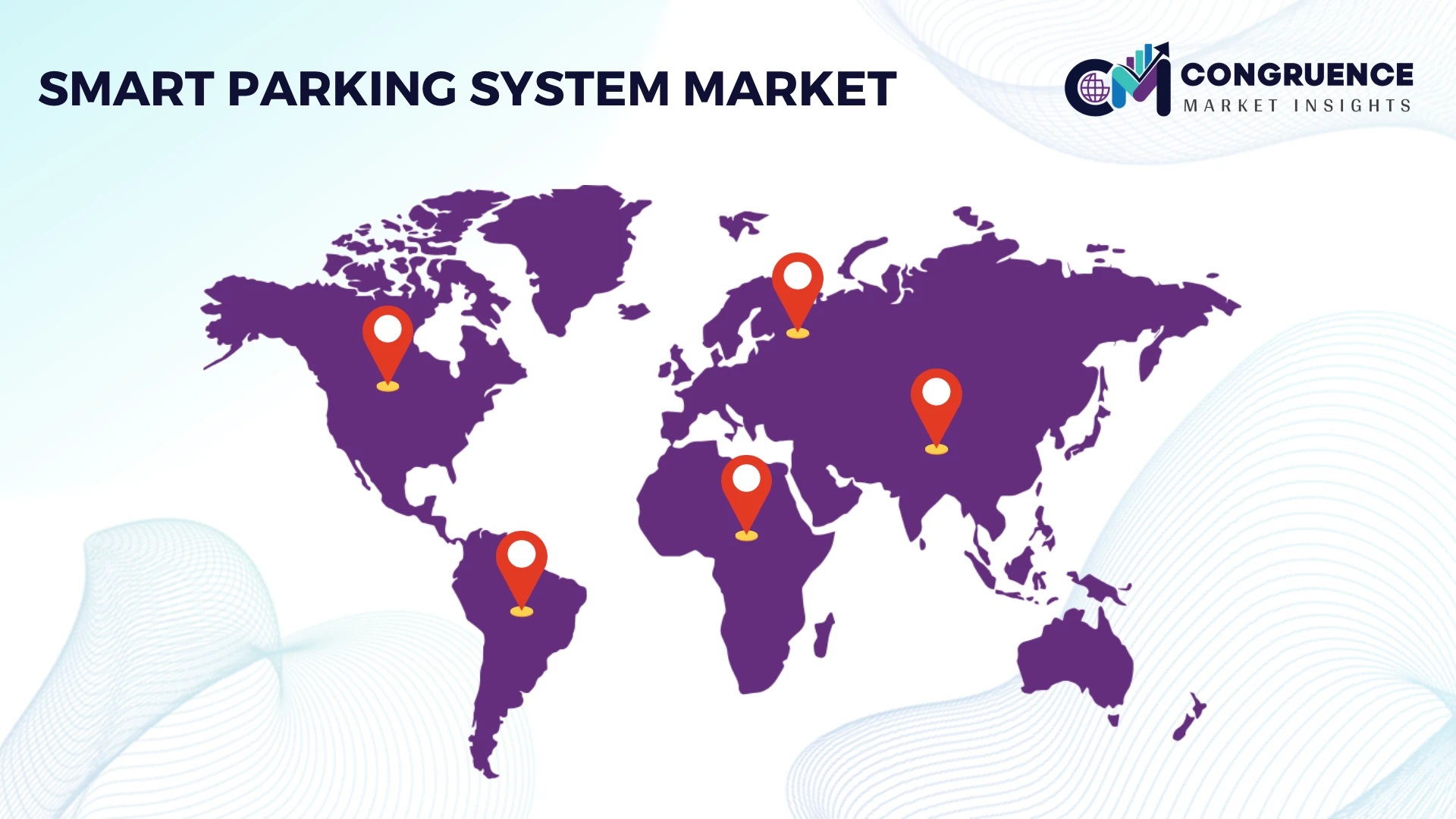
North America held the largest share of the global smart parking system market at 35.7% in 2025. The United States represented approximately 80% of North American demand, supported by mature IoT infrastructure, extensive commercial parking facilities, intelligent transportation programs, and strong adoption of LPR and cloud-based parking platforms. More than 30 U.S. cities have implemented or piloted intelligent transportation projects incorporating smart parking functions. Operators are increasingly integrating occupancy sensors, digital payments, parking guidance, and enforcement into centralized platforms, improving utilization and reducing manual operations. Canada contributes approximately 12% of regional demand, with adoption concentrated around major metropolitan and commercial developments.
United States Market Outlook: The United States represents approximately 28.6% of global smart parking system demand. Strong municipal digitization, extensive parking infrastructure, and established technology ecosystems support large-scale deployments. Companies are expanding cloud platforms, AI-enabled analytics, LPR, and digital payment capabilities while forming partnerships with municipalities, property operators, and mobility providers.
Europe accounted for approximately 28.5% of the global smart parking system market in 2025. Germany, the UK, and France collectively represented nearly 62% of European demand, supported by urban mobility modernization, intelligent transportation infrastructure, environmental policies, and increasing deployment of connected parking platforms. Germany represented more than 36% of European activity, while software-based solutions accounted for approximately 44.9% of regional deployments. Municipalities are integrating parking management with EV charging, traffic monitoring, and digital mobility services. Companies are responding through sensor retrofits, cloud migration, and partnerships linking parking systems with broader transportation platforms.
Germany Market Outlook: Germany accounts for approximately 10.3% of global smart parking system demand and remains Europe's largest national market. Its automotive technology ecosystem, connected mobility infrastructure, and strong municipal digitization provide a favorable deployment environment. Companies are increasingly integrating parking platforms with vehicle connectivity, ANPR, payment systems, and intelligent transportation infrastructure.
Asia Pacific represented approximately 24.2% of the global smart parking system market in 2025, with China, Japan, South Korea, and India accounting for the majority of regional demand. China contributed approximately 47% of Asia-Pacific activity, supported by extensive smart-city investment, AI infrastructure, connected cameras, and digital payment ecosystems. India represented about 9.5% of regional demand and is expanding municipal parking digitization through smart-city initiatives. Hardware accounted for approximately 64.3% of regional deployments, although cloud management and AI analytics are gaining importance. Companies are increasingly using camera-based occupancy detection and centralized platforms to overcome fragmented parking infrastructure.
China Market Outlook: China represents approximately 11.4% of global smart parking system demand and maintains the strongest position in Asia Pacific. Large urban populations, high digital-payment penetration, and extensive AI and camera infrastructure support large-scale deployments. Technology providers are integrating parking systems with smart-city platforms, traffic-management networks, and connected mobility services to improve utilization across dense metropolitan areas.
South America accounted for approximately 5.8% of the global smart parking system market in 2025, with Brazil representing nearly 65% of regional demand. Urban congestion, increasing vehicle ownership, commercial property development, and digital-payment adoption are supporting smart parking deployments in major cities. Brazil's large metropolitan areas provide the primary demand concentration, while Argentina, Chile, and Colombia are developing smaller municipal and commercial projects. Approximately 64% of Brazilian smart parking activity is associated with hardware deployment, including sensors, cameras, meters, and access-control equipment. Companies are favoring modular systems and public-private partnerships to address uneven infrastructure readiness and reduce upfront municipal investment requirements.
Brazil Market Outlook: Brazil represents approximately 3.8% of global smart parking system demand and remains South America's largest national market. São Paulo and Rio de Janeiro provide the strongest deployment concentration because of high vehicle density and commercial parking requirements. Vendors are expanding mobile payment, LPR, digital enforcement, and cloud-based management solutions to improve parking utilization and municipal oversight.
Middle East & Africa accounted for approximately 5.8% of the global smart parking system market in 2025, with the UAE and Saudi Arabia representing approximately 58% of regional demand. The UAE leads adoption through connected infrastructure, high-density commercial developments, airports, tourism facilities, and smart-city programs, while Saudi Arabia is accelerating deployment through large-scale urban modernization projects. Dubai and Abu Dhabi remain the principal technology hubs, with strong adoption of digital payments, LPR, automated parking guidance, and cloud platforms. Companies are targeting new-build developments where smart parking can be integrated during initial infrastructure planning rather than retrofitted later.
UAE Market Outlook: The UAE represents approximately 2.0% of global smart parking system demand and is the region's strongest technology-adoption market. Dubai's integrated transport infrastructure supports digital parking payments, automated enforcement, mobile services, and real-time parking information. Companies are focusing on municipal partnerships and integrated mobility platforms for airports, commercial complexes, tourism facilities, and mixed-use developments.
The competitive field pits integrated access leaders such as SKIDATA, Amano McGann, and HUB Parking Technology against mobility-data specialists including Parkopedia, Flowbird, and SWARCO. The top five players collectively hold an estimated 12–15% share. Technology drives differentiation: AI vision can deliver around 99% detection accuracy, ticketless systems reduce transaction handling time by roughly 20%, and cloud platforms cut manual administration by approximately 15–25%. Global leaders compete through acquisitions, municipal contracts, OEM integrations, and ecosystem partnerships, while regional suppliers emphasize customization, installation speed, and price. The competitive shift is moving from hardware sales toward interoperable parking-as-a-service platforms integrating payments, EV charging, navigation, analytics, and enforcement. High cybersecurity, API interoperability, municipal procurement requirements, and installed-base relationships create entry barriers. Cost pressure remains strongest in emerging markets, where modular retrofit solutions outperform full infrastructure replacement. Winning requires technology breadth, open integration, deployment reliability, recurring software capabilities, and city or enterprise partnerships globally today.
SKIDATA
Amano McGann
HUB Parking Technology
Parkopedia
Flowbird
SWARCO
Passport Labs
ParkMobile
TIBA Parking
Flash
Clever Devices
Scheidt & Bachmann
FAAC Technologies
Robert Bosch GmbH
AI-based computer vision is replacing conventional ultrasonic and single-space sensing in higher-value deployments. Camera systems can reach about 99% detection accuracy, while automated occupancy recognition reduces installation complexity and supports broader coverage. By 2028, vision-led architectures will increasingly become the preferred choice for operators prioritizing scalable analytics, dynamic guidance, and lower infrastructure density.
License-plate recognition, ticketless access, and mobile payments are moving parking workflows away from physical tickets and staffed payment points. Ticketless systems can reduce transaction handling time by roughly 20%, while integrated digital payment adoption is exceeding 60% across technology-forward commercial facilities. SKIDATA, SWARCO, and Parkopedia benefit as platforms combine access, payment, navigation, and parking data.
The disruptive layer is AI-enabled predictive parking, in-car services, and indoor mapping. Parkopedia’s database covers more than 90 million spaces across over 20,000 cities, creating a strong data advantage for connected-vehicle integrations. Compared with legacy static guidance, predictive systems improve space visibility by roughly 15–25%. Between 2026 and 2028, competitive advantage will shift toward interoperable platforms, edge analytics, cybersecurity, EV-charging integration, and recurring software services. Operators that modernize now can capture faster deployment cycles, reduce manual intervention, monetize mobility data, and strengthen customer retention through unified parking ecosystems at scale across cities.
September 2025 SKIDATA acquired ePARK, adding app-based parking across more than 200 municipalities and 6.7 million annual transactions. The move strengthens integrated on- and off-street capabilities, expanding SKIDATA’s digital parking footprint and recurring software services across urban markets globally. Source: skidata.com
April 2025 Parkopedia partnered with ThunderSoft to integrate parking, charging, payments, and indoor mapping into Aqua OS. The platform connects parking data with AI-native vehicle systems, reducing localization complexity for automakers and accelerating connected in-car parking deployment across China. Source: business.parkopedia.com
January 2025 EasyPark completed its acquisition of Flowbird, combining digital parking and transportation capabilities into one mobility platform. The consolidation expands geographic coverage and strengthens integrated urban-mobility offerings, enabling broader deployments across parking, payments, and public-transport management worldwide systems. Source: flowbird.com
2026 SWARCO’s OPTIPARK Parking Guidance System delivers 99% detection accuracy using 360-degree cameras and supports deployments across 200 locations globally. The computer-vision approach offers operators an alternative to costly single-space sensors, improving occupancy visibility while supporting scalable parking guidance and analytics. Source: swarco.com
The Smart Parking System Market report covers the industry across major technology types, applications, and end-user groups, including commercial facilities, government infrastructure, transportation hubs, and other connected parking environments. The analysis evaluates on-street and off-street systems, smart sensors, camera-based detection, LPR, automated payments, parking guidance, cloud platforms, AI analytics, and integrated EV-charging solutions. Coverage extends across North America, Europe, Asia Pacific, South America, and the Middle East & Africa.
The report evaluates deployment concentration, technology adoption, regional market shares, competitive positioning, partnerships, product innovation, and emerging smart-mobility applications. It also examines how approximately 60% of commercial technology buyers increasingly prioritize interoperability across parking, payment, mobility, and charging systems. These insights support investment planning, market-entry decisions, geographic expansion, partnership strategy, technology prioritization, and competitive positioning through 2026–2033.
| Report Attribute / Metric Details | Details |
|---|---|
| Market Revenue (2025) | USD 5,918.3 Million |
| Market Revenue (2033) | USD 19,389.3 Million |
| CAGR (2026–2033) | 15.99% |
| Base Year | 2025 |
| Forecast Period | 2026–2033 |
| Historic Period | 2021–2025 |
| Segments Covered |
By Type
By Application
By End-User
|
| Key Deliverables | Revenue Forecast; Market Trends; Growth Drivers & Restraints; Technology Insights; Segmentation Analysis; Regional Insights; Competitive Landscape; Regulatory & ESG Overview; Recent Developments |
| Regions Covered | North America; Europe; Asia-Pacific; South America; Middle East & Africa |
| Companies Profiled | SKIDATA; Amano McGann; HUB Parking Technology; Parkopedia; Flowbird; SWARCO; Passport Labs; ParkMobile; TIBA Parking; Flash; Clever Devices; Scheidt & Bachmann; FAAC Technologies; Robert Bosch GmbH |
| Customization & Pricing | Available on Request (10% Customization Free) |




