
Reports
The Global Smart Label Market was valued at USD 13,298.5 Million in 2025 and is anticipated to reach a value of USD 21,517.8 Million by 2033 expanding at a CAGR of 6.2% between 2026 and 2033. Growth is being driven by RFID-enabled inventory visibility, item-level traceability, anti-counterfeiting requirements, and connected packaging adoption across retail, pharmaceuticals, food, and logistics.
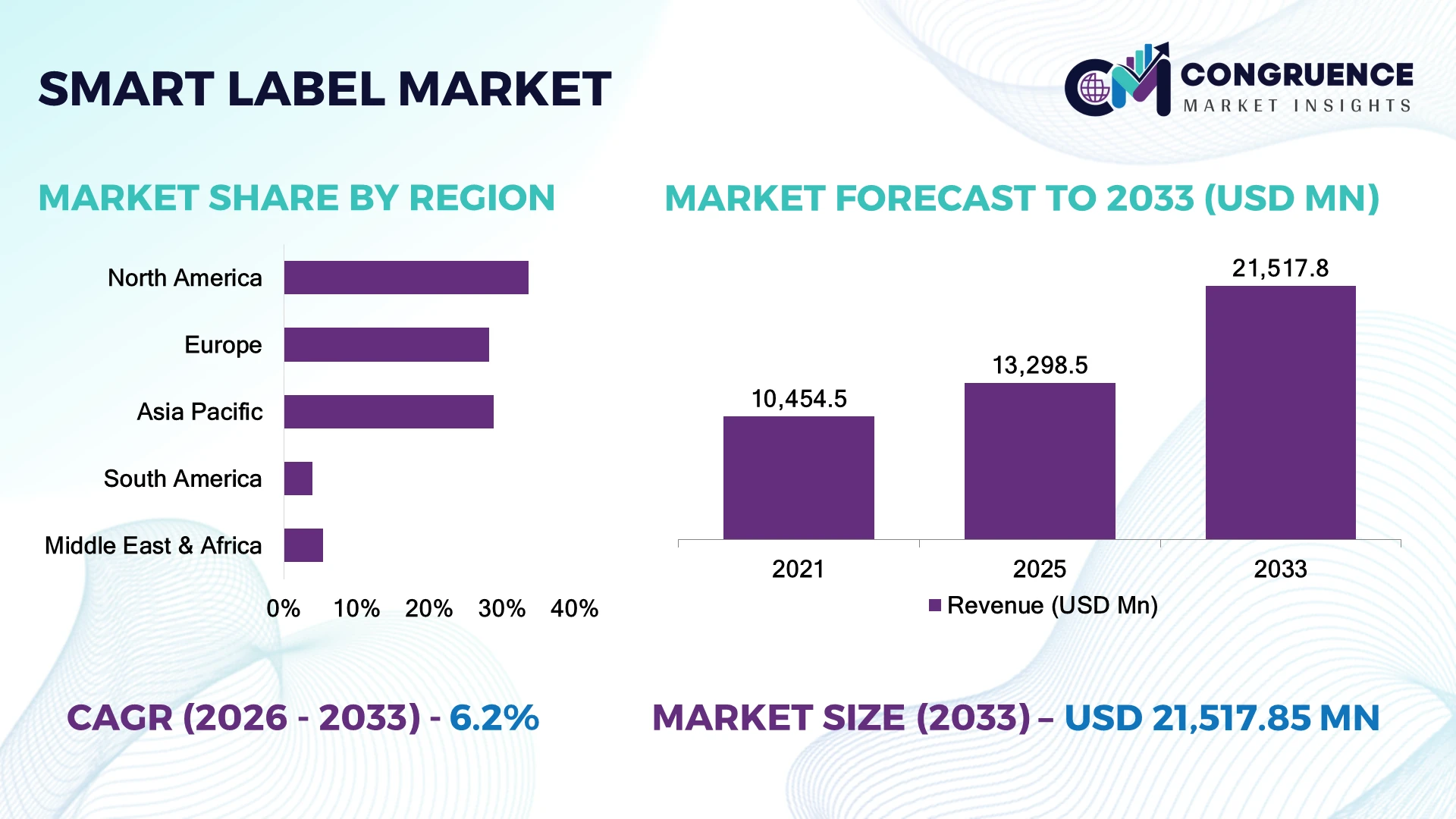
The United States remains the dominant country market, supported by large-scale retail automation, pharmaceutical serialization, and RFID deployment, with North America representing roughly 34% of global demand. China is expanding faster through high-volume manufacturing, e-commerce fulfillment, and government-backed logistics digitization, while Japan emphasizes precision retail and automated inventory management. RFID-enabled smart labels increasingly support item-level identification rates above 90% in mature deployments. Geopolitical supply-chain restructuring is further increasing the value of traceable goods and localized inventory visibility.
Strategically, suppliers that combine low-cost label conversion with RFID, NFC, data integration, and scalable printing capabilities are best positioned to capture enterprise migration toward intelligent identification.
Market Size & Growth: USD 13.30 billion in 2025 to USD 21.52 billion by 2033 at 6.2% CAGR, driven by RFID adoption and supply-chain digitization.
Top Growth Drivers: RFID adoption 38%, inventory automation 31%, anti-counterfeiting requirements 24%.
Short-Term Forecast: By 2028, automated identification workflows are positioned to reduce manual scanning requirements by 20%–30% in high-volume operations.
Emerging Technologies: RFID, NFC, electronic shelf labels, printed sensors, and digital product identifiers are moving smart labels beyond passive identification.
Regional Leaders: North America represents about 34% share, Europe prioritizes traceability, while Asia-Pacific is scaling RFID-enabled manufacturing and logistics.
Consumer/End-User Trends: More than 40% of large retailers increasingly prioritize item-level visibility for inventory-intensive categories.
Pilot/Case Example: 2025 RFID retail deployments demonstrated inventory-accuracy improvements of approximately 15%–25%, strengthening replenishment and shrink-management economics.
Competitive Landscape: Avery Dennison leads the integrated label ecosystem, competing with 3M, CCL Industries, SATO, and Zebra Technologies across RFID, NFC, printing, and identification solutions.
Regulatory & ESG Impact: Digital product-passport and traceability initiatives are increasing pressure for product-level data, while connected labels can reduce paper-based process requirements by approximately 10%–20%.
Investment & Funding: Enterprise investment is shifting toward RFID infrastructure, automated label conversion, digital identity platforms, and integrated warehouse systems rather than standalone label production.
Innovation & Future Outlook: By 2028, sensor-enabled labels, AI-linked inventory analytics, reusable identification formats, and interoperable digital product identities will shift smart labels toward continuous product intelligence.
Smart labels are increasingly moving from identification tools toward operational data interfaces linking products with retail systems, warehouses, pharmaceutical traceability platforms, and consumer-facing digital experiences. RFID remains the strongest commercial technology, while NFC and QR-enabled formats expand consumer engagement and authentication. Approximately 40% of large retailers are increasing investment in item-level visibility, reinforcing demand for scalable encoding, printing, and data-management capabilities. In 2026, supply-chain resilience and emerging product-traceability requirements are making serialized identification strategically important, particularly for pharmaceuticals, food, electronics, and high-value consumer goods. The next competitive battleground is integration: label manufacturers that connect physical identifiers with enterprise data platforms can capture greater value than suppliers competing solely on conversion cost.
Smart labels are becoming strategically important because they connect physical products with inventory, authentication, logistics, and customer-data systems. The transition from conventional barcodes toward RFID, NFC, and serialized digital identifiers is restructuring how enterprises manage item-level information. For pharmaceutical and food companies, traceability is increasingly operational rather than optional, while retailers are prioritizing real-time inventory visibility to reduce stockouts and shrinkage.
RFID-enabled identification can deliver approximately 15%–25% higher inventory accuracy than manual or barcode-dependent processes in suitable high-volume environments, while automated reading reduces repetitive scanning activity by roughly 20%–30%. North America leads enterprise-scale adoption, whereas China, Japan, and South Korea are accelerating manufacturing and logistics integration through high-volume automated facilities.
From 2026 to 2028, deployment is expected to shift toward connected labels integrated with warehouse-management, enterprise-resource-planning, and analytics platforms. Practical applications include automated receiving, shelf-level inventory, pharmaceutical authentication, and temperature-sensitive logistics. Companies are therefore increasing investment in RFID encoding, digital identity infrastructure, sensor integration, and strategic technology partnerships. Competitive advantage will increasingly depend on delivering interoperable smart-label ecosystems rather than simply producing lower-cost labels.
Retailers and manufacturers are accelerating smart-label deployment as item-level visibility becomes central to inventory accuracy, shrink control, and automated fulfillment. RFID adoption in large retail environments is approaching 40%, while automated identification can reduce manual scanning activity by approximately 20%–30%. Pharmaceutical serialization and food traceability requirements are further strengthening enterprise demand. In the United States, retailers are expanding RFID from apparel into cosmetics, electronics, and general merchandise, increasing addressable label volumes. Companies are responding by expanding RFID converting capacity, improving inlay integration, and partnering with software providers to connect labels with warehouse-management platforms. The non-obvious advantage is data continuity: suppliers that provide encoded labels plus integration capabilities can capture recurring enterprise value beyond the physical label.
Smart-label economics remain constrained by higher unit costs, infrastructure requirements, and integration complexity compared with conventional printed labels. RFID-based solutions can carry a 20%–40% cost premium at the label level, while reader, antenna, middleware, and software investments increase initial deployment expenditure. Smaller manufacturers in India and Southeast Asia face greater adoption friction because legacy enterprise systems often lack standardized item-level data structures. Supply-chain disruptions affecting semiconductor-based inlays and specialized antenna materials can further pressure procurement. Companies are mitigating these constraints through dual sourcing, regional inlay procurement, volume contracts, and hybrid deployments combining QR codes with RFID. The critical business issue is not label pricing alone but total deployment economics, making interoperability and infrastructure reuse decisive for scalable adoption.
Digital product identity creates a high-value opportunity as manufacturers connect smart labels with authentication, traceability, recycling information, and product lifecycle data. Digital product-passport initiatives are pushing enterprises toward item-level information systems, while approximately 40% of large retailers are increasing investment in inventory visibility. NFC and QR-enabled labels can extend consumer interaction without requiring dedicated RFID readers, reducing deployment barriers for selected applications. In Europe, sustainability and traceability requirements are creating particularly strong opportunities for apparel, electronics, food, and pharmaceutical packaging. Companies are developing hybrid RFID-NFC-QR architectures, serialized databases, and cloud-based identity platforms. The non-obvious opportunity lies in post-sale data: brands can use connected labels for authentication, warranty registration, recycling instructions, and product engagement, creating measurable value after the initial transaction.
Smart-label expansion increasingly depends on integrating physical identifiers with ERP, warehouse-management, retail, and analytics platforms. Integration projects can increase implementation timelines by 15%–25% when enterprises operate fragmented legacy systems, while RFID read accuracy can fall 5%–15% in dense-metal or liquid-heavy environments without optimized antenna placement and tuning. Cybersecurity and data-governance requirements also become more significant as labels link products to cloud databases and customer-facing services. Companies must therefore invest in middleware, edge processing, reader calibration, cybersecurity controls, and workforce training. The strategic challenge is achieving consistent data capture across suppliers, warehouses, stores, and geographies rather than simply increasing label volumes. Vendors offering standardized APIs, deployment support, and system interoperability will hold an advantage as enterprises scale connected identification infrastructure.
RFID Moves Beyond Apparel: RFID deployment is expanding from apparel into cosmetics, electronics, pharmaceuticals, and general merchandise, with large retailers increasingly targeting item-level visibility. Adoption in major retail environments is approaching 40%, while automated identification can reduce manual scanning activity by 20%–30%. Suppliers are responding with higher-speed encoding, improved inlay placement, and integrated data services.
Hybrid Identification Gains Traction: Enterprises are combining RFID, NFC, and QR technologies rather than relying on a single identification architecture. Hybrid formats can extend connected-label functionality across approximately 20%–30% more consumer touchpoints where RFID infrastructure is unavailable. Companies are restructuring product-identification strategies around application-specific technology combinations, reducing deployment barriers while preserving serialized traceability.
Traceability Becomes Operational: Regulatory pressure and supply-chain restructuring are pushing manufacturers toward product-level digital identity, particularly across pharmaceuticals, food, apparel, and electronics. Digital product-passport initiatives are accelerating investment in serialized records, with traceability programs increasingly covering 50%+ of targeted product information fields. Companies are integrating smart labels with cloud databases, compliance platforms, and recycling workflows rather than treating labels as standalone packaging components.
Connected Labels Add Intelligence: Smart labels are increasingly incorporating sensors and data interfaces for temperature, freshness, authenticity, and condition monitoring. Sensor-enabled formats can improve exception detection by approximately 10%–20% in controlled logistics applications. Pharmaceutical and perishable-goods operators are prioritizing these capabilities where product loss carries high financial impact, while label manufacturers are developing sensor-ready substrates, NFC interfaces, and automated data capture systems.
RFID Dominates as NFC and Sensing Labels Accelerate
RFID labels are the leading smart label type, accounting for approximately 67.3% of market share in 2025, supported by automated identification, longer read ranges, high-volume inventory tracking, and compatibility with warehouse and retail infrastructure. Their mature deployment base gives RFID a clear scalability advantage over NFC, QR-based formats, and sensing labels. NFC labels are the fastest-growing type, driven by smartphone-enabled authentication, consumer engagement, digital product information, and tap-based experiences. Adoption is also expanding as enterprises seek connected packaging without requiring dedicated readers. Companies are increasing RFID converting capacity while developing NFC-compatible product portfolios and integrated encoding platforms.
The competitive shift is moving from single-function identification toward multi-technology label architectures. RFID remains strongest for logistics and inventory, whereas NFC and QR formats are gaining strategic relevance in authentication and interactive packaging. Sensing labels remain comparatively niche but are gaining attention in cold-chain and condition-monitoring applications. Companies are increasingly investing in flexible substrates, battery-free sensing, and interoperable data platforms to broaden smart-label functionality and reduce deployment friction.
GS1's retail RFID guidance highlights item-level identification as an operational mechanism for automated replenishment, inventory updates, self-checkout, loss prevention, and paperless returns, demonstrating how RFID labels are increasingly integrated into end-to-end retail workflows.
Inventory Tracking Leads as Monitoring Expands
Asset and inventory tracking is the leading application, representing approximately 42.6% of smart label demand in 2025, because retailers, manufacturers, and logistics operators prioritize item-level visibility, automated receiving, replenishment, and shrink management. The application benefits from established RFID infrastructure and measurable operational returns, keeping it ahead of product authentication, interactive packaging, and other emerging use cases. Cold-chain monitoring is the fastest-growing application, supported by battery-free sensors, temperature-sensitive logistics, and stricter product traceability requirements. Companies are expanding connected-label deployments from warehouses into transportation, stores, and production environments, improving data continuity across the product lifecycle.
Product authentication and interactive packaging remain strategically relevant as brands combat counterfeiting and seek direct consumer engagement. Approximately 17%–20% of new smart-label deployments increasingly incorporate consumer-facing digital functions alongside identification. Companies are therefore combining RFID, NFC, and QR technologies rather than treating applications as isolated systems. The business priority is shifting toward integrated platforms that capture operational data while supporting authentication, compliance, and consumer interaction from a single serialized product identity.
A 2025 RFID industry assessment identified item-level inventory management as a central deployment priority across retail supply chains, with adoption extending from stores into distribution centers and factories as enterprises pursue more accurate, automated inventory control.
Retail Leads While Healthcare Accelerates
Retail and e-commerce represent the leading end-user group, accounting for approximately 34.8% of smart label demand in 2025, supported by item-level inventory management, automated replenishment, shrink reduction, and omnichannel fulfillment. Retailers have the infrastructure scale and transaction frequency needed to justify RFID investments, while logistics, food and beverage, and manufacturing users increasingly deploy smart labels for asset visibility and traceability. Healthcare and pharmaceuticals are emerging as the fastest-growing end-user group as serialization, authentication, cold-chain monitoring, and product-level traceability become increasingly operationally important.
Retail deployments remain mature and infrastructure-intensive, whereas healthcare buyers place greater emphasis on data integrity, regulatory compliance, and condition monitoring. Approximately 25%–30% of enterprise smart-label programs increasingly extend beyond basic identification into authentication, sensing, or lifecycle data. Companies are responding with sector-specific label designs, stronger software integration, customized inlays, and partnerships spanning printers, RFID platforms, warehouse systems, and cloud analytics. Future competitive positioning will depend on adapting smart-label architectures to industry workflows rather than selling identical identification products across end markets.
GS1's standards framework shows RFID supporting retail receiving, replenishment, point-of-sale inventory updates, loss prevention, returns, and warranty processes, reinforcing the industry's shift from isolated tagging toward integrated item-level data workflows.
North America accounted for the largest market share at 33.6% in 2025 however, Asia-Pacific is expected to register the fastest growth, expanding at a CAGR of 15.1% between 2026 and 2033.
RFID Scale Is Shifting Toward Connected Retail
North America maintains the strongest smart label deployment base, supported by RFID-enabled retail inventory, automated distribution centers, pharmaceutical traceability, and increasingly sophisticated electronic shelf labeling. The region represented 33.6% of global market value in 2025, while RFID remained the dominant technology, accounting for 52.26% of North American smart-label revenue in 2024. Retailers are moving beyond item identification toward real-time pricing, shrink control, and omnichannel inventory synchronization. U.S. enterprises are also expanding NFC and QR-enabled consumer engagement as traceability requirements intensify. Electronic shelf and dynamic display labels represent a particularly important investment direction because they connect pricing workflows directly with store systems. Companies are responding through higher-volume converting, RFID inlay integration, and partnerships linking labels with warehouse-management and retail-analytics platforms.
United States Market Outlook: The United States is the region's principal demand center, supported by extensive retail automation, pharmaceutical logistics, e-commerce fulfillment, and advanced RFID infrastructure. The U.S. smart label market generated approximately USD 567.5 million in 2024, while RFID represented 52.25% of technology revenue. The country's scale gives suppliers a strong platform for deploying item-level identification alongside electronic shelf labeling and connected inventory systems.
Traceability Regulation Is Reshaping Label Architecture
Europe is shifting smart labels from inventory identifiers toward persistent product-data carriers, with regulatory modernization strengthening demand for QR, NFC, RFID, and sensor-enabled formats. Digital Product Passport implementation under the EU Ecodesign framework is creating a structural requirement for digitally accessible product information across targeted categories, with indicative implementation beginning in 2026 for iron and steel and extending into textiles, tyres, aluminium, furniture, and ICT products through 2029. This is pushing manufacturers to design labels around lifecycle traceability rather than one-time identification. Smart-label suppliers are therefore integrating durable identifiers with cloud-linked product records, while converters are prioritizing recyclable substrates and interoperable data structures. The competitive advantage is shifting toward suppliers capable of combining physical durability, serialization, data connectivity, and compliance readiness in a single labeling architecture.
Germany Market Outlook: Germany holds strategic importance through its dense manufacturing base, automotive supply chains, industrial automation ecosystem, and strong emphasis on product traceability. Its manufacturers are well positioned to adopt smart labels for components, spare parts, logistics assets, and digital product records. The country's industrial concentration creates demand for durable RFID and serialized identifiers capable of surviving factory and distribution environments while supporting lifecycle data requirements.
Manufacturing Scale Is Accelerating Connected Label Deployment
Asia-Pacific is becoming the principal expansion engine for smart labels as China, Japan, South Korea, and India combine large manufacturing bases with rapid retail digitization and connected logistics investment. The region captured 28.8% of global market value in 2025 and reached approximately USD 4.63 billion, with demand increasingly extending beyond traditional RFID into NFC, QR, and electronic shelf-label technologies. Japan's technology-intensive retail and manufacturing sectors support sophisticated deployments, while China's production scale strengthens smart-label converting and component supply. India is building demand through organized retail, pharmaceuticals, logistics, and e-commerce. Companies are responding by localizing production, expanding RFID inlay capacity, and integrating smart labels with warehouse automation and enterprise inventory systems. The region's strategic advantage is the combination of manufacturing scale and rapidly expanding digital infrastructure.
China Market Outlook: China combines the region's largest manufacturing ecosystem with extensive e-commerce, logistics, consumer electronics, and automated warehousing activity. Its smart-label market was projected at approximately USD 1.57 billion for 2026, reflecting substantial deployment capacity across digitally managed supply chains. Manufacturers are increasingly positioned to integrate RFID and QR identification directly into high-volume packaging and logistics workflows, strengthening China's role as both a major demand center and production hub.
Retail Modernization Is Driving Selective RFID Adoption
South America's smart label demand remains concentrated in Brazil, where organized retail, food distribution, pharmaceuticals, logistics, and export-oriented supply chains provide the strongest deployment opportunities. Brazil represented approximately 3.9% of global smart-label market value in 2024 and is projected to remain the leading Latin American market through 2030. RFID labels currently anchor adoption, while electronic shelf labels and NFC formats are gaining relevance as retailers digitize pricing and inventory processes. Adoption remains more selective than in North America because infrastructure investment varies significantly across supply-chain operators. Companies are therefore emphasizing scalable RFID programs, localized converting, and phased deployments that prioritize high-value inventory first. The operational opportunity lies in extending smart identification from distribution centers into stores and transport networks without imposing excessive integration costs on fragmented logistics ecosystems.
Brazil Market Outlook: Brazil is the strongest smart-label market in South America, supported by its large consumer-goods industry, organized retail base, agricultural exports, and logistics networks. The market generated approximately USD 95.6 million in 2024 and is projected to reach USD 130.3 million by 2030. RFID adoption remains central, particularly where traceability and inventory accuracy support food, pharmaceutical, and retail operations.
Logistics Modernization Is Creating High-Value Deployments
Middle East & Africa is progressing from conventional barcode identification toward RFID-enabled logistics, cold-chain monitoring, pharmaceutical traceability, and digitally managed retail. The region accounted for approximately 5.0% of global smart-label market value in 2024, with RFID labels representing 52.06% of regional technology revenue. Gulf markets are leading sophisticated deployments because automated warehouses, re-export hubs, healthcare infrastructure, and food-security programs require stronger item-level visibility. Saudi Arabia and the UAE are particularly important as logistics modernization increases demand for serialized tracking and connected inventory. Companies are responding with RFID-enabled warehouse systems, temperature-sensitive labels, and integrated data platforms. The key competitive pressure is infrastructure fragmentation outside major Gulf hubs, making modular deployments and localized implementation capabilities more valuable than broad, one-size-fits-all offerings.
Saudi Arabia Market Outlook: Saudi Arabia is the region's strategic demand center, supported by logistics infrastructure expansion, retail modernization, healthcare supply chains, and large-scale industrial development. Its position is strengthened by advanced warehouse and distribution investment, while industrial and logistics labeling demand benefits from growing automation and traceability requirements. RFID-enabled identification is increasingly relevant for inventory, pallets, pharmaceuticals, and food distribution, creating opportunities for suppliers that can combine durable labels with enterprise-level tracking systems.
Avery Dennison competes with CCL Industries, Zebra Technologies, Checkpoint Systems, and NXP-led technology suppliers, while regional converters compete primarily on price, customization, and delivery speed. The top five players collectively control approximately 53% of the NFC/QR-enabled consumer smart-label segment, indicating moderate consolidation. Avery Dennison leads at about 16%, supported by integrated materials, inlays, converting, and digital identification capabilities. Technology accounts for roughly 35% of purchasing differentiation, while supply-chain responsiveness influences nearly 25% of enterprise selection. Customization and application engineering represent another 20% of competitive decisions. Global leaders are expanding localized manufacturing, integrating RFID chips, and partnering with retailers and logistics operators, while regional converters emphasize shorter lead times and lower conversion costs. The competitive shift is moving from label supply toward integrated physical-digital platforms. High certification requirements, semiconductor access, encoding expertise, and customer qualification cycles constrain entry. Winning requires scalable manufacturing, reliable RFID/NFC performance, localized supply, and integrated data capabilities.
Avery Dennison Corporation
CCL Industries Inc.
Zebra Technologies Corporation
Checkpoint Systems, Inc.
Impinj, Inc.
NXP Semiconductors N.V.
Alien Technology, LLC
Beontag
Tageos
Invengo Information Technology Co., Ltd.
Murata Manufacturing Co., Ltd.
MPI Corporation
Brady Corporation
RFID remains the core smart-label technology, with UHF enabling high-volume inventory identification while NFC supports authentication, consumer engagement, and digital product passports. RFID systems eliminate line-of-sight scanning and can improve inventory-processing efficiency by 20–30% versus manual barcode workflows. NFC adoption is strengthening where brands require secure smartphone interaction, particularly in authentication and connected packaging.
Electronic shelf labels are shifting from display-only systems toward centrally managed dynamic pricing, while sensor-enabled labels add temperature, shock, and condition monitoring. Smart-sensing deployments can reduce manual inspection activity by approximately 15–20%, improving cold-chain visibility and exception management. Newer secure NFC architectures provide cryptographic authentication and larger memory capacity than conventional tags, strengthening anti-counterfeit performance and digital-product-data integration.
Between 2026 and 2028, competitive advantage will increasingly favor suppliers combining RFID/NFC inlays, automated encoding, cloud analytics, and recyclable substrates. Integrated smart labels can reduce process-touch requirements by around 15%, while connected data layers improve traceability. Avery Dennison, CCL Industries, Zebra, Impinj, and NXP benefit most from this convergence because their positions span materials, chips, printers, readers, and software ecosystems. Companies delaying migration risk higher integration costs and weaker interoperability as connected labeling becomes embedded in retail, logistics, healthcare, and circular-packaging workflows. (Avery Dennison)
April 2025 Avery Dennison opened its first India RFID inlay and label facility in Pune, strengthening localized production and reducing lead times for South Asian customers. The plant introduced AD Cobra for Indian operating conditions, supporting faster smart-label deployment across retail, pharmaceuticals, logistics, and FMCG. Source: averydennison.com
June 2025 Avery Dennison launched an RFID label recognized for PET recycling compatibility, combining CleanFlake adhesive technology with RFID functionality. The solution received APR Design for Recyclability recognition, helping brands integrate item-level tracking while reducing label-related contamination in mechanical recycling streams. Source: averydennison.com
September 2025 Avery Dennison integrated Impinj Gen2X chips across its M8 RFID inlay portfolio, strengthening inventory control, item tracking, and anti-counterfeiting capabilities. The integration expanded high-performance RFID options for retail, apparel, logistics, and asset applications, improving interoperability and deployment flexibility. Source: averydennison.com
March 2026 CCL Industries agreed to acquire Sleever International, combining label and sleeve capabilities across 11 manufacturing sites in Canada, Europe, China, and Brazil. The combined sleeve platform represented approximately $700 million in 2025 sales, strengthening global supply resilience and sustainable packaging capabilities. Source: cclind.com (CCL Label)
The Smart Label Market Report covers RFID labels, electronic shelf and dynamic display labels, NFC tags, sensing labels, and electronic article surveillance formats across retail, logistics, healthcare, pharmaceuticals, food and beverage, manufacturing, and consumer goods. The analysis evaluates technology adoption, label construction, connectivity, authentication, sensing, serialization, and integration with enterprise inventory and supply-chain platforms.
Geographic coverage spans North America, Europe, Asia-Pacific, South America, and Middle East & Africa, with country-level assessment of manufacturing capacity, retail automation, logistics modernization, regulatory requirements, and digital traceability. The report evaluates established applications alongside emerging digital product passport, circular-packaging, cold-chain, and connected-consumer use cases. Competitive benchmarking covers major global suppliers, technology providers, regional converters, and ecosystem partnerships, supporting investment allocation, manufacturing expansion, technology prioritization, competitive positioning, and strategic planning through 2026–2033.
| Report Attribute/Metric | Report Details |
|---|---|
|
Market Revenue in 2025 |
USD 13,298.5 Million |
|
Market Revenue in 2033 |
USD 21,517.8 Million |
|
CAGR (2026 - 2033) |
6.2% |
|
Base Year |
2025 |
|
Forecast Period |
2026 - 2033 |
|
Historic Period |
2021 - 2025 |
|
Segments Covered |
By Type
By Application
By End-User
|
|
Key Report Deliverable |
Revenue Forecast, Growth Trends, Market Dynamics, Segmental Overview, Regional and Country-wise Analysis, Competition Landscape |
|
Region Covered |
North America, Europe, Asia-Pacific, South America, Middle East, Africa |
|
Key Players Analyzed |
Avery Dennison Corporation, CCL Industries Inc., Zebra Technologies Corporation, Checkpoint Systems, Inc., Impinj, Inc., NXP Semiconductors N.V., Alien Technology, LLC, Beontag, Tageos, Invengo Information Technology Co., Ltd., Murata Manufacturing Co., Ltd., MPI Corporation, Brady Corporation |
|
Customization & Pricing |
Available on Request (10% Customization is Free) |




