
Reports
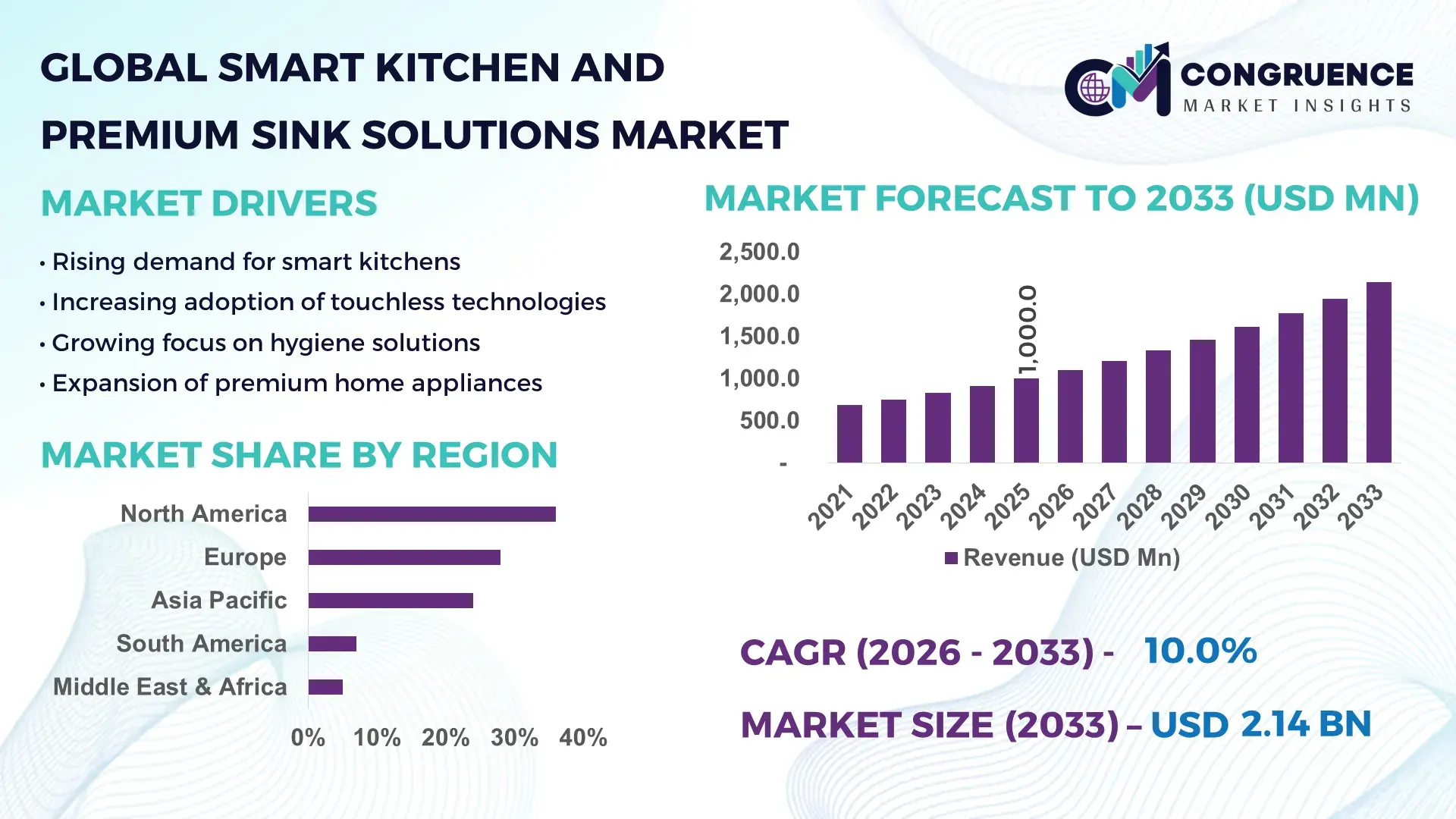
The Global Smart Kitchen and Premium Sink Solutions Market was valued at USD 1,000.0 Million in 2025 and is anticipated to reach a value of USD 2,143.6 Million by 2033 expanding at a CAGR of 10% between 2026 and 2033, according to an analysis by Congruence Market Insights. Growth is primarily driven by rising adoption of connected home ecosystems and demand for multifunctional kitchen infrastructure.
The United States remains a key production and innovation hub in the Smart Kitchen and Premium Sink Solutions Market, supported by over 35% of global smart appliance manufacturing capacity and more than USD 1.2 billion annual investments in IoT-enabled home solutions. Premium sink installations account for nearly 48% of newly constructed luxury residential units, while over 42% of urban households actively use at least one smart kitchen device. Advanced features such as sensor-based faucets, AI-powered water monitoring, and integrated waste management systems are being deployed across hospitality and residential sectors. Additionally, commercial kitchens in the U.S. report up to 30% operational efficiency gains through smart kitchen integrations.
Market Size & Growth: Valued at USD 1,000.0 Million in 2025, projected to reach USD 2,143.6 Million by 2033 at a CAGR of 10%, driven by smart home adoption and premium housing demand.
Top Growth Drivers: Smart appliance adoption (45%), water efficiency improvements (38%), modular kitchen penetration (41%).
Short-Term Forecast: By 2028, smart kitchen systems are expected to improve operational efficiency by 28% and reduce water wastage by 22%.
Emerging Technologies: IoT-enabled sinks, AI-based water monitoring, touchless sensor faucets.
Regional Leaders: North America (USD 780 Million by 2033, high smart home penetration), Europe (USD 620 Million, sustainability-driven adoption), Asia-Pacific (USD 540 Million, rapid urbanization trends).
Consumer/End-User Trends: Over 52% of urban consumers prefer integrated smart kitchen ecosystems with automation features.
Pilot or Case Example: In 2025, a smart kitchen deployment in commercial facilities improved workflow efficiency by 32% and reduced downtime by 18%.
Competitive Landscape: Market leader holds ~18% share, followed by 4–5 key global appliance and fixture manufacturers.
Regulatory & ESG Impact: Water conservation mandates have driven adoption of low-flow smart faucets by over 35% of new installations.
Investment & Funding Patterns: Over USD 900 Million invested globally in smart home and kitchen tech startups between 2023–2025.
Innovation & Future Outlook: Integration of AI, voice assistants, and energy-efficient materials is shaping next-generation kitchens.
The Smart Kitchen and Premium Sink Solutions Market is supported by residential construction (55%), hospitality (25%), and commercial kitchens (20%). Innovations such as antimicrobial sink coatings, IoT-enabled water tracking, and modular installations are gaining traction. Regulatory pressure for water efficiency and sustainability is accelerating adoption, while Asia-Pacific shows rising consumption due to urban housing expansion and increasing smart home penetration.
The Smart Kitchen and Premium Sink Solutions Market is increasingly positioned as a critical component within the broader smart home and sustainable infrastructure ecosystem. With over 52% of new residential developments integrating connected kitchen solutions, the market demonstrates strong alignment with digital transformation and resource efficiency objectives. Smart sinks equipped with IoT sensors deliver up to 35% improvement in water usage efficiency compared to traditional fixtures, while AI-powered kitchen systems optimize workflow and reduce operational inefficiencies in commercial environments.
From a strategic perspective, AI-enabled water management systems deliver 30% improvement compared to conventional manual monitoring systems. North America dominates in volume due to high consumer spending and infrastructure readiness, while Asia-Pacific leads in adoption with over 48% of new urban households integrating at least one smart kitchen device. This divergence highlights both mature and emerging growth pathways.
By 2028, AI-driven predictive maintenance in smart kitchens is expected to reduce equipment downtime by 25%, enabling cost optimization and operational continuity. Firms are committing to ESG improvements such as achieving 40% water recycling efficiency by 2030 through advanced filtration and reuse technologies. In 2025, a U.S.-based smart kitchen deployment achieved a 28% reduction in water consumption through AI-enabled monitoring systems.
Looking ahead, the Smart Kitchen and Premium Sink Solutions Market is expected to evolve as a cornerstone of resilient infrastructure, integrating sustainability, compliance, and digital innovation to support long-term growth across residential and commercial sectors.
The Smart Kitchen and Premium Sink Solutions Market is experiencing dynamic transformation driven by technological integration, sustainability requirements, and evolving consumer lifestyles. Increasing urbanization, which has surpassed 56% globally, is creating higher demand for space-efficient and multifunctional kitchen solutions. Smart kitchen systems are now present in over 40% of newly developed urban housing units, reflecting a shift toward automation and connected living.
Additionally, the demand for premium sink solutions is growing due to rising consumer preference for high-quality, durable, and aesthetically advanced kitchen fixtures. Stainless steel and composite sinks account for more than 65% of installations due to durability and design flexibility. The hospitality sector is also contributing significantly, with over 35% of commercial kitchens adopting smart fixtures to improve hygiene and operational efficiency. Regulatory pressure for water conservation is influencing product innovation, with low-flow and sensor-based faucets reducing water consumption by up to 30%. Overall, the market is shaped by a convergence of digitalization, sustainability, and premiumization trends.
The rapid expansion of smart home ecosystems is a major driver for the Smart Kitchen and Premium Sink Solutions Market. More than 60% of smart home users globally have integrated kitchen-related devices, including smart faucets and connected appliances. These systems improve operational efficiency by up to 30% through automation and remote monitoring capabilities. Voice-controlled assistants and IoT integration have increased user convenience, leading to a 45% rise in adoption rates among urban households. Additionally, smart kitchen installations in commercial settings have improved workflow efficiency by nearly 32%, reducing manual intervention and operational delays. The increasing affordability of smart technologies, along with rising consumer awareness, is further accelerating adoption across both developed and emerging markets.
High upfront costs associated with smart kitchen systems and premium sink installations present a significant restraint for market growth. Advanced smart sinks and integrated kitchen systems can cost 40–60% more than conventional setups, limiting adoption among price-sensitive consumers. Installation complexity also adds to costs, with professional integration required in over 70% of cases. Additionally, maintenance and repair expenses for IoT-enabled systems are approximately 25% higher compared to traditional fixtures. In emerging markets, where over 55% of consumers prioritize affordability, this cost barrier significantly restricts penetration. Limited interoperability between different smart devices further complicates adoption, as users often face compatibility issues when integrating multiple systems from different manufacturers.
The growing emphasis on sustainability and water conservation presents substantial opportunities for the Smart Kitchen and Premium Sink Solutions Market. Smart faucets and water monitoring systems can reduce water usage by up to 35%, making them highly attractive in regions facing water scarcity. Governments and regulatory bodies are promoting water-efficient technologies, with over 30% of new building codes incorporating sustainability requirements. Consumer awareness is also rising, with 48% of homeowners actively seeking eco-friendly kitchen solutions. Innovations such as greywater recycling systems and AI-driven water optimization tools are opening new avenues for growth. Additionally, commercial sectors such as hospitality and food services are adopting these technologies to meet sustainability targets and reduce operational costs.
Technological complexity remains a critical challenge in the Smart Kitchen and Premium Sink Solutions Market. Over 38% of users report difficulties in operating or maintaining smart kitchen systems due to complex interfaces and lack of standardization. Integration issues between devices from different manufacturers affect nearly 32% of installations, leading to reduced user satisfaction. Cybersecurity concerns are also rising, as connected kitchen systems are vulnerable to data breaches, with IoT-related threats increasing by 25% annually. Additionally, the need for continuous software updates and technical support adds operational burdens for both consumers and businesses. Limited technical expertise in emerging markets further restricts adoption, highlighting the need for simplified, user-friendly solutions.
Increasing Adoption of Touchless and Sensor-Based Fixtures: Touchless faucets and sensor-enabled sinks are now installed in over 58% of newly constructed smart kitchens globally. These systems reduce water consumption by up to 30% while improving hygiene standards by 45%, especially in commercial and healthcare kitchen environments.
Integration of AI and Predictive Maintenance Systems: AI-enabled kitchen systems are being adopted by nearly 40% of commercial facilities, enabling predictive maintenance that reduces equipment downtime by 25% and maintenance costs by 20%. These systems enhance operational efficiency through real-time monitoring and automated alerts.
Growth in Modular and Space-Optimized Kitchen Designs: Modular kitchen installations have increased by 52% in urban residential projects, with space optimization improving kitchen usability by 35%. Prefabricated sink systems are gaining traction due to faster installation times, reducing setup duration by 28%.
Rising Demand for Sustainable and Eco-Friendly Materials: Over 47% of consumers prefer sinks made from recyclable or eco-friendly materials. Water-efficient technologies such as low-flow faucets and greywater recycling systems are reducing water usage by up to 33%, aligning with global sustainability goals.
The Smart Kitchen and Premium Sink Solutions Market is segmented based on type, application, and end-user categories, each contributing distinctively to overall market dynamics. Product types range from smart sinks and faucets to integrated kitchen systems, with increasing demand for multifunctional and connected solutions. Applications span residential, commercial, and industrial kitchen environments, with residential adoption leading due to rising smart home penetration. End-user segments include households, hospitality providers, and institutional kitchens, each exhibiting varying adoption rates based on operational needs. Approximately 55% of demand originates from residential applications, while commercial kitchens contribute around 30%, driven by efficiency and hygiene requirements. The integration of IoT and automation technologies across all segments is reshaping product demand patterns and influencing purchasing decisions among consumers and enterprises.
The Smart Kitchen and Premium Sink Solutions Market includes smart sinks, sensor-based faucets, integrated kitchen systems, and premium traditional sinks. Smart sinks dominate the segment, accounting for approximately 38% of adoption due to their multifunctionality, including water monitoring, temperature control, and automation features. Sensor-based faucets hold around 27% share, driven by hygiene benefits and water-saving capabilities. Integrated kitchen systems are the fastest-growing segment, expanding at an estimated CAGR of 12%, supported by increasing demand for fully connected home environments. These systems provide centralized control of appliances and fixtures, improving efficiency by over 30%. Premium traditional sinks and other niche solutions collectively account for around 35% of the market, catering to consumers prioritizing design and durability.
• In 2025, a major residential housing project implemented IoT-enabled smart sinks across over 2,000 units, improving water efficiency by 28% and reducing maintenance requirements significantly.
Residential applications lead the Smart Kitchen and Premium Sink Solutions Market, accounting for nearly 55% of adoption due to increasing smart home penetration. Commercial kitchens follow with approximately 30%, driven by demand for efficiency and hygiene improvements. Industrial and institutional applications contribute around 15%. Commercial applications are the fastest-growing segment, expanding at an estimated CAGR of 11%, supported by rising adoption in hospitality and food service industries. Over 60% of large commercial kitchens are integrating smart solutions to enhance workflow efficiency. In 2025, more than 42% of urban households adopted at least one smart kitchen device, reflecting strong consumer adoption trends.
• In 2025, a large hospitality chain implemented smart kitchen systems across 150 facilities, improving operational efficiency by 30% and reducing water consumption by 25%.
Households represent the largest end-user segment, accounting for approximately 52% of the Smart Kitchen and Premium Sink Solutions Market due to rising disposable incomes and smart home adoption. The hospitality sector holds around 28%, while institutional users such as hospitals and corporate kitchens contribute nearly 20%. The hospitality segment is the fastest-growing, expanding at an estimated CAGR of 11.5%, driven by the need for operational efficiency and hygiene compliance. Over 48% of hotels globally are investing in smart kitchen technologies to enhance guest experience and reduce operational costs. Additionally, 60% of urban consumers show preference for automated kitchen systems.
• In 2025, a global hotel group deployed smart kitchen solutions across multiple properties, achieving a 26% reduction in operational costs and improving service efficiency.
North America accounted for the largest market share at 36% in 2025 however, Asia-Pacific is expected to register the fastest growth, expanding at a CAGR of 12% between 2026 and 2033.

Europe follows with a 28% share, while Asia-Pacific holds approximately 24%, and the remaining 12% is distributed across South America and the Middle East & Africa. North America leads due to high smart home penetration, with over 45% of households using connected kitchen devices. Europe shows strong adoption driven by sustainability regulations, with over 40% of new installations featuring water-efficient systems. Asia-Pacific is witnessing rapid expansion, supported by urbanization rates exceeding 50% and increasing disposable income levels. South America and the Middle East & Africa are emerging markets, with adoption rates growing steadily due to infrastructure development and rising awareness of smart technologies.
North America holds approximately 36% of the Smart Kitchen and Premium Sink Solutions Market, driven by strong demand from residential and commercial sectors. The region benefits from advanced infrastructure and high consumer spending on smart home technologies. Key industries include residential construction, hospitality, and healthcare. Regulatory initiatives promoting water conservation have led to adoption of low-flow fixtures in over 38% of installations. Technological advancements such as AI-based water monitoring and voice-controlled kitchen systems are widely implemented. A major local manufacturer has introduced integrated smart sinks with IoT-enabled monitoring, improving efficiency by 30%. Consumer behavior reflects high adoption of connected devices, with over 50% of households integrating smart kitchen solutions.
Europe accounts for around 28% of the Smart Kitchen and Premium Sink Solutions Market, with key markets including Germany, the UK, and France. Regulatory frameworks focused on water conservation and energy efficiency have driven adoption of eco-friendly kitchen solutions. Over 42% of installations include sustainable materials and water-saving technologies. The region is witnessing rapid adoption of IoT-enabled systems, particularly in urban residential projects. A leading European manufacturer has launched recyclable composite sinks, reducing environmental impact by 25%. Consumer behavior is influenced by regulatory pressure, with strong preference for sustainable and compliant products.
Asia-Pacific holds approximately 24% market share and ranks as the fastest-growing region in the Smart Kitchen and Premium Sink Solutions Market. Key countries include China, India, and Japan, where urbanization exceeds 50% and middle-class expansion is accelerating demand. The region is a major manufacturing hub, producing over 40% of global kitchen fixtures. Technological innovation is driven by smart home integration and mobile-based control systems. A regional manufacturer has introduced cost-effective smart sinks, increasing adoption among middle-income consumers by 35%. Consumer behavior is influenced by e-commerce growth and mobile technology adoption.
South America accounts for approximately 7% of the Smart Kitchen and Premium Sink Solutions Market, with Brazil and Argentina as key markets. Infrastructure development and urban housing projects are driving demand for modern kitchen solutions. Government incentives supporting sustainable construction have increased adoption of water-efficient fixtures by 22%. Regional manufacturers are focusing on affordable premium solutions to expand market reach. Consumer behavior reflects growing interest in smart home technologies, particularly among urban populations, with adoption rates increasing steadily.
The Middle East & Africa region holds around 5% market share, driven by large-scale construction projects in countries such as the UAE and South Africa. Demand is supported by luxury residential developments and hospitality sectors. Technological modernization initiatives have led to adoption of smart kitchen systems in over 25% of new projects. Trade partnerships and government investments are facilitating market growth. Consumer behavior is characterized by preference for high-end, technologically advanced kitchen solutions.
United States – 32% Market share: Driven by high smart home adoption and strong manufacturing capabilities
China – 21% Market share: Supported by large-scale production capacity and rapid urbanization
The Smart Kitchen and Premium Sink Solutions Market is moderately fragmented, with over 50 active global and regional competitors competing across product innovation, pricing, and technological capabilities. The top five companies collectively account for approximately 42% of the total market share, indicating a balanced competitive structure. Leading players are focusing on strategic partnerships, product innovation, and digital integration to strengthen their market positions.
Innovation remains a key competitive factor, with companies investing heavily in IoT-enabled products and AI-driven solutions. Over 60% of major players have launched at least one smart kitchen product in the past two years. Mergers and acquisitions are also shaping the competitive landscape, with companies aiming to expand their product portfolios and geographic presence. Additionally, sustainability initiatives are influencing competition, as manufacturers introduce eco-friendly materials and water-efficient technologies to meet regulatory requirements and consumer preferences.
Franke Group
Elkay Manufacturing Company
Blanco GmbH
TOTO Ltd.
LIXIL Corporation
Moen Incorporated
Hansgrohe SE
Roca Sanitario S.A.
GROHE AG
Samsung Electronics
LG Electronics
Whirlpool Corporation
Electrolux AB
The Smart Kitchen and Premium Sink Solutions Market is being reshaped by rapid technological advancements centered around IoT integration, artificial intelligence, and sustainable engineering. IoT-enabled kitchen systems are now present in over 45% of modern residential developments, enabling real-time monitoring of water usage, temperature control, and appliance performance. Smart sinks equipped with sensors can reduce water wastage by up to 30% through automated flow regulation and leak detection systems.
Artificial intelligence is playing a growing role in predictive maintenance and operational optimization. AI-based systems can analyze usage patterns to optimize water consumption, reducing inefficiencies by 25%. Voice-enabled assistants integrated with kitchen systems allow users to control appliances and fixtures seamlessly, improving user convenience and accessibility. Additionally, cloud-based platforms are enabling remote monitoring and control, enhancing operational flexibility for both residential and commercial users.
Sustainability-focused technologies are also gaining prominence, with over 40% of new products incorporating recyclable materials and energy-efficient designs. Innovations such as antimicrobial coatings and self-cleaning surfaces are improving hygiene standards, particularly in commercial kitchens. Advanced manufacturing techniques, including 3D printing and modular fabrication, are reducing production time by up to 20% and enabling customization. These technological advancements are driving the evolution of the market toward more efficient, sustainable, and user-centric solutions.
• In February 2025, Kohler Co. showcased advanced kitchen and smart water innovations at KBIS 2025, focusing on integrated smart home solutions and design-led functionality. The company highlighted connected kitchen fixtures and digital water management systems aimed at improving user experience and efficiency. Source: www.kohler.com
• In April 2025, Kohler Co. launched its “Strive” stainless-steel kitchen sink range in India, featuring SilentShield sound-absorption technology that significantly reduces noise from water flow and utensils, enhancing user comfort and durability in high-usage kitchen environments.
• In February 2024, Kohler Co. introduced the Cairn Kitchen Sink range in India, made from its proprietary Neoroc composite material offering 2X impact resistance and 1.4X heat resistance, strengthening durability and expanding its footprint in premium kitchen solutions.
• In February 2024, Kohler Co. presented new kitchen faucet collections and smart fixture innovations at the Kitchen & Bath Industry Show (KBIS 2024), focusing on enhanced functionality, sustainability, and modern design integration across kitchen environments.
The Smart Kitchen and Premium Sink Solutions Market Report provides a comprehensive analysis of key industry segments, including product types such as smart sinks, sensor-based faucets, integrated kitchen systems, and premium traditional sinks. The report covers applications across residential, commercial, and institutional kitchens, with detailed insights into adoption patterns, technological integration, and operational efficiency improvements.
Geographically, the report evaluates major regions including North America, Europe, Asia-Pacific, South America, and the Middle East & Africa, offering insights into regional demand patterns, infrastructure development, and consumer behavior. The analysis highlights that over 55% of demand originates from residential applications, while commercial sectors contribute significantly due to efficiency and hygiene requirements.
The report also explores technological advancements such as IoT integration, AI-driven monitoring systems, and sustainable materials, providing insights into how these innovations are shaping product development and market growth. Emerging segments such as modular kitchen systems and eco-friendly sink solutions are examined, reflecting evolving consumer preferences and regulatory requirements.
Additionally, the report includes detailed assessments of competitive dynamics, investment trends, and strategic initiatives undertaken by key market players. It offers valuable insights for stakeholders, enabling informed decision-making and strategic planning in a rapidly evolving market landscape.
| Report Attribute / Metric | Details |
|---|---|
| Market Revenue (2025) | USD 1,000.0 Million |
| Market Revenue (2033) | USD 2,143.6 Million |
| CAGR (2026–2033) | 10% |
| Base Year | 2025 |
| Forecast Period | 2026–2033 |
| Historic Period | 2021–2025 |
| Segments Covered |
By Type
By Application
By End-User Insights
|
| Key Report Deliverables | Revenue Forecast; Market Trends; Growth Drivers & Restraints; Technology Insights; Segmentation Analysis; Regional Insights; Competitive Landscape; Regulatory & ESG Overview; Recent Developments |
| Regions Covered | North America; Europe; Asia-Pacific; South America; Middle East & Africa |
| Key Players Analyzed | Kohler Co.; Franke Group; Elkay Manufacturing Company; Blanco GmbH; TOTO Ltd.; LIXIL Corporation; Moen Incorporated; Hansgrohe SE; Roca Sanitario S.A.; GROHE AG; Samsung Electronics; LG Electronics; Whirlpool Corporation; Electrolux AB |
| Customization & Pricing | Available on Request (10% Customization Free) |




