
Reports
The Global Smart Irrigation Market was valued at USD 2439.42 Million in 2025 and is anticipated to reach a value of USD 5996.9 Million by 2033 expanding at a CAGR of 11.9% between 2026 and 2033. Growth is being driven by water scarcity management, AI-enabled irrigation scheduling, and government-backed precision agriculture programs that improve irrigation efficiency and reduce operational costs.
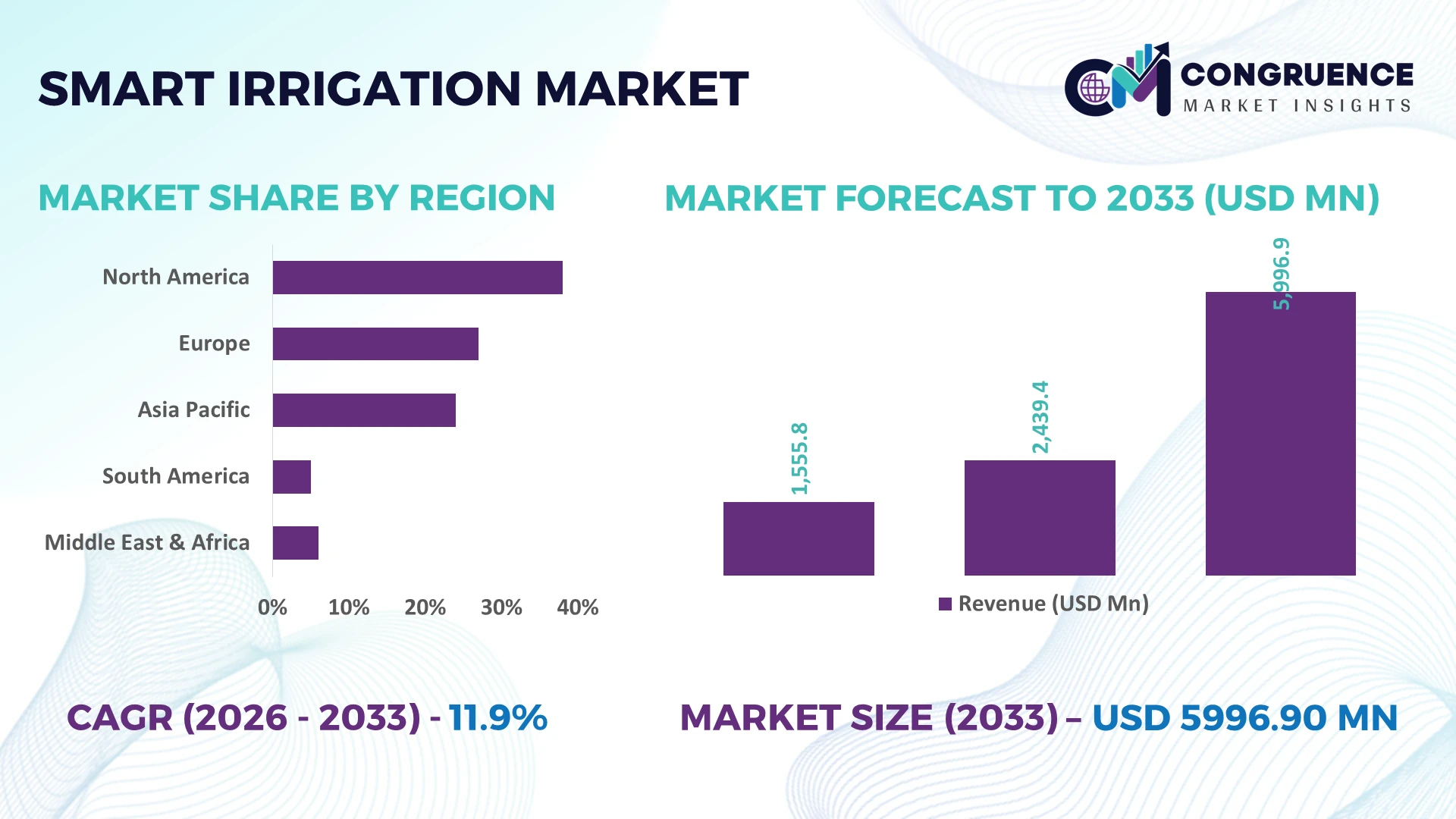
The United States leads the smart irrigation market with an estimated 34% share, supported by advanced precision farming adoption, large-scale landscaping demand, and public investment in water conservation infrastructure. U.S. farms using sensor-based irrigation systems report water savings of up to 30%, while India is emerging as a high-growth market through government-supported micro-irrigation programs and expanding digital agriculture initiatives.
This leadership pattern highlights the importance of targeting regions with strong water-management policies and established precision agriculture ecosystems.
Market Size & Growth: The market is projected to expand from USD 2439.42 Million in 2025 to USD 5996.9 Million by 2033, driven by precision agriculture and water conservation technologies.
Top Growth Drivers: Water scarcity management contributes about 28% of demand growth, precision farming adoption 24%, and government irrigation incentives 18%.
Short-Term Forecast: By 2028, smart irrigation deployment is expected to reduce water consumption by 20% and improve crop yield efficiency by 15%.
Emerging Technologies: AI-driven scheduling, IoT soil moisture sensors, and cloud-based irrigation management are becoming core features of advanced systems.
Regional Leaders: North America leads adoption, Asia-Pacific shows the fastest expansion, and Europe advances through sustainable landscaping and agricultural water-use policies.
End-User Trends: Agricultural applications account for more than 60% of market demand, while commercial landscaping and residential users are increasing adoption.
Pilot Case Example: A 2026 precision irrigation project in India achieved a 25% reduction in water use and a 12% improvement in crop productivity.
Competitive Landscape: The market is moderately consolidated, with leading players such as The Toro Company, Rain Bird Corporation, Hunter Industries, Netafim, and Jain Irrigation Systems.
Regulatory & ESG Impact: Government water-conservation programs and sustainability targets are accelerating adoption, particularly in drought-prone agricultural regions.
Investment & Funding: Investment activity is concentrated in IoT-enabled irrigation platforms, precision farming partnerships, and regional expansion projects.
Innovation & Future Outlook: Next-generation systems are integrating predictive analytics, automated valves, and real-time weather data to optimize irrigation decisions.
The Smart Irrigation Market is expanding through demand from precision agriculture, commercial landscaping, and municipal water-management projects. Recent innovations include AI-based irrigation scheduling, low-power IoT sensors, and cloud-connected controllers that improve water-use efficiency. Adoption of sensor-driven systems has increased by approximately 18% in large farming operations, while drought-related water restrictions in several regions are accelerating investment in automated irrigation infrastructure. This momentum supports the strategic discussion on market positioning and technology adoption.
The Smart Irrigation Market has become strategically important as agriculture, commercial landscaping, and municipal water utilities prioritize resource optimization over conventional irrigation practices. Rising water-stress regulations, digital agriculture initiatives, and infrastructure modernization are accelerating deployment of connected irrigation platforms. Companies are shifting from equipment sales to integrated irrigation ecosystems combining sensors, cloud analytics, and predictive automation, strengthening long-term customer retention while improving operational resilience.
AI-enabled irrigation platforms deliver up to 30% lower water consumption and reduce field monitoring requirements by nearly 40% compared with timer-based legacy systems through real-time weather forecasting and soil moisture analytics. The United States leads large-scale deployment across commercial farms and urban landscapes, while India is expanding adoption through micro-irrigation programs and digital farming initiatives. During the next two to three years, connected irrigation installations are expected to exceed 50% among large commercial farming operations in several developed agricultural markets, supported by expanding precision farming investments.
A practical example is the deployment of sensor-driven irrigation systems in vineyards and high-value orchards, where automated irrigation scheduling improves crop consistency while reducing unnecessary pumping cycles. Leading companies are increasing investments in AI software, strategic partnerships with agritech providers, and localized manufacturing to strengthen deployment capability. Businesses that combine intelligent irrigation hardware with digital service platforms will secure stronger competitive positioning, greater operational efficiency, and sustained relevance in water-constrained agricultural markets.
Water scarcity and precision agriculture are transforming smart irrigation from an efficiency tool into core agricultural infrastructure. Farms deploying intelligent irrigation systems report water-use reductions of up to 30%, while fertilizer utilization efficiency improves by approximately 20% through precision water delivery. More than 55% of large commercial growers are increasing investments in connected farm technologies to improve resource productivity. In India, expanding micro-irrigation programs and digital agriculture policies are encouraging wider deployment of sensor-enabled irrigation solutions. Equipment manufacturers are responding through AI platform development, partnerships with farm technology providers, and expanded production of IoT-enabled controllers. This structural transition is strengthening recurring software revenues alongside hardware sales, creating durable competitive advantages for integrated solution providers.
High implementation costs and fragmented irrigation infrastructure continue to limit deployment across small and medium-sized farms. Initial installation expenses remain 25–40% higher than conventional irrigation systems, while nearly 35% of existing irrigation networks require upgrades before supporting connected automation. Dependence on imported electronic components also exposes manufacturers to supply-chain disruptions and longer procurement cycles. In countries with limited rural digital infrastructure, unreliable connectivity reduces real-time monitoring performance and system efficiency. Companies are mitigating these pressures through localized component sourcing, modular product architecture, and long-term distribution partnerships that lower deployment costs while improving installation flexibility and operational reliability across diverse agricultural environments.
The convergence of artificial intelligence, satellite imagery, and predictive weather analytics is creating new value beyond automated irrigation. AI-enabled irrigation optimization can improve irrigation scheduling accuracy by approximately 35%, while cloud-based farm management platforms reduce manual operational planning by nearly 25%. Australia and India are expanding digital agriculture initiatives that encourage adoption of intelligent water management technologies. Companies are strengthening competitive positioning through R&D investment, strategic software partnerships, and ecosystem development linking irrigation equipment with precision agriculture platforms. A notable opportunity lies in subscription-based irrigation analytics, enabling recurring service income while helping growers optimize water allocation, energy consumption, and crop productivity throughout seasonal operations.
Long-term market expansion depends on overcoming integration complexity across diverse irrigation equipment, communication standards, and farm management software. Approximately 40% of existing agricultural operations continue using legacy irrigation infrastructure that lacks compatibility with advanced digital platforms, while cybersecurity incidents targeting connected industrial devices have increased by more than 20% in recent years. In the United States, expanding deployment of connected agricultural systems is increasing demand for secure data management and standardized interoperability. Companies must invest in open-platform architectures, encrypted communication protocols, workforce training, and strategic technology alliances to ensure scalable deployments, consistent operational performance, and long-term customer confidence across increasingly connected irrigation ecosystems.
AI-Driven Irrigation Optimization AI-powered irrigation scheduling is becoming standard across commercial farming, with automated decision engines reducing water use by nearly 30% and lowering manual monitoring requirements by 40%. Increasing labor shortages in the United States are accelerating deployment, prompting companies to expand cloud platforms, integrate predictive weather analytics, and strengthen software partnerships to improve operational precision and recurring digital service offerings.
Connected Sensor Network Expansion Deployment of IoT soil moisture sensors has increased by approximately 25% across large agricultural operations, while remote field monitoring reduces inspection frequency by nearly 35%. Declining sensor costs and improved wireless connectivity are reshaping irrigation workflows. Manufacturers are responding by scaling modular sensor ecosystems, expanding compatibility with farm management software, and improving edge-based data processing for faster irrigation decisions.
Localized Manufacturing Strategies Supply-chain diversification has become a priority as electronic component sourcing shifts closer to end markets. Localized production has shortened equipment delivery times by around 20% and reduced logistics costs by approximately 15%. Companies are restructuring procurement networks, expanding regional assembly facilities, and increasing partnerships with domestic electronics suppliers to improve resilience against geopolitical trade disruptions and component shortages.
Integrated Water Compliance Platforms Water-use regulations are driving adoption of irrigation systems with automated reporting and compliance functions. Smart controllers now improve irrigation efficiency by roughly 25% while reducing administrative reporting workloads by nearly 30%. Companies are embedding compliance dashboards, sustainability analytics, and remote diagnostics into irrigation platforms, creating differentiated enterprise offerings that strengthen long-term customer retention beyond hardware deployment.
Smart Controllers represent the leading segment because they provide centralized automation, seamless integration with weather forecasts, and compatibility with IoT-enabled irrigation infrastructure. More than 45% of advanced irrigation deployments incorporate intelligent controllers as the primary control platform, enabling water savings of up to 30% while improving scheduling accuracy. Weather-Based Systems remain a mature segment, particularly for commercial landscaping, while Sprinkler Systems continue serving large public spaces through gradual digital upgrades. Companies are strengthening controller portfolios through AI integration, cloud connectivity, and software-based irrigation optimization to improve customer retention.
Soil Moisture Sensors are the fastest-growing type as growers increasingly prioritize real-time field intelligence over fixed irrigation schedules. Sensor deployment has increased by approximately 27% among commercial farms, supported by lower hardware costs and expanding precision agriculture programs. Drip Irrigation continues gaining strategic relevance by combining high water efficiency with intelligent automation for specialty crops. Manufacturers are investing in integrated controller-sensor ecosystems, expanding compatibility across irrigation equipment, and developing subscription-based analytics to strengthen long-term competitive positioning.
Agriculture remains the dominant application due to extensive irrigation requirements, increasing precision farming adoption, and mounting pressure to optimize water resources. Agricultural deployments account for over 60% of smart irrigation installations, while connected irrigation systems reduce field water consumption by approximately 30%. Companies continue integrating irrigation platforms with digital farm management software, enabling automated scheduling and resource optimization. Landscaping represents a stable application as municipalities and commercial properties modernize irrigation infrastructure to reduce operating costs and comply with water conservation requirements.
Greenhouses are the fastest-growing application because controlled-environment agriculture depends on precise irrigation and nutrient delivery. Automated greenhouse irrigation has improved irrigation efficiency by nearly 25% while reducing manual intervention by approximately 35%. Golf Courses and Sports Fields continue upgrading to weather-responsive irrigation systems that minimize maintenance expenses while maintaining turf quality. Suppliers are expanding specialized irrigation packages, AI-enabled monitoring tools, and service partnerships tailored to high-value commercial facilities where operational continuity is critical.
Farmers remain the largest end-user group because irrigation directly influences crop productivity, water utilization, and operating costs. Large commercial farms account for more than 55% of intelligent irrigation deployments, while automated scheduling reduces unnecessary irrigation events by approximately 28%. Equipment suppliers are introducing scalable product portfolios, flexible financing options, and integrated digital advisory platforms to strengthen adoption across both large enterprises and mid-sized agricultural operations. Municipalities maintain strong demand as cities modernize parks and public landscapes through intelligent water management infrastructure.
Greenhouse Operators represent the fastest-growing end-user segment as controlled agriculture increasingly relies on sensor-based irrigation automation and environmental monitoring. Automated irrigation systems have reduced water consumption by roughly 25% while improving production consistency. Commercial Landscapers are adopting cloud-connected irrigation to support multi-site operations, and Sports Facilities continue investing in automated turf management solutions that reduce maintenance downtime. Companies are strengthening customer engagement through customized software platforms, strategic channel partnerships, and ecosystem-based service models designed for long-term operational value.
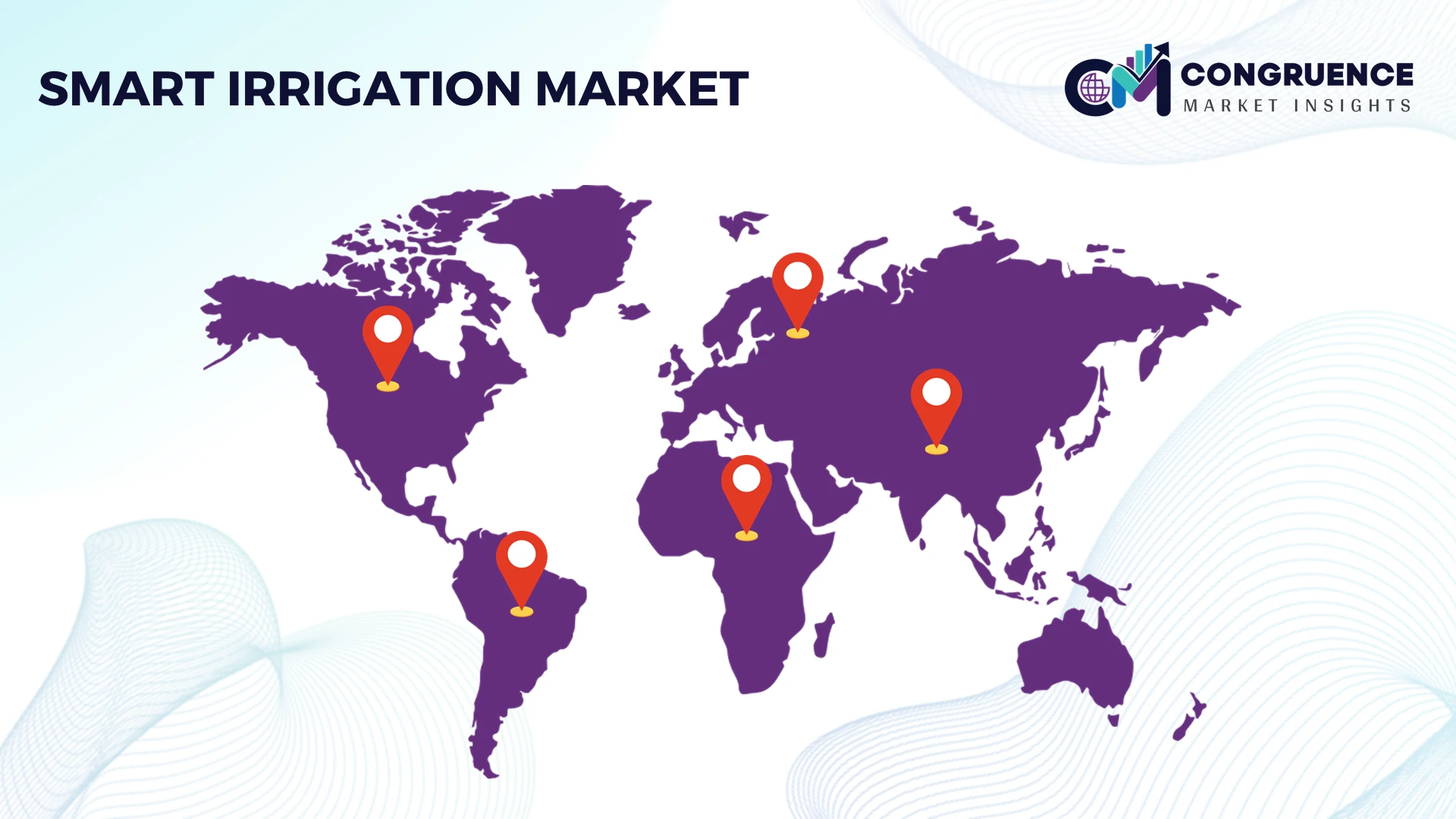
North America accounted for the largest market share at 36.8% in 2025 however, Asia-Pacific is expected to register the fastest growth, expanding at a CAGR of 13.6% between 2026 and 2033.
Advanced Precision Agriculture Drives Regional Leadership
North America maintains the leading position through widespread deployment of precision agriculture, connected irrigation infrastructure, and high adoption of AI-enabled farm management platforms. Large commercial farms and municipalities continue replacing conventional irrigation systems with cloud-connected controllers and soil monitoring technologies to improve water productivity. More than 60% of large irrigated farming operations in the United States utilize digital irrigation management tools, while commercial landscaping projects increasingly integrate weather-responsive automation. Companies are expanding software ecosystems, strengthening dealer partnerships, and introducing predictive irrigation platforms that combine satellite data with field sensors to improve irrigation accuracy and reduce operational costs.
United States Market Outlook: The United States remains the regional growth engine due to extensive commercial agriculture, advanced digital infrastructure, and strong investment in precision farming technologies. Water conservation initiatives across western states continue accelerating deployment of intelligent irrigation systems. Sensor-enabled irrigation has reduced irrigation water consumption by approximately 30% in several large farming operations, while technology providers continue expanding AI-powered analytics, subscription software, and integrated equipment platforms to strengthen long-term enterprise adoption.
Sustainability Regulations Accelerate Digital Water Management
Europe is strengthening its position through sustainability-focused agricultural modernization and strict water efficiency policies. Precision irrigation adoption continues expanding across vineyards, orchards, and commercial landscaping as growers respond to increasing climate variability. Nearly 45% of newly installed commercial irrigation projects now include smart controllers and automated weather integration. Equipment suppliers are investing in interoperable irrigation platforms, remote diagnostics, and digital maintenance services that simplify compliance while improving operational efficiency. Public infrastructure modernization and sustainable landscape management continue supporting demand across institutional and municipal applications.
Spain Market Outlook: Spain represents the region's most strategically significant market because of its extensive irrigated agriculture and persistent water management priorities. Precision irrigation deployment is expanding rapidly across fruit, vegetable, and vineyard production, supported by advanced drip irrigation infrastructure. Intelligent irrigation technologies have improved irrigation efficiency by nearly 25% across commercial agricultural operations, encouraging manufacturers to strengthen regional partnerships and introduce localized digital irrigation solutions.
Large-Scale Agricultural Digitalization Expands Deployment
Asia-Pacific is emerging as the fastest-growing market as governments accelerate digital agriculture, irrigation modernization, and efficient water resource management. Expanding cultivated land under micro-irrigation and increasing adoption of connected farm technologies are strengthening deployment across major agricultural economies. More than 35% of newly installed commercial irrigation systems now incorporate sensor-based automation in leading agricultural districts. Manufacturers are increasing localized production, expanding distribution networks, and partnering with agritech companies to improve affordability and accelerate technology adoption throughout high-volume farming markets.
India Market Outlook: India leads regional expansion through large-scale irrigation modernization, government-backed micro-irrigation initiatives, and rapidly increasing precision farming adoption. Smart irrigation deployment is accelerating across horticulture, sugarcane, and high-value crop cultivation. Automated irrigation solutions have improved field-level water-use efficiency by approximately 30%, while domestic manufacturers continue expanding IoT-enabled product portfolios and digital service capabilities to support both commercial farms and progressive medium-sized growers.
Commercial Farming Modernization Strengthens Demand
South America is experiencing steady adoption as commercial agriculture prioritizes water optimization and operational efficiency. Large-scale soybean, fruit, and sugarcane cultivation is driving demand for automated irrigation technologies capable of reducing resource consumption and improving production consistency. Approximately 20% of newly modernized commercial irrigation projects now incorporate connected monitoring systems. Despite infrastructure gaps in rural areas, irrigation equipment suppliers are expanding technical support networks, strengthening local distribution partnerships, and developing modular solutions suited to diverse agricultural conditions.
Brazil Market Outlook: Brazil dominates regional demand through its extensive commercial farming sector and expanding investment in precision agriculture technologies. Large agricultural enterprises increasingly integrate smart irrigation with digital farm management systems to improve productivity and reduce operational waste. Connected irrigation deployments have improved irrigation scheduling efficiency by nearly 22%, encouraging equipment manufacturers to expand local partnerships, training programs, and after-sales service infrastructure across key agricultural states.
Water Security Investments Transform Irrigation Infrastructure
The Middle East & Africa market is advancing through national water conservation strategies, infrastructure modernization, and increasing deployment of intelligent irrigation technologies. Agriculture and urban landscaping remain priority sectors as governments seek higher water-use efficiency under arid climate conditions. Smart irrigation installations have improved irrigation efficiency by approximately 28% across several commercial projects, while investments in desalination-linked irrigation infrastructure continue supporting advanced deployment. Technology providers are expanding regional partnerships, localized technical services, and integrated monitoring platforms to address complex environmental operating conditions.
Saudi Arabia Market Outlook: Saudi Arabia remains the region's leading market because of strategic investments in water conservation, protected agriculture, and digital infrastructure. Large agricultural projects increasingly integrate AI-enabled irrigation controls with groundwater management systems to maximize resource efficiency. Automated irrigation platforms have reduced agricultural water consumption by around 25% in selected commercial operations, while technology companies continue strengthening regional collaboration, localized implementation expertise, and smart farming ecosystems.
The Smart Irrigation Market is led by The Toro Company, Rain Bird Corporation, Hunter Industries, Netafim, and Jain Irrigation Systems, with global technology leaders competing against regional irrigation manufacturers and low-cost equipment suppliers. The top five companies collectively account for approximately 48% of market activity, reflecting moderate consolidation with strong competition in precision agriculture and commercial landscaping. Competition is driven by technology integration, lifecycle service capability, and deployment speed rather than hardware pricing alone. AI-enabled irrigation platforms improve water-use efficiency by nearly 30%, while cloud-based remote management reduces maintenance visits by about 25%, creating clear differentiation over conventional systems. Leading companies are expanding through software partnerships, localized manufacturing, distributor network expansion, and vertically integrated irrigation ecosystems combining sensors, controllers, and analytics. Competitive pressure is shifting toward intelligent platform ownership as digital services become recurring revenue drivers. High R&D requirements, interoperability standards, and enterprise support capabilities create significant entry barriers. Sustainable competitive success depends on delivering integrated, data-driven irrigation solutions with scalable service ecosystems.
The Toro Company
Rain Bird Corporation
Hunter Industries
Netafim
Jain Irrigation Systems Limited
HydroPoint Data Systems
Rachio Inc.
Weathermatic
Orbit Irrigation Products
Lindsay Corporation
Valmont Industries
Galcon Ltd.
Calsense
Artificial intelligence, IoT connectivity, and predictive analytics are redefining smart irrigation operations. AI-powered irrigation scheduling improves water-use efficiency by approximately 30%, while connected soil moisture sensors increase irrigation accuracy by nearly 25%. More than 45% of newly deployed commercial smart irrigation systems now integrate cloud-based monitoring with weather forecasting. These technologies enable continuous optimization, reduce manual intervention, and provide measurable operational savings for agricultural enterprises, municipalities, and commercial landscape operators.
Modern sensor-driven irrigation platforms outperform timer-based legacy systems by reducing unnecessary irrigation events by approximately 35% while improving irrigation precision by nearly 28%. Edge computing, satellite imagery, and digital twin technology are emerging as advanced decision-support tools for high-value agriculture. Technology leaders and integrated solution providers benefit most because seamless hardware-software ecosystems improve customer retention and create long-term service opportunities beyond equipment installation. Open-platform interoperability is also becoming a key purchasing criterion for enterprise customers managing diverse irrigation assets.
Between 2026 and 2028, autonomous irrigation management, machine learning optimization, and low-power wireless sensor networks will accelerate enterprise deployment across commercial farming and institutional landscapes. Automated diagnostics are expected to reduce maintenance downtime by around 20%, while predictive asset management lowers operating costs. Companies investing early in integrated analytics, cybersecurity, and scalable digital irrigation platforms will strengthen competitive positioning as customers increasingly prioritize intelligent, connected water management infrastructure.
February 2025 The Toro Company partnered with TerraRad to integrate Spatial Adjust software into the Lynx Central Control platform, enabling automated irrigation adjustments using real-time soil moisture mapping. The solution reduced water consumption and labor requirements while delivering automated sprinkler recommendations.
April 2025 Rain Bird acquired OtO Inc., adding solar-powered, app-controlled hose-end irrigation technology to its residential portfolio and expanding smart irrigation coverage for properties without underground systems. The acquisition broadened product reach into an additional residential irrigation segment.
October 2025 Rain Bird completed the acquisition of Rachio, integrating its cloud-connected smart irrigation controller business while retaining Rachio's leadership team. Rachio's portfolio, built over more than 10 years of product innovation, strengthened Rain Bird's connected irrigation ecosystem and consumer technology capabilities.
February 2026 Rain Bird Golf announced new CirrusPRO software integrations with Spectrum Technologies and Watertronics, enabling live soil moisture, pump flow, and pressure monitoring within one irrigation platform. The expanded integration portfolio improved irrigation decision-making and operational efficiency for golf course managers.
This report provides a comprehensive assessment of the Smart Irrigation Market across Smart Controllers, Soil Moisture Sensors, Weather-Based Systems, Drip Irrigation, and Sprinkler Systems. It evaluates applications spanning Agriculture, Landscaping, Golf Courses, Greenhouses, and Sports Fields, alongside key end-user groups including Farmers, Municipalities, Commercial Landscapers, Greenhouse Operators, and Sports Facilities. Regional analysis covers North America, Europe, Asia-Pacific, South America, and the Middle East & Africa, with country-level operational insights. More than 45% of enterprise deployments now incorporate connected monitoring technologies, highlighting the industry's digital transformation.
The study examines competitive positioning, technology integration, deployment strategies, supply-chain developments, and innovation priorities shaping market evolution between 2026 and 2033. It analyzes AI-enabled irrigation, IoT sensors, cloud-based control platforms, predictive analytics, and automation trends while identifying emerging opportunities in precision agriculture and intelligent landscape management. Strategic insights support investment evaluation, product expansion, partnership planning, market entry decisions, competitive benchmarking, and long-term business positioning across mature and emerging irrigation ecosystems.
| Report Attribute/Metric | Report Details |
|---|---|
Market Revenue in 2025 | USD 2439.42 Million |
Market Revenue in 2033 | USD 5996.9 Million |
CAGR (2026 - 2033) | 11.9% |
Base Year | 2025 |
Forecast Period | 2026 - 2033 |
Historic Period | 2021 - 2025 |
Segments Covered | By Type
By Application
By End-User
|
Key Report Deliverable | Revenue Forecast, Growth Trends, Market Dynamics, Segmental Overview, Regional and Country-wise Analysis, Competition Landscape |
Region Covered | North America, Europe, Asia-Pacific, South America, Middle East, Africa |
Key Players Analyzed | The Toro Company, Rain Bird Corporation, Hunter Industries, Netafim, Jain Irrigation Systems Limited, HydroPoint Data Systems, Rachio Inc., Weathermatic, Orbit Irrigation Products, Lindsay Corporation, Valmont Industries, Galcon Ltd., Calsense |
Customization & Pricing | Available on Request (10% Customization is Free) |




