
Reports
The Global Smart Indoor Asset Tracking Labels Market was valued at USD 1,321.0 Million in 2025 and is anticipated to reach a value of USD 4,513.3 Million by 2033 expanding at a CAGR of 16.6% between 2026 and 2033, according to an analysis by Congruence Market Insights. The market is expanding due to increasing demand for real-time asset visibility, inventory optimization, and automation across healthcare, manufacturing, logistics, and retail environments.
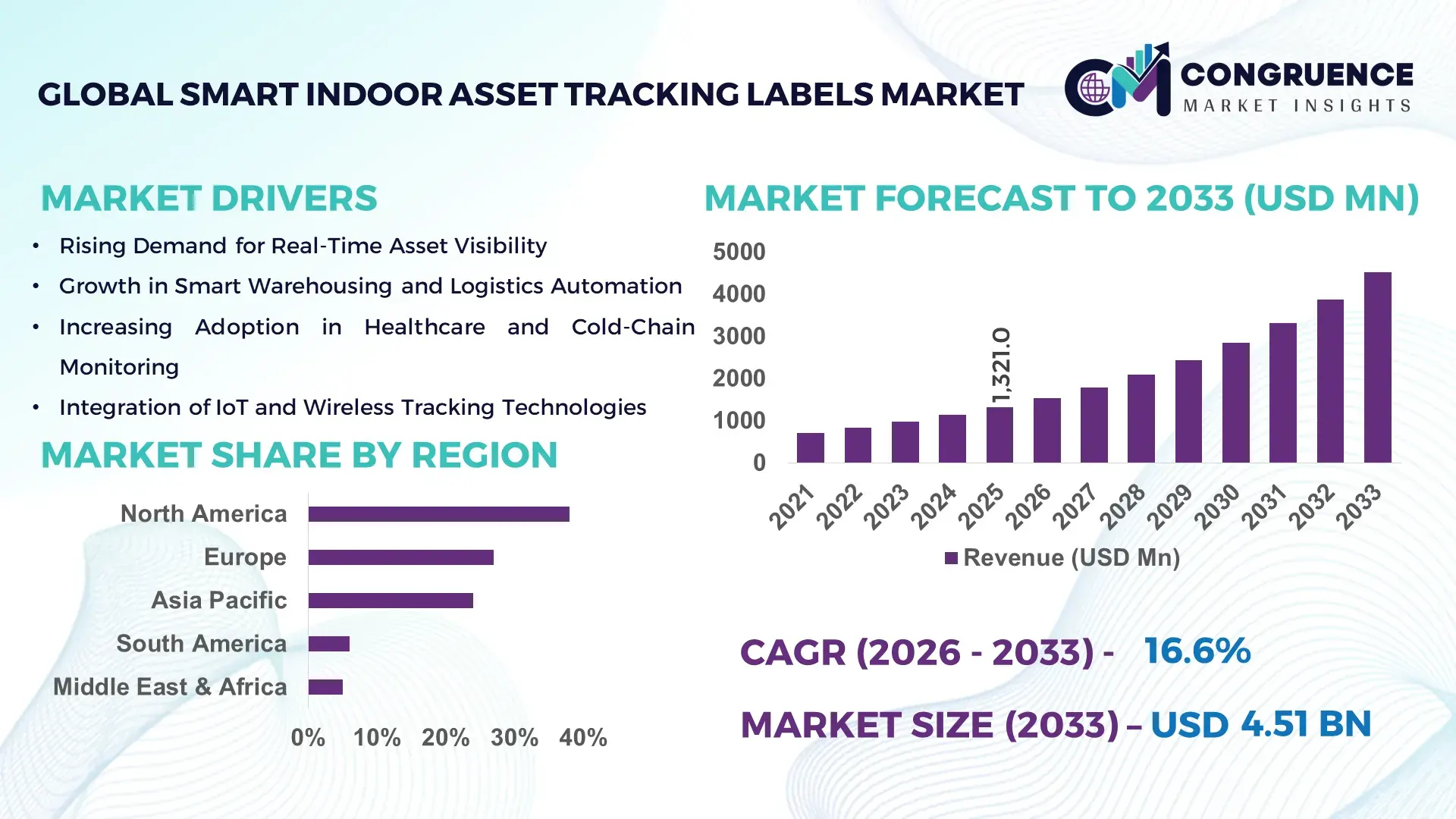
The United States represents the dominant country in the Smart Indoor Asset Tracking Labels Market, supported by strong production capabilities in RFID, BLE, and NFC-based smart label technologies. Over 45% of large U.S. hospitals have deployed RFID-enabled tracking systems for medical equipment and patient assets, while more than 60% of Tier-1 logistics facilities utilize smart labeling integrated with warehouse management systems. Annual private and public investments in IoT and smart manufacturing infrastructure exceed USD 30 billion, driving scalable deployment of indoor asset tracking solutions. The U.S. also leads in advanced semiconductor fabrication and printed electronics manufacturing, enabling high-volume production of intelligent labels with enhanced battery life exceeding 3–5 years and read accuracy above 98% in controlled indoor environments.
Market Size & Growth: Valued at USD 1,321.0 Million in 2025, projected to reach USD 4,513.3 Million by 2033 at 16.6% CAGR, driven by real-time asset monitoring and warehouse automation initiatives.
Top Growth Drivers: 42% rise in warehouse automation adoption; 38% reduction in asset misplacement using RFID; 30% improvement in inventory accuracy via smart labeling.
Short-Term Forecast: By 2028, enterprises are expected to reduce asset search time by 45% through integrated indoor tracking systems.
Emerging Technologies: BLE 5.0 low-energy tags, AI-powered location analytics, ultra-wideband (UWB) precision tracking within 10–30 cm accuracy.
Regional Leaders: North America projected at USD 1,680 Million by 2033 with high healthcare adoption; Europe at USD 1,240 Million driven by Industry 4.0; Asia-Pacific at USD 1,030 Million supported by smart factory expansion.
Consumer/End-User Trends: Hospitals, manufacturing plants, and retail chains represent over 65% of deployments, prioritizing predictive maintenance and shrinkage control.
Pilot or Case Example: In 2024, a U.S. logistics hub improved picking efficiency by 28% and reduced asset downtime by 22% using AI-enabled smart labels.
Competitive Landscape: Zebra Technologies holds approximately 18% share, followed by Avery Dennison, SATO Holdings, Checkpoint Systems, and Alien Technology.
Regulatory & ESG Impact: GS1 compliance mandates and carbon-tracking regulations are accelerating adoption of recyclable, low-power smart labels.
Investment & Funding Patterns: Over USD 2.5 Billion invested globally in IoT-enabled tracking startups since 2022, emphasizing asset intelligence platforms.
Innovation & Future Outlook: Integration of digital twins, edge computing, and cloud-based analytics is enhancing scalability and predictive asset management capabilities.
Healthcare contributes nearly 35% of Smart Indoor Asset Tracking Labels Market deployments, followed by manufacturing at 28% and logistics at 22%. BLE-enabled labels now account for over 40% of new installations due to lower energy consumption. Regulatory traceability mandates in pharmaceuticals and food sectors are accelerating adoption. Asia-Pacific consumption is rising above 20% annually in smart factory environments, while integration with AI-driven predictive maintenance platforms is shaping long-term demand.
The Smart Indoor Asset Tracking Labels Market holds strategic relevance as organizations prioritize operational resilience, compliance transparency, and digital transformation. Enterprises deploying RFID and BLE-enabled tracking systems report up to 30% improvement in inventory accuracy and 25% reduction in manual auditing time. Ultra-wideband (UWB) technology delivers 40% higher location precision compared to traditional passive RFID standards, enabling centimeter-level tracking in high-value environments such as semiconductor fabs and hospital operating units.
North America dominates in deployment volume, while Asia-Pacific leads in adoption velocity with over 48% of newly built smart factories integrating indoor asset tracking solutions at commissioning stage. By 2028, AI-driven location analytics platforms are expected to reduce asset downtime by 35% through predictive utilization mapping and automated alerts.
From an ESG perspective, firms are committing to 50% recyclable smart label materials by 2030 and targeting 20% energy consumption reduction in IoT infrastructure. In 2024, Germany achieved a 27% warehouse efficiency improvement through AI-enabled indoor tracking integrated with Industry 4.0 systems.
Strategically, the Smart Indoor Asset Tracking Labels Market is evolving toward interoperability with ERP, digital twin ecosystems, and cloud-based compliance dashboards. As automation, traceability, and sustainability mandates intensify, the Smart Indoor Asset Tracking Labels Market will remain a pillar of resilience, compliance assurance, and scalable digital growth across global enterprises.
The Smart Indoor Asset Tracking Labels Market dynamics are shaped by rapid digitalization of industrial facilities, increasing automation in supply chains, and regulatory pressure for traceability across pharmaceuticals, food processing, and electronics manufacturing. Indoor tracking accuracy has improved to above 98% in structured environments using BLE and UWB technologies. Over 60% of large distribution centers now integrate indoor positioning systems with warehouse management software. Additionally, the average asset search time in hospitals has reduced from 21 minutes to under 8 minutes after deployment of RFID-based smart labels. Competitive intensity is increasing as printed electronics and battery-efficient chipsets reduce per-label production costs by nearly 18% compared to earlier-generation active tags. Growing enterprise adoption of IoT ecosystems and predictive analytics platforms continues to influence market expansion.
The global surge in warehouse automation is significantly accelerating demand for Smart Indoor Asset Tracking Labels. Over 52% of new logistics facilities commissioned in 2024 incorporated automated storage and retrieval systems requiring real-time asset tagging. Smart labels improve picking accuracy by up to 30% and reduce inventory discrepancies by 35%. In manufacturing, automated guided vehicles (AGVs) integrated with BLE and RFID labels have improved material flow efficiency by 25%. E-commerce fulfillment centers processing over 100,000 orders daily rely on smart labeling to reduce order processing time by nearly 20%. The integration of asset tracking labels with robotics and AI-driven warehouse software ensures faster cycle counts, minimized shrinkage, and optimized asset utilization, strengthening operational throughput across industrial environments.
Despite strong adoption, high upfront infrastructure investments remain a restraint. Deployment of RFID readers, BLE gateways, and network infrastructure can increase facility upgrade costs by 15–25% depending on site complexity. Small and mid-sized enterprises face capital allocation challenges when per-facility integration costs exceed USD 250,000 for mid-scale warehouses. Additionally, interoperability challenges between legacy ERP systems and modern IoT platforms increase implementation timelines by up to 30%. Battery replacement cycles for active labels, typically every 3–5 years, add lifecycle costs. Data security concerns have also intensified, with 22% of industrial IoT deployments reporting cybersecurity incidents in the past two years, creating hesitation among regulated industries.
Healthcare digitization presents substantial opportunity. Over 40% of newly built tertiary hospitals globally are integrating indoor asset tracking for equipment utilization and patient safety compliance. Smart labels reduce medical equipment search time by 60% and improve asset utilization rates from 55% to nearly 80%. In pharmaceutical cold-chain monitoring, intelligent labels equipped with temperature sensors reduce spoilage risk by 18%. Emerging markets in Asia-Pacific are investing heavily in smart healthcare infrastructure, with digital hospital investments growing above 25% annually. Integration with AI-based patient flow analytics and electronic health records further enhances traceability, opening scalable demand avenues across healthcare ecosystems.
Signal interference and system interoperability remain persistent challenges. Indoor environments with dense metal structures or high-frequency machinery can reduce signal accuracy by 10–15% without advanced calibration. Facilities spanning over 500,000 square feet require complex multi-gateway architectures to maintain sub-meter accuracy. Integration across diverse protocols—RFID, BLE, Wi-Fi, and UWB—often requires middleware customization, increasing deployment complexity by 20%. Regulatory compliance requirements in pharmaceuticals and aerospace necessitate data retention and encryption standards, adding additional system validation cycles. These technical complexities slow full-scale enterprise rollouts despite strong operational benefits.
AI-Integrated Real-Time Location Systems Enhancing Operational Precision: Over 58% of newly deployed indoor tracking systems now integrate AI-driven analytics to predict asset movement and utilization patterns. Facilities using AI-enabled labels report 32% faster cycle counts and 26% reduction in misplaced inventory incidents. Predictive asset mapping has improved equipment uptime by 29% across manufacturing plants exceeding 200,000 square feet.
Surge in BLE and UWB Adoption for Sub-Meter Accuracy: BLE-based labels account for nearly 44% of new installations due to low power consumption, while UWB deployments have increased by 36% year-over-year in high-value industrial environments. UWB technology delivers location accuracy within 10–30 centimeters, improving tool tracking precision by 41% compared to conventional Wi-Fi triangulation.
Expansion of Smart Healthcare Asset Monitoring: Approximately 47% of multi-specialty hospitals are implementing smart indoor tracking for infusion pumps, ventilators, and surgical tools. Hospitals deploying RFID labels report 34% reduction in equipment hoarding and 23% improvement in maintenance scheduling efficiency.
Rise in Modular and Prefabricated Construction: The adoption of modular construction is reshaping demand dynamics in the Smart Indoor Asset Tracking Labels Market. Research suggests that 55% of the new projects witnessed cost benefits while using modular and prefabricated practices in their projects. Pre-bent and cut elements are prefabricated off-site using automated machines, reducing labor needs and speeding project timelines. Demand for high-precision machines is rising, especially in Europe and North America, where construction efficiency is critical.
The Smart Indoor Asset Tracking Labels Market is segmented by type, application, and end-user, reflecting diverse deployment requirements across industrial and institutional environments. By type, the market includes RFID-based labels, Bluetooth Low Energy (BLE) labels, Ultra-Wideband (UWB) labels, and NFC-enabled smart labels. These technologies differ in range, accuracy, battery consumption, and integration complexity. By application, key areas include inventory management, equipment tracking, personnel tracking, and cold-chain monitoring, with inventory management representing the most widespread implementation in logistics and retail. End-user segmentation spans healthcare, manufacturing, logistics & warehousing, retail, and aerospace & defense. Healthcare and manufacturing collectively account for over 60% of installations due to compliance requirements and operational efficiency mandates. Increasing digital transformation budgets and automation targets across enterprise sectors are reshaping segmentation dynamics, particularly toward higher-precision UWB and AI-integrated BLE deployments.
RFID-based smart labels currently account for approximately 39% of total deployments, making them the leading product type due to their cost efficiency, mature ecosystem, and compatibility with existing warehouse management systems. Passive RFID solutions are widely used in high-volume inventory environments where read ranges of 3–10 meters are sufficient and per-unit tagging costs must remain low. BLE-based labels follow with nearly 34% adoption, offering improved battery efficiency and real-time tracking capabilities across large indoor facilities. UWB-based labels represent the fastest-growing segment, expanding at an estimated CAGR of 19.8%, driven by demand for sub-meter and 10–30 cm accuracy in semiconductor manufacturing, aerospace assembly, and high-value healthcare asset tracking. While currently holding around 18% adoption, UWB deployments are increasing in precision-critical environments. NFC-enabled labels and hybrid IoT smart tags collectively contribute the remaining 9%, serving niche applications such as authentication and short-range asset validation.
Inventory management leads the Smart Indoor Asset Tracking Labels Market with approximately 41% share, supported by strong adoption across e-commerce fulfillment centers and automated warehouses. RFID and BLE labels improve inventory accuracy by up to 35% and reduce manual stock checks by nearly 30%. Equipment tracking accounts for around 28% adoption, particularly in hospitals and manufacturing plants where reducing idle time improves asset utilization from 60% to nearly 85%. Personnel tracking and workflow optimization represent the fastest-growing application segment, expanding at an estimated CAGR of 18.5%, as enterprises focus on safety compliance and productivity analytics. Real-time monitoring of staff movement has reduced emergency response times in industrial facilities by 22%. Cold-chain monitoring and specialty asset tracking collectively account for approximately 17% of deployments, particularly in pharmaceuticals and food processing industries. In 2025, more than 46% of large global enterprises reported piloting AI-integrated indoor tracking systems to enhance operational visibility. In the U.S., 42% of hospitals are testing integrated asset-location systems linked with electronic health records to streamline equipment availability.
Healthcare is the leading end-user segment, accounting for approximately 35% of Smart Indoor Asset Tracking Labels Market deployments. Hospitals and diagnostic centers rely on RFID and BLE smart labels to manage infusion pumps, ventilators, surgical tools, and mobile diagnostic units. Asset tracking adoption has reduced equipment hoarding by 34% and improved maintenance scheduling compliance above 90%. Manufacturing follows with nearly 28% share, where real-time location systems enhance production flow and reduce tool misplacement incidents by 25%. Logistics & warehousing is the fastest-growing end-user segment, expanding at an estimated CAGR of 18.9%, fueled by rapid e-commerce expansion and automation investments. Over 60% of newly commissioned large-scale warehouses integrate indoor asset tracking during initial setup. Retail, aerospace & defense, and electronics manufacturing collectively contribute around 19% of installations, leveraging smart labels for shrinkage control and compliance tracking. In 2025, more than 52% of global logistics operators reported active deployment of smart indoor tracking labels within automated distribution hubs. Additionally, 48% of large manufacturing enterprises indicated that indoor asset intelligence platforms directly improved operational decision-making speed.
North America accounted for the largest market share at 38% in 2025 however, Asia-Pacific is expected to register the fastest growth, expanding at a CAGR of 18.9% between 2026 and 2033.
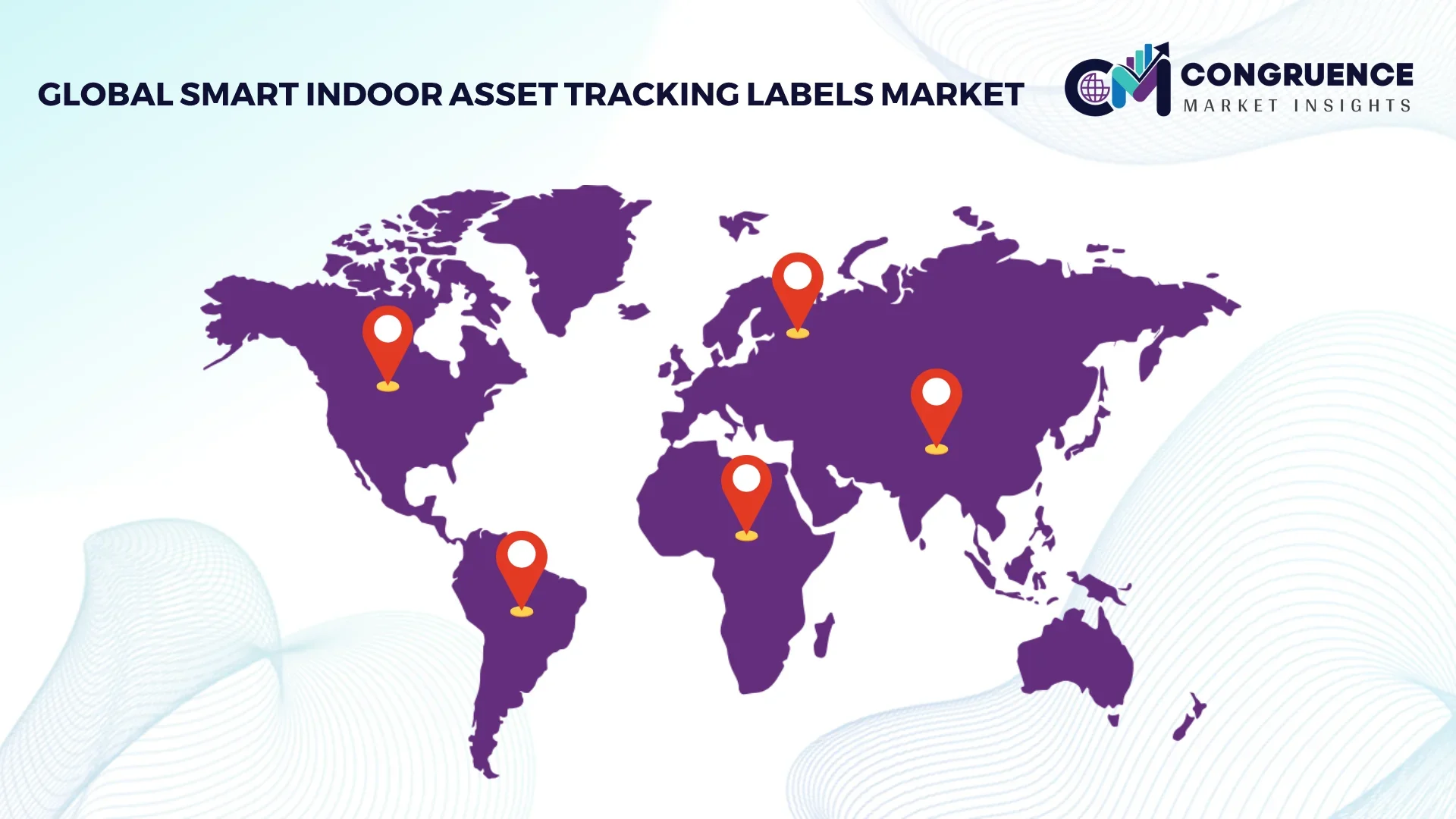
North America’s dominance is supported by over 65% adoption of indoor tracking solutions across Tier-1 logistics hubs and more than 45% deployment penetration in multi-specialty hospitals. Europe follows with approximately 27% market share, driven by Industry 4.0 investments across Germany, the UK, and France, where over 52% of large manufacturing facilities integrate real-time asset visibility systems. Asia-Pacific holds nearly 24% share, with China and Japan accounting for over 60% of regional installations due to large-scale smart factory programs. South America and the Middle East & Africa collectively represent around 11%, with adoption concentrated in oil & gas facilities, smart airports, and expanding e-commerce fulfillment centers. Across all regions, more than 58% of newly commissioned warehouses globally now embed smart indoor asset tracking labels during infrastructure setup, reflecting rising enterprise-level standardization of real-time location systems.
North America accounts for approximately 38% of the Smart Indoor Asset Tracking Labels Market, supported by advanced digital infrastructure and early adoption of RFID, BLE, and UWB technologies. Healthcare, logistics, aerospace, and semiconductor manufacturing are key demand generators, with over 62% of large distribution centers deploying integrated real-time location systems. Regulatory frameworks such as supply chain traceability mandates in pharmaceuticals and food safety modernization initiatives have accelerated adoption. Digital transformation investments exceeding USD 30 billion annually in IoT infrastructure continue to strengthen deployment volumes. Zebra Technologies, a prominent regional player, is expanding AI-enabled RFID readers capable of 99% read accuracy in high-density warehouse environments. Consumer behavior reflects higher enterprise-driven adoption, particularly in healthcare and finance sectors, where compliance reporting accuracy has improved by over 28% following indoor asset intelligence integration.
Europe represents approximately 27% of the Smart Indoor Asset Tracking Labels Market, with Germany, the UK, and France leading deployments. Over 55% of German smart factories utilize RFID-enabled asset management systems aligned with Industry 4.0 initiatives. The European Green Deal and digital traceability regulations are encouraging recyclable smart label materials and energy-efficient IoT infrastructure, influencing over 48% of new installations. Adoption of UWB precision tracking has increased by 33% in aerospace and automotive assembly plants to ensure sub-meter accuracy. Avery Dennison has expanded intelligent label production facilities within the region to support sustainable packaging mandates. European enterprises demonstrate strong regulatory-driven adoption patterns, with compliance transparency and data governance requirements influencing nearly 50% of procurement decisions for smart indoor asset tracking labels.
Asia-Pacific holds nearly 24% of global Smart Indoor Asset Tracking Labels Market installations and ranks as the fastest-growing region. China, Japan, and India collectively contribute over 70% of regional deployments. China leads with large-scale electronics and automotive manufacturing clusters integrating BLE and RFID labels in more than 58% of automated production lines. Smart city infrastructure programs and e-commerce fulfillment expansion are increasing warehouse automation rates above 45% in major metropolitan hubs. Japan’s advanced robotics ecosystem is accelerating UWB adoption for precision manufacturing, improving workflow efficiency by 26%. SATO Holdings, headquartered in Japan, continues to enhance RFID printer-encoder solutions tailored for industrial applications. Regional consumer behavior reflects strong growth driven by e-commerce, mobile-first logistics platforms, and AI-enabled warehouse management systems.
South America accounts for approximately 6% of the Smart Indoor Asset Tracking Labels Market, with Brazil and Argentina as primary contributors. Brazil represents nearly 52% of regional installations, supported by expanding e-commerce distribution centers and modernization of port infrastructure. Logistics automation projects in São Paulo and Rio de Janeiro have improved inventory visibility by 24% using RFID-based indoor tracking systems. Government-backed digital transformation initiatives in manufacturing and energy sectors are stimulating demand for equipment monitoring and safety compliance solutions. Regional adoption is concentrated in oil refining, mining, and retail distribution. Consumer behavior indicates growing demand for localized warehouse automation solutions, with nearly 37% of medium-sized enterprises piloting smart labeling technologies to enhance supply chain transparency.
The Middle East & Africa region represents around 5% of the Smart Indoor Asset Tracking Labels Market, with the UAE and South Africa emerging as high-potential markets. In the UAE, over 40% of newly constructed logistics hubs incorporate RFID-enabled tracking to support free-zone trade efficiency. Oil & gas facilities in Saudi Arabia are deploying BLE tags to monitor equipment utilization, reducing downtime by 21%. Smart airport expansions and mega-construction projects are increasing demand for asset visibility platforms. Trade partnerships and digital modernization strategies are driving IoT integration across ports and energy infrastructure. Regional enterprises emphasize operational resilience, with approximately 33% of large infrastructure projects integrating indoor tracking at the commissioning stage to enhance compliance and asset lifecycle management.
United States – 34% Market Share: Strong production capacity in RFID and BLE technologies, high enterprise adoption across healthcare and logistics, and advanced semiconductor infrastructure support Smart Indoor Asset Tracking Labels Market leadership.
China – 19% Market Share: Large-scale smart manufacturing ecosystems, rapid warehouse automation expansion, and government-backed digital factory initiatives drive Smart Indoor Asset Tracking Labels Market dominance.
The Smart Indoor Asset Tracking Labels Market is moderately fragmented, with more than 60 active global and regional competitors offering RFID, BLE, UWB, and hybrid IoT-enabled smart label solutions. The top five companies collectively account for approximately 48–52% of total market share, indicating a semi-consolidated structure driven by technological differentiation rather than price competition alone. Market leaders compete on read accuracy exceeding 98%, battery lifespan extending up to 5 years for active tags, and integration compatibility with over 70% of enterprise warehouse management systems.
Strategic initiatives shaping competition include cross-industry partnerships between IoT software providers and hardware manufacturers, accounting for nearly 35% of new product rollouts in 2024–2025. Mergers and acquisitions have increased by 18% over the past two years, primarily focused on acquiring AI-based location analytics startups and UWB chipset innovators. Over 40% of leading vendors are investing in recyclable smart label substrates and low-energy chipsets to align with ESG mandates. Product innovation cycles have shortened to 12–18 months, with vendors introducing hybrid BLE-UWB labels capable of sub-30 cm accuracy in high-density industrial environments. Competitive positioning increasingly depends on platform interoperability, cybersecurity compliance certifications, and scalability across facilities exceeding 500,000 square feet.
Checkpoint Systems
Alien Technology
Impinj, Inc.
HID Global Corporation
GAO RFID Inc.
CenTrak, Inc.
Stanley Healthcare
Identiv, Inc.
Brady Corporation
Mojix, Inc.
Beontag
Smartrac N.V.
Ubisense Group plc
Technological evolution in the Smart Indoor Asset Tracking Labels Market is centered on improving accuracy, power efficiency, interoperability, and data intelligence. RFID remains foundational, with passive UHF RFID tags achieving read ranges of up to 12 meters and supporting batch reading of over 1,000 tags per second in high-throughput warehouse environments. BLE 5.0-enabled labels are gaining prominence due to their low power consumption, extending battery life to 3–5 years while maintaining indoor accuracy within 1–3 meters.
Ultra-Wideband (UWB) technology is transforming high-precision tracking, delivering 10–30 cm location accuracy, particularly in aerospace assembly lines and semiconductor fabrication facilities where asset misplacement costs exceed 5% of operational budgets. Hybrid tags integrating BLE and UWB functionalities are improving cross-protocol communication efficiency by 28% compared to single-technology systems.
Edge computing integration allows real-time filtering of asset location data, reducing cloud data transfer volumes by up to 40% and improving decision latency by 22%. AI-driven analytics platforms now process over 500,000 location data points per hour in large-scale distribution centers, enabling predictive asset utilization mapping and automated workflow optimization.
Sustainability-driven innovations include recyclable PET-based smart label substrates and chipsets consuming 15–20% less power than earlier generations. Integration with digital twin ecosystems and ERP systems has improved enterprise asset visibility coverage to over 90% in smart factories. Cybersecurity enhancements such as AES-128 encryption and blockchain-based asset authentication protocols are increasingly embedded to mitigate IoT vulnerabilities, particularly in regulated healthcare and defense sectors.
• In September 2025, Avery Dennison and Walmart announced a collaboration to enhance RFID-enabled inventory tracking across fresh categories such as meat, bakery, and deli departments, enabling faster inventory visibility and improved freshness control in grocery operations. Source: www.averydennison.com
• In June 2025, Avery Dennison unveiled the first RFID label recognized by APR Design® for Recyclability, marking an industry first for RFID smart labels compatible with North America’s PET recycling stream — supporting circular economy and sustainable traceability initiatives. Source: www.averydennison.com
• In November 2025, Impinj expanded its Gen2X RFID innovations, enhancing Gen2X support for M770 and M780 endpoint ICs to reduce stray tag reads, inhibit fraudulent tags, and enable improved enterprise RAIN RFID use cases across logistics, manufacturing, and healthcare tracking environments. Source: www.investor.impinj.com
• In December 2025, Zebra Technologies debuted AI-powered Frontline AI Enablers at droidcon India, showcasing advanced solutions that enhance productivity and operational workflows across Asia Pacific, including improvements relevant to asset tracking and frontline automation. Source: www.zebra.com
The Smart Indoor Asset Tracking Labels Market Report provides comprehensive coverage across product types, applications, end-user industries, and geographic regions. The scope includes RFID (passive and active), BLE, UWB, NFC, and hybrid IoT-enabled smart labels designed for real-time indoor tracking within facilities ranging from 50,000 to over 1 million square feet. The report evaluates deployments across healthcare, manufacturing, logistics & warehousing, retail, aerospace & defense, electronics, and energy sectors, collectively representing more than 80% of total demand.
Geographic analysis spans North America, Europe, Asia-Pacific, South America, and the Middle East & Africa, incorporating country-level insights for the United States, China, Germany, Japan, India, Brazil, UAE, and South Africa. The study examines enterprise adoption rates, regulatory compliance requirements, digital transformation initiatives, and infrastructure modernization programs influencing technology penetration.
The report further explores integration of smart indoor asset tracking labels with AI-based analytics, digital twins, warehouse management systems, ERP platforms, and cybersecurity frameworks. It assesses deployment models across greenfield smart facilities and brownfield retrofits, highlighting accuracy benchmarks ranging from 10 cm to 3 meters depending on technology selection. Emerging segments such as cold-chain pharmaceutical monitoring, smart hospital infrastructure, and automated micro-fulfillment centers are also analyzed to provide forward-looking strategic insights.
Overall, the report delivers a structured evaluation of competitive positioning, innovation pipelines, technological benchmarks, regulatory considerations, and evolving enterprise use cases shaping the Smart Indoor Asset Tracking Labels Market landscape.
| Report Attribute / Metric | Details |
|---|---|
| Market Revenue (2025) | USD 1,321.0 Million |
| Market Revenue (2033) | USD 4,513.3 Million |
| CAGR (2026–2033) | 16.6% |
| Base Year | 2025 |
| Forecast Period | 2026–2033 |
| Historic Period | 2021–2025 |
| Segments Covered |
By Type
By Application
By End-User Insights
|
| Key Report Deliverables | Revenue Forecast; Market Trends; Growth Drivers & Restraints; Technology Insights; Segmentation Analysis; Regional Insights; Competitive Landscape; Regulatory & ESG Overview; Recent Developments |
| Regions Covered | North America; Europe; Asia-Pacific; South America; Middle East & Africa |
| Key Players Analyzed | Zebra Technologies; Avery Dennison; SATO Holdings Corporation; Checkpoint Systems; Alien Technology; Impinj, Inc.; HID Global Corporation; GAO RFID Inc.; CenTrak, Inc.; Stanley Healthcare; Identiv, Inc.; Brady Corporation; Mojix, Inc.; Beontag; Smartrac N.V.; Ubisense Group plc |
| Customization & Pricing | Available on Request (10% Customization Free) |




