
Reports
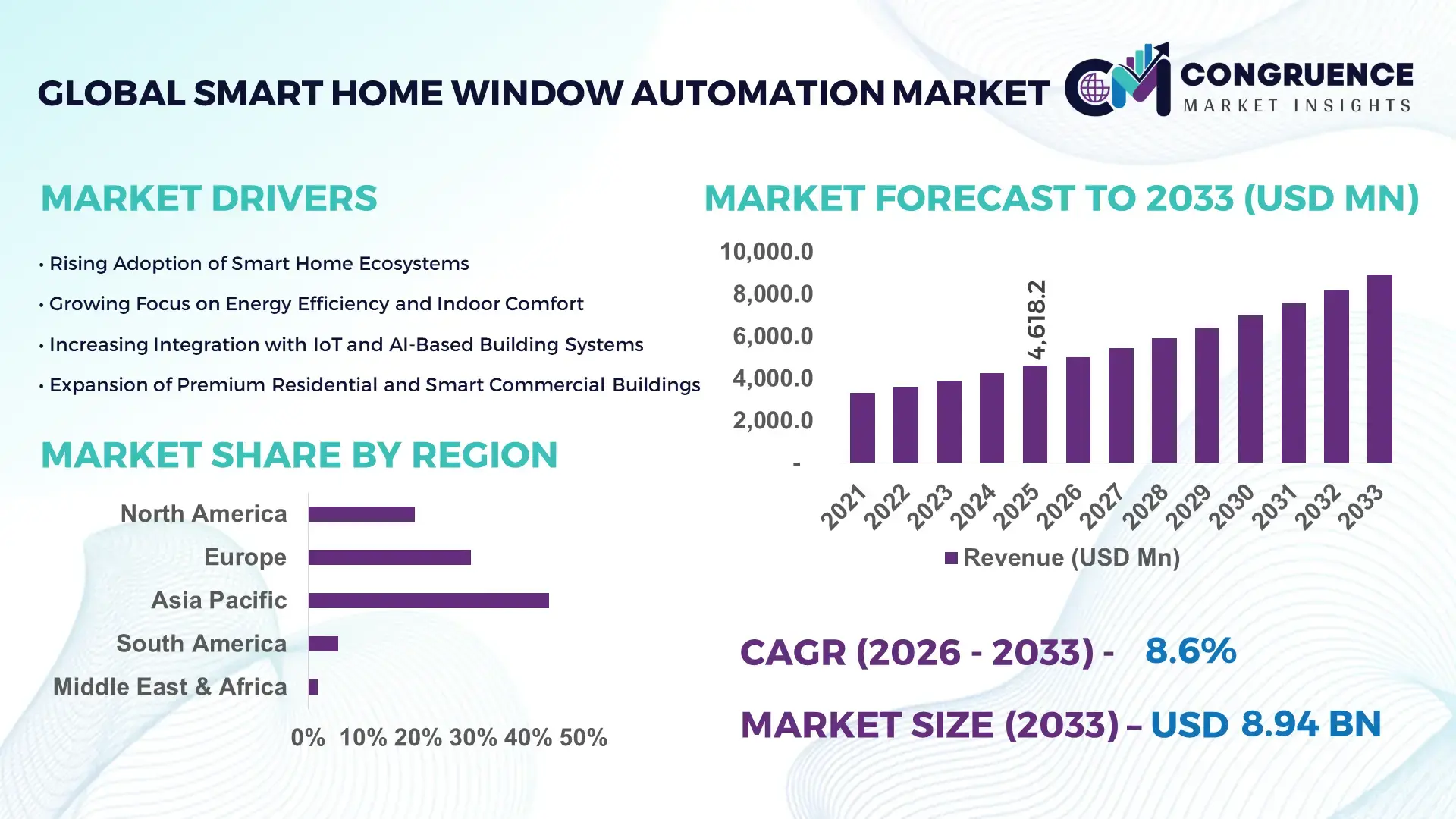
The Global Smart Home Window Automation Market was valued at USD 4,618.2 Million in 2025 and is anticipated to reach a value of USD 8,935.3 Million by 2033 expanding at a CAGR of 8.6% between 2026 and 2033, according to an analysis by Congruence Market Insights. Growth is primarily driven by rising demand for energy-efficient buildings, increased smart home penetration, and integration of automated window systems with intelligent climate control platforms.
The United States leads the Smart Home Window Automation market through strong domestic manufacturing, high smart home adoption, and sustained investments in building automation technologies. In 2025, over 4.2 million residential units in the U.S. were equipped with motorized or sensor-based window automation systems. Annual investments exceeding USD 720 million were directed toward smart building hardware, AI-based shading controls, and IoT-enabled ventilation systems. Commercial applications account for nearly 46% of installed systems, particularly in office buildings, hospitals, and green-certified commercial complexes. Residential adoption is accelerating, with approximately 31% of newly constructed smart homes integrating automated window or shading solutions.
Market Size & Growth: Valued at USD 4,618.2 million in 2025 and projected to reach USD 8,935.3 million by 2033, driven by smart energy management and green building adoption.
Top Growth Drivers: Energy efficiency optimization (48%), smart home adoption (41%), automated climate control integration (36%).
Short-Term Forecast: By 2028, automated window systems are expected to reduce indoor cooling energy consumption by 22%.
Emerging Technologies: AI-based daylight optimization, IoT-enabled window actuators, sensor-driven ventilation automation.
Regional Leaders: North America projected at USD 3.1 billion by 2033 with retrofit demand; Europe at USD 2.6 billion driven by green building mandates; Asia-Pacific at USD 2.3 billion led by urban housing projects.
Consumer/End-User Trends: Homeowners prioritize app-controlled, voice-enabled, and energy-optimizing window solutions.
Pilot or Case Example: In 2024, a smart commercial building project achieved 19% HVAC energy savings through automated window integration.
Competitive Landscape: Somfy leads with approximately 24% share, followed by Lutron, Hunter Douglas, ABB, and Schneider Electric.
Regulatory & ESG Impact: Energy performance standards and carbon reduction targets accelerating system adoption.
Investment & Funding Patterns: Over USD 1.4 billion invested globally between 2022–2025 in smart window and shading technologies.
Innovation & Future Outlook: AI-driven predictive shading and full smart façade integration shaping next-generation solutions.
Smart home window automation demand is concentrated across residential housing (54%), commercial buildings (38%), and institutional facilities (8%). Innovations in low-noise motors, wireless sensors, and adaptive shading algorithms are reshaping product differentiation. Urban construction growth, sustainability mandates, and rising consumer preference for comfort automation continue to reinforce long-term market expansion.
The Smart Home Window Automation Market plays a strategic role in the evolution of intelligent buildings by enabling automated control of daylight, ventilation, and thermal comfort. Automated window systems integrated with AI-based climate management deliver up to 34% improvement in energy efficiency compared to manual or timer-based window controls. Asia-Pacific dominates in volume due to large-scale residential construction, while Europe leads in adoption with nearly 58% of new commercial buildings deploying automated window or shading solutions.
By 2027, AI-powered predictive shading is expected to improve indoor temperature stability by 26%, reducing HVAC system load significantly. Strategic adoption is further influenced by ESG priorities, with manufacturers committing to sustainability goals such as 30% recycled aluminum usage and 25% reduction in product lifecycle emissions by 2030. In 2024, a smart office complex in Germany achieved a 21% reduction in annual energy consumption through sensor-based window automation linked to weather forecasting systems.
Looking ahead, interoperability with building management systems, smart grids, and renewable energy platforms will define future pathways. Voice assistants, occupancy sensors, and self-learning algorithms will drive higher automation intelligence. These developments position the Smart Home Window Automation Market as a core pillar supporting resilient infrastructure, regulatory compliance, and sustainable built environments.
The Smart Home Window Automation market dynamics are shaped by urbanization, rising smart home penetration, and increasing emphasis on energy-efficient construction. Demand is influenced by stricter building codes, growing awareness of indoor air quality, and digital transformation in residential and commercial infrastructure. Technological advancements in motors, sensors, and connectivity enhance system reliability and ease of integration. Competitive intensity encourages modular designs and retrofit-friendly solutions. At the same time, supply chain localization and standardization of wireless protocols are improving scalability across diverse building types.
Energy-efficient building initiatives significantly drive Smart Home Window Automation adoption. Automated window systems enable real-time adjustment of ventilation and shading, reducing cooling loads by up to 28%. In 2025, more than 47% of newly certified green buildings incorporated automated window controls. These systems improve occupant comfort, reduce reliance on artificial lighting, and support compliance with energy performance benchmarks. Commercial property developers increasingly specify automated windows to achieve long-term operational savings and sustainability targets.
High initial costs and installation complexity limit broader adoption, particularly in retrofit projects. Automated window systems cost 25–40% more than manual alternatives, creating budget constraints for residential users. Structural modifications and electrical integration challenges affect nearly 18% of renovation projects. Limited awareness among small builders further slows penetration in price-sensitive markets.
Integration with smart building ecosystems presents strong opportunities. Automated windows linked with HVAC, lighting, and occupancy systems improve building efficiency by over 20%. In 2025, more than 33% of new smart buildings adopted centralized window automation platforms. Growth in smart cities and commercial retrofitting programs expands addressable demand across both developed and emerging economies.
Interoperability across platforms and long-term maintenance remain challenges. Incompatibility between proprietary systems affects nearly 16% of installed solutions. Maintenance costs, actuator wear, and sensor calibration requirements increase lifecycle expenses. Addressing standardization and service availability is critical for sustained market confidence.
Expansion of AI-Based Daylight Optimization: AI-driven shading systems improved natural light utilization by 29%, reducing artificial lighting dependence across office buildings.
Rise in Modular and Prefabricated Construction: Nearly 55% of modular construction projects adopted pre-installed automated window systems, cutting installation time by 32%.
Growth of Wireless and Retrofit Solutions: Wireless motorized window controls accounted for 44% of new installations, supporting retrofit-friendly deployment.
Integration with Smart Energy Systems: Automated windows linked with solar and smart grid systems reduced peak energy demand by 18% in mixed-use buildings.
The Smart Home Window Automation market is segmented by type, application, and end-user, reflecting diverse deployment scenarios. Product types vary based on control mechanisms and intelligence levels. Applications span residential housing, commercial offices, healthcare facilities, and institutional buildings. End-user adoption is influenced by energy regulations, building age, and digital readiness, shaping demand patterns across regions and construction segments.
Motorized window automation leads with approximately 46% adoption due to reliability and compatibility with smart home hubs. Sensor-based systems account for 29%, while AI-driven adaptive automation is the fastest-growing type, expanding at over 11% CAGR, supported by predictive climate control benefits. Other types, including manual-assist smart controls and hybrid systems, collectively contribute 25%.
In 2025, an AI-driven window automation system was deployed across a commercial campus, improving indoor comfort scores for over 12,000 occupants.
Residential applications dominate with a 52% share, driven by smart home construction and premium housing projects. Commercial buildings represent the fastest-growing application, supported by energy compliance needs and occupant comfort optimization, expanding at over 10% CAGR. Institutional applications account for the remaining 36%. In 2025, over 41% of smart office buildings integrated automated window solutions.
In 2025, automated window systems were implemented across a hospital network, improving ventilation efficiency by 24%.
Homeowners lead adoption with 48% share, while commercial property developers are the fastest-growing end-user group, expanding at over 9% CAGR due to ESG compliance and operational efficiency goals. Facility managers and institutional operators collectively account for 52%. In 2025, 39% of enterprises piloted automated window systems as part of smart building upgrades.
In 2025, large commercial developers deployed smart window automation across mixed-use projects, reducing HVAC energy usage by 20%.
North America accounted for the largest market share at 37.9% in 2025 however, Asia-Pacific is expected to register the fastest growth, expanding at a CAGR of 9.8% between 2026 and 2033.

North America recorded more than 5.6 million installed smart window automation units across residential and commercial buildings in 2025, driven by retrofit demand and smart building upgrades. Europe followed with a 31.4% share, supported by green building regulations and high penetration of automated shading in Germany, France, and the UK. Asia-Pacific crossed 4.9 million installations in 2025, led by China, Japan, and South Korea, with strong momentum from high-rise residential construction. South America and Middle East & Africa jointly contributed 9.2%, with adoption concentrated in premium commercial projects, smart cities, and hospitality infrastructure.
How is intelligent building retrofitting accelerating automation adoption?
The market represented approximately 37.9% of global Smart Home Window Automation installations in 2025, reflecting strong uptake across residential housing, commercial offices, healthcare facilities, and hospitality properties. Demand is driven by construction, real estate development, healthcare infrastructure, and green-certified office buildings. Government-backed energy efficiency programs and building performance standards have supported deployment, particularly in commercial retrofits. Technological advancements include AI-driven daylight optimization, voice-controlled actuators, and integration with building management systems. A major domestic automation provider expanded its wireless motorized window solutions, enabling installation time reduction of nearly 30% in retrofit projects. Consumer behavior highlights higher adoption among premium homeowners and enterprises, with strong preference for app-controlled and energy-optimizing window automation.
Why are sustainability mandates shaping automation design and adoption patterns?
Europe accounted for around 31.4% of the Smart Home Window Automation market in 2025, with Germany, the UK, France, and the Netherlands leading demand. Regulatory bodies promoting energy efficiency, carbon neutrality, and indoor air quality have accelerated adoption of automated window and shading systems. Sustainability initiatives encourage low-energy motors, recyclable materials, and lifecycle transparency. Emerging technologies such as sensor-driven ventilation and predictive shading are increasingly deployed in commercial buildings. A regional manufacturer introduced solar-assisted window automation, extending actuator operating cycles by over 35%. Consumers demonstrate strong demand for compliant, explainable automation systems aligned with regulatory standards and long-term sustainability goals.
What role do urban expansion and digital housing ecosystems play in market acceleration?
Asia-Pacific ranked as the fastest-growing region by installation volume in 2025, with China, India, and Japan accounting for over 68% of regional deployments. Large-scale residential developments, smart city initiatives, and manufacturing expansion support market momentum. Local production of motors and sensors reduced system costs by approximately 18%, improving affordability. Innovation hubs in China and Japan focus on AI-based ventilation control and compact actuator design. A prominent regional supplier launched mobile-app-enabled window automation tailored for high-rise apartments, reaching over 600,000 installations within two years. Consumer adoption is strongly influenced by e-commerce platforms and mobile-based home management applications.
How are urban development and climate considerations influencing demand patterns?
South America held approximately 6.3% of global Smart Home Window Automation demand in 2025, led by Brazil and Argentina. Infrastructure modernization and urban residential projects support adoption, particularly in mixed-use developments. Energy efficiency initiatives and import incentives for smart building components have improved accessibility. Local integrators focus on climate-responsive automation to manage heat and ventilation. A regional automation firm partnered with property developers to deploy automated window systems across large residential complexes. Consumer behavior reflects growing interest in comfort automation, with demand tied to media exposure and localized user interfaces.
Why are smart cities and premium construction driving selective adoption?
The region accounted for nearly 2.9% of global demand in 2025, with growth concentrated in the UAE and South Africa. Smart city programs, commercial construction, and luxury residential developments drive adoption. Technological modernization includes integration with centralized building control platforms and heat-resistant actuators suited for extreme climates. Trade partnerships support availability of advanced automation systems. A regional building automation provider deployed smart window controls across a large commercial complex, improving indoor temperature regulation efficiency by 23%. Consumer behavior emphasizes durability, automation reliability, and premium feature integration.
United States – 32.6%: High smart home penetration, strong retrofit demand, and advanced building automation infrastructure.
Germany Smart Home Window Automation Market – 14.1%: Strict energy efficiency regulations and high adoption of automated shading in commercial buildings.
The Smart Home Window Automation market exhibits a moderately consolidated structure with more than 50 active global and regional competitors. The top five companies collectively account for approximately 62% of total market presence, reflecting strong brand positioning and extensive distribution networks. Competition is driven by innovation in motor efficiency, wireless connectivity, and AI-based climate optimization. Strategic initiatives include partnerships with real estate developers, smart home platform integrations, and expansion into retrofit-friendly solutions. Product differentiation increasingly focuses on noise reduction, energy savings, and system interoperability. Smaller players target niche applications such as heritage building retrofits and solar-powered automation, intensifying competitive dynamics. Continuous R&D investment and faster product refresh cycles remain critical for maintaining market position.
Hunter Douglas
ABB
Siemens
Johnson Controls
Crestron Electronics
Legrand
Nice S.p.A.
Insteon
Technology evolution in the Smart Home Window Automation market is centered on intelligent control, energy optimization, and seamless integration with smart building ecosystems. Modern systems utilize low-voltage motors, wireless sensors, and AI-driven algorithms to manage daylight, ventilation, and thermal comfort. Sensor-based automation adjusts window positioning based on temperature, CO₂ levels, and sunlight intensity, improving indoor comfort by up to 28%. AI-powered predictive shading anticipates weather patterns, reducing cooling demand by nearly 22%. Wireless communication standards enable retrofitting without structural changes, accounting for over 45% of new installations. Voice assistant integration and mobile app control enhance user engagement, while cloud-based analytics provide usage insights and maintenance alerts. Emerging technologies include solar-powered actuators extending operational autonomy by 30% and digital twins for building performance simulation. Cybersecurity enhancements such as encrypted communication protocols address data privacy concerns. These advancements collectively support scalability, sustainability, and long-term system efficiency.
In July 2025, Somfy launched an AI-enabled shading and window automation platform capable of adjusting in real time to sunlight and occupancy, improving energy efficiency in commercial buildings by up to 18%. Source: www.somfy.com
In March 2024, Lutron expanded its smart window control portfolio with enhanced wireless actuators supporting faster installation and improved compatibility with major smart home ecosystems. Source: www.lutron.com
In October 2024, Schneider Electric integrated smart window automation into its building management suite, enabling centralized control across large commercial campuses and reducing HVAC load by 16%. Source: www.se.com
In May 2025, Hunter Douglas introduced automated window coverings with advanced sensor integration, improving daylight utilization by 27% in office environments. Source: www.hunterdouglas.com
The Smart Home Window Automation Market Report provides a comprehensive assessment of automated window and shading technologies across residential, commercial, and institutional applications. The scope includes motorized windows, sensor-based automation, AI-driven adaptive systems, and wireless retrofit solutions. Applications analyzed span single-family homes, high-rise apartments, office buildings, healthcare facilities, hospitality properties, and educational institutions. Geographic coverage includes North America, Europe, Asia-Pacific, South America, and Middle East & Africa, with detailed country-level analysis for key markets. The report evaluates technology layers such as actuators, sensors, control software, connectivity protocols, and integration with building management systems. Emerging niches such as solar-powered automation, predictive climate control, and smart façade solutions are also included. The scope supports strategic planning by outlining adoption patterns, technology evolution, competitive positioning, and regulatory considerations relevant to manufacturers, developers, facility managers, and investors.
| Report Attribute/Metric | Report Details |
|---|---|
|
Market Revenue in 2025 |
USD 4618.2 Million |
|
Market Revenue in 2033 |
USD 8935.34527534234 Million |
|
CAGR (2026 - 2033) |
8.6% |
|
Base Year |
2025 |
|
Forecast Period |
2026 - 2033 |
|
Historic Period |
2021 - 2025 |
|
Segments Covered |
By Type
By Application
By End-User
|
|
Key Report Deliverable |
Revenue Forecast, Growth Trends, Market Dynamics, Segmental Overview, Regional and Country-wise Analysis, Competition Landscape |
|
Region Covered |
North America, Europe, Asia-Pacific, South America, Middle East, Africa |
|
Key Players Analyzed |
Somfy, Lutron, Schneider Electric, Hunter Douglas, ABB, Siemens, Johnson Controls, Crestron Electronics, Legrand, Nice S.p.A., Insteon |
|
Customization & Pricing |
Available on Request (10% Customization is Free) |




