
Reports
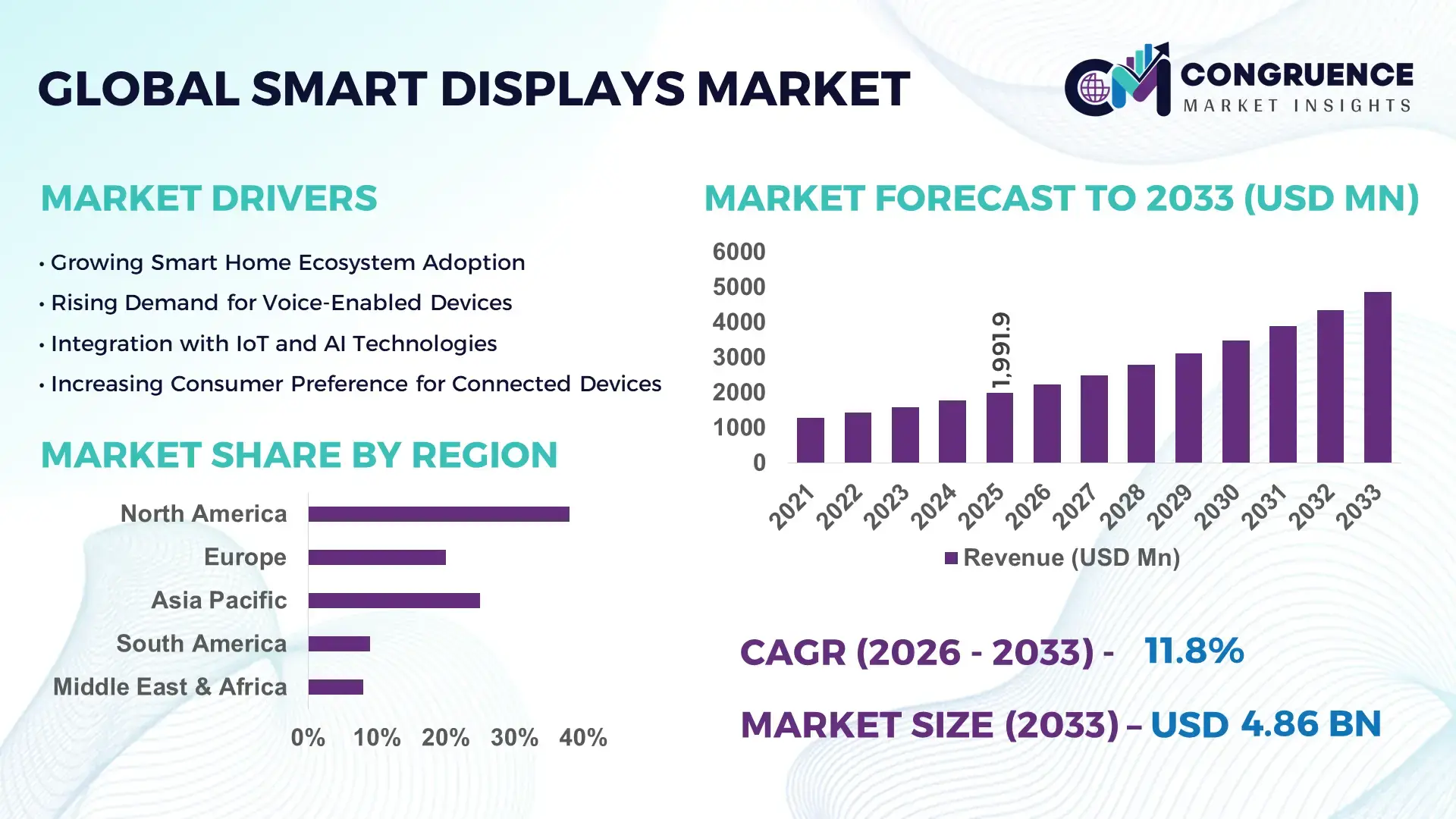
The Global Smart Displays Market was valued at USD 1991.87 Million in 2025 and is anticipated to reach a value of USD 4861.8 Million by 2033 expanding at a CAGR of 11.8% between 2026 and 2033. Rapid integration of voice assistants, AI-driven home automation ecosystems, and connected consumer electronics is accelerating global demand for advanced smart display devices.
The United States remains a major production and innovation hub within the Smart Displays market, supported by extensive consumer electronics manufacturing ecosystems and strong investments in AI-enabled home technologies. In 2024, more than 48 million U.S. households used voice-enabled smart home devices, creating a substantial installed base for smart displays integrated with voice assistants and IoT platforms. Technology companies in the country invested over USD 6 billion in AI-driven smart home research and development between 2022 and 2024. Smart displays are widely deployed in residential home automation systems, hospitality information kiosks, and retail customer-engagement platforms. In addition, U.S. consumer adoption of voice-controlled displays reached approximately 32% of smart speaker users in 2025, reflecting strong ecosystem expansion and device interoperability across connected devices.
Market Size & Growth: The Smart Displays market reached USD 1991.87 million in 2025 and is projected to reach USD 4861.8 million by 2033, expanding at an estimated CAGR of 11.8%, driven by rising adoption of AI-powered home assistants and integrated IoT devices.
Top Growth Drivers: Smart home device adoption increased by 41%, voice-assistant usage expanded by 36%, and connected device interoperability improved operational efficiency by nearly 28%.
Short-Term Forecast: By 2028, enhanced AI interface optimization and display processing efficiency are expected to reduce device response latency by nearly 22% across consumer smart home ecosystems.
Emerging Technologies: Key innovations include generative AI voice interfaces, edge AI processing for on-device personalization, and gesture-controlled interactive display technologies.
Regional Leaders: North America is projected to approach USD 1.9 billion by 2033 with strong smart home adoption; Asia-Pacific could exceed USD 1.6 billion driven by electronics manufacturing ecosystems; Europe is expected to surpass USD 900 million with enterprise digital-assistant deployments.
Consumer/End-User Trends: Residential consumers represent the largest user base, while retail stores, hotels, and healthcare facilities increasingly deploy smart displays for digital concierge and customer interaction services.
Pilot or Case Example: In 2024, a retail automation pilot using AI-enabled smart displays in large supermarkets improved product discovery efficiency by 27% and reduced customer service response time by 18%.
Competitive Landscape: A leading technology provider holds roughly 32% share, followed by major competitors including global consumer electronics and digital assistant platform providers.
Regulatory & ESG Impact: Energy-efficient display technologies and recyclable electronic components are encouraging manufacturers to meet sustainability targets such as 25% lower device power consumption by 2030.
Investment & Funding Patterns: Over USD 4.5 billion has been invested globally since 2022 in smart home AI platforms, display hardware innovation, and voice interface development.
Innovation & Future Outlook: Multi-modal AI interfaces, seamless IoT device connectivity, and context-aware display intelligence are expected to define the next generation of smart displays.
The Smart Displays market is influenced by multiple industry sectors including consumer electronics, smart home automation, retail digital engagement, and hospitality services. Consumer electronics account for roughly 58% of total device deployment, while commercial applications such as retail kiosks and hotel concierge displays contribute approximately 24%. Recent innovations include ultra-low-power micro-LED panels, edge AI processors capable of handling local voice commands, and advanced natural language interfaces for contextual assistance. Regulatory frameworks promoting energy-efficient electronics and circular manufacturing practices are encouraging manufacturers to adopt recyclable materials and modular device architectures. Regionally, Asia-Pacific leads in device manufacturing output, while North America and Europe demonstrate strong demand for integrated smart home ecosystems and enterprise digital assistant solutions.
The Smart Displays market has become strategically important within the broader smart home and connected device ecosystem. As digital assistants evolve into interactive visual platforms, smart displays are increasingly used for communication, productivity, and automated home management. Edge-AI enabled display systems deliver approximately 35% faster voice command processing compared to cloud-dependent voice interfaces, enabling real-time device control and enhanced user experience. Asia-Pacific dominates in manufacturing volume due to strong electronics production capabilities, while North America leads in adoption with nearly 39% of connected households using voice-enabled smart devices integrated with visual display interfaces. By 2028, AI-driven personalization algorithms are expected to improve smart display recommendation accuracy and contextual content delivery by nearly 30%.
Environmental compliance is also shaping market strategies, with manufacturers committing to sustainability targets such as reducing device power consumption by 25% and increasing recyclable material usage by 40% by 2030. In 2024, a smart home pilot project in South Korea integrated AI-powered smart displays with building automation systems, improving residential energy monitoring efficiency by 26%. As AI, IoT connectivity, and energy-efficient hardware converge, the Smart Displays Market is positioned as a critical platform for digital interaction, operational resilience, and sustainable connected living environments.
The rapid growth of smart home ecosystems significantly accelerates demand for smart displays as central control interfaces for connected devices. By 2025, more than 600 million smart home devices were installed globally, including smart lighting, security cameras, and thermostats. Smart displays enable unified management of these devices through voice and touchscreen interfaces. Studies show households with three or more smart devices are 42% more likely to adopt a smart display as a control hub. Enhanced compatibility with IoT platforms and voice assistants is further expanding consumer adoption across residential environments.
Data privacy and cybersecurity concerns remain a key restraint affecting the Smart Displays market. These devices continuously process voice commands, video feeds, and user activity data, raising concerns regarding data storage and surveillance risks. Surveys conducted in 2024 indicated that nearly 37% of potential buyers hesitate to adopt smart displays due to privacy concerns related to always-listening microphones and built-in cameras. Additionally, compliance with global data protection regulations requires manufacturers to implement stronger encryption protocols and secure device architectures, increasing development complexity and deployment costs.
AI-driven personalization technologies create significant growth opportunities for the Smart Displays market. Modern devices integrate machine learning algorithms capable of recognizing user preferences, routines, and contextual behaviors. Advanced recommendation engines can improve content relevance and home automation suggestions by nearly 30%. Smart displays are also being integrated with healthcare monitoring, remote education, and enterprise collaboration systems. For example, AI-enabled health monitoring displays can track daily activity patterns and medication reminders, opening opportunities for deployment in assisted living facilities and digital healthcare environments.
The Smart Displays market faces challenges related to hardware component costs and global electronics supply chain constraints. Advanced display panels, AI processors, and integrated sensors increase production complexity and device pricing. Semiconductor shortages between 2022 and 2024 disrupted consumer electronics manufacturing, delaying device shipments and limiting inventory availability. Additionally, manufacturers must ensure compatibility with multiple smart home platforms and communication protocols, which increases design and engineering requirements. These operational challenges can slow large-scale deployment and reduce affordability in price-sensitive consumer markets.
• Rapid Growth in Voice-Enabled Display Devices: Voice-enabled smart displays are becoming the primary interface in connected homes, with more than 62% of smart display users relying on voice commands as their main control method. In 2025, over 185 million households worldwide used voice assistants integrated with display interfaces for tasks such as video calling, home automation control, and information queries. Device response accuracy improved by nearly 34% with advanced speech recognition models, while multilingual voice recognition systems expanded language compatibility by 28%. This trend is pushing manufacturers to integrate far-field microphones, AI voice processing chips, and context-aware interfaces into next-generation smart display devices.
• Expansion of AI-Driven Personalized Content Interfaces: AI-powered personalization features are transforming how users interact with smart displays. Approximately 46% of modern devices now use machine learning algorithms to analyze user preferences, enabling adaptive content recommendations such as calendar reminders, personalized news feeds, and smart home routines. These systems can improve content relevance by nearly 31% compared with static digital assistants. Additionally, more than 52% of new smart display models launched in 2024 included AI-driven contextual awareness capabilities, allowing devices to automatically adjust display information based on user location, time of day, and historical behavior patterns.
• Integration with IoT-Based Home Automation Systems: Smart displays are increasingly used as central control hubs for connected home ecosystems. Around 58% of households with smart lighting, security cameras, or thermostats now use a display-based interface for device management. IoT connectivity standards such as Matter and Thread have improved device interoperability by nearly 40%, enabling smart displays to control multiple connected appliances through a unified interface. In smart homes equipped with more than five IoT devices, smart display adoption rates exceed 44%, demonstrating their growing importance as centralized digital command centers within residential environments.
• Increasing Adoption in Commercial and Hospitality Environments: Commercial sectors such as retail, hospitality, and healthcare are rapidly adopting smart displays for digital concierge services, customer engagement platforms, and information kiosks. Approximately 35% of large retail stores deployed interactive display assistants in 2024 to improve customer navigation and product discovery. In hotels, smart displays installed in guest rooms increased digital service requests by 27%, reducing front desk workload and improving guest experience efficiency by 19%. Healthcare facilities are also integrating bedside smart displays, enabling patient information access, teleconsultation support, and digital care coordination across more than 1,200 hospitals globally.
The Smart Displays market is segmented by type, application, and end-user industries, reflecting the technology’s diverse deployment across consumer electronics and enterprise environments. Product types vary by screen size, functionality, and integrated voice assistant ecosystems, with mid-sized display devices dominating consumer adoption. Applications range from smart home automation and communication tools to digital retail interfaces and healthcare monitoring systems. Smart home control remains the primary application segment, supported by growing IoT device installations and connected home ecosystems. From an end-user perspective, residential consumers account for the largest share of deployments due to strong demand for voice-enabled assistants and home automation hubs. Commercial sectors including hospitality, healthcare, and retail are emerging as high-growth adoption areas as businesses deploy interactive displays for digital concierge services, remote communication, and customer engagement platforms. These segmentation patterns demonstrate the market’s expansion beyond household use into enterprise digital transformation initiatives.
Smart displays are primarily categorized into small-sized displays (up to 7 inches), medium-sized displays (7–10 inches), and large-sized displays (above 10 inches). Medium-sized smart displays currently account for approximately 47% of total device adoption because they offer an optimal balance between screen visibility, voice interaction, and countertop usability in kitchens and living rooms. Small-sized devices hold about 28% share, commonly used as compact digital assistants in bedrooms or offices. Large displays represent nearly 25% of installations, particularly in commercial environments and shared living spaces. However, large smart displays are expanding fastest with an estimated 14.2% growth rate, driven by demand for video conferencing, digital signage, and advanced home entertainment features.
Applications in the Smart Displays market include smart home control, communication and video calling, entertainment and media streaming, retail and digital signage, and healthcare monitoring. Smart home control remains the leading application, accounting for nearly 44% of total device usage, as consumers rely on displays to manage lighting, thermostats, security cameras, and other connected appliances. Communication and video calling applications represent roughly 26% adoption, supported by growing remote communication needs and integrated camera systems. Retail and digital signage deployments are growing fastest with an estimated 15.3% expansion rate, driven by interactive product catalogs and AI-powered customer assistance systems. Entertainment and media streaming contribute about 18% of use cases, while healthcare monitoring applications account for the remaining 12%.
The Smart Displays market serves residential consumers, retail businesses, hospitality providers, healthcare institutions, and corporate offices. Residential users represent the largest end-user segment with approximately 61% of device installations, largely driven by demand for voice-enabled smart home hubs and family communication devices. Retail and hospitality sectors together account for about 22% of deployments, where interactive displays support digital concierge services, product discovery, and customer engagement. Healthcare facilities represent nearly 9% of installations, particularly in patient rooms and telehealth environments. Corporate offices contribute the remaining 8%, using smart displays for collaboration and meeting room communication systems. However, healthcare is the fastest-growing end-user segment with a projected 16.5% growth rate, supported by digital patient engagement tools and remote monitoring platforms.
Region North America accounted for the largest market share at 38% in 2025, however Asia-Pacific is expected to register the fastest growth, expanding at a CAGR of 13.6% between 2026 and 2033.

Europe held approximately 26% of global Smart Displays installations, supported by rising smart home adoption across Germany, the UK, and France. Asia-Pacific represented nearly 24% of the total market, driven by high-volume electronics manufacturing in China and South Korea. South America accounted for 7%, led by Brazil and Argentina with increasing digital home device penetration. The Middle East & Africa contributed roughly 5%, supported by smart city investments and connected home deployments across the UAE and South Africa.
How Is Advanced Smart Home Integration Reshaping Consumer Interaction with Intelligent Display Devices?
North America represents approximately 38% of the global Smart Displays market, supported by widespread adoption of connected home ecosystems and advanced consumer electronics infrastructure. The United States leads regional demand, with more than 52 million households using voice-enabled smart devices integrated with display interfaces. Key industries driving adoption include smart home automation, healthcare telecommunication, retail digital signage, and hospitality guest service platforms. Regulatory initiatives promoting energy-efficient electronics and consumer data protection frameworks are shaping device development standards. The region is also experiencing rapid digital transformation, with nearly 61% of connected homes operating more than four IoT devices linked to display-based control hubs. A prominent technology provider in the region has introduced AI-powered displays with enhanced voice recognition accuracy exceeding 94%, supporting multilingual interfaces and improved device interoperability. Consumer behavior shows higher enterprise adoption in healthcare and financial service environments where digital communication displays streamline customer interactions and operational efficiency.
What Is Driving Rapid Adoption of AI-Powered Interactive Display Devices Across Modern Households?
Europe accounts for roughly 26% of global Smart Displays installations, with key markets including Germany, the United Kingdom, France, and the Netherlands. Smart home penetration in Western Europe exceeded 35% of households in 2025, creating a strong foundation for smart display adoption as central control hubs. European regulatory frameworks emphasizing energy efficiency and electronic waste reduction have pushed manufacturers to design low-power display technologies and recyclable device components. Regional digital transformation initiatives are accelerating adoption of AI-powered voice assistants and connected home platforms. For example, a European consumer electronics manufacturer recently launched a 10-inch AI-enabled smart display supporting over 20 languages for cross-border consumer markets. Consumer behavior in this region reflects strong demand for privacy-compliant digital assistants and transparent data processing, encouraging the integration of secure on-device AI processing systems rather than cloud-based voice recognition.
How Are Rapid Electronics Manufacturing and AI Innovation Expanding Intelligent Display Ecosystems?
Asia-Pacific holds approximately 24% of the global Smart Displays market and ranks as the largest manufacturing hub for consumer electronics and display technologies. Major consuming countries include China, India, Japan, and South Korea, collectively representing more than 70% of regional device shipments. China alone produced over 65 million smart display units in 2024, supported by large-scale electronics assembly facilities and AI hardware development. Regional technology hubs in Shenzhen, Seoul, and Tokyo are accelerating innovations in voice recognition chips, advanced LCD panels, and edge AI processors. A major Asian consumer electronics manufacturer introduced smart displays equipped with AI-powered visual recognition capable of identifying over 100 household objects, enhancing smart home automation. Consumer behavior across the region shows strong growth driven by e-commerce platforms and mobile AI applications, with more than 45% of connected households integrating digital assistants with visual interfaces.
How Is Digital Media Consumption Influencing Demand for Interactive Home Display Devices?
South America accounts for approximately 7% of global Smart Displays installations, with Brazil and Argentina representing the largest national markets. Urban smart home device adoption across major Brazilian cities increased by 31% between 2022 and 2025, reflecting rising consumer interest in voice-controlled home technologies. Infrastructure improvements in broadband connectivity and affordable consumer electronics imports have accelerated smart display availability across regional markets. Government trade policies supporting digital consumer electronics imports have also reduced device costs by nearly 12% over the past three years. A regional technology distributor in Brazil expanded smart display retail distribution to more than 1,800 electronics outlets, improving device accessibility in urban and suburban areas. Consumer behavior across South America demonstrates strong demand for multilingual voice assistants and localized content platforms, with digital entertainment and media streaming driving significant adoption.
How Are Smart City Investments Transforming Adoption of AI-Driven Interactive Displays?
The Middle East & Africa region represents roughly 5% of the global Smart Displays market, with growing adoption supported by large-scale smart city development projects and digital infrastructure modernization. Key markets include the United Arab Emirates, Saudi Arabia, and South Africa, where government initiatives promoting digital transformation are accelerating smart device adoption. Smart home device penetration in the UAE exceeded 29% of households in 2025, encouraging integration of AI-powered display assistants for home automation and digital concierge services. Technology modernization in hospitality and retail sectors is further expanding demand for interactive displays used for guest services and digital information kiosks. A regional electronics retailer introduced smart display product lines across 350 technology outlets in the Gulf region, expanding consumer accessibility. Consumer behavior in the region indicates rising interest in voice-controlled devices supporting Arabic and multilingual AI assistants.
United States – 32% market share: The Smart Displays market in the United States is driven by strong smart home adoption, advanced consumer electronics innovation, and high deployment of AI-powered voice assistant ecosystems.
China – 27% market share: The Smart Displays market in China is supported by large-scale electronics manufacturing capacity, growing domestic consumer demand, and rapid development of AI-enabled smart home technologies.
The Smart Displays market features a moderately consolidated competitive structure, with approximately 25–30 active global technology companies competing across hardware manufacturing, AI software integration, and smart home ecosystem platforms. The top five companies collectively account for nearly 58% of global device shipments, reflecting strong brand influence and established consumer ecosystems. Competition is driven by continuous innovation in AI-powered voice assistants, edge computing processors, high-resolution display panels, and IoT device compatibility standards. Strategic initiatives include partnerships with smart home platform providers, product launches featuring larger display screens, and integration with digital content services. Over 40 new smart display models were introduced globally between 2023 and 2025, emphasizing improved camera systems, voice recognition accuracy above 90%, and enhanced connectivity protocols such as Matter and Wi-Fi 6.
Amazon
Lenovo
Samsung Electronics
LG Electronics
Facebook (Meta Platforms)
Xiaomi Corporation
Alibaba Group
Baidu Inc.
Sony Corporation
Panasonic Corporation
Technological advancements in artificial intelligence, edge computing, and next-generation display panels are transforming the Smart Displays market. Modern devices increasingly incorporate on-device AI processors capable of processing voice commands locally, reducing response latency by nearly 30% compared with cloud-dependent systems. Edge AI chips with neural processing units exceeding 5 TOPS (trillion operations per second) enable real-time speech recognition, gesture detection, and contextual content delivery without constant internet connectivity.
Display technology improvements are also shaping product capabilities. Manufacturers are adopting high-resolution LCD and OLED panels with pixel densities exceeding 250 pixels per inch to deliver sharper visuals and improved video conferencing experiences. Some new smart display models feature adaptive brightness sensors that reduce power consumption by approximately 18% while maintaining visual clarity.
Connectivity technologies such as Wi-Fi 6 and Bluetooth Low Energy are enhancing device interoperability across smart home ecosystems. Wi-Fi 6 allows simultaneous connectivity for more than 30 IoT devices with up to 40% faster data throughput, improving device responsiveness in connected households. Emerging integration with Matter and Thread communication protocols is further simplifying cross-platform device control. Additionally, advances in computer vision allow smart displays to identify over 100 household objects and gestures, enabling touchless interactions and intelligent automation across home and enterprise environments.
• In January 2024, Lenovo expanded its smart display portfolio with the launch of the ThinkSmart View Plus collaboration display featuring a 27-inch touch screen designed for enterprise communication and Microsoft Teams integration. The device supports dual-camera video conferencing and AI-based noise reduction for improved remote collaboration. Source: www.lenovo.com
• In September 2024, Amazon introduced an updated Echo Show 8 with an enhanced adaptive display interface and improved spatial audio system. The device includes a new AI-powered visual recognition feature capable of identifying household activities to automatically display contextual information such as reminders and smart home alerts. Source: www.amazon.com
• In October 2024, Google released a software update for its Nest Hub smart display platform introducing on-device machine learning capabilities that improve voice command recognition accuracy by nearly 20% and allow faster smart home automation control through local processing.
• In March 2025, Samsung Electronics announced the integration of its SmartThings platform with new AI-enabled smart displays designed to control more than 200 compatible IoT devices through a unified dashboard, strengthening interoperability across smart home appliances and connected entertainment systems.
The Smart Displays Market Report provides a comprehensive analysis of the global industry landscape, covering device technologies, application sectors, and regional market performance. The report evaluates multiple product categories including compact displays below 7 inches, mid-sized devices between 7 and 10 inches, and large-format displays exceeding 10 inches used in residential and commercial environments.
Application analysis spans smart home automation, digital communication, media streaming, retail engagement platforms, hospitality guest services, and healthcare monitoring systems. The study examines deployment across major end-user industries such as residential households, retail businesses, hospitality providers, corporate offices, and healthcare institutions.
Geographically, the report assesses market developments across North America, Europe, Asia-Pacific, South America, and the Middle East & Africa, highlighting technology adoption patterns in more than 20 key countries. The report also reviews advancements in voice recognition, edge AI processing, display panel technologies, and IoT connectivity standards including Wi-Fi 6, Matter, and Bluetooth Low Energy. Additional analysis includes competitive positioning of leading technology companies, product innovation trends, digital ecosystem integration, and emerging smart home infrastructure developments shaping the future of the Smart Displays market.
| Report Attribute/Metric | Report Details |
|---|---|
|
Market Revenue in 2025 |
USD V2025 Million |
|
Market Revenue in 2033 |
USD V2033 Million |
|
CAGR (2026 - 2033) |
11.8% |
|
Base Year |
2025 |
|
Forecast Period |
2026 - 2033 |
|
Historic Period |
2021 - 2025 |
|
Segments Covered |
By Types
By Application
By End-User
|
|
Key Report Deliverable |
Revenue Forecast, Growth Trends, Market Dynamics, Segmental Overview, Regional and Country-wise Analysis, Competition Landscape |
|
Region Covered |
North America, Europe, Asia-Pacific, South America, Middle East, Africa |
|
Key Players Analyzed |
Amazon, Google, Lenovo, Samsung Electronics, LG Electronics, Facebook (Meta Platforms), Xiaomi Corporation, Alibaba Group, Baidu Inc., Sony Corporation, Panasonic Corporation |
|
Customization & Pricing |
Available on Request (10% Customization is Free) |




