Global Smart Concrete Market Report Overview
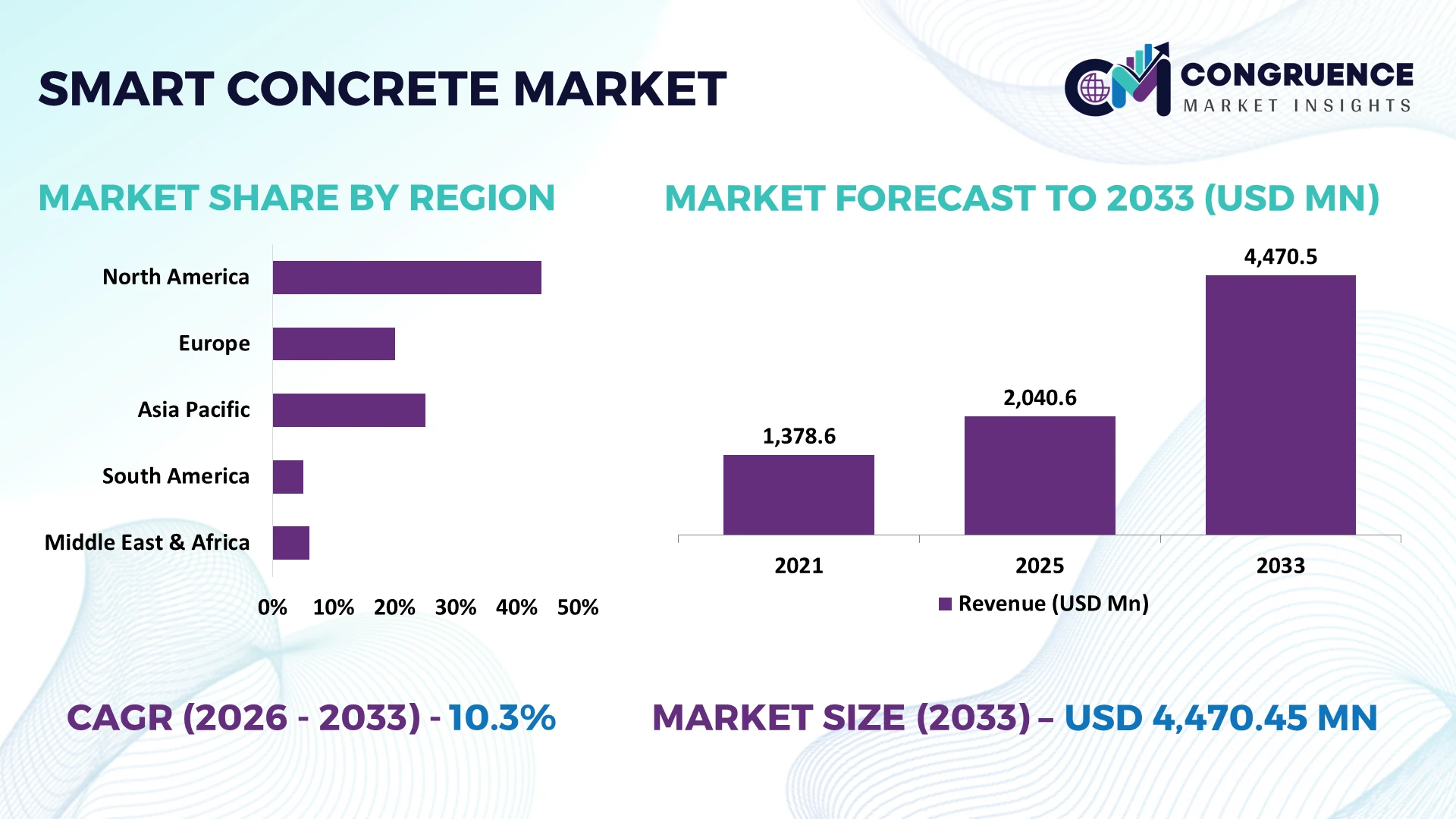
The Global Smart Concrete Market was valued at USD 2040.55 Million in 2025 and is anticipated to reach a value of USD 4470.45 Million by 2033 expanding at a CAGR of 10.3% between 2026 and 2033. Growth is driven by embedded structural health monitoring sensors, self-healing cementitious materials, conductive concrete applications, and infrastructure investment targeting predictive maintenance and extended asset service life.
China maintains a dominant position in smart concrete deployment opportunities, supported by its extensive infrastructure network, advanced construction materials manufacturing, and investment in intelligent transportation systems. The country operates more than 5 million kilometers of highways and has developed a high-speed railway network exceeding 48,000 kilometers, creating substantial potential for sensor-integrated concrete monitoring. Its cement production represents more than 50% of global output, strengthening domestic material supply capabilities. Compared with the United States, where smart concrete adoption emphasizes bridge rehabilitation and structural diagnostics, China benefits from larger infrastructure construction programs and integrated deployment opportunities.
Strategic implication: Manufacturers combining advanced cementitious formulations, embedded sensing technologies, and infrastructure monitoring partnerships gain stronger access to high-value transportation and asset rehabilitation contracts.
Key Highlights of the Global Smart Concrete Market
-
Market Size & Growth: USD 2,040.55 million in 2025, reaching USD 4,470.45 million by 2033 at 10.3% CAGR, driven by intelligent infrastructure monitoring.
-
Top Growth Drivers: China's 44.7% cement production share, India's 12.4% contribution, and 10% global cement-related CO₂ emissions estimates reinforce modernization priorities.
-
Short-Term Forecast: By 2028, predictive monitoring projects targeting 15–20% fewer routine inspection visits will strengthen infrastructure maintenance efficiency.
-
Emerging Technologies: Three innovations—carbon nanotube sensing, bacteria-based self-healing, and AI-enabled structural diagnostics—advance intelligent concrete functionality.
-
Regional Leaders: Asia-Pacific leads infrastructure-scale opportunities, North America emphasizes bridge monitoring, and Europe advances low-carbon materials; regional USD allocations remain unverified.
-
Consumer/End-User Trends: Infrastructure owners increasingly prioritize 2 capabilities: real-time structural monitoring and automated damage detection for bridges and tunnels.
-
Pilot/Case Example: In 2024, self-healing concrete research demonstrated crack closure approaching 0.5 mm under controlled experimental conditions, supporting durability applications.
-
Competitive Landscape: Holcim, Heidelberg Materials, CEMEX, Sika, and Saint-Gobain compete across smart cementitious materials; verified global market leadership shares remain unavailable.
-
Regulatory & ESG Impact: The EU's 2050 climate-neutrality objective strengthens demand for lower-clinker formulations, durability improvements, and lifecycle carbon assessment.
-
Investment & Funding: The US infrastructure program provides approximately USD 110 billion for roads, bridges, and major projects, supporting intelligent monitoring opportunities.
-
Innovation & Future Outlook: Self-sensing conductive composites, embedded fiber-optic networks, and digital twins shift infrastructure management toward continuous condition assessment through 2033.
The Smart Concrete Market is increasingly shaped by infrastructure operators seeking measurable structural durability, reduced maintenance disruption, and early detection of material deterioration. Emerging developments include conductive cementitious composites capable of detecting strain, bacterial self-healing formulations, and embedded fiber-optic sensing systems. China produced approximately 44.7% of global cement output in 2025, providing significant manufacturing scale for advanced material integration. Meanwhile, American bridge rehabilitation programs and European construction decarbonization requirements are encouraging performance-based material specifications. These developments establish sensor reliability, lifecycle performance, and industrial manufacturing compatibility as critical considerations for strategic investment decisions.
What Is the Strategic Relevance and Future Pathways of the Smart Concrete Market?
Smart concrete is becoming strategically important as infrastructure owners transition from periodic structural inspections toward continuous condition monitoring and performance-based asset management. China's highway network exceeding 5 million kilometers and the United States' extensive bridge rehabilitation requirements create substantial opportunities for sensor-integrated cementitious materials. Infrastructure modernization increasingly prioritizes embedded strain monitoring, early crack detection, and service-life optimization. Manufacturers are developing conductive concrete formulations and integrated sensing platforms that convert structural performance data into actionable maintenance decisions, strengthening their positioning in public infrastructure procurement.
Technology differentiation increasingly determines lifecycle economics. Self-sensing concrete incorporating conductive fillers enables distributed strain measurement, whereas conventional concrete requires externally mounted instrumentation for comparable monitoring. Predictive monitoring programs targeting 15–20% fewer routine inspection visits offer potential operational savings, subject to validation. Europe emphasizes low-carbon materials and durability certification, while India prioritizes infrastructure expansion and affordable monitoring integration. During 2026–2028, deployment priorities will increasingly include sensor calibration, digital twin connectivity, and automated structural diagnostics.
Bridge monitoring provides a practical deployment pathway, with embedded fiber-optic sensors tracking strain, temperature, and deformation throughout structural operation. Companies including Sika, Holcim, and Heidelberg Materials are advancing specialized admixtures, durability technologies, and digital construction capabilities. Competitive advantage will depend on verified sensing accuracy, compatibility with established concrete production systems, and demonstrable reductions in infrastructure maintenance disruption.
Smart Concrete Market Dynamics
DRIVER:
Infrastructure Rehabilitation and Predictive Structural Monitoring
Aging transportation infrastructure is accelerating interest in smart concrete capable of supporting continuous structural health assessment. In the United States, approximately 6.8% of bridges were classified as being in poor condition in 2024, highlighting the importance of targeted rehabilitation and monitoring. The Infrastructure Investment and Jobs Act allocated approximately USD 110 billion toward roads, bridges, and major infrastructure projects, strengthening modernization opportunities. Embedded sensing systems can support maintenance programs targeting 15–20% fewer routine inspection visits when monitoring performance is validated. Manufacturers are responding through conductive cementitious composites, fiber-optic sensing partnerships, and specialized concrete admixtures. The strategic advantage lies in identifying deterioration earlier and prioritizing repair expenditure according to measured structural conditions rather than fixed inspection intervals.
RESTRAINT:
Advanced Material Costs and Specialized Input Dependencies
Smart concrete manufacturing faces higher input costs from conductive fillers, encapsulated healing agents, specialized fibers, and sensing components. Carbon nanotube concentrations of approximately 0.1–1.0% by cement weight are investigated for self-sensing applications, but dispersion requirements and material pricing complicate industrial-scale adoption. Some experimental conductive mixtures require 0.5–2.0% specialized additives to achieve targeted electrical responses, increasing formulation complexity. China dominates several advanced carbon material processing supply chains, creating procurement concentration for international manufacturers. In India, conventional ready-mix production infrastructure is not uniformly equipped for precision nanomaterial dispersion. Suppliers are responding through alternative conductive fillers, localized admixture preparation, and standardized mixing procedures. Cost competitiveness depends on achieving reliable sensing performance at minimal additive loading without compromising conventional concrete properties.
OPPORTUNITY:
Self-Healing Materials and Digital Infrastructure Integration
Self-healing concrete presents opportunities to reduce localized repair requirements in tunnels, bridges, marine structures, and water-retaining infrastructure. Experimental bacterial and crystalline healing systems have demonstrated closure of cracks approaching 0.5 mm under favorable moisture conditions, supporting further industrial development. Research formulations incorporating approximately 1–3% specialized healing additives offer pathways for improving crack-sealing performance, although effectiveness depends on material chemistry and exposure conditions. The Netherlands remains an important innovation center for bacteria-based concrete healing, while Singapore emphasizes digitally monitored infrastructure and advanced construction materials. Manufacturers are developing encapsulated healing agents, compatible admixtures, and partnerships with infrastructure engineering firms. The commercial opportunity lies in integrating autonomous crack management with asset monitoring, particularly where inspection access and repair shutdowns create substantial operational costs.
CHALLENGE:
Sensor Calibration and Long-Term Structural Data Reliability
Scaling smart concrete from controlled demonstrations to operational infrastructure requires dependable sensor performance across variable loading, moisture, and temperature conditions. Conductive concrete sensing behavior can change with environmental exposure, complicating interpretation of electrical resistance measurements. Laboratory formulations containing 0.1–1.0% conductive nanomaterials demonstrate sensitivity to dispersion quality and curing conditions. Temperature variations exceeding 20°C across seasonal operating conditions can introduce measurement drift requiring compensation. China's large transportation infrastructure networks illustrate the complexity of managing distributed sensing equipment across geographically diverse environments. Manufacturers must integrate calibration protocols, redundant monitoring architectures, and interoperable data platforms. Long-term competitiveness depends on distinguishing genuine structural deterioration from environmental measurement variation while maintaining dependable monitoring performance throughout infrastructure service life.
Smart Concrete Market Latest Trends
-
Digital Curing Gains Industrial Traction: Concrete producers are integrating embedded temperature sensors with maturity-based strength estimation to optimize formwork removal and construction scheduling. Wireless monitoring typically captures readings at 15–60-minute intervals, replacing periodic manual temperature checks. Systems track the critical first 24–72 hours of hydration, helping contractors identify temperature deviations and reduce unnecessary curing delays. Suppliers including Giatec are expanding connected sensor platforms and contractor training to improve construction workflow coordination.
-
Low-Carbon Formulations Enter Smart Infrastructure: Cement producers are integrating supplementary cementitious materials with performance monitoring to address construction decarbonization requirements. Portland-limestone cement commonly contains 5–15% limestone, while selected blended formulations achieve approximately 10% lower embodied emissions than conventional alternatives. Heidelberg Materials and Holcim are expanding lower-clinker concrete portfolios alongside digital quality management. This combination allows infrastructure developers to evaluate carbon intensity and material performance within coordinated procurement specifications.
-
Conductive Concrete Advances Pavement Electrification: Electrically conductive concrete is progressing through experimental applications involving pavement heating and electrical functionality. Research mixtures incorporating approximately 0.5–2% conductive additives by binder weight demonstrate pathways for modifying electrical resistance, depending on material dispersion. United States engineering institutions are investigating conductive pavement systems for winter maintenance applications. Material developers are refining carbon-based fillers and electrode integration to improve electrical uniformity, positioning functional concrete as an alternative to conventional surface-treatment infrastructure.
-
Automated Quality Verification Reshapes Concrete Production: Ready-mix producers are adopting digital batching records, moisture sensing, and automated mixture adjustment to improve production traceability. Aggregate moisture variations of 1–2 percentage points can materially change effective water content without compensation. Automated controls adjust batching inputs against specified water-cement ratios, reducing avoidable quality variation. Manufacturers are connecting plant production records with construction-site monitoring platforms, strengthening compliance documentation and minimizing disputes over delivered concrete specifications.
Segmentation Analysis
By Type
Self-Sensing Concrete Leads Structural Intelligence Integration
Self-Sensing Concrete accounted for an estimated 38.5% of global smart concrete demand in 2025, supported by applications requiring structural strain measurement, deformation tracking, and infrastructure condition assessment. Conductive cementitious composites incorporate carbon fibers, nanotubes, or other electrically responsive materials to detect changes in mechanical loading. Their compatibility with conventional casting processes supports integration into bridges, tunnels, and specialized structural components. Research formulations frequently investigate conductive filler concentrations between 0.1% and 1.0% by cement weight, depending on dispersion characteristics and targeted electrical response. Manufacturers and engineering institutions are developing repeatable sensing formulations and compatible monitoring interfaces to improve practical deployment.
Self-Healing Concrete represents the fastest-growing type, supported by increasing interest in autonomous crack management and reduced intervention requirements. Self-Cleaning Concrete incorporates photocatalytic surfaces for pollutant degradation and surface maintenance, while Energy-Harvesting Concrete remains concentrated in experimental electricity generation applications. Phase-Change Concrete integrates thermal storage materials to moderate temperature fluctuations in building envelopes. Self-healing formulations demonstrating crack closure approaching 0.5 mm under controlled conditions are attracting durability-focused development. Investment increasingly favors material systems with measurable lifecycle performance rather than isolated laboratory functionality.
- The American Concrete Institute's 2025 technical activities continued emphasizing durability, performance-based specifications, and advanced cementitious materials. These priorities support development of smart concrete technologies capable of integrating structural functionality with established engineering evaluation and quality assurance practices.
By Application
Structural Health Monitoring Dominates Intelligent Concrete Deployment
Structural Health Monitoring represented an estimated 41.2% of global smart concrete applications in 2025, supported by bridge inspection modernization, tunnel condition assessment, and performance monitoring of critical infrastructure. Embedded sensing technologies measure strain, temperature, and deformation, enabling infrastructure operators to identify structural changes between scheduled inspections. The United States maintains substantial deployment potential because approximately 6.8% of its bridges were classified in poor condition in 2024. Engineering contractors are integrating sensor-enabled cementitious materials with digital monitoring platforms to support asset-specific maintenance decisions and improve inspection resource allocation.
Crack Repair and Durability Enhancement represents the fastest-growing application as developers investigate autonomous healing technologies for inaccessible or maintenance-intensive structures. Road and Pavement Construction incorporates conductive and sensor-enabled materials for traffic infrastructure monitoring, while Smart Buildings and Infrastructure integrates embedded data collection with facility management platforms. Thermal Energy Management applies phase-change materials to moderate building temperature fluctuations. Monitoring programs targeting 15–20% fewer routine inspection visits demonstrate potential operational advantages where validated. Manufacturers are expanding engineering partnerships and application-specific material testing to support infrastructure procurement.
- The Federal Highway Administration's 2025 bridge infrastructure programs continued prioritizing structural condition assessment and rehabilitation. Its national bridge inventory covers more than 600,000 bridges, illustrating the potential scale of standardized monitoring and durability technologies.
By End-User
Infrastructure Developers Lead Smart Concrete Procurement
Infrastructure Developers represented an estimated 34.6% of global smart concrete demand in 2025, reflecting concentrated purchasing requirements for bridges, tunnels, transportation corridors, and large engineered structures. These organizations evaluate material performance through lifecycle maintenance expenditure, structural reliability, and compatibility with existing construction methods. China's extensive transportation network and India's infrastructure modernization programs support demand for advanced concrete technologies suited to long-service-life assets. Infrastructure developers increasingly coordinate material suppliers, engineering consultants, and monitoring technology providers to integrate functional concrete into project specifications. Manufacturers are strengthening technical partnerships and developing project-specific sensing and durability solutions.
Government and Public Works Agencies represent the fastest-growing end-user category as infrastructure rehabilitation programs incorporate condition-based asset management and advanced material performance requirements. Construction Companies prioritize installation compatibility and predictable curing behavior, while Ready-Mix Concrete Producers focus on reproducible batching and specialized admixture integration. Research and Engineering Institutions support validation, performance testing, and commercialization pathways. The United States' approximately USD 110 billion federal roads and bridges investment allocation demonstrates the scale of infrastructure modernization commitments. Suppliers are aligning product development with public procurement standards and engineering certification requirements.
- The Federal Highway Administration's 2025 infrastructure modernization initiatives emphasized improved bridge condition assessment and asset management. These programs reinforce opportunities for government agencies and infrastructure developers to evaluate advanced materials through documented structural performance and lifecycle maintenance requirements.
Region-Wise Market Insights
Asia-Pacific accounted for the largest market share at an estimated 39.5% in 2025 however, Asia-Pacific is expected to register the fastest growth, expanding at a CAGR of 12.1% between 2026 and 2033.

North America Smart Concrete Market
Bridge Rehabilitation and Sensor-Integrated Infrastructure Modernization
North America accounted for an estimated 27.5% of global smart concrete demand in 2025, supported by transportation infrastructure rehabilitation, advanced materials research, and structural health monitoring deployment. The United States leads regional adoption through federal infrastructure programs, while Canada contributes through smart construction research and cold-weather concrete engineering. Approximately 6.8% of American bridges were classified in poor condition in 2024, strengthening demand for structural diagnostics and durability-enhancing materials. Embedded fiber-optic sensors, conductive cementitious composites, and maturity-monitoring technologies are gaining attention among infrastructure engineers. The Infrastructure Investment and Jobs Act allocated approximately USD 110 billion toward roads, bridges, and major transportation projects, supporting advanced construction material opportunities. Manufacturers including Sika and Holcim are strengthening specialized admixture portfolios and digital construction capabilities. Competitive advantage increasingly depends on validated structural performance, monitoring compatibility, and compliance with public infrastructure procurement requirements.
United States Market Outlook: The United States benefits from established civil engineering research institutions, advanced concrete testing infrastructure, and extensive transportation asset management programs. The Federal Highway Administration maintains a national inventory covering more than 600,000 bridges, creating substantial opportunities for condition-monitoring technologies. Universities and materials developers are advancing conductive concrete, embedded sensing, and automated diagnostics. Public agencies increasingly prioritize documented durability performance and lifecycle maintenance efficiency when evaluating advanced infrastructure materials.
Europe Smart Concrete Market
Low-Carbon Construction and Autonomous Material Performance
Europe represented approximately 25.8% of global smart concrete demand in 2025, supported by stringent construction environmental requirements, advanced cementitious materials research, and infrastructure modernization programs. Germany, the Netherlands, France, and the United Kingdom maintain strong capabilities in specialty concrete development, digital construction, and performance-based engineering. European manufacturers increasingly combine low-clinker cement formulations with embedded monitoring technologies to improve structural durability and lifecycle assessment. The European Union's climate-neutrality objective for 2050 reinforces investment in resource-efficient construction materials. Self-healing concrete research remains particularly active in the Netherlands, where bacterial and encapsulated healing systems are being developed for crack management. Heidelberg Materials, Sika, and specialized technology developers are expanding advanced admixture capabilities and engineering partnerships. The competitive shift favors solutions demonstrating reliable performance across extended service periods rather than isolated laboratory improvements.
Germany Market Outlook: Germany combines sophisticated construction materials manufacturing, industrial automation, and established structural engineering research capabilities. Heidelberg Materials maintains a significant domestic production and innovation presence, supporting advanced concrete formulation development. German infrastructure operators increasingly evaluate digital monitoring and durability-enhancing materials for bridges, tunnels, and transportation structures. The country's engineering ecosystem supports integration of sensor technologies, automated batching systems, and performance-based material specifications into construction workflows.
Asia-Pacific Smart Concrete Market
Infrastructure Manufacturing Scale and Intelligent Construction Deployment
Asia-Pacific dominates smart concrete market activity, supported by extensive transportation construction, high cement production capacity, and growing integration of digital engineering technologies. China represents the largest manufacturing and infrastructure deployment center, while India contributes through highway modernization, metro rail development, and large-scale urban construction. Japan and South Korea emphasize seismic resilience, advanced materials research, and precision structural monitoring. China's cement production accounts for approximately 44.7% of global output, providing substantial manufacturing infrastructure for specialized concrete formulations. Regional construction companies increasingly integrate maturity monitoring, digital batching, and embedded sensors into complex infrastructure projects. India's infrastructure expansion creates opportunities for smart concrete suppliers targeting bridges, tunnels, and elevated transportation corridors. Manufacturers are strengthening research partnerships, developing localized admixture formulations, and improving compatibility with established ready-mix production systems.
China Market Outlook: China benefits from an extensive transportation infrastructure network, large-scale cement manufacturing, and established digital construction capabilities. Its high-speed railway network exceeded 48,000 kilometers by the end of 2024, supporting demand for advanced structural monitoring and durable concrete materials. Chinese research institutions are investigating conductive cementitious composites, self-healing formulations, and intelligent infrastructure diagnostics. Domestic manufacturers benefit from integrated materials supply chains and industrial-scale production equipment.
South America Smart Concrete Market
Infrastructure Durability and Advanced Concrete Adoption
South America represented approximately 4.2% of global smart concrete demand in 2025, with Brazil accounting for the largest regional concentration. Infrastructure rehabilitation, urban transportation development, and industrial construction support interest in specialized concrete materials. Brazil's established cement manufacturing industry provides a foundation for advanced admixture integration, while Chile and Colombia contribute through transportation and industrial infrastructure modernization. Regional adoption remains concentrated in research collaborations, specialized engineering projects, and performance-oriented construction applications. Smart concrete suppliers increasingly emphasize durability-enhancing formulations and embedded monitoring solutions suited to infrastructure exposed to moisture, temperature variation, and heavy loading. Limited specialized testing infrastructure and higher advanced material procurement costs constrain deployment consistency. Manufacturers are strengthening university partnerships, local admixture distribution, and project-specific technical support to improve commercial adoption.
Brazil Market Outlook: Brazil combines substantial cement production capabilities with established construction engineering institutions and extensive transportation infrastructure requirements. The country maintains more than 1.7 million kilometers of roads, creating opportunities for pavement durability improvements and structural condition assessment. Brazilian universities and construction materials companies are investigating advanced cementitious composites and performance-enhancing admixtures. Localized technical validation and compatibility with domestic ready-mix production remain important for commercial deployment.
Middle East & Africa Smart Concrete Market
Megaproject Construction and Climate-Resilient Material Innovation
The Middle East & Africa accounted for approximately 3.0% of global smart concrete demand in 2025, supported by large infrastructure developments, commercial construction, and increasing interest in durable materials suited to challenging environmental conditions. Saudi Arabia and the United Arab Emirates lead advanced construction deployment, while South Africa contributes through engineering research and infrastructure rehabilitation requirements. Extreme temperatures, chloride exposure, and demanding service-life specifications create opportunities for specialized cementitious materials and structural monitoring technologies. Saudi Arabia's Vision 2030 development programs are encouraging adoption of digital construction management and advanced material engineering. Regional suppliers increasingly collaborate with international cement producers, engineering consultants, and infrastructure developers to evaluate sensor-integrated concrete and durability-enhancing admixtures. Successful deployment depends on local material qualification, environmental performance testing, and integration with established construction supply chains.
Saudi Arabia Market Outlook: Saudi Arabia represents an important market for advanced concrete technologies through large-scale urban development, transportation infrastructure, and industrial construction projects. NEOM and other Vision 2030 developments emphasize modern construction methods and infrastructure performance. Extreme summer temperatures frequently exceeding 40°C create demanding curing and durability requirements. Manufacturers are developing specialized admixtures, temperature-monitoring systems, and concrete formulations designed to maintain performance under challenging climatic conditions.
Market Competition Landscape
The smart concrete market features competition between Holcim, Heidelberg Materials, Sika, CEMEX, and Saint-Gobain, alongside specialized sensing technology developers. These five established construction materials groups collectively represent an estimated 35–40% of commercial smart concrete activity, although product definitions vary. Holcim and Heidelberg Materials compete through advanced cement formulations and integrated construction platforms, while Sika emphasizes specialized admixtures and durability technologies. CEMEX focuses on digitally managed concrete production, whereas Saint-Gobain leverages construction chemistry and materials integration. Conductive formulations incorporating 0.1–1.0% specialized fillers require precise dispersion, making manufacturing consistency a competitive differentiator. Self-healing systems capable of closing cracks approaching 0.5 mm strengthen specialized product positioning. Manufacturers are expanding research partnerships, digital monitoring integration, and low-carbon material development. Certification requirements, advanced additive costs, and field-performance validation create substantial entry barriers. Competitive leadership depends on scalable formulations, verified durability, interoperable monitoring systems, and dependable infrastructure project execution.
Companies Profiled in the Smart Concrete Market Report
-
Holcim Ltd.
-
Heidelberg Materials AG
-
Sika AG
-
CEMEX S.A.B. de C.V.
-
Saint-Gobain S.A.
-
BASF SE
-
Giatec Scientific Inc.
-
Kryton International Inc.
-
Xypex Chemical Corporation
-
Penetron International Ltd.
-
Acciona S.A.
-
UltraTech Cement Limited
-
Fosroc International Limited
-
Solidia Technologies, Inc.
Technology Insights for the Smart Concrete Market
Embedded fiber-optic sensors, conductive cementitious composites, and wireless maturity monitoring are transforming concrete into an instrumented construction material. Fiber-optic systems measure distributed strain and temperature, while carbon-based fillers enable electrical resistance measurements associated with structural deformation. Conductive formulations commonly investigate 0.1–1.0% nanomaterial loading by cement weight. Wireless maturity sensors monitor early hydration continuously, replacing intermittent manual temperature readings. Compared with conventional periodic checks, automated monitoring provides substantially denser measurement records, enabling contractors to optimize formwork removal, identify curing deviations, and improve construction scheduling without compromising specified strength requirements.
Emerging technologies include bacteria-mediated self-healing, encapsulated crystalline additives, and phase-change composites. Experimental healing systems demonstrate closure of cracks approaching 0.5 millimeters under favorable conditions, reducing pathways for moisture ingress. Phase-change inclusions store thermal energy during temperature fluctuations, supporting building envelope performance. Adoption remains concentrated in infrastructure pilots, specialized construction projects, and research-led deployments rather than standardized mass-market production. Manufacturers are developing compatible admixtures, encapsulation methods, and industrial batching protocols to improve commercial reproducibility.
Between 2026 and 2028, AI-assisted structural diagnostics and digital twin integration will strengthen smart concrete applications. Connected monitoring platforms can target 15–20% fewer routine inspection visits where validated. Infrastructure developers benefit from condition-based maintenance, while specialized suppliers gain differentiation through calibrated sensors, verified durability, and interoperable engineering data.
Recent Developments in the Global Smart Concrete Market
-
September 2026: Holcim invested in Cloud Cycle to expand machine-learning concrete quality monitoring. Sensors were deployed across more than 150 mixer trucks in three countries, supporting real-time mixture control, reducing returned concrete, and enabling wider digital fleet integration. Source: investegate.co.uk
-
June 2025: Sika announced a strategic investment in Giatec, integrating AI-powered concrete optimization with advanced admixtures. Giatec's platform subsequently reached one million cubic meters of optimized concrete in 2025, demonstrating industrial adoption of data-driven mixture engineering. Source: sika.com
-
January 2025: Hong Kong Polytechnic University advanced low-carbon marine self-healing concrete with approximately HK$6.03 million in government funding over 24 months. The research targets improved coastal infrastructure durability, strengthening development of specialized cementitious materials for aggressive marine environments. Source: eurekalert.org
-
October 2025: Michigan State University installed four experimental self-heating, self-healing concrete slabs on campus. The pilot evaluates winter durability and ice-melting performance, providing field evidence for pavement technologies designed to reduce maintenance requirements in freezing climates. Source: msutoday.msu.edu
Scope of the Smart Concrete Market Report
The Smart Concrete Market Report evaluates technology development, commercial deployment, manufacturing capabilities, and competitive positioning between 2026 and 2033. Type coverage includes Self-Sensing Concrete, Self-Healing Concrete, Self-Cleaning Concrete, Energy-Harvesting Concrete, and Phase-Change Concrete. Application analysis examines Structural Health Monitoring, Crack Repair and Durability Enhancement, Road and Pavement Construction, Smart Buildings and Infrastructure, and Thermal Energy Management. End-user assessment covers Construction Companies, Infrastructure Developers, Government and Public Works Agencies, Ready-Mix Concrete Producers, and Research and Engineering Institutions.
Regional analysis spans North America, Europe, Asia-Pacific, South America, and Middle East & Africa. The report profiles 14 industry participants and evaluates conductive composites, embedded sensors, autonomous healing technologies, and digital monitoring integration. Strategic assessment supports infrastructure investment planning, technology commercialization, manufacturing expansion, supplier selection, and competitive differentiation through validated material performance and lifecycle efficiency.
Smart Concrete Market Report Summary
| Report Attribute/Metric | Report Details |
|---|
Market Revenue in 2025 | USD 2040.55 Million |
Market Revenue in 2033 | USD 4470.45 Million |
CAGR (2026 - 2033) | 10.3% |
Base Year | 2025 |
Forecast Period | 2026 - 2033 |
Historic Period | 2021 - 2025 |
Segments Covered | By TypeEnergy-Harvesting Concrete
By ApplicationStructural Health Monitoring Crack Repair and Durability Enhancement Road and Pavement Construction Smart Buildings and Infrastructure Thermal Energy Management
By End-UserInfrastructure Developers Government and Public Works Agencies Ready-Mix Concrete Producers Research and Engineering Institutions
|
Key Report Deliverable | Revenue Forecast, Growth Trends, Market Dynamics, Segmental Overview, Regional and Country-wise Analysis, Competition Landscape |
Region Covered | North America, Europe, Asia-Pacific, South America, Middle East, Africa |
Key Players Analyzed | Holcim Ltd., Heidelberg Materials AG, Sika AG, CEMEX S.A.B. de C.V., Saint-Gobain S.A., BASF SE, Giatec Scientific Inc., Kryton International Inc., Xypex Chemical Corporation, Penetron International Ltd., Acciona S.A., UltraTech Cement Limited, Fosroc International Limited, Solidia Technologies, Inc. |
Customization & Pricing | Available on Request (10% Customization is Free) |