
Reports
The Global Smart City Interactive Kiosk Market was valued at USD 2,688.4 Million in 2025 and is anticipated to reach a value of USD 7,777.2 Million by 2033 expanding at a CAGR of 14.2% between 2026 and 2033. Rising smart city infrastructure investments, AI-enabled citizen service platforms, digital wayfinding, and integrated public connectivity solutions are accelerating deployment of advanced interactive kiosks across transportation hubs, municipal services, tourism, and public safety applications.
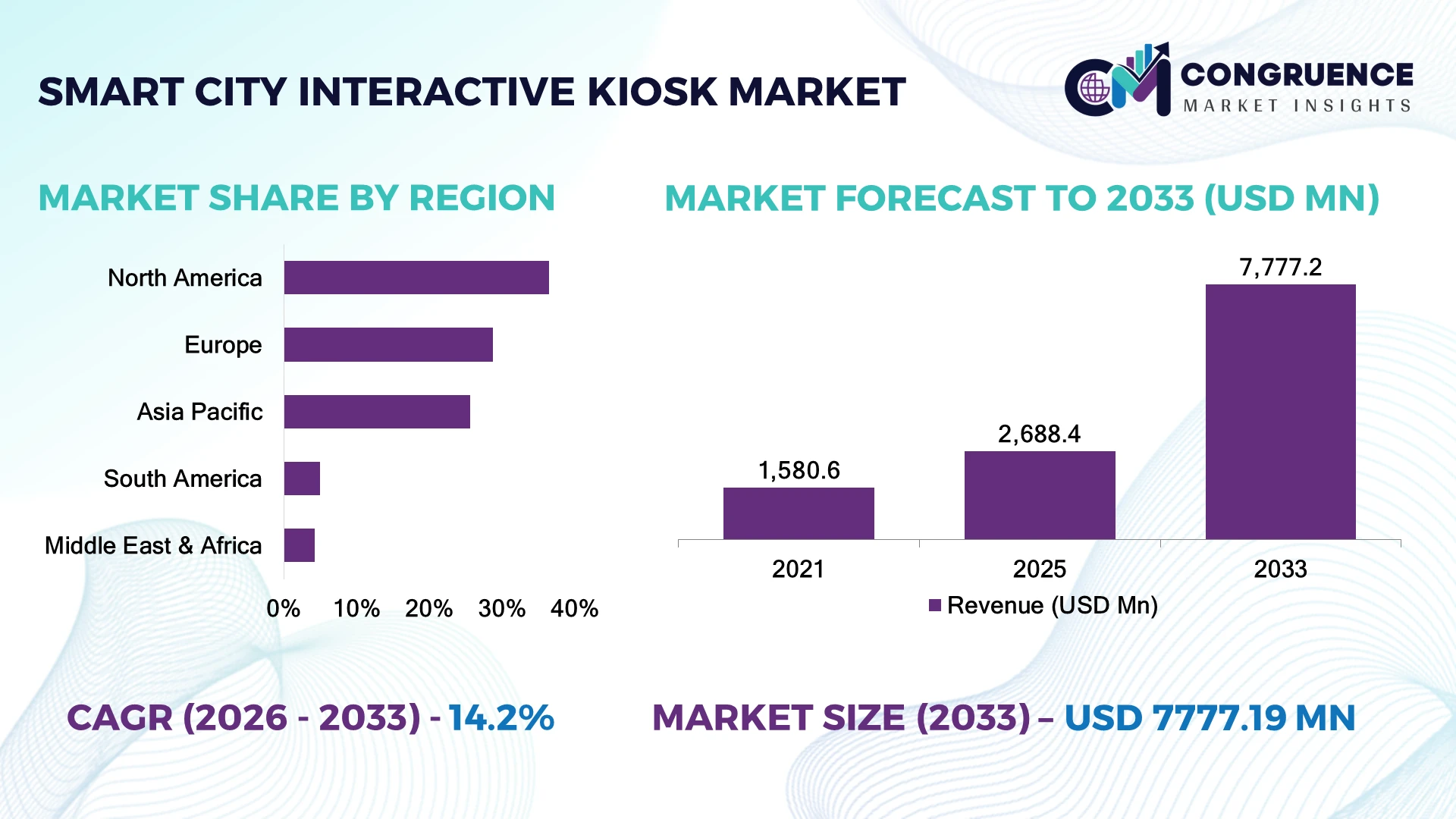
The United States leads the market with approximately 31% global deployment share, supported by large-scale smart infrastructure modernization, digital government initiatives, and intelligent transportation investments. More than 65% of newly deployed municipal kiosks now integrate cloud connectivity, AI-powered assistance, and real-time public information services. Compared with Japan, where urban deployments emphasize transit efficiency and multilingual services, the U.S. demonstrates broader adoption across civic engagement, public Wi-Fi, emergency communication, and digital advertising. Continued infrastructure investment following the Infrastructure Investment and Jobs Act further strengthens nationwide smart city deployment momentum.
Strategic success increasingly depends on delivering secure, interoperable kiosk ecosystems that combine digital citizen services, analytics, and scalable urban infrastructure.
Market Size & Growth: USD 2,688.4 Million in 2025 reaching USD 7,777.2 Million by 2033 at 14.2% CAGR, driven by AI-enabled smart city infrastructure.
Top Growth Drivers: Smart city projects (41%), digital public services (34%), intelligent transportation deployment (29%).
Short-Term Forecast: By 2028, kiosk response time improves 35% through edge computing and cloud integration.
Emerging Technologies: AI assistants, computer vision, and 5G connectivity increase operational efficiency by nearly 30%.
Regional Leaders: North America, Asia-Pacific, and Europe collectively exceed USD 5.8 Billion, supported by urban digital transformation.
Consumer/End-User Trends: Nearly 62% of users prefer self-service public information over staffed service counters.
Pilot/Case Example: 2026 AI-enabled transit kiosks reduce passenger information wait times by approximately 40%.
Competitive Landscape: Top suppliers control nearly 46% share through integrated hardware, software, and managed services.
Regulatory & ESG Impact: Energy-efficient displays reduce electricity consumption by approximately 22% per deployment.
Investment & Funding: More than USD 1.3 Billion supports smart urban digital infrastructure partnerships and deployments.
Innovation & Future Outlook: Digital twin integration and predictive city analytics strengthen advanced public engagement platforms.
The Smart City Interactive Kiosk Market is expanding across transportation terminals, municipal buildings, healthcare facilities, tourism centers, and smart retail districts. AI-powered multilingual interfaces, contactless interaction, and edge analytics are reshaping citizen engagement, while nearly 58% of newly installed kiosks support integrated cloud management. Growing digital sovereignty initiatives are also encouraging localized software deployment, setting the stage for deeper strategic market transformation.
Smart City Interactive Kiosks have become strategic urban infrastructure assets rather than standalone information terminals. Municipal governments increasingly deploy them to improve citizen engagement, streamline public services, strengthen emergency communications, and support intelligent transportation. Public-sector procurement is also shifting toward integrated digital ecosystems combining cloud management, cybersecurity, payment platforms, and real-time analytics, creating stronger competitive opportunities for solution providers.
AI-enabled kiosks process citizen interactions approximately 45% faster than conventional touchscreen terminals while reducing routine service workloads by nearly 30% through automated assistance. North America maintains leadership through mature digital infrastructure and municipal modernization, whereas Asia-Pacific is scaling deployments rapidly through new smart city districts and transit-oriented developments. Over the next two to three years, more than 60% of new installations are expected to incorporate AI assistants, IoT sensors, and centralized device management as standard capabilities.
Transit authorities deploying connected kiosks for ticketing, navigation, and emergency messaging are demonstrating measurable improvements in passenger flow and operational efficiency. Technology providers are expanding software partnerships, cybersecurity capabilities, and managed service portfolios to strengthen long-term customer relationships. Competitive advantage will increasingly depend on delivering secure, interoperable, AI-driven kiosk platforms that continuously enhance urban services while supporting scalable smart city infrastructure.
Government-led digital transformation and intelligent public infrastructure investments are strengthening deployment of smart city interactive kiosks across transportation, tourism, healthcare, and municipal services. Nearly 68% of newly procured public kiosks now include cloud connectivity and AI-enabled interfaces, while contactless interaction capabilities exceed 72% of recent installations. The United States continues expanding digital public service infrastructure under urban modernization programs, increasing demand for integrated self-service platforms. This shift improves citizen engagement, reduces administrative workload, and enables real-time service delivery. In response, manufacturers are investing in AI software, multilingual interfaces, and strategic partnerships with telecom providers, cloud vendors, and municipal authorities to deliver scalable, interoperable kiosk ecosystems with centralized lifecycle management.
Deployment remains constrained by fragmented municipal infrastructure, cybersecurity compliance requirements, and integration challenges with legacy government platforms. Approximately 44% of municipalities continue operating incompatible back-office systems, while nearly 38% of deployment budgets are consumed by networking, installation, and systems integration rather than hardware. Germany and several mature public-sector markets require stringent cybersecurity and data sovereignty compliance, extending implementation timelines. These structural limitations reduce deployment speed, increase project costs, and delay operational returns for system integrators. To reduce exposure, solution providers are localizing software development, adopting modular architectures, securing long-term maintenance contracts, and offering hybrid cloud deployments that simplify integration while minimizing infrastructure replacement costs.
Next-generation kiosks are evolving into intelligent urban service hubs combining AI, edge computing, IoT sensors, and predictive analytics. More than 61% of upcoming smart city projects are expected to prioritize integrated digital citizen platforms, while edge-enabled processing can reduce response latency by approximately 35%. Singapore and South Korea continue expanding digital twin initiatives that complement intelligent kiosk networks for real-time public information delivery. A non-obvious opportunity lies in using kiosk-generated behavioral analytics to optimize pedestrian flow, commercial planning, and emergency response simultaneously. Companies are expanding R&D in computer vision, digital identity verification, and open software ecosystems while partnering with mobility operators and municipal agencies to create interoperable smart city platforms.
Sustaining large-scale kiosk networks requires continuous software updates, cybersecurity management, device interoperability, and skilled operational support. Around 57% of municipal operators identify lifecycle software management as a larger challenge than hardware deployment, while nearly 48% prioritize zero-downtime service availability across distributed installations. Increasing cyber threats targeting connected public infrastructure place additional pressure on secure authentication, endpoint protection, and data governance. These operational complexities directly affect service reliability, public trust, and long-term infrastructure scalability. Companies must strengthen cybersecurity investments, standardized APIs, predictive maintenance capabilities, and managed service partnerships while developing resilient multi-vendor ecosystems capable of supporting continuous digital service delivery across expanding smart city environments.
AI-Powered Public Assistance AI-enabled conversational kiosks now account for nearly 52% of newly deployed municipal systems, while multilingual interaction capability has increased by approximately 40%. Urban digital inclusion initiatives are driving adoption, prompting vendors to integrate generative AI, voice recognition, and centralized cloud management that improve service speed and reduce staffing requirements.
Edge Computing Expansion Nearly 46% of new kiosk deployments now incorporate edge processing, reducing application latency by around 35% and improving operational resilience during network interruptions. Infrastructure modernization programs in Japan and the United States are encouraging suppliers to restructure software architectures for faster local processing and continuous service availability.
Integrated Mobility Services Approximately 58% of transportation-focused kiosks now combine ticketing, navigation, emergency communication, and public information within unified platforms. Transit digitization and increasing passenger expectations are encouraging technology providers to establish partnerships with mobility operators, payment providers, and mapping platforms, improving operational efficiency while expanding recurring software service opportunities.
Energy-Efficient Digital Infrastructure Advanced LED displays and intelligent power management reduce kiosk electricity consumption by nearly 24%, while remote device monitoring lowers maintenance visits by approximately 28%. Sustainability regulations and rising operational costs are encouraging manufacturers to redesign hardware with modular components, enabling faster field servicing and extending equipment lifecycle without increasing municipal infrastructure complexity.
The Smart City Interactive Kiosk market is segmented into Outdoor Kiosks, Indoor Kiosks, Wall-Mounted Kiosks, Freestanding Kiosks, and Multi-Function Smart Kiosks. Outdoor kiosks account for approximately 42.8% of the market, supported by widespread deployment across transport terminals, public plazas, government facilities, and tourism locations. Their weather-resistant construction, high-brightness displays, and continuous operating capability make them suitable for large-scale public infrastructure projects. Municipal authorities increasingly prioritize outdoor digital infrastructure to improve public information access, emergency communication, and mobility services. Vendors are enhancing these systems with AI-enabled cameras, IoT sensors, and centralized remote monitoring to improve uptime and lifecycle performance.
Multi-Function Smart Kiosks represent the fastest-growing segment as cities consolidate digital payments, navigation, citizen services, advertising, and emergency assistance within a single platform. Nearly 26% of new deployments are expected to adopt multifunction configurations by 2026, while over 60% of recently commissioned smart city projects utilize cloud-managed kiosk platforms. Indoor, wall-mounted, and freestanding kiosks remain strategically important for healthcare, education, commercial facilities, and government offices where modular deployment and space optimization are priorities. Manufacturers continue investing in software innovation and scalable hardware platforms to strengthen competitiveness in municipal modernization programs.
Industry observations published during 2026 by the Smart Cities Council indicate that municipalities increasingly prefer integrated multi-service kiosks because they reduce infrastructure duplication while improving accessibility and centralized operational management.
The Smart City Interactive Kiosk market is segmented into Transportation, Government Services, Tourism & Hospitality, Retail & Commercial Areas, Healthcare, Education, and Others. Transportation holds the leading market share of approximately 37.5%, driven by extensive deployment across airports, railway stations, metro systems, and bus terminals. Transit operators increasingly integrate ticketing, passenger information, navigation, emergency communication, and digital payments into unified kiosk platforms. More than 65% of newly deployed transportation kiosks now support multilingual interfaces and contactless payment functionality, improving passenger throughput while reducing manual service requirements. Technology providers continue expanding partnerships with transit authorities to deliver connected mobility infrastructure.
Government Services is the fastest-growing application segment as municipalities digitize permit issuance, citizen services, tax payments, identity verification, and public information delivery. Healthcare and education continue expanding self-service registration and visitor management, while tourism and retail environments leverage kiosks for localized information and customer engagement. Vendors are strengthening cloud-based device management, workflow automation, and enterprise software integration to support expanding multi-sector deployment requirements and improve long-term operational efficiency.
According to implementation findings released by the International Association of Public Transport (UITP) during 2025, integrated passenger information kiosks continue accelerating multimodal transit digitization while improving accessibility across major urban transportation systems.
The Smart City Interactive Kiosk market is segmented into Municipal Governments, Transportation Authorities, Healthcare Institutions, Educational Institutions, Commercial Enterprises, and Others. Municipal Governments account for the largest market share at approximately 39.8%, reflecting sustained investment in digital governance, smart mobility, citizen engagement, and public information infrastructure. Centralized procurement enables large-scale deployments while encouraging standardized software ecosystems across city networks. Around 63% of newly issued municipal tenders now specify cloud-based device management and cybersecurity compliance, encouraging suppliers to strengthen interoperability and long-term managed service capabilities.
Transportation Authorities represent the fastest-growing end-user segment as airports, metro systems, rail operators, and public transit agencies accelerate deployment of intelligent passenger service infrastructure. Healthcare institutions and educational campuses continue adopting self-service platforms to improve operational efficiency, while commercial enterprises expand interactive kiosks to strengthen customer engagement and omnichannel services. Companies increasingly differentiate through customized software, subscription-based maintenance, AI-enabled analytics, and strategic partnerships with system integrators to improve deployment scalability and long-term customer retention.
A 2026 Smart Cities Council implementation review reported that municipal governments continue prioritizing interoperable kiosk platforms capable of supporting multiple citizen services through unified digital infrastructure, reducing operational complexity while improving public service accessibility.
North America accounted for the largest market share at 36.4% in 2025 however, Asia-Pacific is expected to register the fastest growth, expanding at a CAGR of 16.1% between 2026 and 2033.
Digital Public Infrastructure Modernization Accelerates Deployment
North America leads the Smart City Interactive Kiosk market through mature digital infrastructure, strong municipal technology spending, and widespread deployment across transportation, government services, healthcare, and tourism. The region represents approximately 36.4% of global demand, supported by smart mobility initiatives and integrated public information networks. More than 70% of newly installed public kiosks feature cloud-based remote management and contactless payment capability, enabling centralized operations and lower maintenance costs. Cities continue replacing conventional public information systems with AI-enabled, multilingual kiosks that improve citizen engagement and operational efficiency. Technology providers are expanding software partnerships with cloud vendors, transit agencies, and local governments to deliver interoperable platforms supporting multiple municipal services.
United States Market Outlook: The United States remains the regional leader due to extensive smart city investments, advanced digital infrastructure, and large-scale modernization of transportation and municipal services. More than 65% of large metropolitan smart city projects include interactive kiosk deployment for public information, digital payments, emergency communication, or mobility services. Strong collaboration among technology vendors, cloud providers, and municipal agencies continues accelerating innovation while expanding enterprise-scale deployment opportunities.
Sustainability Policies Reshape Public Service Platforms
Europe maintains strong market positioning through urban digitalization, sustainable public infrastructure, and standardized digital governance initiatives. Approximately 28.7% of global deployments originate from the region, supported by intelligent transportation systems, tourism modernization, and citizen-centric government services. Public procurement increasingly favors energy-efficient kiosk hardware, modular system architecture, and secure digital identity integration. Several municipalities continue expanding digital public access points while incorporating multilingual interfaces and accessibility features to improve citizen inclusion. Vendors are strengthening partnerships with municipal authorities and transportation operators while introducing recyclable kiosk materials and lower-power display technologies.
Germany Market Outlook: Germany leads the European market through advanced urban infrastructure, Industry 4.0 integration, and strong municipal digitization programs. More than 60% of newly deployed public kiosks support secure digital identity authentication and cloud-based administration. Local governments continue investing in interoperable digital platforms capable of integrating transportation, municipal administration, and citizen services while maintaining strict cybersecurity and data protection standards.
Large-Scale Urban Expansion Fuels Installations
Asia-Pacific is the fastest-growing regional market, supported by rapid urbanization, expanding smart city programs, and substantial investments in digital public infrastructure. China, India, Japan, Singapore, and South Korea continue deploying intelligent kiosks across transportation, healthcare, tourism, and municipal administration. Nearly 58% of newly commissioned smart city infrastructure projects in major metropolitan areas incorporate self-service digital kiosks for public interaction. Domestic manufacturers continue expanding production capacity while integrating AI, facial recognition, and multilingual software to support high-volume deployments. Increasing public-private partnerships further accelerate implementation across rapidly developing urban centers.
China Market Outlook: China represents the region's largest national market due to extensive smart city implementation, large electronics manufacturing capacity, and comprehensive digital governance initiatives. Hundreds of cities continue expanding AI-enabled public service infrastructure, while integrated payment ecosystems and smart transportation networks support extensive kiosk deployment. Domestic manufacturers benefit from localized production, advanced display manufacturing, and strong government-backed digital infrastructure investments.
Urban Digital Services Expand Across Public Networks
South America is steadily expanding interactive kiosk deployment through transportation modernization, digital government initiatives, and tourism infrastructure development. Brazil, Chile, and Colombia continue investing in public digital service delivery despite budget constraints affecting deployment speed. Approximately 18% of newly approved municipal digital infrastructure projects now include interactive kiosk components for citizen engagement and information services. Cities increasingly prioritize modular systems that minimize installation costs while enabling future software expansion. Technology providers respond through localized manufacturing partnerships, flexible deployment models, and managed service agreements that improve long-term operational efficiency.
Brazil Market Outlook: Brazil leads the regional market through large metropolitan modernization projects, airport digitization, and expanding public transportation infrastructure. Major municipalities continue deploying interactive kiosks for tourism information, municipal services, and digital citizen engagement. Growing investment in smart mobility and integrated public information platforms supports continued demand, while domestic system integrators strengthen implementation capabilities through partnerships with global technology providers.
Government Investments Drive Digital Transformation
The Middle East & Africa market is expanding through government-backed smart city initiatives, public infrastructure modernization, and digital tourism development. Gulf countries continue integrating interactive kiosks into transportation, municipal administration, healthcare, and visitor services as part of broader digital transformation strategies. More than 45% of newly commissioned smart government facilities now incorporate self-service digital interfaces to improve operational efficiency and citizen accessibility. Vendors increasingly establish regional partnerships, localized service centers, and software integration capabilities to support long-term infrastructure projects while meeting cybersecurity and localization requirements.
United Arab Emirates Market Outlook: The United Arab Emirates remains the region's most influential market owing to ambitious smart city programs, world-class transportation infrastructure, and extensive digital government initiatives. Dubai and Abu Dhabi continue deploying advanced interactive kiosks across airports, tourism destinations, government facilities, and public transportation networks. Strong investment in AI, digital identity platforms, and connected urban infrastructure enables rapid deployment while attracting leading international kiosk technology providers.
The Smart City Interactive Kiosk market is characterized by competition between global technology providers including LG Electronics, KIOSK Information Systems, Diebold Nixdorf, Advantech, and Meridian Kiosks, regional kiosk manufacturers, and software integration specialists serving municipal authorities. The top five participants collectively control approximately 48% of the global market through integrated hardware, cloud software, and lifecycle support. Competition increasingly centers on AI functionality, cybersecurity, remote device management, and deployment speed rather than hardware pricing alone. Cloud-managed platforms reduce maintenance costs by nearly 25%, while modular kiosk architecture lowers deployment time by approximately 30%. Companies are expanding through smart city partnerships, localized manufacturing, digital signage integration, and vertically integrated service models. The competitive shift favors software-driven ecosystems over standalone hardware suppliers. Entry barriers remain high because municipalities demand certified cybersecurity, proven deployment capability, and long-term maintenance support. Winning requires scalable software platforms, secure interoperability, rapid customization, and strong public-sector implementation expertise.
LG Electronics
KIOSK Information Systems
Meridian Kiosks
Diebold Nixdorf
Advantech Co., Ltd.
Olea Kiosks Inc.
REDYREF
Pyramid Computer GmbH
Frank Mayer and Associates, Inc.
Axiomtek Co., Ltd.
Embross
Peerless-AV
Interactive kiosks are rapidly evolving through AI-enabled virtual assistants, edge computing, cloud-native management, and IoT connectivity. More than 62% of newly deployed smart city kiosks now support centralized cloud management, while AI-powered multilingual interfaces improve citizen interaction efficiency by approximately 28%. Edge processing reduces application latency by nearly 35%, enabling faster public information delivery, digital payments, and emergency communication without excessive network dependency.
Computer vision, biometric authentication, predictive diagnostics, and remote fleet management are becoming core differentiators. Compared with conventional standalone kiosks, AI-enabled cloud-connected platforms reduce maintenance visits by nearly 30% while improving system availability by approximately 22%. Vendors offering integrated software ecosystems benefit most because municipalities increasingly prefer unified lifecycle management instead of managing separate hardware and software suppliers. Nearly 55% of upcoming procurement projects specify interoperability with existing smart city infrastructure.
Between 2026 and 2028, digital identity integration, 5G connectivity, cybersecurity automation, and digital twin connectivity will reshape deployment strategies. Predictive maintenance algorithms are expected to reduce unplanned downtime by nearly 20%, while modular hardware accelerates installation across expanding urban infrastructure. Organizations investing now in scalable software platforms, open APIs, and AI-driven analytics will establish stronger competitive positions as cities transition toward fully connected public service ecosystems.
February 2025 LG Electronics showcased its second-generation modular kiosk platform and centralized LG Business Cloud management capabilities at ISE 2025, improving installation flexibility while supporting enterprise-wide remote device management. The modular design significantly reduces deployment complexity. Source: lg.com
August 2025 LG Electronics USA introduced its Gen 2 accessible self-ordering kiosks with 22-inch and 27-inch display options, developed alongside accessibility specialists to improve usability for people with disabilities across retail, transportation, healthcare, and public environments. Source: lg.com
June 2025 Seattle City Council advanced deployment of an initial 30 interactive downtown smart city kiosks before the 2026 FIFA World Cup, with projected advertising revenue of approximately USD 1.1 million annually, strengthening digital wayfinding and public information services. Source: Axios
March 2024 KIOSK Information Systems partnered with an urban planning organization to develop smart kiosks integrated with city-wide data platforms, enabling real-time public information services and strengthening connected municipal infrastructure.
The report provides comprehensive analysis of the Smart City Interactive Kiosk market across product types, applications, end-users, deployment models, and major geographic regions between 2026 and 2033. It evaluates outdoor, indoor, wall-mounted, freestanding, and multifunction kiosk platforms supporting transportation, government, healthcare, education, tourism, and commercial applications. Regional assessment covers North America, Europe, Asia-Pacific, South America, and the Middle East & Africa while examining deployment patterns, digital infrastructure maturity, procurement trends, and technology adoption across public-sector ecosystems.
The study further evaluates AI-enabled software, edge computing, IoT integration, cloud management, cybersecurity, biometric authentication, and predictive maintenance technologies influencing competitive positioning. It includes assessment of market concentration, deployment distribution, enterprise adoption trends, investment priorities, and strategic initiatives among leading participants. The report supports product planning, municipal bidding strategies, regional expansion, partnership development, technology investment decisions, and long-term competitive positioning through detailed operational, segmentation, and technology intelligence relevant to evolving smart city infrastructure.
| Report Attribute/Metric | Report Details |
|---|---|
|
Market Revenue in 2025 |
USD 2,688.4 Million |
|
Market Revenue in 2033 |
USD 7,777.2 Million |
|
CAGR (2026 - 2033) |
14.2% |
|
Base Year |
2025 |
|
Forecast Period |
2026 - 2033 |
|
Historic Period |
2021 - 2025 |
|
Segments Covered |
By Type
By Application
By End-User
|
|
Key Report Deliverable |
Revenue Forecast, Growth Trends, Market Dynamics, Segmental Overview, Regional and Country-wise Analysis, Competition Landscape |
|
Region Covered |
North America, Europe, Asia-Pacific, South America, Middle East, Africa |
|
Key Players Analyzed |
LG Electronics, KIOSK Information Systems, Meridian Kiosks, Diebold Nixdorf, Advantech Co., Ltd., Olea Kiosks Inc., REDYREF, Pyramid Computer GmbH, Frank Mayer and Associates, Inc., Axiomtek Co., Ltd., Embross, Peerless-AV |
|
Customization & Pricing |
Available on Request (10% Customization is Free) |




