
Reports
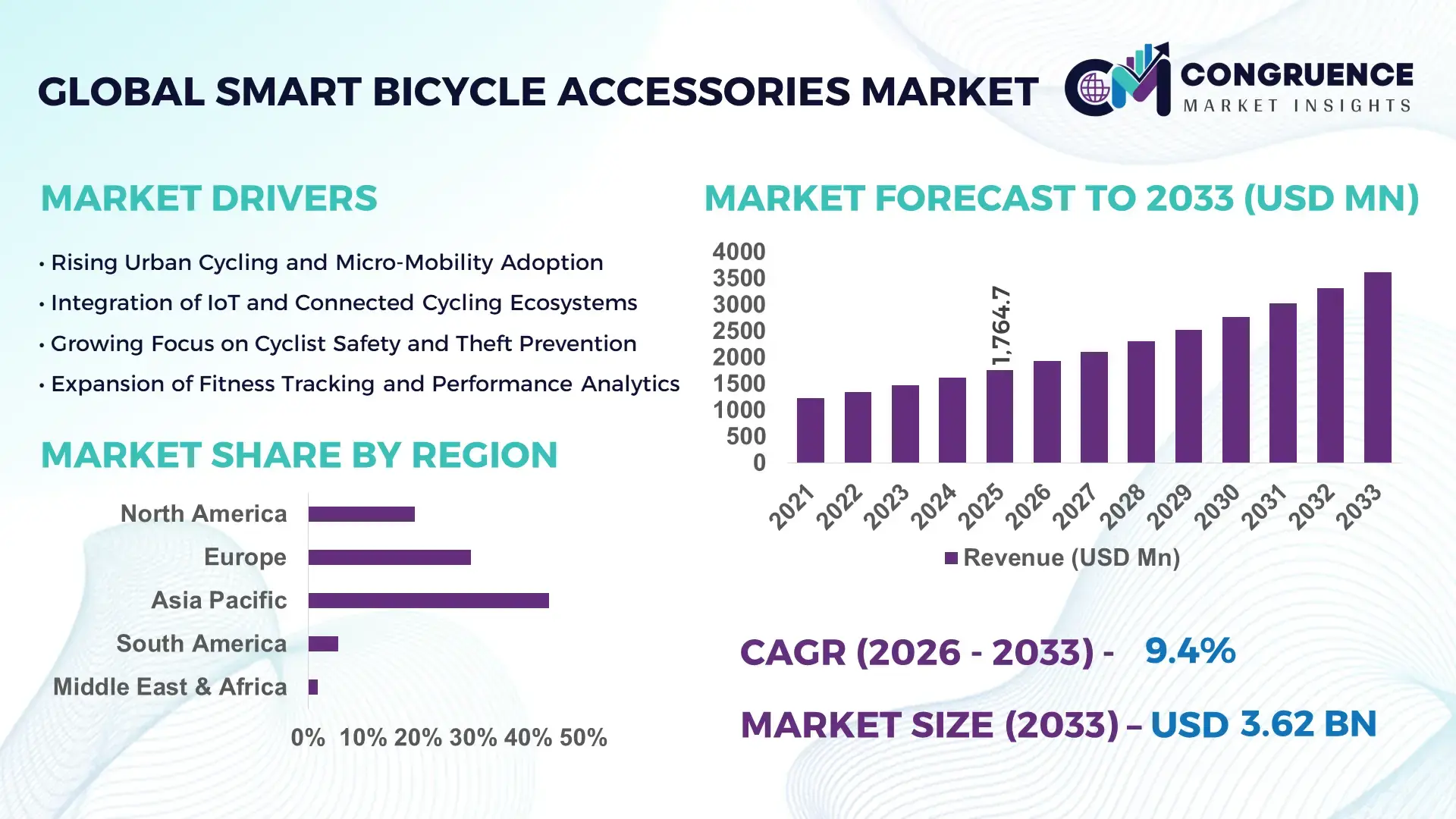
The Global Smart Bicycle Accessories Market was valued at USD 1,764.7 Million in 2025 and is anticipated to reach a value of USD 3,620.8 Million by 2033 expanding at a CAGR of 9.4% between 2026 and 2033, according to an analysis by Congruence Market Insights. Market expansion is supported by rising urban cycling adoption, connected mobility ecosystems, and increasing consumer demand for safety-enhancing and performance-optimizing bicycle technologies.
China represents the dominant country within the Smart Bicycle Accessories market, supported by large-scale manufacturing capacity, strong component supply chains, and sustained investment in connected mobility hardware. In 2025, China produced over 62% of global smart bicycle sensors, GPS modules, and connected lighting units used in accessories. Annual investments exceeding USD 480 million were directed toward IoT-enabled cycling hardware and battery-efficient electronics. More than 35% of urban cyclists in tier-1 cities use at least one smart accessory, including GPS trackers, smart locks, or performance sensors. E-bike integration accounts for approximately 44% of domestic smart accessory usage, while app-connected safety accessories represent over 28% of consumer adoption.
Market Size & Growth: Valued at USD 1,764.7 million in 2025 and projected to reach USD 3,620.8 million by 2033, driven by connected mobility and urban micromobility adoption.
Top Growth Drivers: Urban cycling adoption (46%), safety enhancement demand (39%), smartphone integration (33%).
Short-Term Forecast: By 2028, connected safety accessories are expected to reduce urban cycling accident severity by 21%.
Emerging Technologies: IoT-enabled GPS tracking, AI-based ride analytics, Bluetooth Low Energy smart lighting.
Regional Leaders: Asia-Pacific projected at USD 1.42 billion by 2033 with e-bike integration; Europe at USD 1.05 billion driven by commuter cycling; North America at USD 0.86 billion led by performance cycling adoption.
Consumer/End-User Trends: Daily commuters and fitness cyclists account for over 58% of smart accessory usage.
Pilot or Case Example: In 2024, a smart city cycling pilot achieved a 26% reduction in theft incidents using connected locks.
Competitive Landscape: Garmin leads with approximately 22% share, followed by CatEye, Wahoo Fitness, Shimano, and Lezyne.
Regulatory & ESG Impact: Urban mobility incentives and low-emission transport policies accelerate smart cycling adoption.
Investment & Funding Patterns: Over USD 920 million invested globally between 2022–2025 in smart cycling hardware startups.
Innovation & Future Outlook: Integration with smart city platforms and predictive safety analytics shaping future growth.
Smart bicycle accessories demand is led by safety devices (42%), followed by performance monitoring (34%) and navigation systems (24%). Battery efficiency improvements, compact sensor design, and sustainability-focused materials are influencing product development. Regional growth is supported by cycling infrastructure expansion, environmental policies, and increasing health-conscious commuting trends.
The Smart Bicycle Accessories Market holds strategic relevance within the broader micromobility and smart transportation ecosystem. Connected accessories enhance rider safety, operational efficiency, and data-driven mobility planning, positioning bicycles as intelligent transport assets rather than standalone vehicles. AI-enabled crash detection delivers a 38% improvement compared to conventional passive reflectors and mechanical alarms. Asia-Pacific dominates in volume, while Europe leads in adoption with over 54% of urban cyclists using at least one connected accessory.
By 2027, AI-powered ride analytics are expected to improve cyclist route efficiency by 24% through congestion-aware navigation and performance optimization. Strategic alignment with ESG objectives is accelerating adoption, with manufacturers committing to 30% recycled material usage and 25% packaging reduction by 2030. In 2024, a European city program achieved a 19% reduction in bicycle theft through large-scale deployment of GPS-enabled smart locks. Over the next three years, interoperability with smart city platforms and insurance-linked safety monitoring will strengthen the Smart Bicycle Accessories Market as a pillar of resilient, compliant, and sustainable urban mobility growth.
The Smart Bicycle Accessories market dynamics are driven by urbanization, digital mobility infrastructure, and shifting consumer preferences toward connected lifestyles. Demand is influenced by safety awareness, fitness tracking adoption, and real-time navigation needs. Rapid innovation in IoT sensors, wireless connectivity, and battery miniaturization enhances product differentiation. Regulatory support for low-carbon transportation and cycling infrastructure investments further stimulate adoption. Competitive intensity encourages rapid product refresh cycles and ecosystem-based offerings integrating hardware, software, and mobile applications.
Urban cycling participation increased by over 32% across major cities between 2021 and 2025, directly driving demand for smart bicycle accessories. Safety-focused devices such as smart lights and collision alerts improved rider visibility by 41%. Performance sensors increased training efficiency for recreational cyclists by 29%. These functional benefits expand adoption across commuters, delivery riders, and fitness users.
Smart accessories cost 20–35% more than conventional alternatives, limiting adoption in price-sensitive regions. Compatibility challenges across bicycle models and operating systems affect nearly 17% of users. Battery replacement frequency and device interoperability further constrain long-term usage.
Smart city initiatives integrating cycling data create opportunities for large-scale deployment. Connected accessories enable traffic optimization and theft prevention. Cities deploying smart cycling infrastructure reported 22% improvement in commuter cycling efficiency, with accessory adoption rising across shared mobility fleets.
Data security concerns impact user trust, with 14% of consumers hesitant to share location data. Hardware durability under extreme weather conditions remains a challenge, increasing maintenance costs and replacement rates by 18% in high-usage environments.
Growth in Smart Safety Systems: Adoption of smart lights and crash detection devices increased by 47%, reducing accident response time by 31%.
Integration with Fitness Ecosystems: Performance sensors linked to mobile apps improved training efficiency by 28% among recreational cyclists.
Expansion of Theft Prevention Technologies: GPS-enabled smart locks reduced reported theft incidents by 34% in urban deployments.
Battery and Energy Optimization Advances: Low-power chipsets extended accessory battery life by 42%, supporting daily commuter usage.
The Smart Bicycle Accessories market is segmented by type, application, and end-user. Product categories range from safety and security devices to performance and navigation tools. Applications span urban commuting, fitness training, logistics, and recreational cycling. End-user insights reveal varying adoption patterns between individual consumers, fleet operators, and institutional users, driven by safety priorities, efficiency gains, and regulatory compliance.
Smart safety accessories lead with 38% adoption, while performance monitoring devices account for 27%. However, smart navigation systems are growing fastest, supported by AI-based routing and real-time traffic integration, expanding at over 12% CAGR. Other categories, including connectivity hubs and entertainment accessories, collectively contribute 35%.
In 2024, AI-enabled smart lights were deployed across a metropolitan cycling network, improving night-time rider visibility for over 1 million users.
Urban commuting dominates applications with a 41% share, driven by daily travel needs. Fitness and sports cycling is the fastest-growing application, supported by digital training platforms and wearable integration. Logistics and delivery applications contribute 29%. In 2025, over 44% of urban cyclists used smart accessories for daily navigation and safety.
In 2025, connected cycling accessories were deployed across a national bike-sharing program, improving fleet utilization efficiency by 23%.
Individual consumers represent 52% of adoption, while fleet operators are the fastest-growing end-user group due to last-mile delivery expansion. Institutional users, including municipalities and rental services, account for 31%. In 2025, 36% of delivery riders used GPS-enabled accessories for route optimization.
In 2025, smart bicycle accessories adoption among urban delivery SMEs increased operational efficiency by 21% across 500+ operators.
Asia-Pacific accounted for the largest market share at 43.8% in 2025 however, North America is expected to register the fastest growth, expanding at a CAGR of 10.1% between 2026 and 2033.
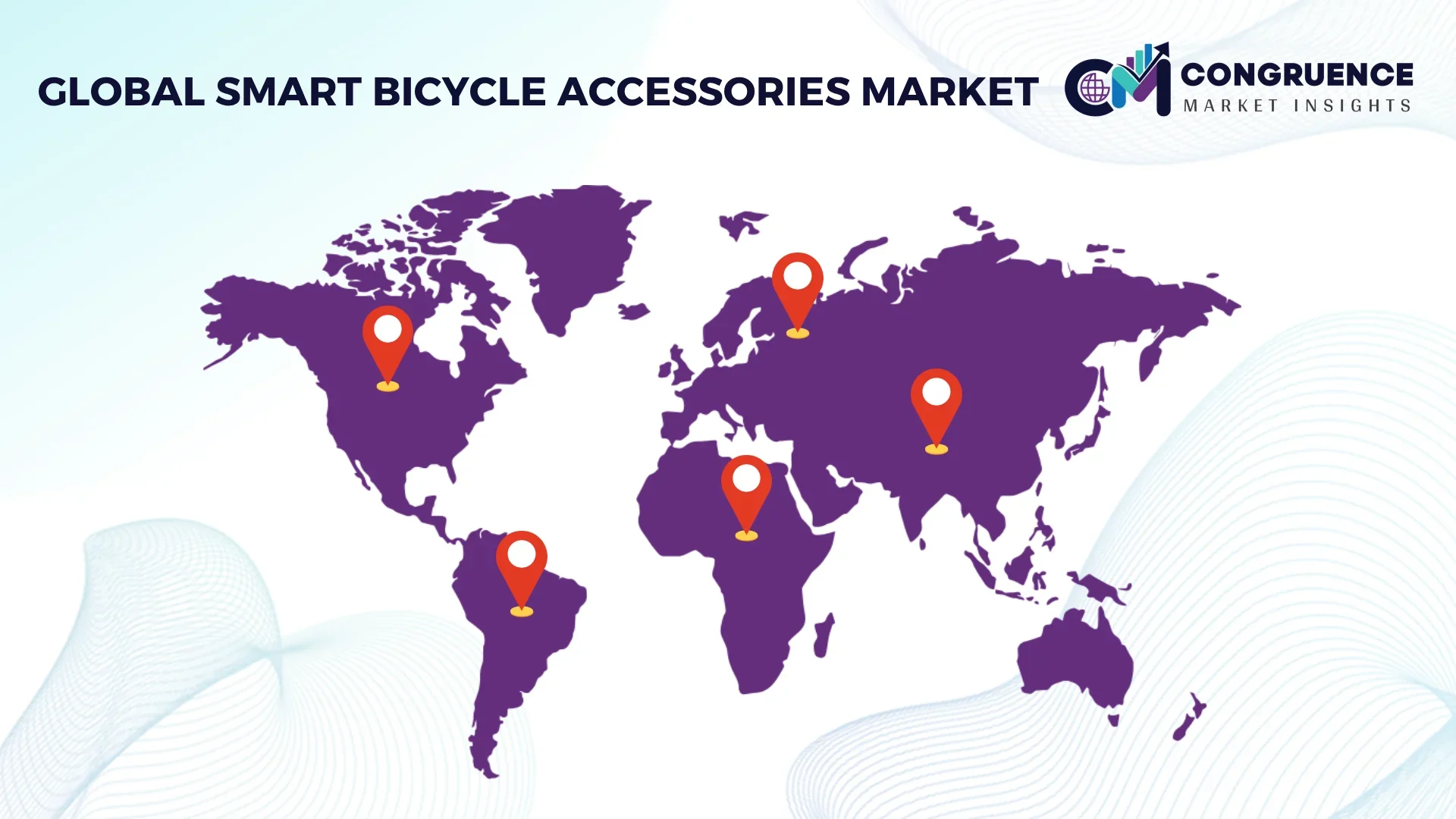
Asia-Pacific recorded more than 52 million smart bicycle accessory units in active use during 2025, driven by large commuter cycling bases and strong e-bike penetration in China, Japan, and India. Europe followed with a 29.6% share, supported by dense cycling infrastructure and government-backed urban mobility programs across Germany, France, and the Netherlands. North America represented approximately 19.4% of global demand in 2025, with over 14 million connected accessories deployed, particularly GPS trackers, smart lights, and performance sensors. South America and the Middle East & Africa together accounted for 7.2%, where adoption is concentrated in urban corridors, logistics fleets, and premium recreational cycling segments.
How are connected mobility and performance cycling accelerating adoption of smart accessories?
The market represented around 19.4% of global Smart Bicycle Accessories demand in 2025, with more than 14 million connected devices in active circulation. Key demand-driving industries include urban commuting, sports and fitness, last-mile delivery, and shared mobility services. Government investments in cycling lanes and micromobility safety programs supported smart lighting and crash-detection adoption, with connected safety accessories used by nearly 48% of daily commuters. Digital transformation trends include AI-enabled ride analytics, Bluetooth LE sensors, and app-based navigation. A leading domestic player expanded its smart cycling computer lineup with real-time hazard alerts and cloud analytics, achieving over 30% increase in user engagement. Consumers show higher adoption among performance cyclists and delivery riders, prioritizing data accuracy, reliability, and smartphone ecosystem compatibility.
Why are regulation-aligned and sustainability-focused smart accessories shaping demand patterns?
Europe accounted for approximately 29.6% of the Smart Bicycle Accessories market in 2025, led by Germany, the UK, France, and the Netherlands. Regulatory frameworks emphasizing road safety, emissions reduction, and data protection increased adoption of compliant smart lights, trackers, and navigation systems. Over 61% of urban cyclists in major cities use at least one connected accessory. Sustainability initiatives encouraged energy-efficient electronics and recyclable materials, influencing product design. Regional manufacturers introduced solar-assisted smart lighting systems, extending battery life by over 35%. Consumers demonstrate strong preference for transparent data usage, durability, and regulatory-certified products, driving demand for explainable, standards-aligned smart bicycle accessories.
What makes mass-scale manufacturing and mobile-first ecosystems central to market leadership?
Asia-Pacific ranked first globally by volume in 2025, with over 52 million smart bicycle accessories deployed. China, Japan, and India collectively contributed more than 72% of regional consumption. Manufacturing hubs increasingly integrate IoT modules and sensors locally, reducing production lead times by nearly 20%. Innovation clusters in Shenzhen, Tokyo, and Bengaluru focus on AI navigation, theft prevention, and e-bike integration. A prominent regional brand launched app-connected smart locks, reaching over 1.2 million active users within a year. Consumer behavior is strongly influenced by e-commerce and mobile applications, with nearly 58% of purchases completed through online channels.
How is urbanization influencing connected cycling adoption across emerging cities?
South America held around 5.4% of the Smart Bicycle Accessories market in 2025, led by Brazil and Argentina. Infrastructure investments in bike lanes and urban transport modernization supported demand for smart lights and GPS trackers. Import incentives for electronic mobility devices improved availability across metropolitan regions. Local assemblers partnered with technology providers to localize navigation and language features. Over 36% of smart accessory users rely on mobile-based navigation and theft alerts. Consumer demand is closely tied to media consumption, multilingual interfaces, and affordability, shaping product customization trends.
Why are premium urban mobility projects driving selective smart accessory adoption?
The region accounted for nearly 1.8% of global demand in 2025, with growth concentrated in the UAE and South Africa. Smart city initiatives and lifestyle cycling adoption supported demand for GPS trackers and connected lighting. Trade partnerships improved access to advanced cycling electronics. A regional distributor introduced heat-resistant smart sensors designed for high-temperature environments, improving device longevity by 22%. Consumer behavior reflects a split between premium recreational users and utility-based commuters, with strong emphasis on durability and security features.
China Smart Bicycle Accessories Market – 31.6%: High production capacity, integrated electronics supply chains, and strong domestic e-bike adoption.
Germany Smart Bicycle Accessories Market – 12.8%: Dense cycling infrastructure, regulatory support, and high consumer adoption of connected safety devices.
The Smart Bicycle Accessories market is moderately fragmented, with more than 60 active global and regional competitors operating across safety, performance, navigation, and security segments. The top five companies collectively account for approximately 58% of total market presence, reflecting strong brand recognition and ecosystem lock-in strategies. Competition is driven by continuous product innovation, with average product refresh cycles of 18–24 months. Strategic initiatives include partnerships with cycling platforms, integration with fitness ecosystems, and expansion into subscription-based analytics services. Hardware differentiation increasingly relies on battery efficiency, sensor accuracy, and software interoperability. Smaller players focus on niche segments such as theft prevention and AI-based coaching, intensifying competitive pressure. Market positioning is influenced by pricing tiers, aftersales support, and mobile app experience, making user retention a critical competitive factor.
CatEye Co., Ltd.
Bryton Inc.
Sigma Sport
Giant Manufacturing
Trek Bicycle Corporation
Bosch eBike Systems
Specialized Bicycle Components
Hammerhead Navigation
Technology evolution in the Smart Bicycle Accessories market centers on IoT connectivity, AI-powered analytics, and energy-efficient electronics. Modern accessories process real-time data from GPS, accelerometers, gyroscopes, and environmental sensors, enabling navigation accuracy within 1–2 meters. Bluetooth Low Energy adoption reduced power consumption by nearly 40% compared to legacy wireless modules. AI-driven ride analytics improve route optimization by 22% and performance benchmarking accuracy by 28%. Emerging technologies include vehicle-to-everything communication, enabling smart lights to react automatically to traffic signals. Solar-assisted charging modules extend device runtime by up to 35%. Cloud-based dashboards allow cyclists and fleet operators to analyze trip history, safety incidents, and maintenance alerts. Cybersecurity enhancements, including encrypted data transmission, are increasingly embedded to address privacy concerns. These technologies collectively support scalability, safety, and long-term user engagement.
In February 2025, Garmin launched an upgraded Varia smart radar system with enhanced rear-vehicle detection range of up to 220 meters and improved alert accuracy by 25% for urban cyclists. Source: www.garmin.com
In September 2024, Bosch eBike Systems introduced a new smart connectivity module integrating GPS tracking and theft alerts, supporting over 100 e-bike models globally. Source: www.bosch-ebike.com
In June 2024, Wahoo Fitness expanded its ELEMNT cycling computer software with AI-based route recommendations, reducing average ride time by 12% for commuter users. Source: www.wahoofitness.com
In April 2025, Lezyne released a solar-assisted smart lighting system extending battery life by up to 30% under urban daylight conditions. Source: www.lezyne.com
The Smart Bicycle Accessories Market Report delivers a comprehensive overview of connected cycling technologies across product types, applications, and global regions. The scope includes smart safety devices, navigation systems, performance monitoring tools, theft prevention solutions, and connectivity modules. Applications covered span urban commuting, fitness and sports cycling, logistics and delivery services, bike-sharing fleets, and recreational touring. Geographic analysis includes North America, Europe, Asia-Pacific, South America, and Middle East & Africa, with country-level insights for key markets. The report evaluates technology layers such as IoT sensors, AI analytics, wireless communication standards, battery technologies, and cloud platforms. Emerging segments, including solar-powered accessories and subscription-based cycling analytics, are also assessed. The scope supports strategic planning by outlining adoption patterns, competitive positioning, technological evolution, and regulatory considerations relevant to manufacturers, investors, urban planners, and mobility solution providers.
| Report Attribute/Metric | Report Details |
|---|---|
|
Market Revenue in 2025 |
USD 1,764.7 Million |
|
Market Revenue in 2033 |
USD 3,620.8 Million |
|
CAGR (2026 - 2033) |
9.4% |
|
Base Year |
2025 |
|
Forecast Period |
2026 - 2033 |
|
Historic Period |
2021 - 2025 |
|
Segments Covered |
By Type
By Application
By End-User
|
|
Key Report Deliverable |
Revenue Forecast, Growth Trends, Market Dynamics, Segmental Overview, Regional and Country-wise Analysis, Competition Landscape |
|
Region Covered |
North America, Europe, Asia-Pacific, South America, Middle East, Africa |
|
Key Players Analyzed |
Garmin, Wahoo Fitness, Lezyne, CatEye Co., Ltd., Bryton Inc., Sigma Sport, Giant Manufacturing, Trek Bicycle Corporation, Bosch eBike Systems, Specialized Bicycle Components, Hammerhead Navigation |
|
Customization & Pricing |
Available on Request (10% Customization is Free) |




