
Reports
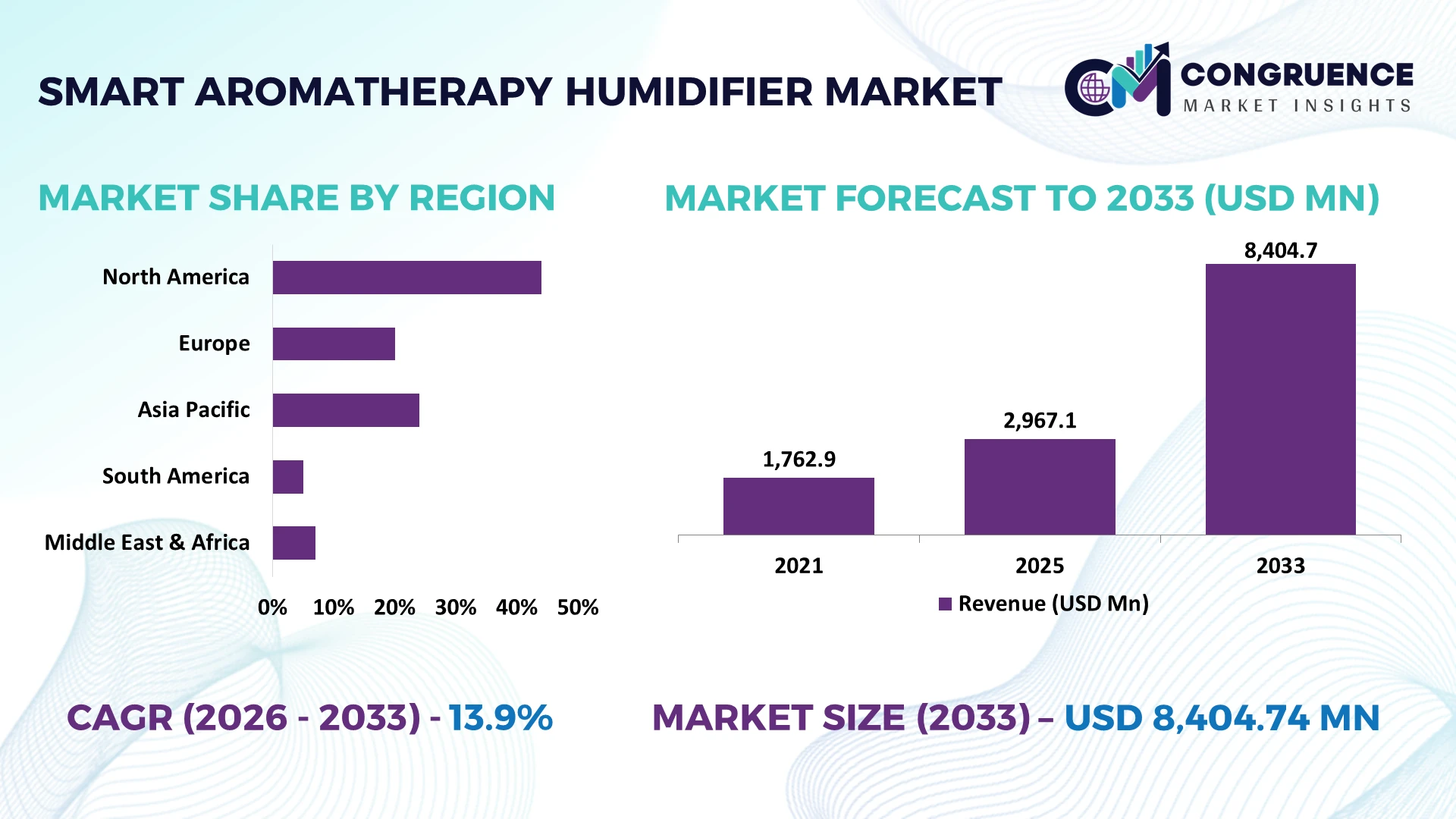
The Global Smart Aromatherapy Humidifier Market was valued at USD 2967.11 Million in 2025 and is anticipated to reach a value of USD 8404.74 Million by 2033 expanding at a CAGR of 13.9% between 2026 and 2033. Growth is driven by connected-home penetration, app-controlled humidity management, ultrasonic atomization, integrated essential-oil diffusion and rising consumer adoption of automated indoor-air-quality devices.
China is the dominant manufacturing hub, producing an estimated 70%+ of global humidifier supply through appliance clusters in Guangdong and Zhejiang, where Xiaomi, Midea and specialized OEMs integrate Wi-Fi, sensors and ultrasonic technology. China’s smart-home penetration exceeds 50%, compared with roughly 45% in Japan, while government-backed appliance trade-in programs are accelerating connected-device replacement and manufacturing automation.
U.S.–China tariff and supply-chain pressures are simultaneously encouraging global brands to diversify component sourcing and final assembly into Vietnam and other Asian manufacturing centers.
Strategically, suppliers combining scalable Asian manufacturing with sensor-driven humidity control, app ecosystems and differentiated wellness functions are positioned to capture premium smart-home demand.
Market Size & Growth: USD 2.97 billion in 2025 advances toward USD 8.40 billion by 2033 at 13.9%, driven by connected wellness and automated humidity management.
Top Growth Drivers: Smart-home adoption above 50%, online-channel penetration exceeding 30%, and ultrasonic technology representing approximately 70% of consumer humidifier configurations strengthen demand.
Short-Term Forecast: By 2027, improved sensor automation and optimized ultrasonic control are positioned to reduce unnecessary operating time by approximately 15–20%.
Emerging Technologies: Wi-Fi, AI-assisted humidity sensing and ultrasonic atomization increasingly converge, with premium devices offering 3–5 automated operating modes.
Regional Leaders: Asia-Pacific approaches USD 4.0 billion, North America USD 2.1 billion and Europe USD 1.6 billion by 2033 as connected-home adoption expands.
Consumer/End-User Trends: More than 50% smart-home penetration in China strengthens consumer familiarity with remotely controlled air-treatment and wellness appliances.
Pilot/Case Example: Xiaomi’s 2025 smart evaporative humidifier offered 800 mL/hour humidification and a 6-liter tank, enabling extended automated operation.
Competitive Landscape: Xiaomi holds an estimated high-single-digit global position; Philips, Levoit, Midea and Dyson intensify competition through connected ecosystems and premium air-care technologies.
Regulatory & ESG Impact: EU ecodesign reforms target approximately 10% lower annual energy consumption across covered products by 2030, reinforcing efficiency-led appliance engineering.
Investment & Funding: China allocated RMB 300 billion in 2025 to consumer-goods trade-in support, accelerating replacement cycles across appliances and connected-home categories.
Innovation & Future Outlook: Next-generation models combine 1 platform with humidity sensing, aroma diffusion, voice control and air-quality analytics, shifting competition toward multifunctional wellness ecosystems.
Smart aromatherapy humidifiers are evolving from standalone mist generators into connected indoor-wellness platforms integrating ultrasonic diffusion, humidity sensing, app control and automated scheduling. Smart-home penetration above 50% in China strengthens adoption potential, while manufacturers increasingly combine aroma and air-care functions within single devices. Supply-chain diversification beyond established Chinese clusters is simultaneously influencing sourcing, setting up the market’s strategic competitive discussion.
Smart aromatherapy humidifiers are becoming strategically important as appliance makers reposition air-care products within connected wellness ecosystems rather than standalone humidification. In the United States, 48% of homes owned at least one smart-home device in 2025, creating an installed ecosystem for app-controlled humidity, scheduling and voice integration. Supply-chain restructuring is also accelerating as electronics assembly shifts from China toward Vietnam under tariff pressure.
Technology is widening product differentiation. Controlled testing found one steam humidifier consumed 21% more energy than the highest-consuming cool-mist unit, reinforcing ultrasonic and evaporative architectures for connected residential products. Meanwhile, 35% of U.S. adults use smart speakers, providing a practical control interface for automated humidification and aroma routines. China retains manufacturing scale, while U.S. brands compete more heavily through software ecosystems, premium design and retail integration.
Through 2026–2028, competition will shift toward sensor-driven humidity control, app interoperability and lifecycle cybersecurity. A practical deployment model links humidifiers with smart speakers and room sensors for automatic operation instead of manual adjustment. Manufacturers are investing in firmware, quieter ultrasonic systems and diversified Asian assembly. Companies that combine dependable hardware with connected services will secure stronger differentiation and repeat-purchase potential.
Connected-home adoption is transforming humidifiers from seasonal appliances into continuously managed wellness devices. In the United States, 48% of households owned at least one smart-home product in 2025, while 35% of adults reported owning smart speakers in 2026 and 15% of adults aged 30–49 used AI-enabled smart thermostats. These installed control points normalize app scheduling, automation and voice commands, directly supporting smart aromatherapy humidifier adoption. The non-obvious advantage is ecosystem familiarity: consumers already managing lighting or temperature digitally face lower behavioral friction when adding humidity and scent routines. Manufacturers are responding by integrating Wi-Fi, mobile controls, automatic humidity sensing and voice-assistant compatibility. Product strategy is therefore shifting from mist-output specifications toward recurring engagement, interoperable controls and multi-room wellness positioning.
Heavy dependence on Chinese electronics, plastics and small-appliance manufacturing creates structural sourcing exposure for smart humidifier brands. U.S. tariff-driven restructuring accelerated during 2025–2026, while U.S. imports from Vietnam rose 40% year over year in the first half of 2026 as companies diversified assembly away from China; average Chinese import tariffs remained materially higher than Vietnam’s. The transition does not fully remove Chinese dependency because components frequently continue originating there, with some Vietnamese electronics assembly contributing less than 8% of final export value. This limits margin protection and complicates supplier qualification. Brands are responding with dual sourcing, Vietnam-based final assembly, longer component contracts and modular designs that permit alternative pumps, sensors and connectivity modules. Supply resilience now influences product architecture as directly as consumer features.
The strongest opportunity lies in turning humidifiers into automated indoor-wellness nodes combining humidity sensing, aromatherapy, scheduling and broader smart-home routines. U.S. smart-device adoption already reaches 59% of households under broader ownership definitions, while approximately two-thirds of younger consumer cohorts own connected-home products. That installed base supports cross-selling of air-care devices without requiring manufacturers to create entirely new digital behavior. Energy efficiency provides another differentiator: controlled testing found steam humidifiers roughly 14% less efficient than ultrasonic and evaporative alternatives under theoretical comparisons. Companies are therefore investing in low-power ultrasonic transducers, adaptive humidity algorithms, refill alerts and ecosystem integrations. A non-obvious opportunity is software-led retention: manufacturers can use app routines and consumable aroma ecosystems to extend customer relationships beyond the initial hardware purchase.
Execution increasingly depends on software reliability rather than humidification performance alone. About 53% of U.S. smart-home consumers report interoperability concerns, while roughly one-third consider connected products difficult to install or configure. These weaknesses directly affect app-controlled humidifiers because failed pairing, inconsistent voice commands or fragmented platforms increase returns and customer-support costs. Regulatory pressure is also tightening: the EU Cyber Resilience Act requires connected products placed on the European market to meet mandatory cybersecurity obligations, with compliant products required by 2027. Manufacturers must therefore maintain firmware, vulnerability management and lifecycle support alongside pumps, atomizers and sensors. The strategic challenge is sustaining affordable consumer pricing while funding software engineering. Brands are responding through standardized connectivity stacks, over-the-air updates, platform partnerships and longer cybersecurity-support programs; execution quality will increasingly determine retailer acceptance and consumer trust.
Smart Controls Replace Manual Operation. Wi-Fi connectivity, automatic humidity sensing and mobile scheduling are moving from premium differentiators into mainstream product specifications. Smart-home devices are already present in 59% of U.S. households, while roughly two-thirds of consumers aged 12–34 own connected products. Manufacturers are integrating app dashboards, voice commands and real-time humidity feedback to increase daily engagement, reduce unnecessary operating cycles and strengthen ecosystem lock-in.
Sleep-Focused Features Gain Priority. Bedroom humidifiers increasingly combine low-noise ultrasonic atomization, night lighting, timed aroma diffusion and voice-assisted routines. In India, 52% of surveyed consumers use voice assistants to establish sleep routines, 54% report better sleep with consistent routines and 22% already control bedroom smart appliances by voice. Brands are repositioning humidifiers as sleep-environment devices rather than seasonal moisture appliances, supporting higher feature density and premiumization.
Hygiene Engineering Shapes Product Design. Mineral residue, stagnant-water contamination and cleaning requirements are pushing companies toward UV treatment, antimicrobial tanks, filter-free architecture and easier top-fill designs. Ultrasonic units represented about 47.6% of humidifier demand in 2025, increasing scrutiny of aerosolized minerals and maintenance. Suppliers are redesigning reservoirs, adding cleaning reminders and improving water-contact materials, turning hygiene performance into a purchase criterion alongside mist output and operating noise.
Hospitality ComfortTech Expands Deployment. Smart-room investment is extending toward personalized environmental controls, scent and air-comfort systems. In 2025, 56% of hotels reported pressure to upgrade technology, while 52% offered technology walkthroughs and more than 90% of surveyed travelers valued guaranteed higher air-quality standards. Hospitality suppliers are therefore emphasizing centrally manageable devices, preset room modes and low-maintenance refill systems that improve guest experience without increasing housekeeping complexity.
Ultrasonic humidifiers lead the Smart Aromatherapy Humidifier Market with an estimated 48% share in 2025, supported by quiet operation, compact construction, comparatively low power consumption and straightforward integration with Wi-Fi modules, humidity sensors and essential-oil functions. Their scalability suits bedrooms, apartments and small offices, while low-noise output strengthens sleep and wellness positioning. Evaporative systems hold an estimated 24% share and remain relevant where consumers prioritize natural moisture dispersion and reduced visible mist. Their filter requirements, however, create higher maintenance expectations than many ultrasonic designs.
Hybrid systems represent approximately 17% and are the fastest-growing type as premium buyers seek multi-mode humidification, intelligent humidity adjustment and combined wellness functions within one appliance. Nebulizing models account for roughly 11%, remaining strategically important in aroma-intensive spa and wellness applications where concentrated essential-oil delivery matters more than broad humidification. Manufacturers are expanding hybrid architectures, washable components and sensor-controlled modes. Investment priorities are shifting toward platforms that combine quiet performance, automated control and aroma flexibility rather than competing only on mist capacity.
Home applications represent the largest segment with an estimated 46% share in 2025, reflecting broad use across bedrooms, living rooms, nurseries and climate-controlled apartments. Connected scheduling, automatic humidity regulation and compact ultrasonic designs make residential deployment straightforward, while smartphone control increasingly integrates humidifiers into broader smart-home routines. Sleep applications account for approximately 22%, supported by low-noise operation, timed diffusion and nighttime automation. Office applications represent nearly 12%, primarily addressing personal comfort in air-conditioned environments where localized humidity management is preferred over building-level retrofits.
Wellness is the fastest-growing application, with an estimated 13% share as consumers combine aromatherapy, relaxation routines and environmental personalization in one connected device. Spa applications account for roughly 7%, emphasizing continuous aroma delivery, premium design and controlled guest environments. Manufacturers are responding with preset wellness modes, quieter transducers, adjustable scent intensity and automation compatible with voice assistants. Demand is therefore shifting from simple humidification toward contextual use cases where sleep, relaxation and personalized environmental settings increase usage frequency and support higher-value product configurations.
Residential Users dominate the Smart Aromatherapy Humidifier Market with an estimated 68% share in 2025 because individual households account for the largest installed base of portable humidifiers, smart speakers and app-controlled appliances. Adoption concentrates in bedrooms, nurseries, apartments and home-office environments, where compact systems require little infrastructure and support direct online purchasing. Hospitality represents approximately 12%, while Wellness Centers hold around 8%, reflecting smaller deployment volumes but higher requirements for atmosphere control, continuous operation and aesthetic integration.
Hospitality is the fastest-growing end-user group as hotels increasingly treat room environment, scent and connected controls as part of differentiated guest experience. Healthcare Facilities represent approximately 6%, emphasizing controlled operation and cleaning requirements, while Corporate Offices account for roughly 6%, mainly through localized comfort applications rather than building-wide humidification. Suppliers are targeting commercial buyers with multi-unit procurement packages, centralized controls, durable tanks and lower-maintenance designs. Residential strategies increasingly emphasize ecosystem compatibility and direct-to-consumer pricing, whereas hospitality and wellness buyers reward reliability, appearance and fleet manageability, creating distinct product-development priorities.
Hotels.com’s 2025 global survey found 56% of hotels felt pressure to upgrade technology, while 52% already provided technology walkthroughs, indicating accelerating smart-room adoption that supports connected environmental and wellness-device deployment.
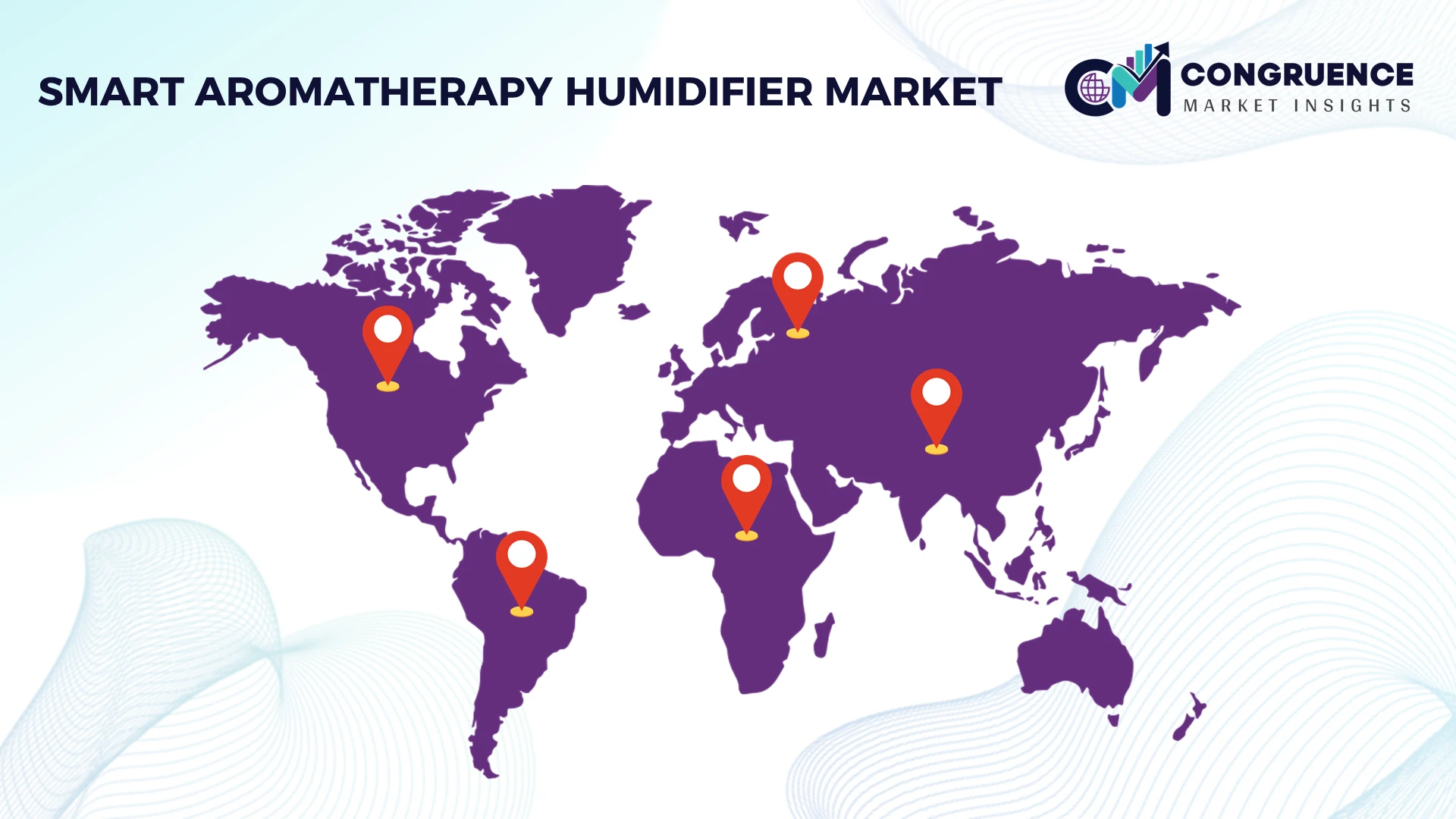
Asia-Pacific accounted for the largest market share at 38% in 2025 however, Asia-Pacific is expected to register the fastest growth, expanding at a CAGR of 15.6% between 2026 and 2033.
Connected Wellness Drives Premium Adoption
North America accounted for an estimated 29% share in 2025, led by strong U.S. penetration of connected-home devices, bedroom wellness products and direct-to-consumer air-care appliances. Approximately 48% of U.S. households owned at least one smart-home device in 2025, creating an established control ecosystem for Wi-Fi humidifiers, voice automation and app-based scheduling. E-commerce distribution strengthens rapid product refresh cycles, while cold winters and mechanically heated indoor environments sustain seasonal humidification requirements. Premium suppliers increasingly differentiate through automatic humidity sensing, quiet sleep modes, top-fill reservoirs and essential-oil compatibility. Retail competition is shifting from basic mist capacity toward software reliability, cleaning convenience and connected routines. Canadian adoption remains concentrated in urban households and winter-use applications, while U.S. scale supports broader product segmentation and faster smart-feature commercialization.
United States Market Outlook: The United States provides the region’s strongest smart-home infrastructure and retail ecosystem. About 35% of adults own smart speakers, creating a substantial installed interface for voice-controlled wellness appliances. Amazon-led e-commerce, specialty retailers and direct brand channels enable rapid deployment of sensor-controlled humidifiers, while consumer preference for bedroom air quality supports premium ultrasonic and hybrid configurations.
Efficiency Regulation Reshapes Product Design
Europe represented an estimated 22% market share in 2025, with Germany, the United Kingdom, France and Italy forming the principal consumer markets. Demand is increasingly influenced by energy efficiency, product durability, cybersecurity and connected-device regulation rather than mist performance alone. The EU Cyber Resilience Act introduces mandatory security obligations for connected products, while ecodesign policies are pushing manufacturers toward lower-energy electronics and longer product lifecycles. Smart-home penetration in major Western European economies provides an established environment for app-controlled humidity and automated wellness routines. Suppliers are responding with low-power ultrasonic transducers, replaceable components, over-the-air firmware capability and simplified cleaning architecture. The operational shift is particularly important for imported brands: compliance engineering and lifecycle software support now influence European market access alongside CE conformity, increasing the advantage of manufacturers capable of maintaining hardware and firmware together.
Germany Market Outlook: Germany combines high household purchasing power with strong energy-efficiency expectations and mature connected-home adoption. Approximately 46% of German households used at least one smart-home application in 2025. Manufacturers targeting this market increasingly emphasize low standby consumption, automatic humidity regulation, quiet operation and durable components, positioning smart aromatherapy humidifiers within broader energy-conscious home automation rather than standalone seasonal appliances.
Manufacturing Scale Meets Connected Demand
Asia-Pacific held approximately 38% of the market in 2025, supported by China’s appliance manufacturing clusters, Japan and Korea’s connected-home maturity, and expanding urban consumer bases in India and Southeast Asia. China remains the central production hub for ultrasonic transducers, electronics, molded reservoirs and finished humidifiers, giving domestic manufacturers significant cost and product-development advantages. Government-backed consumer appliance trade-in programs are accelerating replacement cycles, while regional OEM networks allow rapid integration of Wi-Fi modules, digital displays and humidity sensors. India is developing differently: voice-controlled home routines and online appliance distribution are widening the addressable consumer base without requiring mature whole-home automation. Manufacturers are scaling localized e-commerce, compact bedroom models and app ecosystems. Supply-chain diversification toward Vietnam is simultaneously changing final assembly strategies while Chinese component ecosystems remain difficult to replicate completely.
China Market Outlook: China combines large-scale manufacturing with a rapidly digitalizing domestic consumer market. The 2025 national consumer-goods trade-in program allocated RMB 300 billion to support replacement activity, including household appliances. Guangdong and Zhejiang supply chains give brands rapid access to ultrasonic components, sensors and contract manufacturing, supporting shorter product cycles and aggressive integration of connected features.
Digital Retail Broadens Urban Demand
South America accounted for an estimated 5% share in 2025, with Brazil dominating demand through its large urban consumer base, expanding digital commerce and established small-appliance retail infrastructure. Smart aromatherapy humidifiers remain concentrated in middle- and higher-income households, wellness consumers and air-conditioned residential environments rather than broad household penetration. Brazil’s e-commerce ecosystem increasingly enables Chinese and international brands to reach consumers without extensive physical distribution networks, reducing market-entry costs for compact connected appliances. However, currency volatility, import taxation and dependence on Asian electronics constrain pricing flexibility and premium-product scalability. Suppliers are responding with marketplace-led distribution, localized Portuguese interfaces and smaller ultrasonic models positioned around bedrooms and home offices. The non-obvious opportunity lies in channel economics: digital marketplaces allow brands to test connected wellness products before committing capital to extensive local retail networks.
Brazil Market Outlook: Brazil represents the region’s strongest opportunity because more than 90% of internet users access the web through smartphones, creating a favorable interface for app-controlled consumer appliances. São Paulo and other major urban centers concentrate premium home-wellness spending. Brands are prioritizing marketplace availability, locally compatible electrical specifications and competitively priced ultrasonic models to manage import-related cost pressure.
Hospitality Modernization Expands Wellness Deployment
Middle East & Africa represented an estimated 6% share in 2025, with the UAE, Saudi Arabia, Israel and South Africa providing the strongest commercial demand. Gulf markets differ structurally from humidifier markets in colder climates: premium hotels, spas, wellness facilities and air-conditioned residential properties create more relevant demand than seasonal heating. Saudi Arabia’s hospitality expansion and UAE smart-building adoption are increasing opportunities for connected scent and environmental-control products integrated into premium guest experiences. Suppliers are emphasizing aesthetic design, automated scheduling, commercial durability and distributor partnerships rather than mass-market humidification alone. Africa remains more price-sensitive, with deployment concentrated in South Africa and affluent urban consumers. The strategic advantage for vendors lies in combining aromatherapy with hospitality technology, where environmental personalization can command greater value than basic humidity management and support multi-unit commercial procurement.
United Arab Emirates Market Outlook: The UAE offers the strongest combination of premium hospitality, smart-building infrastructure and international consumer brands. Dubai welcomed 19.59 million international overnight visitors in 2025, sustaining intensive hotel technology investment. Luxury properties, spas and high-end residences provide a concentrated deployment channel for connected aroma humidifiers emphasizing programmable operation, premium aesthetics and integration with room-control ecosystems.
Xiaomi, Levoit, Philips, Dreo and Midea compete across connected residential air care, while specialist aromatherapy brands challenge them through scent-focused customization and wellness positioning. The top five players are estimated to control about 34% of market demand, leaving substantial space for regional and digital-native brands. Ultrasonic products represent roughly 48% of type demand, making quiet atomization, sensor accuracy and cleaning convenience core competitive parameters. Smart-enabled models can command 20–35% price premiums over basic humidifiers, while direct-to-consumer distribution can shorten product-launch cycles by roughly 25%. Xiaomi and Midea leverage manufacturing scale and ecosystem integration; Levoit and Dreo emphasize app functionality, design and online distribution; Philips competes through established air-care credibility. Competition is shifting toward multifunctional platforms combining humidity, aroma, sensing and automation. Firmware support, product certification and reliable component sourcing raise entry barriers. Winning requires cost-efficient hardware, intuitive software, hygienic design, channel strength and dependable lifecycle support.
Xiaomi
Midea
Levoit
Dreo
Philips
Dyson
Stadler Form
Crane USA
Boneco
Vicks
Beurer
Vitruvi
Canopy
Govee
Current smart aromatherapy humidifiers combine ultrasonic atomization, digital humidistats, app control, voice assistants, and aroma trays. Leading connected models maintain target humidity within ±5%, while 28 dB operation supports bedroom deployment. Compared with conventional controls offering roughly ±10% precision, sensor-led systems improve humidity-control accuracy by about 50%. Smart functions are increasingly standard across premium residential portfolios, giving brands advantages through automated schedules, remote monitoring, and maintenance alerts.
Emerging platforms are shifting toward mist-free evaporative humidification, washable antimicrobial filters, and multi-device environmental automation. New evaporative systems deliver 600–800 mL/h output, while two-year washable filters can reduce replacement frequency by more than 75% versus quarterly filter cycles. Connected models also integrate 30-day humidity histories and automated cleaning reminders. This architecture benefits premium wellness brands by lowering maintenance friction while addressing white-dust concerns associated with ultrasonic systems.
Disruptive development through 2026–2028 centers on AI-orchestrated indoor comfort, where humidity, temperature, airflow, lighting, and aroma operate as coordinated environments. Early AI home-air demonstrations already control humidifiers alongside fans and heaters using contextual settings. As connected-home adoption expands, sensor fusion and predictive automation will reduce unnecessary runtime by an estimated 10–15%. Manufacturers investing now gain software differentiation, stronger ecosystem retention, and faster product personalization at scale.
August 2024 DREO expanded smart humidification around HM713S, combining ±5% humidity precision, 30-day app tracking and dual-aroma pads. The connected design strengthened automated bedroom wellness positioning while linking fragrance customization with remote environmental control and maintenance visibility. Source: DREO
January 2025 Levoit unveiled its Sprout Evaporative Humidifier at CES 2025 within a family-focused wellness lineup. The launch targeted 1 integrated nursery environment, extending humidification beyond standalone moisture delivery toward personalized air-care ecosystems for connected households globally.
October 2025 Xiaomi introduced Mijia Smart Evaporative Humidifier Pro globally, delivering 600 mL/h humidification with 30.7 dBA sleep operation. Its mist-free, app-connected architecture expanded Xiaomi’s smart-home climate portfolio while targeting larger bedrooms and low-noise automated environments. Source: Notebookcheck
June 2026 Levoit introduced Superior Studio Smart, featuring 19-decibel operation and a washable wick rated for two years. The design reduces frequent filter replacement while combining antimicrobial water-contact materials with connected control, materially improving evaporative technology’s consumer usability. Source: PRAsia
The Smart Aromatherapy Humidifier Market report evaluates Ultrasonic, Evaporative, Hybrid and Nebulizing technologies across Home, Sleep, Wellness, Office and Spa applications. End-user analysis covers Residential Users, Hospitality, Wellness Centers, Healthcare Facilities and Corporate Offices. Ultrasonic systems represent an estimated 48% of current demand, while residential users contribute approximately 68%, providing clear benchmarks for technology and customer concentration.
Regional coverage includes North America, Europe, Asia-Pacific, South America, and Middle East & Africa, alongside country-level manufacturing, connected-home and distribution dynamics. Technology assessment covers digital humidistats, app and voice control, aroma delivery, mist-free evaporation, antimicrobial filtration, sensor fusion and AI-driven environmental automation. The 2026–2033 framework identifies emerging opportunities in sleep technology, smart hospitality and integrated wellness ecosystems, supporting investment planning, product expansion, geographic prioritization, partnership strategy and competitive positioning.
| Report Attribute/Metric | Report Details |
|---|---|
Market Revenue in 2025 | USD 2967.11 Million |
Market Revenue in 2033 | USD 8404.74 Million |
CAGR (2026 - 2033) | 13.9% |
Base Year | 2025 |
Forecast Period | 2026 - 2033 |
Historic Period | 2021 - 2025 |
Segments Covered | By Type
By Application
By End-User
|
Key Report Deliverable | Revenue Forecast, Growth Trends, Market Dynamics, Segmental Overview, Regional and Country-wise Analysis, Competition Landscape |
Region Covered | North America, Europe, Asia-Pacific, South America, Middle East, Africa |
Key Players Analyzed | Xiaomi, Midea, Levoit, Dreo, Philips, Dyson, Stadler Form, Crane USA, Boneco, Vicks, Beurer, Vitruvi, Canopy, Govee |
Customization & Pricing | Available on Request (10% Customization is Free) |




