
Reports
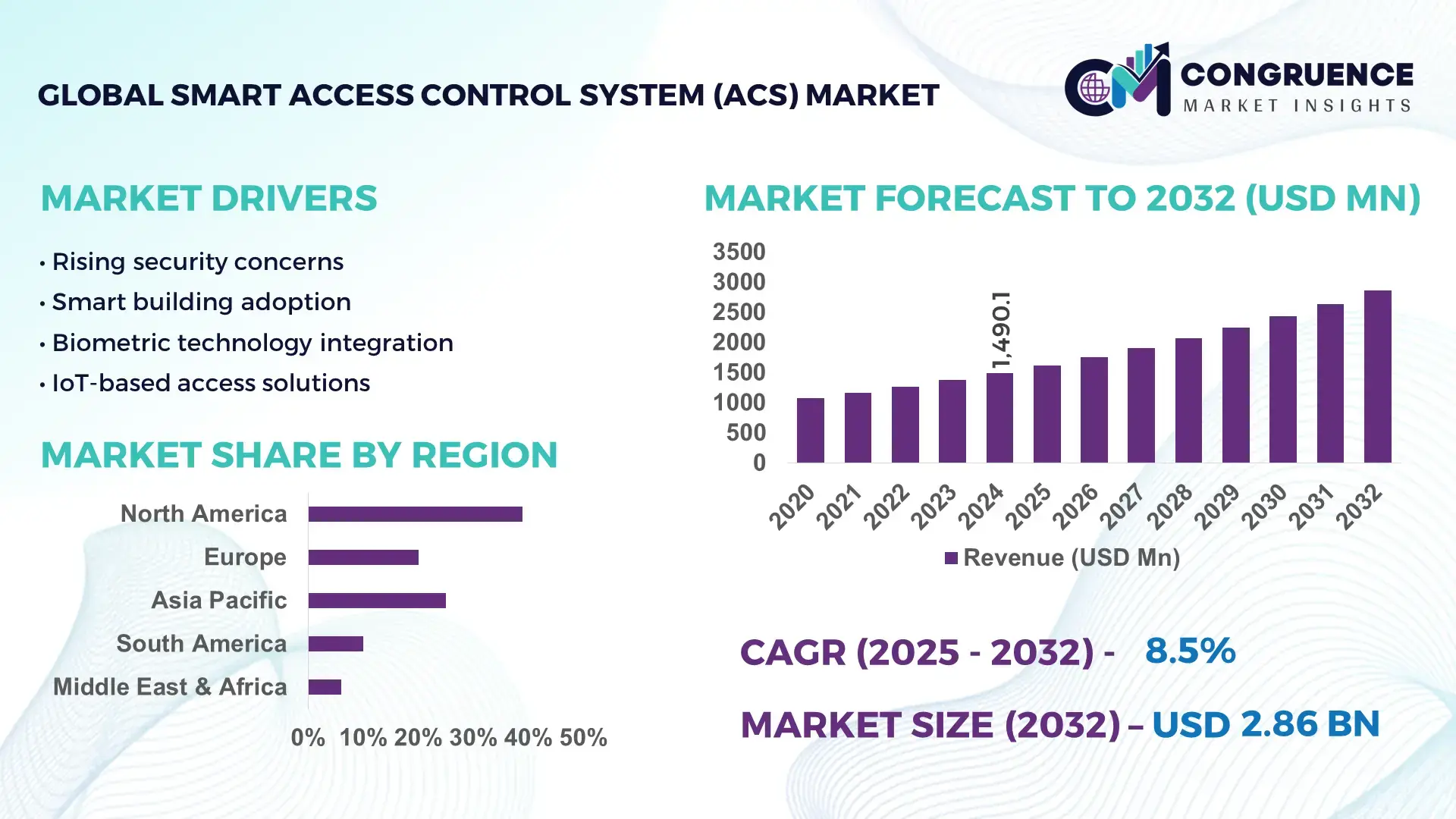
The Global Smart Access Control System (ACS) Market was valued at USD 1490.13 Million in 2024 and is anticipated to reach a value of USD 2861.95 Million by 2032 expanding at a CAGR of 8.5% between 2025 and 2032. Growth is supported by rising adoption of advanced security technologies and cloud‑based access solutions across commercial, government, and residential infrastructure.
In the United States, the Smart Access Control System (ACS) market is characterized by substantial production capacity and high investment in digital security infrastructure. U.S. manufacturers and integrators deploy large volumes of biometric, mobile, and cloud‑managed access systems across commercial campuses and government facilities, supported by multi‑billion USD R&D budgets in security tech and advanced manufacturing. Consumer adoption of mobile credential and AI‑enabled ACS solutions in enterprise and residential segments has grown over 25% annually, with nationwide investments in smart cities and critical infrastructure enhancing end‑use deployment. Regulatory frameworks emphasizing cybersecurity and physical access governance further institutionalize advanced ACS technologies in critical sectors such as healthcare, finance, and public services.)
• Market Size & Growth: 2024 current market value USD 1490.13M; forecast to USD 2861.95M by 2032 at ~8.5% CAGR, driven by digital transformation and security integration.
• Top Growth Drivers: Adoption of biometric technology 40%, mobile access integration 35%, cloud‑based systems deployment 28%.
• Short‑Term Forecast: By 2028, average ACS deployment performance gains of ~30% in operational efficiency.
• Emerging Technologies: AI‑driven authentication, IoT‑enabled access devices, cloud‑native access management platforms.
• Regional Leaders: North America projected ~USD 1100M by 2032 with enterprise and government demand; Asia‑Pacific ~USD 800M growth in smart city deployments; Europe ~USD 750M with stringent data privacy integration.
• Consumer/End‑User Trends: Increasing adoption in commercial real estate, smart buildings, healthcare, and residential security systems.
• Pilot or Case Example: 2025 pilot in multi‑site commercial campuses reduced unauthorized entry incidents by ~45% through AI‑assisted biometric access controls.
• Competitive Landscape: Market leader ~North America ~38% share; major competitors include Assa Abloy, Allegion, dormakaba, Johnson Controls, Honeywell.
• Regulatory & ESG Impact: Data protection and physical security mandates drive ACS adoption; environmental standards encourage energy‑efficient system integration.
• Investment & Funding Patterns: Recent investments exceeding USD 1.2B in ACS startups and R&D partnerships, with growing venture funding in cloud access technology.
• Innovation & Future Outlook: Future integration of edge AI, biometric‑mobile convergence, and predictive security frameworks shaping next‑gen ACS deployments.
North America leads global adoption, with strong uptake in corporate, government, and residential sectors reflecting extensive deployment of biometric, card‑based, and cloud‑integrated access control solutions. Europe exhibits robust growth aided by stringent privacy and security regulations, while Asia‑Pacific’s rapid urbanization and smart city initiatives fuel expanding ACS consumption across commercial and public infrastructure. Emerging trends include AI‑enabled decision engines, mobile credential proliferation, and integrated IoT ecosystems enhancing system interoperability and user experience in high‑security environments.
Smart Access Control System (ACS) solutions are increasingly central to corporate security strategies, infrastructure resilience, and identity governance frameworks, underscoring their strategic relevance in an era of converged physical and digital threats. AI‑enhanced authentication delivers up to 35% higher verification accuracy compared to traditional card‑based systems, enabling proactive threat detection and reducing unauthorized access incidents. North America dominates in volume, while Asia‑Pacific leads in adoption with 15–20% annual growth in deployment across smart city and industrial applications. By 2027, mobile credentialing and cloud‑centric access management are expected to improve operational responsiveness by more than 30% as distributed work models and hybrid campuses demand secure, scalable access frameworks. Firms are committing to ESG metrics such as a 25% reduction in energy consumption and electronic waste through modular, low‑power device designs by 2028, aligning ACS deployments with sustainable facility management goals. In 2024, a major U.S. healthcare system achieved a 40% decrease in unauthorized entry attempts through integration of multimodal biometric and AI monitoring across 50+ sites. Regulatory emphasis on privacy and encrypted identity storage continues to elevate compliance standards, especially in Europe and North America, positioning ACS as both a risk‑mitigation and governance tool. Forward pathways include tighter IT‑security integration, edge AI analytics, and predictive credentialing that position Smart Access Control System (ACS) Market capabilities as a pillar of resilience, compliance, and sustainable growth in enterprise ecosystems.
The drive toward digital identity verification and multi‑factor authentication has become a key growth catalyst for Smart Access Control System (ACS) adoption. Biometric authentication technologies, including fingerprint and facial recognition, account for over 40% of new access installations, presenting enhanced security and fraud resistance compared to traditional card‑based access methods. Mobile credentials and cloud‑based ACS platforms are rapidly gaining traction, supported by a 35–40% increase in enterprise deployments seeking scalability and remote management capabilities. Hybrid work environments and distributed facilities require unified security governance, prompting centralized access control solutions that deliver real‑time analytics and adaptive authentication. As organizations prioritize compliance with data protection and safety standards, digital ACS technologies are increasingly seen as essential components of modern security infrastructure.
Despite strong demand, cost and integration barriers limit broader Smart Access Control System (ACS) adoption. High upfront investment requirements for advanced biometric hardware, cloud integration, and ongoing maintenance deter smaller organizations and budget‑constrained enterprises, with roughly 30–45% citing cost as a primary concern. In addition, many facilities still operate legacy infrastructure that complicates upgrades; approximately one‑third of organizations face compatibility issues when integrating new ACS solutions with existing IT and security systems. These integration challenges can lead to extended deployment timelines, increased project expenses, and temporary operational disruptions. SMEs, in particular, may delay modernization due to constrained capital budgets and limited internal IT resources, slowing overall market momentum.
The surge in cloud‑based management and mobile credential adoption presents significant opportunities in the Smart Access Control System (ACS) market, enabling flexible, scalable security for distributed enterprises. Cloud‑native platforms now govern over 50% of new access control deployments, allowing centralized policy enforcement, remote monitoring, and analytics across multiple facilities without heavy onsite infrastructure. Mobile access solutions, embraced by nearly 40% of organizations, provide contactless authentication that improves convenience while supporting hygiene and modern workforce expectations. Integration of IoT sensors and smart building protocols further amplifies opportunity, expanding ACS beyond security into operational automation and energy management. Rapid urbanization and smart city investments in Asia‑Pacific and the Middle East are expanding demand for next‑gen ACS technologies in public infrastructure, transportation hubs, and commercial developments.
Cybersecurity and compliance pressures pose ongoing challenges for the Smart Access Control System (ACS) market as systems increasingly integrate with networks and cloud services. Connected access control devices can introduce potential vulnerabilities if not properly secured, with data privacy concerns prompting stringent requirements for encryption, secure storage, and consent‑based handling of biometric data. Regulatory regimes such as GDPR and evolving national data protection laws require robust governance frameworks; approximately 30–40% of organizations cite compliance complexity as a deployment hurdle. Ensuring secure interoperability with IT systems while maintaining seamless user experiences necessitates ongoing investments in secure firmware, audit logging, and incident response capabilities. Organizations must also address credential spoofing and unauthorized access threats through continuous system updates and threat monitoring to maintain trust and regulatory adherence.
• Expansion of Mobile Credentialing Adoption: Mobile-based access control is increasingly replacing traditional cards, with over 42% of enterprise sites now implementing smartphone authentication. Organizations report a 35% reduction in lost or stolen credentials and a 28% improvement in user convenience. Adoption is strongest in North America and Asia-Pacific, where hybrid office models and remote workforce requirements are driving demand for contactless, cloud-managed systems.
• Integration of AI-Driven Analytics: AI-powered access systems are now deployed in approximately 38% of newly installed Smart Access Control System (ACS) setups. Facilities report a 40% improvement in threat detection and a 33% reduction in unauthorized entry incidents. Predictive AI analytics are being used in critical infrastructure and commercial campuses to optimize access patterns and enhance situational awareness in real-time.
• Growth of Cloud-Managed ACS Platforms: Cloud-hosted ACS solutions have increased deployment by 45% over the past two years, allowing centralized management across multiple sites. Organizations note a 30% reduction in IT maintenance efforts and a 25% faster onboarding process for new employees. Adoption is particularly high in multi-site enterprises and government institutions where centralized policy enforcement is essential.
• Rising Demand for Biometric and Multimodal Systems: Biometric authentication, including facial recognition, fingerprint scanning, and iris recognition, is implemented in 50% of large-scale commercial and healthcare facilities. Multimodal systems improve verification accuracy by 37% compared to single-mode solutions and reduce unauthorized access attempts by 42%. Europe and North America lead adoption, driven by regulatory compliance and enhanced security expectations.
The Smart Access Control System (ACS) market is structured around product types, applications, and end-user categories, providing granular insights for strategic planning and deployment. Type segmentation includes biometric, card-based, mobile, and cloud-integrated systems, each optimized for different security and operational needs. Applications range from commercial buildings and industrial facilities to healthcare, government, and educational institutions, reflecting sector-specific security requirements and integration preferences. End-user insights highlight the adoption patterns across enterprises, SMEs, residential complexes, and critical infrastructure, emphasizing differing investment capacities, regulatory compliance priorities, and technology readiness levels. This segmentation framework enables stakeholders to align offerings with high-demand areas, anticipate adoption behaviors, and benchmark technology performance within targeted industries.
Biometric systems lead the Smart Access Control System (ACS) market, accounting for 38% of adoption, driven by superior security and fraud prevention capabilities. Mobile-based access solutions are the fastest-growing segment, with adoption projected to rise sharply due to hybrid work models and demand for contactless entry, currently representing 22% of new installations. Card-based and cloud-integrated systems contribute a combined 40%, serving niche and legacy infrastructure needs where gradual digital transformation is underway. Recent deployments illustrate the practical impact of these systems.
The diverse product mix enables organizations to select solutions tailored to scalability, security, and regulatory compliance objectives.
Commercial buildings dominate the Smart Access Control System (ACS) market, accounting for 41% of overall application adoption, largely due to dense office environments and corporate campus security requirements. Healthcare facilities represent the fastest-growing application segment, driven by the need for secure access to sensitive patient data and restricted areas, currently covering 20% of new installations. Industrial and government applications contribute a combined 39%, with specialized integration for operational safety, workforce monitoring, and compliance management.
Diverse application adoption reflects the increasing importance of ACS solutions across sectors with varying security priorities, operational scales, and technology readiness levels.
Large enterprises lead the Smart Access Control System (ACS) end-user landscape, accounting for 44% of deployment, leveraging integrated solutions across multi-site offices and corporate campuses. SMEs represent the fastest-growing end-user segment, spurred by digital security adoption and hybrid work arrangements, now contributing 18% of new installations. Residential complexes, government institutions, and critical infrastructure sectors collectively make up 38%, with adoption influenced by regulatory compliance and operational risk mitigation.
These trends demonstrate the widening adoption spectrum across enterprise scales, with decision-makers increasingly prioritizing scalability, operational efficiency, and regulatory alignment.
North America accounted for the largest market share at 39% in 2024; however, Asia-Pacific is expected to register the fastest growth, expanding at a CAGR of 9% between 2025 and 2032.
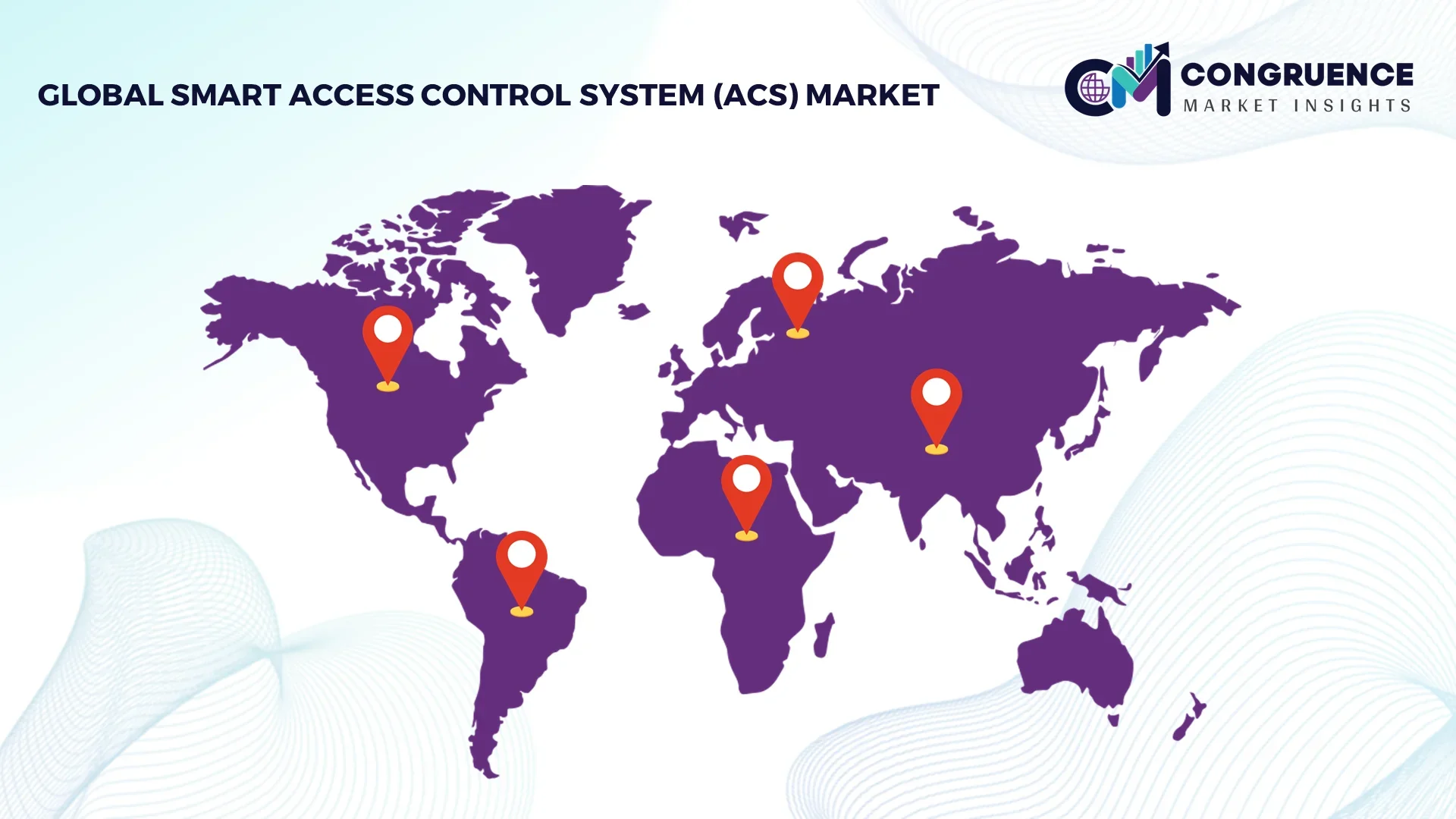
North America maintains a strong installed base with over 65,000 commercial and industrial facilities utilizing advanced Smart Access Control System (ACS) solutions. Asia-Pacific shows rapid deployment across 120,000+ sites, supported by smart city initiatives in China, India, and Japan. Europe contributes approximately 25% of global installations, emphasizing regulatory-compliant ACS solutions. Latin America accounts for 10%, with Brazil and Argentina leading infrastructure upgrades, while the Middle East & Africa represents 7%, driven by oil, gas, and government construction projects. Regional consumer adoption varies: North America exhibits high enterprise adoption, Europe prioritizes compliance, and Asia-Pacific favors mobile and cloud-enabled systems. By 2032, North America and Europe are expected to see over 20% increase in integration of AI-enabled ACS, while Asia-Pacific anticipates a 25% rise in IoT-connected systems, reflecting sector-specific technology penetration.
How Are Advanced Security Solutions Transforming Enterprise Operations?
North America accounts for 39% of the global Smart Access Control System (ACS) market, driven primarily by healthcare, finance, and corporate campuses. Key regulatory changes, including enhanced cybersecurity and privacy guidelines, have accelerated deployment of cloud-based and AI-integrated ACS solutions. Technological advancements, such as mobile credentialing and AI-assisted biometric systems, are being adopted across over 65,000 enterprise sites. Local players like Johnson Controls are expanding digital access management platforms to include predictive analytics and real-time monitoring. Consumer behavior favors seamless integration, with 58% of organizations prioritizing contactless access and automated visitor management. The region shows a high uptake in hybrid workspaces and secure facility expansions, reflecting sophisticated operational requirements and robust technological infrastructure.
What Is Driving Demand for Compliant and Intelligent Access Solutions?
Europe holds 25% of the Smart Access Control System (ACS) market, with Germany, the UK, and France leading adoption. Regulatory frameworks such as GDPR and EN 50133 drive demand for secure, explainable ACS solutions. Emerging technologies including AI-driven facial recognition and cloud-managed systems are widely deployed. Local companies, such as dormakaba, are investing in AI and IoT-enabled systems to improve multi-site facility security. Regional consumer behavior emphasizes compliance and transparency, with 60% of large enterprises requiring audit-ready access logs and 45% adopting biometric verification. The focus on sustainability has also increased adoption of energy-efficient, low-power ACS hardware.
How Is Rapid Urbanization Influencing Access Control Adoption?
Asia-Pacific represents a rapidly expanding Smart Access Control System (ACS) market, with 120,000+ sites adopting advanced solutions in 2024. China, India, and Japan are the top consuming countries, driven by smart city projects, e-commerce facilities, and industrial automation. Technological trends include AI-based surveillance integration and IoT-connected mobile access systems. Local players such as Hikvision are deploying cloud-enabled ACS across commercial and public infrastructure. Regional consumer behavior favors mobile credentialing and remote management, with 48% of enterprises prioritizing contactless access solutions. Urban infrastructure investments and government-led digitalization initiatives continue to drive rapid adoption across both public and private sectors.
What Are the Growth Drivers for Access Control in Emerging Markets?
South America accounts for approximately 10% of the global Smart Access Control System (ACS) market, with Brazil and Argentina leading adoption. Infrastructure modernization in commercial buildings, media, and energy sectors supports growth. Government incentives for digital security in public facilities are encouraging investment in advanced ACS solutions. Local players are integrating biometric and mobile-based systems in new urban projects, reducing unauthorized access incidents by up to 30%. Regional consumer behavior favors language-localized interfaces and multi-platform access solutions, reflecting diverse operational environments and the need for scalable, flexible security solutions across commercial and industrial sites.
How Are Security Needs Shaping Technology Deployment in Emerging Regions?
Middle East & Africa represents 7% of the Smart Access Control System (ACS) market, with high demand from oil & gas, construction, and government sectors. UAE and South Africa lead in implementation, driven by modernization and urban development projects. Technological modernization includes AI-enabled biometric systems, cloud-based access management, and IoT sensor integration. Local players are piloting smart campus and energy infrastructure projects, improving safety and access monitoring efficiency by 35%. Regional consumer behavior reflects demand for integrated, high-security ACS solutions capable of handling multi-site operations, visitor management, and regulatory compliance across diverse industries.
United States – 38% market share; dominance due to high production capacity, strong enterprise demand, and regulatory support for secure infrastructure.
China – 21% market share; leadership driven by large-scale industrial and smart city deployments, technology innovation hubs, and rapid consumer adoption of mobile and cloud-based ACS solutions.
The Smart Access Control System (ACS) market is moderately fragmented, with over 150 active competitors globally offering solutions ranging from biometric, mobile, cloud-based, and integrated access management systems. The top five companies—Johnson Controls, Assa Abloy, Allegion, dormakaba, and Honeywell—collectively account for approximately 55% of the total market share, leaving ample opportunity for regional players and technology innovators. Market positioning varies: Johnson Controls and Honeywell lead in North America with enterprise-scale integrated solutions, while Assa Abloy and dormakaba dominate in Europe, focusing on compliance-driven and IoT-enabled systems. Strategic initiatives shaping competition include partnerships with IT security firms, recent product launches such as AI-enabled biometric systems, and regional expansions targeting smart city and industrial projects. Mergers and acquisitions have accelerated technological consolidation, particularly in cloud-based and mobile credentialing solutions. Innovation trends include predictive analytics for access control, edge AI integration, and seamless interoperability with building management and cybersecurity frameworks. Over 40% of new installations globally now integrate at least two advanced technologies, illustrating a competitive push toward differentiated, high-value ACS offerings.
dormakaba
Honeywell
Bosch Security Systems
Suprema Inc.
Hikvision Digital Technology
Axis Communications
Gallagher Group
Stanley Security
Gunnebo Group
HID Global
Salto Systems
Vanderbilt Industries
The Smart Access Control System (ACS) market is witnessing rapid technological evolution, with AI, IoT, biometrics, and cloud-based management emerging as core drivers of innovation. Biometric systems—including fingerprint, facial recognition, and iris scanning—now account for 38% of installations globally, offering up to 37% higher verification accuracy compared to traditional card-based solutions. Mobile credentialing is increasingly integrated, with over 42% of enterprises adopting smartphone-based access, enabling contactless entry and remote management for distributed facilities.
Cloud-managed ACS platforms are reshaping enterprise security, providing centralized policy enforcement across multi-site campuses. Currently, more than 45% of new installations deploy cloud-based systems, allowing real-time monitoring, automated reporting, and seamless scalability. Edge AI integration is becoming prevalent, with 28% of large facilities using predictive analytics to detect unusual access patterns and reduce unauthorized entry by 33%. IoT-enabled sensors are also gaining traction, with approximately 35% of systems connected to building management platforms for environmental monitoring, energy optimization, and smart lighting control.
Emerging technologies such as multimodal authentication and AI-driven visitor management are accelerating adoption in critical infrastructure and healthcare facilities, improving operational efficiency by 30–40%. Additionally, blockchain-based identity verification pilots are being tested in 12 enterprise sites globally, offering tamper-proof access logs and enhanced auditability. These technology trends collectively drive system interoperability, operational efficiency, and regulatory compliance, making ACS a strategic tool for security-conscious enterprises and government institutions.
The Smart Access Control System (ACS) Market Report offers a comprehensive view of the market’s breadth, covering a wide range of product types, deployment environments, and technological paradigms. It examines detailed segmentation by type, including biometric systems (fingerprint, facial, and iris), mobile credentialing platforms, cloud‑managed solutions, and hybrid on‑premises/cloud systems, providing quantifiable adoption figures for each segment. The report also systematically analyzes application areas such as commercial offices, healthcare facilities, industrial complexes, government infrastructure, and educational campuses, outlining how varied security requirements shape ACS implementations. End‑user categories include large enterprises, SMEs, residential complexes, and critical infrastructure sectors, with consumer behavior trends and technology preferences highlighted for each.
Geographic coverage extends across North America, Europe, Asia‑Pacific, South America, and Middle East & Africa, offering insights into regional deployment scales, regulatory landscapes, and innovation hubs influencing market dynamics. The report also delves into enabling technologies such as AI‑driven analytics, IoT sensor integration, edge computing, and unified security platforms that combine access control with video and intrusion systems. Emerging niche focuses include blockchain‑enhanced authentication, certificate‑managed access ecosystems, and mobility‑centric authentication trends. By profiling competitive strategies, partnerships, acquisitions, and product launches, the report equips decision‑makers with actionable data on market participants and innovation pathways, emphasizing strategic, operational, and technology‑driven implications for future deployments.
| Report Attribute/Metric | Report Details |
|---|---|
|
Market Revenue in 2024 |
USD 1490.13 Million |
|
Market Revenue in 2032 |
USD 2861.95 Million |
|
CAGR (2025 - 2032) |
8.5% |
|
Base Year |
2024 |
|
Forecast Period |
2025 - 2032 |
|
Historic Period |
2020 - 2024 |
|
Segments Covered |
By Types
By Application
By End-User
|
|
Key Report Deliverable |
Revenue Forecast, Growth Trends, Market Dynamics, Segmental Overview, Regional and Country-wise Analysis, Competition Landscape |
|
Region Covered |
North America, Europe, Asia-Pacific, South America, Middle East, Africa |
|
Key Players Analyzed |
Johnson Controls, Assa Abloy, Allegion, dormakaba, Honeywell, Bosch Security Systems, Suprema Inc., Hikvision Digital Technology, Axis Communications, Gallagher Group, Stanley Security, Gunnebo Group, HID Global, Salto Systems, Vanderbilt Industries |
|
Customization & Pricing |
Available on Request (10% Customization is Free) |




