
Reports
The Global Small Wind Turbine Market was valued at USD 231.0 Million in 2025 and is anticipated to reach a value of USD 431.1 Million by 2033 expanding at a CAGR of 8.11% between 2026 and 2033. Growth is anchored in China’s zero-carbon industrial park mandates requiring on-site renewables and India’s telecom tower hybrid tenders specifying 5 kW microturbines.
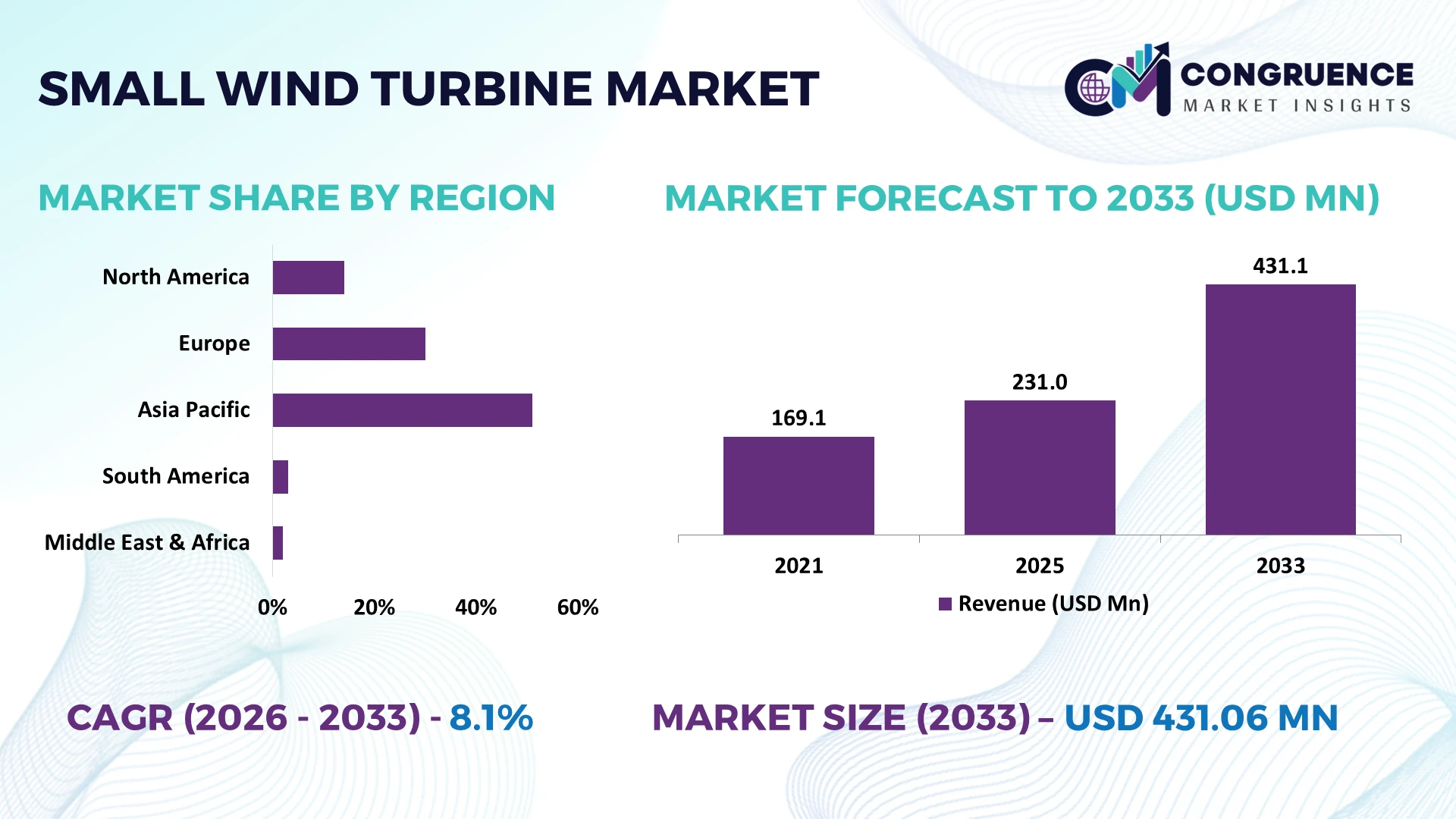
Asia-Pacific commands 47.30% of global share, with China’s ≤50 kW unit shipments rising 22% year-on-year and Europe’s balcony-class 0.5–5 kW installations exceeding 560,000 units. India’s tower operators commit to renewable backup at scale, while Japan’s acoustic rules constrain hub heights below 10 meters in historic districts.
The strategic implication is clear: manufacturers standardizing IEC-certified 2–20 kW platforms for Asian telecom and European building-integrated channels will capture the most defensible volume.
Market Size & Growth: Valued at USD 231.0 Million in 2025, forecast to reach USD 431.1 Million by 2033 at 8.11% CAGR; China’s 40% certified green factory mandate by 2030 drives on-site turbine deployment.
Top Growth Drivers: Off-grid telecom backup (54% of demand), building-integrated balcony units (+31% in Europe), and industrial park self-generation mandates (40% certified output target).
Short-Term Forecast: By 2027, micro-class average selling prices decline 6% annually as power electronics commoditize, while 21–100 kW medium units post 10.83% CAGR through 2031.
Emerging Technologies: Vertical-axis designs capture 13.4% CAGR on omnidirectional airflow; genetic pitch algorithms lift power coefficients by 0.45; ground-level gearboxes cut maintenance truck rolls by 30%.
Regional Leaders: Asia-Pacific at 47.30% share (USD 109.2 Million equivalent); Europe driven by 560,000+ balcony installations; North America led by 10–100 kW agricultural units with federal tax credits extended to 2029.
Consumer/End-User Trends: 54% of demand originates from off-grid distributed applications; farmers with refrigeration loads adopt 15 kW units to offset evening demand charges.
Pilot/Case Example: University of Tokyo field tests verify 15-year bearing life under typhoon gusts for vertical-axis units, addressing durability barriers in Japanese coastal deployments.
Competitive Landscape: Horizontal-axis configurations retain 67.40% of 2025 revenue; key players include Bergey Windpower, Primus Wind Power, Ghrepower, Zephyr Corporation, and Ningbo WinPower.
Regulatory & ESG Impact: EU Rooftop-Renewables Directive boosts building-integrated wind; China’s Jiangsu recycling standards mandate circular supply chains, adding compliance costs but opening leasing models with recycle obligations.
Investment & Funding: Green banks unlock low-cost debt for medium-class suppliers bundling 97% technical availability warranties; vertical-axis suppliers partner with facade engineers to meet EU innovative-technology quotas.
Innovation & Future Outlook: AI-enabled diagnostics and digital twins shift revenue toward service-based models; hybrid wind-solar-battery architectures become the default specification for telecom and microgrid tenders.
The small wind turbine market’s demand center has shifted decisively toward off-grid telecom backup and building-integrated applications, with 54% of unit deployments serving distributed, non-utility loads. Vertical-axis designs now capture 13.4% growth on omnidirectional airflow performance, while Europe’s balcony-class segment surpassed 560,000 installations as permitting frameworks adapted to compact form factors. Supply chains are regionalizing around Chinese manufacturing depth and Indian hybrid tender specifications. These dynamics set the stage for a strategic reassessment of where certified, service-backed platforms create durable competitive advantage.
Small wind turbines are transitioning from niche rural electrification tools into strategic assets for industrial decarbonization and telecom resilience. China’s zero-carbon industrial park mandates and India’s hybrid tender specifications are restructuring demand toward certified, grid-interoperable systems, forcing manufacturers to prioritize IEC compliance and service networks over unit cost alone. This regulatory pull is compressing product cycles and rewarding suppliers with localized assembly and maintenance depth.
Technology differentiation is measurable. Vertical-axis units with genetic pitch algorithms achieve power coefficients of 0.45, approaching Betz-limit benchmarks, while ground-level gearbox placement cuts maintenance truck rolls by 30% versus tower-mounted drivetrains. Regionally, Asia-Pacific’s 47.30% share reflects manufacturing scale and policy-driven volume, whereas Europe’s growth is design-led—balcony units and facade-integrated turbines meeting innovative-technology quotas rather than utility-scale economics.
Operationally, telecom tower operators in India now bundle 5 kW microturbines with solar and lithium storage, a hybrid configuration that reduces diesel dependence and improves uptime in weak-grid zones. Over the next two to three years, expect procurement specifications to converge around 97% technical availability warranties and remote diagnostics as standard. Companies that embed service contracts and recycling obligations into leasing structures will hold pricing power; those selling hardware alone will face commoditization as electronics costs decline 6% annually. Strategic positioning now hinges on certified performance data and lifecycle service infrastructure, not nameplate capacity claims.
China’s requirement for 40% certified green factory output by 2030 compels economic zones to deploy rooftop and courtyard turbines, while India’s telecom tower operators commit to renewable backup with hybrid tenders specifying 5 kW microturbines alongside PV and lithium packs. Off-grid distributed applications already represent 54% of total demand, concentrated in communication. This structural shift rewards suppliers offering certified, fault-ride-through-capable units with integrated SCADA links for battery dispatch. Bergey Windpower and Ningbo WinPower are expanding 2–20 kW standardized platforms to meet USDA and Indian telecom bid specifications, leveraging volume economies to offset electronics commoditization. The operational insight: vendors bundling extended warranties guaranteeing 97% technical availability unlock green-bank financing, converting hardware sales into service-backed revenue streams.
Rooftop solar plus storage undercuts small wind’s levelized cost of energy in the sub-10 kW residential segment, where average selling prices fell 6% year-on-year yet post-installation service revenues remain insufficient to offset margin compression. Municipal height limits constrain hub heights to 10 meters or less across many historic districts, and variance requests demand shadow-flicker and visual assessments that lengthen project timelines. Fragmented jurisdiction means identical installations face divergent rules between adjacent municipalities, discouraging citywide rollouts in Germany and Japan. Companies respond by designing stub-mast vertical-axis units that fit below parapets and by localizing assembly in Jiangsu and Gujarat to shorten lead times. The strategic imperative: standardize certified acoustic and visual impact documentation to reduce permitting friction across fragmented European and Japanese jurisdictions.
Vertical-axis turbines are forecast to post 13.4% growth, outpacing horizontal units by leveraging omnidirectional airflow capture in disrupted urban wind environments. Savonius-Darrieus hybrids with contra-rotating rotors reduce acoustic signatures to 35 dB at 5 meters, meeting EU innovative-technology quotas for facade integration. A non-obvious opportunity lies in retrofitting commercial building parapets and curtain walls: vertical-axis suppliers partnering with facade engineers can embed turbines into existing structures without tower foundations, slashing civil works costs. Chinese and European developers are structuring leasing deals bundling service and recycle obligations to satisfy circular economy rules. Companies investing in modular, parapet-mounted designs with integrated power electronics position themselves for the EU Rooftop-Renewables Directive pipeline—a channel where solar alone cannot satisfy on-site generation mandates in high-rise districts.
Medium-class 21–100 kW units serving telecom towers and data-center campuses require IEC 61400-2-certified fault ride-through and reactive power support to connect without separate converters—a technical bar that smaller manufacturers struggle to clear. Interoperable SCADA links between wind output and on-site battery dispatch are essential to avoid interconnection curtailments, yet installer skill gaps in Indian and Southeast Asian markets delay commissioning and inflate O&M costs. Japan’s stringent acoustic rules and typhoon-load requirements demand field-validated durability data that most suppliers lack. Companies must invest in certified training pipelines and remote diagnostic platforms; those relying on third-party integrators without validated performance histories face warranty exposure and reputational risk as hybrid tenders scale. The execution barrier is not turbine hardware—it is the service and compliance infrastructure surrounding it.
Telecom Hybrid Tenders Reshape Specifications Indian tower operators now specify 5 kW microturbines paired with PV and lithium storage in hybrid tenders, driving a shift from standalone turbine sales to integrated system packages. Suppliers offering IEC-certified fault ride-through and SCADA-linked battery dispatch win preferential qualification. This configuration reduces diesel consumption and improves uptime in weak-grid zones, with operators targeting 97% technical availability warranties.
Balcony-Class Units Scale in European Cities Germany, France, and the Netherlands recorded over 560,000 balcony-mounted 0.5–5 kW installations, a 31% year-on-year increase. Plug-and-play form factors and simplified permitting for sub-1 kW units drive adoption among urban residents facing rising electricity tariffs. Manufacturers respond by bundling acoustic-dampened designs meeting 35 dB thresholds and app-based yield monitoring, converting a niche retrofit product into a standardized consumer appliance channel.
Vertical-Axis Designs Enter Facade Engineering Vertical-axis units capture 13.4% growth as facade engineers embed contra-rotating rotor designs into curtain walls and parapets, meeting EU innovative-technology quotas without tower foundations. Ground-level gearboxes cut maintenance truck rolls by 30%, lowering lifecycle service costs. Developers structure leasing deals bundling recycling obligations to satisfy Chinese and EU circular economy rules, shifting revenue from one-time hardware sales to recurring service and compliance contracts.
AI Diagnostics Enable Service-Based Models Remote monitoring platforms using AI-enabled fault prediction are converting turbine sales into service-level agreements, with suppliers guaranteeing 97% technical availability to unlock green-bank debt. Digital twins simulate site-specific wind profiles to optimize tower siting and battery dispatch, reducing commissioning delays. Companies investing in diagnostic infrastructure position for hybrid tender specifications that increasingly require validated uptime data and remote troubleshooting capability as qualification criteria.
Horizontal-axis turbines command approximately 67.40% of the small wind turbine market, sustaining leadership through proven aerodynamic efficiency, mature supply chains, and seamless integration with both on-grid and off-grid architectures . Their scalability from 1 kW residential units to 100 kW agricultural deployments underpins volume concentration in China and the United States, where standardized nacelle assembly and certified power curves reduce project engineering overhead. Vertical-axis turbines represent the fastest-growing configuration, gaining traction in urban and rooftop environments where omnidirectional airflow capture and compact form factors overcome site constraints that limit horizontal-axis deployment. This emerging segment appeals particularly to European building-integrated installations and Japanese acoustic-sensitive districts, where low vibration signatures and reduced hub heights simplify permitting.
Companies are responding by bifurcating product strategies: horizontal-axis leaders such as Bergey Windpower and Ningbo WinPower optimize 2–20 kW platforms for telecom and agricultural tenders, while vertical-axis specialists pursue facade-engineering partnerships and modular parapet-mounted designs. Investment priorities are shifting toward hybrid configurations that pair horizontal-axis reliability with vertical-axis site adaptability, capturing both volume-driven and premium urban channels. The strategic implication is clear: horizontal-axis platforms will anchor volume economics through 2030, but vertical-axis differentiation determines access to high-margin building-integrated markets.
On-grid applications constitute the leading connectivity segment, benefiting from utility interconnection incentives, net-metering frameworks, and feed-in tariff structures across Germany, Japan, and select U.S. states . Grid-connected small turbines serve residential self-consumption and commercial demand-charge reduction, with inverter-compliant architectures enabling seamless integration into existing distributed energy portfolios. Off-grid applications, while more fragmented, remain operationally indispensable: telecom tower backup, agricultural irrigation, and remote community microgrids account for over half of unit deployments, concentrated in India, Southeast Asia, and sub-Saharan Africa where grid extension costs remain prohibitive .
The fastest-growing application shift is toward hybridized on-grid systems incorporating battery storage and solar co-location, driven by utility interconnection reforms that reward dispatchable distributed generation. Companies are adapting by bundling turbines with lithium storage and smart inverters, converting standalone hardware sales into integrated system packages. Agricultural users increasingly specify 10–15 kW units for irrigation pumping and cold-chain refrigeration, a segment where diesel displacement economics remain compelling despite solar competition. The business implication is that on-grid volume growth depends on interconnection simplification, while off-grid operational criticality sustains pricing power for certified, service-backed platforms in telecom and agricultural channels.
Residential end-users represent the largest buyer group at approximately 46% of installations, driven by energy autonomy preferences, rising retail electricity tariffs, and favorable net-metering policies in Germany, the United Kingdom, and rural North America . Household deployments concentrate in the 1–10 kW range, where plug-and-play balcony units and off-grid cabin systems benefit from simplified permitting and declining power electronics costs. Agricultural users constitute the second-largest and fastest-accelerating end-user segment, leveraging 10–100 kW turbines for irrigation pumping, livestock facility ventilation, and cold-chain operations where grid reliability is inconsistent.
Commercial buyers, including telecom operators and small industrial facilities, are shifting from pilot installations to standardized procurement, specifying fault-ride-through capability and remote diagnostics as qualification criteria. Industrial end-users remain a smaller but strategically significant segment, deploying turbines for warehouse backup and manufacturing resilience in regions with volatile grid quality. Companies are targeting agricultural expansion through dealer networks and financing partnerships in India and Brazil, while commercial engagement relies on energy-service agreements that bundle maintenance and performance guarantees. Future demand is shifting toward end-users requiring documented uptime and lifecycle service commitments, favoring suppliers with certified technical availability warranties over lowest-cost hardware vendors.
Asia-Pacific accounted for the largest market share at 51% in 2025 however, North America is expected to register the fastest growth, expanding at a CAGR of 13.3% between 2026 and 2033.

North America holds approximately 14% of global small wind deployment, concentrated in off-grid agricultural and remote residential applications across the U.S. Midwest and Canadian prairie provinces. The region's operational landscape is shaped by a 30% federal tax credit—capped at USD 3,200 per residential installation through 2032—which sustains household adoption despite persistent interconnection friction in urban jurisdictions. Off-grid configurations dominate regional demand, reflecting the economics of diesel displacement in ranching and irrigation rather than grid-parity ambitions. Horizontal-axis units retain technical preference for their established power curves in steady wind regimes, while vertical-axis designs gain limited traction in university and municipal demonstration projects. Supply chains remain import-dependent for power electronics, though domestic nacelle assembly persists among specialized manufacturers serving agricultural dealers.
United States Market Outlook: The U.S. anchors regional volume through 1–100 kW agricultural deployments and a distributed wind manufacturing base concentrated in western states. Federal tax incentives and state-level renewable portfolio standards sustain procurement momentum, while rural electric cooperatives increasingly evaluate hybrid wind-solar packages for member resilience. Installer networks remain thin outside agricultural strongholds, constraining residential scale.
Europe commands approximately 30% of global small wind deployment, anchored by Germany's Energiewende decentralized generation framework and the UK's Microgeneration Certification Scheme, which validates installer competence and product performance. The region's distinctive operational pattern is building-integrated adoption: balcony-class 0.5–5 kW units and facade-mounted vertical-axis designs proliferate in urban markets where tower installations face height restrictions and acoustic objections. Off-grid configurations retain dominance in rural Alpine and Nordic installations, though on-grid urban applications grow as smart-grid integration matures. German and Dutch grid operators are piloting real-time renewable dispatch protocols that accommodate variable small wind output, addressing a persistent interconnection bottleneck. Supply chains regionalize around Eastern European assembly and German power-electronics clusters.
Germany Market Outlook: Germany leads European deployment through Energiewende-aligned rural distributed generation and a dense installer certification infrastructure. The country's engineering base supports vertical-axis facade integration research, while municipal utilities pilot hybrid wind-solar microgrids for municipal buildings. Permitting variance across Bundesländer remains the primary operational friction for commercial-scale rooftop deployments.
Asia-Pacific accounts for approximately 51% of global small wind deployment, underpinned by Chinese manufacturing depth and Indian telecom hybrid procurement. The region's scale advantage is structural: Chinese producers supply certified 2–20 kW platforms to domestic zero-carbon industrial parks and export markets simultaneously, while Indian tower operators specify microturbines alongside solar and storage in weak-grid states. Off-grid applications dominate regional volume, reflecting rural electrification gaps across Southeast Asia and the subcontinent rather than discretionary residential adoption. Japan's market operates under distinct constraints—stringent acoustic rules and typhoon-load requirements—favoring field-validated vertical-axis designs. Chinese component localization has compressed lead times for regional buyers, though recycling compliance mandates in Jiangsu add lifecycle cost considerations.
China Market Outlook: China anchors Asia-Pacific volume through manufacturing scale and policy-driven industrial park deployment. Provincial zero-carbon factory mandates and Jiangsu recycling standards shape product specifications, while exporters leverage cost advantages in power electronics and nacelle assembly. Domestic competition is intense, with Ningbo and Qingdao clusters supplying both branded and OEM channels.
South America represents approximately 3% of global small wind deployment, concentrated in Brazilian agricultural operations and Andean remote community electrification. The region's operational profile is defined by off-grid necessity: irrigation pumping, livestock facility ventilation, and eco-lodge power supply in areas where grid extension costs exceed small turbine capital outlays. Brazil's wind resource quality supports deployment in northeastern and southern agricultural belts, though import dependence for power electronics and bearings elevates maintenance costs and spares lead times. Deployment momentum faces structural friction from currency volatility affecting project economics and thin installer networks outside São Paulo and Rio Grande do Sul. Hybrid wind-solar configurations gain traction among agricultural cooperatives seeking diesel displacement without full grid dependence.
Brazil Market Outlook: Brazil leads regional deployment through agricultural off-grid applications and a growing base of renewable energy cooperatives. Northeastern wind resources support irrigation and livestock operations, while southern dairy and grain producers evaluate hybrid systems for refrigeration resilience. Domestic assembly remains limited, with most components sourced from Chinese and European suppliers.
Middle East & Africa accounts for approximately 2% of global small wind deployment, with demand concentrated in telecom tower backup across West and East Africa and remote community electrification in Southern Africa. The region's operational logic differs from other markets: small turbines serve as diesel-displacement assets for tower operators facing fuel logistics costs and theft risk, rather than residential or commercial self-generation. Gulf Cooperation Council markets exhibit limited uptake due to low retail electricity tariffs and abundant solar alternatives, though off-grid industrial camps in Saudi Arabia and UAE evaluate hybrid configurations for remote operations. Supply chains depend almost entirely on Chinese and Indian imports, with maintenance capability concentrated in South Africa and Kenya. Currency instability and fragmented procurement frameworks constrain scale.
South Africa Market Outlook: South Africa anchors regional deployment through telecom backup and remote agricultural applications, supported by established renewable energy procurement frameworks and a domestic installer base. Eskom grid reliability concerns sustain commercial interest in hybrid backup systems, while mining and agricultural operations evaluate small wind for diesel displacement. Import dependence for turbines and spares remains the primary operational constraint.
The competitive arena pits established horizontal-axis incumbents—Bergey Windpower, Primus Wind Power, Ghrepower, Ningbo WinPower, and Zephyr Corporation—against emerging vertical-axis disruptors like Challenergy and GEVI. The top five players collectively hold roughly 20% of global volume, confirming a fragmented structure where scale leaders coexist with specialized challengers. Competition hinges on certified reliability (97% availability warranties), power-electronics cost reduction (6% annual ASP decline), and localized service depth; Chinese manufacturers leverage 40% component cost advantages while European innovators differentiate through building-integrated designs and AI-driven blade control. Players are responding via exclusive distribution partnerships (Macnica-Challenergy), serial production funding (GEVI’s €2.7M), and hybrid wind-solar-storage bundling. The competitive shift favors vertical-axis facade integration and telecom tender qualification, where certification and diagnostic infrastructure now outweigh nameplate capacity claims. Entry barriers include IEC 61400-2 certification costs and installer network density, but the sharpest pressure point is the sub-10 kW segment’s inability to match solar-plus-storage economics. Winning requires certified performance data, lifecycle service contracts, and localized assembly—hardware alone commoditizes rapidly.
Bergey Windpower
Primus Wind Power
Ghrepower
Ningbo WinPower
Zephyr Corporation
SD Wind Energy Limited
Britwind Limited
Kliux Energies
Eocycle
LuvSide GmbH
Qingdao Anhua New Energy
Halo Energy
Current small wind technology remains anchored in horizontal-axis architectures optimized for steady wind regimes, with power electronics commoditization driving 6% annual price declines. Vertical-axis designs with genetic pitch algorithms now achieve power coefficients of 0.45, closing the efficiency gap that historically limited omnidirectional turbine adoption in urban environments.
Emerging AI-driven blade control represents the most consequential near-term shift. GEVI’s self-learning vertical-axis system adjusts blade angles every hundredth of a second, delivering up to 60% higher annual energy yield versus leading VAWTs and reducing mechanical loads by 80% in strong winds . Fraunhofer’s hollow composite blades, 35% lighter than foam-core alternatives, start generating at 2.7 m/s—versus 4.0 m/s for comparable systems—and deliver 83% more power at 10 m/s . These advances directly address the sub-10 kW cost-parity gap that has constrained residential adoption.
Between 2026 and 2028, AI-enabled diagnostics and lightweight materials will bifurcate competitive outcomes. Suppliers embedding predictive maintenance and remote monitoring into service-level agreements will capture telecom and commercial buyers requiring validated uptime data; those selling hardware alone face accelerating commoditization. The strategic window for differentiation is narrowing.
September 2025 — Macnica and Challenergy launched an exclusive sales partnership for bladeless Savonius turbines (100W rated, 250W max, 49dB) targeting urban disaster-preparedness installations, with a three-to-five-year sales target of 300 units, expanding vertical-axis access to Japanese corporate and medical facilities. Source: macnica.co.jp
October 2025 — GEVI closed a €2.7 million seed round led by 360 Capital and CDP Venture Capital to industrialize AI-controlled vertical microturbines delivering 5 kW output from 2.5 m/s wind speeds and up to 60% higher annual energy versus leading VAWTs, accelerating serial production and European market rollout. Source: tech.eu
October 2025 — Fraunhofer IAP and BBF Group delivered five prototypes of a lightweight small wind turbine achieving 2,500W output at 10 m/s—83% more powerful than comparable systems—with 35% lighter hollow composite blades that begin rotating at 2.7 m/s, enabling decentralized generation in low-wind Central European locations.Source: idw-online.de
December 2025 — Myriad Wind Energy Systems secured £865,000 in seed funding led by TRICAPITAL Angels to deploy a crane-free modular turbine system, with a 50kW prototype scheduled for 2026 installation, targeting rural businesses and off-grid infrastructure where conventional turbine installation logistics remain prohibitive. Source: deadlinenews.co.uk
This report delivers a comprehensive examination of the global small wind turbine landscape, spanning horizontal-axis and vertical-axis configurations across residential, commercial, agricultural, and industrial end-user segments. Coverage extends to on-grid and off-grid applications, with granular analysis of deployment patterns across Asia-Pacific, Europe, North America, South America, and the Middle East & Africa. Regional shares are quantified—Asia-Pacific at 51%, Europe at 30%, North America at 14%—alongside adoption metrics including balcony-class installation volumes exceeding 560,000 units and off-grid distributed applications representing 54% of demand.
The scope incorporates competitive intelligence on leading manufacturers, technology trends including AI-driven blade control and lightweight composite materials, and regulatory frameworks shaping deployment. Strategic insights support investment planning, expansion prioritization, and competitive positioning through 2033, with operational indicators such as certified availability warranties and hybrid system specifications guiding commercial decisions.
| Report Attribute / Metric | Details |
|---|---|
| Market Revenue (2025) | USD 231.0 Million |
| Market Revenue (2033) | USD 431.1 Million |
| CAGR (2026–2033) | 8.11% |
| Base Year | 2025 |
| Forecast Period | 2026–2033 |
| Historic Period | 2021–2025 |
| Segments Covered |
By Type
By Application
By End-User
|
| Key Report Deliverables | Revenue Forecast; Market Trends; Growth Drivers & Restraints; Technology Insights; Segmentation Analysis; Regional Insights; Competitive Landscape; Regulatory & ESG Overview; Recent Developments |
| Regions Covered | North America; Europe; Asia-Pacific; South America; Middle East & Africa |
| Key Players Analyzed | Bergey Windpower; Primus Wind Power; Ghrepower; Ningbo WinPower; Zephyr Corporation; SD Wind Energy Limited; Britwind Limited; Kliux Energies; Eocycle; LuvSide GmbH; Qingdao Anhua New Energy; Halo Energy |
| Customization & Pricing | Available on Request (10% Customization Free) |




