
Reports
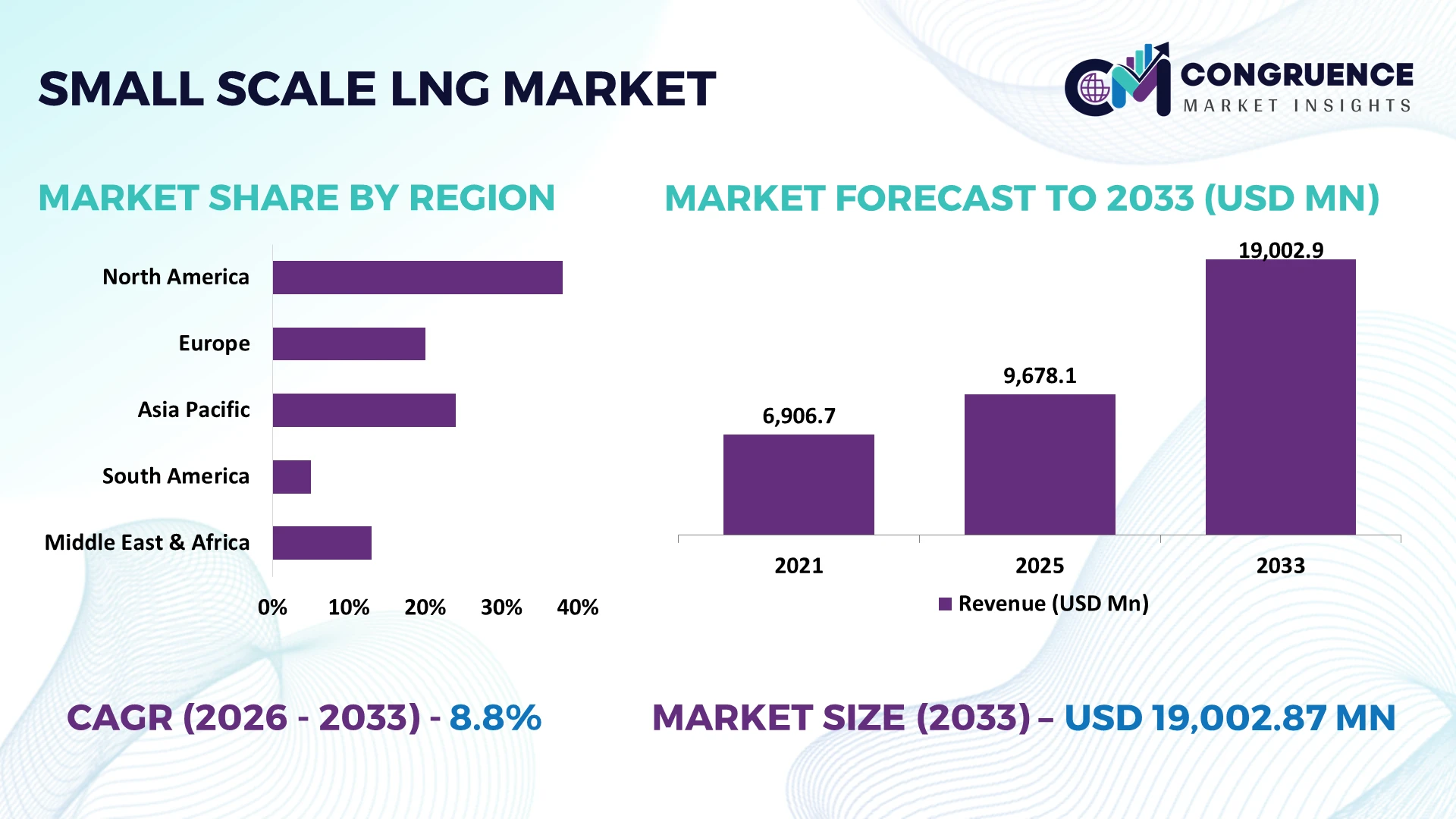
The Global Small Scale LNG Market was valued at USD 9678.05 Million in 2025 and is anticipated to reach a value of USD 19002.87 Million by 2033 expanding at a CAGR of 8.8% between 2026 and 2033. Expansion of modular liquefaction facilities, LNG bunkering infrastructure, and decentralized gas distribution networks is driving sustained deployment across marine transport, industrial operations, and off-grid power generation.
China accounts for approximately 33% of global small-scale LNG capacity, supported by over 25 MTPA handling capability, extensive LNG trucking corridors, and continued investment in industrial energy infrastructure. Compared with Japan's higher terminal automation and LNG distribution efficiency, China maintains broader infrastructure coverage. Post-Russia–Ukraine energy security initiatives have accelerated LNG storage expansion and diversified regional supply chains across Asia.
Strategic investment in modular LNG assets and resilient regional logistics networks will strengthen long-term competitiveness and supply security.
Market Size & Growth: USD 9,678.05 Million in 2025 to USD 19,002.87 Million by 2033 at 8.8% CAGR, driven by modular LNG infrastructure expansion.
Top Growth Drivers: LNG bunkering infrastructure +21%, industrial fuel switching +18%, decentralized energy deployment +16%.
Short-Term Forecast: By 2028, LNG distribution costs decline 12% while terminal operating efficiency improves 15%.
Emerging Technologies: AI-based asset monitoring, automated liquefaction, and advanced cryogenic storage improve operational efficiency by nearly 20%.
Regional Leaders: Asia-Pacific exceeds USD 8.4 Billion, Europe reaches USD 4.7 Billion, and North America approaches USD 3.9 Billion with expanding industrial adoption.
Consumer & End-User Trends: More than 60% of new demand comes from heavy-duty transport, marine bunkering, and industrial manufacturing.
Pilot/Case Example: A 2026 modular LNG terminal project improved loading efficiency by 18% through automated logistics management.
Competitive Landscape: Top five companies hold approximately 43% market share, led by Shell, TotalEnergies, Linde, Air Products, and Chart Industries.
Regulatory & ESG Impact: Low-carbon fuel initiatives reduce lifecycle emissions by nearly 20%, supporting wider LNG infrastructure deployment.
Investment & Funding: More than USD 6 Billion has been committed to liquefaction plants, bunkering terminals, and regional supply-chain expansion.
Innovation & Future Outlook: Predictive maintenance, digital LNG ecosystems, and modular plant designs increase asset utilization by approximately 17%.
Small Scale LNG Market demand continues to strengthen across marine transportation, industrial manufacturing, mining, and remote power generation. Modular liquefaction technologies, smart terminal automation, and advanced cryogenic storage systems are improving operational performance, while digital monitoring has increased infrastructure utilization by approximately 14%. Regional supply-chain diversification and stricter emissions regulations continue to reshape investment priorities, leading into the broader strategic market assessment.
Small Scale LNG Market is becoming strategically important as industries seek resilient fuel distribution models that reduce dependence on centralized pipeline infrastructure while supporting energy transition objectives. Infrastructure modernization, LNG bunkering expansion, and decentralized gas supply are reshaping competitive positioning across manufacturing, shipping, mining, and remote power generation. Following global supply-chain restructuring after the Russia–Ukraine conflict, buyers increasingly prioritize diversified LNG sourcing, shorter delivery cycles, and flexible storage networks to strengthen operational continuity.
Modern modular liquefaction systems consume nearly 18% less energy than conventional large-scale facilities while reducing installation timelines by approximately 30%, improving project economics for distributed applications. China continues to lead deployment through integrated LNG logistics and industrial fuel conversion, whereas Japan emphasizes automation, digital terminal management, and high-efficiency cryogenic technologies. Over the next two to three years, automated monitoring platforms are expected to exceed 45% deployment across newly commissioned small-scale LNG facilities, improving asset utilization and predictive maintenance capabilities.
A growing number of industrial operators are deploying modular LNG hubs integrated with digital fleet scheduling to optimize fuel distribution and lower operational downtime. Companies are expanding strategic partnerships, investing in localized storage assets, and strengthening logistics networks to secure long-term supply flexibility. Organizations capable of combining infrastructure scalability with digital operational efficiency will establish stronger competitive differentiation in the evolving Small Scale LNG Market.
Industrial fuel diversification and decentralized energy deployment continue to accelerate adoption of small-scale LNG solutions across manufacturing, mining, marine transport, and remote power generation. LNG bunkering infrastructure has expanded by approximately 21%, while industrial fuel switching has increased nearly 18% as operators seek cleaner alternatives to diesel and fuel oil. China continues expanding LNG trucking corridors and satellite terminals to strengthen industrial energy security. These developments reduce transportation constraints, improve fuel availability, and increase operational flexibility. Leading companies are responding through modular liquefaction investments, strategic infrastructure partnerships, and expansion of localized LNG distribution networks, enabling faster project deployment while strengthening long-term competitive positioning.
High capital requirements for cryogenic storage, specialized transport fleets, and regasification infrastructure continue to limit wider deployment despite improving technology economics. Logistics costs still represent nearly 25% of delivered LNG expenses in remote markets, while terminal utilization varies by more than 20% depending on regional demand concentration. Import-dependent countries remain exposed to shipping disruptions and LNG price volatility, creating operational uncertainty for industrial users. Companies are addressing these constraints through localized storage investments, long-term supply agreements, diversified sourcing strategies, and integrated logistics planning that improve procurement stability while reducing dependence on single supply corridors.
Digitalization is creating new opportunities beyond conventional LNG distribution by improving operational intelligence and asset optimization. AI-enabled monitoring has increased predictive maintenance efficiency by approximately 20%, while automated terminal scheduling reduces loading delays by nearly 15%. India and Southeast Asian industrial corridors present attractive opportunities as governments continue expanding cleaner industrial fuel infrastructure. Companies are investing in smart cryogenic storage, digital logistics platforms, and modular LNG ecosystems that connect production, storage, and transportation assets. Early adopters gain stronger asset utilization, improved fleet productivity, and greater flexibility in serving underserved industrial clusters with lower distribution costs.
Long-term competitiveness depends on integrating liquefaction, storage, transportation, and digital control systems into reliable operating networks. Commissioning timelines for distributed LNG facilities remain approximately 20% longer where specialized engineering capabilities and cryogenic workforce availability are limited. Japan and South Korea continue advancing automation, while several emerging industrial markets face delays in skilled workforce development and digital infrastructure readiness. Companies must strengthen engineering partnerships, expand workforce training, standardize digital operating platforms, and invest in interoperable infrastructure to ensure consistent operational performance, scalable deployment, and sustainable competitive advantage across increasingly complex LNG value chains.
Modular Terminal Expansion Modular LNG terminals are replacing conventional large facilities as deployment timelines decline by nearly 30% and engineering costs reduce by approximately 15%. China continues expanding distributed LNG hubs to improve industrial fuel accessibility following supply-chain restructuring. Companies are accelerating modular construction, regional partnerships, and standardized engineering designs to improve commissioning speed while increasing network flexibility across manufacturing and remote energy operations.
Digital Asset Optimization AI-driven monitoring platforms and predictive maintenance systems have increased equipment availability by around 18% while reducing unplanned downtime by nearly 20%. Japan is accelerating digital terminal management to address skilled labor constraints and improve operating consistency. Operators are integrating automation with centralized control platforms, enabling faster maintenance scheduling, improved fleet coordination, and lower lifecycle operating costs across LNG distribution assets.
Marine Fuel Integration LNG bunkering activity has expanded by approximately 22% as stricter maritime emissions regulations continue influencing fleet modernization. Vessel turnaround efficiency has improved by nearly 14% through automated loading processes and optimized scheduling. Shipping companies are expanding bunkering partnerships, investing in dedicated storage facilities, and strengthening port infrastructure to improve fuel availability and operational reliability for commercial fleets.
Localized Distribution Networks Satellite LNG stations are expanding by nearly 17% to strengthen energy access for industrial clusters located beyond pipeline networks. India is prioritizing localized LNG logistics to improve supply resilience and reduce transport dependency. Companies are restructuring distribution models, deploying smart logistics platforms, and expanding regional storage capacity to shorten delivery cycles while improving service continuity for industrial customers.
Liquefaction Terminals remain the leading segment, accounting for approximately 39% of total deployment due to their critical role in converting natural gas into transportable LNG and supporting distributed energy networks. Their scalability, integration with satellite distribution systems, and lower logistics dependency continue driving investment. LNG Carriers represent the fastest-growing segment as marine fuel adoption and flexible cross-border LNG distribution expand. Fleet modernization has increased by nearly 18%, encouraging companies to invest in higher-capacity vessels and digital fleet management. Regasification Terminals remain essential for industrial users requiring localized gas delivery, while Satellite Stations continue strengthening last-mile LNG accessibility in remote industrial zones.
Investment priorities are shifting toward integrated liquefaction and transportation ecosystems rather than standalone assets. Companies are expanding modular liquefaction capacity, strengthening equipment partnerships, and developing standardized terminal solutions to improve deployment efficiency. Satellite Stations are gaining momentum in mining and manufacturing corridors where pipeline infrastructure remains limited, while Regasification Terminals increasingly incorporate automation to improve operational flexibility and reduce maintenance requirements.
Industrial Fuel remains the dominant application with approximately 36% of market demand as manufacturers replace conventional liquid fuels with cleaner LNG solutions to improve energy efficiency and emissions performance. Marine Fuel is the fastest-growing application, supported by stricter shipping regulations and expanding LNG bunkering infrastructure. LNG-powered vessel adoption has increased by nearly 20%, while bunkering activity has grown approximately 22%. Power Generation remains a stable application for decentralized electricity supply, whereas Transportation continues expanding among heavy-duty commercial fleets. Remote Energy Supply is strengthening its position in isolated mining and industrial operations requiring reliable off-grid fuel access.
Companies are expanding LNG supply agreements, investing in dedicated fueling infrastructure, and integrating digital fuel management systems across industrial facilities. Deployment strategies increasingly prioritize industrial clusters and logistics corridors where demand concentration supports higher asset utilization and stronger operational returns.
Industrial Manufacturers represent the largest end-user group with approximately 34% of total demand because of continuous energy consumption, fuel flexibility requirements, and large-scale production operations. The Marine Industry is the fastest-growing end-user segment as LNG-powered vessels expand under tighter maritime emissions standards. LNG adoption among commercial shipping operators has increased by nearly 19%, while digital fuel management deployment has improved fleet efficiency by approximately 15%. Power Utilities continue utilizing small-scale LNG for peak-load balancing, Oil & Gas companies strengthen localized gas commercialization, and Mining operators increasingly depend on LNG for remote energy security.
Competitive strategies are shifting toward customized LNG supply contracts, integrated storage solutions, and long-term infrastructure partnerships. Companies are strengthening ecosystem collaborations with terminal operators, logistics providers, and equipment manufacturers while developing industry-specific LNG solutions that improve operational reliability and customer retention across multiple end-user categories.
Asia-Pacific accounted for the largest market share at 42% in 2025 however, Middle East & Africa is expected to register the fastest growth, expanding at a 10.4% CAGR between 2026 and 2033.
Advanced LNG Logistics Strengthen Industrial Supply
North America represents a mature Small Scale LNG Market supported by abundant natural gas production, established liquefaction infrastructure, and expanding LNG trucking networks. The region contributes approximately 24% of global deployment, driven by industrial fuel substitution, marine bunkering, and remote power applications. Continued modernization of satellite LNG facilities and digital logistics platforms has improved fleet utilization by nearly 16%, while modular liquefaction investments continue supporting decentralized gas distribution. Enterprise partnerships between LNG producers, transport operators, and industrial consumers are strengthening regional supply resilience. Growing adoption of automated terminal operations and predictive maintenance technologies is improving asset performance while reducing operational downtime across critical LNG infrastructure.
United States Market Outlook: The United States remains the regional leader due to extensive shale gas production, established LNG export infrastructure, and strong industrial demand. More than 70% of North America's small-scale LNG deployment is concentrated in the country, supported by expanding LNG trucking corridors, marine bunkering facilities, and distributed liquefaction projects. Companies continue investing in modular infrastructure and digital logistics solutions to improve operational flexibility and strengthen domestic fuel distribution.
Infrastructure Modernization Drives Marine Transition
Europe continues strengthening its Small Scale LNG Market through maritime decarbonization initiatives, diversified gas supply strategies, and modern LNG bunkering infrastructure. The region accounts for nearly 23% of global market activity, with commercial shipping and industrial manufacturing remaining key demand centers. LNG bunkering capacity has expanded by approximately 18% through coordinated port infrastructure upgrades, while digital terminal management improves operational efficiency across distribution networks. Enterprise collaborations between terminal operators, shipping companies, and industrial users continue accelerating infrastructure modernization. Increasing investment in flexible regasification and satellite LNG facilities supports reliable fuel access while improving energy security across industrial corridors.
Norway Market Outlook: Norway leads European deployment through its well-established LNG bunkering ecosystem, advanced maritime infrastructure, and early adoption of LNG-powered vessels. More than 60% of the country's domestic LNG consumption supports marine applications, encouraging continuous investment in storage facilities, automated bunkering systems, and integrated port logistics that reinforce operational leadership across the European maritime sector.
Large-Scale Industrial Deployment Leadership
Asia-Pacific maintains the largest share of the Small Scale LNG Market owing to rapid industrialization, extensive LNG infrastructure, and widespread adoption across manufacturing, mining, and transportation. The region contributes approximately 42% of global market demand, supported by expanding LNG trucking networks and modular liquefaction capacity. Industrial LNG distribution has increased by nearly 20% as governments prioritize cleaner industrial fuels and energy diversification. Companies continue strengthening integrated supply chains through strategic terminal investments, localized storage expansion, and digital fleet optimization to improve delivery efficiency and infrastructure utilization across major industrial clusters.
China Market Outlook: China remains the regional growth engine through extensive LNG trucking corridors, widespread satellite station deployment, and large-scale industrial fuel conversion programs. The country accounts for roughly one-third of global small-scale LNG capacity while continuously expanding modular liquefaction facilities and digital logistics platforms. Enterprise investment remains focused on strengthening regional distribution efficiency and industrial energy security.
Industrial Diversification Supports Adoption
South America's Small Scale LNG Market continues expanding as industrial users seek reliable alternatives to conventional liquid fuels in areas with limited pipeline access. The region contributes approximately 6% of global deployment, with mining, manufacturing, and distributed power generation supporting demand. LNG logistics efficiency has improved by nearly 13% through localized storage development and infrastructure partnerships. Although transportation networks remain uneven across several countries, continued investment in modular LNG facilities and integrated distribution systems is improving fuel accessibility. Companies increasingly collaborate with logistics providers and industrial operators to strengthen supply continuity while lowering distribution complexity.
Brazil Market Outlook: Brazil leads regional activity through expanding industrial gas consumption, growing LNG import capability, and increasing investment in distributed energy infrastructure. Industrial clusters and mining operations continue driving LNG deployment, while modular regasification facilities improve supply flexibility. Enterprise partnerships focused on localized infrastructure development are strengthening long-term market competitiveness across the country.
Strategic LNG Infrastructure Transformation
The Middle East & Africa Small Scale LNG Market is advancing through infrastructure diversification, industrial expansion, and localized energy distribution strategies. The region contributes approximately 5% of global deployment while demonstrating the strongest operational momentum. Investments in modular liquefaction facilities and satellite LNG networks have increased by nearly 19%, improving energy access for industrial and remote applications. Governments are supporting cleaner fuel deployment alongside infrastructure modernization, encouraging partnerships between LNG producers, logistics providers, and industrial enterprises. Companies continue prioritizing scalable storage assets and flexible distribution models that strengthen long-term operational resilience.
Saudi Arabia Market Outlook: Saudi Arabia is accelerating investment in localized gas infrastructure to support industrial diversification and cleaner energy deployment. LNG distribution projects increasingly complement national industrial expansion initiatives, while integrated logistics investments improve fuel accessibility across manufacturing and remote operations. Continued modernization of gas infrastructure positions the country as a strategic growth center for future small-scale LNG deployment.
Global energy majors including Shell, TotalEnergies, Linde, Air Products, and Chart Industries compete against regional LNG infrastructure developers and specialized engineering providers for industrial, marine, and distributed energy projects. The top five players collectively control approximately 43% of market activity through integrated infrastructure, engineering expertise, and established LNG logistics networks. Competition centers on technology performance, project execution speed, and supply-chain integration, with automated liquefaction reducing operating costs by nearly 18% and digital asset management improving infrastructure utilization by approximately 17%. Companies increasingly pursue terminal expansion, strategic partnerships, modular infrastructure deployment, and vertical integration to secure long-term LNG supply and customer relationships. Market competition is shifting toward digitally managed LNG ecosystems capable of delivering flexible regional distribution rather than standalone assets. High capital requirements, specialized cryogenic engineering expertise, and infrastructure integration remain significant entry barriers. Success increasingly depends on scalable infrastructure, reliable supply security, digital operational excellence, and strong industrial partnerships.
Shell plc
TotalEnergies SE
Linde plc
Air Products and Chemicals, Inc.
Chart Industries, Inc.
Wärtsilä Corporation
Baker Hughes Company
Honeywell International Inc.
Excelerate Energy, Inc.
New Fortress Energy Inc.
Cryostar SAS
Nikkiso Co., Ltd.
INOX India Limited
CIMC Enric Holdings Limited
Digitalization is transforming small-scale LNG operations through AI-enabled asset monitoring, automated liquefaction controls, and advanced cryogenic storage systems. AI-based predictive maintenance reduces unplanned equipment downtime by approximately 20%, while automated process controls improve liquefaction efficiency by nearly 16%. Around 42% of newly commissioned facilities now integrate digital monitoring platforms, enabling real-time asset diagnostics, optimized fuel scheduling, and lower operating costs. These technologies strengthen supply reliability while improving terminal productivity for industrial users and LNG logistics operators.
Modular liquefaction technology continues replacing conventional centralized processing for distributed applications. Compared with legacy fixed plants, modular systems reduce project commissioning time by nearly 30% and lower engineering requirements by approximately 18% while providing greater deployment flexibility. Smart cryogenic tanks equipped with IoT sensors improve storage performance by around 14% through continuous pressure and temperature optimization. Global energy companies and engineering specialists benefit most from these technologies because they accelerate infrastructure deployment and improve asset utilization across geographically dispersed LNG networks.
Between 2026 and 2028, digital LNG ecosystems integrating predictive analytics, autonomous terminal operations, and cloud-based logistics platforms are expected to exceed 50% deployment across new projects. Companies investing early in intelligent infrastructure, cybersecurity, and interoperable digital systems will strengthen operational resilience, improve fuel distribution efficiency, and establish stronger competitive positioning as decentralized LNG networks continue expanding.
February 2024 Shell expanded its LNG bunkering network by introducing a new LNG bunker vessel supporting marine customers in the Middle East, increasing bunkering flexibility and strengthening regional low-emission shipping operations. Source: shell.com
September 2024 TotalEnergies signed a strategic LNG supply agreement supporting industrial decarbonization and energy security, adding approximately 400,000 tonnes of annual LNG supply capacity while strengthening long-term commercial partnerships. Source: totalenergies.com
May 2025 Chart Industries secured new LNG equipment contracts for modular liquefaction infrastructure, supporting higher production efficiency and accelerating deployment timelines through advanced cryogenic technology integration. Source: chartindustries.com
March 2026 New Fortress Energy expanded small-scale LNG distribution infrastructure through additional terminal capacity supporting industrial and transport customers, improving regional fuel availability and strengthening decentralized LNG logistics. Source: newfortressenergy.com
This report provides comprehensive analysis of the Small Scale LNG Market across Liquefaction Terminals, Regasification Terminals, LNG Carriers, and Satellite Stations while evaluating demand across Power Generation, Marine Fuel, Industrial Fuel, Transportation, and Remote Energy Supply. It further assesses adoption among Power Utilities, Oil & Gas, Marine Industry, Industrial Manufacturers, and Mining companies across North America, Europe, Asia-Pacific, South America, and the Middle East & Africa. More than 40% of market deployment remains concentrated within integrated industrial and transportation applications, highlighting evolving infrastructure priorities.
The report evaluates technology adoption, modular LNG infrastructure, digital terminal automation, AI-enabled monitoring, and cryogenic storage innovations alongside competitive positioning and regional deployment patterns. It delivers strategic insights supporting expansion planning, investment prioritization, supply-chain optimization, partnership evaluation, and infrastructure development while identifying emerging industrial clusters, decentralized energy applications, and operational opportunities expected to influence market direction between 2026 and 2033.
| Report Attribute/Metric | Report Details |
|---|---|
Market Revenue in 2025 | USD 9678.05 Million |
Market Revenue in 2033 | USD 19002.87 Million |
CAGR (2026 - 2033) | 8.8% |
Base Year | 2025 |
Forecast Period | 2026 - 2033 |
Historic Period | 2021 - 2025 |
Segments Covered | By Type
By Application
By End-User
|
Key Report Deliverable | Revenue Forecast, Growth Trends, Market Dynamics, Segmental Overview, Regional and Country-wise Analysis, Competition Landscape |
Region Covered | North America, Europe, Asia-Pacific, South America, Middle East, Africa |
Key Players Analyzed |
|
Customization & Pricing | Available on Request (10% Customization is Free) |




