
Reports
The Global Small Hole Edm Drilling Machine Market was valued at USD 335.2 Million in 2025 and is anticipated to reach a value of USD 546.5 Million by 2033 expanding at a CAGR of 6.3% between 2026 and 2033. Rising aerospace turbine production, precision mold manufacturing, and high-performance machining of difficult-to-cut alloys are accelerating adoption of advanced small hole EDM drilling machines.
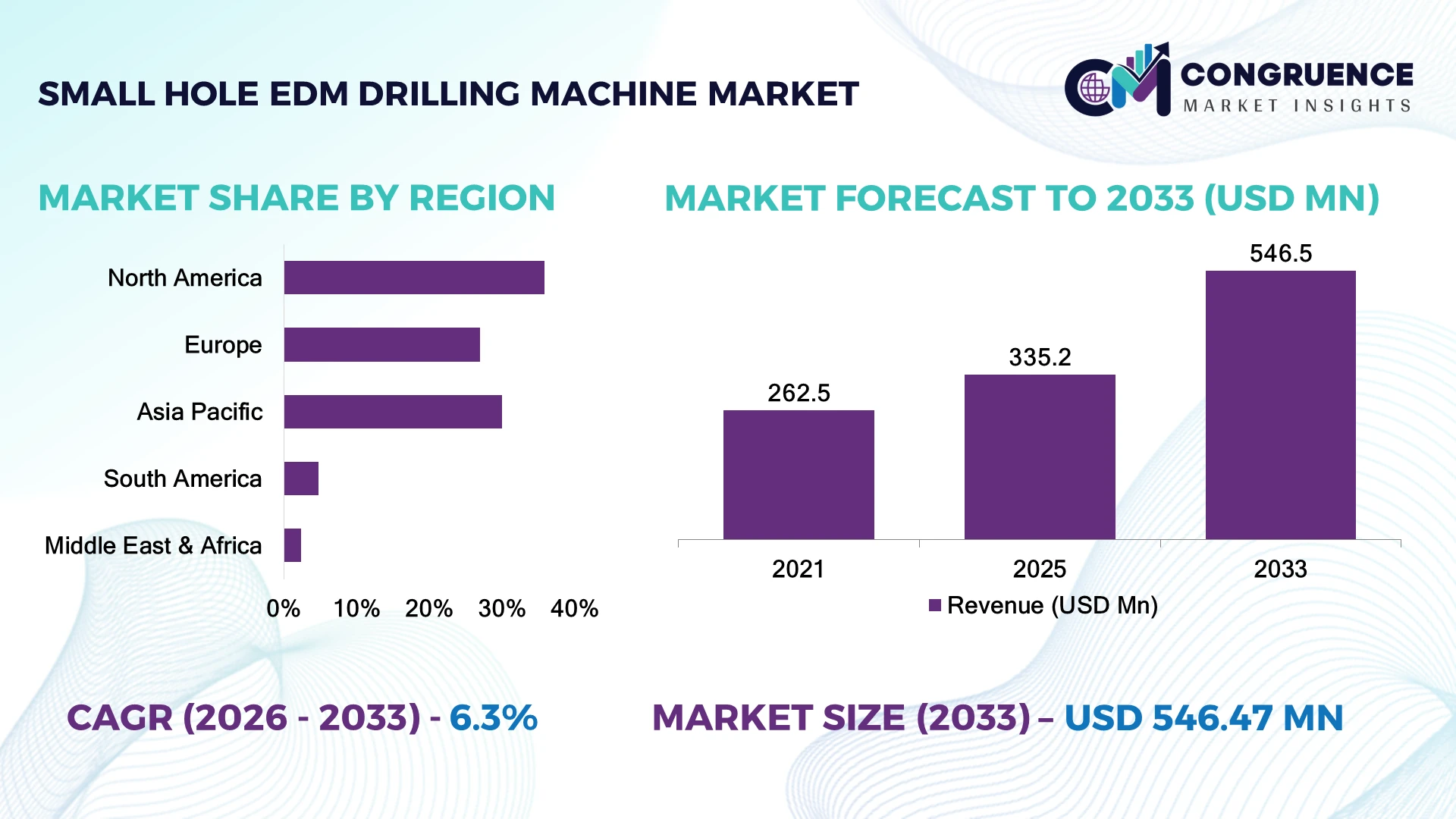
Japan remains the dominant country, contributing approximately 31% of global precision EDM machine production, supported by strong investments in aerospace, automotive, and high-precision tooling industries. More than 68% of domestic EDM systems incorporate CNC automation and digital monitoring, compared with approximately 46% in India, where manufacturing capacity is expanding rapidly. Amid continued supply-chain diversification following Asia-Pacific manufacturing realignment, Japanese manufacturers continue strengthening export-oriented production and technology leadership.
Manufacturers investing in intelligent automation, micron-level accuracy, and multi-axis machining capabilities are best positioned to secure long-term competitive advantage.
Market Size & Growth: USD 335.2 Million in 2025, reaching USD 546.5 Million by 2033 at 6.3% CAGR, driven by aerospace precision machining demand.
Top Growth Drivers: Aerospace +29%, medical device manufacturing +24%, precision tooling +21% accelerate equipment demand.
Short-Term Forecast: By 2028, drilling cycle time declines 18% through CNC optimization and adaptive process control.
Emerging Technologies: AI monitoring, IoT diagnostics, and multi-axis automation improve machining accuracy by nearly 22%.
Regional Leaders: Asia-Pacific leads, Europe follows, North America expands through aerospace modernization and localized production.
Consumer/End-User Trends: Nearly 63% of precision manufacturers prioritize automated EDM systems for higher throughput.
Pilot/Case Example: 2026 smart-factory integration reduced setup time by approximately 20% while improving repeatability.
Competitive Landscape: Leading manufacturers collectively command nearly 58% share through technology and service capabilities.
Regulatory & ESG Impact: Dielectric recycling lowers fluid consumption by nearly 17% across advanced manufacturing facilities.
Investment & Funding: Industrial automation investments exceed USD 900 Million across precision machining expansion projects.
Innovation & Future Outlook: Digital twins and predictive maintenance strengthen next-generation machining productivity.
The Small Hole EDM Drilling Machine Market continues benefiting from increasing demand across aerospace, semiconductor tooling, medical implants, and precision mold manufacturing. Intelligent CNC controls, automated electrode changers, and real-time process monitoring improve machining consistency by nearly 23%. Growing localization of precision manufacturing following global supply-chain diversification is encouraging manufacturers to invest in flexible, digitally connected machining platforms, setting the stage for broader strategic market evolution.
Precision manufacturing requirements are redefining the strategic importance of the small hole EDM drilling machine market across aerospace, automotive, electronics, and medical device production. Manufacturers increasingly require micron-level drilling accuracy for advanced alloys and miniature components that conventional machining cannot consistently achieve. Industrial digitalization and factory modernization are encouraging wider deployment of intelligent EDM systems integrated with automated production cells and centralized manufacturing execution platforms.
Modern CNC-controlled EDM drilling machines improve drilling accuracy by approximately 24% while reducing electrode wear by nearly 18% compared with conventional standalone systems. Japan and Germany continue emphasizing high-end precision engineering and automation, whereas China and India are expanding production capacity through large-scale industrial investments. More than 57% of newly installed precision machining centers now incorporate network-enabled monitoring, predictive diagnostics, or automated process optimization to improve operational consistency.
Manufacturers are expanding partnerships with automation providers, software developers, and precision tooling suppliers to deliver integrated machining solutions. For example, aerospace component manufacturers increasingly deploy automated EDM drilling lines capable of uninterrupted production for turbine cooling holes and precision fuel system components. Companies prioritizing digital manufacturing integration, flexible automation, and high-accuracy machining platforms will strengthen competitive positioning as precision engineering standards continue advancing across global industrial sectors.
Demand for precision cooling holes in turbine blades, fuel injectors, and high-performance aerospace components is accelerating adoption of advanced small hole EDM drilling machines. Approximately 64% of aerospace manufacturers now prioritize non-contact precision drilling for nickel-based superalloys, while automated EDM platforms improve machining accuracy by nearly 21% and reduce electrode replacement frequency by approximately 17%. India's expanding aerospace manufacturing ecosystem and production-linked industrial initiatives are strengthening domestic investment in precision machining capacity. This shift enables manufacturers to meet tighter tolerance requirements while increasing production efficiency. Equipment suppliers are responding through multi-axis CNC innovation, automation partnerships, digital process monitoring, and localized service networks, creating integrated machining solutions that improve productivity and shorten production lead times.
Operational costs remain constrained by dependence on premium electrodes, dielectric fluids, precision guide systems, and skilled maintenance personnel. Consumables account for nearly 24% of annual operating expenditure, while maintenance requirements increase lifecycle costs by approximately 16% for high-utilization facilities. Taiwan's precision component supply chain continues influencing global availability of critical EDM consumables, creating procurement uncertainty during periods of manufacturing disruption. These factors reduce profitability for smaller machining companies and delay modernization projects. Manufacturers are mitigating risks through localized consumable sourcing, longer-term supplier agreements, recyclable dielectric systems, and optimized electrode management software that improves utilization while lowering recurring operating expenses.
Industry 4.0 integration presents substantial opportunities as manufacturers seek autonomous precision machining with higher productivity and lower operating costs. Nearly 59% of newly installed EDM drilling systems now include IoT-enabled monitoring or predictive maintenance capabilities, while AI-assisted parameter optimization improves machining efficiency by approximately 22%. South Korea continues expanding smart manufacturing initiatives that encourage digital machine tool adoption across precision engineering industries. Equipment manufacturers are investing in adaptive control algorithms, robotic workpiece handling, and cloud-connected production analytics to deliver flexible machining cells. A significant strategic opportunity lies in integrating digital twins that simulate drilling performance before production, minimizing setup errors and accelerating new product introduction.
Achieving consistent micron-level drilling performance requires experienced programmers, process engineers, and machine operators capable of optimizing machining parameters across complex materials. Approximately 47% of precision manufacturers report shortages of advanced EDM specialists, while integrating automated drilling cells into legacy production environments extends commissioning timelines by nearly 19%. Germany's advanced manufacturing sector continues emphasizing digital machine interoperability, increasing expectations for standardized industrial communication. These execution challenges affect production scalability, process consistency, and equipment utilization. Machine builders must expand operator training, strengthen software interoperability, invest in intuitive programming interfaces, and collaborate with automation partners to support sustainable deployment across diverse manufacturing environments.
Smart CNC Integration Expands Intelligent CNC controllers with adaptive machining algorithms are being deployed across precision machining facilities, improving drilling accuracy by approximately 24% while reducing setup time by nearly 18%. Japan's smart factory modernization initiatives are encouraging manufacturers to integrate machine analytics, automated parameter optimization, and centralized production monitoring to improve throughput and reduce operator intervention.
Automation Reshapes Production Cells Robotic workpiece loading and automated electrode changers are becoming standard in high-volume aerospace and tooling facilities. Automated machining cells increase equipment utilization by approximately 27% and reduce manual handling by nearly 35%. Manufacturers are expanding turnkey automation partnerships to improve production consistency while addressing skilled labor shortages affecting precision manufacturing.
Advanced Materials Drive Innovation Growing use of titanium, Inconel, and hardened alloys is increasing demand for high-performance EDM drilling platforms. Optimized pulse control improves machining stability by nearly 20%, while electrode consumption declines by approximately 15%. Equipment suppliers continue developing specialized machining strategies and advanced dielectric management systems for next-generation aerospace and medical applications.
Predictive Maintenance Adoption Digital monitoring platforms are transforming machine lifecycle management through real-time equipment diagnostics and predictive maintenance. Unexpected machine downtime has declined by approximately 21%, while maintenance planning efficiency has improved by nearly 19%. Manufacturers are integrating cloud-based service platforms and remote diagnostics to strengthen aftermarket support, improve asset utilization, and extend equipment operating life.
CNC small hole EDM drilling machines accounted for approximately 72% of the market in 2025, maintaining leadership through superior precision, automated process control, and seamless integration with digital manufacturing environments. These systems reduce machining cycle time by nearly 24% while improving positioning accuracy by approximately 30% compared with conventional platforms, making them the preferred choice across aerospace, medical device, and precision tooling production. Manufacturers continue investing in AI-assisted programming, automated electrode changers, and remote diagnostics to strengthen productivity and minimize operator intervention.
Conventional small hole EDM drilling machines remain strategically relevant for job shops, repair centers, and low-volume manufacturing because of their lower acquisition cost and operational simplicity. However, CNC machines represent the fastest-growing segment as factories increasingly modernize production lines for complex alloys and miniature precision components. Nearly 66% of newly installed EDM drilling systems now incorporate CNC control, prompting equipment suppliers to expand modular product portfolios, strengthen software partnerships, and develop intelligent automation features that improve scalability while reducing long-term operating costs.
According to findings published by the Japan Machine Tool Builders' Association (JMTBA) during 2025, demand for CNC-enabled precision machining equipment continues increasing as manufacturers prioritize digitally connected, automated production systems for high-value industrial applications.
Aerospace accounted for approximately 38% of the market in 2025, making it the leading application due to strict precision requirements for turbine blades, combustion chambers, fuel injectors, and engine cooling holes. Small hole EDM drilling machines consistently achieve micron-level accuracy in difficult-to-machine superalloys while improving machining consistency by approximately 23%. Equipment manufacturers continue introducing adaptive pulse control, robotic loading systems, and intelligent process monitoring to support expanding aircraft production and higher quality standards.
Medical device manufacturing represents the fastest-growing application as precision drilling demand increases for implants, surgical instruments, and minimally invasive medical components. Automotive, mold and die manufacturing, electronics, and general precision engineering continue generating stable equipment demand through expanding production of hardened materials and miniature parts. Approximately 31% of recent machine development programs target multi-industry flexibility, enabling manufacturers to broaden customer reach while improving machine utilization across diverse precision manufacturing applications.
Industry assessments released by the European Association of the Machine Tool Industries (CECIMO) during 2025 indicate that aerospace and medical precision machining remain among the fastest adopters of advanced EDM technologies for high-accuracy manufacturing applications.
Large manufacturing enterprises held approximately 61% of the market in 2025, supported by extensive production volumes, advanced automation infrastructure, and continuous investment in high-precision machining technologies. These organizations require consistent drilling accuracy for aerospace, automotive, semiconductor, and medical manufacturing while integrating EDM systems into fully digital production environments. Automated machining deployment improves equipment utilization by nearly 26%, encouraging suppliers to deliver customized software, predictive maintenance services, and integrated automation packages that strengthen long-term customer relationships.
Small and medium-sized enterprises represent the fastest-growing end-user segment as compact CNC systems become more affordable and flexible. Adoption among SMEs has increased by approximately 19%, driven by expanding subcontract manufacturing and precision tooling demand. Manufacturers are responding with modular machine platforms, financing programs, localized technical support, and simplified programming interfaces, allowing smaller workshops to compete effectively in high-value precision manufacturing while improving operational efficiency and production scalability.
A 2025 manufacturing technology survey conducted by SME (Society of Manufacturing Engineers) reported continued growth in investment by small and mid-sized precision manufacturers, with automation and CNC machining remaining among the highest capital spending priorities for improving productivity and machining accuracy.
North America accounted for the largest market share at 35.8% in 2025 however, Asia-Pacific is expected to register the fastest growth, expanding at a CAGR of 7.4% between 2026 and 2033.
Advanced Aerospace Manufacturing Drives Precision Machining Demand
North America remains the leading regional market due to its concentration of aerospace, defense, medical device, and precision engineering industries requiring high-accuracy hole drilling in advanced alloys. The region contributes nearly 36% of global demand, supported by widespread deployment of CNC-controlled EDM systems across OEMs and Tier-1 suppliers. More than 68% of newly installed precision drilling equipment incorporates automation and digital monitoring capabilities, improving machining consistency and reducing setup time by approximately 22%. Continued investment in reshoring high-value manufacturing and modernization of aerospace production facilities is encouraging machine builders to expand local service networks, application engineering capabilities, and automation partnerships to improve operational efficiency and customer responsiveness.
United States Market Outlook: The United States dominates regional demand through its extensive aerospace manufacturing base, defense procurement programs, and medical device production ecosystem. Aerospace manufacturers increasingly require micron-level precision for turbine components and fuel injection systems, while approximately 71% of advanced machining investments are directed toward digitally integrated CNC platforms. Equipment suppliers continue strengthening domestic application centers, aftermarket services, and automation integration to support expanding demand for complex precision manufacturing.
Industrial Modernization Reinforces High-Precision Production
Europe maintains a strong market position through advanced automotive engineering, aerospace production, and industrial automation initiatives. The region accounts for nearly 27% of global demand, supported by precision manufacturing clusters and continuous investment in smart factory modernization. Around 63% of new EDM equipment installations feature automated programming and real-time process monitoring, improving machining repeatability and reducing production downtime. Manufacturers increasingly prioritize energy-efficient machine platforms, digital quality assurance, and integrated production management systems to strengthen competitiveness across high-value industrial applications.
Germany Market Outlook: Germany leads the European market through its globally recognized machine tool industry and precision engineering expertise. Automotive suppliers, aerospace manufacturers, and industrial equipment producers continue expanding investments in CNC-controlled EDM technologies capable of machining hardened materials with superior accuracy. Approximately 42% of Germany's precision machining capacity serves export-oriented industries, encouraging equipment manufacturers to develop intelligent automation features and advanced process optimization solutions.
Manufacturing Scale Accelerates Precision Equipment Deployment
Asia-Pacific represents the fastest-growing regional market as expanding aerospace production, electronics manufacturing, automotive components, and industrial machinery investments strengthen precision machining demand. The region accounts for approximately 30% of global consumption while contributing a significant share of global machine tool production. Nearly 58% of newly commissioned precision manufacturing facilities integrate CNC EDM drilling systems to improve productivity and machining consistency. Industrial expansion, localization of advanced manufacturing, and continuous investment in factory automation continue strengthening regional equipment demand.
China Market Outlook: China remains the region's largest market through its extensive manufacturing ecosystem, expanding aerospace sector, and precision mold production industry. More than 46% of regional machine tool manufacturing capacity is concentrated in China, supported by industrial modernization and domestic equipment innovation. Local manufacturers continue enhancing CNC functionality, intelligent control systems, and production automation while strengthening export competitiveness across global precision machining markets.
Industrial Diversification Expands Precision Machining Requirements
South America is witnessing steady adoption of small hole EDM drilling machines as aerospace maintenance, automotive manufacturing, mining equipment production, and industrial component fabrication gradually modernize machining capabilities. The region contributes approximately 4.8% of global market demand, supported by selective investment in advanced production technologies. Precision machining capacity has improved by nearly 17% across leading industrial facilities as manufacturers upgrade legacy equipment to meet higher quality standards. However, import dependence and limited domestic machine manufacturing continue affecting deployment speed and procurement costs.
Brazil Market Outlook: Brazil leads regional demand through its diversified industrial base, aerospace manufacturing presence, and automotive production network. Precision machining investments continue expanding around aerospace clusters and industrial manufacturing hubs, where CNC equipment adoption has increased by approximately 21% during recent modernization programs. Equipment suppliers are strengthening technical service infrastructure, operator training, and localized maintenance capabilities to improve long-term machine utilization and customer support.
Industrial Investment Supports Precision Manufacturing Expansion
The Middle East & Africa market continues developing through industrial diversification, aerospace maintenance activities, energy equipment manufacturing, and advanced engineering investments. The region represents approximately 2.4% of global demand while increasing deployment of digitally controlled precision machining systems. Around 19% of recently commissioned advanced manufacturing projects include precision EDM capabilities for specialized industrial applications. Government-backed industrial development initiatives and technology partnerships are encouraging manufacturers to modernize machining infrastructure while strengthening localized production capacity.
United Arab Emirates Market Outlook: The United Arab Emirates leads regional adoption through investments in aerospace maintenance, precision engineering, and advanced industrial manufacturing. Industrial free zones continue attracting international precision machining companies, while advanced manufacturing initiatives have increased deployment of CNC machining technologies by nearly 18% across strategic industrial facilities. Companies are expanding technology partnerships, engineering support services, and specialized machining capabilities to strengthen regional competitiveness in high-value manufacturing.
The market is led by Sodick, Makino, Mitsubishi Electric, GF Machining Solutions, and Current EDM, with the top five players collectively controlling approximately 64% of global market share. Japanese precision manufacturers compete against European automation specialists through machining accuracy, linear motor technology, and unattended production capability, while regional suppliers challenge on pricing and localized service. Competition increasingly centers on reducing drilling cycle time by 20–28%, improving positioning accuracy by nearly 30%, and extending automatic machining duration above 150 continuous hours. Companies strengthen positions through application centers, aerospace partnerships, software integration, and vertical expansion into consumables and lifecycle services. The competitive shift favors intelligent CNC platforms with automation-ready architectures over conventional standalone machines. High capital investment, precision engineering expertise, and extensive global service infrastructure remain significant entry barriers. Success depends on combining superior machining performance, automation, responsive technical support, and application-specific engineering that consistently delivers productivity advantages over established industry leaders.
Sodick Co., Ltd.
Makino Milling Machine Co., Ltd.
Mitsubishi Electric Corporation
GF Machining Solutions
Current EDM Inc.
Beaumont Machine Inc.
AccuteX Technologies Co., Ltd.
Chmer EDM
ONA Electroerosión S.A.
Kent Industrial USA, Inc.
Joemars Machinery & Electric Industrial Co., Ltd.
Excetek Technologies Co., Ltd.
Linear motor drives, adaptive CNC controls, and intelligent pulse generators are redefining small hole EDM drilling performance. Around 68% of newly installed premium machines incorporate linear motor technology, improving positioning accuracy by approximately 30% while reducing machining vibration by nearly 18%. AI-assisted parameter optimization shortens programming time by about 22%, enabling faster setup across aerospace, medical, and precision tooling applications. Digital connectivity through Industrial IoT platforms supports predictive maintenance, improving equipment availability by approximately 15% for high-utilization production facilities.
Compared with conventional servo-driven systems, modern linear motor EDM platforms deliver nearly 25% faster drilling speeds and approximately 20% lower electrode wear while maintaining superior hole quality. Around 57% of aerospace-focused installations now integrate automated electrode changers, robotic loading, and in-process monitoring. Global manufacturers with advanced software ecosystems and automation capabilities gain stronger competitive positioning by reducing operator dependency and increasing unattended machining capacity for complex production environments.
Between 2026 and 2028, programmable process optimization, digital twins, and AI-driven machining analytics will accelerate adoption across high-value manufacturing. Intelligent adaptive controls are expected to improve process consistency by nearly 18%, while cloud-based diagnostics reduce maintenance response time by approximately 20%. Companies investing in integrated automation, modular machine architectures, and data-driven production optimization will strengthen productivity, improve lifecycle value, and secure long-term competitive advantages in precision machining applications.
September 2024 Sodick showcased its K4HL linear motor small-hole drilling EDM at IMTS, highlighting automatic electrode feeding capable of continuous machining of thousands of holes with different diameters, strengthening aerospace and medical manufacturing productivity. Source: Sodick
July 2025 Sodick reaffirmed expansion of its machine tool strategy by strengthening its small-hole drilling EDM portfolio alongside AI-enabled maintenance services and solution businesses, targeting improved profitability and higher automation adoption across precision manufacturing. Source: Sodick Integrated Report
2024 Makino expanded promotion of its EDM hole drilling technology featuring the Hyper-i control platform, enabling faster operator training and higher machining productivity for complex conductive materials, supporting increased deployment in high-volume precision manufacturing. Source: Makino
2025 Sodick strengthened commercialization of fully automated K4HL small-hole drilling EDM systems featuring automatic electrode feeding supporting continuous machining exceeding 150 hours, reinforcing unattended production capability for aerospace and energy applications.
The report provides comprehensive assessment of the global small hole EDM drilling machine market across CNC and conventional machine types, major industrial applications, and enterprise categories spanning aerospace, automotive, medical devices, electronics, mold and die, and precision engineering. It evaluates manufacturing trends across North America, Europe, Asia-Pacific, South America, and the Middle East & Africa while analyzing deployment patterns, automation penetration, production concentration, and technology adoption. More than 12 leading equipment manufacturers and multiple emerging suppliers are assessed to benchmark strategic positioning.
The study further examines linear motor technology, intelligent CNC controls, automated electrode handling, digital process monitoring, and Industry 4.0 integration influencing operational performance. It delivers actionable insights supporting investment prioritization, production expansion, supplier evaluation, competitive benchmarking, localization strategies, and technology selection between 2026 and 2033. Coverage also includes niche precision machining applications, evolving customer purchasing behavior, service ecosystem development, and innovation priorities shaping future market competitiveness.
| Report Attribute/Metric | Report Details |
|---|---|
|
Market Revenue in 2025 |
USD 335.2 Million |
|
Market Revenue in 2033 |
USD 546.5 Million |
|
CAGR (2026 - 2033) |
6.3% |
|
Base Year |
2025 |
|
Forecast Period |
2026 - 2033 |
|
Historic Period |
2021 - 2025 |
|
Segments Covered |
By Type
By Application
By End-User
|
|
Key Report Deliverable |
Revenue Forecast, Growth Trends, Market Dynamics, Segmental Overview, Regional and Country-wise Analysis, Competition Landscape |
|
Region Covered |
North America, Europe, Asia-Pacific, South America, Middle East, Africa |
|
Key Players Analyzed |
Sodick Co., Ltd., Makino Milling Machine Co., Ltd., Mitsubishi Electric Corporation, GF Machining Solutions, Current EDM Inc., Beaumont Machine Inc., AccuteX Technologies Co., Ltd., Chmer EDM, ONA Electroerosión S.A., Kent Industrial USA, Inc., Joemars Machinery & Electric Industrial Co., Ltd., Excetek Technologies Co., Ltd. |
|
Customization & Pricing |
Available on Request (10% Customization is Free) |




