
Reports
The Global Small Cell Backhaul Market was valued at USD 2,550.0 Million in 2025 and is anticipated to reach a value of USD 15,102.2 Million by 2033 expanding at a CAGR of 24.9% between 2026 and 2033. Growth is anchored in the shift from macro-only to dense heterogeneous networks, where each 5G small cell demands 10 Gbps uplinks and sub-5 ms latency, pulling investment toward fiber and millimeter-wave backhaul over legacy copper.
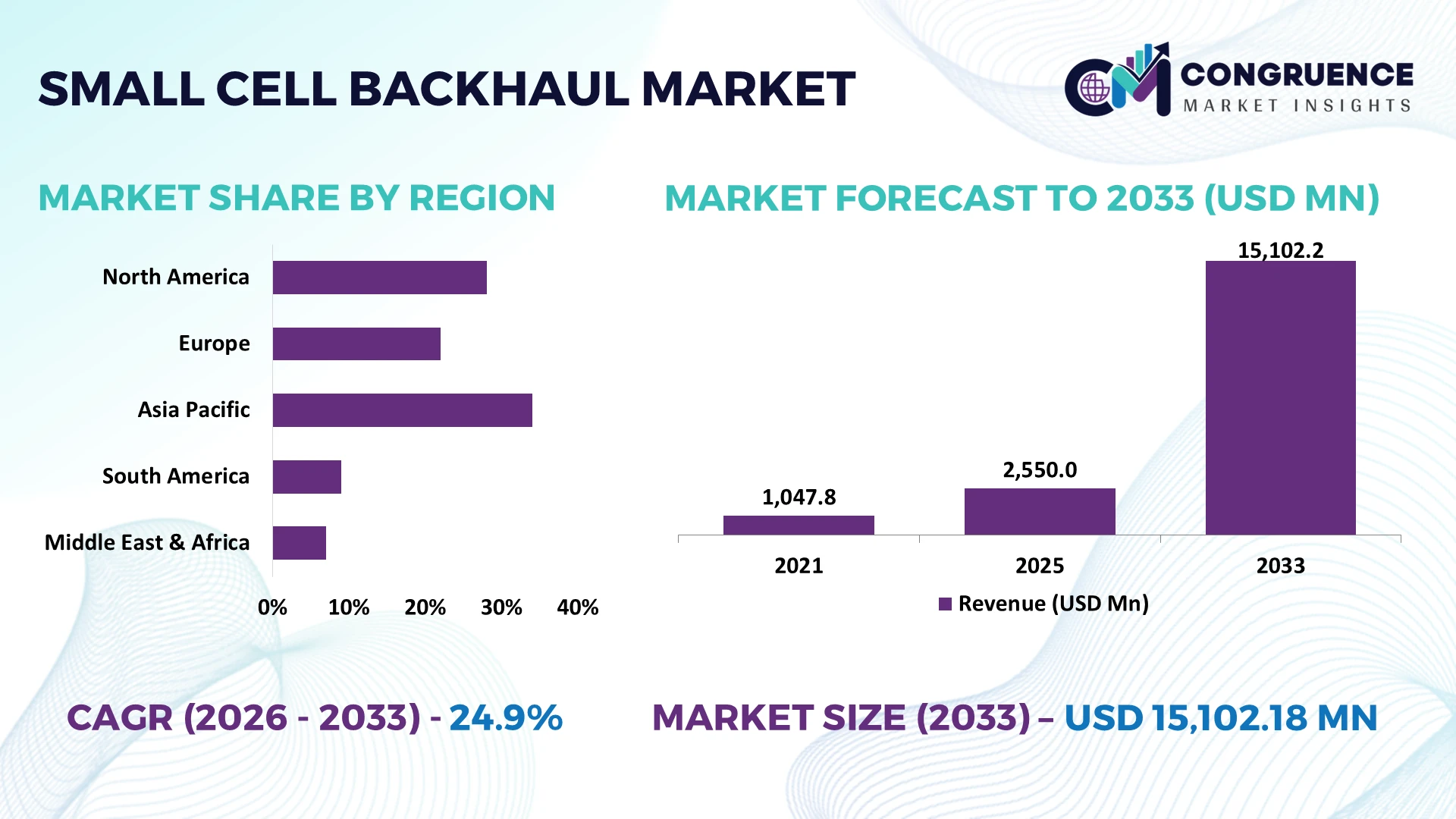
Asia Pacific commands 34% of the mobile backhaul market, with China alone operating roughly 4,000 5G factory networks and targeting 10,000 by 2027—a density-driven demand engine that outstrips North America's 23.8% ultra-dense networking penetration by a wide margin.
The strategic implication is clear, backhaul capacity planning now dictates small cell site economics, making fiber-leaning and hybrid architectures non-negotiable for operators competing on indoor and venue coverage.
Market Size & Growth: Valued at USD 2,550.0 Million in 2025, forecast to USD 15,102.2 Million by 2033 at 24.9% CAGR, driven by indoor 5G densification across stadiums, malls, and transport hubs requiring 10 Gbps uplinks per cell site.
Top Growth Drivers: Enterprise private 5G demand at 25% of ecosystem responses, hybrid public/private networks at 39%, and cloud/AI operation efficiencies at 30% collectively reshape backhaul architecture priorities.
Short-Term Forecast: By 2028, AI-driven RAN control and integrated access and backhaul (IAB) deployments reduce small cell site provisioning costs by an estimated 25–30% while cutting truck rolls for link alignment.
Emerging Technologies: Integrated access and backhaul (IAB) at 28 GHz eliminates separate backhaul radios; millimeter-wave chipset advances have cut power draw by 30% since 2023, enabling pole-mount and window-mount nodes with minimal site work.
Regional Leaders: Asia Pacific leads with 34.60% mobile backhaul share and aggressive 5G factory targets; North America drives virtualized RAN and dark-fiber aggregation; Europe targets energy-efficient small cells with 6,205 5G small cells installed as of 2023, an 850% year-over-year jump.
End-User Trends: Neutral host platforms will deploy over 1.5 million outdoor cells by 2031, accounting for 46% of total deployments as shared models displace single-operator builds.
Pilot/Case Example: In 2025, Ericsson's indoor Fusion 8828 small cell solution deployed with Bell Canada improved enterprise indoor coverage reliability for retail and cinema venues, validating localized small cell backhaul for SMB connectivity.
Competitive Landscape: Huawei, Nokia, Samsung, Cisco, and NEC anchor the vendor field; Huawei's early 5G small cell positioning aligns with China's 4.4 million 5G base station footprint, while Nokia counted 850 private 5G customers by Q4 2024.
Regulatory & ESG Impact: The FCC's USD 9 billion 5G Fund channels investment toward remote county cell-site upgrades, while European spectrum directives mandate 3.5–4.2 GHz releases, accelerating small cell permitting and deployment.
Investment & Funding: Verizon and T-Mobile acquired regional fiber players in 2024 to lock in scalable small cell backhaul for fixed-wireless access rollouts, reflecting a build-versus-buy pivot toward owned infrastructure.
Innovation & Future Outlook: Open RAN small cell units reached 225,000 in 2024, while AI-managed small cells stood at only 80,000—signaling a 2.8× near-term scale-up opportunity for AI-controlled backhaul optimization.
The Small Cell Backhaul Market is pivoting toward fiber-PON reuse and millimeter-wave hybrid architectures, with indoor venues and enterprise private networks absorbing capacity fastest. Recent innovations include integrated access and backhaul (IAB) that collapses separate backhaul radios into the access spectrum, while PON-based small cell backhaul reuses existing building fiber to cut deployment complexity. An estimated 46% of outdoor small cells will connect via neutral host platforms by 2031, reshaping operator partnership models and backhaul ownership economics. These dynamics set the stage for a competitive landscape where backhaul flexibility determines venue-level 5G viability.
Small cell backhaul has shifted from a supporting technical function to a competitive battleground, as operators recognize that venue-level 5G capacity—not macro coverage—determines enterprise and consumer experience. The structural driver is densification economics: each additional small cell demands dedicated backhaul capacity, and fiber trenching in dense cities can exceed USD 100,000 per kilometer, forcing hybrid fiber-wireless strategies. AI-managed RAN control, deployed on only 80,000 small cells in 2024 versus 225,000 Open RAN units, represents the next efficiency frontier, with AI optimization promising faster fault resolution and dynamic spectrum allocation. This gap between available intelligence and deployed intelligence defines near-term investment opportunity.
A measurable technology shift is underway: millimeter-wave chipset advances have reduced power draw by 30% since 2023, enabling pole-mount small cells that bypass costly civil works and shorten deployment cycles from months to weeks. Regionally, Asia Pacific's 34.60% mobile backhaul share reflects state-subsidized 5G density in China, Japan, and South Korea, while Europe's 6,205 5G small cells as of 2023—despite an 850% annual increase—reveal a permitting and business-case gap that neutral host models are beginning to close. In the United States, Crown Castle's cancellation of 7,000 small-cell sites preserved USD 800 million in capital, a cautionary signal that suburban backhaul economics remain unresolved without shared infrastructure.
Operationally, vendors bundling self-organizing-network software are winning tenders by reducing truck rolls and automating link alignment in cluttered urban environments. Over the next two to three years, expect operators to prioritize fiber-leaning hybrid backhaul for high-value indoor venues while reserving microwave and satellite links for lower-density and hard-to-trench geographies. The strategic conclusion is unambiguous: backhaul architecture choices now determine whether small cell deployments generate positive unit economics, and firms that lock in scalable, AI-managed backhaul pathways will control the densification agenda.
Indoor 5G adoption across stadiums, malls, and transport hubs is pulling small cell backhaul toward fiber and PON-reuse architectures, with small cell backhaul gear posting a 17.08% CAGR as venue owners demand 10 Gbps uplinks. PON-based backhaul allows multiple small cells to share existing building fiber infrastructure, eliminating dedicated leased-line costs per node and shortening deployment cycles for multi-floor venues. In China, the government's push toward 10,000 5G factory networks by 2027 is driving operators to pre-provision fiber backhaul in industrial parks before small cell installation begins. Companies are responding by partnering with building owners and neutral hosts to amortize fiber costs across multiple tenants—a structural shift that converts backhaul from a per-site expense into shared infrastructure investment.
Fiber trenching in dense cities can exceed USD 100,000 per kilometer, and permitting delays in right-of-way-constrained markets inflate project timelines unpredictably. Crown Castle's 2024 decision to shelve 7,000 U.S. small-cell sites preserved USD 800 million in capital after backhaul math failed to justify suburban deployments, exposing how trenching costs directly undermine scalability. In developing economies, limited access to low-interest financing further delays fiber build-outs, forcing carriers to rely on microwave even where fiber economics favor long-term capacity. Companies are mitigating exposure through dark fiber leasing, shared neutral host platforms, and millimeter-wave alternatives that avoid civil works entirely—strategies that trade upfront capital intensity for operational flexibility but require rigorous site-level payback modeling.
Only 80,000 small cells were AI-managed in 2024 against 225,000 Open RAN units deployed, revealing a 2.8× near-term scale-up gap for intelligent backhaul control. AI-driven routing and congestion prediction can reduce manual intervention in backhaul link management, directly lowering operational costs for dense urban deployments where truck rolls are expensive and slow. Germany's private 5G ecosystem, with over 60 Boldyn-operated network sites serving Deutsche Bahn and industrial campuses, demonstrates how AI-orchestrated backhaul can support mission-critical enterprise SLAs without proportional headcount growth. Vendors that embed self-organizing-network software into backhaul equipment are already winning tenders by demonstrating measurable reductions in link alignment time and fault resolution cycles—a differentiation that will intensify as AI becomes table stakes.
Operators meshing fiber, microwave, and millimeter-wave backhaul face integration complexity as each medium carries distinct latency, throughput, and management profiles. Europe's 6,205 5G small cells as of 2023 represent an 850% annual increase, yet the region still lags in standalone 5G densification, partly because multi-vendor backhaul orchestration remains immature. Cybersecurity exposure grows as backhaul links multiply: each additional small cell node creates a potential entry point, and SDN-managed backhaul introduces control-plane vulnerabilities that legacy microwave links did not present. Companies must invest in unified management platforms and zero-trust architectures before scaling hybrid deployments, or risk operational fragmentation that erodes the cost benefits of densification. The strategic insight is that backhaul heterogeneity is inevitable—but unmanaged heterogeneity is a liability that compounds with every added cell site.
Fiber Trenching Pushes Hybrid Adoption Rights-of-way delays and civil construction costs now drive operators toward hybrid fiber-wireless designs rather than fiber-only rollouts. In dense European markets, duct congestion extends activation timelines by months, pushing carriers to reserve microwave and E-band links for short-hop urban fill. Companies are restructuring procurement to evaluate route diversity and deployment speed alongside raw capacity, favoring vendors that bundle wireless transport with fiber aggregation.
Neutral Host Models Reshape Site Economics Shared infrastructure is accelerating outdoor small cell deployment where single-operator builds fail payback thresholds. Neutral hosts will deploy over 1.5 million cells by 2031, accounting for 46% of total outdoor deployments as shared models displace individual carrier builds. Venue owners in airports and rail hubs now negotiate multi-operator backhaul contracts upfront, forcing equipment vendors to design multi-tenant transport platforms with service-level isolation.
AI Moves from Pilot to Procurement Criterion Self-organizing network software has shifted from trial feature to tender requirement as small cell density overwhelms manual backhaul management. Cloud and AI operations ranked third among deployment drivers, cited by 30% of ecosystem respondents seeking automated fault resolution and capacity allocation. Vendors embedding predictive maintenance and dynamic routing into backhaul radios are winning contracts where operational expenditure per site determines scalability.
Millimeter-Wave Power Efficiency Unlocks Pole-Mount Sites Chipset advances have reduced mmWave backhaul radio power draw by roughly 30% since 2023, enabling pole-mount and window-mount nodes without dedicated power cabinets. This shift bypasses costly civil works and shortens site activation from months to weeks, particularly in U.S. and Japanese dense urban markets. Suppliers are responding by integrating thermal management and simplified mounting hardware into compact outdoor units, targeting venues where trenching remains prohibitive.
Fiber backhaul anchors the small cell backhaul market, commanding an estimated 48–52% share as operators prioritize low-latency, high-capacity links for urban densification and indoor distributed antenna systems. Its dominance rests on scalable throughput exceeding 10 Gbps per link and declining marginal cost once conduit exists. Millimeter wave represents the fastest-growing type, gaining share as E-band and W-band radios deliver fiber-like capacity for short urban hops without trenching, with adoption concentrated in U.S. and Japanese dense metro deployments where line-of-sight conditions permit.
Microwave retains relevance in markets where fiber access is constrained, offering route diversity and rapid activation for temporary or hard-to-reach sites, though its share erodes as mmWave costs decline. Companies are responding by positioning hybrid fiber-mmWave architectures as the default urban design, while microwave vendors emphasize resilience and disaster-recovery use cases. Investment priorities are shifting toward integrated multi-band platforms that let operators mix transport media per site rather than committing to a single technology.
Outdoor densification accounts for an estimated 55–60% of small cell backhaul demand, driven by urban macro-offload and public venue coverage where fiber aggregation and mmWave links concentrate. Operators in China and South Korea lead outdoor volume, deploying backhaul alongside 5G base station expansion in dense city districts and industrial parks. In-building use represents the faster-growing application, propelled by enterprise private 5G, stadiums, and transport hubs requiring dedicated indoor coverage where macro penetration fails.
The operational shift is from coverage-driven to capacity-driven backhaul planning: outdoor sites increasingly prioritize multi-gigabit aggregation for neutral host sharing, while indoor deployments demand low-latency links to support robotics, video analytics, and mission-critical enterprise applications. Remaining applications such as rural connectivity rely on satellite and microwave where fiber economics fail. Companies are adapting by pre-engineering indoor backhaul kits that bundle small cells with PON-reuse interfaces, targeting building owners and enterprises directly rather than waiting for carrier-led deployments.
Mobile network operators remain the dominant end-user, holding an estimated 65–70% share as they scale small cell backhaul to support 5G densification and macro-offload. Operator deployments concentrate in urban outdoor environments where backhaul aggregation feeds existing fiber and microwave transport networks. Neutral host providers represent the fastest-growing end-user group, gaining share as shared infrastructure models reduce duplicate civil works and accelerate venue coverage, with neutral hosts projected to account for 46% of outdoor small cell deployments by 2031.
Enterprise direct adoption is emerging as a secondary catalyst, particularly in Germany and Japan where private 5G licenses enable industrial campuses to procure backhaul independently of carriers. The buying behavior shift is structural: operators prioritize interoperability with existing transport management systems, while enterprises demand turnkey backhaul with service assurance and lifecycle support. Vendors are responding by segmenting product lines—carrier-grade multi-vendor orchestration platforms for operators, pre-configured backhaul kits for enterprise venues—and forming channel partnerships with systems integrators to reach enterprise buyers.
Asia-Pacific accounted for the largest market share at 34% in 2025 however, North America is expected to register the fastest growth, expanding at a CAGR of 28.6% between 2026 and 2033.

North America holds 28% of global small cell backhaul demand, anchored by operator-led outdoor densification and enterprise indoor coverage programs across U.S. metro corridors. Carriers prioritize fiber aggregation for macro-offload while deploying millimeter-wave links where trenching costs exceed project thresholds. Crown Castle’s 2024 cancellation of 7,000 greenfield small cell nodes, absorbing a USD 106 million write-down, exposed suburban backhaul economics that fail without shared infrastructure or anchor tenants. The region’s competitive dynamic favors neutral host partnerships and dark-fiber leasing over single-operator builds, pushing vendors toward multi-tenant transport platforms with service-level isolation.
United States Market Outlook: U.S. operators are restructuring backhaul procurement around hybrid fiber-wireless designs, with Verizon and T-Mobile acquiring regional fiber assets in 2024 to secure scalable small cell transport. The FCC’s USD 9 billion 5G Fund channels capital toward rural cell-site upgrades, creating a secondary demand layer beyond dense urban cores. Enterprise venues—stadiums, transport hubs, and campuses—increasingly negotiate backhaul SLAs directly with neutral hosts, bypassing traditional carrier-led deployment cycles and accelerating procurement timelines.
Europe captures 22% of global small cell backhaul demand, shaped by spectrum policy modernization and sustainability mandates rather than raw deployment volume. Germany’s Federal Network Agency allocated 465 private 5G campus frequencies by April 2025, a 23% annual increase, establishing the country as the region’s industrial connectivity anchor. European operators prioritize energy-efficient backhaul designs and neutral host models to navigate permitting fragmentation across member states. The region’s 6,205 5G small cells as of 2023, despite an 850% annual jump, signal a market still building density from a low base and dependent on shared infrastructure to justify backhaul investment.
Germany Market Outlook: Germany commands 31.6% of Europe’s private 5G market, with 465 frequency allocations enabling industrial campuses to deploy dedicated small cell backhaul independent of public carrier networks. Automotive and manufacturing sites in Bavaria and Baden-Württemberg drive validated use cases in automated guided vehicles and intralogistics, where sub-10 ms latency justifies private backhaul investment. Vendors targeting Germany must align with Bundesnetzagentur’s local licensing framework and OT integration requirements, where operational technology compatibility outweighs raw throughput specifications.
Asia-Pacific leads global small cell backhaul with 34% share, driven by state-coordinated 5G densification across China, Japan, and South Korea. China’s industrial 5G factory program reached approximately 4,000 networks by 2025, with government targets pushing toward 10,000 by 2027, creating concentrated backhaul demand in manufacturing parks and port zones. The region’s operators deploy fiber-leaning hybrid architectures at scale, leveraging state subsidies and coordinated right-of-way access that elude Western markets. India’s 5G rollout, exceeding 500,000 base transceiver stations by late 2025, represents the next volume frontier pending regulatory streamlining and fiber backbone expansion beyond tier-1 cities.
China Market Outlook: China’s 5G factory ecosystem demonstrates measurable backhaul-dependent outcomes: 100 flagship facilities reported 24.7% average capacity gains and 18.4% operational cost reductions, validating industrial small cell backhaul as productivity infrastructure rather than connectivity overhead. Provincial governments pre-provision fiber in industrial parks before small cell installation, compressing deployment cycles and amortizing backhaul costs across multiple enterprise tenants. Equipment vendors aligning with state industrial digitalization mandates secure position in the world’s densest small cell backhaul market, where volume contracts reward local manufacturing and standards compliance.
South America holds 9% of global small cell backhaul demand, concentrated in Brazil’s urban corridors and enterprise venues where fiber availability supports viable deployment economics. The region’s share reflects infrastructure limitations that constrain broad densification: fiber reach remains uneven outside major metropolitan areas, and right-of-way processes vary significantly across municipal jurisdictions. Operators prioritize targeted high-value deployments—stadiums, shopping centers, and corporate campuses—where backhaul costs amortize against premium connectivity revenues. Microwave and sub-6 GHz links fill gaps where fiber trenching timelines undermine project returns, creating a hybrid transport landscape that rewards equipment vendors offering multi-band flexibility.
Brazil Market Outlook: Brazil anchors South America’s small cell backhaul activity through operator-led 5G expansion in São Paulo and Rio de Janeiro, where fiber backbone availability supports small cell aggregation. Enterprise demand from agribusiness and port logistics creates secondary backhaul requirements in industrial zones where private connectivity justifies dedicated infrastructure. Regulatory modernization under Anatel’s spectrum framework is gradually reducing deployment friction, though municipal permitting inconsistencies continue to delay site activation and force operators to prioritize states with streamlined approval processes.
The Middle East & Africa region captures 7% of global small cell backhaul demand, concentrated in Gulf Cooperation Council states where sovereign investment programs fund smart city and venue connectivity. The UAE’s small cell network market is projected to expand from USD 44.9 million in 2025 to USD 442 million by 2035, driven by Expo City, airport, and hospitality venue deployments requiring high-density backhaul. African markets remain selective, with South Africa’s fixed-wireless and enterprise connectivity creating targeted demand where fiber backbones exist. Satellite and microwave backhaul fill infrastructure gaps across both subregions, with LEO satellite partnerships emerging as a viable alternative for cellular backhaul in underserved territories.
United Arab Emirates Market Outlook: The UAE’s smart city initiatives and venue densification programs create concentrated small cell backhaul demand that outstrips regional averages, with fiber and millimeter-wave architectures deployed for airport, stadium, and mixed-use development coverage. Etisalat and du’s 5G standalone investments prioritize backhaul scalability for enterprise SLAs, attracting vendor partnerships around multi-tenant transport platforms. Sovereign wealth-backed infrastructure programs reduce deployment risk, positioning the UAE as the region’s small cell backhaul innovation testbed where vendors validate high-density venue solutions before scaling across GCC markets.
The small cell backhaul arena pits integrated telecom OEMs—Ericsson, Nokia, Huawei, Samsung—against specialist transport vendors like Ceragon, Siklu, and Aviat, with fiber aggregators and neutral hosts (Cellnex, Crown Castle) increasingly controlling access economics. The top five players command an estimated 52–58% combined share, concentrated in carrier-grade radio and fiber aggregation portfolios. Competition pivots on deployment speed and hybrid transport flexibility: fiber-only proposals lose 30% of urban tenders where trenching exceeds USD 100,000/km, while mmWave vendors win 25% faster site activation. Vendors are pursuing vertical integration—Samsung embedding DOCSIS modems into strand small cells, Ericsson bundling RAN with transport management—to lock operators into single-vendor densification stacks. The decisive shift is from hardware margins to managed transport services, where neutral hosts monetize shared backhaul and pressure OEM pricing. The entry barrier is carrier certification plus multi-band spectrum expertise; without it, vendors cannot pass interoperability gates. Winning requires proven hybrid orchestration, operator-grade service assurance, and the supply-chain resilience to deliver at densification speed.
Ericsson
Nokia
Huawei Technologies
Samsung Electronics
Cisco Systems
NEC Corporation
Ceragon Networks
Aviat Networks
Siklu Communication
CommScope Holding
Corning Incorporated
Fujitsu Limited
ZTE Corporation
Proxim Wireless
Fiber backhaul remains the capacity anchor, but deployment economics favor hybrid designs that pair fiber aggregation with wireless fill. Integrated access and backhaul (IAB) at 28 GHz eliminates dedicated transport radios, with Verizon trialing mesh-based IAB to bypass fiber drops at mmWave sites. This reduces site acquisition constraints and upfront costs where trenching stalls activation.
5G Standalone small cells are becoming the control-plane default, forecast to grow at 56% through 2030, while 43% of new small cells will deploy in FR2 bands by the same year. Edge co-location—projected at 66% of enterprise small cells by 2030—shifts backhaul from passive pipe to latency-critical infrastructure, rewarding vendors that integrate compute-aware transport management.
AI-driven orchestration delivers measurable advantage: automated routing and predictive maintenance cut manual intervention and fault resolution cycles, with 30% of ecosystem respondents citing cloud/AI operations as a primary driver. Vendors embedding analytics into transport platforms gain tender differentiation through lower operational expenditure per site. Between 2026 and 2028, expect consolidation around multi-band, AI-managed hybrid platforms; single-technology suppliers face displacement.
November 2025 – Samsung commercially launched its Strand Small Cell, an all-in-one 5G node with integrated DOCSIS backhaul supporting up to 80 MHz CBRS, now powering Comcast’s commercial service and available to cable operators seeking aerial infrastructure reuse. Source: sdxcentral.com
November 2025 – Verizon / Verana Networks invested in and trialed Verana’s mmWave Integrated Access and Backhaul platform, enabling mesh backhaul that removes dedicated fiber requirements per node, addressing site acquisition constraints across its 40,000+ mmWave node footprint. Source: sdxcentral.com
May 2026 – MaxLinear released its Trinity platform, delivering carrier-grade bidirectional wireless backhaul up to 10 Gbps via the URX850 SoC with cloud-native API integration for millimeter and microwave modems, targeting high-capacity short-hop transport.
December 2025 – Cellnex / Swansea Council signed its third open-access agreement in 18 months with Swansea Council, adding to its 1,200+ small cell site portfolio and enabling street-furniture-based deployment to accelerate urban capacity densification. Source: swansea.gov.uk
The report delivers a complete operational and strategic view of small cell backhaul across technology types—fiber, microwave, millimeter wave, and hybrid—alongside frequency bands, applications spanning outdoor densification and in-building DAS, and end-user segments covering mobile operators, neutral hosts, and enterprise deployers. Regional coverage extends across Asia-Pacific, North America, Europe, South America, and the Middle East & Africa, with country-level deployment and infrastructure readiness indicators where decision relevance is highest.
Quantitative scope includes segment distribution patterns, neutral host adoption trajectories, and enterprise indoor deployment concentration, supporting investment prioritization and partnership targeting. The report equips operators, vendors, and infrastructure investors to align transport architecture choices with densification economics, competitive positioning, and regulatory timelines between 2026 and 2033.
| Report Attribute / Metric | Details |
|---|---|
| Market Revenue (2025) | USD 2550.0 Million |
| Market Revenue (2033) | USD 15102.2 Million |
| CAGR (2026–2033) | 24.9% |
| Base Year | 2025 |
| Forecast Period | 2026–2033 |
| Historic Period | 2021–2025 |
| Segments Covered |
By Type
By Application
By End-User
|
| Key Deliverables | Revenue Forecast; Market Trends; Growth Drivers & Restraints; Technology Insights; Segmentation Analysis; Regional Insights; Competitive Landscape; Regulatory & ESG Overview; Recent Developments |
| Regions Covered | North America; Europe; Asia-Pacific; South America; Middle East & Africa |
| Companies Profiled | Ericsson; Nokia; Huawei Technologies; Samsung Electronics; Cisco Systems; NEC Corporation; Ceragon Networks; Aviat Networks; Siklu Communication; CommScope Holding; Corning Incorporated; Fujitsu Limited; ZTE Corporation; Proxim Wireless |
| Customization & Pricing | Available on Request (10% Customization Free) |




