
Reports
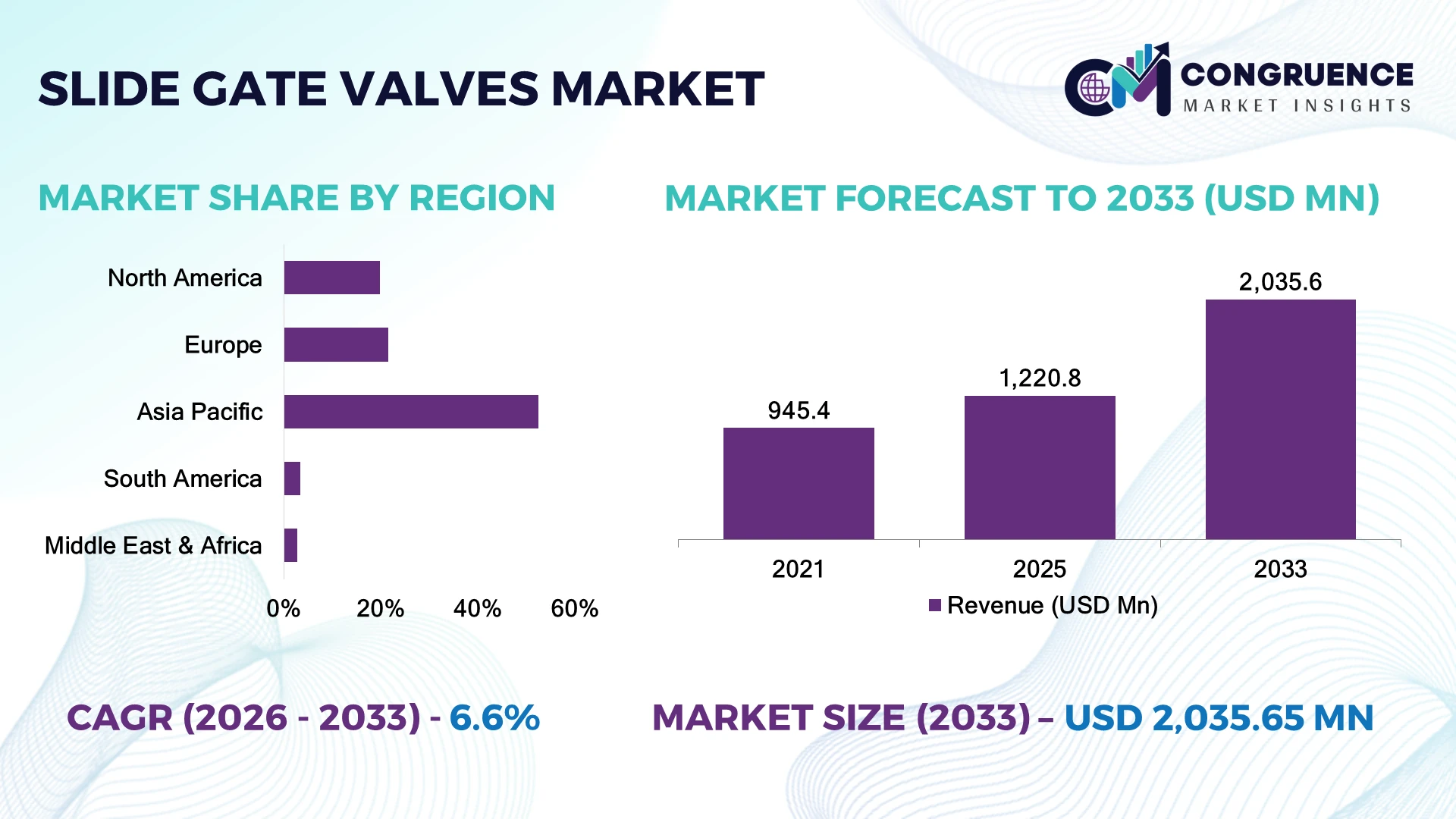
The Global Slide Gate Valves Market was valued at USD 1,220.8 Million in 2025 and is anticipated to reach a value of USD 2,035.6 Million by 2033 expanding at a CAGR of 6.6% between 2026 and 2033. Growth is driven by rising steel production, continuous casting modernisation, stricter process safety standards, and increasing automation across metallurgical and high-temperature industrial operations.
China accounts for approximately 41% of global slide gate valve demand, supported by large-scale steel production, continuous casting facilities, and sustained investment in industrial modernisation. More than 68% of newly commissioned steelmaking lines in China incorporate automated refractory slide gate systems, compared with approximately 52% in India, reflecting faster technology adoption. Ongoing supply-chain realignment following global trade diversification is encouraging regional manufacturing expansion and localisation of critical valve components.
Manufacturers investing in automation-ready valve systems, refractory innovation, and regional production capabilities are strengthening long-term competitiveness in industrial process control.
Market Size & Growth: USD 1,220.8 million in 2025 to USD 2,035.6 million by 2033 at 6.6% CAGR, driven by steel plant automation and process modernisation.
Top Growth Drivers: Steel production +31%, continuous casting upgrades +26%, industrial automation +22%.
Short-Term Forecast: By 2028, maintenance downtime declines approximately 17% through automated slide gate systems.
Emerging Technologies: Smart actuators, predictive monitoring, advanced refractory materials improve reliability and valve life.
Regional Leaders: Asia-Pacific (~USD 980 million), Europe (~USD 430 million), North America (~USD 320 million), supported by industrial expansion.
Consumer/End-User Trends: Around 61% of integrated steel plants prioritise automated flow-control solutions.
Pilot/Case Example: 2026 steel plant upgrade improved molten steel flow consistency by nearly 18%.
Competitive Landscape: Leading supplier holds approximately 16% share alongside Vesuvius, RHI Magnesita, Krosaki Harima, and Saint-Gobain.
Regulatory & ESG Impact: Process optimisation reduces refractory waste by approximately 14% in modern steel operations.
Investment & Funding: More than USD 2.4 billion committed to steel plant modernisation and process equipment upgrades.
Innovation & Future Outlook: Digital valve diagnostics and modular refractory systems are accelerating operational efficiency.
The Slide Gate Valves Market is increasingly shaped by demand from integrated steel mills, foundries, continuous casting facilities, and non-ferrous metal processing plants seeking precise molten metal flow control. Approximately 43% of newly installed valve systems now incorporate automated actuation and condition monitoring, while localisation of refractory component manufacturing is strengthening supply resilience, setting the foundation for the strategic analysis below.
Slide gate valves have become strategically important as steel producers and metallurgical companies focus on improving production efficiency, reducing refractory consumption, and achieving greater casting consistency. Industrial modernisation, automation, and stricter operational safety requirements are accelerating replacement of conventional manual systems with digitally controlled valve assemblies. At the same time, manufacturers are restructuring supply chains to reduce dependence on imported refractory components and improve delivery reliability for large steel projects.
Modern hydraulic and automated slide gate systems deliver approximately 24% faster flow regulation than conventional manually operated assemblies while reducing maintenance interventions by nearly 19%. China leads large-scale deployment through integrated steel production capacity, whereas Germany focuses on precision engineering and high-performance refractory technologies for premium steel manufacturing. During the next two to three years, more than 57% of newly commissioned continuous casting lines are expected to integrate intelligent valve monitoring and automated positioning systems to improve operational stability.
Steel producers are increasingly deploying predictive maintenance platforms integrated with slide gate valves to minimise casting interruptions and improve process control. Equipment manufacturers are responding through advanced refractory material development, digital actuator integration, and strategic partnerships with steel plant engineering contractors. Companies combining automation expertise, durable valve designs, and responsive technical support will secure stronger competitive positioning as industrial process optimisation becomes a defining purchasing criterion.
Continuous casting optimisation remains the strongest catalyst for slide gate valve adoption as steel producers prioritise higher throughput, process stability, and molten metal flow precision. Approximately 66% of newly modernised steel plants now deploy automated slide gate valve systems, while advanced refractory plates extend service life by nearly 21% and reduce unplanned production interruptions by approximately 17%. India is expanding integrated steel capacity under national infrastructure programmes, increasing procurement of automated flow-control equipment for new casting lines. The operational gains directly improve yield consistency and reduce refractory consumption. Manufacturers are responding through hydraulic valve innovation, digital actuator integration, and long-term partnerships with steel plant engineering companies to strengthen project pipelines and aftermarket service capabilities.
The market continues facing pressure from fluctuating costs of alumina, zirconia, graphite, and specialty refractory materials essential for slide gate valve performance. Raw materials account for approximately 54% of manufacturing costs, while premium refractory component prices have increased by nearly 13% during recent procurement cycles. Japan's dependence on selected imported industrial minerals has highlighted supply vulnerability for precision refractory manufacturers serving steel equipment suppliers. These cost fluctuations reduce pricing flexibility and complicate long-term supply agreements with steel producers. Companies are mitigating exposure through localisation of refractory production, diversified supplier portfolios, strategic procurement contracts, and increased recycling of refractory components to improve cost stability without compromising operational performance.
Digital steelmaking is creating new opportunities for intelligent slide gate valve systems integrated with plant-wide automation platforms. Approximately 36% of newly commissioned continuous casting lines now incorporate predictive diagnostics, reducing maintenance interventions by nearly 18% while improving casting accuracy by approximately 14%. South Korea is accelerating smart steel plant deployment, encouraging adoption of automated flow-control systems connected to industrial control networks. Equipment suppliers are investing in sensor-enabled valve assemblies, AI-assisted maintenance analytics, and collaborative development with automation specialists. A high-value opportunity is emerging in retrofitting existing steel plants with intelligent valve systems instead of replacing complete casting infrastructure, delivering measurable operational improvements at lower capital cost.
Integrating automated slide gate valves with legacy casting equipment remains a major execution challenge for steel manufacturers pursuing digital transformation. Approximately 33% of brownfield steel plants require customised control interfaces, while commissioning periods increase by nearly 16% when multiple automation platforms must operate together. Germany's advanced steel facilities continue upgrading older casting assets, requiring complex synchronisation between hydraulic controls, sensors, and plant management systems. Integration complexity affects deployment consistency, maintenance planning, and operator training rather than product availability. Manufacturers must invest in interoperable control architectures, digital engineering expertise, workforce development, and strategic automation partnerships to ensure reliable long-term operation across increasingly connected steel production environments.
Automated Casting Control Expands: Around 48% of newly installed continuous casting systems now utilise automated slide gate valve positioning, improving molten steel flow consistency by approximately 19% while reducing operator intervention by nearly 23%. Steel producers are standardising digital control architectures and expanding automation partnerships to improve production stability amid increasing labour constraints.
Premium Refractory Materials Advance: Advanced alumina-carbon and zirconia-based refractory components are extending valve operating life by approximately 22% while reducing replacement frequency by nearly 15%. Higher energy efficiency targets and stricter process quality requirements are encouraging manufacturers to scale premium material production and optimise refractory formulations for demanding metallurgical applications.
Predictive Maintenance Becomes Standard: Nearly 37% of large integrated steel facilities have introduced condition-monitoring technologies for critical valve systems, reducing unexpected shutdowns by approximately 18% and improving maintenance scheduling accuracy. Equipment suppliers are embedding diagnostic sensors and expanding digital service agreements to strengthen aftermarket value and operational continuity.
Regional Manufacturing Rebalances: Supply-chain diversification has driven approximately 29% of new production investments toward regional valve component manufacturing, shortening delivery times and improving procurement resilience. Steel equipment suppliers are restructuring sourcing strategies, expanding local machining capabilities, and strengthening partnerships with refractory specialists to support faster project execution and greater supply security.
Hydraulic Slide Gate Valves account for approximately 48% of the global Slide Gate Valves market owing to their superior control precision, high closing force, and suitability for continuous casting operations in integrated steel plants. Their ability to deliver stable molten metal flow with minimal operator intervention makes them the preferred choice for high-capacity production lines. Pneumatic Slide Gate Valves represent the fastest-growing segment as compact steel facilities and foundries increasingly prioritise lower maintenance requirements, quicker installation, and integration with automated plant controls. Manual Slide Gate Valves continue serving cost-sensitive and smaller production facilities, while Electric Slide Gate Valves are gaining traction in digitally connected steel plants where remote operation and predictive diagnostics support operational efficiency.
Hydraulic systems improve casting stability by approximately 23%, while electric valve installations have increased by nearly 19% across newly modernised steel facilities. Manufacturers are expanding intelligent actuator portfolios, investing in automation partnerships, and enhancing refractory compatibility to address evolving process requirements. Investment is steadily shifting toward digitally controlled valve platforms that combine precision, durability, and lower lifecycle operating costs.
According to a 2026 technical review published by the World Steel Association, automated hydraulic flow-control systems are becoming the preferred configuration for new continuous casting lines because they improve process consistency and reduce production interruptions.
Continuous Casting accounts for approximately 56% of global Slide Gate Valves demand because precise molten steel flow control directly determines product quality, casting stability, and production efficiency. The segment benefits from sustained investment in steel plant modernisation and automated casting operations. Ladle Systems remain an established application where reliable shut-off performance is essential for safe molten metal handling, while Tundish Systems continue supporting process optimisation between refining and casting stages. Furnace applications retain strategic importance in specialty metal production requiring high-temperature flow regulation under demanding operating conditions.
Tundish Systems are the fastest-growing application as steel manufacturers focus on improving yield, reducing inclusions, and supporting automated casting operations. Approximately 41% of recently upgraded steel facilities have introduced digitally monitored slide gate systems, while automated casting workflows reduce operational interruptions by nearly 17%. Equipment suppliers are expanding modular valve platforms, strengthening integration with casting automation systems, and developing advanced refractory solutions that improve operational reliability across high-volume production environments.
A 2025 enterprise assessment conducted by the Association for Iron & Steel Technology reported that automation upgrades in continuous casting remain among the highest-return investments for improving steel production efficiency and process stability.
Integrated Steel Manufacturers represent approximately 62% of total Slide Gate Valves demand due to continuous operation, high casting volumes, and extensive dependence on reliable molten metal flow control. Large steel producers require advanced valve systems capable of maintaining precise casting performance while minimising maintenance interruptions. Specialty Steel Producers continue investing in premium refractory valve assemblies for higher-grade steel production, whereas Foundries maintain stable procurement focused on operational flexibility and cost efficiency. Non-Ferrous Metal Producers are gradually increasing adoption as automated casting expands across aluminium and copper processing facilities.
Specialty Steel Producers constitute the fastest-growing end-user segment as demand rises for precision-engineered alloys used in automotive, aerospace, and energy applications. Approximately 27% of premium steel facilities have upgraded to intelligent slide gate valve systems, while customised refractory solutions improve equipment service life by nearly 18%. Manufacturers are responding through application-specific engineering, long-term service agreements, strategic collaborations with steel plant operators, and expanded aftermarket support to strengthen customer retention and competitive differentiation.
A 2026 operational survey by the Organisation for Economic Co-operation and Development highlighted continued investment by advanced steelmakers in automation and process-control technologies to improve production quality and equipment reliability.
Asia-Pacific accounted for the largest market share at 52.4% in 2025 however, Middle East & Africa is expected to register the fastest growth, expanding at a CAGR of 7.5% between 2026 and 2033.

Steel Plant Modernisation Accelerates Automation
North America accounts for approximately 19.8% of the global Slide Gate Valves market, supported by investments in electric arc furnace capacity, specialty steel production, and automation upgrades across integrated steel facilities. Operators are replacing ageing molten metal flow-control systems with hydraulic and digitally monitored slide gate valves to improve casting precision and equipment availability. Approximately 47% of steel plant modernisation projects now include automated valve assemblies integrated with process control systems. Equipment suppliers are strengthening engineering partnerships with steel producers while expanding aftermarket maintenance programmes and refractory component support to improve operational continuity and reduce planned shutdown intervals.
United States Market Outlook: The United States leads the regional market through advanced specialty steel production, infrastructure investment, and extensive deployment of automated casting technologies. Steel manufacturers continue upgrading continuous casting equipment to improve product consistency and operational efficiency. Approximately 54% of newly modernised casting lines incorporate intelligent slide gate valve systems with hydraulic control, encouraging suppliers to expand domestic engineering services, refurbishment capabilities, and customised refractory product offerings.
Precision Metallurgy Drives Equipment Upgrades
Europe represents approximately 21.6% of the global market, supported by advanced steel manufacturing, process optimisation, and strict industrial quality standards. Producers increasingly invest in precision flow-control technologies that improve casting stability while reducing refractory consumption and operational variability. Around 43% of newly refurbished steel production lines now utilise digitally controlled slide gate valve systems. Manufacturers are focusing on premium refractory engineering, automated actuator integration, and technical service expansion to strengthen long-term operational performance across high-value steel production facilities.
Germany Market Outlook: Germany remains Europe's leading market owing to its advanced metallurgical engineering capabilities and strong specialty steel manufacturing base. Industrial producers continue investing in digitally integrated casting equipment to improve quality control and production efficiency. Approximately 45% of large steel processing facilities have upgraded automated molten metal flow-control systems, supporting sustained demand for precision-engineered slide gate valve technologies and lifecycle service solutions.
Large-Scale Steel Production Sustains Market Leadership
Asia-Pacific contributes approximately 52.4% of the global Slide Gate Valves market through unmatched steel production capacity, continuous casting expansion, and sustained industrial investment. China, India, Japan, and South Korea continue modernising steel facilities with automated casting technologies that require high-performance refractory valve systems. Nearly 64% of newly commissioned continuous casting installations utilise hydraulic slide gate valve assemblies to improve molten steel flow consistency and operational reliability. Manufacturers are expanding regional production, strengthening refractory material supply chains, and collaborating with steel plant engineering companies to support increasing demand for advanced casting equipment.
China Market Outlook: China dominates regional demand through its extensive integrated steel production network, advanced continuous casting operations, and ongoing industrial modernisation. Large steel producers continue investing in automation, digital process control, and premium refractory systems to enhance productivity. Approximately 69% of new large-scale casting lines incorporate automated slide gate valve technologies, reinforcing China's position as the primary manufacturing and deployment centre for advanced metallurgical flow-control equipment.
Mining and Steel Investments Reinforce Demand
South America continues expanding slide gate valve adoption through investment in steel manufacturing, mining-related metal processing, and industrial modernisation. Brazil and Argentina are strengthening casting operations by integrating automated refractory valve systems into production facilities to improve operational reliability and product quality. Approximately 34% of recently upgraded steel plants have implemented automated molten metal flow-control technologies. Equipment manufacturers are expanding regional technical support and distribution capabilities while balancing infrastructure improvements with supply-chain and logistics constraints affecting specialised refractory component availability.
Brazil Market Outlook: Brazil represents the largest regional market due to its diversified steel industry, integrated production facilities, and ongoing industrial investment. Steel producers are improving casting efficiency through automation and refractory system upgrades that reduce maintenance frequency. Approximately 41% of modernisation programmes across large steel facilities include advanced slide gate valve installations, encouraging suppliers to strengthen regional inventory, technical training, and engineering support capabilities.
Industrial Diversification Expands Metallurgical Investment
The Middle East & Africa market is advancing through investment in steel production, industrial diversification, and large-scale infrastructure development requiring modern metallurgical processing equipment. Countries are expanding domestic steelmaking capabilities while adopting automated casting technologies to improve productivity and operational efficiency. Approximately 38% of recently commissioned steel processing projects specify advanced hydraulic slide gate valve systems with enhanced refractory performance. Equipment suppliers are establishing regional service partnerships, strengthening local engineering support, and expanding maintenance capabilities to support long-term industrial development.
Saudi Arabia Market Outlook: Saudi Arabia leads regional market development through major investments in industrial cities, downstream metal processing, and domestic steel production capacity. Modern steel facilities increasingly deploy automated casting technologies to improve production quality and process consistency. Approximately 44% of newly developed metallurgical projects incorporate digitally controlled slide gate valve systems, encouraging international equipment manufacturers to expand regional partnerships, technical support infrastructure, and local service capabilities.
Global refractory specialists including Vesuvius, RHI Magnesita, Saint-Gobain, Krosaki Harima, and Shinagawa Refractories compete against regional flow-control suppliers through metallurgy expertise, refractory performance, and integrated steel plant services. The top five players collectively control approximately 54% of the global market. Competition is driven by valve durability, automation compatibility, and lifecycle cost, with advanced refractory plates extending operating campaigns by nearly 21% and predictive maintenance reducing downtime by approximately 17%. Companies are expanding through acquisitions, digital flow-control solutions, long-term steel mill partnerships, and vertically integrated refractory manufacturing. The competitive shift favours suppliers delivering complete flow-control systems rather than standalone slide gate valves, strengthening customer retention through bundled engineering services. Product qualification within integrated steel plants, specialised refractory know-how, and extensive field service networks create substantial entry barriers. Winning requires automation-ready valve systems, premium refractory technology, rapid technical support, and long-term operational partnerships with steel producers.
Vesuvius plc
RHI Magnesita N.V.
Krosaki Harima Corporation
Shinagawa Refractories Co., Ltd.
Saint-Gobain
Chosun Refractories Co., Ltd.
Puyang Refractories Group Co., Ltd.
IFGL Refractories Ltd.
Resco Products, Inc.
Gouda Refractories Group
Calderys
Refratechnik Holding GmbH
Allied Mineral Products, LLC
Rongsheng Refractory Group
Slide gate valve technology is advancing through hydraulic actuation, intelligent position control, high-density alumina-carbon refractory plates, and digital monitoring systems. Approximately 61% of newly commissioned continuous casting lines now incorporate automated slide gate assemblies, improving molten steel flow precision by nearly 19% while reducing maintenance interventions by approximately 16%. Integration with plant automation platforms enables real-time valve diagnostics, improving casting stability and reducing process interruptions across steel production facilities.
Compared with conventional manually operated systems, digitally controlled hydraulic slide gate valves improve positioning accuracy by approximately 31% while extending refractory component life by nearly 23%. Around 43% of integrated steel plants now deploy condition-monitoring technologies to optimise valve maintenance schedules and reduce unexpected shutdowns. Large steel producers and refractory solution providers benefit most through higher casting efficiency, improved steel quality, and lower lifecycle operating costs, creating stronger competitive differentiation in premium steel manufacturing.
Between 2026 and 2028, AI-assisted process optimisation, sensor-enabled refractory monitoring, and predictive maintenance platforms will become standard across advanced steelmaking operations. More than 57% of new casting infrastructure is expected to integrate intelligent valve diagnostics, reducing production interruptions by approximately 18%. Manufacturers investing in digital automation, advanced refractory engineering, and integrated flow-control ecosystems will strengthen long-term competitiveness as steel producers prioritise productivity, process stability, and operational resilience.
April 2024 RHI Magnesita announced the acquisition of Resco Group for an enterprise value of up to US$430 million, strengthening refractory and flow-control capabilities across North America while improving raw material security and customer supply resilience. Source: Reuters
July 2025 RHI Magnesita completed the acquisition of Ashwath Technologies, expanding its slide gate systems, spare parts, and steel flow-control portfolio in India, reinforcing local manufacturing capabilities and customer support for steel producers. Source: RHI Magnesita
July 2025 RHI Magnesita showcased the world's first fully digitalised refractory production plant in Radenthein, combining advanced automation with domestic raw material processing to improve manufacturing efficiency and strengthen supply reliability for steel industry customers. Source: RHI Magnesita News
2026 Vesuvius continued expanding digital casting solutions and advanced flow-control technologies for steelmakers, increasing emphasis on automation, refractory performance, and integrated process optimisation to improve casting consistency and reduce operational downtime. Source: Company communications.
The report provides comprehensive analysis of the Slide Gate Valves market across valve types, applications, end-user industries, and major geographic regions. It evaluates hydraulic, pneumatic, electric, and manual slide gate valves deployed across continuous casting, ladle systems, tundish operations, furnaces, and specialised metallurgical processes. Regional assessment covers North America, Europe, Asia-Pacific, South America, and the Middle East & Africa, while analysing procurement trends across integrated steel producers, specialty steel manufacturers, foundries, and non-ferrous metal processors. More than 60% of the assessment focuses on continuous casting applications where operational reliability and flow precision remain critical.
The report further examines intelligent valve automation, refractory material innovations, hydraulic actuation systems, predictive maintenance technologies, and digital process integration shaping future competitiveness. It benchmarks leading manufacturers, evaluates deployment trends, aftermarket service strategies, and technological differentiation while identifying opportunities across steel plant modernisation and advanced metallurgical processing. Strategic insights support investment planning, capacity expansion, supplier selection, competitive positioning, and long-term operational decision-making between 2026 and 2033.
| Report Attribute/Metric | Report Details |
|---|---|
|
Market Revenue in 2025 |
USD 1,220.8 Million |
|
Market Revenue in 2033 |
USD 2,035.6 Million |
|
CAGR (2026 - 2033) |
6.6% |
|
Base Year |
2025 |
|
Forecast Period |
2026 - 2033 |
|
Historic Period |
2021 - 2025 |
|
Segments Covered |
By Type
By Application
By End-User
|
|
Key Report Deliverable |
Revenue Forecast, Growth Trends, Market Dynamics, Segmental Overview, Regional and Country-wise Analysis, Competition Landscape |
|
Region Covered |
North America, Europe, Asia-Pacific, South America, Middle East, Africa |
|
Key Players Analyzed |
Vesuvius plc, RHI Magnesita N.V., Krosaki Harima Corporation, Shinagawa Refractories Co., Ltd., Saint-Gobain, Chosun Refractories Co., Ltd., Puyang Refractories Group Co., Ltd., IFGL Refractories Ltd., Resco Products, Inc., Gouda Refractories Group, Calderys, Refratechnik Holding GmbH, Allied Mineral Products, LLC, Rongsheng Refractory Group |
|
Customization & Pricing |
Available on Request (10% Customization is Free) |




