
Reports
The Global Situation Awareness Systems Market was valued at USD 21148.23 Million in 2025 and is anticipated to reach a value of USD 33453.51 Million by 2033 expanding at a CAGR of 5.9% between 2026 and 2033. Growth is driven by AI-enabled command-and-control, multi-domain surveillance, border monitoring, critical-infrastructure security, sensor fusion, and real-time threat detection across defense, aviation, maritime, and industrial operations.
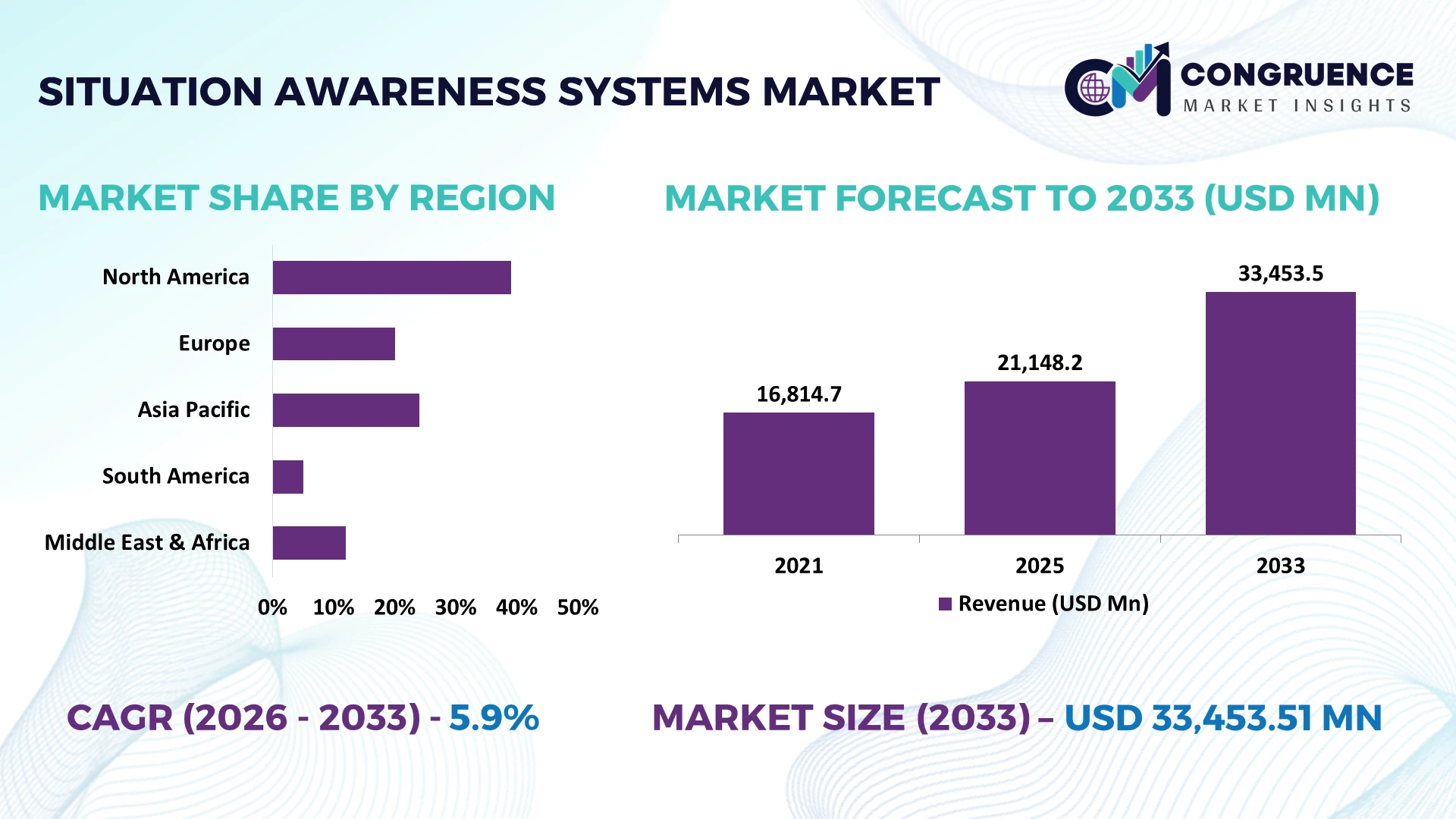
The United States accounts for approximately 38–42% of global situation awareness systems demand, supported by extensive defense modernization, homeland security, aerospace, and intelligence infrastructure. U.S. defense spending exceeds USD 800 billion annually, sustaining deployment of ISR sensors, battlefield networks, radar, and AI-assisted command systems. Compared with Germany and Japan, the U.S. operates substantially larger integrated surveillance and multi-domain command architectures. Russia-Ukraine conflict lessons have accelerated requirements for distributed sensors, resilient communications, and rapid decision-support capabilities.
Strategically, suppliers integrating sensors, AI analytics, secure communications, and interoperable command platforms gain stronger positioning as customers prioritize faster threat identification and cross-domain operational visibility.
Market Size & Growth: USD 21,148.23 million in 2025 reaches USD 33,453.51 million by 2033 at 5.9% CAGR, driven by AI-enabled multi-domain surveillance.
Top Growth Drivers: Defense modernization contributes approximately 40%, critical-infrastructure security 25%, and intelligent transportation and industrial monitoring 15% to incremental demand.
Short-Term Forecast: By 2028, AI-assisted sensor fusion can reduce operator analysis workloads by approximately 20–30% across high-volume surveillance environments.
Emerging Technologies: AI analytics, edge computing, and autonomous sensor networks target 20–40% faster detection-to-decision workflows through automated data correlation.
Regional Leaders: By 2033, North America approaches USD 13.4 billion, Europe USD 8.0 billion, and Asia-Pacific USD 8.7 billion as defense and infrastructure monitoring expand.
Consumer/End-User Trends: Defense and homeland-security organizations represent approximately 45–50% of advanced situation-awareness deployments, reflecting mission-critical surveillance intensity.
Pilot/Case Example: In 2025, AI-enabled command exercises demonstrated approximately 30% faster sensor-to-decision cycles by automating multi-source data correlation and threat prioritization.
Competitive Landscape: Lockheed Martin holds an estimated 10–15% position in defense-oriented systems, competing with RTX, Northrop Grumman, Thales, and BAE Systems.
Regulatory & ESG Impact: NATO’s 2% defense-spending benchmark is accelerating investment in interoperable surveillance, command networks, resilient communications, and shared operational awareness.
Investment & Funding: More than USD 10 billion in major defense digitalization and command-network programs supports AI, ISR, cybersecurity, and integrated battlefield architectures globally.
Innovation & Future Outlook: Multi-domain command platforms increasingly integrate 5+ sensor classes, shifting competition toward open architectures, edge intelligence, autonomous monitoring, and secure data fusion.
The Situation Awareness Systems Market spans defense command centers, border surveillance, aviation, maritime operations, cybersecurity, industrial facilities, and critical infrastructure. AI-enabled sensor fusion, edge analytics, digital twins, autonomous surveillance, and geospatial intelligence are reducing dependence on manually correlated data feeds. Defense and homeland-security applications account for approximately 45–50% of advanced deployments, making interoperability and low-latency threat assessment critical procurement criteria. Russia-Ukraine conflict experience has further elevated resilient communications, distributed sensing, and counter-drone awareness. These operational shifts establish the foundation for evaluating future technology pathways, procurement priorities, and competitive positioning.
Situation awareness systems are becoming strategic infrastructure as defense forces, airports, utilities, ports, and industrial operators replace isolated monitoring tools with integrated decision environments. Russia-Ukraine conflict experience has accelerated procurement of distributed ISR, counter-drone detection, resilient communications, and multi-domain command platforms. Simultaneously, critical-infrastructure operators are digitizing surveillance and incident-management workflows, increasing demand for interoperable sensor networks rather than standalone radar or video systems.
AI-enabled sensor fusion can reduce high-volume operator analysis workloads by approximately 20–30% compared with manually correlated legacy feeds while accelerating detection-to-decision workflows. The United States leads deployment through large defense and intelligence programs; European investment emphasizes NATO interoperability and infrastructure protection, while Japan prioritizes maritime surveillance and disaster awareness. Through 2026–2028, edge AI, autonomous sensors, and open command architectures will penetrate more operational networks as users prioritize faster processing without transmitting every sensor feed centrally.
A practical airport deployment combines radar, video analytics, access control, weather feeds, and geospatial mapping into one operational picture, shortening incident verification. Lockheed Martin, RTX, Northrop Grumman, Thales, and technology partners are investing in AI analytics, open interfaces, edge processing, and secure communications. Competitive advantage increasingly depends on converting fragmented sensor data into trusted, actionable decisions at operational speed.
Defense modernization is the primary structural driver as militaries connect radar, electro-optical sensors, satellites, unmanned platforms, cyber intelligence, and battlefield communications into shared operational pictures. Defense and homeland-security users represent approximately 45–50% of advanced deployments, while AI-assisted fusion can reduce analyst workloads by 20–30% and shorten detection-to-decision cycles by roughly 25–30% in suitable workflows. Ukraine has demonstrated the operational value of distributed sensors, drones, resilient networks, and rapidly updated battlefield intelligence. U.S. defense contractors are responding with open-architecture command systems, edge analytics, counter-UAS integration, and software-defined upgrades. The strategic shift is significant: procurement value is moving from individual sensors toward platforms capable of correlating heterogeneous data and distributing decisions across multiple command levels.
Installed radar, surveillance, access-control, and command systems frequently use proprietary interfaces, creating expensive integration requirements when organizations pursue unified situational awareness. Modernization programs can allocate 20–30% of implementation effort to systems integration, data normalization, testing, and cybersecurity rather than new sensing capability. In complex environments, legacy equipment replacement cycles can exceed 10–15 years, slowing standardization. European defense organizations face an additional constraint because multinational operations must connect equipment sourced from different national procurement programs and vendors. Suppliers are mitigating this through open APIs, middleware, modular mission systems, and standards-based data exchange. The non-obvious commercial constraint is integration economics: customers can postpone advanced analytics purchases when connecting existing sensors costs more operationally than upgrading the intelligence layer itself.
Edge AI creates a major opportunity by processing imagery, acoustic signals, radar tracks, and equipment telemetry near the sensor rather than continuously transferring raw data to centralized infrastructure. Local inference can reduce transmitted data volumes by 50–80% in video-intensive environments while cutting alert latency by 20–40% where connectivity is constrained. Japan’s disaster-management infrastructure, U.S. critical facilities, and smart ports provide strong use cases for distributed intelligence. Through 2026–2028, embedded AI accelerators, autonomous drones, digital twins, and machine-to-machine alerting will expand the addressable system layer. Companies are investing in rugged edge processors, analytics partnerships, model optimization, and cloud-edge orchestration. A less obvious opportunity is bandwidth avoidance: processing locally can defer costly network upgrades while increasing surveillance coverage across remote facilities.
Scaling situation awareness systems creates an execution challenge around cybersecurity, false alarms, data quality, latency, and operator trust. Large command environments can combine 5 or more sensor classes, while AI-assisted surveillance can generate thousands of daily events requiring prioritization. Even a 1–2% false-positive rate becomes operationally significant when systems process high-volume video, radar, cyber, and IoT feeds continuously. U.S. critical-infrastructure operators also face expanding cybersecurity requirements as previously isolated operational technologies become connected to enterprise and cloud networks. Vendors must strengthen zero-trust architectures, model validation, encrypted communications, human-machine interfaces, and continuous software assurance. The strategic risk is information overload rather than insufficient sensing: systems that add feeds without improving confidence scoring and prioritization can increase operator workload instead of accelerating decisions.
Command Centers Shift to Open Architectures: Defense agencies are replacing tightly coupled command environments with modular software and standards-based interfaces. NATO’s 2025 military budget increased 9%, while European Allies and Canada lifted defense spending 20% in real terms. Suppliers are restructuring platforms around reusable applications, interoperable data layers, and faster software releases, reducing integration friction when sensors or mission systems change.
Radar Fleets Enter Replacement Cycle: Aging surveillance infrastructure is triggering large-scale modernization rather than incremental refurbishment. The U.S. FAA is replacing up to 612 radars by June 2028 and consolidating 14 existing configurations, while earlier modernization plans covered 377 critical systems. RTX, Indra, and integrators are deploying commercially available architectures, reducing maintenance complexity, spare-parts exposure, and lifecycle support requirements.
Hybrid Surveillance Replaces Single Sensors: Operational networks increasingly combine radar, ADS-B, satellite feeds, cameras, and multilateration instead of relying on one surveillance technology. More than 750 ground-based radars remain within the U.S. airspace backbone, yet overlapping digital surveillance permits selective divestment. Vendors are integrating heterogeneous tracking feeds and common displays, improving resilience while allowing operators to retire redundant infrastructure without sacrificing coverage.
Infrastructure Protection Broadens Procurement: Situation awareness is expanding beyond traditional military installations into subsea cables, networks, transport corridors, and other critical assets. NATO’s 2025 commitment allocates up to 1.5% of GDP to broader security-related areas alongside 3.5% for core defense requirements. Technology providers are adapting command software, geospatial visualization, and monitoring workflows for infrastructure operators, creating demand outside conventional defense procurement.
Command Systems account for approximately 35–40% of Situation Awareness Systems demand, reflecting their role as the operational layer connecting surveillance feeds, mission applications, communications, and decision workflows. Their leadership stems from deployment across defense command centers, border operations, airspace control, and emergency coordination. Display Systems remain mature, increasingly shifting from dedicated consoles toward configurable geospatial and multi-screen visualization environments. Detection Systems represent approximately 25–30% of activity because radar, electro-optical, acoustic, and related detection assets provide the primary data required for operational awareness.
Sensor Fusion is the fastest-growing type as organizations replace separate surveillance feeds with correlated operational pictures. Combining three or more sensor modalities improves track continuity and reduces duplicate alerts, making fusion increasingly important in contested or congested environments. Vendors are investing in open interfaces, track-management algorithms, configurable command software, and integrated visualization. Procurement priorities are consequently moving from standalone hardware toward architectures that preserve existing sensors while modernizing the intelligence and command layers.
Defense represents approximately 45–50% of application demand because battlefield management, integrated air defense, ISR, counter-UAS operations, and multi-domain command require continuous operational awareness. Border Security remains a major deployment area, integrating radar, electro-optical devices, unmanned systems, and command centers across geographically dispersed assets. Airspace Monitoring combines cooperative and non-cooperative surveillance, while Maritime Security increasingly connects coastal radar, vessel identification, satellite information, and infrastructure monitoring.
Disaster Response is the fastest-growing application as governments integrate geospatial intelligence, weather information, communications, drones, and emergency-service data into common operating pictures. Maritime Security is also strengthening as subsea infrastructure protection becomes a strategic priority. Systems capable of correlating multiple feeds reduce coordination delays and improve resource allocation during rapidly changing incidents. Suppliers are responding with deployable command centers, mobile surveillance systems, cloud-compatible visualization, and configurable analytics. Investment is shifting toward software that can support defense missions during normal operations and rapidly reconfigure for border, maritime, or emergency events.
Defense Forces represent approximately 45–50% of end-user demand because operational awareness depends on persistent ISR, command networks, battlefield surveillance, integrated air defense, and secure communications. Security Agencies form another significant buyer group through border, intelligence, and critical-facility monitoring. Law Enforcement increasingly uses integrated video, geospatial, and incident-management platforms, while Emergency Services require mobile command and multi-agency coordination during disasters and large public events.
Infrastructure Operators are the fastest-growing end-user group as airports, utilities, ports, transport networks, and communications infrastructure require continuous physical and digital monitoring. The FAA modernization program targets replacement of up to 612 radars by June 2028, illustrating the scale of surveillance renewal occurring outside traditional military procurement. Suppliers are adapting defense-grade sensing into configurable commercial platforms, offering modular software, lifecycle support, cybersecurity, and integration partnerships. Future competitive positioning increasingly depends on serving high-assurance government customers while translating the same sensor-fusion capabilities into infrastructure-specific operating environments.
North America accounted for the largest market share at 39% in 2025 however, Asia-Pacific is expected to register the fastest growth, expanding at a CAGR of 7.2% between 2026 and 2033.
Multi-Domain Modernization Reshapes Command Infrastructure
North America represents approximately 39% of global market activity, anchored by U.S. defense command networks, homeland security, airspace surveillance, critical-infrastructure monitoring, and Canadian aerospace systems. The operational shift centers on replacing siloed sensors with interoperable command environments connecting radar, electro-optical systems, satellites, unmanned platforms, and cyber intelligence. U.S. airspace modernization provides a measurable infrastructure catalyst: the FAA plans replacement of up to 612 radars by June 2028 while consolidating 14 radar configurations. Defense programs increasingly emphasize Joint All-Domain Command and Control, distributed sensing, resilient communications, and AI-assisted decision support. Lockheed Martin, RTX, Northrop Grumman, and technology partners are investing in open architectures, edge processing, counter-UAS capabilities, and software-defined upgrades, increasing the value of integration expertise alongside sensor performance.
United States Market Outlook: The United States combines the world’s largest defense procurement ecosystem with extensive civil aviation, border, maritime, space, and critical-infrastructure surveillance. The FAA’s ERAM platform operates across all 20 continental en-route centers, demonstrating large-scale dependence on integrated operational awareness. Defense procurement increasingly rewards vendors that connect legacy assets with secure, software-upgradable command platforms rather than requiring complete hardware replacement.
Interoperability Becomes Strategic Procurement Priority
Europe represents approximately 24% of global market activity, with procurement increasingly shaped by NATO interoperability, Ukraine-related security requirements, border monitoring, air-defense modernization, and critical-infrastructure protection. European Allies and Canada increased defense expenditure by approximately 20% in real terms during 2025, supporting radar, electronic warfare, command-and-control, and surveillance upgrades. Poland, Germany, France, and the United Kingdom are expanding integrated air-defense and battlefield-network capabilities, while Baltic countries emphasize maritime and subsea-infrastructure monitoring. NATO’s Baltic Sentry initiative reinforces requirements for persistent maritime awareness across strategically exposed infrastructure corridors. Thales, BAE Systems, Leonardo, Saab, and national defense suppliers are emphasizing interoperable command software, distributed sensing, mobile surveillance, and secure tactical communications. Procurement is consequently shifting from nationally isolated systems toward architectures capable of sharing validated tracks across allied forces.
Germany Market Outlook: Germany is strengthening operational awareness through Bundeswehr modernization, integrated air defense, digital command networks, and NATO force commitments. Its industrial base supports radar, sensors, electronics, secure communications, and mission-system integration. The country’s commitment to NATO’s defense-spending benchmark is increasing procurement visibility, while multinational operations make standardized interfaces and cross-platform data exchange particularly important supplier capabilities.
Maritime Surveillance Drives Deployment Scale
Asia-Pacific accounts for approximately 27% of global market activity, driven by maritime-domain awareness, air-defense modernization, border surveillance, disaster monitoring, and expanding indigenous defense manufacturing. China operates extensive radar, satellite, naval, and coastal-surveillance infrastructure, while Japan is strengthening integrated air and missile defense around its island geography. India is expanding coastal radar, space-based surveillance, and network-centric command capabilities across a coastline exceeding 7,500 kilometers. Australia is investing in long-range sensing and allied interoperability through Indo-Pacific defense partnerships. South China Sea tensions and growing unmanned-system activity are increasing requirements for persistent multi-sensor tracking. Domestic suppliers are expanding radar production, electro-optical systems, command software, and secure communications, while international contractors pursue local manufacturing partnerships and technology-transfer arrangements to meet sovereign procurement requirements.
Japan Market Outlook: Japan combines advanced radar, electronics, maritime surveillance, and disaster-response infrastructure with increasing investment in integrated defense networks. Its extensive exclusive economic zone creates strong requirements for persistent maritime and airborne awareness. Government priorities increasingly connect satellites, ground sensors, naval assets, and command systems, creating opportunities for secure sensor fusion, distributed processing, and interoperable surveillance architectures.
Border Monitoring Anchors Regional Modernization
South America represents approximately 4% of global market activity, with Brazil accounting for the largest concentration of defense surveillance, aviation monitoring, border security, and critical-infrastructure deployments. Brazil’s extensive land borders and Amazon geography require persistent monitoring across remote areas where terrestrial communications remain uneven. The SISFRON border-monitoring program addresses approximately 16,000 kilometers of Brazilian land borders through sensors, communications, command infrastructure, and surveillance networks. Colombia emphasizes border and internal-security monitoring, while Chile and Argentina maintain airspace, maritime, and disaster-management requirements. Budget variability and dependence on imported high-end sensors constrain deployment consistency, encouraging phased modernization instead of complete system replacement. Suppliers increasingly combine local integration, modular radar, electro-optical surveillance, satellite communications, and software platforms to extend operational coverage without creating unsustainable infrastructure requirements.
Brazil Market Outlook: Brazil provides the strongest regional opportunity through SISFRON, Amazon surveillance, air-traffic infrastructure, offshore energy protection, and domestic aerospace capabilities. Embraer-linked defense expertise strengthens local systems integration, while remote geography favors networked sensors and satellite-supported communications. Procurement increasingly values systems that operate across sparse infrastructure while allowing locally supported maintenance, upgrades, and command-software customization.
Critical Infrastructure Protection Accelerates Investment
Middle East & Africa represents approximately 6% of global market activity, with deployment concentrated around air defense, border monitoring, oil and gas infrastructure, maritime security, airports, and strategic urban assets. Saudi Arabia and the UAE are investing in integrated surveillance and command capabilities as drone and missile threats increase requirements for persistent detection. Gulf operators increasingly combine radar, electro-optical sensors, counter-UAS technologies, and centralized command platforms around energy facilities and transportation corridors. African deployment remains less uniform, although South Africa, Morocco, Egypt, and selected coastal states maintain substantial border, maritime, and aviation requirements. Large territories and limited communications infrastructure make satellite connectivity and distributed sensing operationally important. Suppliers are responding through localization agreements, command-center integration, mobile surveillance systems, training, and lifecycle-support partnerships rather than equipment-only procurement.
Saudi Arabia Market Outlook: Saudi Arabia combines extensive energy infrastructure, long borders, strategic maritime approaches, and major aviation assets, creating concentrated demand for persistent situational awareness. Localization under Vision 2030 is reshaping procurement toward domestic integration and technology transfer. Vendors offering interoperable air-defense, counter-UAS, command, and critical-infrastructure monitoring capabilities alongside local support gain stronger procurement positioning.
Lockheed Martin, RTX, Northrop Grumman, Thales, and BAE Systems compete for defense command, surveillance, and multi-domain integration programs, while specialist sensor and software suppliers challenge incumbents on modularity and deployment speed. The top five suppliers collectively represent approximately 45–50% of advanced situation-awareness activity. Competition centers on sensor fusion accuracy, interoperability, cybersecurity, and lifecycle cost; AI-assisted workflows can reduce analysis workloads 20–30%, while open architectures can shorten integration cycles roughly 15–25%. Leaders compete through radar modernization, software-defined command platforms, acquisitions, government partnerships, and vertically integrated sensor-to-command portfolios. Procurement is shifting from proprietary hardware stacks toward modular, data-centric architectures that preserve installed sensors while continuously upgrading analytics. Security certification, mission validation, integration expertise, and long procurement cycles remain formidable entry barriers. Winning requires trusted mission performance, open interoperability, resilient communications, rapid software upgrades, and sustained lifecycle support across heterogeneous operational environments.
Lockheed Martin
RTX
Northrop Grumman
BAE Systems
Thales
Leonardo
Saab
L3Harris Technologies
General Dynamics
Airbus
Indra
Elbit Systems
Rheinmetall
Kongsberg Gruppen
Current situation-awareness platforms combine AESA radar, electro-optical sensing, ADS-B, geospatial intelligence, communications and software-defined command systems. AI-assisted fusion can reduce analyst workload 20–30%, while edge processing can cut backhaul data volumes 50–80% in video-intensive deployments. Adoption is strongest across defense, airspace surveillance, maritime monitoring, and critical infrastructure, where integrated displays replace isolated sensor consoles and accelerate operational decisions.
Emerging technologies include passive radar, counter-UAS networks, digital twins, autonomous sensors, and machine-learning track classification. Compared with manually correlated legacy feeds, automated multi-sensor fusion can shorten detection-to-decision workflows 25–30%. Open architectures connect five or more sensor classes through standardized interfaces, enabling customers to preserve installed radar and surveillance assets while upgrading analytics. Defense primes and software integrators benefit by supplying modular applications, cybersecurity, and capability updates.
Disruptive architectures are moving intelligence toward distributed edge nodes, airborne surveillance, space-based sensing, and human-machine teaming. Through 2026–2028, software-defined radar, AI-enabled command systems, resilient mesh communications, and cloud-edge orchestration will expand across military and civil networks. Automated prioritization can reduce repetitive monitoring effort by 20% or more, allowing operators to focus on validated threats. Suppliers acting now gain advantage through open APIs, model assurance, cybersecurity certification, and integration partnerships that convert heterogeneous data into trusted awareness.
April 2024 Lockheed Martin secured a C2BMC-Next contract valued up to $4.1 billion to upgrade missile-defense command and control, strengthening global sensor integration and enabling future allied participation through an ordering period extending to 2029 for sustained modernization. Source: Reuters
February 2025 Lockheed Martin demonstrated a scalable counter-UAS architecture combining AI-enabled detection, tracking software, low-cost sensors, command-and-control, and multiple effectors. The company-funded field event validated modular integration designed for rapid deployment against evolving small-drone threats worldwide today. Source: Lockheed Martin
May 2025 FAA announced air-traffic modernization covering more than 4,600 telecommunications sites, replacement of 618 aging radars, and Surface Awareness Initiative expansion to 200 airports, strengthening surveillance resilience while reducing operational dependence on obsolete infrastructure nationwide through integration. Source: FAA
July 2026 Saab was selected for formal NATO negotiations covering up to 10 GlobalEye airborne early-warning aircraft. The multi-domain platform integrates Erieye Extended Range radar, multiple sensors, and command-and-control capabilities to replace part of NATO’s aging E-3 fleet. Source: NATO
The report evaluates Command Systems, Display Systems, Sensor Fusion, and Detection Systems, with Command Systems representing approximately 35–40% of market activity. Application analysis covers Defense, Border Security, Airspace Monitoring, Maritime Security, and Disaster Response, while end-user assessment examines Defense Forces, Security Agencies, Law Enforcement, Emergency Services, and Infrastructure Operators. Defense Forces account for approximately 45–50% of advanced deployments, reflecting persistent ISR and command requirements.
Regional coverage includes North America, Europe, Asia-Pacific, South America, and Middle East & Africa, examining surveillance modernization, procurement priorities, infrastructure exposure, and deployment concentration. Technology assessment tracks AESA radar, AI-enabled sensor fusion, counter-UAS networks, edge analytics, passive surveillance, digital twins, autonomous sensors, and resilient communications through 2026–2033. The report supports investment planning, geographic expansion, technology partnerships, procurement strategy, competitive positioning, and product-roadmap decisions as operational awareness shifts toward integrated, software-defined architectures.
| Report Attribute/Metric | Report Details |
|---|---|
Market Revenue in 2025 | USD 21148.23 Million |
Market Revenue in 2033 | USD 33453.51 Million |
CAGR (2026 - 2033) | 5.9% |
Base Year | 2025 |
Forecast Period | 2026 - 2033 |
Historic Period | 2021 - 2025 |
Segments Covered | By Type
By Application
By End-User
|
Key Report Deliverable | Revenue Forecast, Growth Trends, Market Dynamics, Segmental Overview, Regional and Country-wise Analysis, Competition Landscape |
Region Covered | North America, Europe, Asia-Pacific, South America, Middle East, Africa |
Key Players Analyzed | Lockheed Martin, RTX, Northrop Grumman, BAE Systems, Thales, Leonardo, Saab, L3Harris Technologies, General Dynamics, Airbus, Indra, Elbit Systems, Rheinmetall, Kongsberg Gruppen |
Customization & Pricing | Available on Request (10% Customization is Free) |




