
Reports
The Global Single-Use Bioreactors Market was valued at USD 527.0 Million in 2025 and is anticipated to reach a value of USD 1,865.8 Million by 2033 expanding at a CAGR of 17.12% between 2026 and 2033. Growth is driven by rapid adoption of disposable upstream systems, modular biomanufacturing, contamination-control requirements, and faster facility changeovers for biologics and advanced therapies.
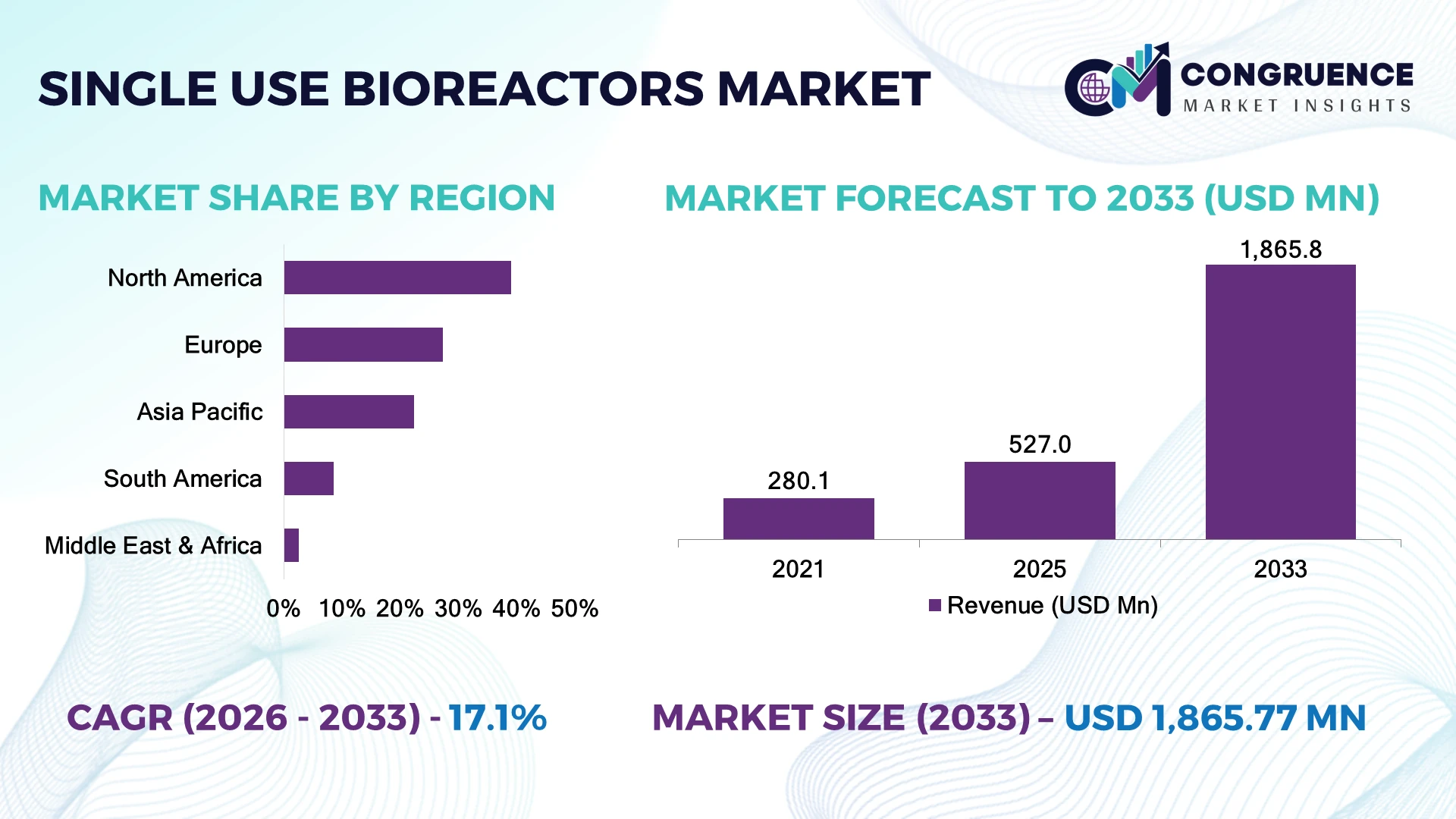
The United States dominates single-use bioreactor deployment, accounting for about 30.2% of global market value in 2025, supported by extensive biologics manufacturing, CDMO capacity, and advanced cell-culture infrastructure. China is scaling faster through biopharmaceutical facility expansion, while India is strengthening local supply capacity, including new pallet-tank production planned through 2027.
Strategically, manufacturers should prioritize scalable systems, localized consumables supply, automation, and partnerships with biologics producers to secure long-term competitive advantage.
Market Size & Growth: USD 527.0 million in 2025 is projected to reach USD 1,865.8 million by 2033 at a 17.12% CAGR, supported by modular biologics manufacturing and disposable process platforms.
Top Growth Drivers: Biologics manufacturing 42%, automated processing 44%, and continuous bioprocessing adoption 19% are strengthening demand for flexible single-use infrastructure.
Short-Term Forecast: By 2028, single-use capacity is projected to reach 21.3% of mammalian cell-culture capacity, increasing the need for scalable vessels and integrated consumables.
Emerging Technologies: AI-enabled monitoring, automated control, sensor-integrated bags, and perfusion systems are accelerating process visibility; 44% of new disposable bioprocessing products incorporated sensor-enabled monitoring in 2025.
Regional Leaders: North America is positioned at about USD 6.4 billion by 2033, Asia Pacific at USD 5.68 billion, while the United States reaches USD 5.68 billion, with China and India driving manufacturing localization.
Consumer/End-User Trends: More than 60% of bioreactors now deploy single-use technology, reinforcing adoption among biologics producers, CDMOs, and advanced-therapy manufacturers.
Pilot/Case Example: In 2025, WuXi Biologics completed commercial production campaigns using three 5,000-liter single-use bioreactors, demonstrating large-scale deployment without equivalent traditional facility infrastructure.
Competitive Landscape: Sartorius, Danaher, Thermo Fisher Scientific, Merck, and Eppendorf form the core competitive group, competing through automation, scalable vessels, consumables, partnerships, and geographic manufacturing expansion.
Regulatory & ESG Impact: Single-use processing eliminates routine cleaning and sterilization requirements, while closed systems reduce contamination exposure; sustainability programs increasingly target polymer recycling and material efficiency.
Investment & Funding: Sartorius is expanding Bengaluru production capacity through 2027, while Thermo Fisher expanded its platform with a 5-liter system supporting scale-up from 1 to 5,000 liters.
Innovation & Future Outlook: Next-generation perfusion, digital monitoring, modular facilities, and high-capacity disposable systems are shifting competition toward integrated process ecosystems rather than standalone reactor hardware.
Single-use bioreactors are gaining traction across monoclonal antibodies, vaccines, cell therapies, and recombinant proteins, with upstream commercial adoption reaching 82.5% in an established industry survey. Demand is increasingly centered on rapid changeovers, closed processing, and flexible capacity as manufacturers respond to supply-chain restructuring and the growing complexity of biologics production. This transition creates a clear pathway toward more automated and modular biomanufacturing strategies.
Single-use bioreactors are becoming strategically important because they allow biopharmaceutical manufacturers to add capacity without replicating the extensive cleaning, sterilization, and fixed-equipment infrastructure associated with stainless-steel facilities. Their strongest advantage appears in clinical manufacturing, CDMOs, vaccines, and personalized therapies, where shorter campaigns and frequent product changeovers directly improve asset utilization. More than 70% of bioreactors controlled by CMOs were reported as single-use in 2024, highlighting the model's commercial relevance.
The technology also changes the economics of facility design. Disposable systems remove cleaning-validation cycles and reduce cross-contamination exposure, while integrated sensors and automation improve process control. In contrast, stainless-steel platforms retain advantages at very large commercial volumes. The United States remains the largest national market, while China and India are emphasizing capacity localization and supply-chain resilience.
Over the next 2–3 years, manufacturers will increasingly combine single-use reactors with perfusion, real-time analytics, and automated feeding. Thermo Fisher's 5-liter platform, scalable across 1–5,000 liters, illustrates the shift toward continuity between development and commercial production. Companies that secure consumables, automation, and local manufacturing partnerships alongside reactor capacity will gain the strongest operational positioning.
The principal growth driver is the shift toward flexible biologics production, where single-use systems shorten setup and changeover requirements while limiting cross-contamination exposure. Commercial upstream single-use adoption has reached 82.5%, while clinical upstream adoption stands at 62.9%, establishing disposable processing as a core manufacturing architecture rather than a niche option. The expansion of cell and gene therapy pipelines further favors modular capacity. In India, Sartorius is adding pallet-tank production through 2027, demonstrating how suppliers are localizing equipment capacity around high-growth bioprocessing hubs. Companies are responding with automated vessels, larger working volumes, and integrated consumables portfolios. The strategic advantage is faster capacity deployment without equivalent fixed-asset complexity.
Disposable architecture creates a structural dependency on specialized films, bags, connectors, sensors, and sterile consumables. Supply interruptions therefore affect production continuity more directly than in conventional stainless-steel systems. Industry assessments identify disposable-component logistics and storage as significant operational considerations, while large-scale systems still face limitations in oxygen transfer, mixing, and mechanical performance. More than 1,000-liter single-use reactors are already deployed at a substantial share of facilities, increasing the importance of reliable high-volume consumables. Companies are reducing exposure through dual sourcing, regional production, longer-term supply contracts, and standardized components. The key operational issue is no longer reactor availability alone but synchronized availability of the entire disposable process train.
The strongest opportunity lies in combining single-use reactors with perfusion, automation, and continuous processing to increase output from smaller physical footprints. Adoption of single-use perfusion equipment has risen from 33.1% in 2016 to 65.8% in 2026, indicating a substantial shift toward intensified upstream processing. India, China, and other Asian manufacturing hubs offer additional opportunities as local biologics capacity expands and imported process components are increasingly localized. Companies are investing in high-capacity reactors, sensor-enabled monitoring, and integrated digital controls. The non-obvious opportunity is the convergence of reactor hardware and process analytics: suppliers that control both layers can capture recurring consumables and software value while improving production consistency.
Scaling single-use systems from development to commercial manufacturing remains an execution challenge because mixing, oxygen transfer, bag integrity, sensor reliability, and automation interoperability become more demanding at larger volumes. Around one-third of surveyed facilities reported single-use bioreactors above 1,000 liters, demonstrating progress but also the increasing technical complexity of large-scale deployment. The simultaneous rise of perfusion evaluation to 42.3% of surveyed manufacturers adds further integration requirements. Companies must strengthen engineering validation, digital integration, workforce training, and supplier qualification. The strategic pressure is to make disposable platforms behave as standardized manufacturing infrastructure rather than isolated equipment, particularly as commercial batch sizes increase.
Automation-Led Process Control: Automated feeding, inline sensors, and digital control systems are moving from premium installations toward mainstream bioprocessing. Sensor-integrated platforms are being adopted across more than 40% of newer disposable workflows, while automated control can reduce manual intervention by roughly 20–30%. Manufacturers are integrating real-time monitoring to improve batch consistency, reduce operator dependency, and address skilled-labor shortages in the United States and Europe.
Larger Disposable Production Trains: Commercial deployment is shifting toward larger single-use vessels as biologics manufacturers seek flexible capacity without extensive fixed infrastructure. Systems above 1,000 L now represent a meaningful portion of commercial installations, while 2,000–5,000 L platforms are gaining traction among CDMOs. Suppliers are strengthening high-volume bag, sensor, and mixing capabilities, creating a non-obvious shift toward disposable infrastructure designed for commercial rather than primarily clinical production.
Cell Therapy Workflow Expansion: Wave-induced and low-shear platforms are gaining attention as cell and gene therapy programs move toward commercial manufacturing. Perfusion-based single-use processing adoption has increased substantially, with evaluation reaching more than 40% among surveyed manufacturers. Companies are redesigning closed workflows around shorter processing cycles, automated cell expansion, and smaller production footprints, particularly in the United States and China.
Supply-Chain Localization Accelerates: Biopharma manufacturers are increasingly prioritizing regional availability of bags, connectors, sensors, and assemblies after pandemic-era supply disruptions exposed dependency on concentrated suppliers. Localization initiatives are targeting 20–30% reductions in lead-time exposure, while dual-sourcing programs are expanding across major manufacturing hubs. Suppliers are responding through local production, inventory agreements, and strategic partnerships, making consumables resilience an increasingly important procurement criterion.
Stirred-tank single-use bioreactors remain the leading type, accounting for approximately 80% of the market in 2025. Their dominance reflects established mixing characteristics, efficient oxygen transfer, compatibility with mammalian-cell culture, and straightforward process transfer from stainless-steel systems. Their ability to support laboratory, clinical, and commercial volumes also gives manufacturers a stronger utilization profile than specialized alternatives. Wave-induced systems represent a smaller but strategically important segment, while bubble-column and other configurations retain relevance for applications requiring lower mechanical complexity or specialized mass-transfer characteristics.
Wave-induced bioreactors are the fastest-growing type, supported by increasing use in sensitive cell-culture and cell-therapy workflows. Their low-shear operation and simplified mixing architecture are strengthening demand, particularly where cell viability is prioritized over maximum volumetric productivity. Wave systems account for roughly 28% in one recent market assessment, compared with more than 50% for stirred-tank configurations in another. Companies are therefore directing investment toward impeller optimization for stirred systems while expanding gentle-mixing platforms for advanced therapies.
Bioproduction is the leading application, accounting for approximately 50% of the market in 2025. Its position reflects extensive use of single-use systems for commercial and clinical manufacturing of monoclonal antibodies, vaccines, recombinant proteins, viral vectors, and other biologics. Process development and research and development remain important applications, but bioproduction carries greater equipment utilization and recurring consumables requirements. The operational advantage is strongest in multiproduct facilities where disposable assemblies reduce turnaround requirements between campaigns.
Process development is emerging as the fastest-expanding application as manufacturers seek greater continuity between laboratory development and commercial production. Single-use platforms allow companies to replicate process conditions across scales while reducing equipment cleaning requirements. R&D remains strategically important for early-stage biologics and cell-therapy programs, particularly in the United States, China, and India. Companies are responding by offering modular systems, automated process controls, and scale-compatible vessel designs that connect development workflows with production infrastructure. The result is a stronger emphasis on platform standardization rather than isolated equipment purchases.
Pharmaceutical and biotechnology companies represent the dominant end-user group, accounting for approximately 61% of market demand. Their leadership reflects extensive biologics pipelines, internal manufacturing requirements, vaccine production, and increasing adoption of flexible multiproduct facilities. CROs and CDMOs follow closely as outsourcing expands and drug developers seek external manufacturing capacity without constructing dedicated facilities. Academic and research institutes represent a smaller segment, primarily supporting early-stage cell culture, translational research, and process-development activities.
CROs and CDMOs are the fastest-growing strategic buyer group as outsourcing reshapes biopharmaceutical manufacturing. Recent market assessments place CMOs and CROs at nearly 39% under an end-use classification, reflecting their high equipment utilization and multiproduct operating models. Their purchasing priorities increasingly favor standardized platforms that can accommodate multiple client processes, rapid campaign changeovers, and scalable production. Pharmaceutical companies are emphasizing long-term supply agreements and integrated equipment ecosystems, while CDMOs are expanding modular capacity and partnering with technology suppliers. Academic institutes remain important for technology validation but generally purchase smaller-scale systems, creating a clear shift in future demand toward commercial outsourcing networks.
North America accounted for the largest market share at 39.1% in 2025 however, Asia-Pacific is expected to register the fastest growth, expanding at a CAGR of 17.02% between 2026 and 2033.
North America remains the largest single-use bioreactor market, supported by the United States’ concentration of biopharmaceutical manufacturers, CDMOs, cell-therapy developers, and advanced manufacturing infrastructure. The region represented approximately 39.1% of global demand in 2025, while the U.S. accounted for the overwhelming majority of North American activity. More than 800 active biopharmaceutical manufacturing facilities in the United States provide a substantial installed base for disposable upstream systems. Deployment is increasingly concentrated around commercial biologics, viral-vector production, and multiproduct CDMO facilities. Companies are expanding modular manufacturing capacity and integrating automation, inline analytics, and high-volume disposable assemblies. The shift toward hybrid facilities is also becoming important as manufacturers combine single-use upstream operations with selected stainless-steel infrastructure, improving asset utilization without abandoning established production capabilities.
United States Market Outlook: The United States remains the principal national market because of its dense network of biologics manufacturers, CDMOs, research institutions, and cell-and-gene-therapy developers. The country accounts for roughly 30% of global single-use bioreactor demand and maintains the strongest concentration of commercial-scale disposable manufacturing. FDA support for advanced manufacturing technologies is encouraging companies to integrate automation, digital process control, and flexible production platforms into new facility designs.
Europe represented approximately 27.3% of the global single-use bioreactor market in 2025, with Germany, Switzerland, Ireland, the United Kingdom, and France forming the principal manufacturing and technology hubs. Strong biologics production, biosimilar manufacturing, and established bioprocess-equipment suppliers are sustaining demand. European manufacturers are increasingly evaluating single-use systems through both productivity and environmental-performance metrics, particularly as water consumption, cleaning chemicals, and facility utilities face greater scrutiny. Germany and Switzerland remain important equipment and consumables centers, while Ireland continues to attract large-scale biopharmaceutical manufacturing. Companies are expanding disposable assembly capacity and strengthening regional supply networks to reduce exposure to long-distance logistics. The growing use of hybrid facilities is also reshaping capital allocation, with manufacturers reserving stainless steel for high-utilization operations and deploying disposable equipment where campaign flexibility delivers greater economic value.
Germany Market Outlook: Germany is a strategic European hub because of its concentration of pharmaceutical manufacturing, process-engineering expertise, and bioprocess technology suppliers. The country benefits from an established industrial base capable of supporting both equipment production and sophisticated GMP manufacturing. German facilities are increasingly integrating automated single-use systems into multiproduct operations, while local suppliers strengthen capabilities in sensors, filtration, fluid handling, and process analytics.
Asia-Pacific is the fastest-expanding major market and represented approximately 22.4% of global demand in 2025. China and India are central to the regional transition, supported by expanding biologics production, biosimilar manufacturing, CDMO capacity, and government-backed efforts to strengthen domestic biopharmaceutical supply chains. South Korea and Singapore are adding high-value commercial manufacturing capacity, while Japan maintains a mature pharmaceutical infrastructure with comparatively measured conversion from stainless steel. India is becoming increasingly important as an equipment and consumables manufacturing base; a major Bengaluru facility delivered 50 pallet tanks to customers in India and international markets in 2024 and is adding dedicated pallet-tank production capacity through 2027. Companies are responding with localized production, regional service networks, and modular systems designed for faster deployment.
China Market Outlook:
China represents one of the largest and fastest-developing national markets, supported by extensive biologics, biosimilar, vaccine, and cell-therapy manufacturing programs. The country is estimated to account for approximately 14–18% of global single-use bioreactor demand. Domestic CDMO expansion and supply-chain localization are accelerating adoption, while manufacturers increasingly prioritize scalable disposable systems that reduce facility construction complexity and support rapid multiproduct production.
South America remains a smaller but strategically relevant market, with approximately 8.6% of global demand concentrated largely in Brazil and Mexico. Brazil has the region’s strongest pharmaceutical manufacturing ecosystem, supported by vaccine production, biologics development, public-sector health programs, and established research institutions. Single-use bioreactors are increasingly relevant for facilities seeking flexible production without extensive stainless-steel infrastructure, particularly for vaccines, recombinant proteins, and process-development activities. Limited local manufacturing of specialized bags, sensors, and assemblies remains an operational constraint, increasing dependence on international suppliers and regional distribution networks. Companies are responding by strengthening distributor partnerships, expanding technical support, and adapting equipment configurations to smaller production footprints. The strategic opportunity lies in pairing modular systems with localized service and consumables inventories, reducing downtime caused by imported components and improving deployment economics.
Brazil Market Outlook: Brazil is the leading South American opportunity because of its pharmaceutical manufacturing scale and established vaccine-production capabilities. The country’s public and private biomanufacturing infrastructure supports demand for flexible upstream systems, particularly where production campaigns change frequently. Brazil’s emphasis on domestic health-product manufacturing also strengthens the case for localized bioprocessing capacity, creating opportunities for equipment suppliers that combine technical support with dependable consumables availability.
Middle East & Africa represents approximately 2.6% of global single-use bioreactor demand, but investment-led biopharmaceutical development is creating new pockets of adoption. Saudi Arabia and the United Arab Emirates are emerging as the most strategically important markets as healthcare diversification programs encourage pharmaceutical manufacturing, biotechnology investment, and advanced laboratory infrastructure. Modular single-use platforms are particularly suited to new facilities because they reduce dependence on extensive water-for-injection, cleaning, and fixed-equipment infrastructure. Regional manufacturers are prioritizing partnerships with international technology providers, localized training, and service capabilities to address workforce and maintenance requirements. The non-obvious advantage is that newer facilities can adopt disposable architectures without carrying large legacy stainless-steel footprints. Companies entering the region are therefore emphasizing turnkey systems, automation, qualification support, and regional technical networks rather than selling reactor hardware alone.
Saudi Arabia Market Outlook: Saudi Arabia is emerging as a leading regional biopharmaceutical investment hub through healthcare industrialization and biotechnology-development initiatives. Its strategy favors modern manufacturing infrastructure capable of supporting vaccines, biologics, and advanced therapies. New facilities can adopt single-use systems from the outset, avoiding many legacy-system constraints. Suppliers that establish local partnerships, workforce training, and after-sales infrastructure are positioned to capture early-stage deployment opportunities.
Sartorius, Thermo Fisher Scientific, Merck, Danaher’s Cytiva, and Eppendorf compete as global platform leaders, while regional bioprocess suppliers challenge them on customization, service, and pricing. The top five players collectively control approximately 55% of the market, creating a moderately concentrated structure. Competition centers on technology, with advanced automation and process analytics influencing roughly 35% of purchasing decisions, while supply reliability affects about 30%. Speed-to-deployment and customization account for another 20–25% as CDMOs prioritize flexible production. Sartorius is expanding bag capacity and digital integration; Thermo Fisher is pushing 5,000-L scalability; Cytiva emphasizes intensified processing; Merck strengthens integrated single-use workflows; and Eppendorf targets validated commercial-scale systems. The competitive shift is moving from standalone reactors toward integrated platforms combining vessels, bags, sensors, automation, and services. High barriers include GMP validation, polymer qualification, global supply assurance, and established customer workflows. Winning requires proven scale-up, dependable consumables, rapid technical support, and an integrated technology ecosystem.
Sartorius AG
Thermo Fisher Scientific Inc.
Merck KGaA
Danaher Corporation
Eppendorf SE
Repligen Corporation
PBS Biotech, Inc.
Solaris Biotech Solutions
Pierre Guerin Technologies
Meissner Filtration Products, Inc.
CerCell ApS
CESCO Bioengineering Co., Ltd.
Advanced automation is becoming the defining technology layer, combining single-use vessels with inline sensors, PAT, digital control, and recipe management. Automated workflows can reduce manual intervention by roughly 20–30%, while high-throughput parallel systems run up to 48 miniature bioreactors simultaneously. Sartorius and Thermo Fisher are integrating scalable automation architectures, giving CDMOs faster process characterization, stronger data integrity, and smoother technology transfer.
Process intensification is the next major shift. Perfusion, intensified fed-batch, improved sparging, and optimized impellers increase volumetric productivity while reducing facility footprint. Modern systems can deliver up to 50% more product within comparable footprints, while optimized single-use designs can lower production costs by as much as 25% versus legacy configurations. Thermo Fisher’s DynaDrive reaches 5,000 L, narrowing the performance gap with stainless steel and benefiting manufacturers pursuing commercial-scale flexibility.
From 2026 to 2028, connected single-use platforms will increasingly combine AI-assisted monitoring, non-invasive sensors, digital twins, and predictive control. Adoption is strongest in development and clinical manufacturing, where platform consistency across 1 L–5,000 L scales directly improves transferability. The disruptive competitive advantage shifts toward suppliers controlling both hardware and digital ecosystems. Companies that integrate analytics with consumables supply can reduce deviations, accelerate batch release, and lock in recurring customer relationships.
June 2025 Sartorius completed its Aubagne, France expansion, nearly doubling cleanroom space to 9,000 square meters for single-use bag production. Automated lines and logistics strengthen output, delivery reliability, and supply resilience, supporting faster customer deployment across global biopharma manufacturing networks worldwide. Source: Sartorius
May 2025 Thermo Fisher Scientific introduced the 5 L DynaDrive Single-Use Bioreactor, using the same design and film architecture across 1–5,000 L. The platform strengthens development-to-commercial continuity, reducing scale-up friction and improving process transfer for biopharmaceutical manufacturers across commercial workflows. Source: Thermo Fisher Scientific
September 2025 Merck launched the CHOZN Elite cell line, designed for suspension growth with chemically defined, animal-component-free media. Higher-producing clones improve monoclonal-antibody productivity, strengthening upstream manufacturing efficiency and supporting larger single-use bioreactor campaigns for biologics producers and CDMOs globally.
July 2026 Repligen highlighted upstream process-intensification results showing up to 10× higher batch yield for mAb perfusion and 3–10× AAV production improvement. The data strengthens demand for integrated perfusion technologies, enabling manufacturers to increase output without proportionally expanding bioreactor footprints. Source: Repligen
The Single-Use Bioreactors Market Report provides a structured assessment of market development across stirred-tank, wave-induced, bubble-column, and other bioreactor configurations, covering bioproduction, process development, and research applications. End-user analysis spans pharmaceutical and biotechnology companies, CROs and CDMOs, and academic and research institutes, with emphasis on purchasing behavior, deployment scale, technology selection, and operational requirements.
Geographic coverage includes North America, Europe, Asia-Pacific, South America, and Middle East & Africa, with country-level perspectives for major manufacturing hubs. The report evaluates automation, PAT, perfusion, process intensification, advanced sensors, scalable vessel architectures, and digital control systems. It also examines competitive positioning across 10+ major industry participants, supply-chain localization, capacity expansion, sustainability priorities, and emerging cell-therapy applications. These insights support investment planning, facility expansion, supplier selection, competitive positioning, and strategic decisions through 2026–2033.
| Report Attribute / Metric Details | Details |
|---|---|
| Market Revenue (2025) | USD 527.0 Million |
| Market Revenue (2033) | USD 1,865.8 Million |
| CAGR (2026–2033) | 17.12% |
| Base Year | 2025 |
| Forecast Period | 2026–2033 |
| Historic Period | 2021–2025 |
| Segments Covered |
By Type
By Application
By End-User
|
| Key Deliverables | Revenue Forecast; Market Trends; Growth Drivers & Restraints; Technology Insights; Segmentation Analysis; Regional Insights; Competitive Landscape; Regulatory & ESG Overview; Recent Developments |
| Regions Covered | North America; Europe; Asia-Pacific; South America; Middle East & Africa |
| Companies Profiled | Sartorius AG; Thermo Fisher Scientific Inc.; Merck KGaA; Danaher Corporation; Eppendorf SE; Repligen Corporation; PBS Biotech, Inc.; Solaris Biotech Solutions; Pierre Guerin Technologies; Meissner Filtration Products, Inc.; CerCell ApS; CESCO Bioengineering Co., Ltd. |
| Customization & Pricing | Available on Request (10% Customization Free) |




