
Reports
The Global Single Girder Bridge Cranes Market was valued at USD 261.0 Million in 2025 and is anticipated to reach a value of USD 409.8 Million by 2033 expanding at a CAGR of 5.8% between 2026 and 2033. Growth is being propelled by accelerated warehouse automation, factory modernization programs, and rising deployment of lightweight material-handling systems across manufacturing and logistics facilities.
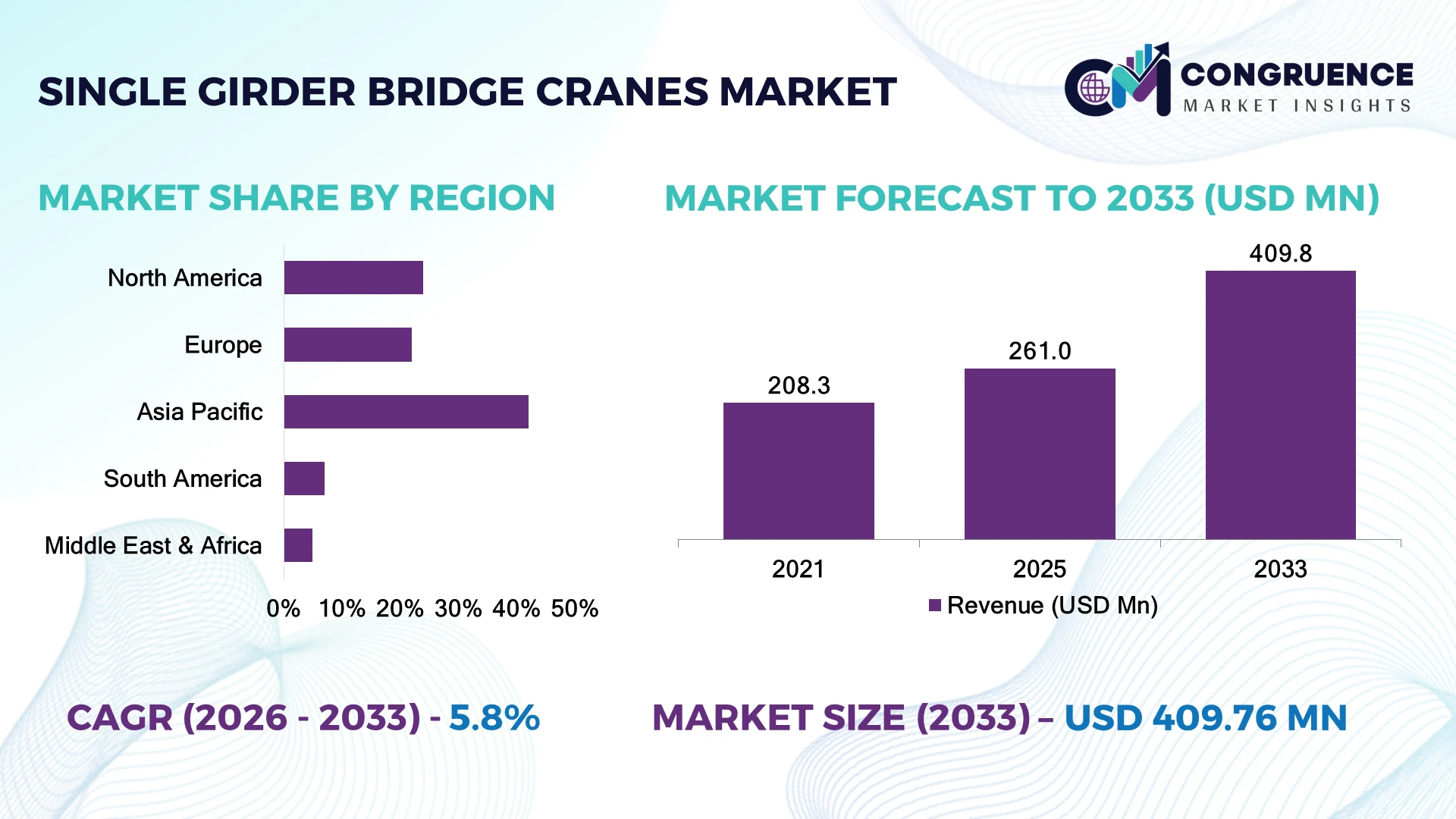
China dominates the market with nearly 34% of global installed bridge crane capacity, supported by over USD 150 billion in industrial automation and smart manufacturing investments and strong adoption across automotive, steel, and machinery sectors. Germany accounts for approximately 9% of installations but records higher smart crane penetration exceeding 40% in advanced factories. Ongoing industrial realignment following global supply-chain diversification continues to strengthen equipment replacement demand across major manufacturing hubs.
Strategic implication manufacturers prioritizing intelligent lifting systems, predictive maintenance, and localized service networks are positioned to secure long-term competitive advantage.
Market Size & Growth: USD 261.0 Million in 2025 reaching USD 409.8 Million by 2033, supported by automation-led material handling upgrades and smart factory expansion.
Top Growth Drivers: Warehouse automation (+28%), industrial modernization (+24%), logistics infrastructure expansion (+19%).
Short-Term Forecast: By 2028, crane downtime is expected to decline by 18% through predictive maintenance deployment.
Emerging Technologies: AI monitoring, IoT-enabled diagnostics, and automated anti-sway controls improve operational precision by over 20%.
Regional Leaders: Asia Pacific (~USD 175 Million), Europe (~USD 88 Million), North America (~USD 74 Million); all benefit from advanced manufacturing adoption.
Consumer/End-User Trends: Over 55% of new industrial facilities prioritize automated lifting and remote-control crane systems.
Pilot/Case Example: In 2024, a smart manufacturing deployment improved lifting efficiency by 22% and reduced maintenance interruptions by 15%.
Competitive Landscape: Top players hold roughly 45% combined share; Konecranes, ABUS, GH Cranes, Demag, and Street Crane lead innovation.
Regulatory & ESG Impact: Energy-efficient drive systems reduce power consumption by up to 25%, supporting industrial sustainability targets.
Investment & Funding: More than USD 3.5 Billion has been directed toward factory automation and material-handling upgrades globally.
Innovation & Future Outlook: Digital twins, autonomous lifting coordination, and cloud-based fleet management are reshaping operational strategies.
Single Girder Bridge Cranes are becoming essential across manufacturing plants, logistics centers, steel processing facilities, and assembly operations where efficient load movement and space optimization are critical. Recent innovations include IoT-enabled condition monitoring, anti-collision systems, and remote operation platforms. More than 35% of newly installed industrial cranes now incorporate smart monitoring features. Supply-chain localization initiatives and industrial resilience programs are also encouraging replacement of legacy lifting infrastructure, setting the stage for broader strategic adoption.
Single girder bridge cranes are increasingly strategic assets in modern industrial operations because they directly influence productivity, facility utilization, and operational safety. As manufacturers restructure supply chains and expand localized production capacity, demand for efficient material-handling infrastructure is rising across automotive, electronics, machinery, and logistics sectors. Industrial modernization programs and smart factory initiatives are accelerating procurement decisions among large enterprises seeking operational flexibility.
Technology adoption is reshaping performance benchmarks. IoT-enabled cranes can reduce unplanned maintenance events by nearly 30% compared with conventional systems while improving asset utilization by more than 20%. Germany and Japan demonstrate higher penetration of digitally connected lifting systems, whereas China and India lead in deployment scale due to expanding industrial facilities and infrastructure investment. This contrast highlights the growing importance of both volume deployment and technology sophistication.
Over the next two to three years, smart monitoring integration is expected to exceed 40% of new installations in advanced manufacturing facilities. Major suppliers are expanding service networks, investing in predictive maintenance platforms, and forming automation partnerships to strengthen customer retention. Companies deploying intelligent crane ecosystems gain stronger operational visibility, lower lifecycle costs, and a sustainable competitive advantage in increasingly automated industrial environments.
Industrial automation is the primary catalyst driving adoption of single girder bridge cranes across manufacturing and logistics environments. More than 55% of newly commissioned production facilities now integrate automated material-handling systems to improve throughput and reduce manual intervention. Smart factories have reported productivity gains exceeding 20% after deploying connected lifting equipment. China's advanced manufacturing initiatives and India's industrial corridor developments continue expanding demand for efficient overhead lifting solutions. The direct impact is higher operational efficiency, lower handling errors, and improved workplace safety. In response, crane manufacturers are investing in IoT platforms, predictive maintenance technologies, and expanded service networks. A notable strategic insight is that buyers increasingly evaluate lifecycle performance and digital capabilities rather than upfront equipment costs alone, reshaping procurement priorities across industrial sectors.
Volatility in steel, electrical components, and industrial electronics remains a significant restraint for the market. Structural steel can account for nearly 40% of crane manufacturing costs, while component procurement expenses have increased by more than 15% during recent supply-chain disruptions. Dependence on imported motors, controls, and electronic systems exposes manufacturers to currency fluctuations and delivery uncertainty. Germany and Italy-based equipment producers have faced procurement lead-time extensions of over 20% in certain component categories. These conditions pressure margins, delay project execution, and complicate pricing strategies. To mitigate risks, companies are expanding supplier networks, increasing local sourcing, and securing long-term procurement contracts. A key operational insight is that supply-chain resilience is becoming as important as engineering capability in maintaining project competitiveness.
A major opportunity lies in transforming single girder bridge cranes into intelligent connected assets. More than 35% of industrial operators now prioritize remote diagnostics and condition-monitoring capabilities when evaluating equipment investments. Predictive maintenance systems can reduce maintenance costs by approximately 25% while increasing equipment availability by over 15%. Japan and South Korea are accelerating adoption of AI-assisted monitoring technologies within advanced manufacturing facilities. Emerging policies supporting industrial digitalization and energy-efficient operations further strengthen this trend. Manufacturers are responding through software development partnerships, cloud-based monitoring platforms, and expanded R&D programs. A unique strategic opportunity exists in recurring digital service revenues, allowing suppliers to transition from equipment vendors to long-term operational technology partners with stronger customer retention.
Integrating modern crane systems into increasingly automated industrial environments presents a significant long-term challenge. Nearly 30% of industrial operators report shortages of technicians capable of managing connected lifting equipment and advanced control systems. Integration with warehouse management software, production execution systems, and plant automation networks can increase deployment timelines by more than 20%. Cybersecurity requirements are also intensifying as remote monitoring adoption expands. Industrial facilities in the United States and Germany face growing pressure to secure connected operational technology environments against digital threats. Failure to address these challenges can reduce deployment consistency and limit operational benefits. Companies must invest in workforce training, cybersecurity frameworks, and ecosystem partnerships to ensure reliable implementation and maintain long-term competitiveness in increasingly digital industrial operations.
Smart Monitoring Becomes Standard Advanced condition-monitoring systems are being integrated into nearly 38% of new single girder crane installations, while predictive maintenance deployment has increased by over 25% across large manufacturing facilities. Industrial operators are using sensor-driven diagnostics to reduce unplanned downtime by approximately 20%. In response to labor shortages and maintenance efficiency targets, crane suppliers are expanding digital service portfolios and embedding remote support capabilities into equipment offerings.
Remote-Controlled Operations Accelerate Adoption of radio remote-control systems has surpassed 45% in newly commissioned industrial lifting projects, improving operator productivity by nearly 18% and reducing safety incidents by around 12%. Automotive plants in Germany and electronics manufacturers in China are replacing wired controls with wireless operation platforms to optimize workflow flexibility. Manufacturers are responding through automation-focused partnerships and integrated control-system upgrades designed for continuous production environments.
Energy-Efficient Components Gain Ground Variable frequency drives, lightweight girder designs, and regenerative braking technologies are reducing energy consumption by 15–25% in modern installations. Rising electricity costs and stricter industrial sustainability targets are encouraging facility operators to prioritize efficient lifting infrastructure. A less obvious trend is the growing preference for lower structural loading designs, allowing companies to avoid costly building modifications while expanding lifting capacity.
Localized Supply Networks Expand More than 30% of crane manufacturers have increased regional sourcing and assembly operations to reduce procurement lead times. Supply-chain restructuring and geopolitical trade uncertainties have encouraged localized production strategies, particularly in India and Southeast Asia. Faster component availability is improving project delivery speed by nearly 20%, while companies strengthen resilience through supplier diversification, regional partnerships, and modular equipment architectures.
Top Running Single Girder Bridge Cranes remain the leading type, accounting for approximately 58% of market demand. Their dominance is supported by superior lifting height utilization, longer runway spans, and greater adaptability across automotive, metal processing, and manufacturing facilities. Industrial operators favor top-running systems because they improve floor-space efficiency while supporting heavier operational workloads. Adoption remains particularly strong in China, Germany, and the United States, where large-scale production environments require consistent material flow and high equipment reliability. Under Running Single Girder Bridge Cranes represent the fastest-growing segment, supported by rising demand from compact manufacturing units, warehouses, and retrofit projects. Adoption has increased by nearly 22% in facilities prioritizing space optimization and lower structural loading requirements. While top-running cranes continue to dominate high-volume industrial operations, under-running variants are gaining traction in modern logistics environments where installation flexibility is critical. Manufacturers are expanding modular product portfolios, developing lightweight structures, and strengthening customization capabilities to capture evolving demand patterns. Investment priorities increasingly favor adaptable crane architectures capable of supporting automation upgrades and facility modernization programs.
Manufacturing is the largest application segment, representing roughly 38% of market deployment. Production facilities rely on single girder bridge cranes for assembly support, component handling, and workflow optimization. Demand concentration remains strongest within automotive, machinery, electronics, and fabricated metal industries, where lifting efficiency directly affects production output. Automated material movement systems have improved handling productivity by more than 20% in several advanced manufacturing environments, reinforcing the segment's leadership position. Warehousing and Logistics is the fastest-growing application area, driven by e-commerce expansion, distribution center modernization, and inventory automation initiatives. Deployment growth exceeds 24% among high-volume logistics operators seeking faster throughput and improved load management. Construction, power facilities, and metal fabrication continue to represent important demand segments, particularly for project-based lifting requirements. Companies are expanding deployment capacity through integrated automation solutions, digital monitoring platforms, and scalable lifting systems. Demand is increasingly shifting toward applications where operational visibility, uptime optimization, and workflow integration create measurable performance advantages.
The Automotive industry remains the dominant end-user segment, accounting for approximately 33% of market demand. Vehicle assembly operations, component manufacturing plants, and supplier facilities depend heavily on single girder bridge cranes for precise and continuous material movement. High production volumes and stringent operational efficiency requirements sustain strong purchasing activity. Many automotive facilities have achieved handling-cycle improvements exceeding 15% through modern crane deployments integrated with automated production systems. Aerospace represents the fastest-growing end-user segment as manufacturers expand aircraft production capacity and increase investment in precision handling technologies. Adoption rates have risen by nearly 20% in facilities requiring enhanced positioning accuracy and load control. Metal and Mining remains a substantial market contributor due to intensive material-handling requirements, while Paper and other industrial sectors continue adopting efficient lifting systems to improve operational reliability. Suppliers are targeting these industries through customized solutions, application-specific engineering, service agreements, and digital maintenance offerings. Competitive positioning increasingly depends on delivering specialized performance tailored to industry-specific operational environments.
Asia-Pacific accounted for the largest market share at 42% in 2025 however, Middle East & Africa is expected to register the fastest growth, expanding at a CAGR of 6.8% between 2026 and 2033.
North America represented approximately 24% of global market activity in 2025, supported by strong manufacturing output, logistics modernization, and warehouse automation investments. The United States and Canada continue expanding advanced production facilities where efficient overhead material handling is critical for operational continuity. Automotive, aerospace, metal fabrication, and distribution sectors remain key deployment centers. More than 40% of newly installed industrial lifting systems in large manufacturing facilities now incorporate remote monitoring or predictive maintenance functionality. Companies are prioritizing equipment upgrades to improve uptime, reduce labor dependency, and enhance workplace safety. Strategic partnerships between crane suppliers and industrial automation providers are accelerating integration with digital factory environments. The region also benefits from ongoing reshoring initiatives that require expanded material-handling capacity across industrial hubs.
United States Market Outlook: The United States remains the largest contributor within North America due to its extensive manufacturing base, advanced logistics infrastructure, and high automation adoption. Automotive assembly plants, aerospace production facilities, and e-commerce distribution centers continue investing in modern lifting systems. Nearly 50% of large industrial facilities evaluating equipment modernization programs include connected crane technologies within their capital expenditure plans. Strong focus on operational efficiency and predictive maintenance capabilities supports sustained deployment activity.
Europe accounts for approximately 22% of global market demand, driven by industrial modernization, advanced engineering capabilities, and sustainability-focused equipment investments. Germany, Italy, France, and the United Kingdom remain major deployment centers due to strong manufacturing ecosystems. Industrial operators increasingly prioritize energy-efficient drive systems and intelligent lifting platforms to reduce operational costs while improving productivity. More than 35% of newly commissioned industrial facilities incorporate automated material-handling technologies as part of broader digital transformation initiatives. Manufacturers are also investing in lightweight structural designs and intelligent controls to meet evolving operational requirements. Regulatory emphasis on workplace safety and energy performance continues influencing procurement decisions. Enterprise adoption is shifting toward connected crane systems that provide greater visibility into equipment utilization and maintenance requirements.
Germany Market Outlook: Germany leads the European market through its highly automated industrial sector and strong machinery manufacturing base. Automotive production, precision engineering, and industrial equipment facilities create sustained demand for advanced lifting solutions. Smart factory implementation remains a major competitive advantage, with connected industrial systems deployed across a significant share of large manufacturing facilities. German enterprises continue investing in integrated automation platforms that enhance operational efficiency and material-flow optimization.
Asia-Pacific remains the largest regional market, contributing around 42% of global demand. The region benefits from extensive manufacturing activity, industrial infrastructure expansion, and large-scale logistics development. China, India, Japan, and South Korea serve as major deployment hubs across automotive, electronics, steel, machinery, and warehousing sectors. Industrial automation initiatives continue accelerating crane installations within modern production facilities. More than 45% of new manufacturing investments across key industrial clusters include upgraded material-handling infrastructure. Rising export-oriented production and warehouse construction further strengthen equipment demand. Companies are expanding production capacity, localizing supply chains, and developing application-specific crane solutions to address diverse industrial requirements. The region's combination of scale, industrial output, and infrastructure investment sustains its leadership position.
China Market Outlook: China dominates regional demand through its vast manufacturing ecosystem and extensive industrial infrastructure. Automotive, steel, machinery, and electronics industries generate substantial deployment activity across production facilities and logistics centers. Approximately one-third of global industrial crane installations are associated with Chinese manufacturing operations. Continuous investment in smart manufacturing programs, factory modernization initiatives, and automated material-handling systems strengthens the country's position as the most influential market for single girder bridge cranes.
South America accounts for approximately 7% of global market activity, supported primarily by mining, metal processing, manufacturing, and infrastructure development projects. Brazil, Chile, and Argentina remain important deployment markets due to their industrial and resource-processing sectors. Material-handling modernization is becoming increasingly important as operators seek productivity improvements and reduced maintenance costs. Several industrial operators have reported equipment efficiency gains exceeding 15% following modernization initiatives. Despite ongoing investment momentum, infrastructure bottlenecks and procurement delays can affect project timelines. Companies are responding through localized service operations, regional partnerships, and targeted equipment customization. Demand remains strongest in applications where operational reliability and heavy-duty handling capabilities directly influence production performance.
Brazil Market Outlook: Brazil represents the largest market within South America due to its diversified industrial base, mining operations, and manufacturing activity. Steel production facilities, automotive plants, and logistics infrastructure projects continue driving equipment deployment. Industrial modernization programs are encouraging replacement of aging lifting infrastructure, while warehouse automation investments support additional demand. Large-scale manufacturing facilities increasingly prioritize operational reliability and maintenance optimization when selecting lifting systems.
Middle East & Africa contributes approximately 5% of global demand but exhibits the strongest forward deployment momentum. Large-scale industrial diversification programs, logistics corridor development, and infrastructure modernization projects are creating new opportunities for material-handling equipment suppliers. Saudi Arabia, the United Arab Emirates, and South Africa remain key deployment centers. More than 30% of major industrial construction projects in several Gulf economies include advanced material-handling systems within their operational planning frameworks. Investments in manufacturing zones, ports, and logistics facilities continue supporting demand for efficient lifting solutions. Companies are expanding regional partnerships, establishing service capabilities, and tailoring solutions for industrial infrastructure projects. The market is increasingly characterized by modernization-led procurement rather than replacement-driven demand.
Saudi Arabia Market Outlook: Saudi Arabia is the most strategically significant market within the region due to extensive industrial diversification initiatives, logistics expansion, and infrastructure development programs. New manufacturing zones, industrial complexes, and logistics facilities are generating sustained demand for modern lifting systems. Industrial project pipelines continue supporting equipment deployment across multiple sectors. Growing emphasis on operational efficiency, local industrial capability development, and advanced infrastructure execution strengthens the country's long-term importance within the global single girder bridge cranes market.
The competitive landscape is led by Konecranes, ABUS Kransysteme, Street Crane, GH Cranes & Components, and Demag, which collectively account for approximately 48% of global market activity. Competition is primarily between global technology leaders and regional cost-focused manufacturers, while OEMs increasingly compete against integrated automation providers offering connected lifting ecosystems. Technology, customization, lifecycle support, and delivery speed have become more influential than equipment pricing alone. Smart crane adoption has increased by over 35%, while predictive maintenance deployment has expanded by nearly 25%, creating differentiation through operational intelligence rather than mechanical performance alone. Leading players are expanding manufacturing footprints, strengthening distributor networks, and forming automation partnerships to secure long-term industrial contracts. Regional suppliers compete aggressively through localized engineering, shorter lead times, and project-specific customization. The competitive shift is moving toward digitally enabled crane platforms and service-based business models. High certification requirements, engineering expertise, and after-sales infrastructure remain major entry barriers. Winning requires scalable technology, responsive service networks, and strong industrial integration capabilities.
ABUS Kransysteme GmbH
Street Crane Company Ltd.
GH Cranes & Components
Demag Cranes & Components
Gorbel Inc.
Weihua Group
Henan Mine Crane Co., Ltd.
Nucleon (Xinxiang) Crane Co., Ltd.
EMH, Inc.
ZASO Industrial Cranes
Ace Industries, Inc.
R&M Materials Handling, Inc.
SWF Krantechnik GmbH
Single girder bridge cranes are rapidly transitioning from conventional lifting equipment into connected industrial assets. IoT-enabled monitoring systems, predictive maintenance platforms, and intelligent diagnostics are now incorporated into roughly 35% of new industrial crane deployments. These technologies reduce unplanned downtime by nearly 20% while improving maintenance planning accuracy. Remote condition monitoring has become particularly valuable for automotive, logistics, and metal-processing facilities seeking higher equipment availability and operational visibility.
Emerging technologies include AI-assisted fault detection, anti-sway automation, digital twin simulation, and cloud-connected fleet management. Compared with traditional manually monitored cranes, connected systems improve maintenance efficiency by approximately 25% and reduce inspection workloads by nearly 30%. Adoption of advanced variable frequency drives and automated load-positioning technologies continues increasing, especially in Germany, Japan, and China. Manufacturers and facility operators benefit through lower lifecycle costs, faster material flow, and improved workplace safety performance.
The next disruptive phase between 2026 and 2028 centers on autonomous lifting workflows and integrated factory automation. More than 40% of large industrial modernization projects are evaluating crane integration with manufacturing execution systems and warehouse management platforms. Technology leaders offering software-enabled crane ecosystems gain stronger customer retention, recurring service opportunities, and measurable operational differentiation. Companies that invest early in intelligent lifting infrastructure will secure substantial productivity and competitive advantages.
March 2024 – Konecranes launched the X-series industrial crane featuring wireless software upgrades, connected architecture, and lifting capacities up to 20 tons. The platform builds on a product family with more than 100,000 installed units globally, strengthening digital service opportunities and lifecycle value. Source: www.news.cision.com
April 2024 – Konecranes expanded digital services across its crane portfolio by standardizing remote monitoring and connected asset management capabilities. The initiative enables 24/7 operational visibility and supports data-driven maintenance optimization, helping industrial operators improve equipment utilization and maintenance planning efficiency. Source: www.investors.konecranes.com
May 2025 – Konecranes completed installation of a new 42-ton coil-handling crane for Welser Profile in Austria, replacing a legacy 36-ton system and upgrading a 175-meter runway. The project improved operational reliability and production support for high-volume metal processing operations. Source: www.konecranes.com
March 2024 – Konecranes introduced enhanced connected crane capabilities through over-the-air feature activation and TRUCONNECT integration, supporting a global installed base of approximately 53,600 connected assets. The development strengthens predictive maintenance adoption and expands data-enabled operational services.
This report provides comprehensive analysis of the global single girder bridge cranes market across major crane types, applications, end-user industries, and key geographic regions. The study evaluates deployment patterns across manufacturing, warehousing, logistics, construction, metal processing, aerospace, automotive, and industrial infrastructure environments. It assesses operational trends including automation adoption, digital monitoring integration, energy-efficient lifting technologies, and smart maintenance platforms. More than 35% of newly installed systems now incorporate connected monitoring capabilities, making technology assessment a central component of market evaluation.
The report further examines competitive positioning, regional industrial concentration, procurement trends, supply-chain developments, and strategic investment priorities between 2026 and 2033. Analysis covers North America, Europe, Asia-Pacific, South America, and Middle East & Africa while highlighting emerging deployment opportunities and evolving enterprise requirements. The insights support expansion planning, product strategy, partnership evaluation, technology investment decisions, and long-term competitive positioning for manufacturers, suppliers, distributors, investors, and industrial end users.
| Report Attribute / Metric | Details |
|---|---|
| Market Revenue (2025) | USD 261.0 Million |
| Market Revenue (2033) | USD 409.8 Million |
| CAGR (2026–2033) | 5.8% |
| Base Year | 2025 |
| Forecast Period | 2026–2033 |
| Historic Period | 2021–2025 |
| Segments Covered |
By Type
By Application
By End-User
|
| Key Deliverables | Revenue Forecast; Market Trends; Growth Drivers & Restraints; Technology Insights; Segmentation Analysis; Regional Insights; Competitive Landscape; Regulatory & ESG Overview; Recent Developments |
| Regions Covered | North America; Europe; Asia-Pacific; South America; Middle East & Africa |
| Companies Profiled | Konecranes; ABUS Kransysteme GmbH; Street Crane Company Ltd.; GH Cranes & Components; Demag Cranes & Components; Gorbel Inc.; Weihua Group; Henan Mine Crane Co., Ltd.; Nucleon (Xinxiang) Crane Co., Ltd.; EMH, Inc.; ZASO Industrial Cranes; Ace Industries, Inc.; R&M Materials Handling, Inc.; SWF Krantechnik GmbH |
| Customization & Pricing | Available on Request (10% Customization Free) |




