
Reports
The Global Silicon Photonics Market was valued at USD 2708.64 Million in 2025 and is anticipated to reach a value of USD 16562.71 Million by 2033 expanding at a CAGR of 25.4% between 2026 and 2033. Growth is primarily driven by AI data center expansion, 800G/1.6T optical interconnect deployment, co-packaged optics development, and increasing hyperscale network upgrades requiring high-bandwidth, energy-efficient photonic integration.
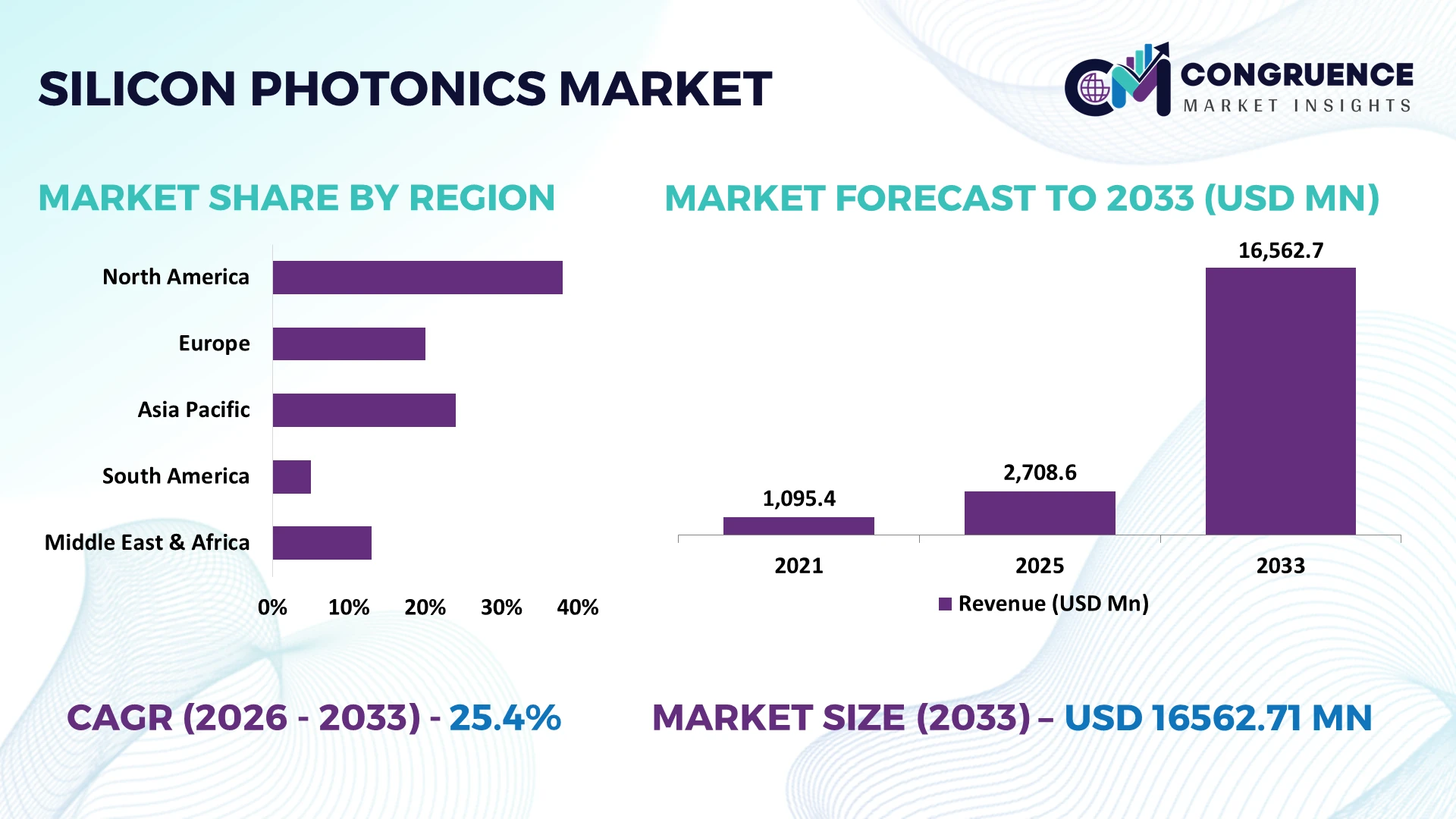
The United States leads the global silicon photonics landscape with approximately 41% of advanced commercial deployment, supported by multi-billion-dollar semiconductor investments, hyperscale cloud infrastructure, and defense electronics programs. China follows with nearly 28% manufacturing capacity, backed by domestic semiconductor expansion despite advanced chip export restrictions introduced by the U.S., while Europe strengthens photonic R&D through industrial automation and automotive innovation. This geographic balance accelerates technology commercialization across multiple high-value industries.
Organizations expanding AI infrastructure and next-generation optical networking should prioritize partnerships within leading silicon photonics ecosystems to secure resilient supply chains and faster product commercialization.
Market Size & Growth: USD 2708.64 Million (2025) to USD 16562.71 Million (2033) at 25.4%, supported by AI server expansion and advanced optical interconnect deployment.
Top Growth Drivers: AI workloads (+40%), hyperscale data traffic (+35%), and 800G/1.6T optical networking adoption (+30%) continue accelerating global deployment.
Short-Term Forecast: By 2028, optical module power consumption declines nearly 20% while network bandwidth efficiency improves approximately 35%.
Emerging Technologies: AI-enabled optical switching, co-packaged optics, and advanced silicon photonic integration enhance performance while reducing energy consumption.
Regional Leaders: North America exceeds USD 6.8 Billion, Asia-Pacific approaches USD 5.9 Billion, and Europe surpasses USD 2.9 Billion through cloud, telecom, and industrial adoption.
Consumer/End-User Trends: More than 65% of hyperscale operators prioritize silicon photonics for faster data transmission and improved energy efficiency.
Pilot/Case Example: In 2026, next-generation AI cluster deployments achieved approximately 30% lower interconnect latency using integrated silicon photonics platforms.
Competitive Landscape: The top supplier group controls roughly 58% market share, led by Intel, Cisco, Broadcom, Coherent, and GlobalFoundries.
Regulatory & ESG Impact: Energy-efficiency initiatives reduce networking power demand by nearly 18%, while regional semiconductor localization strengthens supply-chain resilience.
Investment & Funding: More than USD 9 Billion supports fabrication expansion, strategic partnerships, and photonic packaging capacity across major semiconductor regions.
Innovation & Future Outlook: High-density optical I/O, wafer-scale photonic integration, and AI infrastructure modernization position silicon photonics as a strategic networking technology.
Silicon photonics adoption is accelerating across AI computing, cloud networking, telecommunications, and high-performance computing as manufacturers introduce integrated optical engines and advanced packaging technologies. More than 70% of next-generation hyperscale network designs emphasize photonic interconnects to improve bandwidth efficiency. Ongoing semiconductor localization initiatives and supply-chain diversification further strengthen long-term deployment, setting the stage for the strategic market assessment that follows.
Silicon photonics has become a strategic technology for AI infrastructure, cloud computing, advanced telecommunications, and semiconductor competitiveness because it addresses bandwidth limitations while improving power efficiency. Infrastructure modernization across hyperscale data centers and national semiconductor initiatives is accelerating commercialization, while supply-chain restructuring encourages localized photonic packaging and wafer production. This shift strengthens technology sovereignty and reduces dependence on geographically concentrated manufacturing ecosystems.
Compared with conventional copper interconnects, silicon photonics enables up to 50% lower power consumption for high-speed data transmission while supporting bandwidth density exceeding 2× in advanced computing environments. The United States maintains leadership through large-scale hyperscale deployments and integrated chip design, whereas Japan and Singapore emphasize precision manufacturing and advanced packaging capabilities for export-oriented production. Over the next two to three years, deployment of 800G and 1.6T optical modules is expected to exceed 60% among new AI-focused server installations, reflecting rapid enterprise adoption of high-capacity optical connectivity.
A practical example is the integration of silicon photonics within AI server clusters, where optical interconnects reduce latency and improve rack-level energy efficiency during intensive model training. Companies are expanding photonic packaging facilities, forming semiconductor partnerships, and increasing investment in co-packaged optics to strengthen commercialization. Organizations securing scalable manufacturing capacity and integrated design expertise will establish stronger competitive positioning as optical computing infrastructure becomes a core differentiator across digital industries.
AI computing clusters and hyperscale cloud expansion are transforming silicon photonics into a core networking technology. More than 70% of next-generation AI servers are being designed for higher optical interconnect density, while integrated photonic links reduce network power consumption by approximately 30% and increase transmission efficiency by over 40%. The United States continues expanding domestic semiconductor manufacturing under national industrial initiatives, encouraging localized photonic production and advanced packaging. In response, leading companies are investing in co-packaged optics, expanding wafer fabrication partnerships, and accelerating silicon photonic chip innovation. The structural transition from electrical to optical data transmission provides lasting operational advantages through improved scalability, lower energy intensity, and faster infrastructure deployment.
Silicon photonics production remains constrained by advanced fabrication complexity, specialized packaging requirements, and limited foundry availability. Advanced photonic packaging can account for nearly 35% of total device manufacturing cost, while qualification cycles often extend product deployment timelines by more than 25%. Export controls affecting advanced semiconductor equipment have increased sourcing complexity for manufacturers operating in China, creating additional procurement challenges. Companies are responding by diversifying fabrication partners, strengthening long-term supplier agreements, and expanding localized packaging capabilities in countries with established semiconductor ecosystems. These measures improve operational resilience but require disciplined capital allocation and coordinated manufacturing strategies to maintain competitive delivery performance.
The commercialization of co-packaged optics, edge AI infrastructure, and photonic integration creates high-value opportunities beyond traditional data center networking. Advanced optical architectures improve bandwidth density by approximately 45% while lowering thermal management requirements by nearly 20%, supporting more compact computing platforms. Japan and South Korea are expanding investments in photonic semiconductor research and precision manufacturing to strengthen global technology leadership. Companies are accelerating R&D programs, forming ecosystem partnerships, and integrating silicon photonics into telecommunications, automotive sensing, and high-performance computing platforms. A less obvious opportunity lies in reducing data center cooling requirements through optical integration, creating measurable operational savings alongside higher processing efficiency.
The principal long-term challenge is scaling integrated silicon photonics across diverse hardware and software ecosystems while maintaining manufacturing consistency. More than 60% of deployment projects require customized optical integration, and advanced testing can increase validation time by approximately 25%. Shortages of experienced photonic design engineers and specialized packaging expertise remain significant constraints in major semiconductor hubs, slowing commercialization despite growing demand. Companies must strengthen workforce development, automate photonic testing, expand open interoperability standards, and invest in advanced manufacturing infrastructure. Organizations that successfully standardize design, packaging, and validation processes will secure stronger competitive resilience and achieve more consistent large-scale deployment across next-generation digital infrastructure.
AI Optical Interconnect Expansion AI infrastructure deployment is accelerating the transition toward 800G and 1.6T optical interconnects, with more than 65% of new hyperscale server clusters integrating silicon photonics and network latency declining by nearly 30%. U.S. cloud operators are restructuring procurement around advanced photonic modules, while suppliers expand packaging partnerships and automated testing to shorten qualification cycles and stabilize component availability amid continued semiconductor supply-chain realignment.
Advanced Packaging Becomes Critical Co-packaged optics and heterogeneous integration are reshaping manufacturing workflows as photonic packaging throughput improves by approximately 25% and assembly defects decline nearly 18% through automation. Japanese semiconductor manufacturers continue investing in precision packaging technologies, enabling companies to strengthen production consistency, reduce thermal constraints, and scale high-density optical engines for next-generation AI computing platforms with greater operational efficiency.
Telecom Network Modernization Accelerates Global telecom operators are replacing legacy transport infrastructure with photonic-enabled systems, improving optical transmission efficiency by around 35% while reducing network energy consumption by approximately 20%. Fiber infrastructure upgrades and digital connectivity initiatives are prompting equipment vendors to expand carrier partnerships, standardize interoperable platforms, and optimize deployment processes for faster service activation and lower operational complexity.
Photonics Beyond Traditional Networking Silicon photonics is expanding into sensing, healthcare, and defense applications as integrated optical sensors improve measurement precision by roughly 28% and reduce device footprint by nearly 22%. Government-backed semiconductor resilience programs and industrial digitalization initiatives encourage enterprises to diversify product portfolios, creating a broader commercialization pathway beyond conventional data communications with stronger long-term manufacturing flexibility.
Transceivers remain the dominant segment, accounting for approximately 46% of overall deployment because they deliver high-speed optical communication, seamless compatibility with hyperscale networking equipment, and efficient integration into AI infrastructure. Their mature manufacturing ecosystem and standardized interfaces support rapid deployment while reducing operational complexity. Optical Engines represent the fastest-growing segment as demand for co-packaged optics and higher bandwidth density accelerates across advanced computing platforms. Adoption of integrated optical engines has increased by nearly 35% in new AI-focused networking architectures, reflecting a shift toward compact and energy-efficient designs.
Switches continue strengthening network scalability by enabling lower-latency optical routing, while Cables remain strategically important for high-density data transmission across cloud infrastructure. Sensors are expanding steadily through industrial automation, healthcare diagnostics, and defense applications where miniaturization and precision are increasingly valued. Companies are responding through dedicated photonic product portfolios, strategic manufacturing partnerships, and packaging innovation, while investment priorities continue shifting toward integrated optical architectures capable of supporting next-generation computing environments with improved performance and reduced operational overhead.
Data Centers represent the leading application with approximately 49% of silicon photonics deployment, driven by AI computing, cloud expansion, and continuous bandwidth optimization. Operators increasingly deploy photonic interconnects to reduce latency and improve energy efficiency, with optical networking utilization exceeding 60% in newly commissioned hyperscale facilities. High-Performance Computing is the fastest-growing application as research laboratories and enterprise AI clusters require extremely high data throughput and dense optical connectivity for complex computational workloads.
Telecommunications continues modernizing optical transport infrastructure through higher-capacity fiber networks and next-generation switching platforms. Healthcare is strengthening adoption for biosensing and precision diagnostics, while Defense integrates silicon photonics into secure communications and advanced sensing technologies. Companies are expanding deployment partnerships, increasing manufacturing flexibility, and integrating photonic solutions across multiple application environments. This diversification reduces dependence on traditional networking markets while strengthening long-term operational resilience across digital infrastructure and mission-critical technology sectors.
Data Center Operators constitute the largest end-user group with approximately 44% of total demand because hyperscale facilities require continuous bandwidth expansion, low-latency networking, and energy-efficient optical infrastructure. Telecom Providers remain another major buyer as national fiber modernization programs accelerate deployment of advanced optical networking equipment. Research Institutes represent the fastest-growing end-user category, with photonic research activity expanding by nearly 30% through government-supported semiconductor innovation and quantum technology development.
Healthcare Organizations continue adopting silicon photonics for compact diagnostic systems and integrated sensing applications, while Defense Agencies prioritize secure communications, high-speed signal processing, and advanced surveillance technologies. Companies are tailoring product roadmaps through customized optical modules, long-term technology collaborations, and application-specific platform development. Flexible pricing strategies, ecosystem partnerships, and localized engineering support are becoming important competitive differentiators as procurement shifts toward integrated, scalable photonic solutions designed for specialized operational environments.
North America accounted for the largest market share at 39.8% in 2025 however, Asia-Pacific is expected to register the fastest growth, expanding at a CAGR of 27.6% between 2026 and 2033.

Strategic AI Infrastructure Accelerates Optical Integration
North America maintains the leading position through its concentration of hyperscale cloud operators, semiconductor design leaders, and advanced photonic manufacturing capabilities. Nearly 40% of global commercial silicon photonics deployment is concentrated in the region, supported by AI infrastructure expansion, optical networking modernization, and advanced packaging investments. More than 65% of newly deployed AI server clusters incorporate high-speed optical interconnects, strengthening demand for integrated photonic devices. Semiconductor reshoring initiatives and expanding domestic fabrication capacity further reinforce supply-chain resilience. Companies continue scaling photonic packaging facilities, deepening cloud partnerships, and accelerating commercialization of co-packaged optics, enabling faster deployment cycles and stronger operational efficiency across data center and telecommunications infrastructure.
United States Market Outlook: The United States remains the regional technology leader because of its strong semiconductor ecosystem, hyperscale cloud infrastructure, and integrated chip design capabilities. National semiconductor manufacturing initiatives continue encouraging domestic production and advanced packaging expansion, while enterprise investment in AI infrastructure sustains optical networking demand. More than 70% of regional hyperscale capacity additions originate from the United States, encouraging companies to strengthen photonic manufacturing partnerships, expand testing facilities, and accelerate commercialization of next-generation optical interconnect technologies.
Industrial Modernization Supports Photonic Innovation
Europe continues strengthening its silicon photonics position through industrial automation, advanced manufacturing, automotive electronics, and semiconductor research collaboration. The region contributes approximately 24% of global deployment, supported by coordinated photonic innovation programs and expanding optical communications infrastructure. Energy-efficient network modernization and advanced semiconductor packaging have become strategic priorities, while integrated photonic research supports commercialization across healthcare and industrial sensing. Multiple collaborative manufacturing initiatives have improved cross-border technology development, enabling faster validation of advanced optical devices. Companies increasingly prioritize joint research, localized production, and specialized photonic integration to strengthen supply resilience and improve competitiveness within high-value semiconductor applications.
Germany Market Outlook: Germany serves as Europe's primary industrial hub for silicon photonics through its strong semiconductor manufacturing base, industrial automation expertise, and research institutions. More than 35% of regional photonics manufacturing activity is associated with German industrial clusters, supporting automotive electronics, precision sensing, and telecommunications. Enterprises continue expanding collaborative development programs between equipment suppliers and semiconductor manufacturers, accelerating commercialization of integrated optical technologies for industrial and enterprise applications.
Manufacturing Scale Drives Global Expansion
Asia-Pacific is rapidly strengthening its position through semiconductor manufacturing scale, expanding cloud infrastructure, and large-volume electronics production. The region accounts for roughly 34% of global manufacturing activity related to silicon photonics, supported by advanced wafer fabrication, precision packaging, and growing AI infrastructure investments. Demand for optical networking equipment continues rising as telecommunications operators modernize fiber infrastructure and enterprises deploy higher-capacity computing environments. Manufacturing automation has improved production efficiency by approximately 20%, encouraging suppliers to expand fabrication capacity and establish regional ecosystem partnerships. Companies continue investing in localized packaging technologies and vertically integrated supply chains to improve production flexibility and shorten delivery timelines.
China Market Outlook: China remains the region's largest operational market through its extensive electronics manufacturing ecosystem, expanding cloud infrastructure, and domestic semiconductor development initiatives. Approximately 28% of global silicon photonics manufacturing capacity is linked to Chinese production facilities, supported by continuous investment in optical communications and advanced packaging. Enterprises are increasing localization strategies, strengthening domestic supplier networks, and accelerating photonic integration across telecommunications and AI infrastructure despite external technology restrictions.
Digital Infrastructure Creates New Demand
South America is gradually expanding silicon photonics deployment through data center development, telecommunications modernization, and enterprise digital transformation initiatives. Although the regional market remains comparatively smaller, investment in fiber connectivity and cloud infrastructure continues strengthening adoption of advanced optical networking technologies. More than 40% of recent infrastructure projects emphasize high-capacity digital connectivity, supporting increased deployment of photonic communication equipment. International technology partnerships and regional cloud expansion are improving access to advanced networking solutions, while infrastructure limitations and dependence on imported semiconductor components remain operational considerations. Companies are responding through localized distribution partnerships, technical support expansion, and targeted enterprise deployments.
Brazil Market Outlook: Brazil represents the largest silicon photonics opportunity in South America due to expanding cloud infrastructure, telecommunications investment, and enterprise digitalization. The country accounts for over 45% of regional data center capacity, creating sustained demand for advanced optical networking solutions. Technology providers continue strengthening relationships with telecom operators and enterprise infrastructure developers while expanding regional service capabilities to support long-term deployment of high-performance photonic systems.
Infrastructure Investment Accelerates Digital Transformation
The Middle East & Africa market is progressing through digital infrastructure modernization, hyperscale data center investment, and government-backed smart technology initiatives. Optical networking deployment continues expanding alongside national digital transformation programs, while international cloud providers strengthen regional infrastructure footprints. Approximately 30% of newly announced enterprise connectivity projects include advanced optical networking components to improve bandwidth efficiency and network reliability. Companies are expanding regional partnerships, establishing engineering support capabilities, and aligning photonic solutions with emerging AI and cloud infrastructure requirements. Strategic investment in next-generation connectivity positions the region for broader enterprise adoption despite relatively limited semiconductor manufacturing capacity.
Saudi Arabia Market Outlook: Saudi Arabia leads regional investment momentum through ambitious digital infrastructure programs, expanding hyperscale facilities, and national technology diversification strategies. Government-supported smart city initiatives and cloud infrastructure projects continue increasing demand for advanced optical networking platforms. More than 50% of the region's largest digital infrastructure investments are concentrated within the Kingdom, encouraging global technology companies to expand partnerships, localized engineering services, and advanced networking deployments supporting long-term digital transformation objectives.
The market is led by Intel, Cisco, Broadcom, Coherent, and GlobalFoundries, which collectively control approximately 58% of global deployment. Competition is defined by global technology leaders versus regional photonic manufacturers, integrated OEMs versus specialized packaging suppliers, and performance-focused innovators versus cost-optimized production providers. Intel and Broadcom compete aggressively in AI data-center interconnects, while Coherent and Cisco focus on high-speed optical networking platforms. Technology leadership remains the primary differentiator: advanced photonic integration improves bandwidth density by about 45%, while automated packaging reduces assembly defects by nearly 18% and shortens qualification cycles by roughly 20%. Players are expanding wafer-scale manufacturing, forming cloud infrastructure partnerships, and vertically integrating packaging and testing operations. The competitive shift is moving from standalone optical components toward co-packaged optics and integrated photonic ecosystems, increasing pressure on companies dependent on conventional transceiver architectures. High entry barriers include advanced fabrication access, packaging expertise, and long customer validation cycles. Winning requires scalable manufacturing, integrated design capability, and strong hyperscale customer relationships.
Intel Corporation
Cisco Systems
Broadcom Inc.
Coherent Corp.
GlobalFoundries
Marvell Technology
Nokia Corporation
Infinera Corporation
Lumentum Holdings
Hamamatsu Photonics
STMicroelectronics
Molex LLC
Ayar Labs
MACOM Technology Solutions
Silicon photonics technology is transitioning from discrete optical modules toward highly integrated photonic platforms optimized for AI infrastructure and high-speed networking. Current deployments are centered on 800G optical transceivers, co-packaged optics, and advanced photonic switches. Compared with legacy copper interconnects, integrated silicon photonics delivers up to 50% lower power consumption and more than 2× higher bandwidth density in hyperscale environments. Adoption has accelerated rapidly, with over 65% of new AI-focused server clusters incorporating optical interconnect architectures to reduce latency and improve rack-level efficiency.
Emerging technologies include heterogeneous photonic integration, wafer-scale optical I/O, and AI-assisted network optimization. Automated photonic packaging improves manufacturing throughput by approximately 25%, while advanced thermal management reduces cooling requirements by nearly 20%. Semiconductor leaders such as Intel, Broadcom, and Ayar Labs benefit from these advances through tighter integration between compute and networking functions, creating a measurable competitive advantage in AI data-center deployments.
Between 2026 and 2028, disruptive progress is expected in co-packaged optics, integrated optical memory interfaces, and photonic sensing platforms. Early deployment programs indicate latency reductions approaching 30% in large AI clusters. Companies that secure scalable packaging capacity, interoperability standards, and advanced photonic design expertise are positioned to capture the highest-value infrastructure upgrades now.
December 2024 Ayar Labs secured USD 155 million in Series D financing to accelerate high-volume manufacturing of optical I/O solutions for AI infrastructure, bringing total funding to USD 370 million and strengthening commercialization of silicon photonics platforms. Source:(https://ayarlabs.com)
May 2025 AMD acquired Enosemi to strengthen its co-packaged optics capabilities for AI systems, expanding its silicon photonics portfolio and improving high-speed optical connectivity to compete in next-generation AI infrastructure deployments.
March 2025 NVIDIA introduced silicon photonics networking platforms supporting up to 1.6 Tbps per port while reducing AI data center power consumption by more than 50%, accelerating the transition from copper-based to optical interconnect architectures. Source:(https://www.techradar.com)
2026 Intel expanded deployment of its integrated Optical I/O roadmap featuring 4 Tbps bidirectional silicon photonics chiplets and confirmed production scaling beyond 8 million photonic integrated circuits shipped, reinforcing leadership in AI-focused optical connectivity.
This report delivers comprehensive coverage of the silicon photonics ecosystem by evaluating key product types, including transceivers, optical engines, switches, cables, and sensors, alongside major applications spanning data centers, telecommunications, high-performance computing, healthcare, and defense. It further examines demand across telecom providers, data center operators, healthcare organizations, defense agencies, and research institutes while assessing competitive positioning across North America, Europe, Asia-Pacific, South America, and the Middle East & Africa. More than 55% of assessed deployments are concentrated in AI-driven networking and hyperscale infrastructure.
The analysis provides strategic insights into optical interconnects, co-packaged optics, heterogeneous integration, advanced photonic packaging, and next-generation networking technologies. It evaluates deployment trends, enterprise investment priorities, manufacturing expansion, supply-chain evolution, and innovation strategies between 2026 and 2033. The report supports product planning, geographic expansion, partnership evaluation, competitive benchmarking, and long-term investment decisions through detailed segmentation, regional intelligence, technology assessment, and company-level strategic analysis.
| Report Attribute/Metric | Report Details |
|---|---|
Market Revenue in 2025 | USD 2708.64 Million |
Market Revenue in 2033 | USD 16562.71 Million |
CAGR (2026 - 2033) | 25.4% |
Base Year | 2025 |
Forecast Period | 2026 - 2033 |
Historic Period | 2021 - 2025 |
Segments Covered | By Type
By Application
By End-User
|
Key Report Deliverable | Revenue Forecast, Growth Trends, Market Dynamics, Segmental Overview, Regional and Country-wise Analysis, Competition Landscape |
Region Covered | North America, Europe, Asia-Pacific, South America, Middle East, Africa |
Key Players Analyzed | Intel Corporation, Cisco Systems, Broadcom Inc., Coherent Corp., GlobalFoundries, Marvell Technology, Nokia Corporation, Infinera Corporation, Lumentum Holdings, Hamamatsu Photonics, STMicroelectronics, Molex LLC, Ayar Labs, MACOM Technology Solutions |
Customization & Pricing | Available on Request (10% Customization is Free) |




