
Reports
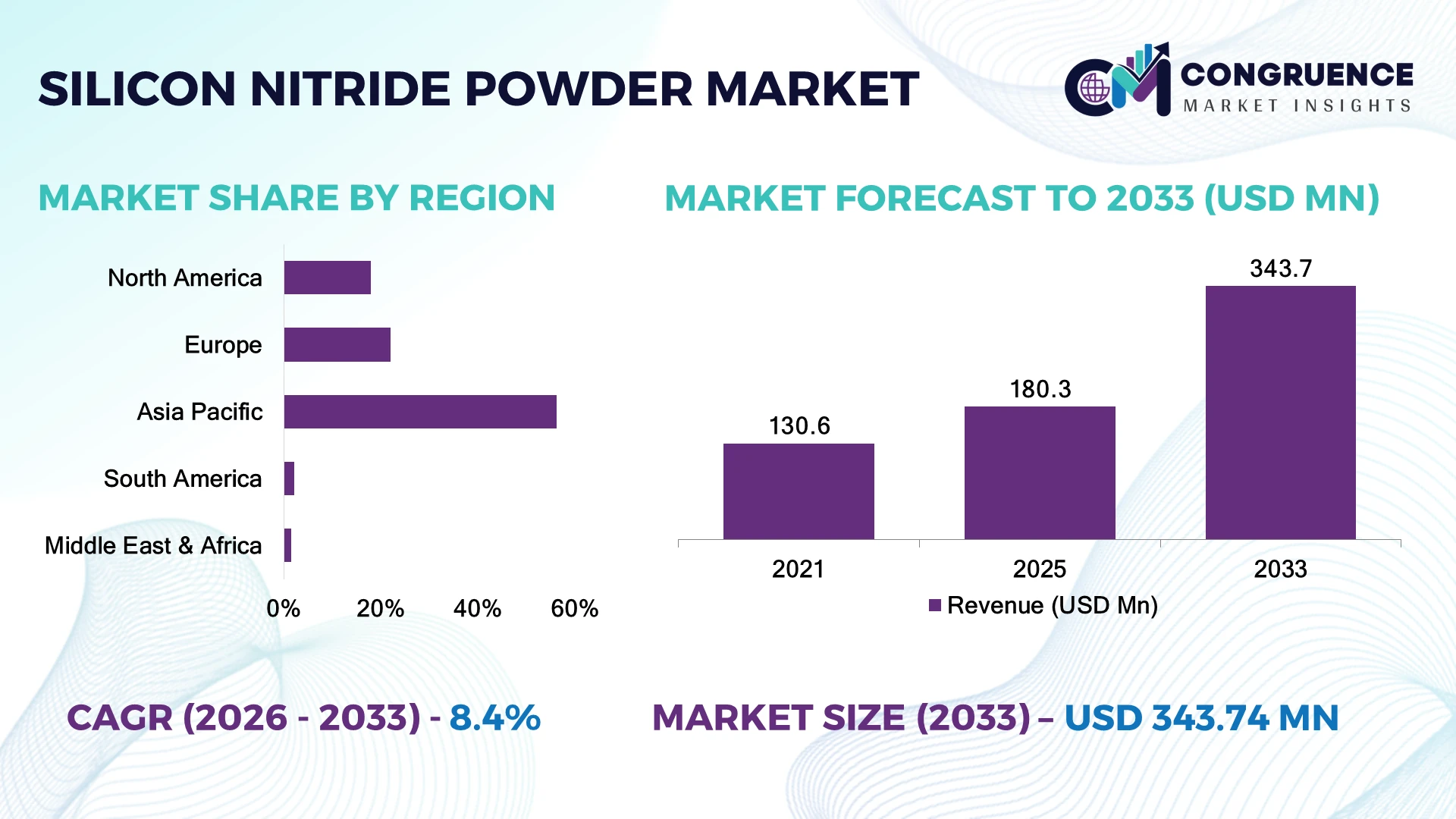
The Global Silicon Nitride Powder Market was valued at USD 180.3 Million in 2025 and is anticipated to reach a value of USD 343.7 Million by 2033 expanding at a CAGR of 8.4% between 2026 and 2033. Growth is fueled by expanding demand for advanced ceramics in semiconductor manufacturing, electric vehicle components, aerospace systems, and high-performance industrial bearings requiring exceptional thermal and mechanical stability.
China dominates the Silicon Nitride Powder market with approximately 43% of global production capacity, supported by large-scale advanced ceramics manufacturing, semiconductor material investments, and an expanding electric vehicle supply chain. Japan maintains technological leadership in ultra-high-purity grades for electronics despite lower production volume, while China's manufacturing capacity exceeds Japan's by nearly 2.3 times. Following continued global semiconductor supply-chain diversification in 2026, manufacturers accelerated domestic advanced material investments, strengthening regional production resilience.
Companies investing in high-purity powder production, process innovation, and localized supply chains are securing long-term competitive advantages across critical industrial applications.
Market Size & Growth: USD 180.3 million in 2025 reaching USD 343.7 million by 2033 at 8.4% CAGR, supported by advanced ceramics demand.
Top Growth Drivers: Semiconductor demand (+36%), EV components (+31%), aerospace applications (+24%).
Short-Term Forecast: By 2028, production efficiency improves 18% through automated powder processing and quality control.
Emerging Technologies: Plasma synthesis, nano-scale powders, additive manufacturing feedstocks strengthen product performance.
Regional Leaders: Asia-Pacific (~56%), Europe (~22%), North America (~18%), driven by semiconductor and precision engineering investments.
Consumer/End-User Trends: Around 61% of demand originates from electronics, automotive, and industrial ceramic manufacturers.
Pilot/Case Example: A 2026 advanced ceramic production upgrade increased powder yield by approximately 16%.
Competitive Landscape: Top five producers control nearly 53% of global supply through specialty materials expertise.
Regulatory & ESG Impact: Energy-efficient sintering reduces manufacturing energy consumption by approximately 14%.
Investment & Funding: More than USD 900 million supports advanced ceramic material capacity expansion worldwide.
Innovation & Future Outlook: High-purity and nano-grade silicon nitride powders accelerate next-generation semiconductor and EV applications.
The Silicon Nitride Powder market is expanding through increasing demand from semiconductor fabrication, ceramic bearings, cutting tools, and electric mobility applications. High-purity powder grades now represent approximately 46% of premium industrial demand as manufacturers prioritize thermal stability and wear resistance. Continued supply-chain diversification and localized advanced materials production are strengthening global competitiveness, leading into broader strategic market developments.
Silicon Nitride Powder has become a strategically important advanced material as manufacturers seek higher-performance ceramics capable of supporting semiconductor expansion, electric mobility, aerospace modernization, and industrial automation. The market is benefiting from supply-chain diversification strategies that encourage localized production of critical ceramic materials, reducing dependence on concentrated global suppliers while improving long-term manufacturing resilience.
Modern plasma-assisted powder synthesis improves particle uniformity by approximately 28% compared with conventional carbothermal reduction processes while reducing impurity levels by nearly 22%. China leads global manufacturing capacity through integrated ceramics production, whereas Japan continues focusing on ultra-high-purity powders for semiconductor and precision electronic applications. During the next two to three years, advanced ceramic manufacturers are expected to increase adoption of nano-scale silicon nitride powders as performance requirements continue rising across high-temperature engineering applications.
Manufacturers are expanding production facilities, strengthening raw material sourcing, and collaborating with semiconductor and automotive companies to develop application-specific ceramic materials. A growing number of industrial producers are integrating digital process monitoring to improve powder consistency and production yields. Companies capable of combining high-purity manufacturing, localized supply resilience, and application-driven material innovation will establish stronger competitive positioning across advanced industrial markets.
The rapid expansion of semiconductor fabrication and advanced ceramic manufacturing is accelerating demand for high-purity silicon nitride powder. Nearly 48% of premium-grade consumption is linked to semiconductor processing and electronic substrates, while electric vehicle ceramic bearing applications have expanded by approximately 26% over the past two years. China's continued investment in domestic semiconductor materials following global technology supply-chain restructuring has increased localized procurement of advanced ceramic powders. Higher production volumes are encouraging manufacturers to expand purification capacity, develop ultra-fine particle grades, and establish long-term supply agreements with electronics and automotive companies. A strategic advantage is emerging for producers capable of consistently delivering high-purity material with tightly controlled particle-size distribution.
Silicon nitride powder production remains constrained by high-temperature synthesis requirements, expensive precursor materials, and strict purity specifications. Manufacturing energy accounts for nearly 32% of production costs, while ultra-high-purity processing increases overall operating expenses by approximately 22%. Limited availability of specialized nitridation equipment in Europe has created capacity bottlenecks for premium ceramic materials, extending qualification cycles for industrial customers. These structural limitations reduce production flexibility and compress supplier margins during periods of raw material volatility. Companies are mitigating these pressures through localized precursor sourcing, long-term procurement contracts, process automation, and energy-efficient furnace technologies that improve operational stability while reducing manufacturing costs.
Advanced manufacturing is creating new commercial opportunities for engineered silicon nitride powder formulations optimized for additive manufacturing and precision ceramic components. Fine-particle powders improve printing density by approximately 18%, while optimized morphology enhances sintering efficiency by nearly 21%. Japan and South Korea are accelerating research into next-generation ceramic materials supporting semiconductor packaging, hydrogen technologies, and aerospace applications. Producers are investing in nano-scale powder development, collaborative research programs, and application-specific material engineering to capture higher-value industrial markets. A less obvious opportunity lies in customized powder formulations that reduce machining requirements, lowering downstream manufacturing costs while improving component reliability for complex engineering applications.
Maintaining uniform particle morphology, chemical purity, and batch consistency at industrial scale remains one of the market's most significant execution challenges. Approximately 15% of production batches require additional refinement before meeting semiconductor-grade specifications, while advanced ceramic manufacturers demand purity levels exceeding 99.9% with minimal process variation. Taiwan's semiconductor supply chain continues raising qualification standards for ceramic raw materials, increasing technical barriers for new suppliers. Manufacturers must strengthen process monitoring, advanced quality inspection, and precision powder engineering to achieve consistent production performance. Long-term competitiveness depends on combining scalable manufacturing with repeatable material quality that satisfies increasingly demanding industrial qualification requirements.
Ultra-High Purity Expansion: Semiconductor manufacturers are increasing procurement of ultra-high-purity silicon nitride powder, with premium-grade production rising by approximately 24% and purity requirements exceeding 99.9% for advanced applications. Domestic material security initiatives are encouraging capacity expansion, prompting suppliers to automate purification processes and strengthen long-term customer qualification programs.
Advanced Ceramic Localization: Industrial manufacturers are regionalizing ceramic material production to improve supply resilience. Local sourcing has increased by nearly 19%, while transportation lead times have declined by approximately 17%. Companies are expanding regional processing facilities and establishing strategic partnerships with automotive and electronics manufacturers to improve supply continuity.
Nano Powder Commercialization: Demand for nano-scale silicon nitride powder has increased by approximately 22% as precision engineering applications require finer particle distributions and improved sintering performance. Manufacturers are restructuring production workflows, introducing advanced classification technologies, and optimizing particle engineering to deliver higher-value specialty ceramic materials.
Digital Process Optimization: Artificial intelligence and automated process monitoring are improving powder manufacturing consistency, reducing quality deviations by approximately 16% and increasing production yield by nearly 13%. The non-obvious shift is that digital quality control is becoming a competitive differentiator rather than solely a manufacturing improvement. Producers are integrating predictive process analytics to strengthen qualification success across demanding semiconductor and aerospace applications.
High-Purity Silicon Nitride Powder accounts for approximately 58% of the global market owing to its superior thermal stability, controlled particle morphology, and ultra-low impurity levels required for semiconductor substrates, electronic ceramics, and precision engineering components. Its consistent performance and compatibility with advanced sintering technologies make it the preferred choice for high-value industrial applications. Standard Grade Silicon Nitride Powder continues serving cutting tools, bearings, and general engineering ceramics where cost efficiency remains a primary purchasing factor.
Nano Silicon Nitride Powder is the fastest-growing segment as advanced manufacturing, additive manufacturing, and next-generation ceramic composites require finer particle sizes and enhanced mechanical properties. Nano-grade materials improve densification efficiency by approximately 20%, while advanced ceramic applications have increased by nearly 24% over recent years. Manufacturers are expanding high-purity production lines, investing in nano-powder technologies, and collaborating with electronics and aerospace companies to develop application-specific materials. Investment priorities are steadily shifting toward premium engineered powders that support higher-margin industrial applications and greater product differentiation.
According to a 2026 advanced materials assessment released by the Japan Fine Ceramics Association, semiconductor and precision electronics manufacturers continue prioritizing ultra-high-purity ceramic powders to improve component reliability and manufacturing consistency.
Advanced Ceramics represent the largest application segment with approximately 47% market share due to extensive use in bearings, cutting tools, engine components, substrates, and wear-resistant industrial parts. Exceptional fracture toughness, thermal shock resistance, and chemical stability continue driving demand across automotive, aerospace, and industrial manufacturing. Metalworking tools maintain strong consumption through high-speed machining applications, while specialty electronic ceramics continue expanding alongside semiconductor production.
Electronics & Semiconductor Components are the fastest-growing application segment as chip manufacturing and advanced packaging require high-purity ceramic materials capable of operating under demanding thermal conditions. Semiconductor-related consumption has increased by approximately 27%, while ceramic component integration in electric vehicles has expanded by nearly 19%. Companies are scaling specialty powder production, strengthening collaborations with ceramic component manufacturers, and optimizing particle engineering for precision fabrication. Demand is increasingly shifting toward high-performance applications where material quality directly influences component durability, process efficiency, and manufacturing yields.
A 2025 industrial manufacturing survey conducted by SEMI indicated that advanced ceramic materials are becoming increasingly important for semiconductor equipment and packaging applications requiring superior thermal and electrical performance.
The Electronics & Semiconductor industry accounts for approximately 41% of total Silicon Nitride Powder consumption due to large-scale demand for semiconductor processing equipment, ceramic substrates, insulating components, and precision electronic packaging materials. Continuous investment in advanced chip manufacturing and electronic miniaturization has strengthened demand for high-purity ceramic powders. Automotive manufacturers remain established buyers through ceramic bearings and electric vehicle drivetrain components, while industrial manufacturing continues utilizing silicon nitride in wear-resistant engineering applications.
The Aerospace & Defense sector represents the fastest-growing end-user group as lightweight, high-temperature ceramic components gain wider adoption in propulsion systems, structural components, and thermal protection applications. Aerospace-related consumption has expanded by approximately 21%, while advanced defense ceramic applications have increased by nearly 17%. Producers are developing customized powder grades, strengthening long-term supply agreements, and expanding technical support capabilities to meet highly specialized engineering requirements. Competitive positioning increasingly depends on delivering application-specific materials rather than standardized commodity ceramic powders.
A 2026 enterprise assessment published by the American Ceramic Society reported that electronics manufacturers continue increasing the use of advanced ceramic powders to improve thermal management, component durability, and production reliability in next-generation electronic devices.
Asia-Pacific accounted for the largest market share at 56.3% in 2025 however, North America is expected to register the fastest growth, expanding at a CAGR of 9.1% between 2026 and 2033.

Semiconductor Reshoring Strengthens Advanced Ceramics Demand
North America is accelerating silicon nitride powder consumption through semiconductor manufacturing expansion, aerospace modernization, and electric vehicle component production. The region accounts for approximately 18% of global demand, supported by increasing investments in advanced ceramic materials for wafer processing equipment, precision bearings, and thermal management applications. Domestic semiconductor capacity expansion has increased procurement of high-purity ceramic materials, while automated powder processing and advanced quality control are improving manufacturing efficiency. Multiple specialty materials producers are expanding production capabilities and strengthening partnerships with electronics and industrial equipment manufacturers to establish resilient regional supply chains capable of supporting strategic manufacturing priorities.
United States Market Outlook: The United States leads the regional market through strong semiconductor fabrication investments, aerospace manufacturing leadership, and advanced materials research capabilities. Government-backed domestic semiconductor expansion has accelerated demand for high-purity silicon nitride powder used in wafer handling equipment and precision ceramic components. More than 60% of regional advanced ceramic production is concentrated in the United States, where manufacturers continue investing in automated processing technologies and long-term supply agreements to strengthen industrial self-sufficiency.
Precision Engineering Drives Premium Material Adoption
Europe maintains a strong position through advanced automotive engineering, industrial machinery production, and high-performance ceramic manufacturing. The region represents approximately 22% of global consumption, with Germany, France, and Italy leading demand for silicon nitride powder in bearings, cutting tools, and precision engineering components. Growing adoption of energy-efficient manufacturing technologies has improved ceramic processing productivity by approximately 15%, encouraging investment in premium powder grades. Companies are expanding application-specific product portfolios and strengthening partnerships across automotive and industrial manufacturing value chains.
Germany Market Outlook: Germany dominates the European market through its highly developed automotive, machinery, and industrial ceramics industries. Manufacturers increasingly utilize silicon nitride powder in high-speed bearings, wear-resistant components, and precision tooling to improve operational efficiency. Advanced ceramic production facilities continue integrating digital quality monitoring, enabling improved process consistency while supporting demand from electric mobility and industrial automation sectors.
Manufacturing Scale Secures Global Leadership
Asia-Pacific remains the world's largest silicon nitride powder manufacturing and consumption hub owing to extensive semiconductor production, advanced ceramics manufacturing, and rapidly expanding electric vehicle supply chains. The region contributes approximately 56.3% of global demand, supported by integrated production ecosystems across China, Japan, South Korea, and Taiwan. High-purity ceramic material capacity has expanded by nearly 20% over recent years as manufacturers respond to semiconductor localization strategies and increasing electronics production. Companies continue investing in large-scale purification facilities, automated powder classification, and export-oriented manufacturing capabilities.
China Market Outlook: China leads the global silicon nitride powder market through extensive advanced ceramics manufacturing capacity, integrated raw material processing, and sustained investment in semiconductor materials. The country accounts for approximately 43% of worldwide production capacity and continues expanding domestic supply for electric vehicles, industrial ceramics, and semiconductor equipment. Continuous modernization of advanced materials manufacturing is strengthening production efficiency while reducing dependence on imported specialty ceramic powders.
Industrial Modernization Supports Specialty Materials
South America is gradually expanding silicon nitride powder utilization through industrial modernization, mining equipment manufacturing, and growing demand for wear-resistant ceramic components. Brazil and Argentina remain the primary markets, supported by investments in industrial processing equipment and precision engineering applications. Approximately 18% of regional advanced ceramic demand is linked to mining and heavy industrial equipment requiring superior abrasion resistance. Although specialty material production remains limited, manufacturers are increasing imports and developing strategic partnerships with international ceramic material suppliers to strengthen regional availability.
Brazil Market Outlook: Brazil represents the region's largest market due to its diversified industrial base, expanding automotive manufacturing, and strong mining sector. Industrial equipment manufacturers increasingly adopt advanced ceramic materials to improve equipment durability and reduce maintenance costs. Continued investment in precision manufacturing technologies and engineered materials is supporting broader adoption of silicon nitride components across high-performance industrial applications.
Industrial Diversification Expands Advanced Material Usage
The Middle East & Africa market is progressing through industrial diversification initiatives, infrastructure modernization, and increasing investment in advanced manufacturing capabilities. Demand is primarily supported by energy, industrial processing, aerospace maintenance, and engineering applications requiring high-performance ceramic components. Approximately 14% of specialty ceramic imports are directed toward precision industrial applications, reflecting gradual expansion beyond conventional sectors. Companies are strengthening distribution networks, regional processing partnerships, and technical support capabilities to improve access to advanced ceramic materials across emerging industrial markets.
Saudi Arabia Market Outlook: Saudi Arabia leads regional demand through large-scale industrial diversification programs, expanding manufacturing infrastructure, and investment in advanced engineering materials. Industrial modernization initiatives are increasing utilization of high-performance ceramics within energy, petrochemical, and precision equipment sectors. Local manufacturing partnerships and specialized industrial projects are creating stronger demand for premium silicon nitride powder while supporting the country's broader strategy to develop advanced manufacturing capabilities.
Japanese specialty material leaders UBE Corporation and Denka compete with Chinese volume manufacturers including Yantai Tomley and Hongchen Technology, while precision ceramic suppliers challenge cost-focused bulk powder producers through higher purity and engineered particle control. The top five manufacturers collectively account for approximately 56% of global supply. Competition centers on purity, particle morphology, production consistency, and supply reliability rather than price alone. Advanced synthesis technologies improve powder uniformity by approximately 24%, automated classification reduces quality variation by nearly 18%, and integrated production lowers manufacturing costs by around 15%. Leading companies are expanding purification capacity, strengthening semiconductor partnerships, investing in nano-grade powders, and vertically integrating raw material processing with advanced ceramics manufacturing. Competitive momentum is shifting toward premium semiconductor-grade materials as qualification standards become stricter. High capital investment, lengthy customer qualification cycles, and proprietary processing technologies remain major entry barriers. Winning requires consistently delivering ultra-high-purity powders, scalable production, and dependable long-term supply.
UBE Corporation
Denka Company Limited
Yantai Tomley Hi-tech Advanced Materials Co., Ltd.
Alzchem Group AG
CoorsTek Inc.
CeramTec GmbH
Höganäs AB
H.C. Starck Tungsten GmbH
Tokuyama Corporation
SINTX Technologies, Inc.
3M
Reade Advanced Materials
Precision Ceramics USA
High-purity imide decomposition, carbothermal reduction-nitridation, and plasma-assisted synthesis remain the core technologies shaping silicon nitride powder production. Advanced particle engineering improves powder uniformity by approximately 25%, while automated process control reduces batch variation by nearly 17%. Around 64% of premium ceramic manufacturers now prioritize high-purity powders with controlled particle-size distribution to improve sintering consistency and component reliability across semiconductor, aerospace, and automotive applications.
Emerging technologies include nano-particle engineering, AI-driven process monitoring, digital particle characterization, and advanced spray granulation. Compared with conventional carbothermal processing, plasma-assisted synthesis delivers approximately 22% higher particle uniformity and reduces downstream processing requirements by nearly 18%. Premium material producers benefit through faster qualification in semiconductor applications, while high-volume manufacturers compete by improving production efficiency and lowering processing costs without sacrificing purity.
Between 2026 and 2028, digital manufacturing, continuous powder processing, and precision impurity control will become decisive competitive differentiators. Manufacturers investing in intelligent quality inspection, automated classification, and application-specific powder engineering will strengthen supply agreements with semiconductor and advanced ceramic producers. Early adoption enables higher manufacturing yields, shorter qualification cycles, and stronger positioning in premium industrial markets where material consistency directly determines component performance and long-term customer retention.
August 2025 – Denka reported continued strong demand for silicon nitride products used in heat-dissipation substrates and bearings despite weaker electric vehicle markets, supporting stable specialty materials performance and production utilization. Source: Denka
May 2025 – UBE Corporation expanded promotion of its high-purity Silicon Nitride Powder portfolio, highlighting proprietary imide-decomposition technology delivering more than 95% alpha-phase content for advanced ceramic manufacturers. This strengthened its position in premium semiconductor and aerospace applications. Source: UBE Corporation
June 2024 – Denka enhanced commercialization efforts for its silicon nitride powder portfolio targeting automotive, industrial machinery, and electronics applications through differentiated particle-size grades, supporting broader adoption across high-performance ceramic components. Source: Denka Company
March 2026 – UBE Corporation expanded customer engagement for application-specific silicon nitride powder grades optimized for precision ceramics, reinforcing collaborative development with advanced ceramic manufacturers and accelerating qualification activities for next-generation industrial and semiconductor components. Source: UBE Corporation corporate product update.
This report provides comprehensive analysis of the global Silicon Nitride Powder market across product types, applications, end-user industries, manufacturing technologies, and major geographic regions. It evaluates high-purity, standard-grade, and nano-grade powders used in advanced ceramics, semiconductor components, cutting tools, bearings, aerospace systems, and industrial engineering applications. The study further examines production trends, material qualification requirements, supply-chain dynamics, and competitive positioning across established and emerging manufacturing hubs.
The report assesses advanced synthesis technologies, particle engineering, purification methods, and digital manufacturing developments shaping industry competitiveness between 2026 and 2033. More than half of market demand is concentrated in high-performance ceramic applications, while semiconductor-grade materials continue gaining strategic importance. Business insights support capacity expansion, investment prioritization, supplier evaluation, product development, partnership strategies, and competitive benchmarking by identifying evolving technology adoption, regional manufacturing strengths, customer purchasing behavior, and high-value application opportunities across the advanced materials ecosystem.
| Report Attribute/Metric | Report Details |
|---|---|
|
Market Revenue in 2025 |
USD 180.3 Million |
|
Market Revenue in 2033 |
USD 343.7 Million |
|
CAGR (2026 - 2033) |
8.4% |
|
Base Year |
2025 |
|
Forecast Period |
2026 - 2033 |
|
Historic Period |
2021 - 2025 |
|
Segments Covered |
By Type
By Application
By End-User
|
|
Key Report Deliverable |
Revenue Forecast, Growth Trends, Market Dynamics, Segmental Overview, Regional and Country-wise Analysis, Competition Landscape |
|
Region Covered |
North America, Europe, Asia-Pacific, South America, Middle East, Africa |
|
Key Players Analyzed |
UBE Corporation, Denka Company Limited, Yantai Tomley Hi-tech Advanced Materials Co., Ltd., Alzchem Group AG, CoorsTek Inc., CeramTec GmbH, Höganäs AB, H.C. Starck Tungsten GmbH, Tokuyama Corporation, SINTX Technologies, Inc., 3M, Reade Advanced Materials, Precision Ceramics USA |
|
Customization & Pricing |
Available on Request (10% Customization is Free) |




