
Reports
The Global Silicon Monoxide Market was valued at USD 285.2 Million in 2025 and is anticipated to reach a value of USD 878.5 Million by 2033 expanding at a CAGR of 15.1% between 2026 and 2033. Growth is driven by the shift toward silicon-based lithium-ion anodes, rising EV battery energy-density requirements, advanced consumer electronics, and expanding high-purity SiO applications in semiconductor, optical-coating, solar, and barrier-film manufacturing.
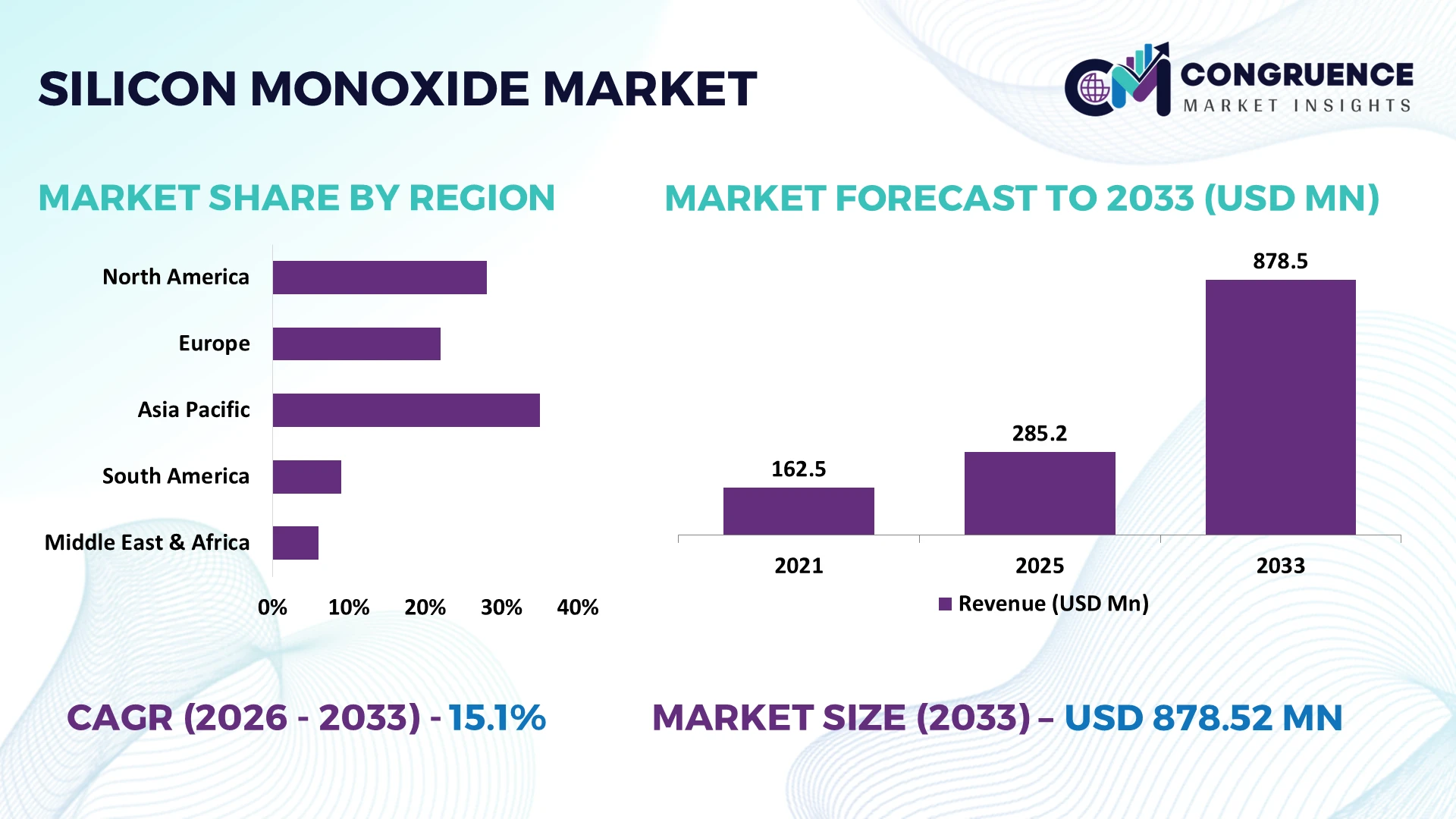
China remains a dominant Asian production and consumption hub, representing about 40% of Asia’s silicon monoxide market, while Japan contributes around 20% and maintains specialized high-purity manufacturing capabilities. Japan’s Osaka Titanium Technologies operates a 30-metric-ton annual SiO anode pilot plant, with its technology increasing graphite-anode capacity by more than 20%. India is also strengthening its silicon-anode ecosystem through a AUD 15 million investment in Sicona technology. These developments are accelerating localization amid battery supply-chain restructuring and geopolitical pressure on Chinese battery materials.
Strategically, manufacturers should prioritize high-purity production, battery-grade formulations, localized supply contracts, and partnerships with cell developers to capture the fastest-growing advanced-material applications.
Market Size & Growth: USD 285.2 million in 2025 is projected to reach USD 878.5 million by 2033 at 15.1% CAGR, driven by silicon-based battery anode adoption.
Top Growth Drivers: EV battery demand contributes to roughly 40% of Asian market concentration, while electronics and energy storage strengthen high-purity SiO consumption.
Short-Term Forecast: By 2028, the market reaches approximately USD 437 million, with advanced SiO-graphite formulations targeting 20%+ capacity improvement.
Emerging Technologies: Pre-lithiation, carbon-composite coatings, catalytic SEI engineering, and AI-assisted materials optimization are advancing SiO commercialization.
Regional Leaders: Asia Pacific leads; North America is projected near USD 271.9 million, Asia Pacific USD 266.8 million, and Europe USD 162.7 million by 2033 based on current regional market shares.
Consumer/End-User Trends: Battery applications are shifting toward higher-energy-density cells, while SiO-graphite systems target more than 20% capacity gains over conventional graphite.
Pilot/Case Example: In 2022, Osaka Titanium Technologies completed a 30-ton-per-year SiO anode pilot plant, supporting Japan’s domestic battery-material supply chain.
Competitive Landscape: Osaka Titanium Technologies led with approximately 14.2% share in 2025, followed by Merck, Shenzhen Rearth Technology, LICHE OPTO GROUP, and American Elements; the top five held 37.7%.
Regulatory & ESG Impact: Japan’s SiO anode project received METI supply-chain investment support, reinforcing domestic sourcing and reducing exposure to concentrated overseas battery-material supply.
Investment & Funding: India’s Himadri approved AUD 15 million for Sicona and secured exclusive Indian SiCx technology licensing, strengthening localized advanced-anode manufacturing.
Innovation & Future Outlook: Next-generation SiO systems are moving toward engineered SEI layers, carbon architectures, pre-lithiation, and application-specific formulations as battery producers prioritize energy density and cycle stability.
Silicon Monoxide is gaining strategic importance across high-energy batteries, semiconductor processing, optical coatings, solar back sheets, and advanced packaging. Battery developers are increasingly combining SiO with graphite and engineered carbon structures to manage expansion while raising usable capacity. With more than 20% capacity improvement demonstrated in graphite-SiO configurations, manufacturers are shifting from laboratory material development toward qualification and localized supply programs, setting the stage for deeper commercial deployment.
Silicon monoxide is becoming strategically important because battery manufacturers need higher energy density without relying entirely on conventional graphite. SiO offers a theoretical capacity of up to 2,680 mAh/g versus approximately 372 mAh/g for graphite, creating a substantial materials-performance advantage. Its smaller volume expansion than silicon also improves mechanical stability, strengthening its position in high-performance lithium-ion cells.
The competitive shift is moving toward engineered SiO rather than commodity-grade material. Pre-lithiation, carbon coating, particle engineering, and advanced solid-electrolyte-interface control directly address SiO’s low initial coulombic efficiency, which is typically below 70% without mitigation. Recent research has demonstrated initial coulombic efficiency of 82.4% using catalytic interfacial engineering, illustrating the pace of technical improvement.
Japan is emphasizing high-purity production and domestic battery supply, while China is leveraging its broader battery-material manufacturing ecosystem. Over the next 2–3 years, qualification programs, pilot-to-commercial transitions, and localized contracts will become decisive. Companies that combine SiO material production with cell-maker partnerships and process engineering will strengthen supply reliability and capture premium battery applications.
The strongest growth driver is the transition toward higher-capacity lithium-ion anodes for EVs and premium electronics. SiO can theoretically deliver 2,680 mAh/g, compared with about 372 mAh/g for graphite, while SiO-graphite formulations have demonstrated capacity improvements exceeding 20%. Japan’s Osaka Titanium Technologies has already established a 30-metric-ton annual pilot capacity, while battery-material producers are expanding carbon-composite and pre-lithiation capabilities. The strategic shift is from simply increasing SiO loading to engineering complete anode architectures. Companies are therefore investing in customer qualification, particle-size control, coating technologies, and long-term supply relationships to convert laboratory performance into repeatable cell-level gains.
Commercial scalability remains constrained by SiO’s first-cycle lithium loss and higher processing complexity. Conventional SiO anodes can show initial coulombic efficiency below 70%, while volume expansion remains significant during cycling. These limitations increase formation requirements, electrolyte consumption, and cell-engineering costs compared with mature graphite systems. China’s large battery-material ecosystem creates cost pressure for producers operating smaller localized facilities, while Japan and North America emphasize higher-purity specialty production. Companies are responding through pre-lithiation, carbon encapsulation, particle engineering, and tighter process controls. The non-obvious constraint is not material availability alone: consistent electrochemical performance across large production batches is becoming the key determinant of commercial qualification and profitability.
The largest opportunity lies in engineered SiO-carbon composites that combine high capacity with controlled expansion and improved conductivity. Advanced SiO systems can target more than 20% higher capacity when incorporated with graphite, while research-scale architectures have demonstrated exceptionally high areal capacities. Pre-lithiation and catalytic SEI engineering are opening additional pathways to overcome first-cycle losses. India is building localized capability through a AUD 15 million investment and exclusive SiCx technology licensing, illustrating the emergence of new manufacturing hubs beyond established East Asian supply chains. Companies should use partnerships with cell manufacturers, universities, and coating specialists to shorten qualification cycles and secure application-specific formulations.
The principal execution challenge is translating laboratory-level SiO performance into stable high-volume battery production. Initial efficiency, expansion behavior, SEI instability, and reaction kinetics can vary with particle morphology, coating thickness, electrolyte chemistry, and electrode loading. Recent engineered SiO achieved 82.4% initial coulombic efficiency, demonstrating progress but also highlighting the performance gap that advanced formulations must address. Battery producers must simultaneously maintain high areal loading, cycle life, fast charging, and manufacturing consistency. Companies therefore need automated process monitoring, tighter material specifications, joint qualification programs, and expanded pilot capacity. The strategic challenge is integrating SiO into existing cell architectures without creating manufacturing bottlenecks or compromising reliability at commercial production volumes.
High-Purity Grades Gain Share: Silicon monoxide above 99.9% purity accounted for 62.3% of 2025 demand as semiconductor, optical, and battery applications tighten contamination specifications. Producers are expanding purification and batch-control systems, while buyers increasingly prioritize consistency over the lowest unit price. This shift is also reducing qualification failures and improving production predictability for high-value applications.
Localized Supply Chains Accelerate: Japanese and Asian producers are increasing domestic SiO capabilities as battery-material supply chains diversify. A 30-ton annual pilot facility demonstrates the move from laboratory production toward controlled commercial qualification, while more than 20% capacity gains from SiO-graphite formulations are strengthening customer interest. Companies are responding with regional supply agreements and dedicated production lines rather than relying entirely on imported specialty material.
Powder Processing Becomes Automated: Powder and granular SiO processing is moving toward tighter particle-size control, with commercial materials commonly engineered within sub-10-micron ranges. Automated classification and coating workflows are improving consistency while reducing manual handling. The non-obvious shift is that process uniformity, rather than nominal material capacity, is becoming a major purchasing criterion as battery and optical-coating customers increase production volumes.
Battery Qualification Moves Forward: Automotive qualification activity is shifting SiO from experimental material toward structured cell-development programs. Silicon-based anodes can deliver substantially higher capacity than conventional graphite, while untreated SiO typically records first-cycle efficiency around 65–72%; pre-lithiation can raise this to roughly 78–82%. Manufacturers are therefore prioritizing formation optimization, supplier co-development, and cell-level validation before committing to larger commercial volumes.
Gaseous Silicon Monoxide leads the researched market segmentation, accounting for approximately 62.4% of 2025 demand, supported by its suitability for controlled deposition, specialty coatings, and tightly regulated high-purity processes. Its established integration into vacuum-deposition workflows gives producers greater process familiarity and supports repeat purchasing from electronics and optical-material customers. Solid Silicon Monoxide represents about 37.6% and is the faster-shifting format as battery manufacturers increase interest in powder-based anode processing and composite electrode formulations.
The mature gaseous segment continues to benefit from established equipment compatibility, while solid SiO is gaining attention where material loading, particle engineering, and electrode formulation determine performance. Companies are therefore directing investment toward morphology control, high-purity processing, and application-specific grades rather than treating the two formats as interchangeable.
Automotive & Transportation represents the leading application at approximately 50.2% of the 2025 market, reflecting the growing requirement for advanced materials across vehicle electronics and next-generation battery systems. Consumer Electronics follows at about 24.8%, supported by compact devices requiring higher energy density. Energy & Power accounts for approximately 15.1%, while Other applications contribute around 9.9%, maintaining demand across specialized industrial and advanced-material uses.
Automotive remains the largest application, but consumer electronics is becoming an important commercialization pathway because qualification cycles are generally shorter for compact battery platforms. Companies are increasing collaboration with cell manufacturers, refining SiO-graphite formulations, and expanding application-specific grades.
Automotive & Transportation is the dominant end-user group, representing roughly 50% of demand when battery-related mobility applications are combined with vehicle electronics requirements. Its purchasing behavior is defined by high-volume qualification, stringent safety validation, and long-term supply commitments. Consumer Electronics forms another major buyer group at approximately 25%, where shorter product cycles and compact form factors encourage faster adoption of high-density SiO-based materials. Energy & Power follows at around 15%, supported by expanding stationary-storage requirements.
Industrial & Manufacturing, Aerospace & Defense, Healthcare & Medical Devices, and other specialized users collectively represent the remaining demand and maintain attractive high-purity niches. The fastest shift is occurring among advanced battery-oriented buyers, where material specifications are increasingly tied to electrode architecture rather than commodity pricing. Companies are responding with customized particle sizes, purity grades, technical partnerships, and qualification support.
Asia Pacific accounted for the largest market share at 35.0% in 2025 however, Asia Pacific is expected to register the fastest growth, expanding at a CAGR of 16.2% between 2026 and 2033.
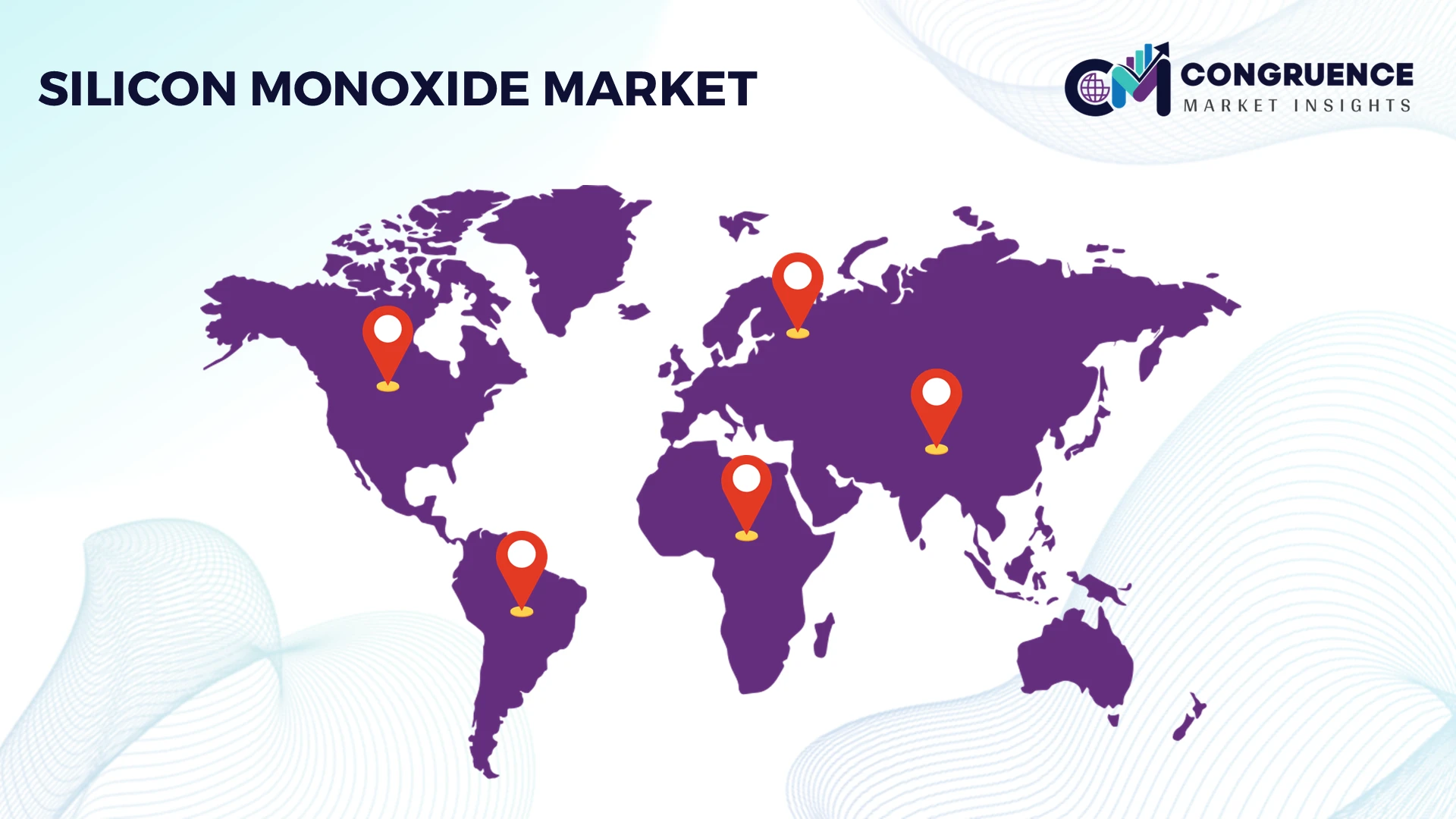
North America accounted for approximately 28.0% of the global Silicon Monoxide Market in 2025, with the United States representing the region’s primary demand center. Semiconductor fabrication, aerospace, specialty coatings, consumer electronics, and advanced battery development are sustaining high-purity SiO consumption. The region’s industrial focus is shifting toward localized advanced-material supply as manufacturers seek shorter qualification cycles and reduced exposure to overseas sourcing. U.S. battery-material investment is also supporting development of silicon-based anode technologies, creating additional downstream opportunities for SiO suppliers. Companies are responding through domestic production partnerships, application-specific grades, and expanded R&D programs. The key operational advantage is proximity to battery and electronics developers, allowing suppliers to accelerate material qualification and optimize formulations directly with downstream customers.
United States Market Outlook: The United States remains the principal North American market because of its concentration of semiconductor fabs, battery developers, aerospace manufacturers, and advanced-material research facilities. Domestic investment in silicon-anode production is strengthening the local ecosystem and creating new qualification opportunities for SiO suppliers. The country’s large EV and electronics manufacturing base provides a strong commercial pipeline for high-purity materials and supports long-term supplier partnerships.
Europe accounted for approximately 22.0% of the global Silicon Monoxide Market in 2025, supported by Germany, France, the United Kingdom, and Italy. Automotive manufacturing, semiconductor development, optical coatings, and battery research are the principal demand centers. European manufacturers are increasingly prioritizing traceable and localized material supply as battery regulations and supply-chain resilience requirements strengthen. Germany remains the largest industrial hub, with major automotive and battery-development programs creating demand for engineered anode materials. Companies are increasing collaboration with cell developers, materials laboratories, and coating specialists while moving toward automated production and tighter quality controls. The region’s strategic shift is toward qualified, low-contamination material streams that can support advanced battery and electronics manufacturing without excessive dependence on imported specialty materials.
Germany Market Outlook: Germany provides Europe’s strongest industrial platform through its automotive manufacturing scale, battery-development ecosystem, chemical-processing capabilities, and advanced engineering base. The country’s automotive supply chain creates substantial opportunities for SiO-based anode materials and specialty coatings. Manufacturers are increasingly integrating material suppliers into early-stage cell-development programs, allowing particle engineering and purity specifications to be optimized before large-scale commercial production.
Asia Pacific accounted for approximately 35.0% of the global Silicon Monoxide Market in 2025, making it the leading regional market. China, Japan, South Korea, and Taiwan provide a highly integrated ecosystem spanning lithium-ion batteries, consumer electronics, semiconductors, optical coatings, and specialty chemicals. China alone represents more than 40% of regional SiO demand, supported by its extensive battery and electronics manufacturing base. Japan contributes through high-purity materials development and specialized SiO production, while South Korea benefits from large-scale battery-cell manufacturing. Companies are expanding production partnerships, application-specific grades, and localized supply contracts. The region’s major competitive advantage is manufacturing proximity: SiO producers can qualify materials directly with cell and electronics manufacturers, shortening development cycles and reducing logistics complexity.
China Market Outlook: China is the most strategically significant country because of its extensive battery-material, lithium-ion cell, electronics, semiconductor, and specialty-chemical manufacturing infrastructure. More than 6,800 metric tons of SiO-related demand was estimated across Chinese applications in 2025, reinforcing its role as a major downstream consumption center. Suppliers are expanding powder-processing, coating, and high-purity capabilities to serve rapidly scaling battery and electronics customers.
South America accounted for approximately 9.0% of the global Silicon Monoxide Market in 2025, with Brazil representing the principal demand center. Consumption is concentrated in specialty coatings, electronics, optical materials, chemical processing, and emerging energy-storage applications. The region remains more dependent on imported specialty materials than Asia Pacific or North America, making distributor networks and inventory availability important competitive factors. Brazil’s automotive manufacturing base and expanding renewable-energy infrastructure are gradually broadening the addressable market for advanced materials. Companies are responding through regional distribution agreements, localized inventories, and partnerships with industrial buyers. The immediate commercial opportunity is not large-scale SiO production but dependable regional supply, technical support, and application-specific material distribution that can support future battery and electronics manufacturing expansion.
Brazil Market Outlook: Brazil represents South America’s strongest market because of its comparatively broad manufacturing base, automotive industry, renewable-energy investments, and research infrastructure. Demand for specialty materials is increasingly linked to industrial modernization and advanced coatings. Suppliers that establish regional warehousing and technical distribution partnerships can reduce import lead times and provide more consistent supply to industrial customers, strengthening their position as advanced-material applications expand.
Middle East & Africa accounted for approximately 6.0% of the global Silicon Monoxide Market in 2025, with demand concentrated in specialty coatings, electronics, optical materials, research, industrial manufacturing, and emerging energy-storage applications. Gulf economies are investing heavily in advanced manufacturing and technology infrastructure, creating new opportunities for specialty-material suppliers. Saudi Arabia and the UAE are developing industrial ecosystems that increasingly require high-performance chemicals and functional materials. Import dependency remains significant, encouraging suppliers to establish regional distribution and inventory networks. Companies are responding through partnerships with industrial distributors, localized warehousing, and application-focused technical support. The strategic opportunity is to connect SiO supply with expanding electronics, coatings, and energy-storage projects before local downstream manufacturing reaches larger commercial scale.
Saudi Arabia Market Outlook: Saudi Arabia offers the strongest regional platform because of its industrial diversification programs, energy-sector scale, advanced manufacturing investments, and expanding technology infrastructure. The country is developing new industrial value chains that require specialty chemicals and high-performance materials. SiO suppliers can use Saudi industrial hubs as regional distribution points while building partnerships with electronics, coatings, energy-storage, and advanced-manufacturing companies.
Osaka Titanium Technologies competes with Merck, Shenzhen Rearth Technology, LICHE OPTO GROUP, and American Elements, combining a Japanese high-purity producer with regional specialty-material suppliers and distributors. The top five collectively held 37.7% in 2025, while Osaka Titanium held 14.2%, indicating moderate concentration. Competition is driven by purity, technology, supply reliability, customization, and price: grades above 99.9% captured 62.3% of demand, raising qualification pressure, while Osaka’s share shows scale and process control matter. Osaka is advancing SiO anode commercialization; Asian suppliers emphasize powder and granular availability; distributors compete through broader grades, custom specifications, and fulfillment. The market is shifting from conventional deposition supply toward battery-grade qualification, continuous gas generation, engineered powders, and integrated anode development. Entry barriers include vacuum-processing know-how, purity control, specialized equipment, customer validation, and long qualification cycles. Winning requires reproducible high-purity output, application-specific formulations, dependable regional supply, and demonstrated cell-level performance that converts technical differentiation into qualified contracts.
ACS Material
American Elements
BTR New Material Group Co., Ltd.
FUJIFILM Wako Pure Chemical Corporation
LICHE OPTO GROUP CO., LTD.
Lorad Chemical Corporation
Merck
Nanochemazone
Osaka Titanium Technologies Co., Ltd.
Shenzhen Rearth Technology Co., Ltd.
Current SiO production relies on vacuum sublimation, controlled gas generation, and high-purity feedstock. Grades above 99.9% represented 62.3% of 2025 demand, making contamination control commercially decisive. Continuous gas-generation technology can stabilize feeding and deposition, while automated thermal control targets tighter consistency and lower material losses across coating and battery-material operations.
Emerging technology centers on SiO/graphite composites, carbon coating, prelithiation, and controlled oxygen stoichiometry. Na2CO3 pretreatment increased first-cycle efficiency from 61.4% to 86.0%, a 40.1% relative improvement versus untreated SiO. Carbon-coated structures reduce interfacial reactions and volume expansion, improving cycle stability. Adoption is moving from laboratory validation toward pilot-scale qualification, favoring suppliers that can integrate powder engineering with electrode processing.
Disruptive progress through 2026–2028 will focus on high-strength SiO, continuous production, and integrated coating-prelithiation lines. A 2026 study demonstrated high-strength, high-modulus SiO for high-energy-density and fast-charging batteries, strengthening the case for engineered SiO rather than conventional powder. Battery-material specialists and vertically integrated producers benefit most because qualification, formulation, and cell testing can be coordinated internally. Acting now on process IP, pilot capacity, and customer validation can shorten commercialization cycles and protect supply positions. Integration reduces qualification delays and improves batch-to-batch reproducibility where automotive customers demand tighter specifications and traceability controls.
July 2024 Osaka Titanium Technologies secured U.S. Patent US12024437B2 for continuous silicon monoxide gas generation using inert-gas-assisted feeding. The patented process targets yield preservation and tighter production control, supporting scalable SiO supply for battery-material applications at industrial scale. Source: patents.google.com
October 2024 Shin-Etsu Chemical published U.S. Patent Application US20240336488A1 covering silicon monoxide production through controlled silicon-oxygen reactions and sublimation. The method targets reproducible SiO formation and extraction, strengthening process control for battery-material manufacturing and supports future commercial scale-up. Source: patents.justia.com
April 2025 Merck’s Sigma-Aldrich revised its Silicon Monoxide safety documentation to Version 6.9 for product 262951. The update confirms active laboratory supply and standardized handling requirements, supporting continued material qualification and controlled synthesis workflows for research customers globally. Source: sigmaaldrich.com
May 2026 Osaka Titanium Technologies identified commercial production of SiO anode material as a development priority within its high-performance materials strategy. The company set a 2030 high-performance materials sales target of ¥15 billion, supporting broader commercialization efforts ahead. Source: osaka-ti.co.jp
The Silicon Monoxide Market Report covers gaseous and solid silicon monoxide, purity grades, battery-anode materials, barrier films, optical coatings, solar applications, and electronic-material uses. End-user coverage spans automotive and transportation, consumer electronics, energy and power, industrial manufacturing, aerospace and defense, healthcare, and specialty-material applications. Regional analysis covers Asia Pacific, North America, Europe, South America, and Middle East & Africa, with country-level assessment of production, imports, qualification activity, and application concentration.
The report evaluates high-purity SiO above 99.9%, which represented 62.3% of 2025 demand, alongside emerging SiO/graphite composites, carbon-coated anodes, prelithiation, continuous gas generation, and engineered powders. Competitive analysis covers 10 major profiled companies and assesses technology, supply-chain resilience, customization, and qualification barriers. These insights support investment planning, capacity expansion, supplier selection, competitive positioning, and technology decisions through 2033.
| Report Attribute / Metric | Details |
|---|---|
| Market Revenue (2025) | USD 285.2 Million |
| Market Revenue (2033) | USD 878.5 Million |
| CAGR (2026–2033) | 15.1% |
| Base Year | 2025 |
| Forecast Period | 2026–2033 |
| Historic Period | 2021–2025 |
| Segments Covered |
By Type
By Purity
By End-Use Industry
|
| Key Deliverables | Revenue Forecast; Market Trends; Growth Drivers & Restraints; Technology Insights; Segmentation Analysis; Regional Insights; Competitive Landscape; Regulatory & ESG Overview; Recent Developments |
| Regions Covered | North America; Europe; Asia Pacific; South America; Middle East & Africa |
| Companies Profiled | ACS Material; American Elements; BTR New Material Group Co., Ltd.; FUJIFILM Wako Pure Chemical Corporation; LICHE OPTO GROUP CO., LTD.; Lorad Chemical Corporation; Merck; Nanochemazone; Osaka Titanium Technologies Co., Ltd.; Shenzhen Rearth Technology Co., Ltd. |
| Customization & Pricing | Available on Request (10% Customization Free) |




