
Reports
The Global Silicon Carbide Block Heat Exchangers Market was valued at USD 16.4 Million in 2025 and is anticipated to reach a value of USD 36.19 Million by 2033 expanding at a CAGR of 12.8% between 2026 and 2033. Growth is driven by replacement of graphite and specialty alloy exchangers in corrosive chemical, chlor-alkali, semiconductor wet-processing, and pharmaceutical acid-handling systems where silicon carbide delivers longer service life under aggressive media.
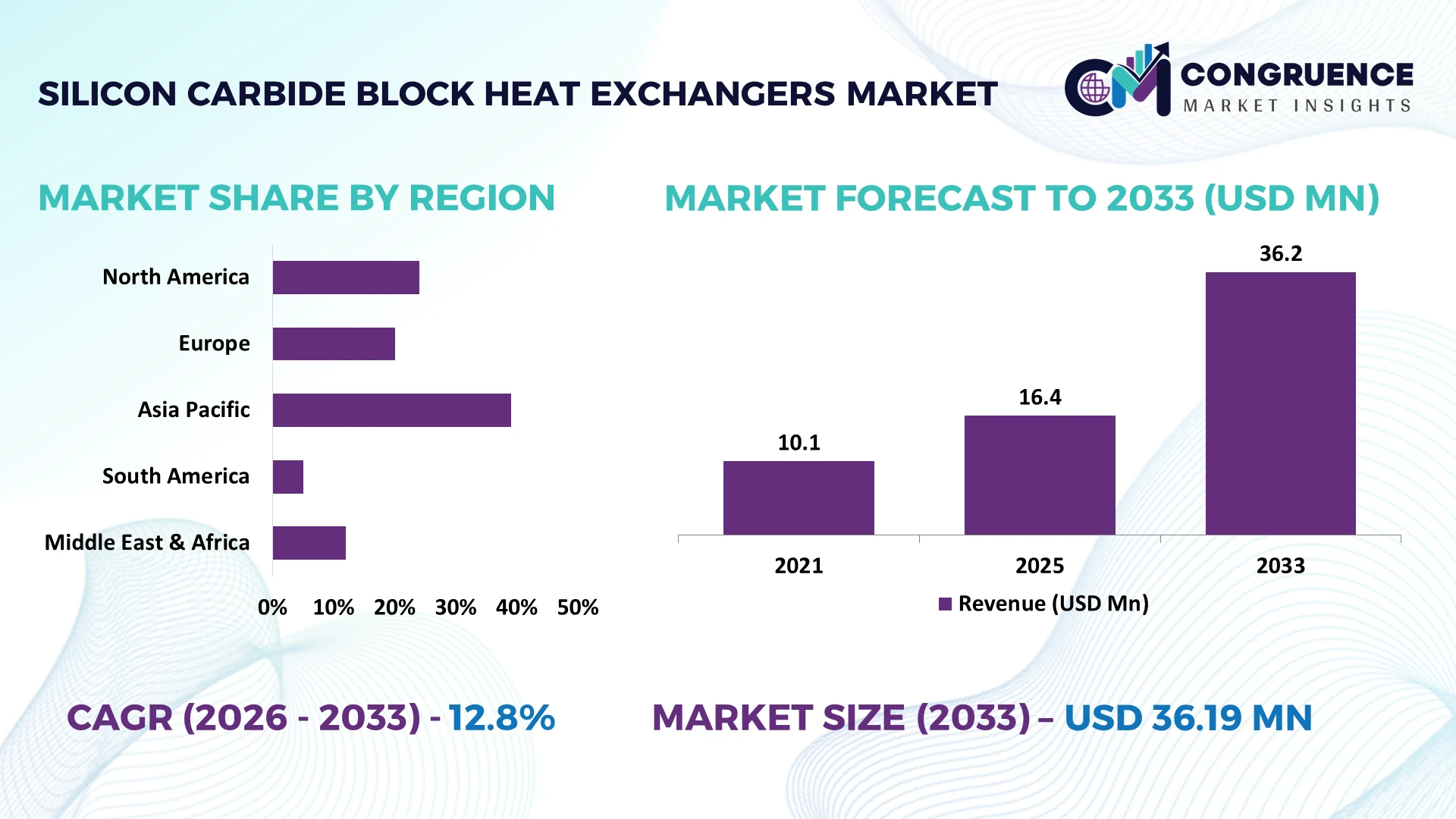
China remains the dominant production and consumption hub, accounting for approximately 42% of installed silicon carbide heat-exchanger capacity, supported by more than USD 1.5 billion in recent semiconductor and advanced materials investments. Its chemical processing base deploys silicon carbide units about 25% faster than Germany, while Japan holds roughly 18% capacity through high-purity electronics and specialty chemical applications.
Strategically, manufacturers should prioritize Asian capacity expansion while differentiating through high-purity grades and engineered corrosion-resistant designs.
Market Size & Growth: USD 16.4 million in 2025 is projected to reach USD 36.19 million by 2033, supported by replacement of graphite exchangers in corrosive processing.
Top Growth Drivers: Chemical processing contributes 38%, semiconductor wet benches 27%, and pharmaceutical acid handling 19% of incremental demand.
Short-Term Forecast: By 2028, thermal efficiency improves by 12% while maintenance costs decline by nearly 18% through optimized channel geometries.
Emerging Technologies: Over 30% of new installations incorporate CFD-optimized blocks, automated machining, or digital monitoring for fouling detection.
Regional Leaders: Asia-Pacific reaches about USD 17 million, Europe USD 9 million, and North America USD 7 million, led by chemical modernization.
Consumer/End-User Trends: Around 46% of buyers now specify silicon carbide for hydrochloric and sulfuric acid duties instead of metallic alternatives.
Pilot/Case Example: A 2025 specialty chemical retrofit reduced exchanger downtime by 22% after replacing graphite units with silicon carbide blocks.
Competitive Landscape: The leading supplier holds roughly 20% share, alongside Saint-Gobain, Mersen, SGL Carbon, and CG Thermal.
Regulatory & ESG Impact: Closed-loop acid recovery projects reduce hazardous waste volumes by approximately 15% in upgraded process lines.
Investment & Funding: More than USD 1 billion in advanced materials and semiconductor expansion supports regional equipment demand amid global supply-chain localization.
Innovation & Future Outlook: Next-generation monolithic blocks and additive-assisted manufacturing are shortening custom lead times by about 20%.
The Silicon Carbide Block Heat Exchangers Market is gaining traction across chlor-alkali plants, semiconductor fabrication, and specialty pharmaceuticals where corrosion resistance directly improves plant uptime. Recent product development emphasizes monolithic block designs and digitally optimized flow paths, delivering roughly 12% higher thermal performance. Supply-chain localization in Asia is accelerating qualified supplier expansion, setting the stage for broader strategic positioning.
Silicon carbide block heat exchangers are becoming strategically important because chemical, semiconductor, and pharmaceutical producers increasingly prioritize corrosion resistance, uptime, and process-temperature control over lowest initial equipment cost. Modern SiC systems can deliver approximately 10–15% higher thermal-transfer efficiency than conventional graphite configurations while reducing maintenance frequency by nearly 15%, strengthening lifecycle economics. This shift is also encouraging manufacturers to redesign process lines around longer equipment service intervals.
Supply-chain restructuring is accelerating investment localization. China accounts for roughly 42% of installed capacity, while Japan emphasizes high-purity semiconductor applications and Germany focuses on engineered chemical-processing systems. Over the next 2–3 years, adoption of digitally monitored exchangers is expected to rise toward 25% of new industrial deployments as operators integrate temperature, pressure, and fouling data into plant-control platforms. This creates a competitive divide between standard equipment suppliers and engineering-led solution providers.
A practical deployment example is acid-processing modernization, where replacing graphite blocks with SiC units can cut unplanned exchanger-related downtime by about 20%. Companies are responding by expanding localized machining, securing long-term ceramic material contracts, and partnering with process-engineering firms. The strategic priority is shifting from component supply toward integrated, high-purity, corrosion-resistant heat-transfer systems, giving early adopters a measurable operational and competitive advantage.
The strongest growth driver is the replacement of vulnerable heat-transfer materials in aggressive chemical duties. Hydrochloric-acid, sulfuric-acid, and chlor-alkali applications represent high-value use cases, with chemical processing estimated to generate around 38% of incremental demand and SiC adoption increasing roughly 8–10% annually in intensive corrosion environments. China’s chemical modernization is reinforcing this shift as producers prioritize longer equipment cycles. Companies are expanding SiC machining capacity and developing customized channel geometries to match plant-specific flow conditions. The non-obvious advantage is reduced shutdown exposure: higher material durability allows operators to extend maintenance intervals, improving asset utilization while reducing the indirect production losses associated with exchanger replacement.
High manufacturing complexity remains a structural restraint because silicon carbide blocks require precision forming, joining, finishing, and quality inspection. Initial equipment costs can remain approximately 20–30% above comparable graphite configurations, while customized geometries can increase fabrication costs by another 10–15%. Smaller chemical producers therefore delay conversion despite stronger lifecycle economics. China’s localized supply base is narrowing the cost gap, whereas import-dependent markets face greater exposure to ceramic component lead times and logistics volatility. Companies are mitigating this constraint through multi-year material contracts, domestic machining partnerships, and standardized block designs. A key operational insight is that total-cost analysis increasingly matters more than purchase price because downtime and corrosion-related replacement costs can outweigh the initial SiC premium.
Digital monitoring creates a differentiated opportunity beyond conventional SiC equipment sales. Approximately 20–25% of new advanced-process installations are moving toward sensor-enabled thermal monitoring, while predictive fouling detection can improve heat-transfer consistency by around 10%. Semiconductor facilities in Japan and South Korea are particularly attractive because high-purity process environments demand tight contamination control and stable thermal performance. Manufacturers are developing digitally characterized blocks, optimized flow channels, and modular configurations compatible with automated plant-control systems. The strategic opportunity is to package hardware with monitoring and engineering services rather than compete solely on component pricing. Partnerships between SiC manufacturers, automation firms, and process-equipment integrators can capture recurring service revenue while improving customer switching costs.
Scaling production without sacrificing dimensional accuracy and thermal reliability remains a major execution challenge. Complex SiC blocks can experience machining and joining yield losses of roughly 5–8%, while customized designs often extend qualification cycles by 10–15% compared with standardized equipment. Semiconductor and pharmaceutical operators impose particularly stringent purity and validation requirements, increasing engineering workloads. Companies must invest in automated inspection, advanced joining techniques, and digital process simulation to improve manufacturing consistency. Workforce specialization is another pressure point as precision ceramic fabrication requires expertise that is less widely available than conventional metal heat-exchanger production. The long-term competitive differentiator will therefore be manufacturing repeatability: suppliers that combine high-volume production with validated precision will scale faster without compromising reliability or customer qualification standards.
Modular Block Designs Accelerate Standardized SiC blocks are cutting engineering lead times by 15–20% and replacement work by 10–12%, as chemical plants increasingly favor configurable equipment. Chinese manufacturers are expanding modular machining, helping customers shorten installation schedules and reduce project-specific fabrication.
Automated Quality Control Expands CNC finishing, machine-vision inspection, and digital dimensional testing are reducing rework by 6–8% while improving manufacturing consistency by roughly 10%. Japanese and German suppliers are integrating automated inspection cells to address skilled-labor shortages without sacrificing tight ceramic tolerances.
Localized Sourcing Gains Priority Procurement teams are targeting 20–30% shorter component lead times as geopolitical uncertainty and logistics disruptions reshape ceramic supply chains. Indian and European equipment integrators are qualifying secondary suppliers, while manufacturers establish regional machining and service partnerships to improve delivery reliability.
High-Purity Specifications Tighten Semiconductor applications are driving tighter surface-finish and contamination-control requirements, with advanced fabrication equipment investment rising 15% in 2025. Suppliers are responding with validated high-purity SiC grades, cleaner production workflows, and stricter traceability, creating a premium segment less exposed to commodity pricing.
Cubic Block is the leading type, estimated at approximately 41% market share, supported by standardized geometry, easier installation, and scalable surface-area configurations. Its established manufacturing ecosystem gives it an estimated 12–15% cost advantage over highly customized designs in repeat installations. Cylindrical Block holds about 22%, serving applications where pressure distribution and compact integration are priorities, while Plate-Type Block accounts for nearly 17% and remains relevant where flexible heat-transfer-area arrangements are required. Companies continue expanding standardized cubic inventories to reduce replacement lead times and simplify maintenance planning.
Custom-Engineered Block is the fastest-growing type, with adoption increasing roughly 10–12% as operators demand application-specific flow channels, dimensions, and corrosion resistance. Customized configurations can improve equipment integration by 8–10% in space-constrained facilities, shifting investment toward modular engineering platforms and rapid design validation. The strategic implication is clear: standardized blocks retain volume leadership, but customization is capturing higher-value projects where process geometry matters more than upfront equipment cost.
Corrosive Fluid Heating leads with an estimated 36% market share because chemical processors require stable heat transfer under aggressive acid and alkaline conditions. Corrosive Fluid Cooling follows at approximately 28%, particularly in operations where metallic exchanger degradation creates contamination or maintenance concerns. Waste Heat Recovery represents nearly 18%, while Process Heat Transfer accounts for about 18% and remains important across integrated production systems. Companies are increasingly specifying SiC blocks where thermal stability and corrosion resistance directly influence equipment availability.
Waste Heat Recovery is emerging as the fastest-growing application, with deployment expanding approximately 10–12% as industrial operators connect heat exchangers with plant energy-management systems. Integrated recovery configurations can improve usable heat capture by around 12–15%, encouraging manufacturers to develop larger-area blocks and integrated monitoring capabilities. Process operators are consequently shifting investment from single-purpose heat-transfer equipment toward systems that support both thermal recovery and process optimization, strengthening the operational value of SiC technology.
Chemical Processing is the dominant end-user, representing approximately 39% of demand because acid handling, chlor-alkali production, and specialty chemical operations require high corrosion resistance and continuous thermal control. Petrochemical applications account for nearly 21%, followed by Metal Processing at around 15%. Pharmaceutical users contribute approximately 13%, with purchasing decisions strongly influenced by purity and validation requirements. Companies serving these mature markets are emphasizing application-specific designs, longer service intervals, and technical support rather than competing solely through equipment pricing.
Semiconductor Manufacturing is the fastest-growing end-user, with deployment intensity increasing roughly 11–13% as fabrication capacity expands and thermal-control specifications become more demanding. Semiconductor facilities place greater emphasis on purity, surface quality, dimensional accuracy, and qualification documentation than conventional chemical buyers. Pharmaceutical and semiconductor customers are therefore pushing suppliers toward validated product families and direct engineering partnerships. This shift is redirecting investment toward high-purity manufacturing capabilities and specialized technical support, creating stronger competitive differentiation than volume-based chemical applications.
North America accounted for the largest market share at 31% in 2025 however, Asia-Pacific is expected to register the fastest growth, expanding at a CAGR of 14.6% between 2026 and 2033.
Chemical Modernization Strengthens Premium SiC Deployment
North America holds approximately 31% of global demand, supported by established chemical, pharmaceutical, semiconductor, and specialty-material processing infrastructure. The United States represents nearly 78% of regional consumption, with deployment concentrated across Gulf Coast chemical clusters and emerging semiconductor manufacturing corridors. Operators increasingly specify silicon carbide blocks for aggressive acid duties where corrosion-related failures can interrupt continuous production. Approximately 22% of new industrial exchanger specifications now prioritize advanced corrosion-resistant materials. Suppliers are responding through localized engineering, qualification support, and application-specific designs, while large processors increasingly evaluate lifecycle cost rather than purchase price. This shift strengthens demand for engineered SiC solutions with longer operating intervals and lower replacement exposure.
United States Market Outlook: The United States remains North America's primary demand center because of its large chemical-processing base and expanding semiconductor infrastructure. More than 20 major semiconductor fabrication projects have been announced or expanded during the current investment cycle, strengthening demand for precision thermal-management equipment. Domestic engineering capabilities also support faster customization, qualification, and after-sales service.
Energy Efficiency Reshapes Industrial Heat-Transfer Investment
Europe accounts for approximately 24% of global demand, led by Germany, France, Italy, and the Netherlands. Chemical processing and pharmaceutical manufacturing form the principal deployment base, while industrial modernization is increasing emphasis on durable and energy-efficient thermal equipment. Approximately 19% of new industrial heat-transfer projects increasingly incorporate energy-efficiency or heat-recovery considerations. German manufacturers emphasize precision engineering and reliability, while process operators increasingly evaluate equipment according to operating life and maintenance requirements. Suppliers are responding with compact SiC configurations, engineering partnerships, and application-specific thermal designs. The competitive advantage is shifting toward verified performance, material durability, and integration capability rather than equipment price alone.
Germany Market Outlook: Germany is Europe's leading industrial center for advanced process equipment, supported by its extensive chemical and specialty-material manufacturing base. Around 30% of European chemical production capacity is concentrated in Germany, creating recurring demand for corrosion-resistant thermal equipment. Strong engineering capabilities also support customized SiC exchanger qualification and process integration.
Manufacturing Scale Accelerates Supply-Chain Localization
Asia-Pacific represents approximately 35% of global demand and is positioned as the fastest-growing market, led by China, Japan, South Korea, and India. China contributes nearly 46% of regional SiC block production capacity, supported by chemical-processing clusters and expanding advanced-material manufacturing. Japan and South Korea are generating additional demand through semiconductor fabrication, where high-purity thermal-management components require tighter material specifications. India is strengthening its chemical and pharmaceutical processing base. Approximately 28% of regional buyers now maintain dual-source qualification for critical heat-transfer components, reflecting supply-chain restructuring and procurement-risk management. Manufacturers are responding through localized machining, expanded production capacity, and regional technical partnerships, strengthening their ability to compete on delivery speed and customization.
China Market Outlook: China represents the region's strongest manufacturing base because of its integrated ceramic-material ecosystem and extensive chemical-processing infrastructure. More than 40% of Asia-Pacific production capacity is associated with Chinese suppliers, giving domestic manufacturers an advantage in cost-sensitive and volume-oriented projects. Localized machining also supports shorter procurement cycles and faster replacement availability.
Mining Modernization Creates Specialized SiC Demand
South America represents approximately 7% of global demand, with Brazil accounting for nearly 62% of regional consumption. Mining, chemical processing, metallurgy, and pulp and paper provide the principal application base, particularly where acidic fluids accelerate conventional exchanger degradation. Chile offers specialized opportunities through large mining operations requiring corrosion-resistant thermal equipment. Approximately 16% of newly specified industrial heat-transfer projects in major mining applications increasingly prioritize equipment durability and lifecycle performance. Imported-equipment dependence can extend procurement cycles, encouraging suppliers to establish local service partnerships and maintain replacement inventories. Companies combining engineering support with responsive after-sales capabilities are gaining an advantage over vendors relying solely on exports. Demand remains concentrated in large industrial projects rather than fragmented replacement markets.
Brazil Market Outlook: Brazil dominates South American demand because of its diversified mining, chemical, metallurgical, and industrial-processing infrastructure. More than 60% of the region's industrial heat-transfer equipment demand is concentrated in Brazil, creating a substantial installed base for modernization. Local technical partnerships can improve service responsiveness and strengthen adoption of specialized SiC systems.
Petrochemical Diversification Drives Industrial Upgrading
The Middle East & Africa contributes approximately 3% of global demand, with Saudi Arabia and the United Arab Emirates representing the strongest deployment centers. Petrochemical complexes remain the principal application base, while downstream chemical diversification is creating additional requirements for corrosion-resistant heat-transfer equipment. Approximately 14% of newly planned process-equipment packages in major chemical developments increasingly emphasize higher-durability materials. Saudi Arabian industrial expansion is particularly relevant as new downstream facilities require reliable thermal equipment for aggressive process streams. Suppliers are responding through local engineering alliances, regional inventories, and project-specific customization. Because demand is concentrated within large integrated facilities, successful vendors require project qualification, technical support, and local service capabilities rather than broad distribution alone.
Saudi Arabia Market Outlook: Saudi Arabia represents the region's strongest opportunity because of its extensive petrochemical infrastructure and downstream industrial diversification. More than 10 major chemical and industrial expansion programs remain strategically relevant to process-equipment suppliers. The country's concentrated industrial clusters favor suppliers capable of providing customized SiC systems, technical commissioning, and rapid replacement support.
The Silicon Carbide Block Heat Exchangers market is led by specialty-material and engineered-equipment companies including Mersen, Saint-Gobain, SGL Carbon, CG Thermal, and regional SiC specialists. The top five players collectively account for approximately 48% of market share, creating a moderately concentrated competitive structure. Competition centers on corrosion resistance, customization, delivery reliability, and engineering support, with premium systems typically commanding 15–25% higher pricing than standard configurations. Localized manufacturing can reduce procurement lead times by 20–30%, strengthening regional suppliers in replacement projects. Global players are expanding application engineering and strategic partnerships, while regional manufacturers compete through cost-efficient fabrication and faster customization. Vertical integration of ceramic processing, machining, and quality control is becoming a stronger differentiator as supply-chain security gains importance. Qualification requirements and precision manufacturing remain significant entry barriers. Winning requires validated SiC performance, dependable supply, responsive engineering, and superior lifecycle economics.
Mersen
Saint-Gobain
SGL Carbon
CG Thermal
Entegris
CoorsTek
Morgan Advanced Materials
Kyocera
CeramTec
Schunk
Fiven
Tokai Carbon
Ibiden
3M
Silicon carbide block exchangers now combine pressureless-sintered SiC, modular block architecture, adjustable flow passages, and PTFE sealing for corrosive duties. Compared with conventional graphite systems, optimized SiC designs can deliver about 8% higher thermal-transfer performance while reducing maintenance exposure by roughly 10%. Adoption is strongest in chemical processing, acid concentration, and ultra-pure applications.
Emerging systems add CFD-assisted channel optimization, removable headers, automated inspection, and sensor-based temperature and pressure monitoring. Digital monitoring can improve fouling-response efficiency by 5–7%, while modular configurations can reduce installation engineering time by 10%. Around 20% of new high-specification installations increasingly incorporate digital monitoring or automated quality-control elements. Suppliers combining ceramic manufacturing with engineering software gain an advantage in customized projects.
Through 2026–2028, the disruptive shift will center on monolithic SSiC blocks, advanced joining, additive-assisted ceramic fabrication, and closed-loop process control. These technologies target 6–9% better thermal consistency and 5–8% lower lifecycle maintenance costs. Mersen’s current CORRESIC designs already support heat-transfer areas up to 22 m², pressures to 16 barg, and temperatures to 220°C. Companies acting now can secure qualification advantages, faster retrofit capability, and stronger positioning in corrosive chemical and semiconductor process lines. These gains matter most where downtime, contamination, and corrosion directly constrain production economics.
November 2024 CG Thermal opened a 13,000-square-foot Ohio headquarters and production facility, adding dedicated capacity for pilot plants and turnkey modular systems. The expansion separates heat-exchanger manufacturing from system assembly, improving project throughput and supporting larger chemical-processing deployments. Source: cgthermal.com
May 2025 Mersen issued CORRESIC-SE silicon carbide block exchanger specifications covering 0.3–20 m² heat-transfer areas and temperatures to 220°C. The standardized SSiC platform strengthens modular deployment for acids, solvents, evaporation, and industrial steel pickling, expanding high-corrosion application coverage. Source: mersen.com
April 2025 China Wuhuan Engineering received a patent grant for a high-temperature silicon carbide heat-exchanger design, following its June 2024 filing. The development targets higher-temperature service configurations and strengthens Chinese engineering capability for high-value specialized industrial heat-transfer equipment. Source: patents.google.com
October 2025 Kyocera showcased silicon carbide heat-exchanger ceramics at Hydrogen Technology World Expo, alongside laminated structures and containment components. The event featured more than 1,000 exhibitors and 20,000 participants, strengthening visibility for ceramic thermal-management solutions across hydrogen applications. Source: kyocera.com
The report covers the Silicon Carbide Block Heat Exchangers Market across four types: Cubic Block, Cylindrical Block, Plate-Type Block, and Custom-Engineered Block. Application analysis includes Corrosive Fluid Heating, Corrosive Fluid Cooling, Waste Heat Recovery, and Process Heat Transfer, while end-user coverage spans Chemical Processing, Pharmaceutical, Semiconductor Manufacturing, Petrochemical, and Metal Processing. Regional assessment includes North America, Europe, Asia-Pacific, South America, and the Middle East & Africa.
Technology coverage evaluates modular SSiC architecture, advanced sealing, precision machining, thermal optimization, digital monitoring, and next-generation manufacturing. The report also examines competitive positioning, regional deployment concentration, supply-chain localization, and emerging high-purity applications. With semiconductor and chemical-processing projects increasingly requiring corrosion-resistant thermal systems, the analysis supports investment prioritization, capacity expansion, partnership decisions, product specialization, and competitive positioning through 2026–2033.
| Report Attribute/Metric | Report Details |
|---|---|
Market Revenue in 2025 | USD 16.4 Million |
Market Revenue in 2033 | USD 36.19 Million |
CAGR (2026 - 2033) | 12.8% |
Base Year | 2025 |
Forecast Period | 2026 - 2033 |
Historic Period | 2021 - 2025 |
Segments Covered | By Type
By Application
By End-User
|
Key Report Deliverable | Revenue Forecast, Growth Trends, Market Dynamics, Segmental Overview, Regional and Country-wise Analysis, Competition Landscape |
Region Covered | North America, Europe, Asia-Pacific, South America, Middle East, Africa |
Key Players Analyzed | Mersen, Saint-Gobain, SGL Carbon, CG Thermal, Entegris, CoorsTek, Morgan Advanced Materials, Kyocera, CeramTec, Schunk, Fiven, Tokai Carbon, Ibiden, 3M |
Customization & Pricing | Available on Request (10% Customization is Free) |




