
Reports
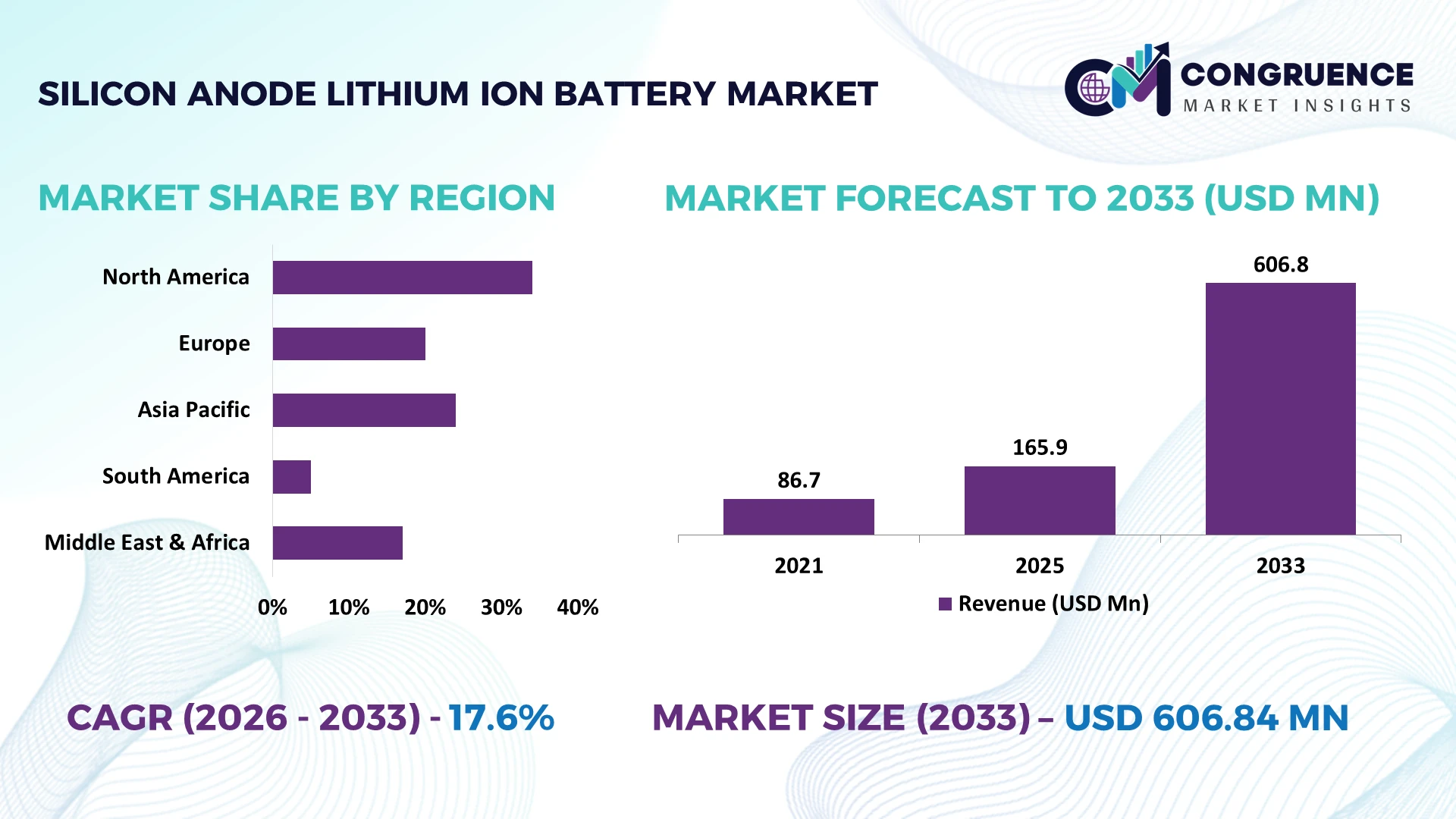
The Global Silicon Anode Lithium-Ion Battery Market was valued at USD 165.89 Million in 2025 and is anticipated to reach a value of USD 606.84 Million by 2033 expanding at a CAGR of 17.6% between 2026 and 2033. Commercial deployment of high-silicon anode materials, expanding electric vehicle production, and fast-charging battery innovation are accelerating large-scale manufacturing while improving energy density and cycle-life performance across automotive and premium consumer electronics applications.
China accounts for approximately 58% of global lithium-ion battery manufacturing capacity, supported by multi-billion-dollar investments in integrated battery supply chains and advanced anode material production, while South Korea contributes nearly 16% through technology-intensive cell manufacturing and silicon-material innovation. Ongoing supply-chain diversification beyond China following global critical mineral security initiatives is reshaping sourcing strategies, with silicon-anode adoption improving battery energy density by over 20% in commercial applications.
Battery manufacturers prioritizing localized silicon anode supply, strategic material partnerships, and scalable production technologies will strengthen competitive positioning as next-generation battery commercialization accelerates.
Market Size & Growth: USD 165.89 Million in 2025, projected to reach USD 606.84 Million by 2033 at 17.6% CAGR, driven by high-energy-density battery commercialization.
Top Growth Drivers: Silicon anodes improve energy density by over 20%, EV battery demand expands above 25%, and fast-charging capability reduces charging time by nearly 30%.
Short-Term Forecast: By 2028, manufacturing yields improve by approximately 15% while production costs decline nearly 12% through process optimization.
Emerging Technologies: AI-enabled battery design, silicon-composite anodes, and automated electrode coating accelerate advanced battery development and production efficiency.
Regional Leaders: Asia Pacific exceeds USD 340 Million through battery manufacturing expansion, North America surpasses USD 125 Million via domestic gigafactories, and Europe approaches USD 95 Million with localized battery value chains.
Consumer & End-User Trends: More than 40% of premium battery development programs integrate silicon-enhanced anodes for higher driving range and compact device performance.
Pilot Case Example: In 2026, commercial silicon-anode validation projects demonstrated over 20% higher energy density with measurable fast-charging improvements.
Competitive Landscape: Leading manufacturers collectively control approximately 45% market share, with Amprius Technologies, Sila Nanotechnologies, Group14 Technologies, Nexeon, and Enevate driving innovation.
Regulatory & ESG Impact: Localized battery material strategies reduce logistics-related emissions by nearly 18% while strengthening supply-chain resilience.
Investment & Funding: More than USD 3 Billion in strategic investments supports pilot plants, manufacturing expansion, and technology partnerships across global battery ecosystems.
Innovation & Future Outlook: Next-generation silicon-rich composite materials and scalable manufacturing platforms strengthen long-term competitiveness amid ongoing regional supply-chain expansion.
The Silicon Anode Lithium-Ion Battery Market is advancing through stronger demand from electric vehicles, premium consumer electronics, and energy storage systems, where higher energy density and faster charging deliver measurable performance advantages. Commercial silicon-composite anodes now improve battery capacity by over 20%, while localized material sourcing and advanced manufacturing reduce supply-chain risks amid evolving critical-mineral strategies, setting the stage for broader strategic market expansion.
Silicon anode lithium-ion batteries are becoming strategically important as battery manufacturers compete to deliver higher energy density without significantly increasing cell size or production footprint. Supply-chain restructuring and government-backed critical mineral strategies are accelerating localized anode material manufacturing, reducing dependence on single-country sourcing while strengthening resilience across electric mobility and energy storage value chains. This transition is influencing investment priorities, technology licensing, and long-term procurement strategies.
Compared with conventional graphite anodes, silicon-enhanced anodes deliver approximately 20–30% higher energy density while reducing battery pack weight by nearly 10% in selected applications. China continues to lead commercial-scale manufacturing, whereas the United States is expanding pilot production through advanced material partnerships and domestic cell manufacturing initiatives. Over the next two to three years, commercial deployment of silicon-rich anodes is expected to exceed 35% of premium battery development programs as manufacturers prioritize fast-charging capability and extended battery life.
A practical example is the integration of silicon-composite anodes into premium electric vehicle battery platforms to increase driving range without enlarging battery packs. Companies are expanding pilot manufacturing, forming long-term material partnerships, and investing in scalable production processes that improve consistency while reducing manufacturing waste. Organizations securing reliable silicon anode supply and advanced production capabilities will establish stronger competitive positioning as next-generation battery technologies become mainstream.
Rapid commercialization of high-performance battery platforms is accelerating silicon anode adoption across electric vehicles and premium electronics. Silicon-based anodes increase energy density by approximately 20–30% while enabling charging times to improve by nearly 25% compared with conventional graphite systems. China continues expanding integrated battery manufacturing clusters, while South Korea is strengthening advanced material production through strategic partnerships. This structural transition is encouraging battery manufacturers to invest in silicon-composite technologies, automated electrode production, and long-term supply agreements. A notable operational insight is that companies integrating silicon anodes into existing production lines achieve faster product differentiation without completely redesigning cell architecture, creating a measurable competitive advantage in premium battery segments.
Commercial scalability remains constrained by complex silicon processing requirements, elevated production costs, and dependence on specialized precursor materials. Manufacturing costs for silicon-rich anodes remain approximately 20% higher than conventional graphite alternatives, while production yield losses during early-scale manufacturing can exceed 10%. Japan and South Korea continue relying on highly specialized processing technologies, limiting broader supplier diversification. These factors directly affect profitability, procurement planning, and production consistency for battery manufacturers. Companies are responding through localized material sourcing, multi-year procurement contracts, and development of silicon-carbon composite formulations that improve manufacturing stability while reducing dependence on single-source processing technologies and strengthening long-term operational resilience.
Advanced silicon-carbon composites, AI-assisted material optimization, and scalable manufacturing processes are creating new commercial opportunities beyond conventional battery applications. Next-generation electrode technologies improve cycle life by nearly 30%, while automated quality inspection reduces manufacturing defects by approximately 15%. India is expanding battery manufacturing infrastructure, creating new demand for localized advanced anode materials and technology partnerships. Companies are increasing investment in research collaborations, pilot manufacturing facilities, and integrated supply ecosystems that accelerate commercialization. A significant strategic opportunity lies in licensing proprietary silicon-anode manufacturing processes, enabling technology providers to expand market presence without constructing large-scale production assets in every target country.
Maintaining consistent battery performance during high-volume production remains a major execution challenge. Silicon experiences significant volume expansion during charge-discharge cycles, requiring advanced material engineering and precision manufacturing controls. Commercial production lines targeting defect rates below 2% and manufacturing utilization above 85% require substantial process optimization and workforce expertise. The United States and Germany are investing in advanced battery manufacturing automation to improve production consistency and quality assurance. Companies must strengthen digital manufacturing systems, process analytics, and collaborative material development while expanding specialized engineering capabilities. Successfully balancing large-scale production with long-term durability will determine sustainable competitiveness in the next generation of lithium-ion battery manufacturing.
Localized Anode Material Expansion Battery manufacturers are restructuring supply chains by increasing localized silicon-anode production, with domestic material sourcing improving by nearly 25% and logistics lead times declining approximately 18%. Critical mineral security policies in the United States and Europe are accelerating new processing facilities, while companies are expanding strategic partnerships with material suppliers to reduce import dependence. This operational shift improves procurement stability, strengthens inventory planning, and enables faster commercialization of advanced battery platforms.
AI-Driven Manufacturing Optimization Artificial intelligence and automated quality inspection are transforming battery manufacturing workflows, reducing defect rates by nearly 20% and improving production throughput by approximately 15%. Chinese and South Korean manufacturers are integrating predictive analytics with digital process monitoring to stabilize silicon-anode production. Companies are scaling smart manufacturing systems to lower operating costs, improve yield consistency, and accelerate qualification of next-generation battery cells across high-volume production environments.
Fast-Charging Battery Integration Premium electric vehicle manufacturers are increasing deployment of silicon-composite anodes capable of improving charging performance by nearly 30% while enhancing battery energy density by over 20%. Product development priorities are shifting toward optimized battery architectures rather than larger battery packs. Companies are collaborating with automotive OEMs to integrate silicon-rich cells into future vehicle platforms, strengthening product differentiation while improving overall system efficiency.
Advanced Composite Material Adoption Nanostructured silicon and engineered silicon-carbon composites are reducing electrode degradation by approximately 25% and extending cycle life by nearly 30%. Growing demand for longer-lasting batteries in consumer electronics and energy storage is encouraging manufacturers to automate composite material production and expand pilot-scale manufacturing. A less obvious trend is the increased use of digital material simulation before commercial production, reducing development cycles and accelerating product validation.
Silicon-Graphite remains the leading segment with an estimated market share of approximately 48% because it balances higher energy density with manufacturing compatibility using existing lithium-ion production infrastructure. Manufacturers prefer this chemistry due to lower integration costs, stable cycle performance, and minimal redesign requirements. Silicon Composite follows as an established commercial option for premium batteries, while Silicon-Dominant technologies continue gaining traction in high-performance applications where energy density is prioritized over manufacturing simplicity.
Nanostructured Silicon represents the fastest-growing segment as advanced material engineering addresses expansion-related degradation and improves long-term stability. Commercial testing indicates nearly 30% higher energy density and approximately 20% longer cycle life compared with conventional graphite-based systems. Companies are expanding pilot production, licensing proprietary material technologies, and strengthening research partnerships to accelerate commercialization. Investment priorities increasingly favor scalable silicon-rich architectures that balance performance, production efficiency, and long-term reliability, positioning advanced material developers for stronger competitive differentiation.
Electric Vehicles account for approximately 56% of overall demand as automakers prioritize batteries offering higher driving range, faster charging, and improved energy density. Silicon anodes support these objectives without significantly increasing battery pack size, making them attractive for premium and mass-market electric vehicle platforms. Consumer Electronics remains a mature segment where compact battery design and extended operating time continue supporting adoption, while Aerospace applications focus on lightweight, high-performance battery systems.
Energy Storage Systems represent the fastest-growing application as grid modernization and renewable integration increase demand for high-capacity batteries with improved operational efficiency. Commercial deployments indicate nearly 22% higher storage performance and approximately 18% faster charging capability using advanced silicon-enhanced cells. Companies are expanding battery manufacturing capacity, integrating automated production systems, and collaborating with utility operators and vehicle manufacturers to strengthen deployment across multiple end-use industries while diversifying commercial opportunities.
Automotive remains the dominant end-user, representing approximately 58% of market demand due to large-scale electric vehicle production and continuous investment in next-generation battery technologies. Vehicle manufacturers require batteries with higher energy density, reduced charging time, and improved operational efficiency, making silicon-anode integration strategically important. Electronics manufacturers continue adopting silicon-enhanced batteries for premium devices, while Aerospace & Defense focuses on lightweight power systems designed for mission-critical performance.
Energy & Utilities is the fastest-growing end-user segment as grid-scale storage projects expand alongside renewable energy deployment. Battery installations using advanced silicon-based materials demonstrate nearly 20% higher operational efficiency and approximately 15% improved storage utilization. Companies are strengthening ecosystem partnerships, customizing battery platforms for industry-specific requirements, and expanding localized production capabilities. Competitive positioning increasingly depends on delivering application-specific battery solutions supported by integrated supply networks and long-term technology collaboration.
Asia-Pacific accounted for the largest market share at 57.8% in 2025 however, North America is expected to register the fastest growth, expanding at a 19.2% between 2026 and 2033.
Advanced Battery Manufacturing and Domestic Supply Expansion
North America is strengthening its position through domestic battery manufacturing, advanced material commercialization, and localized critical mineral strategies. The region represents approximately 21% of global demand, supported by electric vehicle manufacturing, energy storage deployment, and government-backed industrial investments. Commercial partnerships between battery developers and automotive manufacturers are accelerating qualification of silicon-rich anode technologies for next-generation battery platforms. More than 35% of newly announced advanced battery projects emphasize localized material sourcing and integrated manufacturing. Companies continue expanding pilot production, automated quality control, and strategic supply agreements to improve manufacturing resilience while reducing dependence on imported battery materials.
United States Market Outlook: The United States leads the regional market through large-scale battery manufacturing investments, advanced material innovation, and expanding electric vehicle production. More than 40 gigafactory projects are supporting domestic battery capacity expansion, while advanced silicon-anode developers continue forming long-term partnerships with automotive manufacturers. Federal support for battery supply chains and increasing investment in next-generation battery technologies strengthen commercialization opportunities and accelerate adoption of silicon-rich battery materials across mobility and stationary storage applications.
Localized Battery Ecosystems Drive Industrial Transformation
Europe continues expanding advanced battery manufacturing through localized supply chains, sustainability-focused industrial policies, and strategic technology partnerships. The region contributes nearly 18% of global market activity, supported by rapid electric vehicle electrification and investment in advanced battery materials. Manufacturing clusters across Germany, France, and Sweden are integrating silicon-enhanced battery technologies into next-generation production facilities. Battery manufacturers are improving localized component sourcing by approximately 20%, reducing supply-chain exposure while strengthening operational flexibility. Companies increasingly prioritize circular manufacturing practices and battery recycling integration to support long-term competitiveness and regulatory compliance.
Germany Market Outlook: Germany remains the strategic center of European battery innovation through its automotive manufacturing base and advanced engineering capabilities. Premium vehicle manufacturers are collaborating with battery technology developers to commercialize higher-energy-density cells for future electric platforms. Automated battery manufacturing facilities and growing investments in advanced material research continue strengthening industrial competitiveness while supporting broader adoption of silicon-anode technologies across automotive and industrial battery applications.
Manufacturing Scale and Export Leadership
Asia-Pacific dominates the global market through unmatched battery manufacturing capacity, integrated supply chains, and advanced material production. The region accounts for approximately 57.8% of global market activity, supported by large-scale battery cell manufacturing, consumer electronics production, and electric vehicle deployment. China, South Korea, and Japan continue investing in high-volume silicon-anode manufacturing while expanding export-oriented production. Battery manufacturing utilization exceeds 80% across major industrial hubs, enabling efficient commercialization of advanced battery technologies. Companies are strengthening vertical integration, expanding processing facilities, and increasing automation to improve production efficiency and maintain global supply leadership.
China Market Outlook: China remains the industry's largest manufacturing hub with approximately 58% of global lithium-ion battery production capacity. Integrated supply chains covering raw materials, advanced anode processing, and battery assembly provide significant operational advantages. Leading manufacturers continue investing in silicon-rich anode commercialization, automated manufacturing systems, and strategic export expansion, reinforcing China's leadership in advanced battery technology deployment and industrial-scale production.
Battery Value Chain Development Gains Momentum
South America is gradually strengthening its role through critical mineral resources, expanding battery investments, and increasing electric mobility adoption. The region contributes approximately 4% of global market activity, supported primarily by lithium supply and growing downstream battery initiatives. Infrastructure limitations remain, yet new processing investments and international partnerships are improving regional participation in advanced battery value chains. Battery-related industrial projects have increased by nearly 18% over recent years, encouraging technology transfer and localized processing. Companies are focusing on strategic partnerships and resource integration rather than large-scale battery manufacturing during the current commercialization phase.
Brazil Market Outlook: Brazil leads regional deployment through expanding electric mobility initiatives, industrial manufacturing capability, and investments in battery assembly operations. Automotive manufacturers continue increasing electrification programs while domestic energy storage projects create additional demand for advanced battery technologies. Government-backed industrial modernization and international technology collaborations are strengthening Brazil's long-term position within the regional battery ecosystem despite continuing infrastructure development requirements.
Energy Diversification Supports Battery Investments
The Middle East & Africa market is progressing through renewable energy deployment, industrial diversification, and strategic investment in advanced energy storage infrastructure. The region represents approximately 3% of global market activity, with demand increasingly linked to utility-scale storage and industrial electrification. National energy transition programs are encouraging battery deployment alongside renewable generation projects, while infrastructure investments continue expanding localized energy storage capacity. Battery-related infrastructure projects have increased by nearly 15% across selected markets, supporting gradual commercialization of advanced battery technologies. Companies are entering joint ventures and technology partnerships to establish regional supply capabilities and improve long-term market access.
Saudi Arabia Market Outlook: Saudi Arabia is emerging as the region's most influential market through energy diversification initiatives and investments in advanced manufacturing. Large-scale renewable energy projects are increasing demand for high-performance battery storage systems, while industrial development programs encourage localized technology partnerships. Expansion of clean energy infrastructure and strategic investment in advanced industrial capabilities position the country as a key future destination for silicon-anode battery deployment.
The market is led by Amprius Technologies, Sila Nanotechnologies, Group14 Technologies, Nexeon, and Enevate, which compete directly with established battery material suppliers and cell manufacturers seeking faster commercialization of silicon-rich anode technologies. The top five players collectively control approximately 46% of the market, with competition centered on energy density, manufacturing scalability, intellectual property, and strategic supply agreements rather than price alone. Silicon-enhanced batteries deliver over 20% higher energy density, while advanced manufacturing processes reduce production variability by nearly 15%, creating measurable differentiation. Companies are expanding pilot production, securing automotive partnerships, pursuing vertical integration, and licensing proprietary materials to accelerate deployment. The competitive landscape is shifting toward technology leadership and supply-chain control as manufacturers seek reliable commercial-scale production. High qualification requirements, process complexity, and protected material technologies create significant entry barriers. Success increasingly depends on scalable manufacturing, validated performance, resilient supply networks, and long-term OEM partnerships.
Amprius Technologies
Sila Nanotechnologies
Group14 Technologies
Nexeon
Enevate
OneD Battery Sciences
Enovix Corporation
NanoGraf Corporation
California Lithium Battery Inc.
Shin-Etsu Chemical Co., Ltd.
BTR New Material Group Co., Ltd.
POSCO Future M Co., Ltd.
Hitachi Chemical Co., Ltd.
Resonac Corporation
Silicon-carbon composite anodes, advanced binders, and engineered electrolyte formulations are the core technologies reshaping battery performance. Commercial silicon-enhanced cells improve energy density by approximately 20–30% over conventional graphite anodes while reducing charging time by nearly 25% in optimized applications. Around 35% of premium battery development programs now incorporate silicon-rich anode architectures, particularly for electric vehicles and advanced consumer electronics. Manufacturers are integrating digital process control with precision coating technologies to improve electrode uniformity, increasing production yield by nearly 15% and lowering material waste by approximately 10%.
Emerging technologies focus on nanostructured silicon, artificial intelligence-assisted material discovery, and digital twin manufacturing platforms. AI-driven electrode optimization shortens formulation development by roughly 20%, while automated quality inspection reduces defect rates by nearly 18%. Compared with legacy graphite systems, silicon-rich composite anodes deliver approximately 25% higher usable energy density without requiring complete production-line replacement. Companies investing in scalable silicon-carbon materials and automated manufacturing gain stronger product differentiation through improved battery performance and faster commercial qualification.
Between 2026 and 2028, commercialization will increasingly depend on high-volume manufacturing consistency rather than laboratory breakthroughs. Integrated battery ecosystems combining silicon-anode materials, predictive analytics, and localized supply chains are expected to exceed 45% deployment among advanced battery manufacturers. Early adopters securing proprietary material platforms, strategic partnerships, and automated production capabilities will strengthen competitive positioning as next-generation lithium-ion batteries move into mainstream automotive and energy storage applications.
January 2024 Amprius Technologies launched its commercial SiCore™ silicon-anode battery platform, offering up to 400 Wh/kg and as many as 1,200 charge cycles, expanding applications beyond aviation into broader mobility markets. The launch strengthened commercial product diversification and customer reach.
May 2025 Amprius Technologies signed a strategic manufacturing partnership with a South Korean battery producer to expand global SiCore® cell production for advanced drone applications. The agreement increased contracted manufacturing capacity beyond 2 GWh, strengthening supply-chain resilience and production scalability. Source: https://amprius.com
May 2025 GDI secured an additional USD 11.5 million in Series A funding, bringing the round above USD 20 million to scale silicon-anode production. The company targets approximately 30% higher energy density than graphite anodes, accelerating pilot manufacturing and commercial readiness. Source: https://reuters.com
March 2026 Group14 Technologies began EV-scale production at its South Korea facility, designed to manufacture 2,000 metric tons of SCC55® annually, supporting about 10 GWh of battery capacity. The expansion strengthens global silicon battery material supply and reduces graphite dependence. Source: https://group14.technology
This report provides a comprehensive assessment of the Silicon Anode Lithium-Ion Battery Market across silicon-dominant, silicon-graphite, silicon composite, and nanostructured silicon technologies. It evaluates deployment across electric vehicles, consumer electronics, energy storage systems, and aerospace while examining demand from automotive, electronics, energy & utilities, and aerospace & defense end-users. The analysis covers North America, Europe, Asia-Pacific, South America, and the Middle East & Africa, with country-level strategic insights for major battery manufacturing and technology hubs.
The study reviews advanced silicon-anode materials, automated battery manufacturing, AI-assisted material development, and next-generation electrode engineering while tracking commercialization trends between 2026 and 2033. It evaluates competitive positioning across more than 10 major industry participants, highlights technology adoption exceeding 35% in premium battery programs, and assesses production, deployment, and supply-chain strategies. The report supports investment prioritization, expansion planning, product development, partnership evaluation, and long-term competitive decision-making through detailed operational and strategic market intelligence.
| Report Attribute/Metric | Report Details |
|---|---|
Market Revenue in 2025 | USD 165.89 Million |
Market Revenue in 2033 | USD 606.84 Million |
CAGR (2026 - 2033) | 17.6% |
Base Year | 2025 |
Forecast Period | 2026 - 2033 |
Historic Period | 2021 - 2025 |
Segments Covered | By Type
By Application
By End-User
|
Key Report Deliverable | Revenue Forecast, Growth Trends, Market Dynamics, Segmental Overview, Regional and Country-wise Analysis, Competition Landscape |
Region Covered | North America, Europe, Asia-Pacific, South America, Middle East, Africa |
Key Players Analyzed | Amprius Technologies, Sila Nanotechnologies, Group14 Technologies, Nexeon, Enevate, OneD Battery Sciences, Enovix Corporation, NanoGraf Corporation, California Lithium Battery Inc., Shin-Etsu Chemical Co., Ltd., BTR New Material Group Co., Ltd., POSCO Future M Co., Ltd., Hitachi Chemical Co., Ltd., Resonac Corporation |
Customization & Pricing | Available on Request (10% Customization is Free) |




