
Reports
The Global Silica Gel Desiccant Market was valued at USD 690.0 Million in 2025 and is anticipated to reach a value of USD 981.2 Million by 2033 expanding at a CAGR of 4.5% between 2026 and 2033. Growth is driven by increasing moisture-control requirements across pharmaceutical packaging, electronics, food exports, and moisture-sensitive logistics, alongside wider adoption of high-performance desiccant formats.
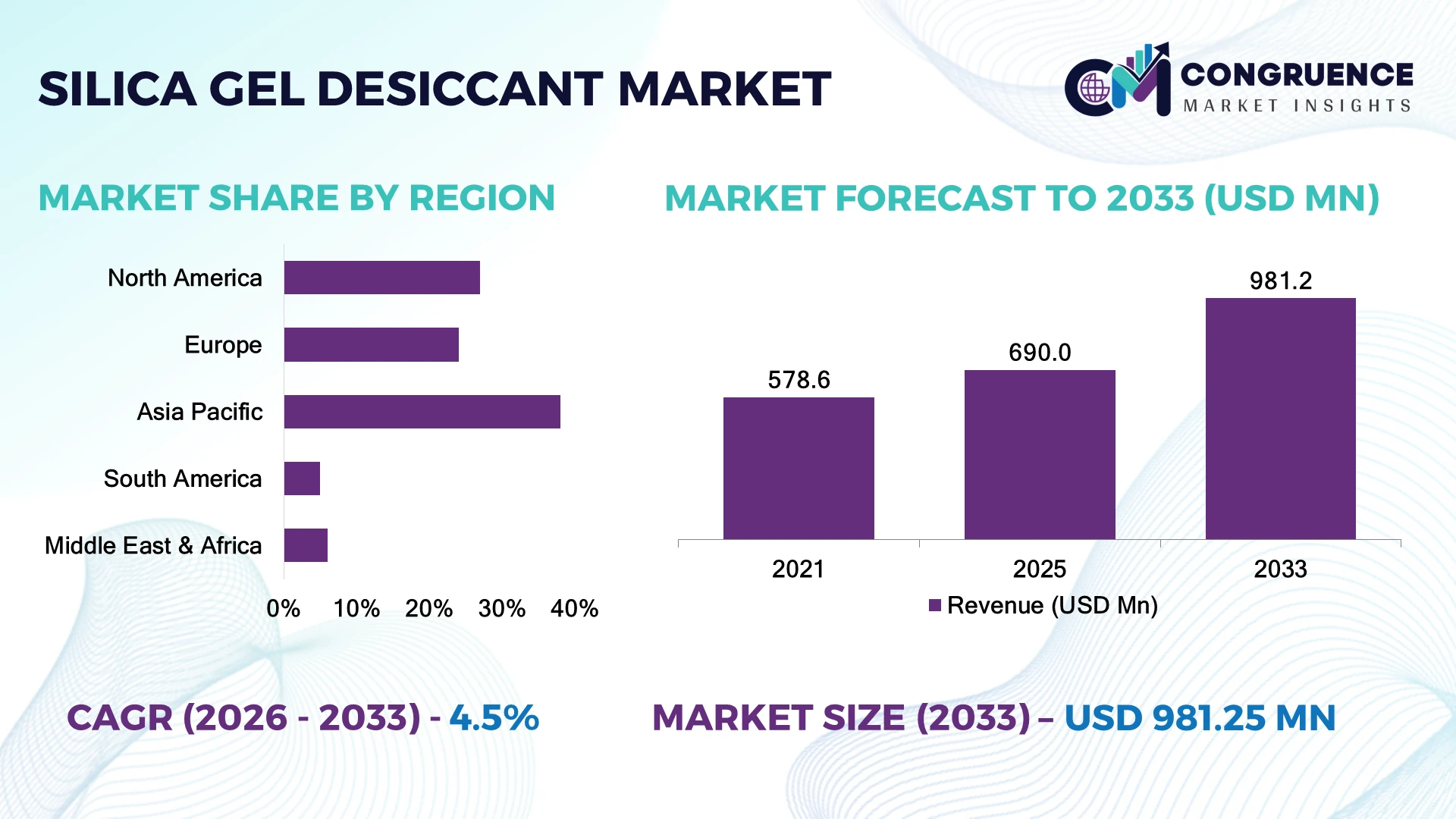
China holds approximately 35% of global silica-gel production capacity, supported by electronics, pharmaceutical, chemical, and packaging industries, while India is expanding localized production and pharmaceutical applications at around 6.0% annually. China maintains greater manufacturing scale, whereas India is recording faster adoption across pharmaceutical packaging and electronics. Geopolitical supply-chain restructuring is encouraging regional sourcing and capacity expansion.
The strategic priority is to secure localized capacity while moving toward application-specific, high-purity, and sustainable desiccant formats.
Market Size & Growth: The market is valued at USD 690.0 Million in 2025 and reaches USD 981.2 Million by 2033 at a 4.5% CAGR, supported by pharmaceutical and electronics packaging.
Top Growth Drivers: Pharmaceutical packaging accounts for approximately 28%, electronics 19%, and food packaging 15% of key application demand.
Short-Term Forecast: By 2028, optimized sachet formats are expected to improve moisture-control efficiency by 8–12% while reducing material consumption by approximately 5%.
Emerging Technologies: Indicating silica gel, low-dust formulations, and automated moisture-monitoring packaging are improving handling efficiency by approximately 10%.
Regional Leaders: Asia Pacific reaches approximately USD 328 Million, North America USD 245 Million, and Europe USD 220 Million by 2033, driven by pharmaceutical-grade and sustainable-format adoption.
Consumer/End-User Trends: Packaging, pharmaceuticals, and electronics represent more than 60% of major demand, with increasing use of compact 1–5 gram sachets.
Pilot/Case Example: A 2019 pharmaceutical desiccant manufacturing expansion in India strengthened localized packet production and reduced dependence on imported finished formats.
Competitive Landscape: Leading participants include Clariant, BASF SE, Multisorb Technologies, W. R. Grace & Co., and Sorbead India, with leading suppliers generally holding less than 20% individually.
Regulatory & ESG Impact: Cobalt-free indicating systems and recyclable sachet materials are reducing environmental impact by approximately 15–20% in selected packaging applications.
Investment & Funding: Large-scale silica-gel capacity expansions involve investments exceeding USD 100 Million, with capital directed toward regional production and automated processing.
Innovation & Future Outlook: High-purity grades, automated filling, recyclable substrates, and application-specific adsorption profiles are shifting competition toward performance, compliance, and supply reliability.
Silica gel desiccant demand is concentrating around pharmaceuticals, electronics, food exports, and moisture-sensitive industrial packaging, while advanced indicating and precision-filled formats improve product protection. Approximately 70% of demand remains concentrated in non-indicating silica gel, but premium formats are gaining traction as manufacturers respond to tighter packaging specifications and cross-border supply-chain requirements. These developments are creating a stronger foundation for strategic differentiation.
The Silica Gel Desiccant Market is becoming strategically important because moisture control directly influences product integrity, shelf life, export quality, and pharmaceutical compliance. Packaging, pharmaceutical, and electronics applications account for more than 60% of major demand, positioning desiccants as an integral component of product protection. Supply-chain restructuring is also encouraging manufacturers to develop localized production and sourcing networks.
Technology adoption is shifting from conventional loose beads toward indicating grades, precision-filled sachets, low-dust formulations, and application-specific adsorption systems. Optimized sachets can reduce material consumption by approximately 5–10% while improving moisture-control consistency compared with oversized conventional formats. China retains manufacturing scale, while India is strengthening adoption through pharmaceutical production and electronics manufacturing.
During the next 2–3 years, automated filling, recyclable packaging, and validated pharmaceutical formats will strengthen production consistency. Pharmaceutical desiccant manufacturing in India demonstrates how localized capacity can improve supply continuity and shorten procurement cycles. Companies are consequently prioritizing regional manufacturing, dual sourcing, automation, and partnerships with packaging converters. Competitive positioning will increasingly depend on adsorption performance, regulatory compliance, localized availability, and packaging efficiency.
Increasing moisture sensitivity across pharmaceuticals, diagnostics, electronics, and export packaging is strengthening silica gel adoption. Pharmaceutical and electronics applications represent major consumption categories, while India’s demand is expanding at approximately 6.0% annually and China’s market is advancing at around 6.5%. Biologics, precision electronics, and high-barrier packaging require tighter moisture-control specifications than conventional products. Geopolitical supply-chain restructuring is further encouraging regional packaging production. Companies are responding through localized packet manufacturing, higher-purity grades, automated filling, and multi-site procurement. The key strategic shift is integrating desiccant selection into packaging engineering, enabling manufacturers to optimize adsorption capacity, package dimensions, and product protection simultaneously.
Silica gel manufacturing remains exposed to fluctuations in sodium silicate, energy, logistics, and processing costs. China represents approximately 35% of global silica-gel production capacity, creating substantial sourcing concentration for downstream users. Import-dependent markets can source more than 60% of specialized formats externally, increasing exposure to freight disruption and supplier concentration. Margin pressure rises when chemical inputs and transportation costs increase, while pharmaceutical customers require consistent adsorption performance across suppliers. Companies are reducing exposure through dual sourcing, regional inventories, long-term procurement agreements, and localized converting operations. The critical restraint is maintaining identical adsorption, particle-size, and moisture-control specifications when production is distributed across multiple suppliers.
Application-specific silica gel formats present a significant opportunity as manufacturers seek stronger moisture protection with lower material consumption. Non-indicating products account for approximately 70% of demand, leaving substantial room for premium indicating, pharmaceutical-grade, low-dust, and recyclable formats. Sustainable desiccant adoption is increasing by approximately 38% in selected packaging applications, while automated sachet filling can reduce handling losses by around 10%. India offers strong opportunities across pharmaceutical exports, food processing, and electronics. Companies are investing in cobalt-free indicators, precision dosing, recyclable substrates, and packaging partnerships. Embedding desiccant specifications into smart packaging systems provides a non-obvious advantage by allowing moisture protection to be matched precisely to product sensitivity.
Maintaining consistent adsorption capacity, particle size, dust control, and filling accuracy becomes increasingly difficult as manufacturers scale customized products. Pharmaceutical and electronics customers require tightly controlled specifications, while automated packaging lines demand dimensional and weight consistency. Poorly controlled filling and sealing processes can reduce operational efficiency by approximately 5–10%. Sustainability requirements simultaneously pressure manufacturers to introduce recyclable substrates and lower-impact indicator chemistries without compromising performance. Companies must invest in automated inspection, validated production systems, application testing, and supplier qualification. The long-term challenge is scaling multiple customized grades without creating excessive SKU complexity, production downtime, or inconsistent performance across geographically distributed manufacturing facilities.
Precision Sachet Automation: Automated filling and weight-control systems are expanding across pharmaceutical and electronics packaging, with precision dosing improving material utilization by 8–12% and reducing manual handling by nearly 10%. Manufacturers are shifting toward compact 1–5 gram sachets and automated inspection to improve line speed, batch consistency, and labor productivity.
Cobalt-Free Indicator Transition: Indicator formulations are moving toward cobalt-free and lower-impact chemistries as packaging requirements tighten. Around 15–20% lower environmental impact is targeted in selected indicator formats, while orange and other non-cobalt technologies are gaining acceptance. Producers are reformulating portfolios and partnering with packaging converters to maintain visual saturation monitoring without legacy chemistry concerns.
Regional Supply Localization: Supply-chain disruption and freight volatility are accelerating localized converting and inventory strategies. China retains roughly 35% of production capacity, while Indian manufacturers are expanding pharmaceutical and electronics-oriented packet production. Regional sourcing can shorten replenishment cycles by approximately 10–15%, prompting companies to establish dual-source contracts, local warehouses, and smaller production hubs closer to export-packaging customers.
Smart Moisture Monitoring: Desiccant systems are increasingly integrating humidity indicators, sensor-enabled packaging, and digital quality workflows. Smart-format development represents more than 40% of recent product innovation activity, while advanced adsorption materials can improve moisture-capture capacity by over 20% compared with conventional formulations. Companies are combining desiccants with traceability systems to identify exposure during warehousing and international transit, creating a non-obvious shift from passive protection toward measurable moisture management.
Non-Indicating Silica Gel dominates the product-type segment with approximately 61.3% share, supported by lower production cost, broad compatibility, and high-volume use across pharmaceutical packaging, food protection, electronics, and industrial drying. Its colorless formulation avoids additional indicator chemistry and simplifies procurement for regulated applications. Standard non-indicating grades remain particularly strong where automated filling and routine moisture protection are prioritized, while indicating silica gel serves applications requiring visual saturation checks. Companies are therefore expanding high-purity, low-dust, and customized non-indicating grades while maintaining specialized indicating portfolios.
Indicating Silica Gel is the faster-shifting segment as users seek quicker visual verification during storage and transit. Demand is strengthening particularly in electronics, laboratories, and controlled inventory environments, where moisture exposure requires immediate identification. Adoption of advanced indicator formulations is increasing by approximately 10–15% in specialized applications, while cobalt-free alternatives are gaining preference. The mature non-indicating segment provides scale and cost advantages, whereas indicating products offer higher functional differentiation. Manufacturers are increasing R&D spending on safer color-change technologies and application-specific formulations.
Pharmaceuticals represent the leading application with approximately 31.2% share, reflecting the need for validated humidity protection across tablets, capsules, biologics, diagnostics, and sensitive formulations. Food & Beverage follows at approximately 25.8%, supported by shelf-life protection and moisture-sensitive packaged products. Packaging remains a broad-volume application because sachets and canisters can be integrated directly into established packing workflows. Companies serving pharmaceutical customers are increasing use of validated canisters, low-dust materials, and controlled filling systems, while food-packaging suppliers emphasize compact formats and compliance-oriented material specifications.
Electronics is the fastest-growing application, accounting for around 20.3% and expanding as semiconductor, component, and consumer-electronics manufacturing increases. Moisture protection is becoming operationally critical during long storage and international transportation, particularly where condensation can cause corrosion or reliability failures. Chemicals and other industrial applications remain strategically relevant for gas drying, storage protection, and process environments. Electronics-focused manufacturers are adopting cleaner grades, tighter particle specifications, and customized packaging formats. The shift from general-purpose sachets toward application-engineered protection is strengthening supplier differentiation and increasing the value of technical partnerships.
Industrial end-users dominate the market with approximately 68.4% share, driven by recurring procurement across pharmaceuticals, electronics, food processing, chemicals, manufacturing, storage, and transportation. Large industrial buyers typically purchase standardized grades in bulk and require consistent adsorption capacity, documentation, and batch traceability. Commercial users account for a smaller but diverse demand base covering retail packaging and professional storage applications, while residential consumption remains comparatively limited. Companies are responding to industrial procurement requirements through long-term contracts, customized specifications, regional inventories, and integrated packaging partnerships.
Commercial and residential adoption is shifting toward convenient pre-packed formats, reusable containers, and small-volume moisture-control products. Consumer-oriented demand is estimated at approximately 23.8%, with adoption increasing around 5.8% as e-commerce improves product accessibility and awareness of moisture-related damage expands. Industrial procurement remains more specification-driven, whereas commercial and residential purchasing emphasizes convenience, price, and ease of use. Manufacturers are therefore segmenting product portfolios by pack size, performance grade, and channel requirements. The strategic implication is clear: industrial customers provide volume stability, while commercial and residential applications create opportunities for differentiated formats and higher-margin specialty products.
Asia-Pacific accounted for the largest market share at 38% in 2025 however, Asia-Pacific is expected to register the fastest growth, expanding at a CAGR of 6.2% between 2026 and 2033.
North America held approximately 27% of the global market in 2025, supported by large-scale pharmaceutical, food, electronics, and specialty packaging operations. The United States accounts for roughly 70–75% of regional silica gel sachet consumption, reflecting its extensive pharmaceutical manufacturing and e-commerce packaging base. Pharmaceutical packaging represents approximately 24% of broader regional desiccant demand, while packaging applications exceed 34%. Automated filling, compact sachets, and integrated desiccant closures are gaining traction as manufacturers prioritize consistent dosing and contamination control. Companies are expanding domestic inventory, qualifying multiple suppliers, and integrating desiccant components directly into packaging lines to improve supply continuity and production efficiency.
United States Market Outlook: The United States remains the principal North American market because of its pharmaceutical manufacturing scale, electronics production, and sophisticated packaging infrastructure. Desiccant import shipments recorded an approximately 8.7% annualized increase between 2020 and 2024, indicating sustained procurement activity. Manufacturers are increasingly emphasizing domestic inventory, validated pharmaceutical formats, and automated packaging compatibility.
Europe represented approximately 24% of the global market in 2025, supported by pharmaceutical manufacturing, food processing, specialty chemicals, and advanced packaging operations. Germany, France, Italy, and the United Kingdom account for a substantial proportion of regional consumption, with Germany particularly strong in pharmaceutical packaging engineering and specialty desiccant manufacturing. Pharmaceutical and diagnostic applications increasingly use dust-controlled silica gel capsules and sachets designed around regulated packaging requirements. European manufacturers are also moving toward recyclable substrates, cobalt-free indicators, and integrated closure systems. Standardized desiccant calculation and packaging specifications are improving material utilization, while customized formats help reduce unnecessary fill volumes. Companies are responding through local production, packaging partnerships, and product redesign focused on compliance and sustainability.
Germany Market Outlook: Germany holds a strategically important position through its pharmaceutical-packaging ecosystem, chemical manufacturing base, and specialized desiccant producers. Silica gel can adsorb up to 40% of its own weight in moisture, supporting compact packaging designs where controlled humidity is essential. German suppliers are increasingly combining desiccant filling with pharmaceutical packaging development, strengthening integrated manufacturing capabilities.
Asia-Pacific accounted for approximately 38% of the global market in 2025, making it the largest regional market. China represents roughly 35% of global silica-gel production capacity, while India, Japan, South Korea, and Southeast Asian economies are strengthening downstream consumption. Electronics, pharmaceuticals, food exports, chemicals, and logistics collectively drive high-volume demand. China benefits from integrated chemical and packaging supply chains, while India is expanding pharmaceutical and electronics applications at approximately 6.0% annually. Regional manufacturers are increasing automated sachet production, high-purity grades, and localized inventory networks. Supply-chain restructuring is encouraging companies to diversify production beyond single-country sourcing, while export-oriented manufacturers are adopting tighter moisture-control specifications for international shipments.
China Market Outlook: China remains the region’s dominant manufacturing base, supported by extensive chemical production, electronics manufacturing, pharmaceutical packaging, and export logistics. Its approximately 35% share of global silica-gel production capacity provides significant scale advantages and supports competitive pricing. Producers are increasingly investing in higher-purity grades, automated processing, and specialized formulations for electronics and pharmaceutical applications.
South America represented approximately 5% of the global market in 2025, with Brazil accounting for the largest portion of regional consumption. Pharmaceutical packaging, food processing, agricultural exports, electronics distribution, and industrial storage are the principal demand areas. Brazil’s large packaged-food and pharmaceutical sectors create recurring requirements for moisture-control sachets and containers, while Argentina and Chile contribute through food, agricultural, and specialty-product exports. Adoption remains more concentrated in industrial and commercial applications than in household use. Import dependence for specialized grades creates procurement pressure, particularly when international freight costs rise. Companies are responding through regional warehousing, distributor partnerships, localized converting, and broader product portfolios designed around food-safe and pharmaceutical-compatible formats.
Brazil Market Outlook: Brazil is the most strategically significant South American market because of its large pharmaceutical, food-processing, agricultural, and consumer-packaging industries. Food and pharmaceutical manufacturers increasingly incorporate moisture-control components into products intended for extended domestic and export distribution. Companies are strengthening distributor networks and inventory coverage to reduce exposure to international supply interruptions and improve availability of specialized desiccant formats.
Middle East & Africa accounted for approximately 6% of global demand in 2025, with Saudi Arabia, the United Arab Emirates, South Africa, and Egypt representing key consumption centers. Pharmaceutical manufacturing, food processing, electronics distribution, chemicals, oil and gas equipment, and international logistics are strengthening moisture-protection requirements. Gulf logistics hubs are particularly important because temperature and humidity fluctuations create additional storage and transportation challenges. Pharmaceutical and food-packaging applications increasingly favor compact, dust-controlled sachets and canisters. Companies are expanding regional inventories and partnering with packaging distributors to shorten replenishment cycles. Industrial diversification programs in Gulf economies are also encouraging localized manufacturing and more sophisticated packaging workflows, reducing reliance on finished imported products.
Saudi Arabia Market Outlook: Saudi Arabia holds a strong strategic position through pharmaceutical localization, food processing, petrochemical activity, and logistics infrastructure development. Industrial diversification is increasing demand for reliable moisture protection across stored equipment, packaged products, and exported goods. Companies are prioritizing local distribution partnerships and inventory availability around major industrial and logistics hubs, strengthening supply resilience and supporting wider adoption of specialized silica gel formats.
Clariant, W. R. Grace & Co., Multisorb Filtration Group, Sanner GmbH, and Sorbead India compete across global and regional markets. Global players focus on advanced formulations, packaging integration, and supply reliability, while regional suppliers compete through pricing and shorter lead times. The top five players collectively hold approximately 32% market share. Competition is based on adsorption performance, price, customization, and supply-chain efficiency. Premium pharmaceutical formats command around 15–25% higher pricing, while automated packaging formats can reduce handling requirements by 10–15%. Companies are investing in automated production, customized grades, integrated packaging, and regional manufacturing partnerships. The market is shifting from commodity silica gel toward engineered moisture-control solutions. Key entry barriers include product qualification, regulatory compliance, production consistency, and customer testing requirements. Companies with reliable supply, competitive pricing, application-specific products, and integrated packaging capabilities are best positioned to strengthen their competitive position.
Clariant
W. R. Grace & Co.
Multisorb Filtration Group
Sanner GmbH
Sorbead India
Mitsubishi Gas Chemical Company
OhE Chemicals
Desiccare, Inc.
Wisesorbent Technology
ThoMar OHG
Capitol Scientific
Flow Dry Technology
Oker-Chemie GmbH
ProAmpac
The market is shifting from conventional loose silica gel and manually inserted sachets toward precision-filled packets, automated insertion systems, integrated desiccant closures, and moisture-control films. Automated insertion can reduce manual handling by approximately 10–15%, while automated inspection improves filling consistency. Adoption is particularly strong in pharmaceutical, nutraceutical, electronics, and specialty packaging operations.
Integrated packaging technologies are becoming increasingly important. Built-in desiccant systems can eliminate separate insertion steps and improve packaging-line efficiency by approximately 8–12%. Compared with conventional manual insertion, these systems also reduce component handling by around 10%. Conventional silica gel remains cost-effective for general moisture control, while molecular sieves are preferred for applications requiring extremely low humidity.
Between 2026 and 2028, AI-assisted inspection, automated dosing, recyclable substrates, cobalt-free indicators, and active moisture-control packaging will influence technology investment. Suppliers offering integrated packaging solutions gain an advantage through higher throughput, customization, and reduced labor requirements. Companies investing early can improve production efficiency, reduce handling costs, and strengthen product differentiation. Digital traceability is also becoming more relevant for monitoring humidity exposure during storage and transportation.
April 2026 – Clariant introduced continuous-strip desiccant packets wound on reels for automated high-speed packaging lines. The formats support existing insertion equipment and use AI-based inspection to improve packet integrity and uniformity, strengthening automated pharmaceutical and nutraceutical packaging operations. Source: Clariant
October 2025 – ProAmpac expanded its Moisture Protect solutions using 3-Phase Activ-Polymer technology, eliminating conventional desiccant packets. The portfolio includes foil-based, foil-free, and Recycle Ready options, supporting sustainable moisture protection and reducing packaging-component handling. Source: ProAmpac
June 2025 – Sanner launched manufacturing operations in Greensboro, North Carolina, covering injection-molded components, pharmaceutical packaging, and desiccant solutions. The facility strengthens localized production capacity and provides customers with a scalable North American manufacturing source. Source: Sanner Group
May 2025 – Sanner introduced its optimized TabTec CR packaging with integrated desiccant technology. The system supports silica gel, activated carbon, molecular sieve, and blends while eliminating separate desiccant insertion, improving packaging-line efficiency for oral solid-dose products. Source: Sanner Group
The Silica Gel Desiccant Market Report covers type, application, end-user, regional markets, competitive landscape, and technology developments. Type analysis includes indicating and non-indicating silica gel. Application coverage includes pharmaceuticals, food and beverage, packaging, electronics, chemicals, and other industrial uses. End-user analysis covers industrial, commercial, and residential users.
The report covers North America, Europe, Asia-Pacific, South America, and Middle East & Africa. It also evaluates automated packaging, integrated desiccant systems, AI-assisted inspection, sustainable substrates, cobalt-free indicators, and advanced adsorption technologies. Asia-Pacific accounts for approximately 38% of global demand, while industrial users represent about 68%. The analysis supports investment planning, expansion strategies, supplier selection, product development, partnerships, and competitive positioning through 2033.
| Report Attribute / Metric | Details |
|---|---|
| Market Revenue (2025) | USD 690.0 Million |
| Market Revenue (2033) | USD 981.2 Million |
| CAGR (2026–2033) | 4.5% |
| Base Year | 2025 |
| Forecast Period | 2026–2033 |
| Historic Period | 2021–2025 |
| Segments Covered |
By Type
By Application
By End-User
|
| Key Deliverables | Revenue Forecast; Market Trends; Growth Drivers & Restraints; Technology Insights; Segmentation Analysis; Regional Insights; Competitive Landscape; Regulatory & ESG Overview; Recent Developments |
| Regions Covered | North America; Europe; Asia-Pacific; South America; Middle East & Africa |
| Companies Profiled | Clariant; W. R. Grace & Co.; Multisorb Filtration Group; Sanner GmbH; Sorbead India; Mitsubishi Gas Chemical Company; OhE Chemicals; Desiccare, Inc.; Wisesorbent Technology; ThoMar OHG; Capitol Scientific; Flow Dry Technology; Oker-Chemie GmbH; ProAmpac |
| Customization & Pricing | Available on Request (10% Customization Free) |




