
Reports
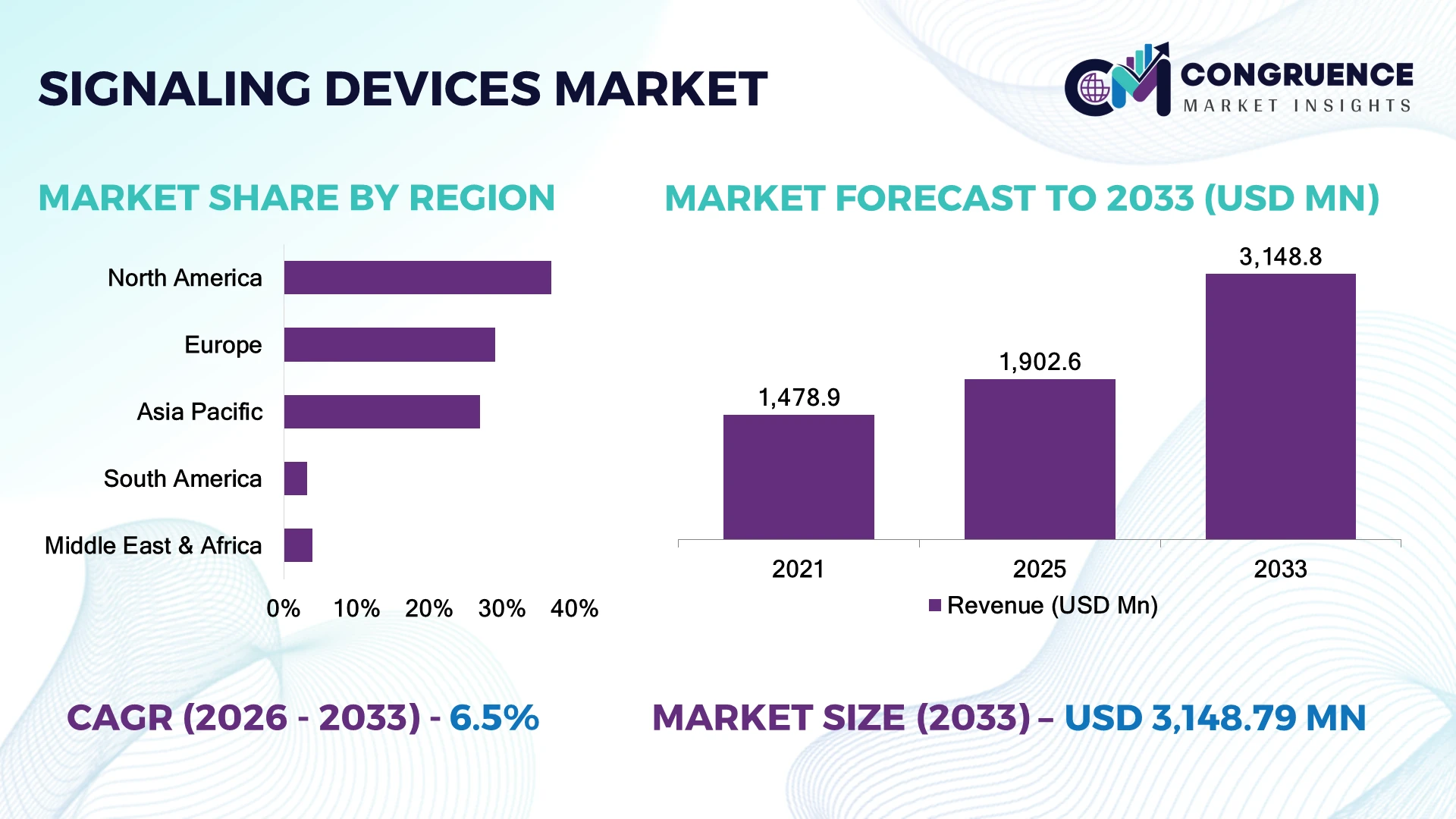
The Global Signaling Devices Market was valued at USD 1,902.6 Million in 2025 and is anticipated to reach a value of USD 3,148.8 Million by 2033 expanding at a CAGR of 6.5% between 2026 and 2033. Growth is being driven by industrial automation, machine-safety requirements, connected factory architectures, and replacement of conventional indicators with intelligent visual and audible signaling systems.
Germany remains a leading industrial signaling market, supported by approximately 35%–40% penetration of connected automation architectures across advanced manufacturing environments, while the United States benefits from extensive process-industry and warehouse automation investment. China is expanding faster through factory modernization and robotics deployment. European machinery-safety requirements and ongoing supply-chain localization are accelerating replacement of legacy signaling hardware with network-ready devices.
Strategically, suppliers that combine safety compliance, connectivity, modularity, and rapid customization are best positioned to capture higher-value industrial automation deployments.
Market Size & Growth: USD 1,902.6 million in 2025 to USD 3,148.8 million by 2033 at a 6.5% CAGR, driven by smart-factory automation and machine-safety upgrades.
Top Growth Drivers: Industrial automation 32%, machine-safety modernization 27%, connected equipment 21%.
Short-Term Forecast: By 2028, intelligent signaling adoption is projected to improve response efficiency by 12%–15% and reduce diagnostic time by 10%.
Emerging Technologies: IO-Link, Industrial Ethernet, wireless signaling, and condition-monitoring integration are increasing connected-device deployment by approximately 15%.
Regional Leaders: North America, Europe, and Asia-Pacific collectively represent over 80% of demand, with Asia-Pacific showing the strongest factory-automation adoption.
Consumer/End-User Trends: Manufacturing accounts for approximately 38% of demand, while logistics and warehousing adoption is increasing through automated material-handling systems.
Pilot/Case Example: 2025 smart-factory deployments using networked tower lights reduced machine-status identification time by approximately 20%, improving operator response.
Competitive Landscape: Global automation suppliers collectively control approximately 45%–50% of the market, competing through connectivity, safety certification, customization, and industrial ecosystem integration.
Regulatory & ESG Impact: Machine-safety modernization can reduce avoidable operational interruptions by approximately 8%–12%, while LED signaling reduces power consumption versus conventional lamps.
Investment & Funding: More than USD 1 billion in industrial automation investments is supporting connected signaling demand through factory expansion, robotics, and warehouse modernization.
Innovation & Future Outlook: AI-enabled diagnostics, wireless signaling, edge connectivity, and predictive maintenance will shift signaling devices from visual indicators toward intelligent industrial communication nodes.
Signaling Devices are increasingly concentrated in manufacturing plants, process industries, logistics facilities, machine-building environments, warehouses, and transportation infrastructure. LED-based products now account for more than 70% of new industrial signaling installations in many developed applications, supported by longer operating life and lower maintenance requirements. In 2026, manufacturers are increasingly pairing stack lights, beacons, buzzers, and safety indicators with PLCs and industrial networks, creating a transition from standalone alerts toward connected operational intelligence.
The strategic importance of the Signaling Devices Market is shifting from basic machine indication toward real-time operational visibility and safety communication. Industrial facilities increasingly require signaling components that interact with PLCs, sensors, safety controllers, and manufacturing-execution systems. This shift is particularly important as manufacturers expand robotics, automated material handling, and digitally monitored production lines.
Technology selection is becoming measurable. Modern LED signaling systems can deliver approximately 30%–50% lower energy consumption than conventional incandescent-based indicators while extending service intervals substantially. Network-connected devices further reduce troubleshooting time by approximately 10%–20% through remote status identification. North American and European facilities emphasize safety certification and interoperability, while China, India, and Southeast Asian manufacturing hubs increasingly prioritize scalable automation and cost-efficient deployment.
Over the next 2–3 years, demand will move toward signaling platforms combining visual indication, audible alerts, wireless connectivity, and condition monitoring. A warehouse using automated conveyors, for example, can integrate signaling directly with machine-status data to identify stoppages without relying solely on physical inspection. Manufacturers are therefore expanding modular product portfolios, strengthening industrial-network compatibility, and developing application-specific configurations. Competitive advantage will increasingly depend on delivering signaling hardware as part of a connected safety and automation architecture rather than as an isolated component.
Industrial automation is shifting signaling devices from standalone status indicators toward connected safety and diagnostic interfaces. In 2025, approximately 9.7 million new IO-Link devices and master ports were installed globally, taking the installed base to 71 million nodes and expanding the addressable ecosystem for intelligent signaling. Network-enabled signaling adoption is rising roughly 12%–15% across modernized production environments, while LED-based architectures reduce maintenance intervention by approximately 20%–30% versus conventional lamp technologies. Germany and the United States are prioritizing connected factory upgrades as manufacturers expand robotics and machine-vision systems. Companies are responding with Ethernet, IO-Link, wireless, and configurable tower-light portfolios. The strategic shift is significant: suppliers that embed diagnostics and machine-status data into signaling products capture higher-value automation projects rather than competing solely on hardware price.
Mixed-generation automation infrastructure remains a major constraint because approximately 30%–40% of industrial facilities still operate equipment using legacy signaling interfaces, creating conversion and integration requirements during modernization. Compatibility issues can increase installation engineering effort by 15%–20%, particularly where older PLC architectures coexist with Ethernet-based controls. Component cost volatility also affects procurement, with electronics and specialized LED assemblies representing a meaningful portion of signaling-device input costs. In Germany and the United States, manufacturers increasingly demand backward-compatible products to avoid unnecessary machine downtime during upgrades. Suppliers are mitigating these constraints through universal voltage configurations, modular interfaces, retrofit adapters, and multi-protocol connectivity. The non-obvious pressure point is engineering complexity: the lowest-cost device can become commercially unattractive when integration labor and commissioning time outweigh its initial price advantage.
The strongest opportunity lies in combining signaling hardware with edge diagnostics, wireless communication, and predictive-maintenance workflows. Approximately 20%–25% of newly specified industrial signaling projects are moving toward network-connected architectures, while connected factory deployments can reduce manual machine-status checks by 15%–25%. In the United Kingdom, 53% of manufacturers reported using AI on the factory floor in 2025, strengthening the infrastructure case for signaling devices capable of feeding machine-state information into digital systems. Suppliers are developing IO-Link, Ethernet, wireless, and software-configurable products that support condition-based alerts. India, China, and Southeast Asian manufacturing hubs offer additional opportunities as automation investments expand. The unique strategic opportunity is to position signaling devices as low-cost edge nodes that provide operational data without requiring a separate sensing layer.
Connected signaling creates execution challenges because devices increasingly operate within safety-critical industrial networks rather than isolated electrical circuits. Approximately 15%–20% of new intelligent signaling deployments require additional cybersecurity, network validation, or software configuration work compared with conventional indicators. Workforce capability is another constraint, with industrial facilities reporting persistent shortages in automation and digital skills that complicate commissioning and maintenance. The EU Machinery Regulation becomes applicable on 20 January 2027, increasing pressure on manufacturers to address evolving machinery-safety and digital requirements. Companies must therefore strengthen firmware security, functional-safety engineering, protocol validation, and technical training. The long-term competitive issue is interoperability under stricter safety conditions: suppliers that cannot maintain secure connectivity across mixed automation environments risk losing projects even when their signaling hardware performs reliably.
Networked Signaling Gains Ground Industrial signaling is moving toward IO-Link, Ethernet, and wireless connectivity, with approximately 71 million IO-Link nodes installed globally by 2025 and 9.7 million added during the year. Manufacturers are integrating tower lights and beacons with PLC diagnostics, reducing manual status checks by approximately 15%–25% and shifting purchasing toward configurable connected platforms.
LED Platforms Replace Legacy Lamps LED signaling continues replacing incandescent and halogen architectures as manufacturers prioritize lower maintenance and longer operating cycles. New LED installations now represent approximately 70%–75% of industrial signaling demand in mature applications, while energy consumption can fall 30%–50%. Suppliers are responding with modular colors, programmable patterns, and longer-life assemblies designed for continuous production environments.
Safety Rules Reshape Product Design The EU Machinery Regulation applying from January 2027 is accelerating redesign of machinery-associated signaling and safety interfaces. Compliance preparation is increasing engineering activity by approximately 10%–15% for affected equipment programs, particularly where connected devices interact with safety functions. Manufacturers are strengthening documentation, diagnostics, firmware controls, and conformity processes rather than treating signaling as simple auxiliary hardware.
Wireless Signaling Expands Flexible Factories Wireless signaling is gaining traction in warehouses, modular production cells, and reconfigurable manufacturing lines where cabling restricts layout changes. Adoption is increasing approximately 10%–15% in flexible automation projects, while deployment can reduce field wiring requirements by 20%–30%. Suppliers are combining battery-efficient beacons, gateways, and network diagnostics to support faster line reconfiguration without sacrificing operational visibility.
Visual signaling devices represent the leading type, accounting for approximately 48% of global demand, supported by widespread deployment of stack lights, beacons, indicator lamps, and machine-status displays across manufacturing and logistics facilities. Their dominance reflects low installation complexity, strong visibility, LED efficiency, and compatibility with PLC-based control systems. Combined visual-audible devices follow at approximately 31%, particularly in high-noise environments where operators require simultaneous optical and acoustic alerts. Audible signaling devices account for about 21% and remain strategically important in process plants, warehouses, and emergency-response applications.
The fastest-growing type is combined visual-audible signaling, as automated production cells increasingly require differentiated alerts for stoppage, maintenance, safety, and process escalation. Adoption is increasing approximately 10%–13% in digitally upgraded facilities, compared with 6%–8% for conventional standalone signaling. Manufacturers are responding with programmable patterns, IO-Link connectivity, wireless communication, and modular configurations. Investment is consequently shifting toward multifunctional devices that combine indication with diagnostics, allowing suppliers to capture higher-value automation projects rather than compete primarily on unit price.
The International Federation of Robotics reported 542,000 industrial robots installed globally in 2024, with Asia accounting for 74% of new deployments, reinforcing the expanding automation base requiring machine-status and safety signaling.
Manufacturing represents the leading application, accounting for approximately 38% of Signaling Devices Market demand, as factories deploy visual and audible indicators across assembly lines, robotic cells, packaging equipment, and machine-safety systems. Automotive, electronics, food processing, and machinery production generate the highest deployment intensity because signaling is embedded directly into automated workflows. Logistics and warehousing is the fastest-growing application, expanding at approximately 11%–13% as automated storage, conveyors, sorting systems, and mobile robotics increase the need for real-time operational indication. Manufacturing applications remain more mature, with approximately 72% of established facilities using LED-based signaling, while logistics operators increasingly prioritize wireless and network-enabled devices.
Process industries, transportation infrastructure, and commercial facilities retain specialized demand, particularly where audible alerts and high-visibility beacons are essential. Companies are adapting by developing application-specific signaling configurations, expanding wireless portfolios, and integrating devices with PLCs and industrial networks. The business implication is a shift from simple status indication toward operational event management, increasing the value of programmable and remotely diagnosable signaling systems.
Deloitte’s 2025 Smart Manufacturing and Operations Survey found that 41% of manufacturers planned to prioritize factory-automation hardware investment over the following 24 months, strengthening the equipment ecosystem supporting intelligent signaling deployment.
Manufacturing enterprises are the leading end-user group, representing approximately 42% of Signaling Devices Market demand because large production facilities deploy signaling across machines, production cells, safety zones, conveyors, and maintenance systems. Automotive and electronics plants generate particularly high installation intensity, with automated environments requiring multiple visual and audible indicators per production line. Logistics and warehousing is the fastest-growing end-user segment, with adoption expanding approximately 12%–14% as distribution centers increase automation density. Large manufacturers typically prioritize standardized, network-compatible signaling, while logistics operators increasingly value wireless deployment, rapid reconfiguration, and centralized status visibility.
Process-industry operators, transportation organizations, and commercial facilities represent smaller but technically important demand pools. Process industries emphasize hazardous-area compatibility and high-intensity alarms, whereas commercial facilities focus more heavily on cost and simplified installation. Suppliers are responding with configurable products, application-specific enclosures, and connectivity options across price tiers. Approximately 25%–30% of new enterprise specifications now emphasize network compatibility, shifting competitive advantage toward vendors capable of integrating signaling with broader automation ecosystems. This creates a clear opportunity for suppliers to combine hardware, connectivity, and diagnostics rather than sell isolated signaling components.
Deloitte’s 2025 manufacturing survey found 46% of manufacturers were already using Industrial Internet of Things solutions at facility or network level, reinforcing the shift toward connected signaling and machine-status infrastructure.
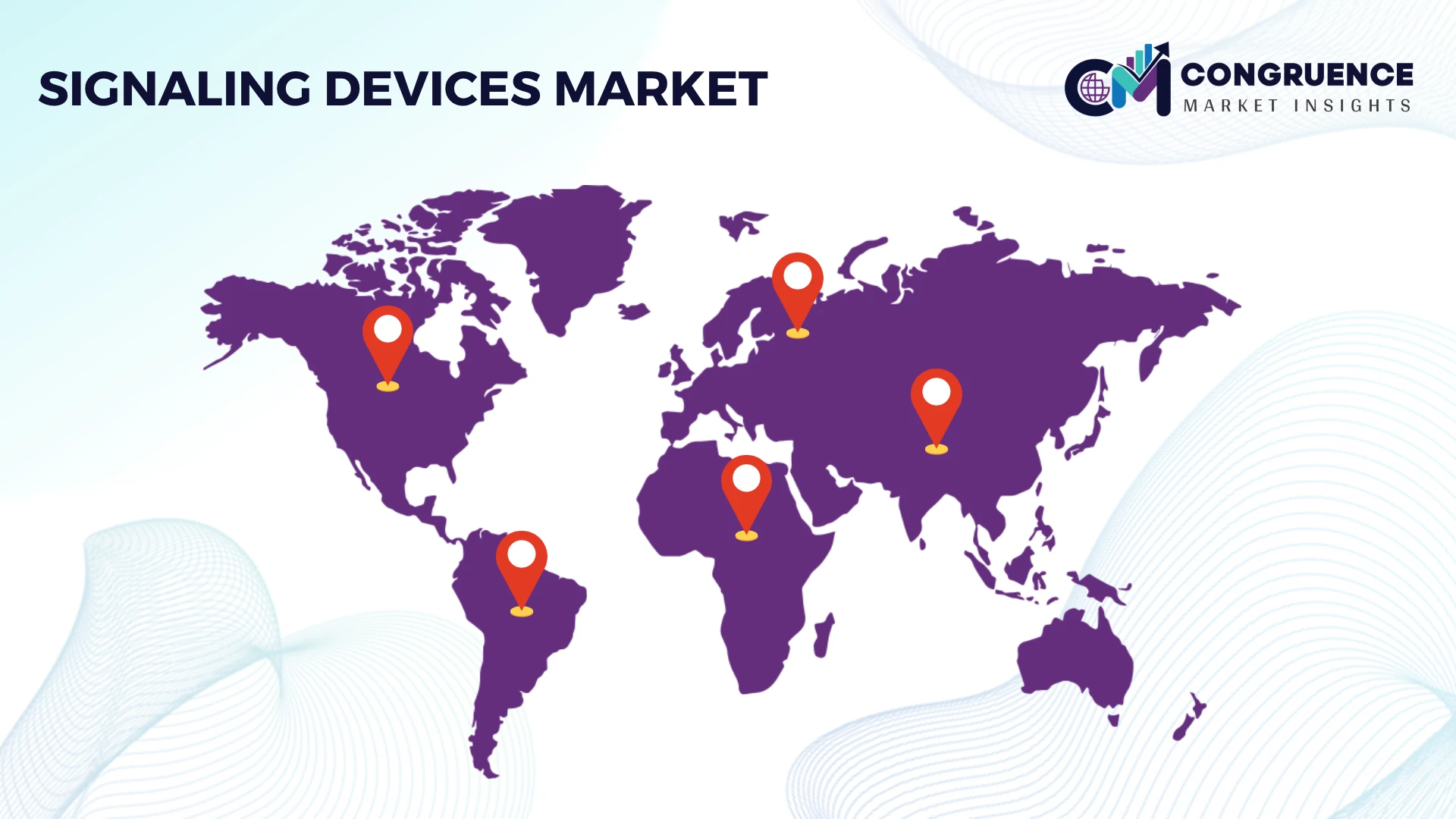
North America accounted for the largest market share at 36.8% in 2025 however, Asia-Pacific is expected to register the fastest growth, expanding at a CAGR of 8.1% between 2026 and 2033.
Connected factory modernization strengthens intelligent signaling deployment
North America holds the leading position in the Signaling Devices Market, supported by dense automation infrastructure across the United States and Canada. The region contributes approximately 36.8% of global demand, with automotive, electronics, food processing, logistics, and process industries representing major deployment centers. More than 60% of newly specified industrial signaling systems in large automated facilities increasingly incorporate LED-based or network-compatible functionality, reflecting the transition from standalone indicators to connected machine-status infrastructure. U.S. manufacturers are accelerating modernization through robotics, industrial Ethernet, and predictive maintenance architectures, while Canadian facilities emphasize safety signaling across resource processing and automated warehousing. Suppliers are responding with modular beacons, programmable stack lights, wireless interfaces, and industrial networking capabilities, positioning connectivity and diagnostic functionality as key differentiation factors.
United States Market Outlook: The United States remains the region's principal demand center because of its extensive manufacturing base, warehouse automation activity, and high concentration of digitally enabled production facilities. Approximately 70% of industrial automation projects in advanced manufacturing environments incorporate machine-status visualization or signaling functionality at equipment level. Automotive plants, semiconductor facilities, distribution centers, and process industries are prioritizing programmable signaling linked to PLCs and industrial networks. This favors suppliers offering configurable architectures rather than basic fixed indicators. The country's reshoring initiatives and continued investment in domestic manufacturing infrastructure are also increasing demand for durable, rapidly deployable signaling equipment capable of supporting high-throughput production environments.
Safety modernization and energy efficiency reshape industrial signaling
Europe maintains a technologically mature Signaling Devices Market, driven by Germany, Italy, France, and the United Kingdom, where automated manufacturing and machinery-intensive industries sustain high deployment density. Approximately 29% of global demand is concentrated across European industrial applications, with machine safety, production monitoring, logistics, and process automation remaining important use cases. EU energy-efficiency priorities are accelerating replacement of conventional signaling equipment with LED-based systems, which can reduce signaling power consumption by approximately 50%–70%. German manufacturers are increasingly integrating signaling with industrial communication architectures, while Eastern European production hubs continue expanding conventional machine-level installations. Companies are therefore balancing premium connected products with cost-optimized LED portfolios to address differing modernization levels across national manufacturing bases.
Germany Market Outlook: Germany represents Europe's strongest industrial signaling market because of its concentration of automotive production, machinery manufacturing, factory automation, and advanced engineering facilities. More than 65% of newly commissioned automated production equipment in sophisticated manufacturing environments increasingly incorporates network-compatible status indication or machine signaling. Industrial facilities are moving toward programmable visual signaling linked with PLCs, safety controllers, and condition-monitoring systems, improving response speed during equipment stoppages and maintenance events. Germany's emphasis on Industry 4.0 architecture also favors suppliers capable of integrating signaling into broader automation ecosystems. Manufacturers are consequently investing in IO-Link-compatible devices, modular stack lights, high-intensity LEDs, and diagnostic functionality to strengthen machine-level visibility.
Automation scale is accelerating connected signaling adoption
Asia-Pacific represents the largest manufacturing deployment base and the fastest-expanding demand center for signaling devices, supported by China, Japan, South Korea, India, and Southeast Asian production hubs. The region accounts for approximately 27% of current global demand, while electronics, automotive, semiconductor, logistics, and machinery facilities are increasing signaling density alongside automation investments. China alone represents more than 45% of regional industrial automation equipment deployment, creating substantial demand for machine-status indicators, audible alarms, beacons, and modular stack lights. India is simultaneously expanding factory automation and warehouse infrastructure, encouraging suppliers to localize production and distribution. Manufacturers are increasingly combining LED signaling with wireless communication and PLC connectivity, shifting purchasing priorities from low unit cost toward lifecycle reliability and integration capability.
China Market Outlook: China remains the most strategically significant country because of its extensive electronics, automotive, semiconductor, machinery, and logistics manufacturing base. Industrial facilities increasingly deploy multi-color LED stack lights and programmable signaling across automated production cells, with connected configurations gaining traction in digitally upgraded plants. More than 50% of advanced factory projects now incorporate some form of networked machine-status visualization, strengthening demand for intelligent signaling components. Domestic manufacturing scale supports competitive pricing and rapid product customization, while localization reduces procurement lead times for large automation integrators. Suppliers are expanding Chinese production capacity, developing communication-enabled product families, and partnering with system integrators to secure positions in high-volume factory modernization projects.
Industrial modernization is concentrating demand around Brazil
South America remains a developing but strategically relevant signaling market, with Brazil accounting for the largest share of regional industrial demand across automotive, mining, food processing, oil and gas, and logistics operations. Approximately 55% of regional signaling-device consumption is concentrated in Brazil, reflecting its broader manufacturing and industrial infrastructure base. Automated warehouses and processing facilities are increasingly replacing conventional indicators with LED-based visual and audible systems, while mining operations maintain strong demand for high-intensity and ruggedized signaling equipment. Adoption of LED signaling has increased by an estimated 8%–10% across modernization projects as operators seek lower maintenance requirements and improved visibility. Suppliers are strengthening local distribution, inventory availability, and application engineering to manage import lead times and support customized industrial installations.
Brazil Market Outlook: Brazil offers the strongest demand base in South America because of its diversified industrial structure and concentration of automotive, mining, food-processing, agricultural equipment, and logistics operations. Industrial automation projects increasingly specify LED signaling because of its lower maintenance burden and longer operating life. Approximately 40% of newly upgraded production equipment in larger Brazilian manufacturing facilities incorporates enhanced machine-status indication. Mining and heavy-processing applications additionally require high-visibility signaling capable of operating under dust, vibration, and outdoor conditions. Companies are therefore emphasizing ruggedized enclosures, high-intensity LEDs, audible alarms, and localized service support, while distributors are increasing inventory depth to reduce exposure to imported-component delays.
Industrial diversification is expanding specialized signaling deployment
Middle East & Africa demand is increasingly shaped by industrial diversification, energy infrastructure modernization, logistics expansion, and new manufacturing facilities in Saudi Arabia, the United Arab Emirates, South Africa, and other industrial hubs. Approximately 7% of global signaling-device demand is associated with the region, with oil and gas, utilities, mining, logistics, and process manufacturing generating the highest deployment intensity. Saudi Arabia's industrial diversification programs are increasing demand for hazardous-area signaling, emergency indicators, and high-visibility beacons across new facilities. Connected signaling adoption in newly automated industrial installations is estimated at approximately 20%–25%, creating an early opportunity for suppliers offering network-enabled products. Companies are strengthening regional partnerships, local inventory, and application-specific engineering to address harsh operating conditions and project-based procurement.
Saudi Arabia Market Outlook: Saudi Arabia represents the region's strongest strategic opportunity because of large-scale industrial infrastructure development, energy-sector modernization, logistics expansion, and manufacturing diversification. Industrial projects increasingly require signaling equipment designed for high temperatures, dust exposure, hazardous environments, and continuous operation. Approximately 30% of newly specified automated industrial installations incorporate programmable or network-compatible signaling, particularly across process plants and logistics facilities. The country's expanding industrial cities and warehouse infrastructure are creating demand beyond conventional oil and gas applications. Suppliers are positioning through localized distribution, hazardous-area product portfolios, engineering partnerships, and project-specific customization, making environmental durability and certification capability important competitive differentiators.
Honeywell, Siemens, Eaton, Federal Signal, and Schneider Electric compete as integrated automation and safety suppliers, while Patlite, WERMA, Pfannenberg, and hazardous-area manufacturers compete through signaling depth and customization. The top five hold 37.1% collectively, indicating a concentrated but contestable structure. Technology-led products command roughly 30% premium pricing, while connected signaling can reduce wiring-related installation effort by 15%–25%. Competition centers on network compatibility, ruggedization, response visibility, and customization rather than hardware price. Siemens and Schneider leverage automation ecosystems; Honeywell integrates safety intelligence; Eaton and Federal Signal emphasize hazardous-location reliability; Patlite and WERMA differentiate through specialized connected signal towers. Manufacturers are expanding distribution, partnering with automation integrators, and adding IO-Link, Ethernet, wireless, and programmable interfaces. The shift favors vertically integrated suppliers controlling electronics, software, certification, and service. Entry pressure remains high because safety certification, installed-base trust, and channel coverage require investment. Winning requires certified reliability, fast customization, interoperability, and lifecycle support.
Honeywell International Inc.
Siemens AG
Eaton Corporation plc
Schneider Electric SE
ABB Ltd.
Federal Signal Corporation
Rockwell Automation, Inc.
Patlite Corporation
WERMA Signaltechnik GmbH + Co. KG
Pfannenberg GmbH
R. STAHL AG
Pepperl+Fuchs SE
Emerson Electric Co.
E2S Warning Signals Ltd.
Current signaling technology is moving from standalone lamps and horns toward networked LED towers, IO-Link, Ethernet, PoE, and wireless interfaces. Connected devices can cut installation wiring effort by 15%–25% and improve machine-status visibility by 20%–30%. Adoption is strongest in automated plants, where programmable colors and diagnostics support faster intervention and fewer unplanned response delays. Patlite and WERMA benefit from specialized connectivity, while automation giants gain through ecosystem integration.
Emerging systems combine signaling with Andon workflows, edge analytics, remote monitoring, and predictive-maintenance platforms. Network-enabled towers can reduce manual status inspections by about 20% and shorten fault-identification time by 10%–15%. LED architectures also deliver roughly 50%–70% lower signaling energy consumption than conventional incandescent solutions. The competitive advantage shifts toward suppliers that integrate signaling hardware with PLC, SCADA, MES, and industrial Ethernet environments.
Between 2026 and 2028, intelligent signaling will increasingly function as an operational data endpoint rather than a visual alarm. Wireless retrofits, programmable diagnostics, and machine-learning-assisted alert prioritization will strengthen deployment in brownfield factories. Companies adopting connected platforms now can reduce integration friction, standardize device management, and improve response consistency, while suppliers with interoperable architectures gain faster access to multinational automation projects and recurring replacement demand across standardized installed bases globally.
July 2024 PATLITE advanced IO-Link signaling integration, enabling bidirectional status and diagnostics while reducing complex wiring and interface converters. The shift strengthens predictive-maintenance visibility and supports standardized machine connectivity across smart factories, improving replacement and configuration efficiency. Source: patlite.com
June 2025 Pfannenberg introduced the PROTECT Series, using die-cast aluminum construction for signaling in harsh and hazardous environments. The platform strengthens reliability across machine safety, marine, and fire applications, supporting ruggedized deployments where environmental durability influences uptime. Source: pfannenbergusa.com
September 2025 Federal Signal expanded its Global Series platform with a red housing option covering six hazardous-location signaling products. The visual configuration improves emergency recognition across manufacturing, oil and gas, and chemical facilities while broadening international deployment. Source: fedsig.com
2025 WERMA expanded its eSIGN LED signal tower with PROFINET connectivity, strengthening integration into automation environments. The platform combines colors, light effects, and machine communication, accelerating connected signaling adoption and positioning visualization across smart factory production lines. Source: werma.com
The Signaling Devices Market Report evaluates visual, audible, and combination signaling systems across industrial automation, manufacturing, oil and gas, chemical processing, energy and power, mining, logistics, and safety-critical environments. Coverage includes wired, wireless, network-enabled, LED, programmable, and hazardous-area signaling technologies, with analysis of adoption patterns, deployment intensity, integration requirements, and product-level differentiation. The assessment distinguishes mature machine-status applications from emerging connected signaling architectures.
Regional analysis covers North America, Europe, Asia-Pacific, South America, and Middle East & Africa, with country-level evaluation of industrial automation intensity, infrastructure modernization, regulatory requirements, and technology adoption. Competitive analysis examines leading suppliers, specialized signaling manufacturers, automation integrators, and technology-focused entrants. The report supports investment planning, product portfolio prioritization, geographic expansion, partnership strategy, technology positioning, and competitive decision-making through 2033, with particular emphasis on connected signaling adoption and industrial digitalization.
| Report Attribute/Metric | Report Details |
|---|---|
|
Market Revenue in 2025 |
USD 1,902.6 Million |
|
Market Revenue in 2033 |
USD 3,148.8 Million |
|
CAGR (2026 - 2033) |
6.5% |
|
Base Year |
2025 |
|
Forecast Period |
2026 - 2033 |
|
Historic Period |
2021 - 2025 |
|
Segments Covered |
By Type
By Application
By End-User
|
|
Key Report Deliverable |
Revenue Forecast, Growth Trends, Market Dynamics, Segmental Overview, Regional and Country-wise Analysis, Competition Landscape |
|
Region Covered |
North America, Europe, Asia-Pacific, South America, Middle East, Africa |
|
Key Players Analyzed |
Honeywell International Inc., Siemens AG, Eaton Corporation plc, Schneider Electric SE, ABB Ltd., Federal Signal Corporation, Rockwell Automation, Inc., Patlite Corporation, WERMA Signaltechnik GmbH + Co. KG, Pfannenberg GmbH, R. STAHL AG, Pepperl+Fuchs SE, Emerson Electric Co., E2S Warning Signals Ltd. |
|
Customization & Pricing |
Available on Request (10% Customization is Free) |




