
Reports
The Global Shrimp Feed Market was valued at USD 4835.98 Million in 2025 and is anticipated to reach a value of USD 7216.02 Million by 2033 expanding at a CAGR of 5.13% between 2026 and 2033. Growth is driven by precision feeding, functional diets for disease management, antibiotic-free formulations, and wider adoption of intensive shrimp-farming systems.
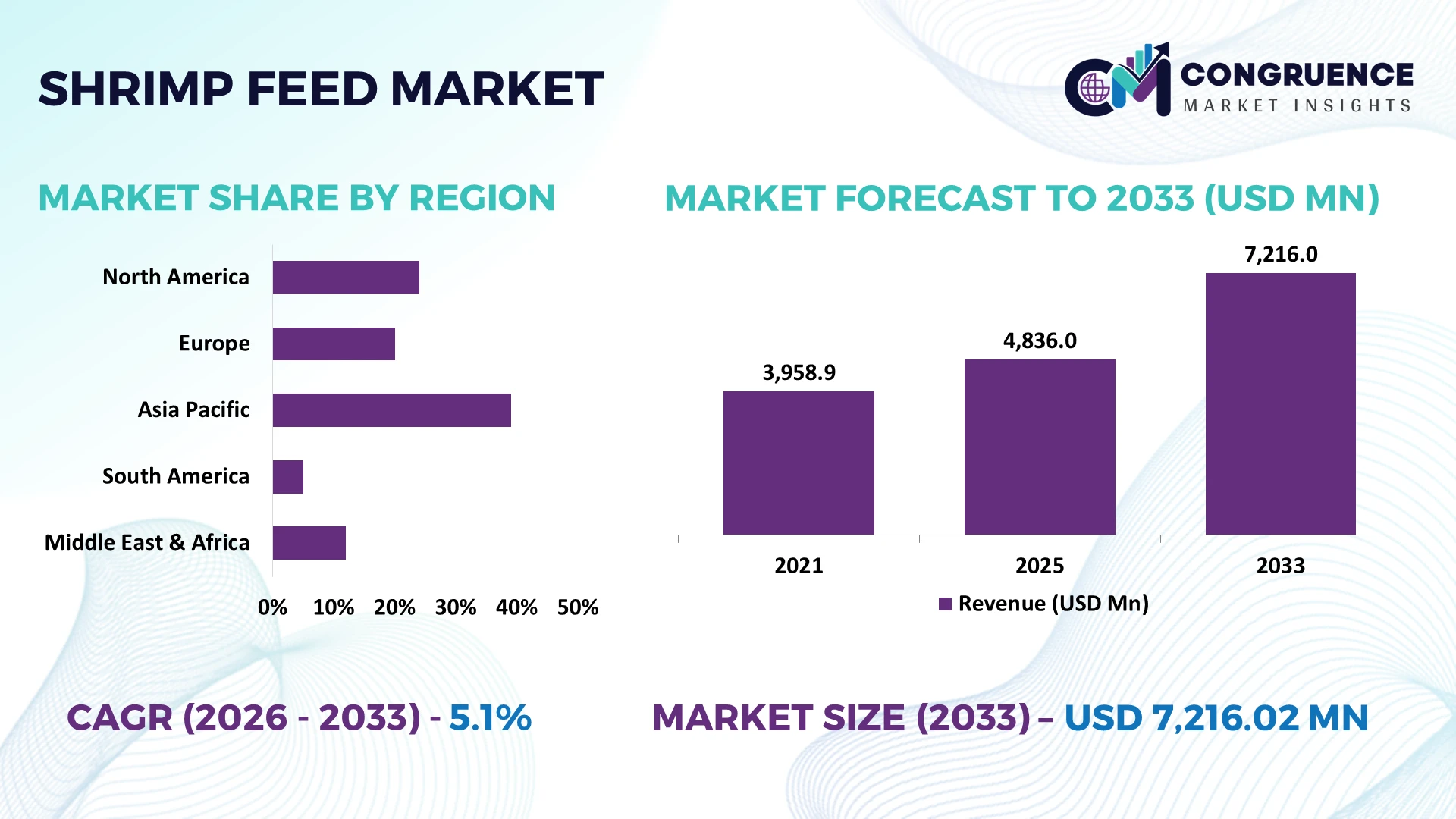
China remains the dominant country, supported by large-scale aquaculture, advanced feed manufacturing, and automated feeding adoption. China’s farmed shrimp production reached about 2 million metric tons, while India maintains strong feed manufacturing capacity, with leading producers operating more than 700,000 MT annually. Ecuador recorded a 23.2% increase in shrimp exports in 2025, with China absorbing 49.5% of shipments, highlighting shifting global trade flows.
Strategically, suppliers should prioritize disease-resilient formulations, localized capacity, and precision feeding technologies across China, India, and export-oriented production hubs.
Market Size & Growth: USD 4,835.98 Million in 2025 to USD 7,216.02 Million by 2033 at 5.13% CAGR, supported by functional nutrition and precision feeding.
Top Growth Drivers: Disease-management diets 5%, intensive farming 4%, and precision feeding 3% are strengthening feed efficiency and farm productivity.
Short-Term Forecast: By 2030, automated feeding systems are positioned to reduce feed waste by 3–5% while improving operational efficiency by 4–6%.
Emerging Technologies: AI biomass monitoring, automated feeders, probiotics, and alternative proteins are accelerating data-driven shrimp nutrition and feed optimization.
Regional Leaders: Asia-Pacific leads with approximately 70% share, while South America and Southeast Asia strengthen adoption through intensive aquaculture expansion.
Consumer/End-User Trends: Grower feed represents more than 45% of demand in major intensive farming markets, reflecting strong requirements during shrimp growth cycles.
Pilot/Case Example: A probiotic shrimp-feeding trial delivered approximately 35% improvement in gross feed-conversion efficiency, demonstrating the economic value of functional formulations.
Competitive Landscape: Avanti Feeds holds approximately 50% of India’s shrimp-feed market, competing with CP Foods, Cargill, Skretting, BioMar, and Tongwei.
Regulatory & ESG Impact: Antibiotic-free feeding programs are expanding, while export farms increasingly align formulations with international residue, traceability, and sustainability requirements.
Investment & Funding: Ecuador’s shrimp industry generated more than USD 7 billion in export value in 2025, supporting additional feed capacity, technology investment, and supply-chain integration.
Innovation & Future Outlook: AI-controlled feeding, probiotics, low-leaching pellets, and alternative protein ingredients will shift competition toward feed-conversion performance and production resilience.
The global shrimp feed market is being reshaped by disease-management nutrition, intensive aquaculture, and precision feeding technologies. Demand is strongest across large production bases where feed efficiency directly influences farm margins. Probiotics, functional additives, automated feeders, and alternative protein ingredients are gaining traction, with technology-led feeding systems targeting 3–5% lower feed waste. Ecuador’s expanding exports and China-focused trade flows are also encouraging supply-chain diversification and localized feed manufacturing, strengthening the strategic importance of resilient production networks.
The Shrimp Feed Market is becoming strategically important because feed represents a major controllable input in intensive aquaculture, directly shaping survival, growth rates, disease exposure, and farm profitability. Competition is shifting from volume-based supply toward nutrition performance and technical support. Supply-chain restructuring is accelerating as producers reduce dependence on imported fishmeal and develop localized ingredient sourcing. Digital adoption is also advancing through automated feeders and biomass monitoring. Automated demand-based feeding can reduce feed waste by roughly 10–20% versus manual fixed-schedule practices, creating a measurable operational advantage.
China operates at significantly greater production scale, while India combines large farming clusters with concentrated commercial feed manufacturing and Ecuador emphasizes export-integrated aquaculture systems. Advanced automated feeding delivers more consistent portions than legacy manual distribution, improving feed conversion and lowering labor requirements. Over the next 2–3 years, deployment of sensor-supported feeding and functional formulations is expected to expand across intensive farms, particularly where disease losses and feed costs remain critical operational pressures. Companies are responding through mill upgrades, localized capacity, formulation R&D, and partnerships with farms.
A practical example is the integration of automatic feeders with farm biomass assessments to adjust rations according to stock conditions rather than fixed feeding cycles. This shifts investment toward data-enabled nutrition platforms and strengthens customer retention. Competitive leadership will increasingly depend on delivering lower feed waste, reliable ingredient supply, and measurable farm-level performance.
Intensive shrimp farming is the primary structural driver, increasing demand for nutritionally precise feed capable of improving survival and feed conversion under high stocking densities. Feed typically accounts for 50–60% of shrimp farm operating costs, making even a 5–10% improvement in feed efficiency commercially significant. India’s organized feed producers are expanding technical support and specialized formulations as disease management becomes integrated with feeding strategy. China’s adoption of automated feeders and controlled aquaculture systems is also shifting purchasing decisions toward performance-based products. The cause is higher production intensity; the impact is greater demand for stable, functional diets; company response centers on probiotics, enzyme blends, precision formulations, and expanded local manufacturing. The sharp strategic insight is that technical farm support is becoming as important as feed price in securing repeat commercial demand.
Raw-material volatility remains a major structural restraint because fishmeal, soybean derivatives, wheat products, and marine ingredients influence formulation economics. Fishmeal and fish oil markets can experience price movements above 20% during periods of reduced catches and supply disruption, while feed conversion losses can quickly erode farm margins where feed represents 50–60% of operating expenditure. China and India also face varying dependence on imported marine ingredients, exposing manufacturers to freight costs and currency movements. The direct business impact is reduced pricing flexibility and pressure on feed margins. Companies are responding through alternative proteins, diversified supplier bases, longer procurement contracts, and localized ingredient sourcing. A critical operational insight is that formulation flexibility increasingly determines whether producers can maintain consistent nutritional performance during commodity disruptions.
The strongest opportunity lies in combining functional nutrition with automated feeding and farm-data platforms. Probiotics and specialized additives have demonstrated feed-conversion improvements of around 10–15% under suitable farming conditions, while automated feeding can reduce unnecessary feed application by 10–20%. India’s high-density shrimp clusters provide a strong deployment base for integrated feed-and-advisory models, while Ecuador’s export-oriented farms create demand for consistent nutrition and traceability. Future innovation is shifting toward AI-assisted rationing, alternative proteins, and low-pollution pellet technologies. Companies are positioning through R&D partnerships, digital aquaculture collaborations, and specialized product portfolios. The non-obvious opportunity is recurring service income from nutrition analytics and farm support, allowing suppliers to move beyond one-time feed transactions toward higher-value operational partnerships.
The central long-term challenge is achieving consistent performance across farms with different water quality, stocking densities, disease conditions, and technical capabilities. Automated systems can reduce feeding variability by approximately 10–20%, yet their benefits decline when biomass data, farm infrastructure, or operator training remain inadequate. In India, smaller farms face uneven access to digital equipment and technical expertise, while China’s larger modernization programs require integration between feeding systems, sensors, and farm-management platforms. This creates an execution challenge rather than simply a cost constraint. Companies must invest in interoperable equipment, farmer training, technical service networks, and reliable data systems. The strategic priority is scalable deployment: suppliers that standardize nutrition and digital workflows across diverse farm conditions will build stronger long-term competitiveness than companies relying solely on product expansion.
Functional Feeds Gain Ground: Disease-management formulations are moving beyond niche use, with functional diets gaining traction as farms prioritize survival, immunity, and feed-conversion performance. Stricter residue expectations in export markets are accelerating probiotic, beta-glucan, enzyme, and immunostimulant adoption. Companies are expanding premium formulations rather than competing solely on commodity feed pricing.
Grower Formulations Stay Central: Grower Feed represented approximately 45.5% of demand in 2025 because shrimp consume the greatest feed volumes during the rapid-growth phase. Indian producers are refining amino-acid profiles and pellet stability, while Chinese mills increasingly connect formulations with automated feeding workflows. The non-obvious shift is greater emphasis on feed-conversion performance rather than kilograms sold.
Alternative Proteins Reshape Formulation: Fishmeal price pressure is pushing manufacturers toward soybean, insect, algae, and single-cell proteins. Reduced marine-ingredient availability is reinforcing this transition, while alternative inputs reduce exposure to raw-material volatility. Companies are restructuring procurement and investing in formulation trials to maintain protein quality while controlling input costs.
Smart Feeding Enters Operations: Digital monitoring, automated feeders, and predictive feeding are moving into commercial shrimp production as farms seek tighter ration control and lower waste. Smart-aquaculture programs increasingly integrate monitoring, automation, and predictive analysis for stronger biosecurity and production efficiency. Feed companies are partnering with technology providers to create integrated nutrition-and-data workflows.
Grower Feed remains the leading type, accounting for approximately 45.5% of the global shrimp feed market in 2025. Its dominance reflects the longest and most feed-intensive production stage, when shrimp biomass expands rapidly and feed intake peaks. Grower formulations therefore deliver stronger volume scalability than Starter or Finisher Feed. Starter Feed retains strategic importance because early-stage mortality makes nutritional consistency critical, while Finisher Feed supports size, pigmentation, and flesh-quality requirements. Broodstock Feed remains a specialized segment tied to hatchery genetics and reproductive performance. Companies are concentrating manufacturing capacity on grower formulations while adding premium functional ingredients to differentiate mature products.
Finisher Feed is gaining formulation sophistication as exporters target consistent product quality, while Starter Feed benefits from customized amino-acid and immune-support profiles. Broodstock Feed remains smaller but strategically important because superior broodstock quality improves downstream hatchery economics. Over the next several years, investment is shifting toward functional grower and starter diets, where feed-conversion gains of 5–10% can materially improve farm-level margins. Indian manufacturers are strengthening localized formulation capabilities as intensive farming expands.
Intensive Farming represents the leading application, estimated at approximately 55% of global shrimp feed consumption, because high stocking densities require continuous formulated feeding and tighter nutritional control. Semi-Intensive Farming remains significant at roughly 30%, balancing commercial feed with natural pond productivity, while Extensive Farming accounts for a smaller share because feed dependency is lower. Hatchery Nutrition is the fastest-evolving application, driven by greater attention to post-larval survival and controlled nursery performance. Companies are adapting through higher-density formulations, automated feeding equipment, and technical farm-support programs.
The operational gap between intensive and extensive systems is widening: intensive farms can require multiple feeding cycles daily, while extensive systems rely more heavily on natural productivity. Vietnam, India, and China are strengthening intensive deployment, whereas hatchery operators increasingly use specialized nutrition for early-stage development. The shift makes feed consistency, water stability, and feed-conversion performance increasingly critical purchasing criteria. Companies are therefore pairing feed sales with monitoring tools, dosing equipment, and technical advisory services to strengthen customer retention and improve production economics.
Shrimp Farms constitute the dominant end-user group, representing an estimated 65% of global shrimp feed demand because commercial ponds consume formulated feed throughout repeated production cycles. Aquaculture Companies follow with approximately 18%, benefiting from integrated production, processing, and export operations. Hatcheries account for a smaller share but are becoming strategically important as demand rises for high-quality post-larvae and specialized early-stage diets. Feed Mills remain central to the value chain as manufacturers, formulators, and technology partners rather than the primary consumption base.
Aquaculture Companies are the fastest-expanding buyer group because integrated operators can standardize feed procurement, farm protocols, disease management, and data collection across multiple sites. Their purchasing behavior increasingly favors customized formulations, contracted supply, technical support, and performance-linked partnerships. Shrimp Farms remain more price-sensitive, but adoption of automated feeding and functional diets is strengthening demand for premium products. Feed Mills are responding by expanding R&D, local manufacturing, and formulation flexibility. The competitive advantage is shifting toward suppliers capable of supporting the entire farm-to-feed workflow rather than supplying feed alone.
Asia-Pacific accounted for the largest market share at 70% in 2025 however, Middle East & Africa is expected to register the fastest growth, expanding at a CAGR of 7.2% between 2026 and 2033.

Premium Nutrition and Controlled Aquaculture Reshape Demand
North America remains a specialized shrimp-feed market, with demand concentrated around controlled-environment farms, hatcheries, and technology-oriented aquaculture operations. The United States represents the principal commercial demand center, while Mexico contributes through expanding shrimp production and feed consumption. Indoor and recirculating aquaculture systems are increasing requirements for precisely formulated diets, probiotics, and low-waste pellets. Automated feeding and water-quality monitoring are becoming increasingly integrated, with advanced systems targeting 10–20% reductions in unnecessary feed application. Regulatory emphasis on traceability and responsible ingredient sourcing is also influencing procurement decisions. Feed producers are responding through customized formulations, technical partnerships, and smaller-batch premium products rather than competing primarily on volume. The strategic shift favors suppliers capable of combining nutrition expertise with farm-management technology.
United States Market Outlook: The United States provides the region’s strongest technology and investment environment for controlled aquaculture. Commercial operators increasingly use recirculating systems, automated dosing, and sensor-based monitoring, creating demand for specialized feed formulations. More than 60% of U.S. aquaculture value is associated with food-fish production, supporting opportunities for integrated nutrition solutions.
Sustainability Standards Drive Formulation Upgrades
Europe represents a technology- and regulation-driven shrimp-feed market where sustainability, ingredient traceability, and controlled production increasingly influence formulation strategies. Shrimp farming remains smaller than in Asia, but countries with advanced aquaculture infrastructure are adopting precision nutrition, alternative proteins, and automated feeding technologies. Sustainability requirements are pushing manufacturers toward lower-marine-resource formulations and documented ingredient sourcing. Feed producers increasingly test insect meal, algae, microbial proteins, and functional additives to reduce dependence on conventional marine ingredients. Germany, France, Spain, and the Netherlands provide strong technical ecosystems, while Mediterranean markets offer more direct aquaculture deployment opportunities. Companies are prioritizing R&D partnerships and certified formulations, with premium products commanding greater attention than low-cost commodity diets. The region’s strategic importance lies in setting formulation and sustainability standards that influence export-oriented producers.
Spain Market Outlook: Spain provides one of Europe’s strongest aquaculture production and research environments, supported by established marine-farming infrastructure and technical expertise. Its Mediterranean production base creates demand for specialized feeds designed for controlled growth and water-quality management. Producers increasingly prioritize functional ingredients and efficient feeding protocols to strengthen farm economics.
Scale Leadership Accelerates Feed Industrialization
Asia-Pacific dominates shrimp-feed consumption through the scale of commercial aquaculture in China, India, Vietnam, Indonesia, and Thailand. China remains the largest production and consumption center, while India has developed substantial commercial feed-manufacturing capacity around Andhra Pradesh and Gujarat. Intensive farming systems increasingly use automated feeders, water-quality sensors, and functional formulations to improve feed conversion. Commercial mills are expanding capacity closer to farming clusters, reducing logistics exposure and improving delivery speed. China’s farmed shrimp production approaches 2 million metric tons, while India’s leading feed producers operate annual capacities exceeding 700,000 MT. Companies are strengthening vertical integration across ingredient procurement, formulation, technical services, and farm relationships. The strategic advantage increasingly comes from manufacturing scale combined with localized technical support rather than feed volume alone.
China Market Outlook: China provides the strongest manufacturing and aquaculture ecosystem, supported by large farming clusters, extensive feed-mill infrastructure, and rapid technology deployment. Commercial producers increasingly integrate automated feeding with water-quality monitoring. The country’s approximately 2 million metric tons of farmed shrimp production creates a large addressable base for functional and precision-formulated diets.
Export Integration Strengthens Feed Supply Chains
South America is gaining strategic importance through Ecuador’s highly integrated shrimp-production and export ecosystem. Ecuador dominates regional shrimp production, supported by large pond networks, processing infrastructure, feed mills, and export logistics. Its shrimp exports increased 23.2% in 2025, creating sustained demand for reliable feed availability and consistent nutritional performance. China absorbed approximately 49.5% of Ecuadorian shrimp export shipments, strengthening the importance of supply-chain synchronization between feed production, farms, processors, and exporters. Companies are expanding localized feed capacity and improving formulation consistency to support intensive pond operations. Brazil contributes a smaller but developing production base, while Peru and Colombia offer selective expansion opportunities. Infrastructure concentration remains an advantage for Ecuador but also creates exposure to export-market shifts. Suppliers are therefore emphasizing local manufacturing, technical support, and long-term farm relationships.
Ecuador Market Outlook: Ecuador is the region’s strongest shrimp-feed opportunity because its vertically coordinated aquaculture industry links feed manufacturing, pond production, processing, and exports. Shrimp exports exceeded 3 billion pounds in 2025, reinforcing demand for dependable feed supply. Producers increasingly prioritize feed-conversion efficiency and consistent pellet performance across large commercial farms.
Aquaculture Infrastructure Drives Commercialization
Middle East and Africa markets are transitioning from fragmented aquaculture activity toward more structured commercial shrimp production. Saudi Arabia, Egypt, Oman, and selected African coastal markets are strengthening investment in hatcheries, pond infrastructure, water-management systems, and feed distribution. Saudi Arabia is particularly important because desert aquaculture requires controlled water systems and specialized feed management. Egypt combines extensive aquaculture infrastructure with established feed-manufacturing capabilities, creating a stronger base for commercial formulation adoption. New projects increasingly incorporate automated feeding and water-quality monitoring, with technology-enabled systems targeting 10–15% improvements in feeding consistency. Companies are responding through localized partnerships, technical training, and distribution networks rather than relying solely on imported products. The major constraint remains uneven infrastructure and technical capability across markets, making localized service networks a key competitive differentiator.
Saudi Arabia Market Outlook: Saudi Arabia offers strong strategic potential because government-backed aquaculture development is encouraging modern marine and inland production systems. Controlled farming environments require reliable formulated diets, water-management technology, and automated feeding. Commercial projects increasingly combine infrastructure investment with technical partnerships, creating opportunities for suppliers offering integrated feed and farm-management solutions.
The competitive landscape is led by global nutrition companies such as Cargill, BioMar, Skretting, and CP Foods, competing with regional scale leaders including Avanti Feeds and Tongwei. The top five players collectively control an estimated 25–30% of organized shrimp-feed sales, leaving substantial room for regional manufacturers. Competition centers on formulation performance, raw-material security, technical service, and delivered cost. Functional formulations can command 5–10% pricing premiums, while automated feeding programs target 10–20% reductions in feed waste. Players are expanding mills near production clusters, securing ingredient contracts, and partnering with aquaculture-technology providers. Regional producers compete through localized formulations and faster farmer support, while multinational suppliers emphasize R&D and sustainability credentials. The current shift is toward vertical integration and data-enabled nutrition, raising entry barriers around formulation expertise, manufacturing scale, distribution relationships, and farm-level technical capabilities. Winning requires reliable supply, measurable feed-conversion performance, and integrated technical support.
Cargill, Incorporated
Charoen Pokphand Foods PCL
BioMar Group
Skretting
Avanti Feeds Limited
Tongwei Co., Ltd.
Grobest Group
De Heus Animal Nutrition
Nutreco
Alltech
ADM
Zeigler Bros., Inc.
Olam Agri
Benchmark Holdings PLC
Current shrimp-feed technology is moving from fixed formulations to precision nutrition, automated dosing, and digital farm monitoring. AI-assisted biomass estimation and sensor-linked feeders can reduce feed waste by 10–20%, while advanced pellet processing improves delivery consistency by 1–2%. Adoption remains concentrated among intensive commercial farms.
Emerging technologies include probiotics, functional phytocomplexes, alternative proteins, and near-infrared quality control. Compared with manual feeding, automated systems improve ration consistency by roughly 10–15% and can lower avoidable feeding costs by 3–5%. Integration with water-quality sensors is becoming strategically important because feed decisions increasingly respond to pond conditions rather than fixed schedules.
Disruptive development is the convergence of feed formulation, automation, and farm analytics into integrated nutrition platforms. By 2026–2028, commercial deployment should prioritize closed-loop feeding, AI-supported ration adjustment, and lower-marine-ingredient formulations. Producers adopting these systems gain tighter inventory control, faster response to biomass changes, and stronger customer retention. Large Chinese, Indian, and Ecuadorian operators benefit first because scale supports technology investment, while suppliers gain competitive advantage by combining premium feed performance with measurable farm-level efficiency and sustainability outcomes. This shift also strengthens traceability, supports reduced nutrient discharge, and creates differentiated service models around technical advisory, predictive feeding, and performance monitoring across multi-site aquaculture operations.
June 2025 Thai Union Feedmill committed 300 million baht to upgrade four aquafeed lines toward Industry 4.0. Projects cover over 60% of production capacity, adding automation, precision machinery, and energy-saving technology to improve consistency and reduce manufacturing costs for scale. Source: Thai Union Feedmill
May 2025 IFB Agro Industries approved acquisition of Cargill India’s commercial shrimp and freshwater fish-feed business, including Vijayawada and Rajahmundry facilities. The transaction adds distribution infrastructure and manufacturing assets, strengthening backward integration and expanding IFB’s aquafeed operating footprint for scale. Source: India Infoline
June 2025 Sheng Long acquired three Cargill aquafeed factories in Vietnam, including a micro-feed facility, expanding its network to eight feed mills with 1 million tonnes annual fish and shrimp feed capacity. The consolidation strengthens local supply control for scale. Source: Aqua Culture Asia Pacific
October 2025 Skretting launched Lorica and Optiline shrimp feeds featuring EDGEOS PhytoComplexes, reducing marine-ingredient reliance and nutrient discharge. The rollout begins in Ecuador, strengthening premium functional nutrition and positioning the company around shrimp health, resilience, and feed efficiency for scale. Source: Skretting
The Shrimp Feed Market report covers Starter Feed, Grower Feed, Finisher Feed, and Broodstock Feed across Intensive Farming, Semi-Intensive Farming, Extensive Farming, and Hatchery Nutrition. End-user analysis includes Shrimp Farms, Hatcheries, Aquaculture Companies, and Feed Mills, enabling assessment of purchasing concentration, formulation requirements, deployment intensity, and technology adoption.
Geographic coverage spans North America, Europe, Asia-Pacific, South America, and Middle East & Africa, with country-level analysis focused on major production and manufacturing hubs. The report evaluates precision feeding, automated dosing, functional additives, probiotics, alternative proteins, digital monitoring, and sustainable formulation technologies. With Grower Feed representing approximately 45.5% of demand and intensive farming accounting for roughly 55%, the analysis supports capacity planning, market-entry decisions, manufacturing expansion, partnership development, competitive positioning, and technology investment priorities through 2026–2033.
| Report Attribute/Metric | Report Details |
|---|---|
Market Revenue in 2025 | USD 4835.98 Million |
Market Revenue in 2033 | USD 7216.02 Million |
CAGR (2026 - 2033) | 5.13% |
Base Year | 2025 |
Forecast Period | 2026 - 2033 |
Historic Period | 2021 - 2025 |
Segments Covered | By Type
By Application
By End-User
|
Key Report Deliverable | Revenue Forecast, Growth Trends, Market Dynamics, Segmental Overview, Regional and Country-wise Analysis, Competition Landscape |
Region Covered | North America, Europe, Asia-Pacific, South America, Middle East, Africa |
Key Players Analyzed | Cargill, Incorporated, Charoen Pokphand Foods PCL, BioMar Group, Skretting, Avanti Feeds Limited, Tongwei Co., Ltd., Grobest Group, De Heus Animal Nutrition, Nutreco, Alltech, ADM, Zeigler Bros., Inc., Olam Agri, Benchmark Holdings PLC |
Customization & Pricing | Available on Request (10% Customization is Free) |




