
Reports
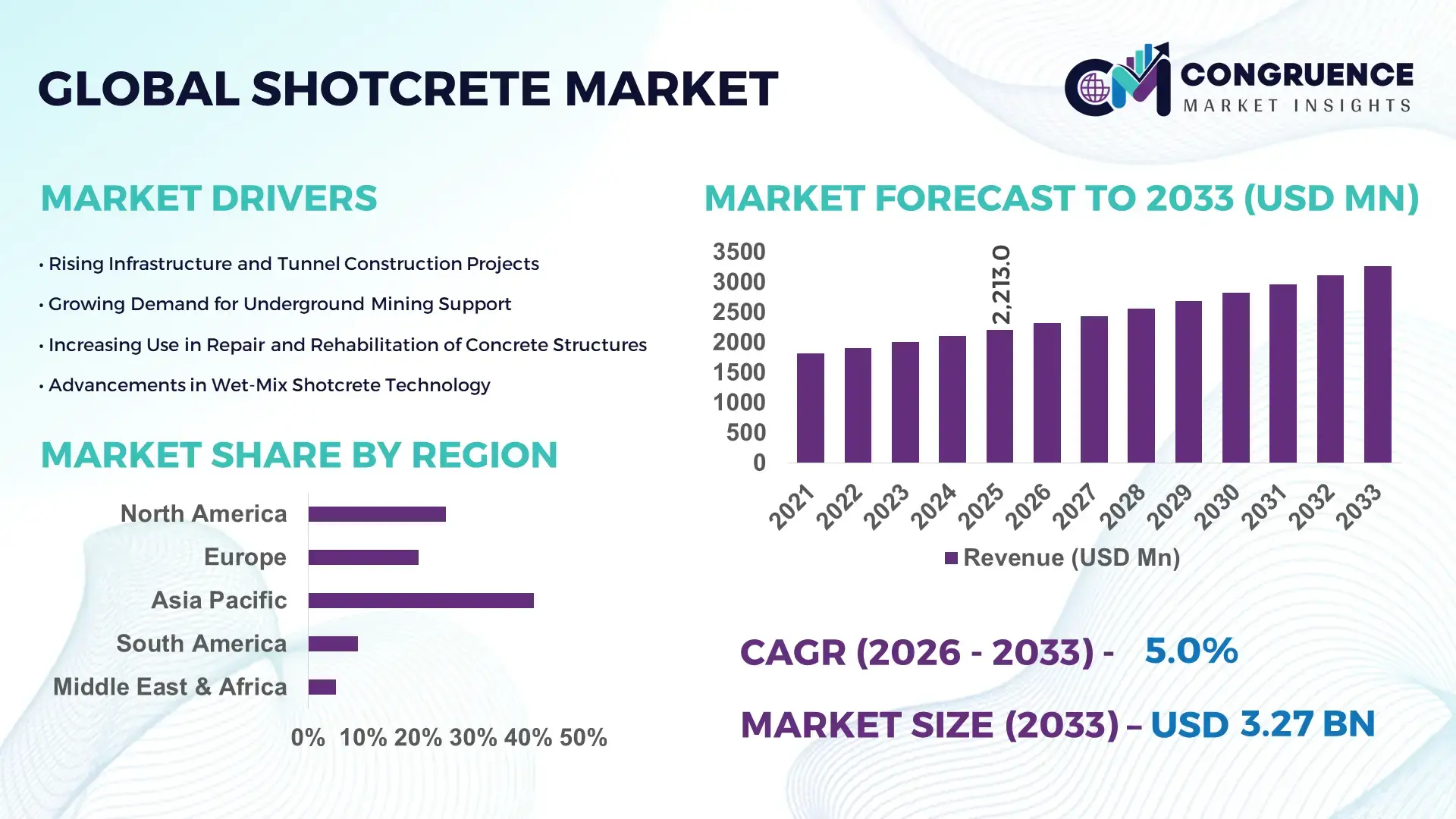
The Global Shotcrete Market was valued at USD 2213 Million in 2025 and is anticipated to reach a value of USD 3269.6 Million by 2033 expanding at a CAGR of 5% between 2026 and 2033. This growth is largely driven by the increasing demand for efficient concrete reinforcement solutions in tunnel construction, underground mining operations, and infrastructure rehabilitation projects.
China stands out as a dominant country in the global Shotcrete market due to its extensive underground infrastructure development and large-scale engineering projects. The country has constructed more than 2,000 kilometers of new rail and metro tunnels in recent years, significantly increasing demand for sprayed concrete solutions used in tunnel lining and structural stabilization. Annual shotcrete consumption in China is estimated to exceed 5 million cubic meters across mining, hydroelectric dam tunnels, and transportation infrastructure. Additionally, advanced robotic spraying systems capable of delivering over 8 cubic meters of shotcrete per hour are increasingly deployed in major construction projects. Government-backed infrastructure investment programs exceeding USD 1 trillion across transportation, water management, and urban transit systems further support the consistent deployment of high-performance wet-mix shotcrete technologies.
• Market Size & Growth: The global Shotcrete market reached USD 2213 Million in 2025 and is projected to grow to USD 3269.6 Million by 2033 at a CAGR of 5%, supported by expanding tunnel construction, underground transportation systems, and mining ground stabilization projects.
• Top Growth Drivers: Infrastructure tunnel construction adoption (42%), underground mining support usage (36%), and infrastructure repair and rehabilitation demand (31%).
• Short-Term Forecast: By 2028, automated shotcrete spraying systems are projected to reduce material waste by nearly 18% while improving project productivity and structural application efficiency by approximately 22%.
• Emerging Technologies: Robotic shotcrete spraying equipment, steel and synthetic fiber-reinforced shotcrete mixtures, and digitally controlled wet-mix dosing systems designed to improve application precision and durability.
• Regional Leaders: Asia-Pacific projected to reach approximately USD 1.5 Billion by 2033 driven by transportation tunnels and hydroelectric projects; Europe expected to approach USD 900 Million supported by infrastructure renovation programs; North America anticipated to exceed USD 700 Million due to mining and transportation infrastructure upgrades.
• Consumer/End-User Trends: Underground mining companies, transportation infrastructure contractors, and hydropower construction firms represent the primary end-users, with underground tunnel projects accounting for nearly 45% of global shotcrete consumption.
• Pilot or Case Example: In 2024, a major tunnel construction project in Norway implemented automated robotic shotcrete systems that improved application efficiency by 24% while reducing labor requirements by nearly 20%.
• Competitive Landscape: The market leader holds approximately 18% of the global market, followed by several large construction technology and equipment manufacturers competing through equipment innovation, material formulation improvements, and automated spraying solutions.
• Regulatory & ESG Impact: Environmental construction regulations promoting sustainable materials and reduced dust emissions have accelerated the use of wet-mix shotcrete technologies that cut airborne particulate emissions by up to 35%.
• Investment & Funding Patterns: Global infrastructure investment related to underground transport, hydropower, and mining stabilization projects exceeded USD 50 Billion in recent years, significantly boosting demand for advanced shotcrete equipment and materials.
• Innovation & Future Outlook: Ongoing innovations include self-healing concrete additives, automated spraying robotics, and fiber-reinforced shotcrete materials designed to enhance durability, reduce structural maintenance requirements, and improve long-term infrastructure resilience.
Shotcrete technologies are increasingly applied across mining, transportation infrastructure, and hydropower sectors, which together account for nearly 70% of global demand. Transportation tunnel projects alone contribute approximately 40–45% of shotcrete consumption due to the need for rapid concrete reinforcement and slope stabilization. Technological innovations such as steel-fiber reinforcement, accelerator-enhanced wet-mix shotcrete, and robotic spraying arms have improved structural strength by more than 30% compared with conventional sprayed concrete techniques. Environmental regulations encouraging dust reduction and improved material efficiency are further accelerating adoption. Emerging trends include digital monitoring systems for spray thickness control, automated batching equipment, and high-durability concrete mixtures capable of extending infrastructure lifespan by over 20 years.
The Shotcrete Market plays a strategically important role in modern infrastructure development, particularly in underground construction, mining stabilization, and transportation tunnel engineering. Increasing global demand for metro rail networks, hydropower tunnels, and underground mining operations has accelerated the adoption of advanced shotcrete application technologies. Modern robotic spraying systems deliver approximately 25% faster application speeds compared to traditional manual spraying methods while reducing rebound material losses by nearly 20%. In terms of regional dynamics, Asia-Pacific dominates global shotcrete consumption volume due to extensive infrastructure construction, while Europe leads in advanced technology adoption with nearly 48% of major tunnel construction firms deploying automated spraying equipment.
By 2028, AI-enabled material dosing systems and robotic spraying units are expected to improve application precision and reduce material wastage by nearly 22%, significantly improving operational efficiency in large-scale construction projects. Companies are also committing to environmental sustainability goals, targeting up to 30% reduction in dust emissions and increased recycling of construction materials by 2030 through improved wet-mix shotcrete processes. In 2024, a Scandinavian infrastructure project implemented automated shotcrete robotics that improved structural reinforcement efficiency by 26% while reducing project completion time by nearly 18%. These advancements position the Shotcrete Market as a critical pillar supporting resilient infrastructure development, regulatory compliance, and sustainable construction growth.
The increasing development of underground transportation networks and mining infrastructure is significantly driving the demand for shotcrete solutions. Globally, more than 300 major tunnel construction projects are currently underway across metro rail systems, highway tunnels, and hydropower facilities. Shotcrete is preferred for tunnel linings because it provides immediate ground stabilization and rapid structural reinforcement. Modern wet-mix shotcrete technologies allow application rates exceeding 8 cubic meters per hour, enabling faster construction timelines. In underground mining operations, shotcrete is used to strengthen tunnel walls and prevent rockfalls, improving worker safety and operational efficiency. With urbanization driving expansion of underground transport systems in major cities, demand for high-performance sprayed concrete technologies continues to grow steadily.
Despite its advantages, the adoption of advanced shotcrete technologies faces challenges due to the high cost of specialized spraying equipment and skilled labor requirements. Automated robotic shotcrete systems used in large tunnel projects can cost several hundred thousand dollars, limiting accessibility for smaller construction firms. Additionally, the operation of shotcrete equipment requires trained technicians capable of managing material ratios, spray thickness control, and equipment calibration. In many developing regions, the shortage of skilled operators has slowed the adoption of advanced wet-mix shotcrete systems. Maintenance costs for spraying equipment and pumps also increase operational expenses, making project budgeting more complex for contractors working on smaller infrastructure projects.
The emergence of smart construction technologies presents major opportunities for the shotcrete market. Digital monitoring systems capable of tracking spray thickness, rebound rates, and structural stability are improving application precision and material efficiency. Robotic shotcrete equipment integrated with sensor-based control systems can increase spraying accuracy by nearly 25% while reducing material wastage. The growing adoption of fiber-reinforced shotcrete mixtures also enhances structural durability and crack resistance, making them suitable for high-stress infrastructure applications such as tunnels and mining shafts. As governments continue to invest in smart infrastructure and sustainable construction practices, these technologies are expected to create significant opportunities for advanced shotcrete equipment manufacturers and material suppliers.
Environmental regulations related to dust emissions, waste management, and material sustainability present ongoing challenges for shotcrete applications. Traditional dry-mix shotcrete processes can generate airborne particulate emissions, requiring additional dust control measures at construction sites. Governments in several regions have implemented stricter environmental standards that require contractors to adopt low-emission wet-mix systems and improved material containment practices. Additionally, achieving consistent concrete quality and structural performance can be challenging due to variations in raw materials and site conditions. Infrastructure projects often require strict compliance with durability and strength standards, forcing manufacturers to invest in advanced material formulations and testing procedures to meet evolving regulatory and engineering requirements.
• Rapid Expansion of Robotic Shotcrete Application Systems: Automation is transforming shotcrete operations in underground construction and mining. Robotic spraying systems can apply between 7 and 10 cubic meters of shotcrete per hour, improving application efficiency by nearly 25% compared to manual spraying methods. Adoption of robotic shotcrete equipment has increased by approximately 30% across major tunnel projects in Europe and Asia since 2022. Automated nozzle positioning and sensor-based spray control also reduce rebound material waste by nearly 18%, improving construction material utilization. In large-scale metro and hydropower tunnel projects, robotic systems are now used in over 40% of underground reinforcement operations due to improved worker safety and precision.
• Increasing Adoption of Fiber-Reinforced Shotcrete Materials: Fiber-reinforced shotcrete formulations are gaining strong traction in structural reinforcement applications. Steel and synthetic fibers improve crack resistance and increase compressive strength by nearly 30% compared to conventional sprayed concrete. Approximately 55% of modern tunnel construction projects now use fiber-reinforced shotcrete instead of traditional mesh reinforcement. In mining ground-support systems, fiber shotcrete layers ranging between 50 mm and 150 mm thickness are widely applied to stabilize rock surfaces. The adoption of synthetic fiber shotcrete mixtures has grown by about 28% over the past three years due to their corrosion resistance and reduced installation time.
• Rising Deployment in Underground Infrastructure Projects: Global expansion of underground transportation systems is significantly increasing shotcrete demand. Over 300 major tunnel projects are currently under construction worldwide, including metro rail, hydropower tunnels, and highway infrastructure. In urban metro projects alone, shotcrete accounts for nearly 45% of primary tunnel lining applications due to its rapid application capability. Large metropolitan cities are investing heavily in underground rail networks, with more than 1,200 kilometers of metro tunnels currently under development globally. Shotcrete technology is also widely used in slope stabilization and retaining wall reinforcement, particularly in mountainous regions where landslide prevention infrastructure has increased by nearly 20% in recent years.
• Integration of Smart Monitoring and Digital Construction Technologies: Digital construction technologies are increasingly integrated into shotcrete operations to improve accuracy and project efficiency. Modern spraying systems now include real-time thickness monitoring sensors capable of measuring shotcrete layers within ±5 mm accuracy. Digital monitoring tools can reduce over-spraying by nearly 15% while improving structural consistency across tunnel surfaces. Approximately 35% of large infrastructure contractors are implementing digital monitoring systems to track application parameters such as spray velocity, rebound rates, and material flow. The use of 3D scanning technologies for shotcrete surface verification has also increased by more than 22% in major infrastructure projects, enabling precise quality control and faster project completion.
The Shotcrete market is segmented by type, application, and end-user industry, reflecting its diverse use across construction and infrastructure sectors. By type, wet-mix shotcrete dominates global deployment due to its superior material consistency and reduced dust emissions, while dry-mix systems remain widely used in smaller-scale repair applications. In terms of applications, underground construction and tunnel reinforcement represent the largest segment, accounting for a substantial share of shotcrete utilization across transportation and mining infrastructure. From an end-user perspective, construction and infrastructure companies represent the primary adopters, followed by mining and energy sectors. Growing demand for underground transportation networks, hydropower tunnels, and mining stabilization projects continues to influence segmentation patterns across regional markets.
The Shotcrete market is primarily categorized into wet-mix shotcrete and dry-mix shotcrete systems, each offering distinct operational advantages. Wet-mix shotcrete currently represents the leading segment, accounting for approximately 62% of global adoption due to its superior material homogeneity, reduced dust generation, and improved spraying efficiency. Wet-mix systems deliver consistent concrete mixtures directly through pumping equipment, allowing application rates exceeding 8 cubic meters per hour in large infrastructure projects. In comparison, dry-mix shotcrete holds roughly 38% of the market, mainly used for smaller construction repairs and slope stabilization applications where flexibility in water content control is beneficial. Wet-mix shotcrete is also the fastest-growing segment, expanding at an estimated 6.5% growth rate as major infrastructure projects prioritize worker safety and environmental compliance. Reduced airborne particulate emissions and improved bonding strength have accelerated adoption in large-scale tunnel and underground construction projects. Dry-mix systems continue to maintain niche relevance in remote construction sites and maintenance work where simpler equipment and material transportation are preferred.
Shotcrete is widely used across multiple infrastructure and industrial applications including tunnel construction, mining ground support, slope stabilization, and infrastructure rehabilitation. Tunnel construction currently represents the leading application segment, accounting for nearly 44% of global shotcrete usage. The method is highly effective for rapid tunnel lining and structural reinforcement due to its ability to adhere to irregular rock surfaces and deliver immediate load-bearing support. Mining ground support follows with approximately 28% adoption, where shotcrete layers help stabilize underground shafts and prevent rock fragmentation. Slope stabilization and infrastructure repair applications collectively contribute around 28% of the market. These applications include retaining walls, bridge rehabilitation, and dam reinforcement projects where sprayed concrete improves structural durability and erosion resistance.
Among all applications, infrastructure rehabilitation and repair represent the fastest-growing segment with an estimated 6.8% growth rate. Aging bridges, tunnels, and highway structures across developed economies are driving increased demand for sprayed concrete solutions capable of restoring structural integrity without extensive demolition.
The Shotcrete market serves several key end-user industries including construction and infrastructure, mining, and energy sectors. Construction and infrastructure companies represent the dominant end-user segment, accounting for approximately 52% of global shotcrete demand. These companies extensively deploy shotcrete in tunnel construction, bridge reinforcement, and underground transportation systems due to its rapid application capability and strong adhesion properties. The mining sector represents the second-largest end-user segment with around 30% adoption. Underground mining operations utilize shotcrete for ground support and tunnel stabilization to reduce rockfall risks and improve worker safety. The energy sector, particularly hydropower construction projects, contributes approximately 18% of market demand, where shotcrete is used to reinforce dam tunnels and water diversion structures.
Among these segments, the mining industry is the fastest-growing end-user group with an estimated growth rate of nearly 7%. Increasing demand for minerals and metals is driving expansion of underground mining operations, which require extensive ground reinforcement systems.
Region Asia-Pacific accounted for the largest market share at 41% in 2025 however, Region North America is expected to register the fastest growth, expanding at a CAGR of 5.9% between 2026 and 2033.

Asia-Pacific’s leadership is supported by large-scale tunnel construction and mining reinforcement activities, with more than 1,200 km of metro rail tunnels under development across China, India, and Japan. North America held approximately 24% of the global market in 2025, driven by underground transportation projects and mining stabilization applications. Europe represented around 22% of global shotcrete consumption, supported by infrastructure renovation programs and strict construction safety regulations. South America contributed nearly 8% of market demand due to mining projects in Brazil, Chile, and Peru. The Middle East & Africa region accounted for about 5%, supported by hydropower tunnel construction, oil and gas infrastructure reinforcement, and large-scale urban development projects.
How Are Advanced Construction Technologies Reshaping Demand for Sprayed Concrete Solutions?
North America represents approximately 24% of the global shotcrete market, driven by strong demand from underground transportation infrastructure, mining operations, and highway tunnel reinforcement projects. The United States and Canada together account for nearly 85% of regional shotcrete consumption. Government-backed infrastructure initiatives supporting tunnel rehabilitation and metro rail expansion are increasing demand for high-performance sprayed concrete. Regulatory guidelines related to construction safety and dust reduction have accelerated the shift toward wet-mix shotcrete technologies. Robotic shotcrete spraying systems are now used in nearly 38% of large tunnel construction projects in the region. A major construction technology provider has expanded automated shotcrete equipment deployment across several North American mining sites, improving ground stabilization efficiency by nearly 25%. Consumer behavior shows higher adoption among large infrastructure contractors focusing on safety and operational efficiency.
How Are Sustainability Regulations Driving Innovation in Advanced Concrete Reinforcement Solutions?
Europe accounts for approximately 22% of the global shotcrete market, with Germany, the United Kingdom, and France serving as major consumption centers. Infrastructure renovation and tunnel rehabilitation projects across these countries are driving steady demand for sprayed concrete reinforcement technologies. Regulatory initiatives focused on sustainable construction and reduced dust emissions have encouraged contractors to adopt wet-mix shotcrete systems that reduce particulate emissions by nearly 30%. Over 45% of large infrastructure projects in Western Europe utilize fiber-reinforced shotcrete to enhance durability and structural strength. A leading European construction equipment manufacturer has introduced automated shotcrete spraying systems capable of applying more than 9 cubic meters of material per hour for large tunnel projects. Consumer behavior in the region shows strong preference for environmentally compliant materials and high-precision spraying equipment due to strict regulatory requirements.
What Factors Are Accelerating the Expansion of Underground Infrastructure Technologies?
Asia-Pacific leads the global shotcrete market with nearly 41% share, supported by massive infrastructure and mining development across China, India, Japan, and South Korea. China alone accounts for over 5 million cubic meters of shotcrete usage annually in transportation tunnels, hydropower construction, and underground mining stabilization. India has more than 800 kilometers of metro rail tunnels currently under development, significantly increasing demand for sprayed concrete reinforcement technologies. Regional manufacturers are introducing high-capacity shotcrete pumps capable of delivering 8–10 cubic meters per hour for large tunnel construction projects. A major Asian construction equipment manufacturer recently deployed robotic shotcrete application systems across several hydropower tunnel projects, improving application efficiency by nearly 22%. Regional consumer behavior reflects strong adoption among infrastructure contractors focusing on rapid urbanization and large-scale transportation development.
Why Are Mining and Infrastructure Projects Increasing the Need for Structural Reinforcement Technologies?
South America represents nearly 8% of the global shotcrete market, with Brazil, Chile, and Argentina serving as key demand centers. Mining operations across the Andes region require extensive underground stabilization, leading to increased shotcrete consumption for tunnel reinforcement and slope stabilization. Brazil alone accounts for approximately 40% of regional shotcrete demand due to infrastructure upgrades and hydroelectric tunnel construction. Government investments supporting transportation corridors and energy infrastructure are also expanding market opportunities. Regional construction equipment suppliers are introducing mobile shotcrete spraying units designed for remote mining environments. Consumer demand in the region is strongly influenced by mining industry requirements, where shotcrete layers ranging from 50 mm to 120 mm are widely used to stabilize underground tunnels and improve operational safety.
How Are Large Infrastructure and Energy Projects Transforming Demand for Sprayed Concrete Solutions?
The Middle East & Africa region accounts for approximately 5% of the global shotcrete market, driven by large infrastructure development and energy projects. Countries such as the United Arab Emirates, Saudi Arabia, and South Africa are investing heavily in underground transportation systems, hydropower tunnels, and mining infrastructure. More than 200 major infrastructure projects are currently under construction across the region, requiring extensive use of sprayed concrete for slope stabilization and tunnel reinforcement. Technological modernization is accelerating adoption of robotic shotcrete spraying equipment capable of improving application efficiency by nearly 20%. Regional construction firms are also implementing wet-mix shotcrete technologies to comply with environmental dust emission regulations. Consumer adoption patterns show increasing demand from large-scale infrastructure developers focusing on durable and rapid concrete reinforcement solutions.
• China – 29% Market Share: China dominates the shotcrete market due to extensive tunnel construction, large-scale mining operations, and high infrastructure investment supporting transportation and hydropower projects.
• United States – 17% Market Share: The United States holds a strong position in the shotcrete market driven by underground transportation infrastructure expansion, mining stabilization projects, and advanced construction technology adoption.
The Shotcrete market is characterized by a moderately fragmented competitive environment with more than 35 active global and regional companies participating across equipment manufacturing, material supply, and specialized construction services. The top five companies collectively account for approximately 38% of the global market, indicating significant competition among equipment providers and construction technology firms. Market leaders focus heavily on technological innovation, particularly robotic spraying equipment, fiber-reinforced shotcrete materials, and automated dosing systems designed to improve application accuracy and reduce construction waste.
Product development remains a major competitive strategy, with several companies introducing high-capacity shotcrete pumps capable of delivering more than 10 cubic meters of material per hour for large tunnel and mining projects. Strategic partnerships between equipment manufacturers and infrastructure contractors have also increased, enabling companies to deploy integrated construction solutions in major underground projects. Mergers and acquisitions are emerging as another key strategy as companies expand their regional presence and strengthen distribution networks. Additionally, innovation in environmentally sustainable shotcrete formulations that reduce dust emissions by up to 35% is becoming a significant differentiating factor in competitive positioning across global infrastructure markets.
Normet Group
Putzmeister
Sika AG
BASF Construction Chemicals
CIFA S.p.A.
Reed LLC
Aliva Equipment
Atlas Copco
Shotcrete Technologies Inc.
Thiessen Team USA
Gunite Supply & Equipment Company
Lancy Mixers
Technological innovation in the Shotcrete market is centered on automation, advanced material formulations, and digital monitoring systems that improve efficiency and structural performance. Robotic shotcrete spraying equipment is increasingly used in tunnel construction and mining operations, capable of applying between 7 and 10 cubic meters of material per hour with consistent spray thickness accuracy within ±5 mm. These automated systems reduce rebound loss by nearly 20% compared to manual application, improving material utilization and project productivity.
Wet-mix shotcrete technology continues to gain traction due to its improved material homogeneity and lower dust emissions, reducing airborne particulate levels by nearly 30% in enclosed construction environments. Fiber-reinforced shotcrete mixtures containing steel or synthetic fibers enhance compressive strength by up to 30% and significantly improve crack resistance in underground reinforcement structures.
Digital construction technologies are also transforming shotcrete applications. Sensor-based monitoring systems can track spray thickness, rebound rates, and material flow in real time, allowing operators to optimize application precision. Approximately 35% of large infrastructure contractors are integrating digital monitoring platforms with spraying equipment to ensure structural consistency across tunnel surfaces. In addition, self-healing concrete additives and accelerator-enhanced formulations are emerging technologies designed to extend infrastructure lifespan and improve early-strength development in sprayed concrete applications.
• In March 2025, Normet Group introduced the Spraymec MF 050 VC SD robotic sprayer designed for underground mining and tunneling operations. The equipment features advanced boom control systems and automated dosing technology to improve spraying accuracy and operator safety.
• In September 2024, Putzmeister launched the SPM 4210 Wetkret shotcrete pump, designed for high-performance wet-mix shotcrete applications in tunnel construction. The equipment can deliver up to 30 cubic meters per hour of sprayed concrete while maintaining consistent pressure for large underground infrastructure projects. Source: www.putzmeister.com
• In April 2024, Sika AG expanded its shotcrete accelerator product line with the Sigunit L-5601 AF, a new alkali-free liquid accelerator designed to improve early strength development and reduce dust emissions during sprayed concrete applications. Source: www.sika.com
• In November 2024, Blastcrete Equipment LLC introduced the X-10 Ultra high-capacity shotcrete pump system designed for underground construction and refractory applications. The system supports improved pumping efficiency and enhanced durability for heavy-duty construction environments. Source: www.blastcrete.com
The Shotcrete Market Report provides a comprehensive evaluation of the global sprayed concrete industry, covering key product types, applications, end-user industries, and regional markets. The report analyzes two primary technology segments—wet-mix shotcrete and dry-mix shotcrete—while examining material innovations such as steel fiber reinforcement, synthetic fiber additives, and accelerator-enhanced concrete formulations designed to improve structural strength by up to 30%. The scope includes detailed segmentation across major applications such as tunnel construction, mining ground support, slope stabilization, infrastructure rehabilitation, and hydropower tunnel reinforcement. Tunnel construction alone accounts for nearly 40–45% of total shotcrete utilization globally, highlighting its importance in underground infrastructure development.
Geographically, the report evaluates market activity across five major regions: North America, Europe, Asia-Pacific, South America, and the Middle East & Africa, covering more than 25 key countries involved in large-scale infrastructure and mining operations. The report also analyzes technological advancements including robotic shotcrete spraying systems, digital monitoring platforms, and automated dosing equipment capable of improving application efficiency by up to 25%.
Additionally, the report reviews competitive positioning among more than 30 major companies operating in the market and identifies emerging industry trends influencing the future adoption of advanced shotcrete technologies across construction and mining sectors.
| Report Attribute/Metric | Report Details |
|---|---|
|
Market Revenue in 2025 |
USD V2025 Million |
|
Market Revenue in 2033 |
USD V2033 Million |
|
CAGR (2026 - 2033) |
5% |
|
Base Year |
2025 |
|
Forecast Period |
2026 - 2033 |
|
Historic Period |
2021 - 2025 |
|
Segments Covered |
By Types
By Application
By End-User
|
|
Key Report Deliverable |
Revenue Forecast, Growth Trends, Market Dynamics, Segmental Overview, Regional and Country-wise Analysis, Competition Landscape |
|
Region Covered |
North America, Europe, Asia-Pacific, South America, Middle East, Africa |
|
Key Players Analyzed |
Normet Group, Putzmeister, Sika AG, BASF Construction Chemicals, CIFA S.p.A., Reed LLC, Aliva Equipment, Atlas Copco, Shotcrete Technologies Inc., Thiessen Team USA, Gunite Supply & Equipment Company, Lancy Mixers |
|
Customization & Pricing |
Available on Request (10% Customization is Free) |




