
Reports
The Global Shortwave Infrared Market was valued at USD 690.0 Million in 2025 and is anticipated to reach a value of USD 1,660.2 Million by 2033 expanding at a CAGR of 11.59% between 2026 and 2033. Defense modernization programs and semiconductor inspection demand anchor near-term procurement cycles across North America and Europe.
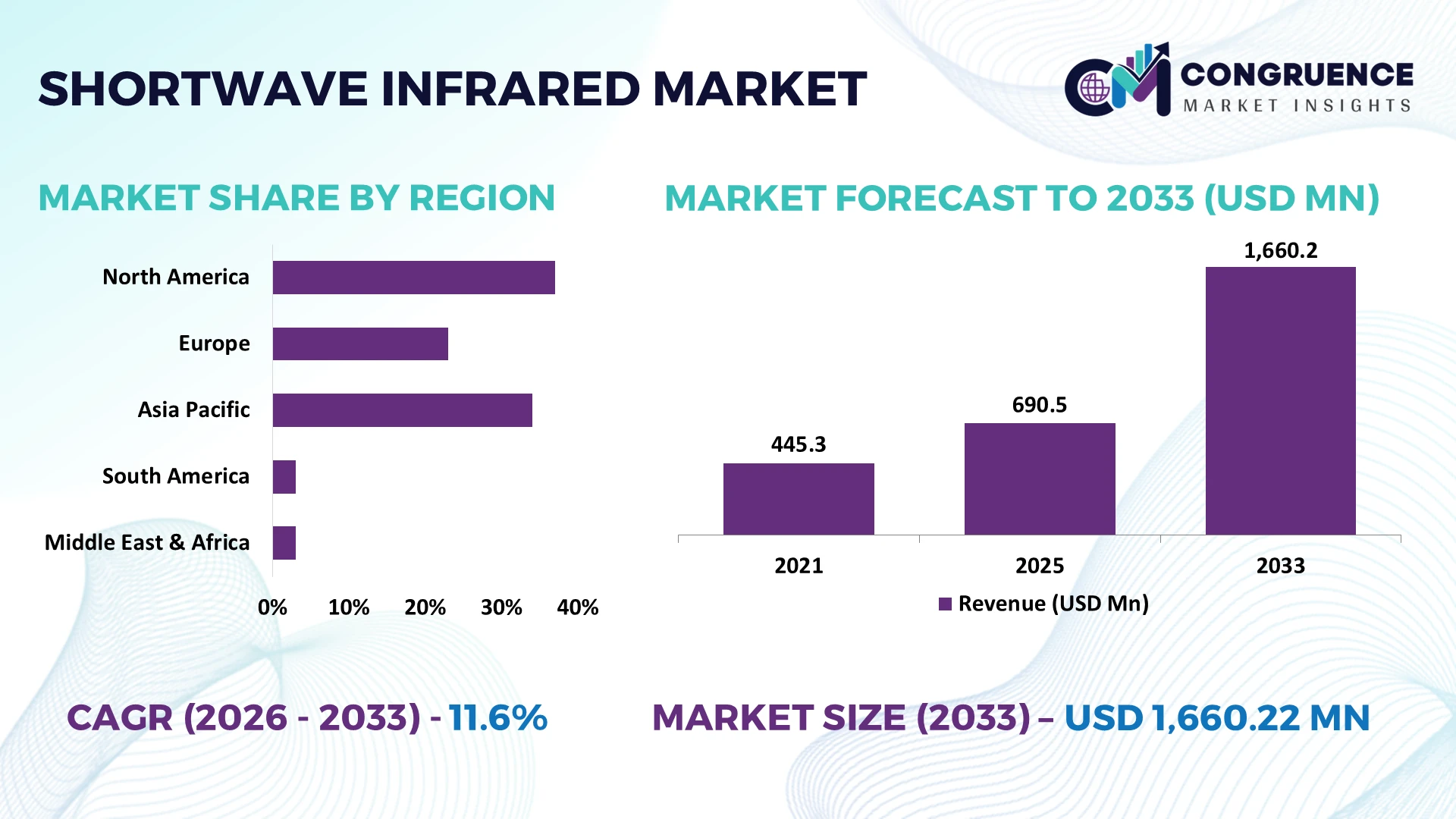
North America commands 36%–39% of global SWIR deployment, with the United States accounting for 78%–82% of regional volume, sustained by aerospace-electronics clusters and domestic photonics supply-chain investment . Europe holds 24%–27% share, led by Germany’s industrial inspection and recycling automation base, while Asia-Pacific accelerates at a faster adoption pace driven by China’s semiconductor fab expansion . The U.S. defense imaging segment alone deploys SWIR arrays across surveillance and targeting platforms at nearly double the volume of European counterparts.
Strategic implication: suppliers prioritizing ITAR-free detector capacity and application-specific machine-vision modules capture the highest-margin procurement pipelines.
Market Size & Growth: Valued at USD 690.0 Million in 2025, forecast to reach USD 1,660.2 Million by 2033 at 11.59% CAGR, propelled by defense surveillance modernization and semiconductor defect inspection demand.
Top Growth Drivers: Defense and security procurement (38% of application revenue), industrial machine vision adoption (27%), and agricultural crop-health sensing (11% growth contribution).
Short-Term Forecast: By 2027, uncooled SWIR module costs decline 18%–22%, lifting commercial machine-vision integration rates by 15 percentage points.
Emerging Technologies: Quantum-dot detector architectures, AI-enabled spectral decision systems, and extended-range eSWIR sensors redefine cost-performance boundaries.
Regional Leaders: North America (USD 250–269 Million, defense-led), Europe (USD 166–186 Million, circular-economy sorting), Asia-Pacific (USD 180–200 Million, semiconductor inspection expansion) .
Consumer/End-User Trends: 64% of new machine-vision deployments evaluate SWIR capability for moisture, polymer, or coating inspection; food sorting adoption rises 19% annually.
Pilot/Case Example: 2025 Lynred Eyesential SW launch delivers VGA-format SWIR at half the price of comparable InGaAs sensors, targeting machine-vision OEM integration .
Competitive Landscape: Teledyne, Hamamatsu, Sony, and onsemi control 48% of 2024 revenue; Lynred’s EUR 85 Million Grenoble expansion raises regional detector capacity 50% .
Regulatory & ESG Impact: EU circular-economy directives drive SWIR-based plastic sorting infrastructure; export controls on InGaAs detectors accelerate dual-sourcing across U.S. and European OEMs.
Investment & Funding: Lynred commits EUR 85 Million to capacity expansion; Emberion raises EUR 6 Million for nanomaterial imagers priced an order of magnitude below InGaAs peers .
Innovation & Future Outlook: Colloidal quantum-dot matrices enable visible-to-eSWIR coverage, shifting competitive advantage toward software-integrated spectral analytics rather than raw detector sensitivity .
The Shortwave Infrared Market’s demand centers on semiconductor inline inspection, pharmaceutical non-destructive quality control, and defense surveillance, where SWIR penetrates packaging and atmospheric obscurants invisible to silicon-based imagers. Recent product innovations include Lynred’s Eyesential SW sensor, priced at half the cost of comparable InGaAs units, and quantum-dot matrix prototypes extending spectral coverage from visible through eSWIR . An emerging trend is AI-embedded spectral decision systems that convert SWIR contrast into automated accept-reject signals, reducing reliance on trained operators by up to 30%. Supply-chain context: export-control uncertainty on InGaAs detectors pushes OEMs toward dual-sourcing and non-cooled architectures, reshaping procurement strategy across U.S. and European defense programs. This operational shift frames the strategic discussion that follows.
SWIR imaging is transitioning from a niche defense capability into a strategic inspection layer for semiconductor yield management, pharmaceutical quality assurance, and autonomous navigation. The shift matters because silicon-based vision fails precisely where SWIR delivers contrast: through packaging, beneath surface films, and across atmospheric haze. Supply-chain restructuring around detector materials—particularly InGaAs export controls—forces procurement teams to dual-source and qualify alternative architectures, elevating SWIR from component selection to supply-security planning.
A measurable technology comparison illustrates the inflection: uncooled SWIR modules now achieve 70%+ quantum efficiency at 1.55 µm with power draw below 1.5 W, replacing thermoelectrically cooled legacy systems that consumed 3–5× more power and required 30–60 seconds of stabilization before imaging . Regionally, North America prioritizes defense-qualified, ITAR-compliant detectors, while Asia-Pacific emphasizes cost-driven semiconductor inspection deployment at scale—China’s fab expansion absorbs SWIR modules for wafer-level defect detection at adoption rates outpacing European industrial inspection by an estimated 4–6 percentage points annually.
A practical deployment example: Lynred’s 2025 Eyesential SW launch targeted machine-vision OEMs with VGA-format SWIR at half the prior price point, prompting integrators to redesign inspection cells previously priced out of SWIR adoption . Companies are responding by shifting R&D budgets toward software-defined spectral analytics and partnering with optics suppliers to reduce calibration complexity. The strategic conclusion: competitive positioning now depends less on detector sensitivity alone and more on delivering application-specific, cost-defensible SWIR decision systems that integrate into existing automation stacks.
Defense surveillance and semiconductor defect inspection together anchor 65% of SWIR application revenue, with military procurement cycles driving 38% of demand and fab inspection contributing 27% . The structural shift is toward uncooled, compact SWIR modules integrated into unmanned platforms and inline metrology tools, reducing dependency on cooled detector supply chains. In the United States, defense modernization programs fund SWIR array deployments across targeting and reconnaissance platforms, while semiconductor fabs in Taiwan and South Korea adopt SWIR for wafer-level crack and contamination detection. Companies respond by expanding detector capacity—Lynred’s EUR 85 Million Grenoble investment raises regional output 50%—and forming acquisition-driven vertical integration, as evidenced by Hamamatsu’s purchase of BAE Systems Imaging Solutions . Strategic insight: suppliers aligning detector roadmaps with defense qualification timelines and fab inspection throughput requirements lock in multi-year procurement agreements before commercial competitors qualify.
InGaAs detector pricing remains 3–5× higher than silicon-based alternatives, constraining adoption in cost-sensitive industrial segments where payback periods exceed 24 months . Export controls on SWIR detectors and related photonics components create supply friction, particularly for European and Asian OEMs sourcing U.S.-origin InGaAs arrays. The direct business impact: machine-vision integrators defer SWIR adoption in food sorting and recycling applications where ROI thresholds demand sub-18-month payback. Companies mitigate through dual-sourcing strategies—qualifying both U.S. and non-U.S. detector suppliers—and by designing around uncooled architectures that reduce system-level cost. Lynred’s Eyesential SW pricing at half comparable InGaAs units signals a competitive response, but broader cost relief depends on quantum-dot and germanium detector commercialization reaching volume maturity . Operational insight: procurement teams that qualify alternative detector technologies before export-control disruptions occur avoid 6–9 month revalidation cycles.
The highest-value opportunity lies in software-defined SWIR: AI/ML analytics that convert spectral contrast into automated pass-fail decisions for semiconductor, pharmaceutical, and food inspection, reducing operator dependency by 25%–35%. Quantum-dot detector architectures present a cost-disruption pathway, with prototypes demonstrating visible-to-eSWIR coverage at pricing projected an order of magnitude below InGaAs equivalents . In Japan and South Korea, precision equipment makers are embedding SWIR modules into metrology tools, leveraging historic optics leadership to capture inspection-software value layers. Companies position through R&D partnerships—Emberion’s EUR 6 Million funding for nanomaterial imagers exemplifies—and through ecosystem development with lighting and calibration vendors . Unique strategic insight: the winning business model shifts from detector sales to calibration-library licensing, where recurring software revenue exceeds hardware margins within three deployment cycles.
SWIR deployment faces execution barriers in calibration reproducibility and integration with existing machine-vision architectures. Image calibration and standardization gaps persist across vendors, requiring 4–8 weeks of on-site tuning per inspection cell—a hidden cost that erodes ROI and delays factory-wide rollout . Workforce gaps compound the issue: fewer than 15% of machine-vision integrators hold hands-on SWIR calibration expertise, concentrating deployment capability in a narrow specialist pool. In Germany’s industrial inspection market, where SWIR adoption for polymer sorting expands, integrators report calibration variability across detector batches as a persistent production-line bottleneck. Companies must solve this through investment in automated calibration routines and partner-enabled deployment models. Strategic insight: vendors that ship pre-calibrated, application-specific SWIR modules with validated defect libraries reduce integration time by 50% and capture share in mid-market factory automation.
Uncooled Architectures Reshape Cost Baselines Uncooled SWIR modules now account for 18.2% of sensor shipments, with material quality improvements narrowing the performance gap against cooled alternatives . Lynred’s Eyesential SW launch in January 2025 priced VGA-format SWIR at half comparable InGaAs sensors, directly targeting machine-vision OEMs previously excluded by cost thresholds . This pricing pressure forces incumbents to redesign thermal management and packaging rather than compete solely on sensitivity. Integrators in Germany and Japan are recalibrating inspection-cell budgets around uncooled modules, compressing payback periods below 18 months.
Line-Scan Adoption Accelerates in Conveyor Workflows Line-scan architectures capture 28%–32% of SWIR imaging deployments, growing faster than area-scan as recycling and semiconductor conveyors demand continuous high-throughput inspection . New Imaging Technologies’ Lisa SWIR platform pairs 2,048-pixel arrays with 60 kHz line rates synchronized to production-line geometry. The operational shift moves SWIR from batch sampling to inline process control, where defect detection latency directly gates throughput.
Export Controls Drive Dual-Sourcing and ITAR-Free Design Proposed Category XII updates place additional focal-plane arrays under ITAR restrictions, adding licensing delays for non-allied shipments . European suppliers such as Xenics responded with ITAR-free camera lines, though performance tradeoffs persist. Procurement teams in France and the UK now qualify dual detector supply chains before production commitments, treating export classification as a design constraint rather than a procurement afterthought.
AI Spectral Analytics Shift Value to Software Layers Vendors increasingly embed calibration libraries and defect-classification retraining into SWIR systems, converting cameras from imaging devices into decision engines . This is non-obvious: the hardware margin compresses as uncooled modules commoditize, but recurring software licensing for pass-fail thresholds and spectral libraries captures higher lifetime value. Food-sorting operators in the Netherlands report 25%–30% reduction in manual reinspection after deploying AI-embedded SWIR decision systems.
Area-scan cameras retain 68%–72% of SWIR imaging type share, reflecting their established role in fixed inspection and laboratory imaging where full-frame capture outweighs throughput constraints . Their dominance rests on mature integration ecosystems and broad pixel-format availability, but the segment grows at a comparatively measured pace as conveyor-driven production lines demand different geometry. Line-scan represents the fastest-expanding type at 28%–32% share, propelled by recycling sorting and roll-to-roll semiconductor inspection that require continuous, high-line-rate capture synchronized to material flow .
Companies are responding by rebalancing product portfolios: Teledyne and Hamamatsu maintain broad area-scan lines while investing in line-scan platforms optimized for specific conveyor speeds and illumination geometries. The strategic distinction matters because area-scan competes on versatility and resolution, whereas line-scan competes on integration depth—camera timing, lighting synchronization, and defect-classification latency become the procurement criteria. Investment priorities shift toward application-specific line-scan modules rather than generalized area-scan sensors.
Industrial application and military/defense each command approximately 25% of SWIR application share, forming the twin demand anchors for the market . Industrial inspection’s concentration reflects semiconductor wafer defect detection and inline quality control, where SWIR penetrates packaging and identifies contamination invisible to silicon-based vision. Defense demand is structurally different: qualification cycles are longer, but surveillance and targeting programs specify SWIR for low-light and obscurant-penetrating performance, creating durable procurement visibility.
The fastest-growing application cluster is material sorting and recycling, driven by regulatory mandates for plastic separation and food quality grading. SWIR’s spectral fingerprinting distinguishes polymer types that appear identical in visible light, enabling automated sorting at throughputs manual inspection cannot match. Companies adapt by embedding application-specific defect libraries and collaborating with lighting vendors to standardize illumination geometry—a shift from selling cameras to selling validated inspection outcomes. Semiconductor inline metrology represents the most operationally critical use case, where a single missed defect carries yield-loss consequences that justify premium system pricing.
Military and defense end-users represent the leading buyer group, with surveillance and targeting programs driving qualification-gated demand that rewards suppliers with established ITAR-compliant supply chains. This segment’s purchasing behavior is characterized by multi-year program commitments and performance specifications that prioritize reliability under adverse conditions over unit cost. Industrial manufacturers constitute the second anchor, with semiconductor fabs and electronics assembly operations integrating SWIR into inline inspection workflows where defect escape costs dwarf sensor pricing.
The fastest-expanding end-user group is food and beverage processing, where moisture-content detection and contamination screening drive adoption at rates outpacing traditional industrial inspection. These buyers behave differently: they demand turnkey sorting integration, reject camera-only offerings, and evaluate ROI against labor reduction and recall avoidance rather than imaging performance alone. Companies target this segment through application-specific modules with pre-loaded spectral libraries and partnership models with sorting-machine OEMs. Automotive end-users remain an emerging buyer group, with SWIR evaluation concentrated in ADAS sensor fusion and battery inspection rather than volume deployment.
North America accounted for the largest market share at 37% in 2025 however, Asia-Pacific is expected to register the fastest growth, expanding at a CAGR of 14.3% between 2026 and 2033.

North America commands 37% of global SWIR deployment, with the United States contributing 78%–82% of regional volume . Defense surveillance, semiconductor metrology, and aerospace inspection form the three procurement pillars, supported by domestic detector manufacturing capacity that reduces dependence on imported InGaAs arrays. Machine-vision integration in electronics and food sorting adds commercial volume, though qualification cycles remain longer than in industrial segments. A measurable development: Teledyne FLIR’s Forge 1GigE SWIR camera, built around Sony’s IMX990 sensor, targets industrial inspection and recycling applications, reflecting the shift toward compact, commercially accessible modules. The region’s competitive advantage rests on ITAR-aligned supply chains and defense program visibility rather than unit-cost leadership.
United States Market Outlook: The U.S. defense imaging budget and semiconductor fab inspection investments sustain premium SWIR procurement, with military surveillance programs specifying SWIR for low-light and obscurant-penetrating performance. Domestic detector suppliers Teledyne and Sensors Unlimited anchor the supply chain, while university and national laboratory research programs feed next-generation detector architectures into commercial qualification pipelines.
Europe holds 23% of global SWIR share, with Germany leading regional deployment through industrial inspection and polymer sorting infrastructure . The region’s adoption pattern differs from North America: commercial machine-vision and recycling automation drive volume, while defense procurement remains secondary. Lynred’s January 2025 Eyesential SW launch—priced at half comparable InGaAs sensors—directly targets European machine-vision OEMs, signaling a cost-down trajectory that aligns with the EU’s circular-economy sorting mandates. France’s Grenoble photonics cluster and Germany’s Fraunhofer research network provide the R&D backbone, though export-control friction on U.S.-origin detectors pushes European integrators toward dual-sourcing strategies.
Germany Market Outlook: Germany’s Industrie 4.0 infrastructure and precision manufacturing base create sustained demand for SWIR in inline quality control, particularly for semiconductor wafer inspection and polymer sorting. Fraunhofer-led hyperspectral imaging projects convert research output into industrial deployment, while the country’s automotive and electronics sectors evaluate SWIR for battery inspection and advanced driver-assistance sensing.
Asia-Pacific captures 34% of global SWIR share, with China, Japan, South Korea, and Taiwan forming a manufacturing corridor that integrates SWIR into semiconductor wafer inspection, solar cell quality control, and consumer electronics packaging . The region’s structural advantage lies in proximity to both detector consumers and packaging capacity, compressing qualification cycles for new sensor formats. Japan’s Sony Semiconductor Solutions has commercialized SWIR sensors using Cu-Cu connections between InGaAs photodiodes and silicon readouts, while China’s fab expansion absorbs SWIR modules for defect detection at scale. The region’s growth trajectory reflects manufacturing volume rather than premium pricing.
China Market Outlook: China’s semiconductor self-sufficiency initiatives and “Made in China 2025” industrial policy accelerate SWIR deployment in wafer inspection and photovoltaic quality control. Domestic detector development reduces reliance on imported InGaAs arrays, while the country’s automotive sector evaluates SWIR for autonomous navigation through smog and low-visibility conditions, creating a volume-driven demand pathway distinct from defense-led markets.
South America represents 3% of global SWIR share, with adoption concentrated in Chile’s copper and lithium mining operations and Brazil’s agricultural processing sector . The region’s deployment pattern is project-based rather than infrastructure-driven, with SWIR used for mineral sorting and crop quality assessment where visible-spectrum imaging fails. Infrastructure limitations and import dependency constrain scale, but mining operators prioritize reliability over acquisition cost, creating premium niches for ruggedized systems. Chile’s mining monitoring requirements support SWIR adoption at a measured pace, while Brazil’s food processing sector evaluates spectral sorting for export-quality compliance.
Brazil Market Outlook: Brazil’s agricultural export economy and expanding food-processing base drive SWIR demand for quality grading and contamination detection. The country’s mining sector, though smaller than Chile’s, evaluates SWIR for ore sorting, while government-supported smart-agriculture research programs position SWIR as a tool for precision farming and soil health assessment.
Middle East & Africa accounts for 3% of global SWIR share, with Saudi Arabia and the UAE leading deployment through border security, critical infrastructure protection, and smart surveillance investments. The region’s procurement is project-driven, with annual demand uneven but long-term trajectory supported by defense modernization and airport/port surveillance upgrades. South Africa contributes industrial and mining-related demand, though at smaller scale. SWIR’s ability to image through dust, haze, and low-light conditions aligns with the region’s environmental operating requirements, creating a defensible use case for security operators who prioritize reliability over unit cost.
Saudi Arabia Market Outlook: Saudi Arabia’s Vision 2030 security infrastructure investments and border surveillance modernization programs create procurement pathways for SWIR imaging in perimeter protection and critical asset monitoring. The country’s defense sector evaluates SWIR for targeting and reconnaissance applications, while smart-city initiatives in NEOM and Riyadh incorporate advanced sensing into urban security architectures.
The SWIR market pits vertically integrated imaging giants—Teledyne FLIR, Hamamatsu, and Sony—against European detector specialists Lynred/NIT and Xenics/Exosens, with cost-focused innovators like Aeluma challenging on CMOS-compatible architectures. The top five players command approximately 48% combined share, leaving a fragmented mid-tier competing on application depth. Competition pivots on detector cost-per-pixel and supply-chain control: Lynred’s NIT acquisition delivered an HD1080p 8µm-pitch array, while Hamamatsu’s 640×512 InGaAs sensors hit 116fps for sorting and spectroscopy. Price pressure intensifies as uncooled modules compress margins 15%–20%, pushing incumbents toward software-embedded spectral libraries. Players compete through capacity expansion—Lynred’s Grenoble investment—and vertical integration, as Sony pairs InGaAs photodiodes with Cu-Cu silicon readouts. The decisive shift is from detector specification to calibrated decision-system delivery; entry barriers now rest on application validation libraries and defense-qualified supply chains rather than fab access alone. Winning requires simultaneous cost leadership in uncooled formats and proprietary calibration depth for semiconductor and defense qualification cycles.
Teledyne FLIR IIS
Hamamatsu Photonics
Sony Semiconductor Solutions
Lynred (including New Imaging Technologies)
Xenics (Exosens)
Sensors Unlimited (Collins Aerospace)
SemiConductor Devices (SCD)
Aeluma
Emberion
SWIR Vision Systems
Photon etc.
Infrared Cameras Inc.
Sierra-Olympic Technologies
Princeton Infrared Technologies
Current SWIR deployment is anchored by InGaAs focal-plane arrays with thermoelectric cooling, delivering 640×512 resolution at up to 116fps for industrial sorting and semiconductor inspection. These mature platforms achieve quantum efficiency above 70% in the 0.9–1.7µm band, but cost-per-pixel remains 3–5× silicon alternatives, limiting adoption to high-value inspection nodes.
Emerging quantum-dot and wafer-scale architectures target cost disruption. Aeluma’s DOE-backed CMOS-compatible platform aims to deliver SWIR sensitivity on large-diameter substrates, potentially reducing detector cost by an order of magnitude while enabling mobile and automotive integration. Line-scan formats exceed 110kHz rates, with IWR functionality lifting operational throughput by over 100% versus prior generations. Uncooled modules now capture 18%–22% of industrial deployments.
Disruptive impact concentrates in software-defined spectral analytics: embedded AI libraries convert contrast data into pass-fail signals, reducing operator dependency 25%–35%. Companies benefiting are integrators with calibration depth, not detector fabs alone. Between 2026 and 2028, cost compression from quantum-dot scaling and uncooled maturation will shift competitive advantage toward application-validated decision systems, making early qualification library investment decisive.
April 2025 – Lynred (NIT) Launched LiSaSWIR line-scan camera delivering double the sensitivity and 30% faster readout versus predecessor, with IWR enabling over 100% operational speed gain for wafer and solar panel inspection. Business impact: compresses defect detection cycles and reduces scrap rates. Source: lynred.com
June 2025 – Hamamatsu Released G16562-0808T InGaAs SWIR sensor with integrated cooling for hyperspectral imaging and industrial inspection. Business impact: enables real-time spectral capture in harsh environments, expanding semiconductor and traffic monitoring deployment. Source: gophotonics.com
September 2025 – SemiConductor Devices (SCD) Secured $115 million Israeli Ministry of Defense contract for SWIR/MWIR/LWIR sensor development and manufacturing infrastructure expansion. Business impact: scales defense-qualified production capacity for aerial payloads and space systems. Source: globes.co.il
December 2025 – Sony Semiconductor Solutions Demonstrated IMX992 SWIR image sensor with transmission observation capability at APCS 2025, targeting semiconductor packaging inspection. Business impact: validates SWIR integration into advanced packaging metrology workflows. Source: sony-semicon.com
The report covers the global SWIR market across type, application, end-user, and regional dimensions, with type segmentation spanning area-scan and line-scan architectures, and application coverage extending from industrial inspection and defense surveillance to sorting, spectroscopy, and scientific imaging. End-user analysis addresses military, industrial manufacturing, food processing, automotive, and healthcare segments, with adoption patterns quantified where deployment data supports differentiation.
Regional coverage encompasses North America, Europe, Asia-Pacific, South America, and Middle East & Africa, with country-level outlooks for the United States, Germany, China, Brazil, and Saudi Arabia. The report incorporates technology assessment across InGaAs, quantum-dot, and uncooled architectures, and profiles fourteen active competitors. Strategic coverage supports investment prioritization by mapping calibration-library depth, defense qualification status, and uncooled cost trajectories against application-specific demand concentrations, enabling expansion planning and competitive positioning through 2033.
| Report Attribute / Metric | Details |
|---|---|
| Market Revenue (2025) | USD 690.5 Million |
| Market Revenue (2033) | USD 1,660.2 Million |
| CAGR (2026–2033) | 11.59% |
| Base Year | 2025 |
| Forecast Period | 2026–2033 |
| Historic Period | 2021–2025 |
| Segments Covered |
By Type
By Application
By End-User
|
| Key Deliverables | Revenue Forecast; Market Trends; Growth Drivers & Restraints; Technology Insights; Segmentation Analysis; Regional Insights; Competitive Landscape; Regulatory & ESG Overview; Recent Developments |
| Regions Covered | North America; Europe; Asia-Pacific; South America; Middle East & Africa |
| Companies Profiled | Teledyne FLIR IIS; Hamamatsu Photonics; Sony Semiconductor Solutions; Lynred (including New Imaging Technologies); Xenics (Exosens); Sensors Unlimited (Collins Aerospace); SemiConductor Devices (SCD); Aeluma; Emberion; SWIR Vision Systems; Photon etc.; Infrared Cameras Inc.; Sierra-Olympic Technologies; Princeton Infrared Technologies |
| Customization & Pricing | Available on Request (10% Customization Free) |




