
Reports
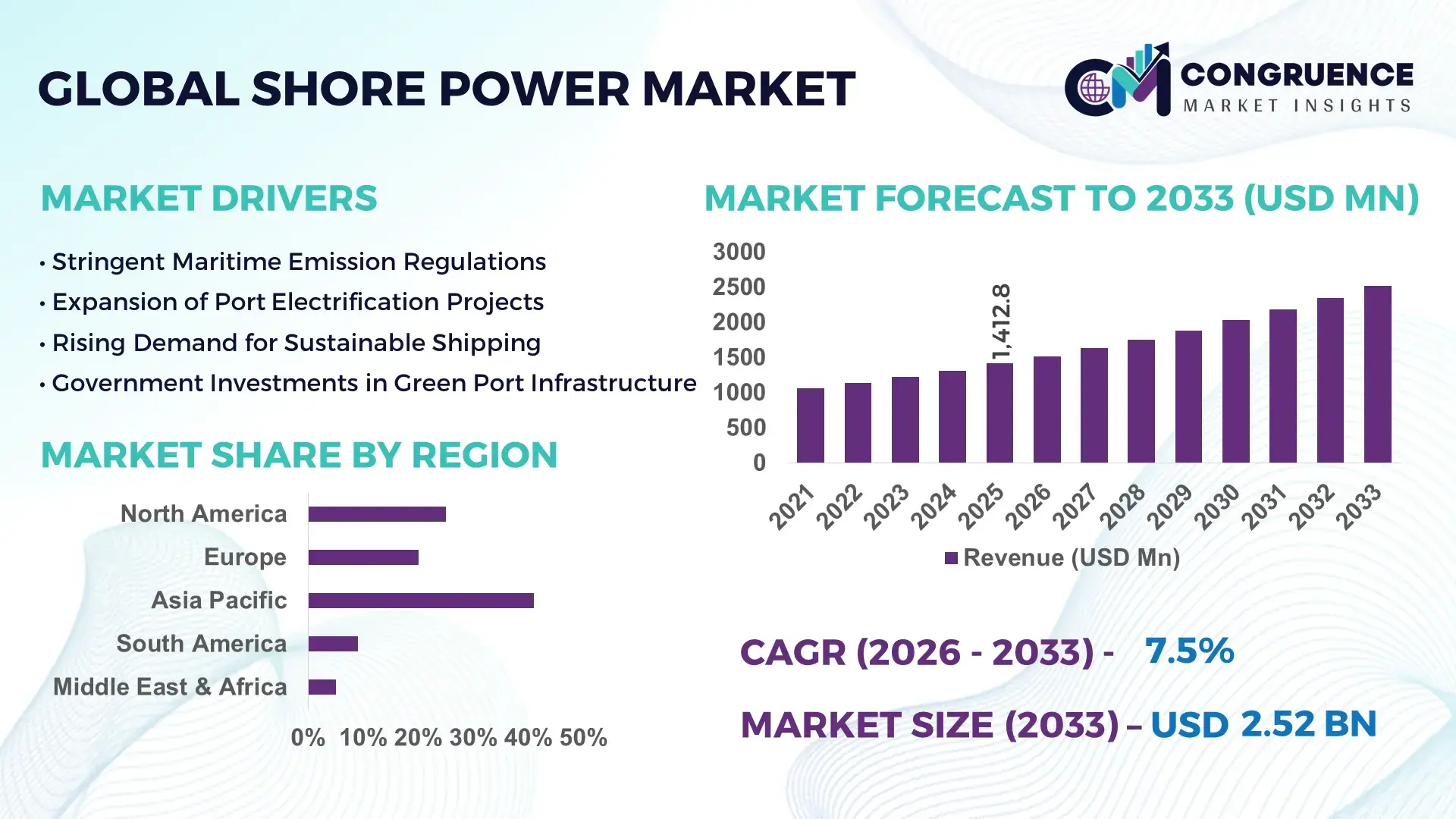
The Global Shore Power Market was valued at USD 1412.75 Million in 2025 and is anticipated to reach a value of USD 2519.61 Million by 2033 expanding at a CAGR of 7.5% between 2026 and 2033. Increasing maritime decarbonization initiatives and port electrification programs are accelerating deployment of shore-to-ship power infrastructure across major global ports.
In China, large-scale port electrification programs have accelerated shore power deployment across container, bulk, and passenger terminals. The country operates more than 200 major seaports with over 7,000 berths, and government-backed upgrades have installed shore power systems at thousands of docking positions. Investments exceeding several billion USD have supported high-voltage shore connection technologies, automated grid integration, and adoption across cruise terminals and container hubs such as Shanghai and Shenzhen. Electrified berthing infrastructure has been widely implemented across domestic coastal shipping routes, with usage rates in key commercial ports surpassing 60% of eligible vessel calls. Continuous upgrades in power conversion systems and smart grid monitoring platforms are improving efficiency and operational reliability across port clusters.
Market Size & Growth: Valued at USD 1412.75 Million in 2025 and projected to reach USD 2519.61 Million by 2033 at a CAGR of 7.5%, driven by rising electrification of ports and emission reduction mandates for docked vessels.
Top Growth Drivers: Port electrification adoption 42%, emission reduction compliance initiatives 37%, operational fuel savings improvement 29%.
Short-Term Forecast: By 2028, ports implementing shore power are expected to reduce vessel-at-berth emissions by approximately 35% while improving port energy efficiency by nearly 20%.
Emerging Technologies: High-voltage shore connection (HVSC) systems, smart grid-integrated port energy management, and automated cable handling solutions.
Regional Leaders: Asia Pacific projected to reach about USD 980 Million by 2033 with rapid port modernization; Europe estimated near USD 760 Million with strict maritime emission standards; North America expected around USD 620 Million supported by port sustainability programs.
Consumer/End-User Trends: Container shipping lines, cruise operators, and ferry services are expanding shore power utilization to meet decarbonization goals and reduce onboard generator use during port stays.
Pilot or Case Example: In 2024, a large-scale port electrification pilot reduced dockside fuel consumption by nearly 28% and lowered maintenance downtime for auxiliary engines by about 18%.
Competitive Landscape: Market leadership held by major marine power infrastructure providers with about 18% share, followed by key competitors including ABB, Siemens, Schneider Electric, and Wärtsilä.
Regulatory & ESG Impact: Stricter maritime emission control regulations, port sustainability mandates, and incentives for zero-emission docking infrastructure are accelerating adoption.
Investment & Funding Patterns: Recent investments in port electrification and marine power systems exceed USD 3 Billion globally, supported by public-private partnerships and green infrastructure financing.
Innovation & Future Outlook: Integration of renewable-powered shore grids, modular power conversion platforms, and digital port energy management systems will drive scalable and efficient deployments.
The shore power market is strongly influenced by container shipping, cruise tourism, naval operations, and ferry transportation, which collectively contribute the majority of infrastructure demand at electrified ports. Container terminals account for roughly 45% of installations, followed by cruise and passenger terminals near 30%, while ferries and offshore support vessels form a growing segment. Recent innovations include compact high-voltage frequency converters, automated connection systems, and grid-synchronized energy storage integration that stabilize port power supply. Regulatory initiatives targeting reductions in sulfur oxides, nitrogen oxides, and carbon emissions at berth are accelerating infrastructure expansion across major coastal economies. Regional consumption is rising rapidly across Asia Pacific and Europe as ports expand electrified docking capacity, while North American ports are focusing on retrofitting older terminals. Over the coming decade, integration with renewable energy sources and digital energy monitoring platforms is expected to shape long-term operational efficiency and sustainability outcomes across global maritime logistics hubs.
The strategic relevance of the Shore Power Market is closely tied to global maritime decarbonization targets, port modernization programs, and energy transition frameworks adopted by coastal economies. Governments and port authorities are increasingly prioritizing shore-to-ship electrification to reduce emissions produced when vessels are docked. In major global ports, auxiliary engines operating at berth can account for up to 6–8% of a vessel’s total voyage emissions, creating measurable incentives for electrified docking infrastructure and grid integration projects.
From a technology perspective, high-voltage shore connection systems are becoming the preferred infrastructure standard across large container and cruise terminals. High-voltage shore connection technology delivers nearly 30% efficiency improvement compared to conventional low-voltage shipboard auxiliary power operations. Asia Pacific dominates in volume due to large-scale port infrastructure development, while Europe leads in adoption with approximately 65% of major commercial ports integrating shore power connectivity across at least one terminal. Countries such as Norway and China are accelerating deployment through national maritime electrification programs and port electrification incentives.
In the short term, digital port energy management and AI-driven load balancing are expected to reshape operational efficiency. By 2028, AI-based port energy optimization is expected to improve grid utilization efficiency by around 22% while reducing peak electricity demand fluctuations. Firms are committing to ESG performance improvements such as 40% dockside emission reduction targets by 2030, aligning with international maritime sustainability frameworks and green port certification initiatives. A measurable example emerged in 2024 when Port of Los Angeles implemented expanded shore power capacity and automated connection systems, achieving a 30% reduction in vessel-at-berth emissions within electrified terminals. Such initiatives demonstrate operational scalability and measurable environmental outcomes. Looking forward, the Shore Power Market is increasingly positioned as a pillar of resilient port infrastructure, regulatory compliance, and sustainable growth across global maritime logistics ecosystems.
The implementation of strict emission control measures in major shipping corridors is significantly accelerating adoption of shore power infrastructure. Regulatory frameworks within emission control areas require vessels to reduce sulfur oxide and nitrogen oxide emissions while docked, pushing ports to deploy electrified docking solutions. Studies of port emissions indicate that auxiliary engines running at berth can emit several tons of pollutants during extended docking periods, prompting authorities to introduce mandatory electrification measures. In several European ports, more than 50% of newly constructed berths are now equipped with shore power connectivity systems designed for container vessels and passenger ships. Cruise operators have also upgraded fleets so that over 60% of new cruise ships launched in recent years are technically compatible with shore power connections. As port authorities expand electrified terminals and integrate grid upgrades, shipping companies benefit from reduced fuel consumption, improved compliance with environmental regulations, and enhanced operational efficiency during port stays.
One of the primary limitations affecting the Shore Power Market is the substantial capital investment required to build and integrate shore-side electrical systems into port infrastructure. Installation of high-capacity substations, frequency converters, cable management systems, and berth-level connection equipment can require extensive engineering upgrades within ports that were originally designed for conventional docking operations. In many large ports, retrofitting older terminals requires reinforcing grid connections capable of supplying tens of megawatts of power simultaneously to multiple vessels. Additionally, electrical compatibility challenges between international vessel fleets—operating on different voltage and frequency standards—require specialized conversion systems that increase project complexity. Some ports also face constraints related to grid stability, particularly in regions where local electricity networks must be expanded or modernized to support continuous high-load operations. These infrastructure and integration requirements often slow deployment timelines despite the growing demand for cleaner port operations.
The integration of renewable energy sources and digital port management systems is creating significant new opportunities for the Shore Power Market. Many ports are investing in solar, wind, and hybrid microgrid projects designed to supply clean electricity directly to docked vessels through shore power systems. In several advanced port clusters, renewable-powered microgrids are capable of supplying a substantial portion of the electricity used for vessel docking operations, reducing dependency on fossil-fuel-based generation. Additionally, smart port technologies—including real-time energy monitoring, automated cable handling equipment, and predictive maintenance systems—are improving operational reliability and enabling ports to optimize energy distribution. Electrification initiatives also support the growth of electric ferries and hybrid vessels that rely heavily on port-based charging infrastructure. As governments and port authorities continue funding sustainable port transformation programs, these developments open new opportunities for technology providers, infrastructure developers, and maritime energy solution companies.
A major operational challenge in the Shore Power Market involves the complexity of aligning international vessel fleets with standardized shore connection systems. Ships operating across different regions often use varying electrical configurations, including differences in voltage levels, connection interfaces, and onboard power management systems. This creates interoperability challenges when vessels dock at ports equipped with different shore power standards. Even though international guidelines for high-voltage shore connections are expanding, not all ports have fully adopted unified infrastructure specifications. Furthermore, upgrading existing vessels to support shore power can involve significant modifications to onboard electrical systems, including transformers, switchboards, and connection equipment. In large global fleets, only a portion of vessels may be fully compatible with shore-side electrical supply, requiring phased retrofitting programs. These compatibility and standardization gaps can slow widespread implementation and require coordinated industry collaboration to ensure seamless operation across international maritime networks.
• Accelerated Electrification of Commercial Ports and Terminals: Global port electrification programs are expanding rapidly as maritime authorities prioritize emission reduction at berth. More than 70% of newly developed large container terminals worldwide now include shore power readiness in infrastructure planning. In leading maritime economies such as China and United States, over 300 commercial berths have been upgraded with shore-to-ship electrical systems in recent years. Operational data from electrified terminals indicates up to 45% reduction in onboard auxiliary engine usage during docking, improving energy efficiency and environmental compliance across high-traffic shipping corridors.
• Integration of High-Voltage Shore Connection (HVSC) Systems: High-voltage shore connection infrastructure is becoming a standard requirement in large-scale ports handling container ships and cruise liners. Approximately 60% of new installations globally now deploy HVSC systems capable of supplying between 6.6 kV and 11 kV power levels to vessels. These systems reduce transmission losses by nearly 28% compared to conventional low-voltage port connections. European maritime hubs led by countries such as Norway and Netherlands have expanded HVSC-compatible docking capacity across more than 120 terminals supporting high-energy demand vessels.
• Expansion of Smart Energy Management and Digital Port Platforms: Digitalization is transforming the Shore Power Market through advanced monitoring, predictive maintenance, and automated energy distribution technologies. Around 48% of large international ports are deploying digital energy management systems integrated with grid forecasting tools and automated cable handling mechanisms. Ports implementing these systems have reported approximately 22% improvement in energy load balancing and nearly 18% reduction in equipment downtime. Organizations such as Port of Rotterdam Authority are expanding digital infrastructure to support real-time monitoring of multiple electrified berths simultaneously.
• Growing Adoption by Cruise, Ferry, and Hybrid Vessel Fleets: The increasing electrification of maritime fleets is significantly influencing shore power demand patterns. More than 65% of newly built cruise vessels are designed with shore power compatibility, while electric ferry deployments have expanded by nearly 35% across coastal transport networks. Regions including Scandinavia and parts of East Asia have introduced electrified ferry routes where over 50% of daily port calls utilize shore-side electricity instead of onboard generators. Shipping operators adopting these systems have recorded approximately 30% reductions in dockside emissions and measurable improvements in port operational efficiency.
The Shore Power Market segmentation reflects the varied technical configurations, operational environments, and user requirements associated with port electrification and vessel connectivity. Market segmentation by type primarily includes different voltage configurations and connection systems designed to support ships with varying power requirements. High-voltage systems are typically deployed in large commercial ports serving container vessels and cruise ships, while low-voltage solutions are commonly used in smaller terminals and ferry operations. From an application standpoint, container terminals represent a major area of deployment because of frequent port calls and long berthing durations that increase the efficiency of shore-side electricity usage. Passenger ferry routes and cruise operations are also expanding electrified docking infrastructure to reduce emissions in coastal urban regions. In terms of end-user insights, port authorities, shipping companies, and terminal operators are the primary stakeholders investing in shore power infrastructure. Electrification initiatives in major maritime corridors have resulted in more than 60% of new terminal developments integrating shore power compatibility as part of long-term port modernization strategies, indicating growing institutional commitment to cleaner maritime logistics.
The Shore Power Market by type is primarily categorized into High-Voltage Shore Connection (HVSC), Low-Voltage Shore Connection (LVSC), and hybrid or flexible connection systems designed for mixed vessel compatibility. High-voltage systems currently account for about 58% of installed infrastructure globally, reflecting their suitability for container ships, cruise liners, and large cargo vessels that require significant electrical loads during docking operations. In comparison, low-voltage systems represent nearly 27% of installations, mainly supporting ferries, offshore support vessels, and smaller commercial ships operating on short coastal routes. However, adoption in hybrid connection systems is rising fastest, projected to grow at approximately 9.2% annually as ports aim to accommodate multiple vessel classes with adaptable infrastructure. Other specialized connection solutions—including automated cable handling and mobile shore power units—collectively contribute around 15% of installations and serve niche operational environments such as temporary berths and smaller ports transitioning toward electrification. Increasing global shipping traffic and modernization of legacy ports are encouraging broader deployment of these flexible solutions.
By application, container shipping terminals represent the largest segment of the Shore Power Market, accounting for approximately 46% of total deployment due to high vessel traffic, extended cargo operations, and environmental compliance requirements in major global ports. Passenger cruise operations follow with nearly 24% adoption, as cruise ships typically remain docked for longer durations and operate in environmentally regulated urban port areas. However, ferry transportation is emerging as the fastest-growing application segment, expanding at an estimated 10.1% annually as coastal transport networks transition toward electrified and hybrid ferry fleets. Other applications—including offshore service vessels, naval logistics support, and bulk cargo operations—collectively contribute around 30% of installations. These segments are gradually increasing adoption as governments promote emission reduction programs across maritime industries and expand electrified port capacity in industrial and energy-related ports.
From an end-user perspective, port authorities and terminal operators represent the leading segment, accounting for roughly 52% of infrastructure deployment decisions because they control port modernization planning and electrical grid integration projects. Shipping companies represent about 28% of the market’s operational demand, as fleet operators increasingly retrofit vessels with shore power compatibility to meet environmental compliance requirements and operational efficiency targets. However, cruise line operators are emerging as the fastest-growing end-user segment, expanding at approximately 9.8% annually due to stricter environmental standards in major tourism ports and increasing public demand for cleaner maritime operations. Other stakeholders—including ferry operators, offshore energy logistics providers, and naval fleets—collectively contribute around 20% of shore power adoption. Electrified ferry operations in particular have achieved adoption rates exceeding 40% in some coastal regions where short-distance routes make shore charging highly efficient and operationally practical.
Asia Pacific accounted for the largest market share at 41% in 2025 however, Europe is expected to register the fastest growth, expanding at a CAGR of 8.4% between 2026 and 2033.

Asia Pacific leads due to extensive port infrastructure with more than 1,200 major commercial ports and thousands of active berths handling container and bulk shipping operations annually. Countries such as China, Japan, and South Korea have collectively installed shore power systems across over 400 high-traffic terminals. Europe follows with approximately 29% share, supported by strict maritime emission regulations affecting more than 250 ports and increasing electrification across cruise and passenger terminals. North America accounts for nearly 20% of the market with over 90 large berths already equipped with shore-side electricity infrastructure, particularly in the United States and Canada. South America holds around 6% share as modernization programs expand across key export hubs, while the Middle East & Africa contribute close to 4%, supported by large logistics and energy ports undergoing digital and electrical upgrades. Global deployment of shore power infrastructure surpassed 1,000 electrified berths worldwide in 2025, with more than 35% of newly built terminals integrating high-voltage shore connection technology.
How are port electrification mandates transforming infrastructure investments and vessel operations?
North America accounts for approximately 20% of the global Shore Power Market, supported by strong adoption across container shipping, cruise tourism, and naval logistics operations. The region operates more than 70 major commercial ports with electrified berths expanding steadily, particularly along the Pacific and Atlantic coasts. Regulatory frameworks requiring emission reductions at berth are pushing ports to integrate shore power infrastructure into modernization programs. In the United States, several major ports have installed systems capable of supplying between 6 MW and 20 MW of electricity to docked vessels. Government-backed port sustainability initiatives and funding programs are accelerating deployment of grid-connected power systems and automated cable handling technologies. Regional technology adoption trends show increasing use of digital energy management systems capable of monitoring dozens of berths simultaneously. Companies such as Wärtsilä have supported infrastructure upgrades through advanced marine power solutions and smart port integration platforms. Consumer behavior in the region indicates higher enterprise adoption among cruise operators and logistics shipping companies prioritizing environmental compliance and operational efficiency improvements.
What is driving large-scale electrified docking infrastructure across major maritime hubs?
Europe represents about 29% of the Shore Power Market and is one of the most advanced regions in electrified port infrastructure. Key markets including Germany, United Kingdom, and France are expanding shore power availability across container terminals, cruise ports, and ferry networks. More than 150 ports across the region have implemented electrified docking systems, with many supporting high-voltage connections designed for large vessels. Sustainability initiatives aligned with maritime emission reduction targets are accelerating adoption, with ports introducing requirements for ships to connect to shore-side electricity while docked. Digital transformation trends include integration of renewable-powered microgrids and real-time monitoring platforms that optimize energy consumption across terminals. Infrastructure providers such as ABB are actively deploying high-voltage shore connection systems in several European port expansions. Consumer behavior variations show strong demand driven by regulatory pressure and environmental compliance standards that require shipping operators to reduce emissions during port stays.
Why are large-scale maritime infrastructure upgrades accelerating electrified port adoption?
Asia-Pacific leads the global Shore Power Market in volume, accounting for nearly 41% of total installations worldwide and hosting some of the busiest shipping corridors globally. Top consuming countries include China, India, and Japan, where port authorities are investing heavily in electrified berthing systems and smart port infrastructure. The region handles more than 60% of global container traffic through major logistics hubs, which has encouraged deployment of shore power systems across hundreds of terminals. Infrastructure expansion includes high-capacity substations, automated connection technologies, and integration with renewable energy projects. Innovation hubs in coastal industrial clusters are developing advanced grid management platforms capable of supporting multiple docked vessels simultaneously. Regional companies such as State Grid Corporation of China are contributing to port electrification through large-scale power infrastructure investments. Consumer behavior across Asia Pacific shows rapid adoption driven by expanding maritime trade, growing port modernization programs, and increasing focus on sustainable shipping operations.
How are export-driven ports modernizing energy infrastructure for cleaner maritime logistics?
South America holds approximately 6% of the global Shore Power Market and is gradually expanding electrified docking infrastructure as regional ports modernize operations linked to commodity exports and international trade. Key countries such as Brazil and Argentina are investing in port upgrades across container terminals and energy logistics hubs. Several ports in the region handle millions of tons of agricultural and mineral exports annually, creating demand for cleaner port operations and improved energy efficiency. Government-supported port development initiatives are promoting electrification projects and grid improvements to support future vessel compatibility. Technology adoption trends include digital monitoring platforms and automated power distribution systems designed for high-load cargo terminals. Regional logistics operators are exploring hybrid docking solutions to support both conventional and electrified vessels. Consumer behavior variations in the region show demand tied to trade expansion and localized maritime operations requiring efficient port turnaround times.
What role do logistics mega-ports and energy trade corridors play in electrified port development?
The Middle East & Africa account for about 4% of the Shore Power Market but are witnessing steady infrastructure modernization as ports expand to support global logistics and energy trade routes. Demand is particularly strong in countries such as United Arab Emirates and South Africa, where large ports handle significant volumes of container shipments, oil, and industrial cargo. Several logistics hubs are integrating electrified berths as part of broader smart-port transformation initiatives involving automated cargo handling and digital monitoring systems. Ports in the region are installing high-capacity power distribution infrastructure capable of supplying electricity to large cargo vessels and cruise ships. Strategic trade partnerships and port expansion agreements are encouraging adoption of energy-efficient maritime infrastructure. Companies such as DP World are investing in port modernization and digital port management technologies that support future shore power integration. Consumer behavior variations indicate increasing interest in efficient logistics operations and sustainable port practices among regional shipping operators.
China – 28% share in the Shore Power Market due to extensive port electrification programs, high maritime cargo throughput, and large-scale infrastructure investments across commercial terminals.
United States – 17% share in the Shore Power Market driven by strict port emission regulations, advanced maritime infrastructure, and widespread adoption across major container and cruise ports.
The Shore Power market has a moderately fragmented structure with more than 40 active companies supplying port electrification systems, power conversion equipment, and automated connection technologies. The top five companies together hold about 44% of total installed projects worldwide. Competition is driven by large infrastructure contracts at container ports, cruise terminals, and ferry hubs where high-voltage shore connection systems between 6.6 kV and 11 kV are increasingly deployed. Over 25 partnership agreements between technology providers and port authorities have been formed in recent years to expand electrified berths and improve grid connectivity.
Several competitors are focusing on modular shore power units that can support 5 MW to 20 MW per berth, allowing ports to scale installations as vessel traffic increases. Digital energy monitoring platforms are also becoming a key differentiator, with some systems capable of managing power distribution across more than 10 berths simultaneously. In addition, automated cable management technologies are helping ports reduce vessel connection time by nearly 30%. With more than 300 new electrified berths planned globally in upcoming port development programs, companies are investing in product upgrades, engineering capabilities, and long-term service agreements to strengthen their market positioning.
ABB Siemens Energy
Schneider Electric
Wärtsilä
Cavotec
Eaton
VINCI Energies
General Electric
PowerCon
Danfoss
Ratio Electric
Cochran Marine
Smart Plug Systems
ESL Power Systems
The Shore Power Market is being reshaped by advances in high-voltage electrical systems, automated connection technologies, and digital port energy management platforms. One of the most significant technologies currently deployed is High-Voltage Shore Connection (HVSC), typically operating between 6.6 kV and 11 kV, which enables large container ships and cruise vessels to shut down onboard auxiliary engines while docked. Modern HVSC installations can deliver between 5 MW and 20 MW of electrical capacity per berth, allowing ports to support multiple large vessels simultaneously. In several large ports, electrified berths equipped with HVSC have reduced dockside engine operation by nearly 45%, significantly lowering emissions and fuel usage during cargo handling and passenger operations.
Another major technological development involves automated cable management and robotic connection systems designed to improve operational efficiency. Traditional manual cable connection processes can take 30 to 45 minutes per vessel, whereas automated systems reduce connection time by nearly 30% and improve safety during docking procedures. Companies such as ABB and Siemens are developing integrated shore power platforms that combine power conversion units, frequency converters, and digital monitoring systems capable of handling varying ship voltage requirements.
Digitalization is also becoming central to shore power deployment. Advanced port energy management software can monitor load demand across more than 10 electrified berths simultaneously and optimize power distribution in real time. Some smart-port platforms now use predictive analytics to forecast vessel arrivals and adjust energy supply schedules, improving grid stability by approximately 20%. Integration with renewable energy systems, including solar installations and battery storage units exceeding 50 MWh capacity in some ports, is further strengthening the sustainability of electrified docking infrastructure. As ports continue to modernize, the combination of automated infrastructure, digital monitoring, and high-capacity electrical systems is expected to support large-scale adoption of shore-to-ship power technologies across global maritime logistics networks.
• In March 2025, ABB announced the expansion of its Onboard DC Grid and shore connection technologies for large container and cruise vessels, enabling automated shore-to-ship power transfer and improved port electrification capabilities. The upgrade supports multi-berth operations and enhanced energy efficiency for modern ports. Source: https://global.abb
• In October 2024, Cavotec secured a major contract to supply automated shore power cable management systems for a European container terminal modernization program. The project includes high-capacity connection units designed to support several megawatts of electrical supply per berth for large vessels. Source: https://www.cavotec.com
• In February 2025, Wärtsilä introduced upgraded shore power integration capabilities within its port energy management solutions, enabling improved compatibility with high-voltage shore connection infrastructure and digital monitoring systems supporting multiple docked vessels simultaneously across large commercial ports. Source: https://www.wartsila.com
• In July 2024, Siemens advanced its port electrification solutions by deploying new shore power frequency converter systems designed to stabilize grid supply for high-load maritime operations, helping ports handle large cruise and cargo ships requiring continuous electrical power during docking operations. Source: https://www.siemens.com
The Shore Power Market Report provides a comprehensive evaluation of technologies, applications, regional developments, and industry stakeholders involved in port electrification and shore-to-ship power infrastructure. The report analyzes more than 15 technology categories related to electrical connection systems, including high-voltage shore connection installations operating between 6.6 kV and 11 kV, automated cable handling equipment, frequency conversion systems, and digital port energy management platforms capable of supporting multiple vessels simultaneously. It also evaluates over 20 operational use cases across container terminals, cruise ports, ferry operations, naval facilities, and offshore service vessel docking points.
Geographically, the report covers five primary regions and more than 25 major maritime economies with large port infrastructure networks. Over 1,000 electrified berths globally are assessed in terms of infrastructure readiness, operational efficiency, and compatibility with modern vessel fleets. The analysis includes key vessel categories such as container ships, passenger cruise vessels, electric ferries, and hybrid maritime transport systems, with deployment trends measured across high-traffic global shipping corridors.
The report further reviews industry participation across more than 40 technology providers, marine engineering firms, and port infrastructure developers involved in implementing shore power solutions. It includes evaluation of port modernization initiatives, integration with renewable energy systems such as solar-supported microgrids and battery storage installations exceeding 50 MWh capacity in some locations, and digital transformation projects enabling predictive energy distribution across multiple berths.
| Report Attribute/Metric | Report Details |
|---|---|
|
Market Revenue in 2025 |
USD V2025 Million |
|
Market Revenue in 2033 |
USD V2033 Million |
|
CAGR (2026 - 2033) |
7.5% |
|
Base Year |
2025 |
|
Forecast Period |
2026 - 2033 |
|
Historic Period |
2021 - 2025 |
|
Segments Covered |
By Types
By Application
By End-User
|
|
Key Report Deliverable |
Revenue Forecast, Growth Trends, Market Dynamics, Segmental Overview, Regional and Country-wise Analysis, Competition Landscape |
|
Region Covered |
North America, Europe, Asia-Pacific, South America, Middle East, Africa |
|
Key Players Analyzed |
ABB Siemens Energy, Schneider Electric , Wärtsilä, Cavotec , Eaton, VINCI Energies, General Electric, PowerCon, Danfoss, Ratio Electric, Cochran Marine, Smart Plug Systems, ESL Power Systems |
|
Customization & Pricing |
Available on Request (10% Customization is Free) |




