
Reports
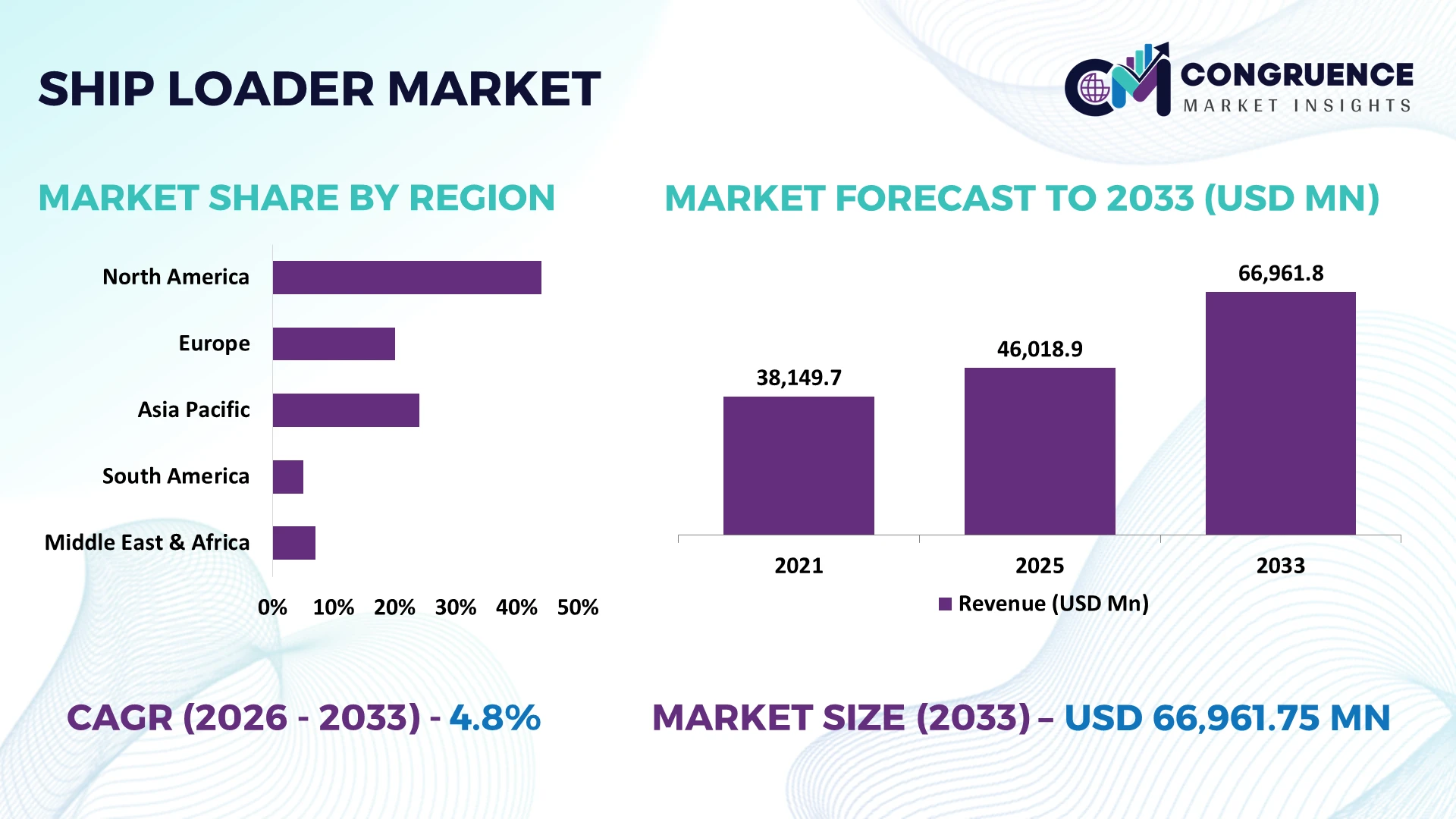
The Global Ship Loader Market was valued at USD 46018.93 Million in 2025 and is anticipated to reach a value of USD 66961.75 Million by 2033 expanding at a CAGR of 4.8% between 2026 and 2033. Growth is driven by high-capacity bulk terminal modernization, automated material-transfer systems, dust-control requirements, and rising throughput of coal, iron ore, grain, cement, and fertilizers across strategically important ports.
China remains the dominant country, supported by 18.3 billion tonnes of port cargo throughput in 2025, 3,061 berths handling vessels above 10,000 tonnes, and 60 automated terminals representing about 27% of the global total. Tianjin Port achieved over 88% automation for large equipment and 15% higher operating efficiency, while Red Sea disruptions are reinforcing resilience-focused port investment.
Strategically, suppliers should prioritize automated, high-capacity, digitally monitored ship loaders for Asia-Pacific bulk terminals and modernization projects.
Market Size & Growth: USD 46.02 billion in 2025 to USD 66.96 billion by 2033 at 4.8%, supported by automated bulk-terminal modernization.
Top Growth Drivers: Automation 15%; port modernization 12%; bulk cargo expansion 10%.
Short-Term Forecast: By 2030, automated loading can reduce handling costs 8% and improve equipment efficiency 12%.
Emerging Technologies: AI controls, digital twins, remote monitoring, and electric drives are reshaping advanced ship-loader deployment.
Regional Leaders: Asia-Pacific targets about USD 28.8 billion; North America USD 14.1 billion; Europe USD 12.7 billion by 2033.
Consumer/End-User Trends: About 27% of China’s automated terminals reflect accelerating preference for digitally controlled bulk logistics.
Pilot/Case Example: 2026 Jingjiang Port smart ship-loader deployment delivered approximately 30% higher overall efficiency.
Competitive Landscape: China leads regional adoption; key suppliers include FLSmidth, thyssenkrupp, Sandvik, TAKRAF, and VIGAN.
Regulatory & ESG Impact: Dust suppression and electrification can reduce localized emissions by 10% while improving compliance readiness.
Investment & Funding: Around USD 40 billion in port modernization investment is supporting automation, capacity expansion, and resilient supply chains.
Innovation & Future Outlook: Next-generation loaders combine AI, predictive maintenance, remote operation, and low-emission drives, shifting competition toward lifecycle efficiency.
The Ship Loader Market is increasingly concentrated around coal, iron ore, grain, cement, and fertilizer terminals requiring faster and more controlled bulk transfer. Automated equipment is gaining traction as ports pursue measurable productivity improvements, with smart systems delivering efficiency gains of up to 30% in advanced deployments. Supply-chain rerouting linked to Red Sea disruptions is strengthening the strategic value of resilient, digitally managed loading infrastructure and setting the stage for deeper automation-led investment.
Ship loaders are becoming strategically important as ports compete on vessel turnaround, bulk-handling reliability, and supply-chain resilience. China’s automated terminals demonstrate the shift: digital cargo-handling systems can improve equipment productivity by around 15%, while high-capacity loaders increasingly support coal, iron ore, grain, and fertilizer corridors. Supply-chain restructuring following Red Sea disruptions is also encouraging operators to strengthen alternative port capacity.
Technology is changing the economics of loading operations. Modern automated ship loaders with variable-speed drives, remote controls, and predictive monitoring can deliver approximately 10–15% higher handling efficiency than legacy manually controlled systems while reducing unplanned stoppages by nearly 8%. China is advancing large-scale automation faster than India and Indonesia, where infrastructure upgrades are increasingly focused on selective mechanization and higher berth productivity.
Over the next 2–3 years, operators are expected to prioritize digitally integrated loaders, targeting 8–12% shorter vessel turnaround and wider deployment of remote diagnostics. At major bulk terminals, companies are combining equipment upgrades with long-term technology partnerships and electrification programs. Competitive positioning will increasingly depend on lifecycle efficiency, automation readiness, and the ability to integrate ship loaders into resilient, low-emission port ecosystems.
Automation is the strongest structural driver as bulk terminals seek higher throughput without proportional labor expansion. Advanced ship loaders can improve loading productivity by 10–15%, reduce unplanned downtime by 8–12%, and support more consistent vessel turnaround. China’s automated port infrastructure is accelerating this transition, while India is upgrading major cargo gateways around mechanized bulk handling. Equipment manufacturers are responding with remote-control systems, predictive maintenance, variable-speed drives, and integrated terminal software. The non-obvious advantage is operational continuity: automated loaders maintain tighter loading cycles during labor shortages and peak vessel windows. Companies investing early in digitally connected equipment are gaining stronger asset utilization and more predictable terminal economics.
High equipment costs and uneven terminal infrastructure remain immediate barriers to ship-loader deployment. Electrified and automated systems can require 15–25% higher upfront investment than conventional configurations, while inadequate conveyor integration can reduce achievable throughput by 10% or more. India and Indonesia face greater retrofit complexity than newly developed Chinese automated terminals because legacy berth layouts often constrain equipment placement. Volatile steel, electrical-component, and heavy-machinery costs further pressure project budgets. Companies are reducing exposure through phased modernization, localized fabrication, multi-year procurement contracts, and modular equipment designs. The sharpest constraint is often not loader capacity itself but the terminal’s ability to synchronize conveyors, stockyards, berths, and vessel scheduling.
The strongest opportunities are emerging around AI-enabled controls, digital twins, electrification, and remote operations. Predictive maintenance can reduce equipment-related downtime by 10–15%, while optimized loading sequences can improve energy efficiency by approximately 8–12%. Japan and China are well positioned for advanced deployments because high-throughput terminals already use sophisticated automation platforms. India offers a different opportunity through brownfield modernization, where modular automation can upgrade existing assets without complete terminal reconstruction. Manufacturers are expanding R&D partnerships with port operators and control-system providers to create interoperable platforms. A particularly attractive niche is software-enabled performance optimization, allowing suppliers to generate recurring service revenue from installed ship-loader fleets.
Long-term competitiveness depends on integrating ship loaders with increasingly complex terminal control environments. Cybersecurity exposure rises as connected equipment expands, with industrial operators frequently allocating 5–10% of technology budgets to security and resilience measures. Workforce requirements are also shifting, with operators needing stronger capabilities in automation, diagnostics, and industrial software rather than conventional mechanical handling alone. Ports in Australia and China are advancing integrated digital systems faster than many emerging-market terminals, creating deployment disparities. Companies must address interoperability, workforce training, remote-operation reliability, and evolving emissions requirements through standardized interfaces and strategic technology partnerships. The critical challenge is ensuring that automation improves the entire cargo-handling chain rather than creating isolated high-performance equipment within inefficient terminal infrastructure.
Smart Loading Control: AI-assisted controls, sensor networks, and remote monitoring are moving from pilot projects toward commercial deployment, improving loading consistency by 8–12% and reducing manual intervention by roughly 10%. Chinese terminal operators are integrating real-time equipment data with berth scheduling, while manufacturers are expanding software partnerships to improve predictive maintenance and asset utilization.
Electrification Gains Ground: Electric drives and energy-optimized conveyor systems are gaining traction as ports respond to tighter emissions expectations and operating-cost pressure. Advanced systems can reduce diesel consumption by 20–30% and improve energy efficiency by 8–12%. India’s port modernization programs and China’s automated terminals are accelerating equipment replacement, shifting procurement toward lower-emission machinery with longer operating cycles.
Flexible Cargo Handling: Bulk terminals are increasingly favoring adaptable loading configurations that handle changing cargo flows without extensive reconstruction. Modular equipment can shorten installation requirements by approximately 15% and reduce retrofit disruption by 10%. Coal, grain, ore, cement, and fertilizer terminals are prioritizing flexible integration, while suppliers are redesigning loaders around interchangeable components and standardized controls.
Resilience Becomes Priority: Geopolitical rerouting and supply-chain volatility are changing ship-loader investment criteria, with operators emphasizing throughput predictability alongside capacity. UNCTAD reported a 5.9% increase in global ton-miles in 2024 as vessel rerouting lengthened trade routes. The World Bank also highlights digitalization and automation as tools for improving port resilience and operational efficiency.
Fixed ship loaders remain the leading type, accounting for approximately 46% of installations because high-capacity terminals prioritize continuous throughput, structural stability, and direct conveyor integration. Their established position is strongest in large coal and ore facilities, where throughput requirements justify permanent infrastructure. Mobile loaders represent a faster-expanding category, with adoption increasing about 9% as operators seek flexible capacity for secondary berths and changing cargo routes. Telescopic systems capture roughly 15% of deployments by improving outreach and trim control, while radial loaders serve specialized stockpile-to-vessel configurations. Shipboard systems remain strategically relevant where berth infrastructure is constrained.
Companies are increasingly balancing fixed-loader scale with mobile and telescopic flexibility. Investment is shifting toward modular controls, remote diagnostics, and variable-speed drives, with advanced configurations improving operational efficiency by approximately 10–12%. The key competitive shift is toward equipment that combines fixed-terminal productivity with adaptable operating envelopes, particularly in brownfield facilities where complete berth reconstruction is uneconomic.
Ore loading holds the leading application position at approximately 31% of deployments, supported by high-volume iron ore and mineral export terminals requiring continuous, high-capacity transfer. Coal loading follows closely at about 28%, but its equipment pipeline is becoming more selective as energy-transition policies reshape investment priorities. Grain loading is the fastest-growing application, advancing adoption by roughly 10% as exporters seek faster seasonal vessel turnaround and reduced cargo handling losses. Cement and fertilizer loading remain specialized but strategically important for regional terminals.
Technology investment is increasingly concentrated where cargo variability and vessel scheduling create operational bottlenecks. Grain terminals are adopting automated flow controls that can improve loading consistency by 8–12%, while ore facilities prioritize high-throughput fixed systems and integrated conveyor networks. Companies are responding with application-specific loader configurations, digital controls, and service partnerships. The operational implication is clear: cargo type is increasingly determining automation architecture rather than simply equipment capacity.
Mining companies represent the leading end-user group at approximately 34% of ship-loader demand because bulk mineral terminals require high-capacity equipment, continuous operation, and tight integration with rail, stockyard, and conveyor systems. Port operators follow at roughly 24%, while bulk terminal operators are the fastest-growing buyer group, with adoption expanding around 10% as independent terminals invest in automated, multi-cargo infrastructure. Grain exporters and cement producers maintain more specialized purchasing patterns.
Mining buyers increasingly favor long-life fixed systems with predictive maintenance, while port and terminal operators prioritize flexible configurations that can serve multiple cargo streams. Digital monitoring can reduce unplanned equipment interruptions by approximately 8–12%, strengthening the business case for connected loaders. Companies are responding through customized engineering contracts, lifecycle-service agreements, and partnerships with automation providers. The strategic shift favors suppliers capable of delivering complete loading ecosystems rather than isolated mechanical equipment.
Asia-Pacific accounted for the largest market share at 43.2% in 2025 however, Asia-Pacific is expected to register the fastest growth, expanding at a CAGR of 5.6% between 2026 and 2033.

Automation and brownfield terminal upgrades reshape bulk handling
North America represents approximately 21.4% of global ship-loader demand, supported by major mineral, grain, fertilizer, and coal terminals along the U.S. Gulf Coast and Great Lakes. Operators are prioritizing replacement of aging mechanical loaders with remotely monitored systems that improve loading consistency by 8–12%. U.S. Gulf terminals are increasingly integrating ship loaders with conveyor controls, stockyard management, and vessel scheduling platforms. The region’s mature infrastructure favors targeted brownfield investment rather than entirely new terminals, creating demand for modular equipment and retrofit-compatible controls. Canadian grain and mineral exporters are also emphasizing faster vessel turnaround and dust-management systems. Equipment suppliers are responding through engineering partnerships, predictive-maintenance packages, and localized service networks. The strategic opportunity centers on upgrading existing high-throughput assets without prolonged berth shutdowns.
U.S. Market Outlook: The United States remains the regional anchor because of its extensive Gulf Coast bulk-terminal infrastructure and large agricultural export network. Grain and mineral terminals are adopting remote diagnostics and automated loading controls, with advanced systems delivering approximately 10% higher equipment utilization. Port modernization is increasingly centered on lifecycle replacement rather than capacity alone.
Decarbonization accelerates replacement of legacy handling equipment
Europe accounts for approximately 17.8% of global ship-loader demand, with deployment concentrated around mineral, grain, cement, fertilizer, and industrial bulk terminals. Regulatory pressure on port emissions is shifting procurement toward electric drives, energy-efficient conveyors, and digitally controlled loading systems. Electrified equipment can reduce direct fuel consumption by roughly 20–30% compared with diesel-intensive configurations, strengthening the business case for modernization. Germany, the Netherlands, Belgium, and Spain are prominent deployment markets, while northern European terminals increasingly combine automated loaders with integrated cargo-management platforms. Suppliers are competing through low-emission engineering, retrofit packages, and lifecycle service agreements. The region’s distinctive market feature is the premium placed on compliance-ready equipment, making environmental performance an increasingly important purchasing criterion alongside throughput and reliability.
Germany Market Outlook: Germany benefits from a dense industrial logistics network linking steel, mineral, chemical, and inland-waterway cargo flows. Modernization programs emphasize electrification and automated material handling. High-efficiency drive systems can improve energy performance by around 10%, encouraging operators to replace aging equipment with digitally monitored, lower-emission configurations.
Scale leadership meets rapid terminal automation
Asia-Pacific commands approximately 43.2% of global ship-loader demand, led by China, Australia, India, Indonesia, and Japan. China remains the dominant deployment base because of its enormous bulk-cargo infrastructure and rapid automation of high-throughput terminals. Automated equipment can improve loading productivity by 12–15%, while remote-control architectures reduce manual intervention and improve operational consistency. Australia’s iron ore terminals emphasize ultra-high-capacity fixed systems, whereas India is increasingly focused on brownfield modernization and mechanized cargo handling. Chinese manufacturers and engineering groups are expanding integrated solutions combining ship loaders, conveyors, sensors, and control software. Investment is also shifting toward energy-efficient drives and predictive maintenance. The region’s strongest competitive advantage is the combination of manufacturing depth, large terminal projects, and established automation capabilities.
China Market Outlook: China is the region’s strongest ship-loader market because its ports combine extensive bulk-handling capacity with advanced automation. More than 60 automated container terminals and smart port facilities demonstrate the country’s broader equipment-digitization capability. Ship-loader suppliers benefit from domestic manufacturing depth, engineering integration, and large-scale deployment opportunities.
Commodity exports drive capacity-focused terminal investment
South America contributes approximately 9.6% of global ship-loader demand, with Brazil accounting for the largest share through iron ore, grain, fertilizer, and other bulk-export corridors. High-volume mining and agricultural terminals prioritize fixed loaders, conveyor integration, and rapid vessel turnaround. Brazil’s major mineral-export infrastructure supports equipment configurations designed for continuous operation, while grain terminals increasingly require flexible loading systems to manage seasonal export peaks. Automated monitoring can improve equipment utilization by approximately 8–10%, encouraging operators to modernize control architecture even where mechanical infrastructure remains relatively mature. Argentina also presents demand for grain-handling upgrades, although infrastructure bottlenecks constrain deployment speed. Suppliers are responding through localized engineering, maintenance partnerships, and modular retrofit solutions. The strategic opportunity lies in improving existing export corridors rather than relying solely on greenfield terminal construction.
Brazil Market Outlook: Brazil dominates regional demand through its globally significant iron ore and agricultural export infrastructure. Mining terminals require high-capacity equipment capable of sustained loading cycles, while grain facilities increasingly favor flexible automation. Digitally monitored systems can reduce operational interruptions by around 8%, strengthening the case for integrated loader and conveyor modernization.
Port diversification and industrial expansion reshape bulk infrastructure
Middle East & Africa represents approximately 8.0% of global ship-loader demand, with investment concentrated around mineral exports, cement, fertilizers, grains, and expanding logistics hubs. Gulf countries are developing automated port infrastructure as part of broader industrial-diversification strategies, while African mining corridors are upgrading bulk-export capacity. Saudi Arabia and the United Arab Emirates are prioritizing digitally integrated terminals capable of supporting higher throughput with tighter emissions controls. Automated loading systems can reduce manual handling requirements by roughly 10–15%, improving consistency across continuous operations. Africa presents greater infrastructure variability, making modular systems and phased modernization commercially attractive. Manufacturers are forming local service partnerships and adapting equipment to constrained power, maintenance, and berth conditions. Competitive advantage increasingly depends on engineering flexibility, after-sales support, and the ability to integrate loaders into new industrial logistics corridors.
Saudi Arabia Market Outlook: Saudi Arabia is emerging as a strategically important market through port expansion, mineral development, fertilizer logistics, and industrial diversification. New logistics infrastructure increasingly incorporates automated cargo-handling systems. Digitally controlled loading equipment can improve operational consistency by approximately 10%, supporting investment in integrated bulk terminals connected to expanding industrial corridors.
The Ship Loader market features global engineering leaders such as FLSmidth, thyssenkrupp, TAKRAF, Sandvik, and VIGAN competing with specialized regional equipment suppliers and automation integrators. The leading five players collectively hold an estimated 28–32% share, indicating a moderately fragmented structure with strong project-based competition. Global OEMs compete through engineering depth, reliability, lifecycle servicing, and integrated conveyor systems, while regional manufacturers emphasize 8–15% lower equipment costs and faster customization. Digital controls, predictive maintenance, and electrification increasingly influence purchasing, with advanced systems improving equipment utilization by 10–12%. Players are expanding through port partnerships, localized manufacturing, retrofit programs, and technology alliances. Vertical integration across mechanical equipment, controls, and maintenance is strengthening supplier differentiation. The main entry barrier remains proven performance on high-capacity bulk terminals and the ability to meet stringent safety and integration requirements. Winning suppliers combine competitive lifecycle economics, automation capability, customization, and dependable regional service coverage.
FLSmidth
thyssenkrupp AG
TAKRAF GmbH
Sandvik AB
VIGAN Engineering
Siwertell AB
NEUERO Industrietechnik
AUMUND Group
BEUMER Group
Bruks Siwertell
Astec Industries
Caterpillar Inc.
Metso Corporation
MacGregor (Cargotec)
Automation is now the core ship-loader technology, combining PLC controls, variable-speed drives, sensors, and remote monitoring. Deployment across advanced terminals is estimated at 30–40%, improving loading efficiency 8–12% and reducing stoppages 5–8%. Integrated berth and conveyor controls strengthen throughput visibility, operator productivity, vessel turnaround, and maintenance planning, particularly for high-capacity ore, coal, and grain terminals. Standardized industrial Ethernet is also improving cross-equipment interoperability.
Emerging digital twins, AI-assisted trim optimization, and predictive maintenance are moving into commercial deployments, with adoption around 15–20% at technology-leading bulk terminals. Predictive analytics can lift equipment availability 3–5%, while automated trim control improves loading performance 4–6%. Suppliers gain differentiation through software-enabled service contracts, lifecycle optimization, remote diagnostics, and tighter integration with terminal operating systems. Adoption is strongest where automated stockyards and conveyor networks already exist.
Disruptive electrification, machine vision, and autonomous operating architectures will shape 2026–2028 investment. Electric drive systems can cut direct energy use 10–15%, while vision-based monitoring improves positioning accuracy 5–8%. Compared with legacy manually controlled loaders, integrated automation can deliver 10–15% higher operational efficiency. Large automated terminals benefit most, making early digital integration a competitive advantage for OEMs, port operators, and bulk-terminal owners. Procurement is shifting toward connected ecosystems across global export corridors.
July 2025 TAKRAF secured a ship-loader contract from PT Freeport Indonesia for its MOPH-2 copper-concentrate export upgrade. The project supports expanded processing infrastructure and strengthens TAKRAF’s position in electrification-linked mineral logistics. Source: TAKRAF
April 2024 Bühler supplied SOCEP’s Port of Constanta expansion with a 50,000-tonne grain terminal and ship loader, supported by nearly €10.4 million investment. The project responds to a 50% increase in grain volumes, strengthening export-handling capacity. Source: World Grain
2025 Bruks Siwertell won a Port of Long Beach ship-loader contract rated at 5,000 t/h for coal and petcoke and 2,000 t/h for other bulk materials. The turnkey system targets late-2026 commissioning, strengthening multi-cargo terminal flexibility. Source: Bruks Siwertell
February 2026 Paradip Port Authority reported an iron-ore handling plant equipped with a 3,200 t/h ship loader and 5.9-million-tonne annual rated throughput. The infrastructure supports high-volume mineral exports and demonstrates India’s continued mechanized bulk-terminal capacity. Source: Paradip Port Authority
The Ship Loader Market Report covers Telescopic, Radial, Shipboard, Mobile, and Fixed configurations across Coal Loading, Grain Loading, Cement Loading, Ore Loading, and Fertilizer Loading applications. End-user analysis includes Mining Companies, Grain Exporters, Cement Producers, Port Operators, and Bulk Terminal Operators, providing visibility into purchasing priorities, deployment intensity, and equipment specialization.
Regional coverage spans North America, Europe, Asia-Pacific, South America, and the Middle East & Africa, with country-level assessment of infrastructure modernization, bulk-export activity, automation adoption, and terminal investment. The report evaluates AI-enabled controls, predictive maintenance, digital twins, electrification, remote monitoring, and dust-management technologies, alongside competitive positioning and supplier strategies. With advanced automation adoption concentrated around 15–20% of technology-leading terminals, the analysis supports investment planning, expansion decisions, technology selection, partnership development, and competitive positioning through 2026–2033.
| Report Attribute/Metric | Report Details |
|---|---|
Market Revenue in 2025 | USD 46018.93 Million |
Market Revenue in 2033 | USD 66961.75 Million |
CAGR (2026 - 2033) | 4.8% |
Base Year | 2025 |
Forecast Period | 2026 - 2033 |
Historic Period | 2021 - 2025 |
Segments Covered | By Type
By Application
By End-User
|
Key Report Deliverable | Revenue Forecast, Growth Trends, Market Dynamics, Segmental Overview, Regional and Country-wise Analysis, Competition Landscape |
Region Covered | North America, Europe, Asia-Pacific, South America, Middle East, Africa |
Key Players Analyzed | FLSmidth, thyssenkrupp AG, TAKRAF GmbH, Sandvik AB, VIGAN Engineering, Siwertell AB, NEUERO Industrietechnik, AUMUND Group, BEUMER Group, Bruks Siwertell, Astec Industries, Caterpillar Inc., Metso Corporation, MacGregor (Cargotec) |
Customization & Pricing | Available on Request (10% Customization is Free) |




