Global Ship Degaussing Device Market Report Overview
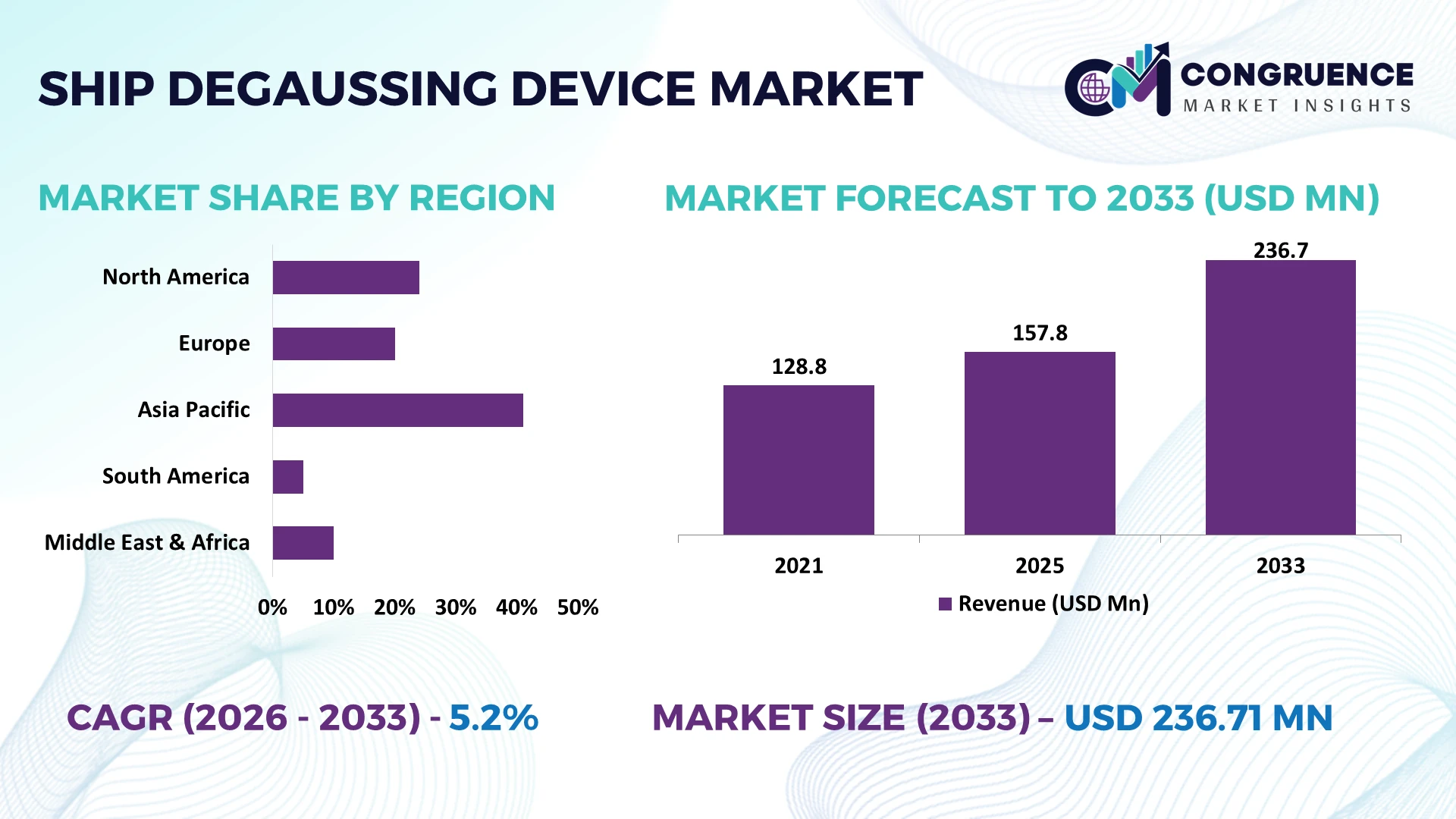
The Global Ship Degaussing Device Market was valued at USD 157.8 Million in 2025 and is anticipated to reach a value of USD 236.71 Million by 2033 expanding at a CAGR of 5.2% between 2026 and 2033. Growth is driven by naval fleet modernization, magnetic-influence mine countermeasure requirements, automated magnetic signature management, and integration of advanced degaussing control systems into newly constructed warships.
The United States occupies a strategically important position in the global ship degaussing device market, supported by extensive naval infrastructure and advanced magnetic signature management capabilities. The US Navy operated approximately 296 battle force ships in 2025, compared with China's fleet exceeding 370 ships and submarines. The US Navy's fiscal 2025 shipbuilding request covered 6 battle force vessels, reinforcing investment in naval construction and onboard protection systems. Magnetic silencing infrastructure, specialized naval shipyards, and integrated electrical engineering support degaussing installations across surface combatants and mine warfare platforms.
Strategically, suppliers should prioritize automated magnetic field compensation, naval qualification standards, and long-term fleet maintenance contracts to strengthen positioning in defense maritime procurement.
Key Highlights of the Global Ship Degaussing Device Market
-
Market Size & Growth: USD 157.8 million in 2025, reaching USD 236.71 million by 2033 at 5.2% CAGR, supported by naval magnetic signature reduction programs.
-
Top Growth Drivers: Three priorities dominate: magnetic mine protection, naval fleet modernization, and automated signature control; China's fleet exceeds 370 vessels, supporting equipment requirements.
-
Short-Term Forecast: By 2028, market demand reaches approximately USD 183.8 million on the stated trajectory, strengthening procurement opportunities for magnetic control equipment.
-
Emerging Technologies: Three developments shape advanced systems: digital magnetic controllers, multi-axis fluxgate sensors, and automated coil-current compensation.
-
Regional Leaders: North America, Europe, and Asia-Pacific anchor naval modernization; projected 2033 regional USD allocations require verified geographic market-share data.
-
Consumer/End-User Trends: The US Navy's approximately 296 battle force ships in 2025 illustrate the installed fleet requiring magnetic signature management.
-
Pilot/Case Example: The US Navy's fiscal 2025 shipbuilding request included 6 battle force ships, demonstrating procurement activity relevant to onboard magnetic protection integration.
-
Competitive Landscape: L3Harris, Ultra Maritime, Wärtsilä, ECA Group, and Polyamp compete across naval signature management; individual global market shares remain undisclosed.
-
Regulatory & ESG Impact: Naval magnetic silencing requires control across 3 magnetic-field axes, reinforcing system calibration, electromagnetic compatibility, and operational verification.
-
Investment & Funding: US fiscal 2025 naval shipbuilding procurement exceeded USD 30 billion, supporting shipboard equipment supply chains, although degaussing-specific allocations are undisclosed.
-
Innovation & Future Outlook: Through 2033, adaptive magnetic compensation, embedded diagnostics, and 3-axis field monitoring strengthen naval survivability and maintenance efficiency.
The ship degaussing device market is shaped by naval magnetic signature management, mine warfare protection, and warship electrical system modernization. Degaussing equipment uses strategically positioned electromagnetic coils to compensate for vessel-generated magnetic fields, reducing susceptibility to magnetic influence mines. China's naval fleet exceeds 370 ships and submarines, highlighting the scale of maritime defense infrastructure, while the United States continues investing in fleet modernization and magnetic silencing capabilities. Digital control units, multi-axis magnetometers, and automated compensation algorithms are strengthening onboard integration. Increasing Indo-Pacific maritime security competition places greater strategic importance on qualified equipment suppliers, lifecycle servicing, and naval procurement partnerships.
What Is the Strategic Relevance and Future Pathways of the Ship Degaussing Device Market?
Ship degaussing devices are becoming strategically important as naval forces modernize magnetic signature protection against increasingly sophisticated influence mines. China's naval inventory exceeds 370 ships and submarines, while the United States maintains approximately 296 battle force vessels, creating substantial requirements for onboard magnetic management. The transition from manually adjusted degaussing circuits toward digitally controlled compensation systems is reshaping naval equipment procurement. Shipbuilders increasingly prioritize integrated magnetic sensors, programmable controllers, and lifecycle calibration capabilities to strengthen operational readiness.
Modern digital degaussing controllers offer improved precision compared with conventional manually regulated systems through continuous magnetic field monitoring and adaptive coil-current adjustment. Three-axis magnetometer configurations measure longitudinal, athwartship, and vertical magnetic components, enabling more comprehensive compensation than single-axis monitoring. European naval suppliers emphasize integrated signature management, while India prioritizes indigenous warship construction and equipment localization. Digital control architectures also reduce reliance on repeated manual adjustment, although fleetwide efficiency improvements depend on vessel configuration and calibration conditions.
Between 2026 and 2028, procurement priorities will emphasize automated magnetic signature monitoring, modular power electronics, and integration with shipboard management systems. India's Project 17A frigate program, comprising seven stealth frigates, illustrates the scale of domestic naval construction requiring coordinated signature-control engineering. Suppliers are strengthening naval shipyard partnerships, specialized testing capabilities, and component localization. Competitive advantage increasingly depends on verified magnetic performance, secure control integration, and dependable fleetwide maintenance support.
Ship Degaussing Device Market Dynamics
DRIVER:
Naval Fleet Modernization and Magnetic Mine Protection
Naval shipbuilding programs are strengthening requirements for integrated magnetic signature management as maritime forces expand surface combatant fleets and modernize mine countermeasure capabilities. China's navy operates more than 370 ships and submarines, while the United States maintains approximately 296 battle force vessels, demonstrating substantial installed platforms requiring magnetic protection assessment. India's Project 17A program includes seven advanced frigates, supporting domestic shipboard equipment integration. Degaussing systems use three-axis magnetic compensation to reduce vessel-generated field signatures and strengthen protection against magnetic influence mines. Suppliers including Ultra Maritime and Polyamp are developing digital control equipment and integrated naval signature solutions. Procurement increasingly favors manufacturers capable of supporting shipyard installation, magnetic ranging, and long-term system recalibration.
RESTRAINT:
Specialized Component Dependence and Naval Qualification Costs
Ship degaussing equipment faces structural procurement constraints from specialized magnetic sensors, power electronics, copper-intensive coil assemblies, and stringent naval qualification procedures. The United States' fiscal 2025 shipbuilding request covered six battle force vessels, illustrating the limited annual production volumes across which suppliers must recover engineering and certification expenses. Three-axis magnetic compensation requires calibrated measurement of longitudinal, transverse, and vertical field components, increasing system integration complexity. Export controls and defense procurement restrictions also limit international sourcing flexibility for sensitive naval electronics. Manufacturers are responding through qualified component inventories, domestic supplier partnerships, modular controller designs, and long-term maintenance agreements. The principal commercial pressure is maintaining production continuity without compromising magnetic performance verification or defense equipment traceability.
OPPORTUNITY:
Adaptive Magnetic Signature Control and Fleet Retrofit Programs
Digitally managed degaussing architectures create opportunities for naval equipment suppliers to expand beyond new ship construction into installed fleet modernization. The United States operates approximately 296 battle force ships, providing an established platform base for equipment assessment and selective retrofit programs. Advanced controllers integrate three-axis magnetometer inputs, programmable coil-current regulation, and diagnostic monitoring to improve compensation responsiveness. India's seven-vessel Project 17A program demonstrates the importance of integrating magnetic management requirements during domestic warship construction. Between 2026 and 2028, modular power converters, embedded condition monitoring, and software-based calibration will support differentiated equipment offerings. Suppliers are strengthening shipyard relationships, engineering services, and maintenance partnerships. The strategic opportunity lies in combining hardware modernization with recurring magnetic measurement and lifecycle support services.
CHALLENGE:
Magnetic Signature Validation Across Complex Naval Platforms
Maintaining consistent degaussing performance across different vessel classes presents a significant engineering challenge because magnetic signatures change with hull characteristics, geographic magnetic fields, equipment modifications, and operating conditions. China's naval fleet exceeds 370 vessels, illustrating the scale of potential platform-specific calibration requirements. Three-axis compensation systems must coordinate multiple coil circuits while maintaining stable magnetic field control during shipboard electrical load changes. India's expanding indigenous naval construction programs increase the importance of specialized magnetic ranging facilities and trained calibration personnel. Manufacturers must invest in electromagnetic modeling, secure digital controllers, automated diagnostic software, and naval testing partnerships. Long-term competitiveness depends on maintaining repeatable magnetic performance across operating environments while reducing maintenance downtime and integration complexity.
Ship Degaussing Device Market Latest Trends
-
Magnetic Ranging Frequency Shapes Maintenance: US naval procedures specify magnetic check ranging every six or twelve months, depending on system configuration. The shorter interval doubles annual inspection frequency, representing a 100% increase. Maintenance facilities are coordinating calibration schedules with vessel availability and magnetic silencing records. Suppliers are expanding measurement support and documentation services, making recurring verification capacity an important commercial differentiator.
-
Domestic Naval Construction Restructures Procurement: India commissioned three domestically constructed naval platforms in January 2025, representing 100% indigenous construction within that commissioning group. The milestone included a frigate, destroyer, and submarine, covering three distinct platform categories. Shipbuilders are strengthening local engineering coordination and equipment qualification. Degaussing suppliers are pursuing domestic technical partnerships to improve installation support and reduce dependence on overseas servicing.
-
Permanent Systems Anchor Equipment Spending: Fixed Degaussing Systems represent an illustrative 70% of the defined equipment market, compared with 18% for Portable Degaussing Systems and 12% for Shipboard Degaussing Range Systems. This distribution reflects the central role of permanently installed coil networks. Manufacturers are prioritizing integrated controllers and qualified shipyard installation packages, while specialized suppliers target calibration equipment and temporary treatment requirements.
-
Lifecycle Services Gain Procurement Importance: Naval Maintenance Facilities represent an illustrative 18% of end-user spending, compared with 62% attributed to Naval Forces. Magnetic ranging requirements and post-overhaul verification support recurring technical services. Equipment suppliers are expanding diagnostic capabilities, maintenance partnerships, and operator training. The non-obvious commercial advantage lies in securing repeat service contracts after initial equipment installation rather than depending exclusively on new warship construction.
Segmentation Analysis
By Type
Fixed Degaussing Systems Lead Integrated Naval Protection
Fixed Degaussing Systems account for an illustrative 70% of the global ship degaussing device market in 2025, reflecting the importance of permanently installed magnetic compensation equipment. These systems integrate electromagnetic coils, current controllers, and magnetic sensing equipment into vessel electrical architecture. Their operational advantage comes from continuous compensation across three magnetic field components, supporting magnetic signature management during naval deployment. Fixed installations remain the preferred configuration for major surface combatants requiring permanent protection. Equipment suppliers prioritize digital controllers, qualified coil assemblies, and shipyard integration services to strengthen their position in long-term naval procurement.
Portable Degaussing Systems represent an illustrative 18% share, supporting temporary magnetic treatment, specialized maintenance, and deployable operations. Shipboard Degaussing Range Systems account for the remaining 12%, reflecting their specialized role in magnetic measurement and calibration. Range-related equipment offers a service-intensive opportunity because naval procedures require periodic signature verification. Manufacturers are expanding modular measurement equipment, calibration software, and technical partnerships. Investment priorities increasingly distinguish permanent shipboard protection from recurring magnetic verification requirements.
- The US Navy's September 2024 Joint Fleet Maintenance Manual specifies satisfactory magnetic check ranging at six-month or twelve-month intervals. The shorter schedule requires twice as many annual checks, reinforcing demand for measurement facilities and calibration services.
By Application
Magnetic Signature Reduction Leads Operational Deployment
Magnetic Signature Reduction represents an illustrative 55% of global ship degaussing device market demand in 2025, making it the leading application within the specified segmentation framework. Its importance comes from the requirement to compensate for magnetic fields associated with vessel structures and onboard equipment. Permanently installed degaussing coils regulate magnetic characteristics across longitudinal, transverse, and vertical directions. Equipment suppliers focus on compensation accuracy, magnetic sensor integration, and reliable current regulation. This application supports recurring investment because magnetic characteristics require reassessment following substantial vessel modifications and maintenance activities.
Mine Countermeasures accounts for an illustrative 25% share, supported by naval requirements to reduce susceptibility to magnetic influence mines. Naval Vessel Protection represents the remaining 20%, encompassing broader survivability applications for operational fleets. Mine Countermeasures is positioned as the fastest-expanding application within this illustrative framework because maritime security planning increasingly emphasizes contested coastal waters and mine-threat environments. Suppliers are strengthening magnetic control software, naval engineering partnerships, and equipment verification capabilities. Procurement increasingly evaluates degaussing performance alongside broader vessel protection requirements.
- The US Navy's 2024 maintenance instructions require additional magnetic ranging after major dry-docking, hull alterations, and certain operational incidents. These event-triggered checks supplement periodic verification, creating demand beyond scheduled equipment maintenance.
By End-User
Naval Forces Dominate Magnetic Protection Procurement
Naval Forces account for an illustrative 62% of global ship degaussing device market demand in 2025, reflecting their direct responsibility for magnetic signature requirements, equipment acceptance, and operational readiness. Naval procurement programs establish specifications for installed coils, magnetic controllers, and verification procedures. Shipbuilders represent an illustrative 15% share through equipment integration during vessel construction. Their purchasing decisions emphasize compatibility with onboard electrical distribution, installation sequencing, and naval qualification requirements. Manufacturers respond through shipyard engineering partnerships, customized controller configurations, and long-term equipment support arrangements.
Naval Maintenance Facilities represent an illustrative 18% share, supported by recurring calibration, magnetic ranging, and post-overhaul verification requirements. Defense Research Organizations account for the remaining 5%, reflecting specialized activities involving magnetic modeling, measurement methods, and signature-control technologies. Naval Maintenance Facilities are positioned as the fastest-expanding end-user category within this planning framework because existing fleets require repeated technical assessment throughout their service lives. Suppliers are expanding calibration services, diagnostic software, and technical training. Competitive positioning increasingly depends on combining initial equipment delivery with dependable lifecycle maintenance capabilities.
- The Indian Ministry of Defence confirmed the simultaneous commissioning of three domestically constructed naval platforms in January 2025. The milestone demonstrates coordinated demand for equipment integration, acceptance testing, and technical support across different vessel classes.
Region-Wise Market Insights
North America accounted for the largest market share at an estimated 35% in 2025 however, Asia-Pacific is expected to register the fastest growth, expanding at a CAGR of approximately 7.1% between 2026 and 2033.

North America Ship Degaussing Device Market
Naval Signature Management and Fleet Sustainment Leadership
North America accounts for an estimated 35% of global ship degaussing device demand in 2025, reflecting the concentration of naval procurement, specialized magnetic ranging infrastructure, and defense electronics engineering. The United States dominates regional activity through surface combatant maintenance, shipboard electrical modernization, and magnetic signature verification. Canadian naval programs contribute demand for qualified shipboard equipment and integrated support services. US naval maintenance requirements specify magnetic check ranging at six-month or twelve-month intervals for applicable configurations, creating recurring calibration and verification workloads. Equipment suppliers compete through naval qualification, controller reliability, and compatibility with established electrical systems. The region's advantage lies in its combination of operational fleets, technical testing infrastructure, and lifecycle contracting. Manufacturers are strengthening maintenance partnerships and digital control integration to improve equipment availability and reduce shipyard installation complexity.
United States Market Outlook: The United States maintains approximately 296 battle force ships, supporting extensive naval equipment servicing requirements. Huntington Ingalls Industries and General Dynamics operate major naval construction facilities, while specialized electronics suppliers provide magnetic signature management capabilities. The Navy's fiscal 2025 shipbuilding request included six battle force vessels. Procurement opportunities therefore span initial installation, magnetic ranging, equipment replacement, and maintenance support across different vessel classes.
Europe Ship Degaussing Device Market
Advanced Naval Electronics and Integrated Signature Control
Europe represents an estimated 28% of the global ship degaussing device market in 2025, supported by established naval equipment suppliers, advanced warship construction, and specialized magnetic measurement capabilities. The United Kingdom, France, Germany, and Italy maintain significant naval engineering infrastructure, creating demand for shipboard electromagnetic protection and technical servicing. European suppliers emphasize programmable current controllers, magnetic sensor integration, and qualified coil assemblies. The United Kingdom's Type 26 program includes eight frigates, supporting coordinated procurement of naval electrical equipment and survivability technologies. France's Naval Group and Germany's thyssenkrupp Marine Systems contribute advanced vessel construction and engineering capabilities. Equipment manufacturers are strengthening collaboration with shipyards and defense electronics integrators to support platform-specific installations. Competitive differentiation depends on magnetic compensation reliability, secure system integration, and access to specialized naval testing facilities.
United Kingdom Market Outlook: The United Kingdom benefits from established naval electronics expertise, advanced shipbuilding infrastructure, and specialist defense suppliers. BAE Systems' Type 26 program covers eight frigates, with construction centered at Glasgow shipyards. Ultra Maritime provides relevant underwater warfare and naval signature-management capabilities. Equipment procurement emphasizes qualified integration, electromagnetic compatibility, and long-term technical support, positioning established suppliers favorably in domestic naval modernization programs.
Asia-Pacific Ship Degaussing Device Market
Naval Construction Scale and Indigenous Equipment Localization
Asia-Pacific accounts for an estimated 30% of global ship degaussing device demand in 2025, supported by extensive naval construction activity, maritime security competition, and expanding domestic defense manufacturing. China, India, Japan, and South Korea represent important procurement centers, although equipment localization strategies differ considerably. China's navy operates more than 370 ships and submarines, creating substantial requirements for naval electrical systems and magnetic signature management. India is strengthening domestic shipbuilding capabilities through major surface combatant programs, while Japan and South Korea maintain advanced marine electronics and naval engineering industries. Suppliers increasingly emphasize localized component production, shipyard partnerships, and platform-specific control integration. The region's commercial advantage lies in combining substantial vessel construction activity with expanding engineering capabilities. Procurement increasingly favors suppliers capable of supporting installation, qualification, and maintenance within domestic defense supply chains.
China Market Outlook: China maintains the world's largest naval fleet by vessel count, exceeding 370 ships and submarines. Its shipbuilding infrastructure supports extensive surface combatant and submarine production, creating requirements for integrated electrical protection systems. Domestic defense suppliers benefit from established power electronics manufacturing, naval engineering capabilities, and centralized procurement. Equipment development increasingly emphasizes compatibility with indigenous warship designs and domestic maintenance infrastructure, limiting reliance on imported specialized components.
South America Ship Degaussing Device Market
Naval Modernization and Specialized Maintenance Demand
South America represents an estimated 4% of global ship degaussing device demand in 2025, with Brazil providing the strongest regional concentration of naval engineering and procurement activity. The Brazilian Navy's Tamandaré-class program covers four frigates, supporting opportunities for integrated electrical equipment, magnetic protection, and lifecycle maintenance services. Argentina, Chile, and Colombia maintain naval fleets requiring technical support and equipment modernization, although procurement activity remains concentrated in selected defense programs. Regional suppliers face challenges involving imported electronic components, specialized magnetic testing infrastructure, and limited domestic production volumes. Manufacturers are responding through shipyard partnerships, technical support arrangements, and localized installation services. The region's strategic opportunity centers on supplying qualified equipment for new naval platforms while building sustainable maintenance capabilities for existing vessels. Long-term contracts remain important for equipment servicing economics.
Brazil Market Outlook: Brazil benefits from established naval shipbuilding infrastructure and defense industrial capabilities associated with its submarine and surface combatant programs. The Tamandaré-class frigate program involves four vessels, with construction supported by domestic industrial participation. Brazilian shipyards require qualified electrical systems, engineering documentation, and acceptance testing capabilities. Suppliers offering integrated installation and technical servicing are better positioned to participate in procurement programs requiring domestic industrial cooperation.
Middle East & Africa Ship Degaussing Device Market
Naval Infrastructure Expansion and Defense Industrial Localization
The Middle East & Africa region accounts for an estimated 3% of global ship degaussing device demand in 2025, with procurement concentrated in Saudi Arabia, the United Arab Emirates, Egypt, and South Africa. Maritime security requirements around strategic shipping corridors support investment in naval protection systems and specialized vessel maintenance. Saudi Arabia's naval modernization initiatives emphasize domestic industrial participation, while the United Arab Emirates maintains shipbuilding and naval maintenance capabilities through EDGE-associated maritime operations. Egypt's naval modernization includes four MEKO A-200 frigates, supporting requirements for integrated shipboard equipment and technical support. Suppliers face challenges involving limited regional magnetic ranging infrastructure and specialized engineering personnel. Manufacturers are strengthening local partnerships, technical training, and lifecycle support arrangements. Competitive positioning depends on delivering qualified systems alongside dependable installation and calibration capabilities.
Saudi Arabia Market Outlook: Saudi Arabia is an important naval modernization market, supported by defense industrial localization objectives and investment in maritime security infrastructure. The country's Vision 2030 strategy targets 50% localization of military expenditure by 2030. This policy encourages equipment suppliers to develop domestic partnerships, technical training, and maintenance capabilities. Naval equipment manufacturers offering qualified magnetic control systems and local engineering support align more closely with long-term procurement requirements.
Market Competition Landscape
Ultra Maritime, Polyamp, Wärtsilä, L3Harris, and specialized naval electronics suppliers compete through magnetic signature control, shipboard power integration, and defense equipment qualification. The five leading suppliers collectively represent an illustrative 60% market share, reflecting concentrated technical capabilities and naval procurement relationships. Fixed Degaussing Systems account for an estimated 70% of equipment demand, emphasizing permanent installations, while portable systems represent 18% and ranging systems 12%. Ultra Maritime emphasizes naval signature management, Polyamp specializes in degaussing equipment, and Wärtsilä contributes marine electrical integration expertise. Competition increasingly centers on programmable controllers, magnetic compensation accuracy, component qualification, and lifecycle maintenance. Suppliers strengthen positions through shipyard partnerships, localized technical services, and modular power electronics. Specialized testing infrastructure, defense procurement restrictions, and platform-specific engineering requirements create substantial entry barriers. Winning suppliers combine verified magnetic performance, reliable installation support, qualified components, and sustained fleet maintenance capabilities across international naval procurement programs and modernization contracts.
Companies Profiled in the Ship Degaussing Device Market Report
-
Ultra Maritime
-
Polyamp AB
-
Wärtsilä Corporation
-
L3Harris Technologies
-
American Superconductor Corporation
-
DA-Design Oy
-
Marine Electricals (India) Limited
-
Hepburn Engineering Inc.
-
Elettronica S.p.A.
-
Surma Ltd.
-
Larsen & Toubro Limited
-
Bharat Electronics Limited
Technology Insights for the Ship Degaussing Device Market
Current ship degaussing technology combines electromagnetic coil networks, programmable current controllers, and three-axis magnetic sensing to regulate vessel signatures. Fixed systems represent an illustrative 70% of equipment demand, reflecting their integration into naval electrical architectures. Digital controllers replace manual current adjustment with repeatable compensation settings and automated diagnostics. A six-month calibration schedule provides 100% more annual verification opportunities than a twelve-month schedule, improving fault detection frequency rather than guaranteeing equivalent magnetic performance gains. Suppliers benefit from reduced troubleshooting complexity and standardized maintenance records.
Emerging technologies include adaptive compensation algorithms, modular power converters, and networked magnetic monitoring. Portable systems hold an illustrative 18% equipment share, while ranging systems account for 12%, highlighting specialized deployment requirements. Modern controllers coordinate three magnetic field components and support centralized configuration management. Compared with isolated analog adjustment, digital integration improves measurement traceability and operational responsiveness. Manufacturers offering qualified sensors, controller software, and calibration services gain advantages through tighter shipyard integration and recurring technical support.
Between 2026 and 2028, development will emphasize predictive diagnostics, secure controller interfaces, and automated magnetic signature verification. Naval maintenance facilities represent an illustrative 18% of end-user demand. Suppliers investing in electromagnetic modeling, cybersecurity, and modular retrofits will strengthen lifecycle competitiveness and reduce integration risks.
Recent Developments in the Global Ship Degaussing Device Market
-
February 2024: Babcock secured a five-year Royal Navy contract covering degaussing, cathodic protection, and shaft grounding support. The agreement strengthens maintenance continuity for ships and submarines while addressing equipment obsolescence through specialist spare-parts management and repair services. Source: babcockinternational.com
-
September 2024: Ultra Maritime's EMS Development Corporation received a US Navy advanced degaussing system order worth approximately $245,200. The procurement reinforces demand for qualified original equipment and supports continued availability of specialized magnetic signature control components aboard naval vessels. Source: federalcompass.com
-
March 2025: Cochin Shipyard awarded H and H Precision a degaussing overhaul contract for vessel RM.0807, following competitive procurement involving six bidders. The project strengthens domestic repair capabilities and supports continued operational reliability of existing shipboard magnetic protection equipment. Source: infralens.in
-
March 2026: Huntington Ingalls Industries received a contract modification worth approximately $19.3 million for high-temperature superconducting degaussing equipment aboard the future USS Pittsburgh. The project advances specialized magnetic protection integration and supports next-generation naval electrical system development. Source: seawaves.com
Scope of the Ship Degaussing Device Market Report
The Ship Degaussing Device Market Report examines equipment procurement, magnetic signature management, and naval protection technologies between 2026 and 2033. Type segmentation covers Fixed Degaussing Systems, Portable Degaussing Systems, and Shipboard Degaussing Range Systems. Application analysis addresses Magnetic Signature Reduction, Mine Countermeasures, and Naval Vessel Protection. End-user coverage includes Naval Forces, Shipbuilders, Naval Maintenance Facilities, and Defense Research Organizations. Illustrative 2025 segmentation assigns fixed installations a 70% share, highlighting the importance of permanently integrated protection systems.
Geographic coverage includes North America, Europe, Asia-Pacific, South America, and the Middle East & Africa. Technology assessment examines three-axis magnetometers, programmable current controllers, modular power electronics, and superconducting degaussing. The report evaluates naval qualification requirements, domestic manufacturing participation, maintenance contracts, and supplier differentiation to support investment planning, procurement decisions, and competitive positioning.
Ship Degaussing Device Market Report Summary
| Report Attribute/Metric | Report Details |
|---|
Market Revenue in 2025 | USD 157.8 Million |
Market Revenue in 2033 | USD 236.71 Million |
CAGR (2026 - 2033) | 5.2% |
Base Year | 2025 |
Forecast Period | 2026 - 2033 |
Historic Period | 2021 - 2025 |
Segments Covered | By TypePortable Degaussing Systems Shipboard Degaussing Range Systems
By ApplicationMagnetic Signature Reduction
By End-UserNaval Maintenance Facilities Defense Research Organizations
|
Key Report Deliverable | Revenue Forecast, Growth Trends, Market Dynamics, Segmental Overview, Regional and Country-wise Analysis, Competition Landscape |
Region Covered | North America, Europe, Asia-Pacific, South America, Middle East, Africa |
Key Players Analyzed | Ultra Maritime, Polyamp AB, Wärtsilä Corporation, L3Harris Technologies, American Superconductor Corporation, DA-Design Oy, Marine Electricals (India) Limited, Hepburn Engineering Inc., Elettronica S.p.A., Surma Ltd., Larsen & Toubro Limited, Bharat Electronics Limited |
Customization & Pricing | Available on Request (10% Customization is Free) |