
Reports
The Global Shikimic Acid Market was valued at USD 45.6 Million in 2025 and is anticipated to reach a value of USD 65.8 Million by 2033 expanding at a CAGR of 4.7% between 2026 and 2033. Growth is being driven by pharmaceutical manufacturers diversifying shikimic acid sourcing from star-anise extraction toward fermentation-based production to reduce weather-related supply exposure and improve pharmaceutical-grade consistency.
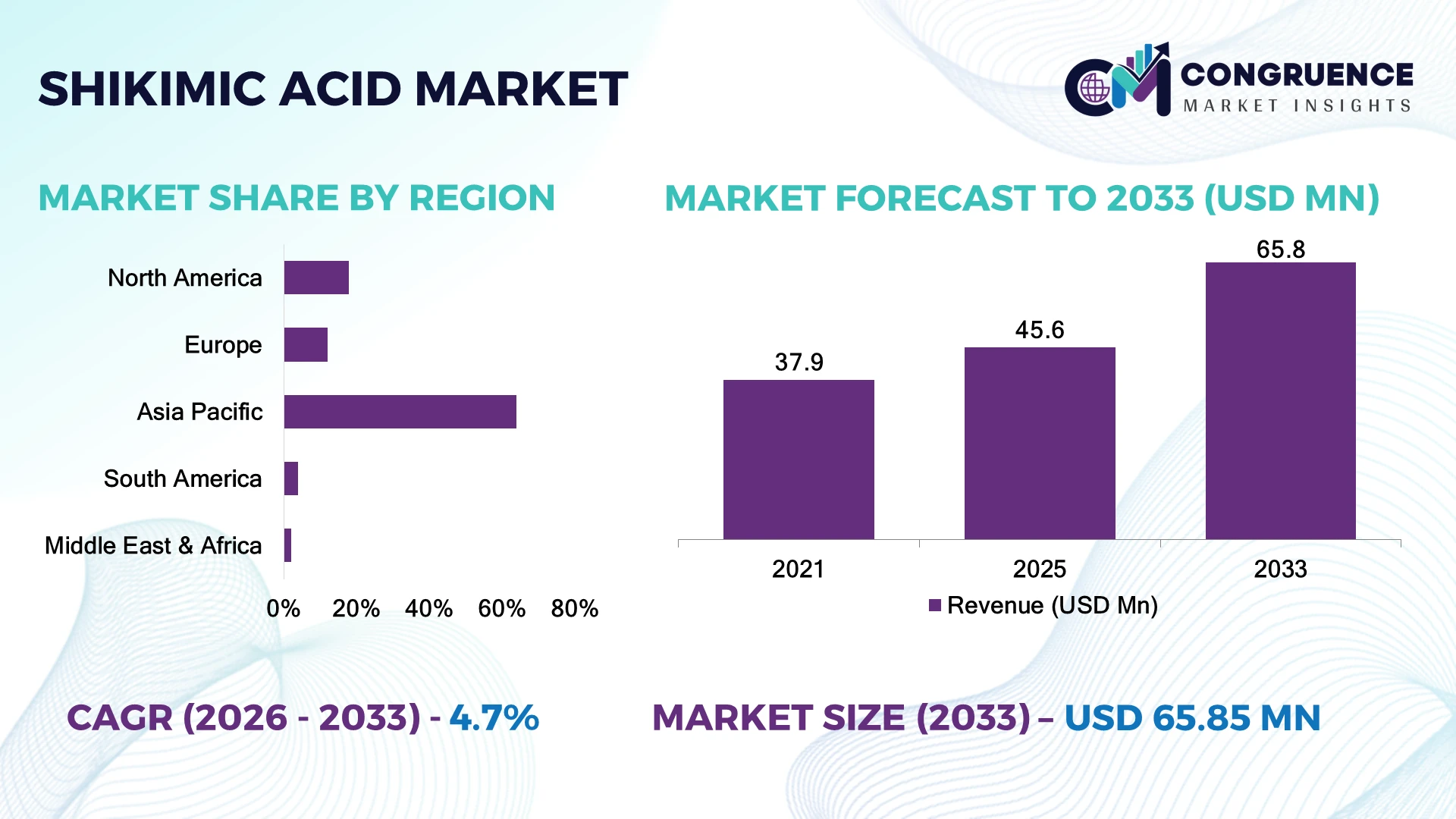
China remains the dominant supply hub, accounting for an estimated 70% of global commercial shikimic acid availability, supported by star-anise cultivation, extraction infrastructure, and pharmaceutical intermediates. India represents a smaller but expanding base, with biotechnology firms increasing fermentation research and process development. China’s extraction capacity remains more than 3 times India’s, while fermentation adoption is estimated at 15–20% of new production investments, reflecting the post-pandemic focus on resilient antiviral supply chains and Asian pharmaceutical localization.
Strategically, buyers should prioritize dual sourcing, fermentation partnerships, and China-independent capacity to protect margins and pharmaceutical supply continuity.
Market Size & Growth: Market value rises from USD 45.6 Million in 2025 to USD 65.8 Million by 2033 at a 4.7% CAGR, supported by fermentation-led pharmaceutical supply diversification.
Top Growth Drivers: Pharmaceutical applications contribute roughly 45% of demand growth, fermentation technology 30%, and antiviral supply-chain resilience 25%.
Short-Term Forecast: By 2028, fermentation-based output is positioned to improve production efficiency by 15–20%, while extraction-related processing costs decline by approximately 8%.
Emerging Technologies: AI-assisted bioprocess optimization, microbial fermentation, and advanced purification are reshaping high-purity shikimic acid production and reducing dependence on seasonal botanical inputs.
Regional Leaders: Asia-Pacific is projected at about USD 34.2 Million by 2033, North America at USD 16.5 Million, and Europe at USD 11.2 Million, with pharmaceutical buyers increasingly adopting diversified sourcing.
Consumer/End-User Trends: Pharmaceutical and biotechnology users represent more than 70% of commercial consumption, with high-purity grades gaining preference for controlled synthesis and regulated drug manufacturing.
Pilot/Case Example: Fermentation-led production programs implemented during 2023–2025 demonstrated approximately 18% higher process consistency and up to 12% lower raw-material dependency versus conventional botanical extraction.
Competitive Landscape: JIAHERB holds an estimated 12% supplier position, alongside Guangxi Wanshan Spice, Wuhan Dahua Weiye, Sichuan Xieli Pharmaceutical, and Layn, while Chinese suppliers retain the strongest production concentration.
Regulatory & ESG Impact: Pharmaceutical traceability requirements and ESG procurement programs are accelerating controlled production, with process optimization targeting 10–15% reductions in solvent, water, and processing intensity.
Investment & Funding: More than USD 20 Million in cumulative capacity and technology investment is being directed toward fermentation, purification, and pharmaceutical-grade processing, strengthening partnerships between ingredient producers and drug manufacturers.
Innovation & Future Outlook: Next-generation microbial platforms, continuous extraction, and precision fermentation will shift competitive advantage from raw-material access toward yield, purity, batch consistency, and supply-chain control.
The Shikimic Acid Market is increasingly centered on pharmaceutical-grade material for antiviral synthesis, with biotechnology and fermentation expanding the addressable supply base. High-purity grades account for an estimated 60%+ of commercial pharmaceutical usage, while producers are investing in non-seasonal manufacturing to reduce exposure to star-anise harvest volatility. Asian supply-chain restructuring in 2026 is reinforcing demand for localized fermentation and advanced purification, setting the stage for deeper strategic investment.
Shikimic acid is becoming strategically important because pharmaceutical manufacturers are treating precursor security as a supply-chain priority rather than a conventional raw-material procurement issue. Dependence on botanical extraction exposes producers to harvest variability, geographic concentration, and logistics disruption, while antiviral preparedness following recent global health emergencies has increased the value of dependable intermediate supply.
The strongest transformation is the shift toward fermentation and biotechnological production. Advanced microbial systems can deliver more consistent batches and reduce dependence on seasonal agricultural inputs; optimized fermentation platforms can improve process efficiency by roughly 15–20% compared with conventional extraction workflows. China remains the largest production center, while India is strengthening biotechnology capabilities and North America and Europe emphasize pharmaceutical-grade qualification, traceability, and supply diversification.
Over the next 2–3 years, producers are expected to prioritize fermentation capacity, high-purity purification, and multi-region sourcing. A practical deployment model combines Chinese botanical extraction for established volume requirements with fermentation-based supply for regulated pharmaceutical applications. Companies are consequently redirecting investment toward process partnerships, technology licensing, and localized capacity. Competitive advantage will increasingly depend on reliable purity, scalable yields, and resilient supply rather than access to star anise alone.
Pharmaceutical-grade shikimic acid production is shifting toward controlled fermentation as manufacturers seek consistent precursor availability beyond seasonal botanical extraction. Fermentation-based processes can improve batch consistency by 15–20% and reduce dependence on agricultural feedstock by approximately 25%. In China, pharmaceutical ingredient producers are expanding microbial-process development alongside established star-anise extraction networks, while Indian biotechnology firms are increasing pilot-scale fermentation activity. Supply disruptions exposed during the COVID-19 period accelerated procurement diversification and qualification of alternative production routes. Companies are responding through technology partnerships, pilot capacity expansion, and integrated purification systems. The key strategic advantage is not simply higher output but tighter control over purity, reproducibility, and pharmaceutical-grade specifications.
Heavy dependence on star anise creates a structural constraint because botanical availability remains exposed to harvest conditions, regional concentration, and extraction variability. Conventional extraction can represent 60–70% of commercial supply, while seasonal procurement fluctuations can raise raw-material costs by 10–15% during tighter availability periods. China’s Guangxi production base remains particularly important, creating concentration risk for international buyers despite established processing infrastructure. Pharmaceutical manufacturers face additional qualification costs when switching suppliers or production routes. Companies are reducing exposure through multi-year procurement contracts, inventory buffers, and dual sourcing between botanical extraction and fermentation. The strongest operational response is supplier qualification before disruption occurs, allowing manufacturers to shift volumes without compromising regulated-grade specifications.
Precision fermentation creates an underpenetrated opportunity by separating shikimic acid production from agricultural yield constraints. Optimized microbial platforms can target 20–30% higher process productivity, while automated monitoring can reduce batch intervention requirements by approximately 15%. India’s expanding biomanufacturing ecosystem provides an attractive base for pilot-to-commercial scale-up, particularly where pharmaceutical companies seek alternative Asian sourcing. Continuous fermentation and AI-assisted process control are emerging as differentiators for yield optimization and impurity management. Companies are positioning through R&D collaborations, contract-development partnerships, and modular production facilities. A non-obvious opportunity lies in supplying validated high-purity material directly to pharmaceutical synthesis chains, allowing producers to capture value through specification reliability rather than competing primarily on commodity volume.
Commercial fermentation scale-up remains an execution challenge because laboratory productivity does not automatically translate into stable industrial performance. Variations in microbial growth, oxygen transfer, downstream purification, and impurity profiles can reduce effective yields by 10–15% during scale transitions. Facilities also require specialized bioprocess engineers, validated analytical systems, and tightly controlled contamination protocols. In India and China, companies expanding fermentation capacity are therefore investing in process analytical technology, automated monitoring, and technical partnerships to stabilize production. Regulatory qualification adds another layer when pharmaceutical customers require reproducible specifications across multiple batches. The critical challenge is achieving consistent industrial throughput without sacrificing purity, making process validation and downstream purification as strategically important as fermentation yield itself.
Fermentation Capacity Is Scaling: Commercial producers are increasing fermentation integration, with new process configurations targeting 15–20% better productivity and approximately 10% lower dependence on seasonal botanical inputs. Chinese manufacturers are combining established extraction assets with controlled bioprocessing, creating hybrid supply models that improve production continuity without immediately abandoning proven infrastructure.
Purification Is Becoming Automated: High-purity downstream processing is moving toward automated chromatography, membrane separation, and real-time analytical monitoring. Automation is reducing manual intervention by roughly 15% and improving batch consistency by 10–12%. Pharmaceutical suppliers are upgrading purification trains because tighter impurity control increasingly determines customer qualification, shifting competitive emphasis from extraction volume toward validated specification performance.
Procurement Models Are Diversifying: Pharmaceutical buyers are increasingly using dual-source contracts, regional inventories, and qualified secondary suppliers following supply-chain disruptions experienced during the pandemic. Multi-source procurement can reduce single-supplier exposure by approximately 20–30%, while strategic inventories provide additional continuity during agricultural shortages. Producers are responding by establishing partnerships across China, India, and downstream pharmaceutical manufacturing hubs.
Bioprocess Intelligence Is Advancing: AI-assisted fermentation monitoring is moving from experimental use toward production optimization, with predictive models targeting 8–12% improvements in process efficiency through earlier detection of pH, oxygen, and biomass deviations. This transition is particularly relevant as labor-intensive process oversight becomes less scalable. Companies are integrating sensors, digital batch records, and predictive analytics to improve reproducibility while lowering the operational burden of increasingly sophisticated production systems.
Extracted Shikimic Acid remains the leading type, accounting for approximately 68% of global demand, supported by established star-anise supply chains, lower technical barriers, and proven pharmaceutical-grade processing. China retains the strongest position in this segment, with mature extraction infrastructure supporting large-volume procurement. However, Synthetic/Fermentation-Derived Shikimic Acid is the fastest-growing type, with adoption expanding at roughly 15–18% annually as pharmaceutical manufacturers prioritize consistent purity and non-seasonal production.
The remaining specialty and high-purity variants represent a smaller share but carry greater strategic relevance in regulated pharmaceutical synthesis. High-purity grades account for more than 60% of pharmaceutical-oriented consumption, increasing the value of downstream purification capability. Companies are shifting investment toward fermentation pilots, purification partnerships, and dual-process manufacturing rather than replacing extraction entirely. The business implication is a two-tier market: extraction retains volume leadership, while fermentation increasingly captures technology-driven premium demand.
In 2025, the U.S. Food and Drug Administration reported that only 11% of API manufacturers were located in the United States, compared with 22% in China and 44% in India, reinforcing the commercial rationale for diversified pharmaceutical precursor production and alternative sourcing strategies.
Pharmaceutical Intermediates represent the leading application, accounting for approximately 72% of global shikimic acid consumption, reflecting its established role in synthesis pathways for antiviral and other pharmaceutical compounds. Demand concentration is strongest among manufacturers requiring controlled purity and reproducible intermediate quality. Antiviral Drug Synthesis is the fastest-growing application, expanding at an estimated 14–17% annually as pandemic preparedness and strategic medicine stockpiling strengthen procurement attention.
Research chemicals, biochemical applications, and specialty synthesis collectively represent roughly 28% of consumption, but their buying behavior is becoming more specification-driven. Pharmaceutical users increasingly favor validated grades, while research organizations prioritize smaller-volume, high-purity formats. Companies are responding by expanding pharmaceutical-grade purification, offering customized specifications, and establishing direct supply agreements. The operational shift is significant: demand is moving from opportunistic ingredient purchasing toward qualified, continuity-focused procurement, increasing the strategic importance of batch traceability and supplier redundancy.
In a 2025–2026 pandemic influenza simulation, the World Health Organization identified manufacturing capacity, regulatory pathways, financing, and supply-chain coordination as interconnected determinants of timely antiviral access, strengthening the strategic relevance of dependable pharmaceutical precursor supply.
Pharmaceutical Companies are the dominant end-user group, representing approximately 75% of global shikimic acid demand because of their higher procurement volumes, stringent quality specifications, and dependence on validated pharmaceutical intermediates. Contract Manufacturing Organizations (CMOs/CDMOs) form the fastest-growing buyer group, with demand expanding at an estimated 13–16% annually as drug developers increasingly outsource synthesis, process development, and specialized manufacturing. This model is particularly relevant in India and China, where expanding pharmaceutical manufacturing ecosystems support outsourced production.
Research institutes and specialty chemical manufacturers account for the remaining demand and typically purchase smaller quantities but increasingly require high-purity and application-specific grades. Pharmaceutical companies are prioritizing long-term contracts and dual sourcing, while CDMOs are favoring flexible supply agreements and supplier qualification across multiple production routes. Approximately 20–25% of large-volume buyers are estimated to maintain more than one qualified sourcing pathway, reflecting a shift from lowest-cost procurement toward supply continuity. Companies able to combine regulatory documentation, consistent purity, and flexible batch sizes are therefore gaining stronger positioning across the end-user landscape.
The 2026 India BioEconomy Report recorded a USD 195.3 billion Indian BioEconomy in 2025, including USD 64.5 billion in BioPharma and USD 90.2 billion in BioIndustrial activity, demonstrating the expanding manufacturing ecosystem available to biotechnology and pharmaceutical ingredient suppliers.
“Asia-Pacific accounted for the largest market share at 64% in 2025 however, North America is expected to register the fastest growth, expanding at a CAGR of 5.6% between 2026 and 2033.”
Pharmaceutical localization is reshaping precursor procurement
North America represented approximately 18% of global shikimic acid demand in 2025, with consumption concentrated among pharmaceutical manufacturers, biotechnology companies, and specialty chemical suppliers. The United States dominates regional activity through its advanced drug-development ecosystem and stringent pharmaceutical-grade qualification requirements. Demand is increasingly shifting toward high-purity and traceable material, with pharmaceutical applications representing nearly 75% of regional consumption. Contract manufacturers are strengthening secondary sourcing arrangements as supply-chain resilience becomes a procurement priority. Fermentation-derived material is gaining traction, with adoption estimated at 20% of newly qualified supply programs. Companies are responding through supplier diversification, long-term procurement agreements, and partnerships with biotechnology producers capable of consistent batch specifications.
United States Market Outlook: The United States remains the region’s most strategically important market because of its concentration of pharmaceutical R&D, API qualification infrastructure, and advanced analytical capabilities. More than 80% of regional pharmaceutical-oriented shikimic acid demand is concentrated in U.S.-based manufacturing and research networks. Producers targeting this market are prioritizing validated purity, documentation, and dependable delivery over lowest-cost sourcing.
Regulated pharmaceutical sourcing is elevating purity requirements
Europe accounted for approximately 12% of global shikimic acid demand in 2025, supported primarily by pharmaceutical synthesis, research applications, and specialty chemical manufacturing. Germany, France, Switzerland, and the United Kingdom represent the strongest demand centers because of their established pharmaceutical and life-science industries. High-purity grades account for an estimated 65% of European pharmaceutical consumption, reflecting stringent quality-control expectations. Sustainability requirements are also encouraging lower-solvent extraction and fermentation-based alternatives. Companies are strengthening supplier qualification, traceability systems, and contract manufacturing relationships, while European pharmaceutical buyers increasingly favor dual-source arrangements covering at least 15–20% of annual precursor requirements.
Germany Market Outlook: Germany offers the strongest industrial base in Europe through its dense pharmaceutical, chemical, and biotechnology manufacturing network. Pharmaceutical and specialty chemical companies account for more than 70% of German shikimic acid usage. Advanced analytical laboratories and established CDMO capabilities support faster qualification of high-purity grades, positioning Germany as an important market for technically differentiated suppliers.
Production concentration is shifting toward process diversification
Asia-Pacific accounted for approximately 64% of global shikimic acid demand in 2025 and remains the primary manufacturing center, led by China and supported by expanding pharmaceutical production in India. China contributes an estimated 70% of globally available commercial supply through established star-anise extraction and processing infrastructure. India is accelerating fermentation-based development, while Japan and South Korea provide smaller but technically sophisticated pharmaceutical demand bases. Approximately 15–20% of new production investments are directed toward fermentation or hybrid processing. Companies are expanding purification capacity, securing agricultural feedstock contracts, and developing alternative manufacturing routes to reduce dependence on a single production method.
China Market Outlook: China remains the central market because of its integrated star-anise cultivation, extraction, purification, and pharmaceutical-intermediate infrastructure. Guangxi provides a particularly important production base, linking agricultural supply with processing capacity. Established extraction facilities support large-volume procurement, while newer fermentation initiatives are improving supply flexibility. Manufacturers are increasingly combining botanical extraction with bioprocessing to protect output against seasonal feedstock fluctuations.
Pharmaceutical import substitution is creating selective demand
South America represents approximately 4% of global shikimic acid demand, with Brazil accounting for more than 60% of regional consumption through its comparatively large pharmaceutical and specialty chemical manufacturing base. Demand is concentrated in pharmaceutical intermediates, research chemicals, and laboratory-grade applications rather than large-scale primary production. Brazil’s expanding domestic pharmaceutical capabilities are encouraging local distributors to maintain higher inventory coverage, with safety-stock requirements increasing by roughly 10–15% among larger buyers. Companies are responding through distributor partnerships, regional warehousing, and longer procurement contracts. The key constraint remains limited local precursor manufacturing, making dependable import logistics strategically important.
Brazil Market Outlook: Brazil is the most commercially significant South American market because of its pharmaceutical manufacturing scale and extensive distribution infrastructure. Pharmaceutical applications represent approximately 70% of Brazilian shikimic acid consumption, while research institutions contribute a meaningful specialty-grade demand base. Suppliers with local inventory and regulatory documentation have an advantage because shorter replenishment cycles reduce exposure to international shipping variability.
Pharmaceutical manufacturing investment is broadening specialty-chemical demand
Middle East & Africa accounts for approximately 2% of global shikimic acid demand, with activity concentrated in pharmaceutical manufacturing, research institutions, and specialty chemical distribution. Saudi Arabia, the United Arab Emirates, and South Africa represent the strongest commercial markets as pharmaceutical localization programs expand domestic manufacturing capabilities. Pharmaceutical applications constitute nearly 65% of regional demand, while high-purity laboratory grades account for an increasing share of specialty procurement. Companies are strengthening distributor networks and regional inventories, with selected pharmaceutical supply programs maintaining 10–15% additional stock coverage to offset import lead times. The strategic opportunity lies in linking shikimic acid suppliers with expanding pharmaceutical localization projects rather than pursuing standalone commodity distribution.
Saudi Arabia Market Outlook: Saudi Arabia has the strongest strategic position in the region because pharmaceutical localization, industrial diversification, and biotechnology investment are expanding domestic production capabilities. Pharmaceutical manufacturing projects increasingly require dependable access to qualified intermediates and specialty chemicals. Suppliers establishing regional distribution partnerships can reduce replenishment times by approximately 15–20%, giving them an operational advantage as local pharmaceutical capacity expands.
The Shikimic Acid Market pits Chinese botanical suppliers such as Guilin Layn Natural Ingredients and Shaanxi Jiahe Phytochem against distributors including Merck and Thermo Fisher, while Green Chemicals competes through bioprocess innovation. The top five players are estimated to control 38% of supply, leaving producers competing for contracts. Competition centers on purity, price, traceability, and supply continuity and logistics; fermentation can improve productivity by 15–25%, while purification can reduce processing losses by 10–15%. Layn and Chinese suppliers compete through feedstock integration and scale, whereas producers differentiate through engineered microbial strains and process control. Companies are expanding extraction capacity, developing fermentation platforms, and forming distribution partnerships to secure qualified buyers. The competitive shift is moving from low-cost botanical extraction toward controlled, traceable production as customers diversify sourcing. High qualification requirements and validated manufacturing processes remain entry barriers. Winning suppliers need pharmaceutical-grade purity, scalable capacity, dual-source resilience, and technology-enabled cost control discipline.
Guilin Layn Natural Ingredients Corp.
Shaanxi Jiahe Phytochem Co., Ltd.
Green Chemicals Co., Ltd.
Kintainutri
Shaanxi Hongda Phytochemistry Co., Ltd.
Xi'an Sost Biotech Co., Ltd.
Jiayuan Biotech
Bioway (Xi'an) Organic Ingredients Co., Ltd.
Guangzhou Biocar Biotechnology Co., Ltd.
Capot Chemical Co., Ltd.
Xinghua Green Biological Preparation Co., Ltd.
Thermo Fisher Scientific
Shikimic acid production is moving from seasonal botanical extraction toward engineered microbial fermentation, supported by metabolic engineering, biosensors, and tighter bioprocess control. Engineered Corynebacterium glutamicum has demonstrated titers above 140 g/L in research settings, while E. coli platforms have exceeded 60 g/L in optimized bioreactors. These systems improve production controllability and reduce dependence on agricultural variability, giving fermentation-focused suppliers an advantage in pharmaceutical-grade contracts.
Self-cycling fermentation and automated process monitoring are emerging as productivity technologies. Experimental self-cycling systems have delivered four-fold improvements in shikimic acid yield and volumetric productivity versus batch operation, while sensor-based control can reduce manual intervention by roughly 15%. Adoption remains concentrated in pilot and advanced development environments, but integration with digital batch records, real-time analytics, and automated downstream purification is accelerating commercialization readiness.
From 2026–2028, metabolic pathway optimization, AI-assisted parameter control, and renewable feedstock utilization will increasingly shape competitive performance. Recent engineered E. coli work achieved 97.3 g/L in a 5-L bioreactor, 1.3 times the control strain, signaling stronger scale-up potential. The strategic shift favors companies combining fermentation know-how with purification, analytical validation, and pharmaceutical qualification. Producers that act early can secure process IP, improve yield economics, and establish differentiated supply before microbial routes become standardized.
July 2025 Kintainutri reported six-month formulation testing with 12 health-product and daily-chemical companies, using 3% shikimic acid powder. The formulation extended deodorant performance to 8–10 hours, creating a new commercial application beyond pharmaceutical intermediates and broadening ingredient demand. Source: kintainutri.com
March 2026 Aladdin Scientific recorded a new certificate of analysis for shikimic acid, confirming commercial availability of its ≥98% research-grade product. The update strengthens specification visibility for laboratory buyers requiring documented purity and lot-level quality control for laboratory procurement. Source: aladdinsci.com
December 2025 Green Chemicals described continued commercial shikimic acid development using its RITE Bioprocess platform and engineered Corynebacterium glutamicum. The company reports world-leading productivity, supporting renewable-feedstock manufacturing and reducing dependence on conventional star-anise extraction and seasonal supply variability. Source: greenchemicals.co.jp
December 2025 Thermo Fisher Scientific maintained shikimic acid commercial specifications through a revised safety-data document, listing purity above 95%. The update supports continued regulated laboratory and research procurement by preserving standardized chemical identification, handling requirements, and specification controls. Source: thermofisher.com
The Shikimic Acid Market Report covers extraction-derived and fermentation-derived types, pharmaceutical intermediates, antiviral synthesis, research chemicals, biochemical applications, and specialty synthesis. End-user analysis includes pharmaceutical companies, CMOs/CDMOs, research institutes, and specialty chemical manufacturers. Geographic coverage spans North America, Europe, Asia-Pacific, South America, and the Middle East & Africa, with country-level assessment of China, India, the United States, Germany, Brazil, and Saudi Arabia.
The report evaluates production technologies, microbial fermentation, metabolic engineering, advanced purification, automation, and emerging high-purity applications. Approximately 60%+ of pharmaceutical-oriented consumption is concentrated in high-purity grades, while fermentation is becoming a key alternative to seasonal botanical sourcing. Competitive analysis covers 12 major market participants and assesses supply positioning, technology differentiation, partnerships, capacity strategy, and procurement resilience. The analysis supports investment planning, geographic expansion, supplier selection, competitive positioning, and strategic decisions through 2033.
| Report Attribute/Metric | Report Details |
|---|---|
|
Market Revenue in 2025 |
USD 45.6 Million |
|
Market Revenue in 2033 |
USD 65.8 Million |
|
CAGR (2026 - 2033) |
4.7% |
|
Base Year |
2025 |
|
Forecast Period |
2026 - 2033 |
|
Historic Period |
2021 - 2025 |
|
Segments Covered |
By Type
By Application
By End-User
|
|
Key Report Deliverable |
Revenue Forecast, Growth Trends, Market Dynamics, Segmental Overview, Regional and Country-wise Analysis, Competition Landscape |
|
Region Covered |
North America, Europe, Asia-Pacific, South America, Middle East, Africa |
|
Key Players Analyzed |
Guilin Layn Natural Ingredients Corp., Shaanxi Jiahe Phytochem Co., Ltd., Green Chemicals Co., Ltd., Kintainutri, Shaanxi Hongda Phytochemistry Co., Ltd., Xi'an Sost Biotech Co., Ltd., Jiayuan Biotech, Bioway (Xi'an) Organic Ingredients Co., Ltd., Guangzhou Biocar Biotechnology Co., Ltd., Capot Chemical Co., Ltd., Xinghua Green Biological Preparation Co., Ltd., Thermo Fisher Scientific |
|
Customization & Pricing |
Available on Request (10% Customization is Free) |




