Global Shell Core Power Transformer Market Report Overview
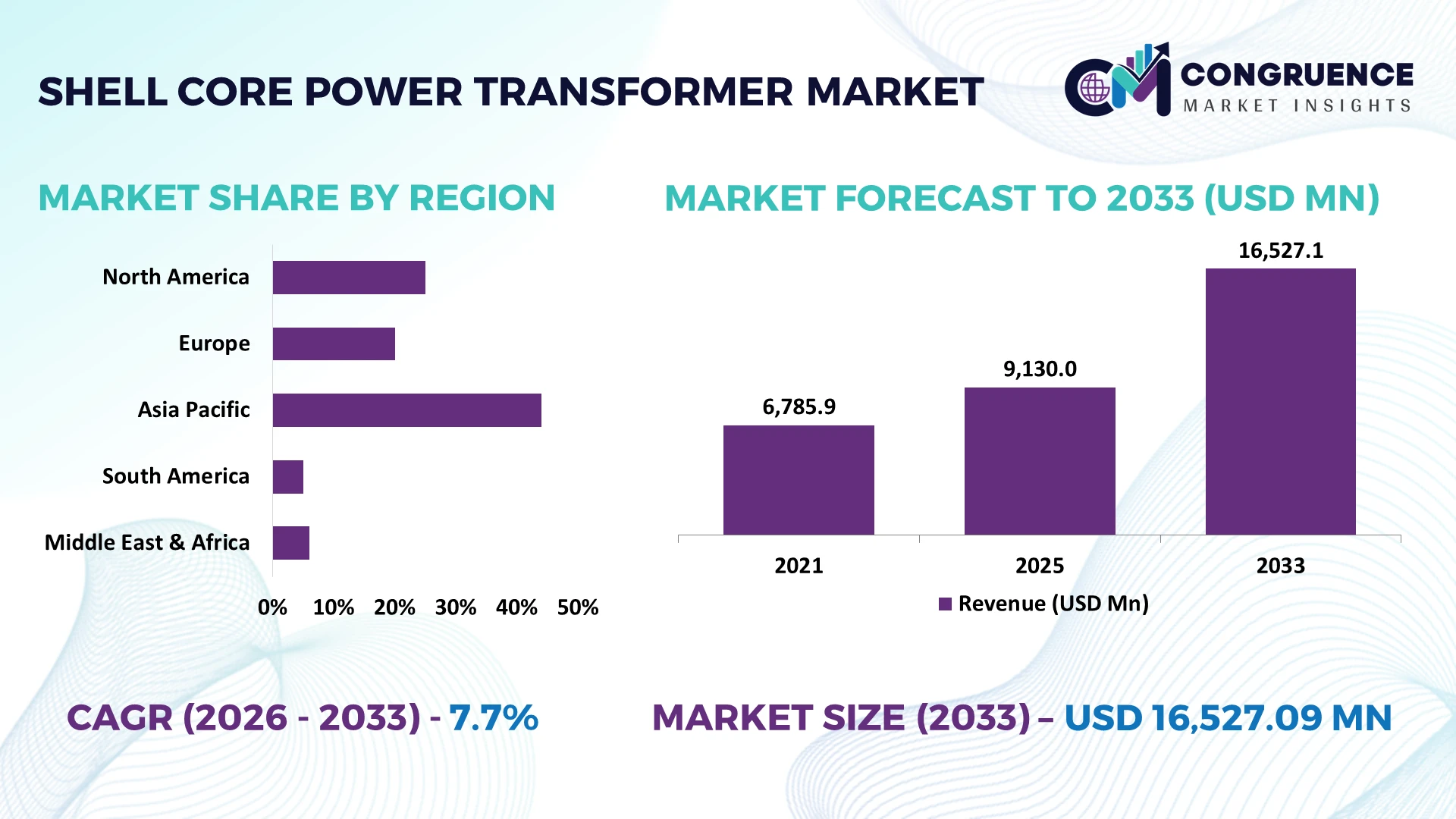
The Global Shell Core Power Transformer Market was valued at USD 9130 Million in 2025 and is anticipated to reach a value of USD 16527.09 Million by 2033 expanding at a CAGR of 7.7% between 2026 and 2033. Growth is driven by high-voltage transmission expansion, renewable energy grid integration, replacement of aging power transformers, and increasing adoption of low-loss electrical steel and digitally monitored transformer designs.
China holds a strategically dominant position in global power transformer manufacturing, supported by State Grid investment, electrical steel production, and high-voltage equipment manufacturing. State Grid announced planned investments exceeding CNY 650 billion in 2025, supporting transmission modernization and equipment procurement. China accounts for more than 50% of global crude steel production, strengthening its broader industrial materials base, while India is targeting 500 GW of non-fossil electricity capacity by 2030. Chinese manufacturers are advancing 500 kV and 1,000 kV transformer technologies for ultra-high-voltage transmission applications.
Strategically, China's CNY 650 billion grid investment program and India's 500 GW non-fossil capacity target reinforce the importance of high-voltage manufacturing capability, electrical steel procurement, and transformer supply chain localization.
Key Highlights of the Global Shell Core Power Transformer Market
-
Market Size & Growth: USD 9,130 million in 2025, reaching USD 16,527.09 million by 2033 at 7.7% CAGR, driven by transmission upgrades and renewable integration.
-
Top Growth Drivers: Global electricity demand increased 4.3% in 2024, renewable generation expanded 15%, and electricity network investment requirements continue accelerating.
-
Short-Term Forecast: By 2028, advanced transformer designs targeting 10%–20% lower no-load losses will strengthen procurement competitiveness in efficiency-sensitive utility projects.
-
Emerging Technologies: Three advancing technologies include amorphous metal cores, AI-enabled dissolved gas analysis, and automated winding systems for improved manufacturing precision.
-
Regional Leaders: Asia-Pacific benefits from China's CNY 650 billion grid investment, North America from aging transformer replacement, and Europe from transmission modernization.
-
Consumer/End-User Trends: Electricity networks require more than 80 million kilometers of grid additions and refurbishment globally by 2040, reinforcing long-term transformer procurement requirements.
-
Pilot/Case Example: In 2024, China's State Grid commissioned ultra-high-voltage transmission infrastructure operating at 1,000 kV, demonstrating advanced transformer deployment capabilities.
-
Competitive Landscape: Hitachi Energy, Siemens Energy, GE Vernova, Mitsubishi Electric, and TBEA compete through high-voltage engineering, manufacturing capacity, and utility contracts.
-
Regulatory & ESG Impact: EU transformer efficiency requirements under Ecodesign regulations strengthen demand for designs targeting 10%–20% lower energy losses.
-
Investment & Funding: Global grid investment exceeded USD 400 billion in 2024, supporting transformer manufacturing expansion, electrical steel procurement, and transmission equipment modernization.
-
Innovation & Future Outlook: Advanced shell-core transformers increasingly integrate 24/7 condition monitoring, digital diagnostics, and optimized magnetic materials to improve asset reliability.
The Shell Core Power Transformer Market is advancing through utility transmission modernization, renewable energy interconnection, and replacement of aging high-voltage equipment. Shell-type magnetic core configurations provide strong mechanical support for windings, making them relevant to specialized power transmission and demanding electrical applications. Advanced grain-oriented electrical steel, optimized winding geometry, and online dissolved gas monitoring are improving operational performance. Global electricity demand increased 4.3% in 2024, intensifying requirements for reliable transmission infrastructure. Supply constraints affecting transformer-grade electrical steel and long manufacturing lead times are encouraging utilities to prioritize supplier qualification, domestic manufacturing capacity, and digitally monitored transformer procurement.
What Is the Strategic Relevance and Future Pathways of the Shell Core Power Transformer Market?
Shell core power transformers are becoming strategically important as utilities modernize transmission networks, integrate renewable generation, and secure reliable high voltage equipment. Global electricity consumption increased approximately 4.3% in 2024, intensifying requirements for transformer capacity and grid reliability. Supply chains are shifting toward localized electrical steel processing, domestic winding manufacturing, and long term equipment procurement agreements. Shell type configurations offer mechanical winding support and controlled leakage flux, strengthening their relevance in demanding high capacity applications.
Advanced grain oriented electrical steel can reduce no load losses by 10%–20% compared with less efficient conventional core materials, depending on design. China emphasizes ultra high voltage transmission equipment, while the United States prioritizes aging grid replacement and manufacturing localization. Europe concentrates on Ecodesign compliance and low loss transformer procurement. These differences influence supplier qualification, production investment, and engineering customization across major electricity markets.
During 2026–2028, manufacturers will prioritize digital diagnostics, automated winding processes, and expanded high voltage testing capabilities. China's 1,000 kV transmission projects demonstrate the operational requirements of advanced transformer engineering. Hitachi Energy and Siemens Energy are expanding manufacturing capabilities and digital monitoring portfolios. Competitive advantage will depend on electrical steel availability, verified efficiency, manufacturing throughput, and dependable utility delivery schedules.
Shell Core Power Transformer Market Dynamics
DRIVER:
Transmission Modernization and Renewable Grid Integration
Rapid electricity network modernization is increasing demand for high capacity shell core power transformers across transmission infrastructure. Global electricity demand expanded 4.3% in 2024, while renewable electricity generation increased approximately 15%, requiring stronger grid interconnections and voltage regulation. China continues investing in ultra high voltage transmission, including 1,000 kV alternating current infrastructure connecting distant generation centers with industrial demand hubs. Advanced shell type transformers provide robust winding support and effective short circuit force management in selected high capacity applications. Manufacturers including Hitachi Energy and TBEA are expanding production capabilities and engineering expertise to address complex transmission requirements. The strategic advantage lies in securing qualified manufacturing capacity before utility procurement cycles tighten.
RESTRAINT:
Electrical Steel Constraints and Manufacturing Cost Exposure
Shell core transformer production faces structural constraints from grain oriented electrical steel availability, copper procurement, and specialized insulation materials. Copper represents approximately 15%–25% of transformer material costs in selected designs, creating significant exposure to commodity fluctuations. A 10% copper price increase can raise total material expenditure by roughly 1.5%–2.5% where copper represents that cost proportion. Electrical steel manufacturing requires specialized processing and magnetic property control, limiting qualified supplier availability. United States transformer manufacturers face additional pressure from imported electrical steel dependence and extended equipment procurement schedules. Companies are responding through multiyear supplier contracts, localized core fabrication, and alternative conductor engineering. Securing stable magnetic material supply increasingly determines manufacturing profitability and delivery competitiveness.
OPPORTUNITY:
Digital Transformers and Advanced Magnetic Material Integration
Digitally monitored shell core transformers create opportunities for predictive maintenance, improved asset utilization, and reduced unplanned outages. Advanced condition monitoring integrates dissolved gas analysis, fiber optic temperature sensing, and digital asset diagnostics to identify insulation deterioration and thermal abnormalities. Predictive maintenance programs can reduce equipment downtime by 30%–50% in suitable industrial applications, strengthening utility interest in continuous monitoring. Advanced magnetic materials offer potential no load loss reductions of 10%–20% compared with older core designs. India provides opportunities through its 500 GW non fossil electricity capacity objective for 2030, requiring substantial transmission expansion. Manufacturers are developing digitally enabled transformers, modular monitoring systems, and utility analytics partnerships. Competitive differentiation increasingly depends on combining electrical efficiency with lifecycle maintenance intelligence.
CHALLENGE:
High Voltage Qualification and Manufacturing Scalability
Scaling shell core transformer manufacturing requires precise winding assembly, magnetic flux control, and extensive high voltage qualification testing. Large power transformers commonly operate at efficiencies exceeding 99%, leaving limited tolerance for additional electrical losses or thermal instability. Ultra high voltage equipment operating at 500 kV–1,000 kV demands rigorous insulation coordination, impulse testing, and mechanical short circuit withstand validation. In China, advanced transmission projects require customized engineering and specialized factory testing infrastructure, increasing production complexity. Manufacturing defects affecting even 1% of completed units can create substantial rework, delivery disruption, and warranty exposure. Companies must invest in automated winding equipment, digital quality inspection, skilled engineering personnel, and expanded testing facilities. Long term competitiveness depends on reproducible performance and reliable qualification across increasingly demanding utility specifications.
Shell Core Power Transformer Market Latest Trends
-
Automated Winding Production Gains Industrial Momentum: Transformer manufacturers are introducing programmable winding machines and digital tension control to improve coil geometry and manufacturing consistency. Large power transformers commonly exceed 99% efficiency, making winding precision critical to minimizing stray losses. Automated production systems monitor 3 parameters: conductor tension, winding alignment, and insulation placement. Manufacturers including Hitachi Energy are investing in factory modernization to improve production throughput and reduce assembly defects.
-
Natural Ester Insulation Expands Utility Adoption: Utilities are evaluating biodegradable natural ester dielectric fluids for specialized high-voltage transformer applications. Natural esters typically exhibit fire points above 300°C, compared with approximately 160–180°C for conventional mineral oils. Their moisture tolerance supports improved insulation management under appropriate operating conditions. European transformer manufacturers are expanding ester-compatible designs and qualification procedures, improving fire-safety positioning and supporting environmentally sensitive installations.
-
Factory Testing Capacity Becomes Procurement Priority: Extended transformer delivery schedules are increasing attention to high-voltage testing infrastructure and production scheduling. Large transformers require dielectric withstand, temperature rise, and short-circuit performance validation under applicable IEC 60076 requirements. Manufacturers are expanding test facilities capable of supporting 400–800 kV equipment. Siemens Energy and other suppliers are strengthening production infrastructure to reduce qualification bottlenecks and improve delivery predictability for transmission projects.
-
Modular Transportation Shapes Transformer Engineering: Heavy equipment transportation constraints are influencing shell-type transformer design and assembly planning. Ultra-high-voltage transformers can exceed 300 metric tons in transport weight, requiring specialized logistics and route assessments. Manufacturers increasingly evaluate modular components and site assembly options for constrained infrastructure corridors. Chinese equipment suppliers are coordinating factory dimensions, rail transport requirements, and installation schedules to reduce project delays and improve deployment flexibility.
Segmentation Analysis
By Type
Three-Phase Transformers Dominate High Capacity Applications
Three-Phase Transformers represent the leading type, with an indicative 45%–50% share of the global shell core power transformer market. Their position reflects extensive use in high capacity electricity transmission, industrial power systems, and large grid substations. Three-phase configurations provide efficient power transfer and integrated magnetic circuit designs, reducing installation complexity compared with multiple independent units in suitable applications. Modern large power transformers commonly achieve efficiencies exceeding 99%, making magnetic core optimization and winding geometry critical to lifecycle performance. Manufacturers are expanding high voltage production capabilities and developing advanced insulation systems to address increasingly demanding utility specifications.
Autotransformers represent the fastest advancing type, supported by transmission network interconnections and voltage conversion requirements between closely related system levels. Their shared winding architecture can reduce conductor requirements compared with conventional two-winding transformers under appropriate voltage ratios. Power Transformers remain important for high capacity generation and transmission applications, while Single-Phase Transformers support specialized utility installations and transport constrained projects. Companies including Hitachi Energy, Siemens Energy, and TBEA are prioritizing high voltage engineering, automated winding processes, and customized equipment manufacturing to improve production efficiency and grid compatibility.
- The International Energy Agency's 2025 electricity assessment identified accelerating network investment requirements alongside rising electricity consumption. Large-scale transmission modernization strengthens demand for three-phase equipment and specialized autotransformers designed for high capacity voltage interconnection.
By Application
Transmission Networks Lead High Voltage Transformer Deployment
Transmission Networks represent the leading application, with an indicative 35%–40% share of the global shell core power transformer market. Demand concentrates around long distance electricity transfer, high voltage interconnections, and transmission capacity reinforcement. China operates extensive ultra high voltage infrastructure, including alternating current systems rated at 1,000 kV, requiring specialized insulation coordination and mechanical winding strength. Shell core transformer designs are relevant to selected demanding transmission applications where short circuit withstand capability and controlled magnetic performance are critical. Manufacturers are expanding high voltage testing capacity and engineering customization to meet utility procurement specifications.
Grid Substations represent the fastest advancing application, supported by grid modernization, increased electricity demand, and renewable generation interconnection requirements. Power Generation remains an established application for generator step-up transformers, while Industrial Power Supply supports energy intensive manufacturing and large industrial facilities. Modern transformer designs exceed 99% efficiency, increasing procurement emphasis on load losses, cooling performance, and long-term reliability. Companies are integrating digital monitoring, advanced electrical steel, and customized winding configurations to strengthen competitiveness across utility and industrial projects.
- The International Energy Agency's 2025 electricity analysis projected global electricity demand increases exceeding 3% annually through 2027. This reinforces transmission reinforcement and substation equipment procurement, particularly where generation expansion requires additional high voltage transformation capacity.
By End-User
Utilities Lead High Voltage Equipment Procurement
Utilities represent the dominant end-user category, with an indicative 50%–55% share of the global shell core power transformer market. Their purchasing concentration reflects ownership of transmission infrastructure, high voltage substations, and major grid interconnection assets. Utility procurement emphasizes electrical efficiency, mechanical reliability, and equipment service life, frequently exceeding 30 years under appropriate operating conditions. Large transformer efficiency above 99% makes lifecycle loss evaluation increasingly important when comparing technically qualified suppliers. Manufacturers are strengthening utility partnerships, expanding testing facilities, and offering customized transformer engineering to support long-term infrastructure programs.
Renewable Energy Developers represent the fastest advancing end-user category as wind, solar, and hybrid generation projects require specialized voltage transformation and grid interconnection equipment. Power Generation Companies remain important buyers of generator step-up transformers, while Industrial Facilities require reliable high capacity electricity supply for continuous manufacturing operations. Global renewable power capacity additions reached approximately 585 GW in 2024, creating substantial downstream grid integration requirements. Suppliers including GE Vernova and Hitachi Energy are expanding transformer manufacturing capabilities and engineering services to address complex project specifications and demanding delivery schedules.
- The International Renewable Energy Agency reported that renewables accounted for 92.5% of global power capacity additions in 2024. This deployment concentration strengthens equipment demand from renewable developers and utilities responsible for integrating new generation assets.
Region-Wise Market Insights
Asia-Pacific accounted for the largest indicative market share at 42% in 2025 however, Asia-Pacific is expected to register the fastest growth, expanding at an indicative CAGR of 8.9% between 2026 and 2033.

North America Shell Core Power Transformer Market
Grid Replacement and Domestic Manufacturing Capacity Expansion
North America represents an indicative 25% share of the global shell core power transformer market, supported by aging transmission infrastructure, electricity demand from data centers, and domestic manufacturing investment. The United States dominates regional utility procurement, while Canada contributes high-voltage engineering capabilities and hydroelectric transmission infrastructure. The U.S. Department of Energy identifies large power transformers as critical electricity network components, strengthening domestic supply-chain priorities. Transformer manufacturers are expanding production facilities, specialized winding equipment, and high-voltage testing capabilities. Hitachi Energy announced a USD 1 billion investment in United States manufacturing in 2025, including a major power transformer facility in Virginia. Regional utilities increasingly prioritize long-term supply agreements, factory acceptance testing, and condition-monitoring compatibility. The operational advantage lies in securing domestic production capacity while reducing exposure to extended international equipment delivery schedules.
United States Market Outlook: The United States is the region's principal procurement center, supported by extensive transmission infrastructure and increasing electricity requirements from industrial facilities. The national electricity network includes approximately 240,000 miles of high-voltage transmission lines. Utility investment priorities include replacing aging transformers, improving grid resilience, and expanding connections for large electricity consumers. Domestic manufacturers are strengthening transformer assembly, insulation processing, and electrical testing capabilities to support technically demanding procurement programs.
Europe Shell Core Power Transformer Market
Energy Transition Reinforces High-Voltage Equipment Modernization
Europe holds an indicative 23% share of the global market, supported by transmission modernization, offshore wind integration, and established electrical equipment manufacturing capabilities. Germany, France, Italy, and the United Kingdom concentrate important transformer engineering and utility procurement activities. The European Union's electricity grid action plan identifies investment requirements of approximately EUR 584 billion through 2030, reinforcing equipment modernization priorities. European transformer manufacturers emphasize low-loss magnetic materials, advanced insulation systems, and compliance with Ecodesign efficiency requirements. Siemens Energy and other established suppliers are strengthening manufacturing capacity and utility relationships to address equipment procurement constraints. Cross-border electricity interconnections create demand for specialized high-voltage transformation equipment and coordinated technical specifications. Competitive positioning increasingly depends on manufacturing reliability, certified electrical performance, and compatibility with evolving European transmission infrastructure requirements.
Germany Market Outlook: Germany is a strategic manufacturing and technology center through its transformer engineering expertise, industrial automation capabilities, and established electrical equipment supply chains. The country targets at least 80% renewable electricity consumption by 2030, increasing the importance of transmission reinforcement and grid stability. German manufacturers are advancing magnetic core optimization, automated winding production, and digital transformer diagnostics. Utilities prioritize efficient equipment replacement and compatibility with complex high-voltage networks.
Asia-Pacific Shell Core Power Transformer Market
Ultra-High-Voltage Expansion Strengthens Manufacturing Leadership
Asia-Pacific accounts for the largest indicative market share at 42%, supported by extensive transformer manufacturing capacity, large transmission construction programs, and increasing electricity infrastructure requirements. China dominates regional production through integrated electrical steel supply chains, transformer engineering facilities, and ultra-high-voltage equipment deployment. State Grid announced planned investments exceeding CNY 650 billion in 2025, supporting transmission reinforcement and electricity network modernization. India contributes additional demand through renewable generation integration and transmission capacity expansion. Japan and South Korea emphasize advanced magnetic materials, precision manufacturing, and specialized high-voltage engineering. Chinese manufacturers including TBEA and China XD Electric maintain extensive experience with large power transformer production. Regional competitive advantages include industrial scale, established component sourcing, and engineering expertise in 500 kV and 1,000 kV equipment applications.
China Market Outlook: China is the leading industrial center for large power transformer manufacturing and ultra-high-voltage transmission deployment. Its electricity infrastructure includes 1,000 kV alternating current and ±800 kV direct current transmission technologies. Domestic manufacturers maintain integrated capabilities spanning electrical steel processing, magnetic core fabrication, winding production, and high-voltage testing. Equipment suppliers benefit from proximity to major grid construction programs and established heavy electrical manufacturing clusters.
South America Shell Core Power Transformer Market
Renewable Transmission Corridors Drive Equipment Procurement
South America represents an indicative 6% share of the global shell core power transformer market, supported by hydropower transmission infrastructure, renewable electricity development, and industrial grid modernization. Brazil dominates regional equipment demand through extensive transmission networks and large electricity generation assets. The country's interconnected power system spans approximately 180,000 kilometers of transmission lines, creating substantial transformer maintenance and replacement requirements. Chile contributes specialized demand through renewable energy projects and long-distance electricity transfer from northern generation centers. Regional utilities increasingly prioritize high-voltage equipment reliability, transformer efficiency, and compatibility with demanding environmental conditions. Manufacturers face logistics constraints associated with oversized equipment transportation and geographically dispersed substations. Companies are strengthening local technical support, maintenance capabilities, and partnerships with transmission concessionaires to improve equipment availability and project execution.
Brazil Market Outlook: Brazil maintains a strong position through its extensive electricity transmission system and domestic heavy electrical manufacturing capabilities. Renewable sources account for more than 80% of national electricity generation, reinforcing the importance of dependable grid transformation infrastructure. Brazilian utilities and transmission concessionaires procure high-voltage equipment for network expansion, hydropower integration, and industrial electricity supply. Local manufacturing and technical service capabilities provide advantages in equipment maintenance and long-term utility contracts.
Middle East & Africa Shell Core Power Transformer Market
Grid Diversification Accelerates High-Voltage Infrastructure Investment
The Middle East & Africa region represents an indicative 4% share of the global shell core power transformer market, supported by electricity network expansion, industrial diversification, and renewable generation integration. Saudi Arabia and the United Arab Emirates are modernizing transmission infrastructure to accommodate growing electricity consumption and new industrial developments. Saudi Arabia targets renewable energy supplying approximately 50% of its electricity generation mix by 2030, strengthening requirements for transmission reinforcement and grid stability. South Africa contributes demand through electricity infrastructure rehabilitation and transmission expansion programs. Regional equipment procurement increasingly emphasizes high-temperature operating performance, insulation reliability, and maintenance accessibility. Manufacturers are developing utility partnerships, regional service capabilities, and transformer designs suited to demanding climatic conditions. Competitive opportunities concentrate around technically qualified suppliers capable of delivering reliable equipment for complex infrastructure projects.
Saudi Arabia Market Outlook: Saudi Arabia is a strategically important market through its electricity infrastructure modernization and industrial diversification programs. The Kingdom plans substantial renewable generation expansion alongside conventional electricity network reinforcement. High ambient temperatures require careful transformer cooling design, insulation coordination, and thermal performance management. Utilities increasingly prioritize reliable high-voltage equipment and localized technical services. Manufacturers are strengthening regional engineering partnerships and equipment support capabilities to address demanding transmission applications.
Market Competition Landscape
Hitachi Energy, Siemens Energy, GE Vernova, TBEA, and Mitsubishi Electric compete through high-voltage engineering, manufacturing capacity, and utility procurement relationships. Their combined shell core transformer market share is indicatively estimated at 40%–45%, reflecting competition from regional heavy electrical equipment manufacturers. Hitachi Energy and Siemens Energy emphasize advanced transformer engineering and digital monitoring, while TBEA competes through integrated manufacturing and extensive Chinese transmission projects. GE Vernova and Mitsubishi Electric focus on specialized high-capacity applications and utility relationships. Advanced magnetic core designs target 10%–20% lower no-load losses, while large transformer efficiency typically exceeds 99%. Companies are expanding manufacturing facilities, developing automated winding capabilities, and strengthening electrical steel procurement agreements. The competitive shift favors localized production, shorter delivery schedules, and verified equipment performance.
Companies Profiled in the Shell Core Power Transformer Market Report
-
Hitachi Energy Ltd.
-
Siemens Energy AG
-
GE Vernova Inc.
-
Mitsubishi Electric Corporation
-
TBEA Co., Ltd.
-
China XD Electric Co., Ltd.
-
Toshiba Energy Systems & Solutions Corporation
-
Hyundai Electric & Energy Systems Co., Ltd.
-
Bharat Heavy Electricals Limited
-
CG Power and Industrial Solutions Limited
-
WEG S.A.
-
HD Hyundai Electric Co., Ltd.
-
SGB-SMIT Group
-
Wilson Transformer Company
Technology Insights for the Shell Core Power Transformer Market
Current shell core transformer technologies emphasize grain oriented electrical steel, precision winding geometry, and optimized cooling systems. Large power transformers routinely achieve efficiencies above 99%, making incremental reductions in magnetic and resistive losses commercially significant. Compared with conventional core laminations, advanced electrical steel grades can deliver 10%–20% lower no load losses under comparable design conditions. Automated winding equipment improves dimensional consistency, supporting reliable insulation clearances and mechanical short circuit strength. Utility procurement increasingly evaluates total ownership costs rather than purchase prices alone.
Emerging technologies integrate fiber optic winding temperature sensors, online dissolved gas analysis, and digital transformer monitoring platforms. These systems track thermal loading, insulation deterioration, and fault indicators continuously, replacing periodic inspection with condition based maintenance. Digital diagnostics are increasingly deployed on critical 400 kV and 765 kV transmission assets. Manufacturers combine sensor integration with automated factory testing, improving equipment traceability and enabling earlier detection of manufacturing deviations.
Disruptive developments include artificial intelligence assisted thermal modeling, additive manufactured insulation components, and digital twins for lifecycle optimization. During 2026–2028, suppliers will prioritize validated monitoring algorithms and production automation. Utilities gain maintenance visibility, while manufacturers offering integrated diagnostics and certified high voltage performance strengthen competitive positioning against conventional equipment suppliers.
Recent Developments in the Global Shell Core Power Transformer Market
-
September 2025: Hitachi Energy announced a USD 1 billion American manufacturing expansion, including USD 457 million for a large power transformer factory in Virginia. The investment strengthens domestic transformer availability, addresses grid equipment shortages, and supports expanding data center electricity requirements. Source: reuters.com
-
February 2026: Siemens Energy India approved INR 2,060 crore to establish additional large power transformer manufacturing capacity of approximately 30,000 MVA. Scheduled commissioning between 2030 and 2032 strengthens long-term production capabilities and positions the company for domestic and international transmission equipment procurement. Source: siemens-energy-india.com
-
January 2026: KONČAR and Siemens Energy inaugurated their transformer tank manufacturing facility near Zagreb, Croatia. The joint venture, owned 60% by KONČAR and 40% by Siemens Energy, strengthens European component production, manufacturing resilience, and supply-chain integration for large transformer applications. Source: koncar.hr
-
May 2025: GE Vernova announced a USD 16 million investment in Indian electrification manufacturing and engineering facilities across Chennai and Noida. The expansion supports advanced HVDC and grid stabilization technologies, strengthens localized equipment supply, and improves capabilities for renewable electricity integration. Source: gevernova.com
Scope of the Shell Core Power Transformer Market Report
The Shell Core Power Transformer Market Report examines equipment technologies, manufacturing capabilities, procurement structures, and infrastructure investment priorities between 2026 and 2033. Type segmentation covers Single-Phase Transformers, Three-Phase Transformers, Power Transformers, and Autotransformers. Application analysis evaluates Power Generation, Transmission Networks, Grid Substations, and Industrial Power Supply. End-user coverage includes Utilities, Power Generation Companies, Industrial Facilities, and Renewable Energy Developers. The analysis assesses transformer efficiency exceeding 99%, advanced electrical steel, insulation systems, and high voltage equipment qualification.
Regional coverage includes North America, Europe, Asia-Pacific, South America, and the Middle East & Africa, examining production localization, transmission modernization, and supply chain competitiveness. Technology assessment addresses automated winding, digital monitoring, thermal modeling, and advanced magnetic materials. Competitive benchmarking evaluates manufacturing capacity, utility partnerships, equipment customization, and procurement risks, supporting investment planning, geographic expansion, and long-term supplier positioning.
Shell Core Power Transformer Market Report Summary
| Report Attribute/Metric | Report Details |
|---|
Market Revenue in 2025 | USD 9130 Million |
Market Revenue in 2033 | USD 16527.09 Million |
CAGR (2026 - 2033) | 7.7% |
Base Year | 2025 |
Forecast Period | 2026 - 2033 |
Historic Period | 2021 - 2025 |
Segments Covered | By TypeSingle-Phase Transformers
By ApplicationBy End-UserPower Generation Companies Renewable Energy Developers
|
Key Report Deliverable | Revenue Forecast, Growth Trends, Market Dynamics, Segmental Overview, Regional and Country-wise Analysis, Competition Landscape |
Region Covered | North America, Europe, Asia-Pacific, South America, Middle East, Africa |
Key Players Analyzed | Hitachi Energy Ltd., Siemens Energy AG, GE Vernova Inc., Mitsubishi Electric Corporation, TBEA Co., Ltd., China XD Electric Co., Ltd., Toshiba Energy Systems & Solutions Corporation, Hyundai Electric & Energy Systems Co., Ltd., Bharat Heavy Electricals Limited, CG Power and Industrial Solutions Limited, WEG S.A., HD Hyundai Electric Co., Ltd., SGB-SMIT Group, Wilson Transformer Company |
Customization & Pricing | Available on Request (10% Customization is Free) |





