
Reports
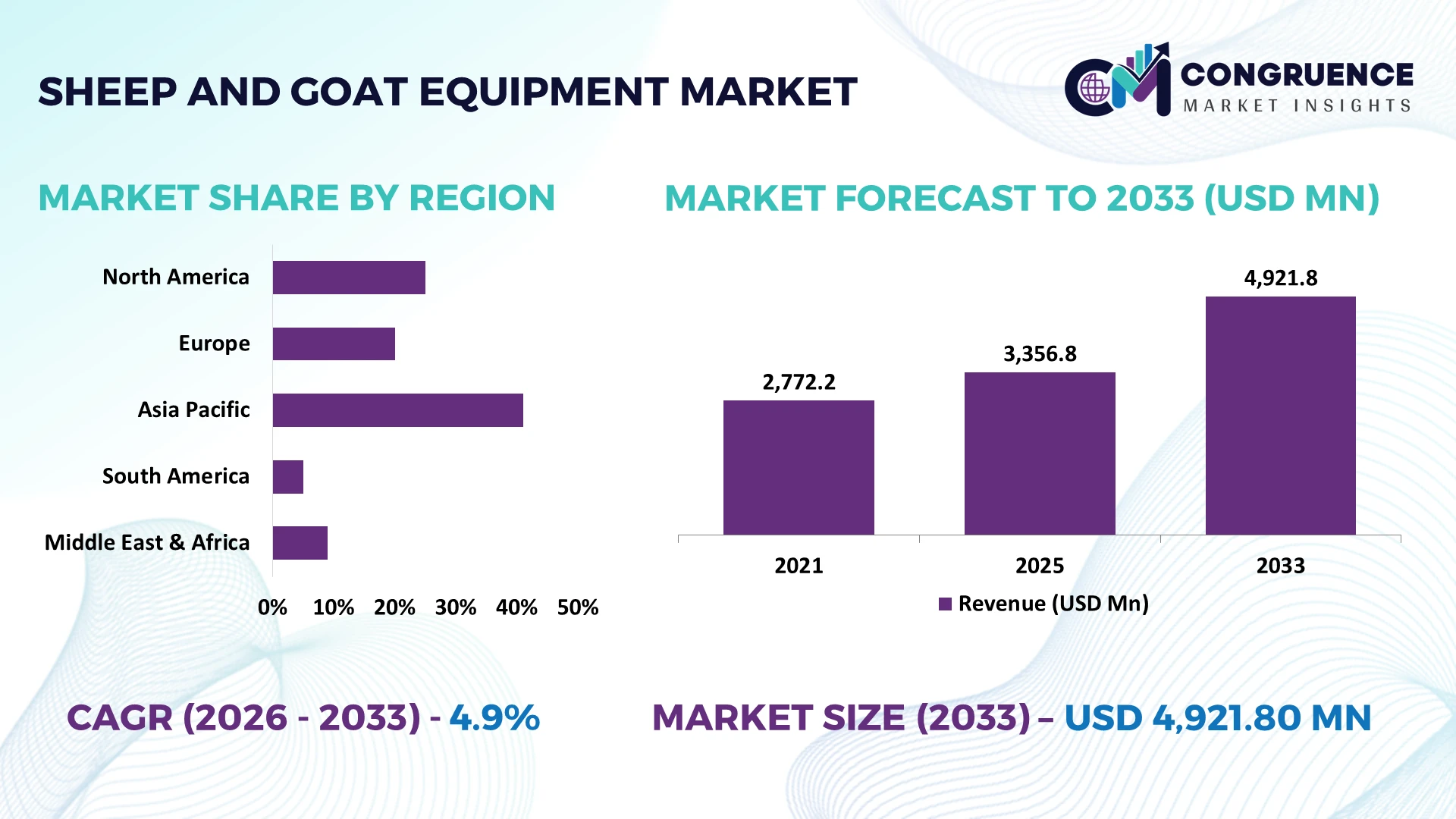
The Global Sheep and Goat Equipment Market was valued at USD 3356.8 Million in 2025 and is anticipated to reach a value of USD 4921.8 Million by 2033 expanding at a CAGR of 4.9% between 2026 and 2033. Growth is driven by automated milking, electronic livestock identification, precision feeding, and labor-saving handling systems as commercial sheep and goat farms modernize herd management.
China represents a dominant equipment demand center, supported by a sheep population exceeding 190 million head and goat numbers above 120 million, creating substantial requirements for feeding, housing, shearing, milking, weighing, and health-monitoring systems. Mechanized livestock operations increasingly deploy RFID identification, automated rationing, environmental controls, and digital herd records. Australia, by comparison, maintains roughly 70 million sheep but exhibits deeper adoption of automated weighing, electronic identification, and advanced shearing infrastructure. China’s food-security strategy continues directing agricultural investment toward productive domestic livestock operations.
Strategically, suppliers should differentiate between China’s scale-driven equipment opportunity and Australia’s technology-intensive replacement market when prioritizing products, distribution partnerships, and localization.
Market Size & Growth: USD 3,356.8 million in 2025 advances to USD 4,921.8 million by 2033 at a 4.9% CAGR, supported by livestock automation, precision feeding, and connected herd-management systems.
Top Growth Drivers: Automated milking adoption, labor-saving handling equipment, and electronic livestock monitoring contribute approximately 34%, 27%, and 21% of equipment purchasing momentum, respectively.
Short-Term Forecast: By 2028, integrated feeding, weighing, and identification systems are positioned to reduce routine handling labor requirements by approximately 15–20% across technology-enabled livestock operations.
Emerging Technologies: RFID identification, machine-vision monitoring, and AI-assisted herd analytics are shifting equipment portfolios toward connected operations, with automated data capture reducing manual recording requirements by more than 50%.
Regional Leaders: Europe approaches USD 1.5 billion, Asia Pacific exceeds USD 1.3 billion, and North America approaches USD 0.7 billion by 2033, supported by automation, herd modernization, and precision livestock management.
Consumer/End-User Trends: Commercial livestock operators increasingly prioritize multifunctional systems capable of consolidating 3–5 activities, including identification, weighing, sorting, feeding, and animal-health monitoring.
Pilot/Case Example: In 2025, precision livestock deployments combining electronic identification and automated weighing demonstrated approximately 20% lower manual handling requirements by eliminating repeated individual-animal recording processes.
Competitive Landscape: The leading supplier holds an estimated 8–10% share, while DeLaval, GEA, Fullwood JOZ, Gallagher, and Allflex compete through milking, identification, handling, and livestock-monitoring technologies.
Regulatory & ESG Impact: Electronic identification requirements are accelerating equipment replacement, with Australia’s national sheep and goat EID transition targeting 100% electronically traceable individual livestock identification.
Investment & Funding: More than USD 500 million in broader precision-livestock technology investment and expansion activity supports sensors, automation, digital identification, robotics, and data platforms serving connected livestock operations.
Innovation & Future Outlook: Next-generation platforms integrating 3+ technologies across sensing, automation, and analytics are shifting competition from standalone machinery toward interoperable livestock-management ecosystems and recurring digital services.
The Sheep and Goat Equipment Market is increasingly concentrated around automated milking, precision feeding, electronic identification, handling equipment, shearing systems, and connected animal-health monitoring. Commercial farms are replacing isolated mechanical equipment with integrated platforms capable of reducing repetitive handling and improving individual-animal visibility; digital identification can eliminate more than 50% of manual record-entry steps in connected workflows. Australia’s electronic identification transition is reinforcing traceability-led equipment replacement, while Asian producers emphasize scalable feeding and housing automation. These developments reposition purchasing decisions around interoperability, labor productivity, traceability compliance, and lifecycle operating efficiency, establishing the strategic priorities shaping the market.
Sheep and goat equipment is becoming strategically important as livestock operators shift capital from standalone machinery toward integrated systems that reduce labor intensity, strengthen traceability, and improve animal-level productivity. Australia’s mandatory electronic identification transition for sheep and goats illustrates this structural change, moving identification infrastructure from visual tags toward electronically readable records. For equipment manufacturers, regulatory modernization expands competition beyond conventional feeding, milking, and handling hardware into readers, sensors, software, and interoperable farm platforms.
Technology economics reinforce this transition. Automated weighing and RFID-linked identification can reduce animal data collection time by roughly 40–60% compared with manual weighing and record entry, while automated feeding improves ration consistency and limits avoidable feed losses. Australia emphasizes traceability and high-throughput handling, whereas China’s livestock scale creates stronger opportunities for standardized feeding, housing, and health-monitoring installations. Through 2028, connected identification and automated handling should penetrate progressively deeper into commercially managed flocks.
A practical deployment combines electronic ear tags, walk-over weighing, drafting gates, and herd-management software, allowing animals to be identified, weighed, and sorted without repeated manual intervention. Suppliers are consequently investing in sensor integration, dealer capabilities, software interoperability, and livestock-technology partnerships. Competitive advantage will increasingly belong to companies converting equipment portfolios into connected operating systems that deliver measurable labor savings and actionable animal data.
Persistent livestock labor constraints are accelerating investment in automated feeding, milking, weighing, drafting, and identification equipment. Automated handling can reduce routine animal-processing labor by approximately 20–40%, while RFID-linked data capture can cut manual recording activity by more than 50%. Australia’s transition toward electronic sheep and goat identification is simultaneously increasing requirements for compatible readers, tags, scanners, and management software. The operational effect extends beyond headcount reduction: faster animal throughput increases equipment utilization and enables more frequent performance monitoring. Manufacturers are responding by integrating electronic identification with weighing and automated drafting rather than selling isolated hardware. Companies expanding dealer installation capabilities and interoperable product portfolios gain a stronger position because farmers increasingly evaluate equipment on labor saved per animal handled, not simply acquisition price.
Upfront investment remains a structural constraint because automated milking, feeding, electronic identification, and handling systems require complementary infrastructure that many small producers lack. Equipment installation can add approximately 15–30% to project costs once electrical systems, gates, connectivity, housing modifications, and software integration are included. In fragmented farming environments, utilization rates can remain below 60% when equipment capacity substantially exceeds individual herd requirements. India illustrates the constraint: highly distributed sheep and goat ownership limits the economics of farm-level automation despite its enormous livestock base. Suppliers are addressing this through modular equipment, mobile handling units, cooperative purchasing, leasing, and dealer-supported maintenance. The critical commercial issue is therefore equipment utilization rather than hardware affordability alone; vendors that align system capacity with herd size can protect customer payback and expand addressable demand.
The strongest emerging opportunity lies in combining identification, sensing, automated weighing, health monitoring, and decision software into precision small-ruminant platforms. Connected systems can eliminate more than 50% of repetitive manual data entry, while automated weight monitoring enables producers to identify underperforming animals several weeks earlier than periodic manual assessment. New Zealand offers an attractive deployment environment because performance recording and pasture-based livestock management create practical applications for electronic identification, walk-over weighing, and automated drafting. Through 2028, machine vision, edge analytics, and sensor-based behavioral monitoring will increasingly extend equipment value from mechanical handling into predictive flock management. Manufacturers are directing R&D toward interoperable controllers, cloud-connected platforms, and analytics partnerships. A particularly valuable opportunity is recurring software and monitoring income, allowing equipment suppliers to build customer relationships beyond one-time machinery sales.
Long-term deployment depends on integrating equipment, animal identifiers, sensors, farm software, and connectivity without disrupting livestock workflows. Connected farms can operate equipment from 3–5 different technology categories, making incompatible data formats and proprietary interfaces a material implementation problem. Rural connectivity remains another execution barrier; even where mobile coverage exists, inconsistent field-level performance can reduce real-time synchronization by 10–20% during intensive operations. Australia’s expanding electronic identification infrastructure increases pressure for dependable interoperability between tags, readers, saleyard systems, processors, and producer databases. Vendors must therefore solve system reliability rather than simply increase device functionality. Investment in offline-capable software, standardized interfaces, technician networks, cybersecurity, and cross-vendor integration partnerships is becoming essential. Companies that cannot guarantee dependable data continuity risk losing competitiveness as livestock equipment evolves from mechanical assets into interconnected operational infrastructure.
Mobile Infrastructure Gains Farm Share: Portable yards, collapsible races, mobile feeders, and relocatable fencing are gaining traction as producers seek assets that can serve multiple paddocks rather than duplicate fixed infrastructure. Mobile configurations can lower site preparation requirements by 20–30% and shorten equipment relocation cycles to hours rather than days. Australian grazing enterprises are using transportable systems to support rotational flock management. Manufacturers are responding with lighter galvanized structures, quick-connect assemblies, trailer-mounted equipment, and standardized components designed for repeated field deployment.
Water Management Becomes Equipment Priority: Drought exposure is increasing investment in automatic drinkers, storage-linked troughs, level sensors, and leak-detection equipment. Livestock water losses from poorly maintained distribution infrastructure can exceed 10%, while sensor-controlled systems can identify abnormal consumption within 24 hours. Spanish and Australian producers facing recurring dry conditions are placing greater emphasis on water reliability alongside conventional feed infrastructure. Suppliers are expanding remote tank monitoring, low-pressure drinking systems, solar-powered pumping compatibility, and telemetry-enabled water controls to reduce inspection travel and safeguard flock access.
Dairy Parlors Target Faster Throughput: Commercial sheep and goat dairies are redesigning parlors around rapid-entry platforms, automatic cluster removal, milk metering, and centralized cleaning. Modern configurations can raise animals milked per operator-hour by 20–35%, while automated cleaning can shorten sanitation procedures by around 15%. France and Spain provide strong deployment environments because specialized dairy flocks supply established cheese-processing industries. Equipment companies are adapting cattle-derived technologies into smaller-capacity clusters, species-specific stalls, compact rotary layouts, and automated wash systems suited to small-ruminant physiology.
Electric Fencing Adds Remote Control: Connected energizers and solar-powered fencing are changing pasture-control workflows by allowing voltage faults and fence performance to be checked remotely. Digital monitoring can reduce physical fence inspections by 30–50%, particularly across extensive grazing properties. Solar configurations also decrease dependence on grid connections at remote boundaries. New Zealand suppliers are combining energizers, fault finders, remote controllers, and mobile interfaces, turning fencing from passive infrastructure into an actively managed component of rotational grazing and predator-control strategies.
Feeding Equipment leads with an estimated 26% share because every production model requires troughs, racks, mixers, forage dispensers, and concentrate-delivery equipment regardless of whether animals are raised for meat, milk, breeding, or fiber. Mechanized ration distribution can shorten feeding cycles by approximately 20–25%, making this category particularly valuable as commercial herd sizes increase. Housing Equipment retains substantial importance in intensive systems, while Fencing Equipment remains fundamental to grazing control. Shearing Equipment serves a narrower but equipment-intensive wool production base, particularly across Australia and New Zealand.
Health Monitoring Equipment is the fastest-advancing type, reflecting movement from periodic physical checks toward continuous animal-level measurement. Wearable and fixed sensors can capture activity, temperature, rumination, and location at intervals below 60 minutes, creating earlier intervention windows. Milking Equipment benefits from specialized dairy operations, while Handling Equipment increasingly emphasizes higher-throughput races and restraint systems. Suppliers are directing product development toward sensor durability, species-specific ergonomics, automated dispensing, and modular configurations, making functionality per installed asset a more important purchasing criterion.
Feeding accounts for approximately 28% of application demand because its equipment operates daily and directly determines ration delivery, forage accessibility, wastage control, and animal grouping efficiency. Precision concentrate dispensers can deliver predetermined portions with accuracy approaching 95%, creating stronger value in dairy and breeding herds where nutritional variation affects output. Housing supports controlled kidding, lambing, and intensive production environments, while Shearing remains seasonally concentrated. Milking represents a specialized high-utilization application where equipment specifications depend heavily on flock size and collection frequency.
Health Monitoring is the fastest-expanding application as farms increasingly use alerts to identify deviations in movement, feeding behavior, body condition, or physiological status. Sensor-based systems can collect multiple observations per animal each day, replacing the limited sampling frequency achievable through scheduled inspection. Breeding increasingly uses structured performance information, while Animal Handling remains critical during vaccination, classification, transport preparation, and selection. Manufacturers are responding with configurable sensor packages, precision dispensers, specialized milking components, and application-focused equipment bundles, allowing producers to direct capital toward workflows generating the highest measurable productivity return.
Sheep Farms hold an estimated 37% share, reflecting the breadth of equipment required across pasture management, lambing, wool harvesting, feeding, containment, and flock processing. Large sheep enterprises can process several hundred animals during a single husbandry event, favoring equipment designed around throughput and durability rather than intensive individual-animal interaction. Commercial Ranches similarly emphasize rugged fencing and mobile infrastructure. Livestock Farms purchase broader multipurpose configurations, while Dairy Farms allocate proportionally greater capital toward sanitation-sensitive installations and controlled production environments.
Goat Farms represent the fastest-developing buyer category as commercial operators replace improvised multipurpose equipment with goat-specific feeders, milking stalls, housing fixtures, and restraint systems. Purpose-designed feeder dimensions can materially reduce forage displacement, an important operating consideration where feed represents a substantial production expense. Agricultural Cooperatives strengthen equipment accessibility through shared ownership and service models, particularly where individual herds cannot fully utilize high-capacity machinery. Suppliers are therefore differentiating portfolios by species, production intensity, herd size, and service model, while financing programs and shared-use configurations widen the addressable customer base.
North America accounted for the largest market share at 31.8% in 2025 however, Asia-Pacific is expected to register the fastest growth, expanding at a CAGR of 5.8% between 2026 and 2033.

Commercial Mechanization Strengthens Equipment Utilization
North America accounted for approximately 31.8% of global demand in 2025, supported by commercially organized livestock operations, established equipment dealerships, and high replacement activity across the United States and Canada. Investment is increasingly directed toward high-capacity feeders, lambing systems, pasture fencing, loading equipment, and configurable handling yards that improve throughput across larger flocks. U.S. operations also favor modular equipment that can accommodate seasonal changes in animal numbers without extensive facility reconstruction. Manufacturers are strengthening domestic inventories and dealer installation capabilities to reduce equipment downtime during lambing, breeding, and marketing periods. An important operational shift is toward multifunctional machinery: producers increasingly prefer assets capable of performing several husbandry tasks, improving capital utilization while limiting the number of separate machines maintained on farm.
United States Market Outlook: The United States combines extensive pasture-based production with specialized meat, breeding, and dairy operations, creating differentiated equipment requirements across major sheep-producing states. Texas alone maintains more than 700,000 sheep and lambs, supporting concentrated demand for durable fencing, watering, feeding, loading, and flock-processing infrastructure. Suppliers emphasizing rapid parts availability and adaptable equipment configurations gain a practical service advantage.
Professionalization Reshapes Farm Equipment Spending
Europe represented approximately 27.4% of global demand in 2025, with Spain, France, Romania, Italy, Greece, and the United Kingdom supporting substantial small-ruminant production. The European Union maintained roughly 55 million sheep and more than 10 million goats around 2025, but continuing farm consolidation is concentrating equipment expenditure among larger professional operations. Mediterranean dairy producers emphasize milking hygiene, milk cooling, kidding facilities, and nutritional management, while northern European farms place greater weight on weather protection and efficient indoor husbandry. Equipment replacement is also being influenced by European animal-welfare requirements, encouraging better ventilation, flooring, pen design, and animal-access systems. Suppliers are adapting portfolios around energy efficiency, corrosion resistance, easier sanitation, and configurable farm layouts, allowing producers to modernize infrastructure without replacing entire livestock buildings.
Spain Market Outlook: Spain remains strategically important because it combines approximately 13 million sheep with a substantial goat population and an established sheep and goat dairy-processing industry. Commercial cheese production creates intensive requirements for hygienic milking installations, cooling equipment, feeding infrastructure, and reproductive management. Equipment vendors benefit by offering dairy-specific configurations rather than standardized solutions designed primarily for extensive meat production.
Production Scale Broadens Mechanization Pathways
Asia-Pacific held approximately 25.6% of global demand in 2025, but its equipment requirements differ sharply between industrialized and smallholder production systems. China and India provide enormous livestock scale, while Australia and New Zealand support sophisticated commercial operations linked to meat, wool, breeding, and export supply chains. Chinese operators are expanding purpose-built sheds, centralized feed distribution, manure removal, and controlled production infrastructure as livestock enterprises become more organized. Indian purchasing remains more price-sensitive, strengthening opportunities for compact equipment and community-scale machinery. Australia creates demand for high-throughput field systems capable of processing large mobs efficiently. Manufacturers are therefore developing tiered portfolios combining affordable mechanical products with premium automated configurations, while local assembly and distributor partnerships improve accessibility across geographically dispersed production centers.
China Market Outlook: China possesses one of the world’s largest combined sheep and goat populations, with major production concentrations in Inner Mongolia, Xinjiang, Gansu, and surrounding livestock provinces. Large commercial operations increasingly require standardized housing, forage-processing machinery, climate management, manure handling, and centralized feeding infrastructure. Local manufacturing capability gives suppliers an additional advantage in cost control, component availability, and equipment customization.
Extensive Production Favors Rugged Equipment
South America accounted for approximately 6.7% of global demand in 2025, with Brazil, Argentina, Uruguay, Chile, and Peru forming the principal equipment markets. Purchasing patterns remain closely tied to extensive grazing, making durability, portability, low maintenance, and independent operation more important than sophisticated fixed automation. Uruguay and Argentina support established commercial sheep industries requiring shearing, wool handling, pasture management, and animal-processing equipment, while Brazil generates substantial requirements for goat infrastructure. Financing constraints and long distances between livestock properties and service centers restrict deployment of complex machinery in several production zones. Manufacturers are addressing these conditions with simplified mechanical designs, replaceable components, mobile installations, and distributor-held spare parts. This creates a defensible market position for suppliers optimizing lifecycle cost rather than maximizing technological complexity.
Brazil Market Outlook: Brazil provides a distinctive goat-equipment opportunity because more than 90% of its goat population is concentrated in the Northeast. Semi-arid production conditions make dependable watering, feed storage, shade infrastructure, containment, and drought-resilient husbandry equipment operational priorities. Suppliers establishing distribution close to northeastern livestock clusters can reduce service distances and address highly localized production requirements more effectively.
Climate Resilience Directs Modernization Spending
Middle East & Africa represented approximately 8.5% of global demand in 2025 while containing one of the largest underlying populations of sheep and goats. Equipment purchasing increasingly reflects climatic constraints rather than conventional mechanization alone. Gulf livestock projects require insulated shelters, ventilation, cooling, water storage, and controlled feeding infrastructure capable of maintaining animal performance during extreme heat. South Africa supports comparatively developed commercial sheep production with established requirements for wool harvesting, handling, fencing, and farm infrastructure. Across African production systems, unreliable electricity and limited technical support favor mechanically simple or solar-compatible equipment. Manufacturers are responding with low-energy ventilation, gravity-fed watering, solar pumping compatibility, heat-resistant components, and maintenance-light designs. Climate-adapted engineering therefore provides a stronger competitive differentiator than adding unnecessary automation to infrastructure-constrained farms.
Saudi Arabia Market Outlook: Saudi Arabia’s food-security strategy is encouraging investment in controlled livestock production suited to temperatures that regularly exceed 40°C. Modern sheep and goat operations require dependable cooling, shaded housing, water distribution, feed storage, and ventilation infrastructure. Suppliers capable of engineering equipment specifically for heat, dust, and water scarcity can capture higher-value modernization projects while supporting year-round production reliability.
Gallagher, Datamars, Heiniger, Kerbl, and Te Pari compete with specialized handling, fencing, feeding, and shearing manufacturers across distinct equipment categories. The top five suppliers collectively account for approximately 30–35% of market activity, leaving regional manufacturers influential where customization and dealer relationships determine purchasing. Gallagher and Datamars emphasize livestock-management ecosystems, while Heiniger concentrates on shearing performance; Kerbl competes through broad farm-equipment coverage and Te Pari through integrated handling solutions. Premium equipment can deliver 20–30% faster animal processing, while optimized feeding designs can reduce wastage by approximately 10–15%. Regional suppliers counter through simpler configurations and prices frequently 10–20% below advanced systems. Competition is shifting toward modularity, aftermarket responsiveness, equipment compatibility, and localized inventory. Companies are expanding dealer partnerships, integrating complementary products, and strengthening spare-parts networks. Livestock-specific engineering and dependable service remain significant entry barriers. Winning requires demonstrable operating savings, durable equipment, rapid support, and configurations matched precisely to production systems.
Gallagher Group Limited
Datamars SA
Heiniger AG
Albert Kerbl GmbH
Te Pari Products Ltd.
Arrowquip
Lister Shearing Equipment Ltd.
Premier 1 Supplies LLC
Priefert Manufacturing Co. Inc.
Ritchie Agricultural Ltd.
Sydell Inc.
IAE
WOPA B.V.
Stockpro Livestock Equipment
Current technology development is centered on integrated weighing, electronic identification, precision dispensing, and automated milking controls that convert routine livestock procedures into structured workflows. Walk over weighing captures animal performance without scheduled restraint, while programmable feeders regulate concentrate allocation according to production stage. Modern electronic drafting systems can classify animals into several management groups during one passage, improving labor productivity without expanding handling facilities. Equipment manufacturers benefit by combining traditionally separate functions within modular platforms.
Emerging technologies include thermal imaging, acoustic monitoring, machine vision, and wearable accelerometers for detecting behavioral or physiological abnormalities. Computer vision increasingly supports contactless weight estimation and body condition assessment, reducing dependence on physical measurement. Sensor platforms recording activity throughout the day provide substantially denser information than periodic stockperson observations. Technology specialists and established equipment manufacturers are increasingly integrating these capabilities through software partnerships, creating differentiation around decision support rather than mechanical specifications alone.
Between 2026 and 2028, edge computing and predictive analytics will move processing closer to farm equipment, enabling alerts even where continuous connectivity is unavailable. Automated drafting linked to health, reproductive, and performance records will increasingly convert collected data into immediate physical actions. Suppliers investing now in open architecture, offline functionality, retrofit compatibility, and unified animal profiles will hold the strongest competitive position as farms demand connected infrastructure rather than isolated machinery.
October 2024 Te Pari introduced its Series 2 Racewell Sheep Handler following more than two years of product development, redesigning access and operating features around practical livestock processing. The launch strengthens Te Pari’s position in integrated sheep handling and automated drafting equipment. Source: tepari.com
February 2025 Allflex Australia introduced a bonus program providing 100 additional sheep and goat electronic identification tags with qualifying purchases of 1,000 tags. The initiative reduced effective tagging costs while supporting producer preparation for Australia’s expanding mandatory electronic livestock identification requirements. Source: allflex.com.au
May 2025 Nutrien Ag Solutions launched an Allflex sheep electronic identification campaign requiring purchases of at least 250 eligible tags, supported by ten Combi Clamp Sheep Handlers valued at AUD 9,240 each. The program connected traceability adoption directly with handling-infrastructure modernization. Source: nutrienagsolutions.com.au
July 2025 Australia’s Integrity Systems Company listed multiple Datamars devices among fully approved NLIS sheep and goat electronic identifiers. Approval supports standardized deployment across livestock movements, strengthening interoperability between farm identification equipment, saleyards, processors, and Australia’s national traceability infrastructure. Source: integritysystems.com.au
The Sheep and Goat Equipment Market report covers Feeding Equipment, Milking Equipment, Housing Equipment, Handling Equipment, Shearing Equipment, Fencing Equipment, and Health Monitoring Equipment across feeding, milking, housing, shearing, breeding, animal handling, and health monitoring applications. End-user assessment includes Sheep Farms, Goat Farms, Dairy Farms, Livestock Farms, Commercial Ranches, and Agricultural Cooperatives, distinguishing equipment requirements across extensive grazing, intensive dairy, wool, meat, and mixed-production systems.
Geographic coverage spans North America, Europe, Asia-Pacific, South America, and Middle East & Africa, with country-level evaluation of production structures, modernization priorities, distribution conditions, and equipment deployment. Technology coverage examines automated livestock handling, precision nutrition, machine vision, sensor-enabled monitoring, intelligent controllers, and connected farm platforms. Competitive assessment evaluates established manufacturers and specialist suppliers through product breadth, localization, aftermarket support, interoperability, and distribution strength. The 2026–2033 framework supports investment planning, portfolio prioritization, market entry, partnership selection, and identification of underserved equipment applications.
| Report Attribute/Metric | Report Details |
|---|---|
Market Revenue in 2025 | USD 3356.8 Million |
Market Revenue in 2033 | USD 4921.8 Million |
CAGR (2026 - 2033) | 4.9% |
Base Year | 2025 |
Forecast Period | 2026 - 2033 |
Historic Period | 2021 - 2025 |
Segments Covered | By Type
By Application
By End-User
|
Key Report Deliverable | Revenue Forecast, Growth Trends, Market Dynamics, Segmental Overview, Regional and Country-wise Analysis, Competition Landscape |
Region Covered | North America, Europe, Asia-Pacific, South America, Middle East, Africa |
Key Players Analyzed | Gallagher Group Limited, Datamars SA, Heiniger AG, Albert Kerbl GmbH, Te Pari Products Ltd., Arrowquip, Lister Shearing Equipment Ltd., Premier 1 Supplies LLC, Priefert Manufacturing Co. Inc., Ritchie Agricultural Ltd., Sydell Inc., IAE, WOPA B.V., Stockpro Livestock Equipment |
Customization & Pricing | Available on Request (10% Customization is Free) |




