
Reports
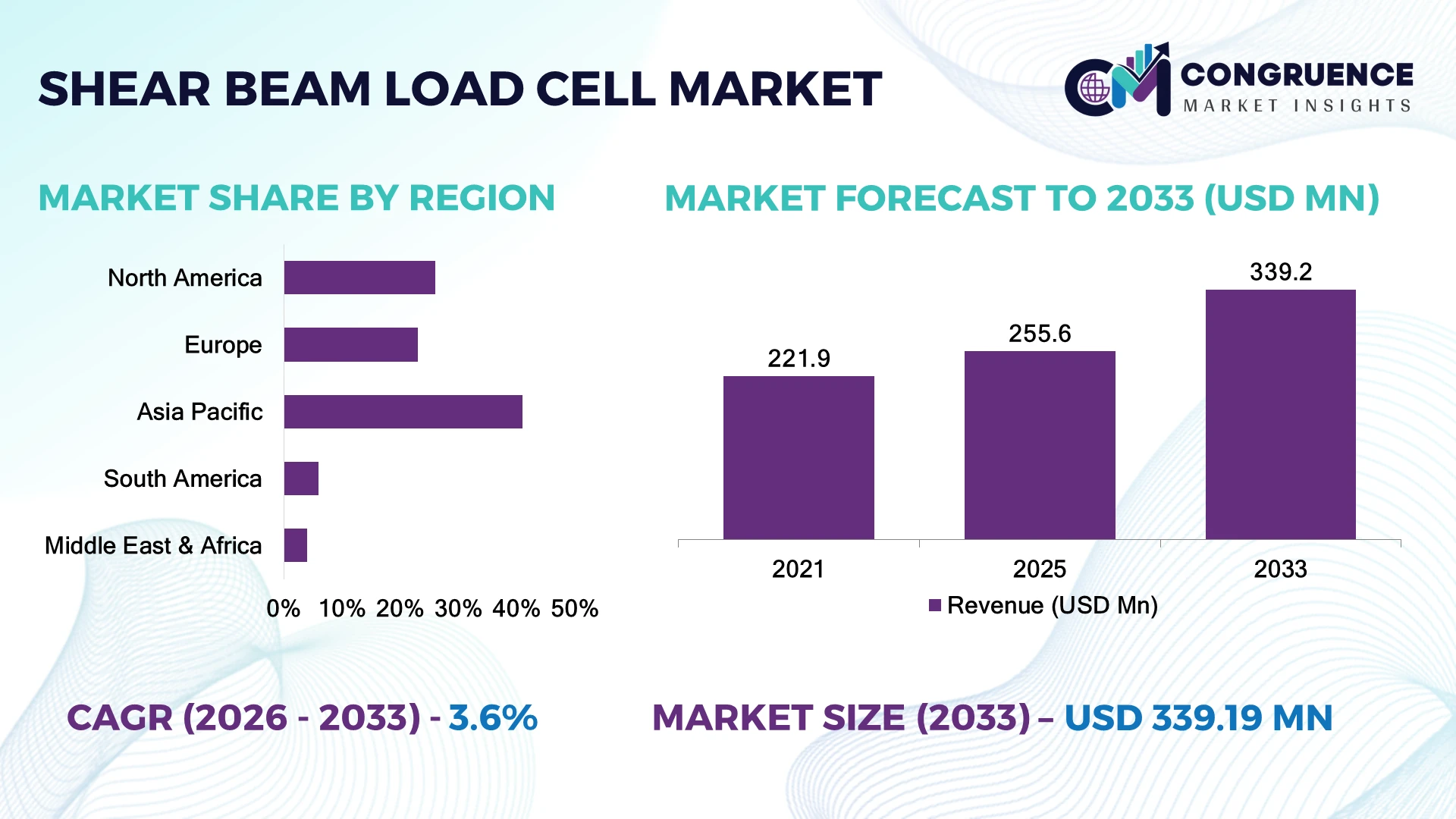
The Global Shear Beam Load Cell Market was valued at USD 255.6 Million in 2025 and is anticipated to reach a value of USD 339.2 Million by 2033 expanding at a CAGR of 3.6% between 2026 and 2033. Growth is driven by increasing automation across industrial weighing systems, logistics infrastructure, food processing, and precision material handling requiring high-accuracy force measurement.
China dominates the global market with approximately 34% manufacturing capacity, supported by investments exceeding USD 2 billion in industrial automation and smart manufacturing initiatives. The country records over 65% adoption of digital weighing systems across major logistics and manufacturing facilities, compared with Germany's nearly 48% adoption in advanced industrial production. Ongoing supply-chain diversification following post-pandemic manufacturing realignments further strengthens China's production leadership and export competitiveness.
Manufacturers prioritizing digital calibration, localized production, and Industry 4.0 integration are strengthening long-term competitive positioning across industrial weighing applications.
Market Size & Growth: Valued at USD 255.6 Million in 2025 and projected to reach USD 339.2 Million by 2033, supported by 3.6% CAGR and expanding factory automation investments.
Top Growth Drivers: Industrial automation (+18%), warehouse modernization (+15%), and smart logistics deployment (+21%) continue accelerating product adoption.
Short-Term Forecast: By 2028, digital weighing systems improve operational efficiency by nearly 20% while maintenance costs decline by approximately 15%.
Emerging Technologies: AI-enabled diagnostics, wireless load monitoring, and stainless-steel sensor engineering enhance precision, uptime, and predictive maintenance.
Regional Leaders: Asia-Pacific approaches USD 145 Million, North America exceeds USD 82 Million, and Europe nears USD 71 Million, driven by manufacturing modernization and supply-chain expansion.
Consumer/End-User Trends: More than 62% of industrial facilities prefer digitally integrated load cells for automated weighing operations.
Pilot/Case Example: In 2024, a smart logistics warehouse deployment improved weighing accuracy by 19% while reducing loading-cycle delays by 14%.
Competitive Landscape: Vishay Precision Group holds approximately 16% market share alongside Flintec, MinebeaMitsumi, HBM, and FUTEK Advanced Sensor Technology.
Regulatory & ESG Impact: Industrial energy-efficiency standards reduce equipment power consumption by nearly 12% through optimized sensor integration.
Investment & Funding: More than USD 900 Million has been directed toward factory automation, production expansion, and strategic industrial partnerships.
Innovation & Future Outlook: Edge-enabled diagnostics, Industrial IoT connectivity, and intelligent calibration software continue reshaping advanced industrial weighing ecosystems.
Industrial automation, warehouse digitization, food processing, and logistics remain the strongest demand centers for shear beam load cells. Manufacturers increasingly introduce IoT-enabled monitoring, digital calibration, and corrosion-resistant stainless-steel designs to improve operational reliability. Nearly 40% of new industrial weighing installations now incorporate connected sensing capabilities, while supply-chain localization initiatives continue accelerating procurement resilience and production flexibility across major manufacturing economies.
The shear beam load cell market has become strategically important as manufacturers compete to improve production accuracy, warehouse efficiency, and digital process control. Industrial automation programs, supply-chain restructuring, and smart factory investments continue redefining procurement priorities. Companies increasingly integrate intelligent sensing technologies into weighing equipment to support real-time operational visibility and minimize production inconsistencies across manufacturing, logistics, and food processing facilities.
Modern digital shear beam load cells deliver nearly 25% faster calibration and reduce maintenance requirements by approximately 18% compared with conventional analog systems. China continues scaling manufacturing capacity through automation investments, while Germany emphasizes precision engineering and high-performance industrial instrumentation. Over the next two to three years, connected industrial weighing platforms are expected to account for more than 45% of newly deployed systems across advanced manufacturing facilities.
Leading suppliers are expanding localized production, strengthening distributor partnerships, and investing in Industrial IoT-compatible product portfolios. A recent warehouse automation deployment demonstrated measurable improvements in inventory accuracy and loading efficiency through continuous weight monitoring. Organizations that prioritize intelligent sensing integration, production flexibility, and digital service capabilities will secure stronger competitive positioning across increasingly automated industrial ecosystems.
Rapid expansion of industrial automation is increasing demand for high-accuracy shear beam load cells across manufacturing, logistics, and process industries. More than 60% of newly automated production lines incorporate digital weighing technologies, while warehouse automation projects have increased by approximately 22% over recent years. China's smart manufacturing initiatives continue expanding advanced industrial infrastructure, encouraging greater deployment of precision sensors. This transition improves process consistency, minimizes material losses, and enhances production efficiency. Manufacturers are responding through expanded production facilities, Industrial IoT integration, and strategic collaborations with automation system providers. Companies combining intelligent diagnostics with durable sensor platforms gain stronger operational differentiation and long-term industrial customer retention.
Volatility in stainless steel and electronic component prices continues affecting production economics for shear beam load cell manufacturers. Raw material costs have fluctuated by nearly 17%, while semiconductor lead times remain approximately 20% longer than pre-pandemic averages in several supply chains. Strict industrial certification requirements further extend product qualification cycles, delaying commercial deployment. These constraints increase manufacturing costs and reduce pricing flexibility for suppliers serving multiple industrial sectors. Companies are reducing exposure through localized sourcing strategies, long-term supplier agreements, and diversified procurement networks. Businesses capable of strengthening regional supply resilience maintain better operational continuity and delivery performance under evolving global trade conditions.
Industrial IoT adoption and predictive maintenance platforms are creating new commercial opportunities for advanced shear beam load cells. Connected manufacturing facilities report up to 28% lower unplanned downtime through continuous equipment monitoring, while digital asset management improves maintenance planning by approximately 24%. Japan and South Korea continue investing heavily in smart manufacturing initiatives supporting intelligent sensing deployment. Companies are developing wireless monitoring platforms, cloud-based diagnostics, and AI-assisted calibration technologies to strengthen equipment performance. Strategic partnerships between sensor manufacturers and industrial automation providers enable integrated weighing ecosystems that deliver measurable operational efficiency while expanding recurring software and service opportunities.
Integrating advanced shear beam load cells into legacy industrial infrastructure remains a significant execution challenge. Nearly 35% of older production facilities require additional control system upgrades before supporting connected weighing technologies, while implementation timelines increase by approximately 18% when interoperability issues arise. Industrial cybersecurity requirements also continue expanding as more weighing equipment becomes network connected. These factors influence deployment consistency, operational resilience, and long-term maintenance planning. Companies must invest in standardized communication protocols, workforce training, cybersecurity capabilities, and collaborative technology partnerships. Organizations successfully addressing integration complexity will establish stronger operational scalability and sustained competitive advantage across digitally transformed industrial environments.
Smart Weighing Platform Integration Industrial facilities are rapidly integrating shear beam load cells with Industrial IoT platforms, with connected weighing installations increasing by nearly 32% and remote diagnostics adoption surpassing 46%. Automated calibration workflows reduce inspection time by approximately 18%, improving production continuity. Rising digital manufacturing initiatives in Germany and Japan continue accelerating deployment, while equipment suppliers are expanding software partnerships and embedding cloud-based monitoring capabilities to deliver predictive maintenance and higher operational visibility.
Localized Manufacturing Expansion Supply-chain diversification has encouraged manufacturers to regionalize production, with localized sourcing increasing by nearly 24% and average component lead times declining by about 17%. Post-pandemic procurement restructuring and evolving trade policies have prompted enterprises to establish assembly operations closer to industrial customers. Companies are expanding regional production centers, strengthening supplier networks, and redesigning procurement strategies to improve delivery consistency while reducing logistics risks and inventory exposure.
Advanced Stainless-Steel Sensor Designs Demand for corrosion-resistant shear beam load cells has increased by approximately 21% across food processing, pharmaceutical, and chemical industries. New hygienic sensor designs improve equipment service life by nearly 16% while reducing maintenance interventions by around 14%. Compliance with stricter industrial sanitation requirements is accelerating replacement cycles, encouraging manufacturers to introduce sealed, washdown-certified products and invest in advanced material engineering for long-term operational reliability.
Automation Addresses Labor Constraints Industrial labor shortages continue accelerating automated weighing deployment, with automated material-handling systems expanding by roughly 27% and manual weighing tasks declining by nearly 19%. Large logistics operators in China increasingly deploy intelligent weighing stations to improve throughput and minimize operator dependency. Equipment manufacturers are responding through automation-focused product portfolios, robotics integration partnerships, and modular sensor architectures that simplify installation across high-volume distribution and manufacturing facilities.
The market is segmented into Single-Ended Shear Beam Load Cells, Double-Ended Shear Beam Load Cells, Stainless Steel Shear Beam Load Cells, Alloy Steel Shear Beam Load Cells, and Others. Single-Ended Shear Beam Load Cells lead with an estimated 41% market share because of their compact design, cost efficiency, and seamless integration into platform scales, conveyor systems, and industrial batching equipment. Their widespread compatibility with automated weighing infrastructure continues supporting strong replacement demand. Stainless Steel Shear Beam Load Cells represent the fastest-growing segment as food, pharmaceutical, and chemical industries increasingly prioritize corrosion resistance and hygienic processing environments. Adoption of stainless-steel variants has increased by nearly 23%, while demand for digital-ready configurations has grown by approximately 19%. Double-Ended Shear Beam Load Cells remain preferred for heavy-capacity industrial applications requiring enhanced structural stability, whereas Alloy Steel variants continue serving general manufacturing and logistics operations where durability and cost optimization remain priorities. Manufacturers are expanding product portfolios through digital calibration, IP-rated enclosures, and customized industrial solutions while increasing investment in intelligent sensing technologies to strengthen long-term differentiation.
The market is segmented into Industrial Weighing Systems, Platform Scales, Tank and Hopper Weighing, Conveyor Belt Weighing, Material Handling Equipment, and Others. Industrial Weighing Systems account for approximately 38% of market demand as manufacturers increasingly deploy precision load measurement across production lines, packaging operations, and warehouse automation. The segment benefits from high equipment utilization, process consistency, and digital manufacturing integration. Tank and Hopper Weighing represents the fastest-growing application, supported by expanding chemical, food processing, and pharmaceutical production. Adoption within automated process plants has increased by nearly 22%, while connected monitoring installations have expanded by approximately 20%. Platform Scales continue serving logistics and commercial weighing operations, while Conveyor Belt Weighing gains importance across mining and bulk material transportation. Material Handling Equipment is strengthening its market position through warehouse automation and robotic logistics expansion. Suppliers are scaling production, integrating Industrial IoT compatibility, and strengthening automation partnerships to support evolving industrial process requirements and improve operational productivity.
The market is segmented into Manufacturing, Logistics and Warehousing, Food and Beverage, Pharmaceuticals, Mining, and Others. Manufacturing remains the largest end-user with an estimated 36% market share due to extensive deployment across production automation, assembly operations, and quality control systems. High production intensity and continuous process optimization sustain consistent equipment demand. Logistics and Warehousing represents the fastest-growing buyer group as automated fulfillment centers and smart distribution facilities expand globally. Automated warehouse weighing deployments have increased by approximately 26%, while digital inventory management adoption has improved by nearly 24%. Food and Beverage companies continue investing in hygienic weighing infrastructure to satisfy quality and sanitation standards, whereas Pharmaceuticals prioritize high-precision measurement for regulated production environments. Mining maintains stable demand for heavy-duty weighing applications supporting bulk material movement. Manufacturers are strengthening competitive positioning through customized product configurations, enterprise partnerships, industry-specific calibration services, and integrated automation ecosystems tailored to operational requirements.
Asia-Pacific accounted for the largest market share at 41% in 2025 however, North America is expected to register the fastest growth, expanding at a CAGR of 4.2% between 2026 and 2033.

North America represents approximately 26% of the global market, supported by advanced manufacturing, automated logistics, and widespread deployment of digital weighing systems. Industrial facilities continue replacing conventional weighing equipment with connected load cell technologies integrated into Industrial IoT platforms. Nearly 68% of newly commissioned warehouse automation projects incorporate digital weighing solutions to improve operational accuracy and inventory visibility. Food processing, pharmaceuticals, aerospace, and logistics remain the primary deployment sectors. Ongoing modernization of manufacturing facilities and investment in intelligent factory infrastructure continue strengthening demand. Companies are expanding local engineering capabilities, increasing calibration services, and establishing technology partnerships to improve lifecycle support and accelerate deployment across industrial enterprises.
United States Market Outlook: The United States remains the region's largest market because of its advanced industrial base, extensive logistics infrastructure, and continuous investment in factory automation. More than 70% of large manufacturing facilities have implemented some level of automated weighing integration within production operations. Expansion of e-commerce fulfillment centers, food manufacturing capacity, and industrial robotics deployment continues supporting demand for precision load measurement solutions, while domestic manufacturers strengthen competitiveness through digital calibration technologies, localized production, and Industrial IoT-enabled product development.
Europe accounts for approximately 23% of the global market, supported by precision engineering, advanced manufacturing standards, and extensive industrial automation. Manufacturers increasingly deploy intelligent weighing systems across automotive, pharmaceutical, and food processing facilities to improve production consistency and regulatory compliance. Around 61% of newly upgraded industrial production lines incorporate digitally integrated weighing equipment to enhance process monitoring and operational efficiency. Sustainability initiatives also encourage replacement of aging equipment with energy-efficient sensor technologies. Companies continue investing in intelligent manufacturing platforms, expanding engineering partnerships, and strengthening regional production capabilities to support evolving industrial requirements and improve equipment reliability.
Germany Market Outlook: Germany leads the European market through its globally competitive machinery manufacturing sector, advanced industrial automation ecosystem, and strong engineering expertise. Nearly 65% of smart factory modernization projects integrate precision weighing technologies into automated production environments. Domestic manufacturers continue investing in intelligent sensor innovation, digital production infrastructure, and export-oriented manufacturing capabilities, reinforcing Germany's leadership in high-performance industrial weighing solutions across automotive, chemicals, and precision engineering industries.
Asia-Pacific contributes approximately 41% of global market demand, benefiting from extensive manufacturing capacity, expanding logistics infrastructure, and strong industrial automation investments. Large-scale production of electronics, machinery, food products, and industrial equipment continues driving deployment of precision weighing technologies across factories and distribution centers. More than 64% of newly established manufacturing facilities in major industrial economies deploy automated weighing systems during initial infrastructure development. Export-oriented production, expanding warehouse automation, and government-backed smart manufacturing initiatives continue strengthening regional competitiveness. Companies are increasing localized manufacturing, expanding supplier networks, and investing in digital weighing technologies to improve production efficiency and supply-chain responsiveness.
China Market Outlook: China remains the dominant national market because of its large industrial manufacturing base, integrated supply chain, and significant investment in intelligent factory development. Approximately 34% of global shear beam load cell manufacturing capacity is concentrated in China, supported by rapid expansion of automated production facilities. Domestic enterprises continue strengthening export capabilities, digital manufacturing adoption, and advanced sensor production while increasing collaboration with automation equipment providers to serve both domestic and international industrial markets.
South America accounts for approximately 6% of the global market, with demand primarily driven by mining, agriculture, food processing, and logistics modernization. Industrial operators increasingly deploy digital weighing technologies to improve production control, bulk material handling, and operational efficiency. Automated weighing installations across large industrial facilities have increased by approximately 18% over recent years, supported by warehouse upgrades and modernization of manufacturing infrastructure. Although infrastructure investment varies across countries, expanding industrial automation initiatives continue improving deployment opportunities. Equipment suppliers are strengthening distributor partnerships, expanding regional service capabilities, and increasing localized technical support to improve implementation efficiency and customer retention.
Brazil Market Outlook: Brazil represents the largest market in South America owing to its diversified manufacturing sector, mining industry, and expanding agricultural processing infrastructure. More than 55% of large industrial processing facilities utilize automated weighing technologies for production monitoring and inventory management. Industrial modernization programs, logistics improvements, and continued investment in food manufacturing support increasing adoption, while suppliers expand technical service networks and customized industrial solutions for high-volume processing operations.
The Middle East & Africa accounts for approximately 4% of the global market, supported by industrial diversification, logistics infrastructure expansion, and modernization of manufacturing facilities. Governments continue investing in industrial zones, warehouse development, and automated material-handling systems to improve operational productivity. Nearly 20% more industrial weighing equipment has been deployed within newly developed logistics facilities over recent years. Energy, food processing, construction materials, and port logistics remain key deployment sectors. Companies are strengthening regional partnerships, expanding technical support capabilities, and introducing durable weighing technologies designed for demanding operating environments and large-scale infrastructure projects.
Saudi Arabia Market Outlook: Saudi Arabia leads the regional market through sustained industrial diversification, logistics expansion, and large-scale infrastructure investment under national economic transformation programs. Automated industrial facilities continue expanding across manufacturing and logistics sectors, with digital weighing deployment increasing by approximately 22% in newly commissioned industrial projects. Equipment suppliers are strengthening local partnerships, enhancing engineering support, and expanding distribution capabilities to serve growing demand across industrial production, warehousing, and infrastructure development.
The competitive landscape is led by Vishay Precision Group, Flintec, MinebeaMitsumi, Interface Inc., and FUTEK Advanced Sensor Technology, while regional manufacturers compete aggressively on pricing and delivery speed. Global technology leaders compete against cost-focused Asian suppliers, whereas OEM-integrated manufacturers challenge independent load cell specialists through customized industrial solutions. The top five companies collectively control approximately 48% of the global market. Competition is driven by measurement accuracy, digital connectivity, product durability, customization capability, and supply-chain responsiveness. Manufacturers offering Industrial IoT-ready products achieve nearly 20% faster deployment, while localized production reduces lead times by approximately 18% and customized engineering improves customer retention by nearly 15%. Companies continue expanding manufacturing capacity, strengthening distributor partnerships, investing in intelligent calibration technologies, and vertically integrating sensor production. Competitive momentum is shifting toward digitally connected weighing ecosystems and application-specific solutions rather than standardized hardware alone. High certification requirements, precision manufacturing expertise, and long customer qualification cycles remain significant entry barriers. Success depends on innovation, application engineering, rapid delivery, and dependable lifecycle support.
Flintec Group AB
MinebeaMitsumi Inc.
Interface, Inc.
FUTEK Advanced Sensor Technology, Inc.
ZEMIC Europe B.V.
Thames Side Sensors Ltd.
Rice Lake Weighing Systems
LAUMAS Elettronica S.r.l.
Hardy Process Solutions
HBM (Hottinger Brüel & Kjær)
Keli Sensing Technology (Ningbo) Co., Ltd.
Digital shear beam load cells are replacing conventional analog systems across industrial weighing operations through embedded signal processing, onboard diagnostics, and Industrial IoT connectivity. Digital platforms improve measurement stability by approximately 22% while reducing calibration time by nearly 25%. More than 58% of newly installed industrial weighing systems now support Ethernet- or fieldbus-enabled communication, allowing continuous monitoring and predictive maintenance. Manufacturers adopting intelligent sensing platforms achieve higher operational reliability, faster commissioning, and improved production traceability.
Emerging technologies include wireless load monitoring, AI-assisted calibration, edge computing, and cloud-based asset management. Compared with legacy analog equipment, AI-enabled diagnostic systems reduce unexpected maintenance events by approximately 20% and improve fault detection accuracy by nearly 18%. Stainless-steel laser-welded sensor construction and advanced strain-gauge materials further enhance corrosion resistance and long-term measurement consistency. Large manufacturing enterprises and warehouse automation providers benefit most from these technologies because they improve process continuity while lowering service intervention requirements.
Between 2026 and 2028, intelligent weighing ecosystems will increasingly integrate robotics, autonomous material handling, and digital twin platforms. Adoption of predictive analytics is expected to exceed 45% across advanced manufacturing facilities, enabling faster production optimization and improved asset utilization. Companies investing early in connected sensor architecture, software-enabled diagnostics, and interoperable automation platforms will strengthen competitive differentiation, accelerate deployment efficiency, and establish long-term advantages in industrial weighing applications.
March 2025 – Flintec introduced the SSB7 beam load cell for onboard vehicle weighing with 8-ton and 12-ton capacity variants, featuring IP68 protection and OIML C3 certification to improve fleet weighing accuracy and simplify installation. Source: www.flintec.com
May 2025 – Flintec opened a dedicated strain gauge manufacturing facility in Sri Lanka, expanding in-house sensor production and strengthening supply-chain resilience through vertically integrated manufacturing for precision weighing products. Source: www.flintec.com
July 2025 – Flintec achieved ISO 50001 certification across its Sri Lankan manufacturing facilities, reinforcing energy-management performance and supporting more efficient production operations through internationally recognized sustainability standards. Source: www.flintec.com
June 2025 – Vishay Intertechnology introduced new high-reliability isolation amplifiers with industry-leading common-mode transient immunity for precision industrial applications, strengthening measurement performance and supporting advanced sensing system integration.
The report provides comprehensive analysis of the global shear beam load cell market across major product types, applications, end-users, and regional markets. It evaluates deployment trends across single-ended, double-ended, stainless steel, alloy steel, and specialized load cell variants while assessing demand from industrial weighing, platform scales, tank and hopper weighing, conveyor systems, and material handling applications. Regional assessment covers North America, Europe, Asia-Pacific, South America, and the Middle East & Africa, with country-level strategic analysis for major industrial economies.
The study examines technology adoption, digital weighing integration, Industrial IoT deployment, automation trends, competitive positioning, and enterprise expansion strategies. More than 60% of recent industrial weighing installations incorporate digitally connected measurement solutions, reflecting the industry's transition toward intelligent manufacturing. The report supports investment planning, product development, market entry, partnership evaluation, competitive benchmarking, and expansion strategy by identifying operational trends, deployment priorities, emerging application opportunities, and strategic market direction across the 2026–2033 forecast period.
| Report Attribute / Metric | Details |
|---|---|
| Market Revenue (2025) | USD 255.6 Million |
| Market Revenue (2033) | USD 339.2 Million |
| CAGR (2026–2033) | 3.6% |
| Base Year | 2025 |
| Forecast Period | 2026–2033 |
| Historic Period | 2021–2025 |
| Segments Covered |
By Type
By Application
By End-User
|
| Key Deliverables | Revenue Forecast; Market Trends; Growth Drivers & Restraints; Technology Insights; Segmentation Analysis; Regional Insights; Competitive Landscape; Regulatory & ESG Overview; Recent Developments |
| Regions Covered | North America; Europe; Asia-Pacific; South America; Middle East & Africa |
| Companies Profiled | Vishay Precision Group, Inc.; Flintec Group AB; MinebeaMitsumi Inc.; Interface, Inc.; FUTEK Advanced Sensor Technology, Inc.; ZEMIC Europe B.V.; Thames Side Sensors Ltd.; Rice Lake Weighing Systems; LAUMAS Elettronica S.r.l.; Hardy Process Solutions; HBM (Hottinger Brüel & Kjær); Keli Sensing Technology (Ningbo) Co., Ltd. |
| Customization & Pricing | Available on Request (10% Customization Free) |




