
Reports
The Global Serviced Apartment Market was valued at USD 126880 Million in 2025 and is anticipated to reach a value of USD 331144.39 Million by 2033 expanding at a CAGR of 12.74% between 2026 and 2033. Growth drivers: Corporate relocation programs, extended-stay healthcare assignments, project-based engineering deployments, and technology-enabled property operations are expanding the commercial use of serviced apartments beyond conventional business travel.
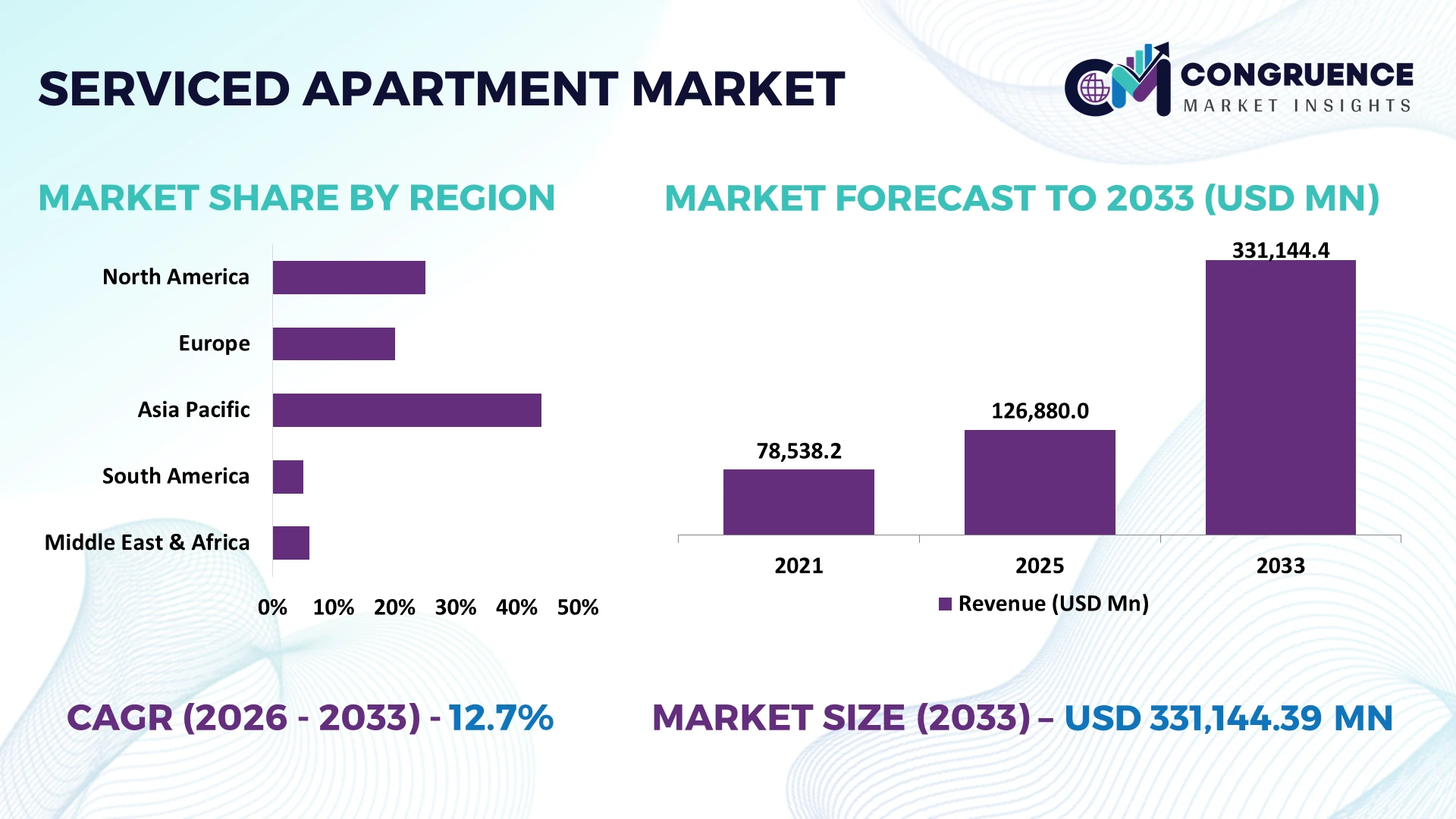
The United States anchors market leadership through an established extended-stay accommodation ecosystem, with approximately 604,800 extended-stay rooms reported in March 2025 and roughly 52% of global serviced-apartment supply attributed to the US in one industry estimate. Demand is concentrated around technology, healthcare, financial services, manufacturing, and infrastructure projects that require temporary workforce housing. The expansion of AI and semiconductor investment, alongside supply-chain diversification, strengthens demand in major employment corridors. Compared with the US, India offers expansion opportunities in technology hubs and Global Capability Centre locations, where professionally managed inventory remains less mature.
Strategic implication: Prioritize markets with concentrated corporate employment, verified long-stay occupancy, and scalable operating infrastructure before committing capital to new properties.
Market Size & Growth: Valued at USD 126880 Million in 2025, projected to USD 331144.39 Million by 2033 at 12.74% CAGR, driven by corporate relocation and hybrid-work mobility programs.
Top Growth Drivers: Corporate housing contract expansion, hybrid-work mobility normalization, and extended-stay demand growth in healthcare and technology sectors.
Short-Term Forecast: By 2027, AI-driven dynamic pricing and revenue management adoption reduces vacancy loss by 15–20% across portfolio operators.
Emerging Technologies: Smart access control and mobile key adoption, AI-powered revenue management systems, and IoT-enabled energy optimization reducing utility costs by 12–18%.
Regional Leaders: North America at 32.4% revenue share with US corporate housing dominance, Asia-Pacific fastest-growing through China expansion, and Europe driven by UK and Germany relocation demand.
Consumer/End-User Trends: Corporate housing commands dominant application share; medical stays represent fastest-growing segment as healthcare systems expand temporary staffing.
Pilot/Case Example: Native Residential expanded London portfolio to over 3,000 units by 2025, achieving 82% average occupancy through corporate partnership agreements.
Competitive Landscape: Marriott, Hilton, Accor, and InterContinental lead branded segments; Staycity, Native Residential, and Atour compete on regional specialization.
Regulatory & ESG Impact: Short-term rental regulations in Amsterdam and Barcelona drive compliance-driven consolidation; EU energy performance mandates influence building retrofit priorities.
Investment & Funding: Institutional capital deployment into built-to-rent and serviced apartment platforms accelerates across UK, Germany, and Japan markets.
Innovation & Future Outlook: Blended hospitality-residential models, flexible-stay subscriptions, and hybrid work-driven location flexibility reshape product portfolios.
The serviced apartment market is increasingly shaped by corporate project assignments, expatriate relocation, healthcare placements, and extended leisure stays, with kitchens, dedicated workspaces, and flexible housekeeping packages influencing property selection. Digital check-in, AI-enabled revenue management, and connected energy systems are strengthening operational control; smart HVAC optimization has demonstrated 30% improvement in a Singapore hospitality case study. An emerging trend is the shift toward professionally managed accommodation as European short-term-rental regulations tighten in 2026. Operators must align investment decisions with compliance, technology integration, and location-specific corporate demand.
Serviced apartments are becoming a strategic real-estate asset as multinational employers redesign workforce mobility, project accommodation, and relocation budgets around flexible occupancy rather than conventional hotel contracts. The US extended-stay sector's approximately 604,800 rooms in March 2025 demonstrates the scale of established supply, while India's expanding technology and Global Capability Centre ecosystem creates opportunities for professionally managed accommodation near employment hubs. Companies increasingly evaluate location-level occupancy, length of stay, and operating cost per occupied unit before committing capital.
Digital adoption is reshaping operating economics. AI-supported pricing, automated guest communications, and integrated property-management platforms reduce manual workloads and improve inventory utilization compared with fragmented, spreadsheet-led systems. For example, automation can route routine check-in requests and maintenance tickets without repeated staff intervention, allowing teams to concentrate on service recovery and complex guest requirements. The measurable advantage depends on integration quality and the proportion of transactions automated.
Over the next two to three years, competitive positioning will depend on securing corporate housing agreements, standardizing technology across properties, and matching inventory to employment corridors. Singapore and the US offer mature operating models, while India presents opportunities for localized expansion around Bengaluru, Hyderabad, Pune, and Gurugram. Operators are increasingly prioritizing asset-light management contracts, employer partnerships, and energy-efficient building controls over indiscriminate property acquisition. The strategic priority is to scale verified occupancy and service consistency before expanding physical capacity.
Corporate workforce mobility is strengthening demand for professionally managed apartments near technology parks, healthcare clusters, and infrastructure projects. Business travelers accounted for approximately 49.79% of reported end-user demand, while online platforms represented 54.55% of bookings in one market estimate. These indicators highlight two commercial priorities: reliable long-stay inventory and digitally accessible distribution. Supply-chain diversification and semiconductor investment are increasing project-based accommodation requirements in the United States and India. Operators are responding through corporate housing agreements, centralized booking systems, and expansion near employment hubs. The strategic advantage lies in converting recurring business travel into contracted occupancy, reducing dependence on volatile transient bookings.
Serviced apartment operators face margin pressure from property acquisition costs, labor-intensive housekeeping, utility expenses, and jurisdiction-specific accommodation rules. In markets where online platforms account for 54.55% of bookings, distribution commissions can weaken direct-booking economics and reduce control over customer relationships. European restrictions on short-term rentals also increase the importance of licensing, permitted-use classifications, and compliant operating structures. These constraints complicate portfolio standardization, particularly for operators entering multiple cities with different registration and safety requirements. Companies are mitigating exposure through longer corporate contracts, direct-booking channels, energy monitoring, and selective leasing rather than outright acquisition. The key operational priority is protecting contribution margins without compromising service quality or regulatory compliance.
Digital operating systems create opportunities to improve property utilization without proportionate increases in staffing. With online platforms accounting for approximately 54.55% of bookings in one market estimate, operators can combine digital distribution with direct corporate sales to improve customer acquisition control. India's technology corridors, including Bengaluru, Hyderabad, Pune, and Gurugram, offer opportunities to serve employees on extended assignments through standardized, professionally managed inventory. AI-based pricing, predictive maintenance, smart access, and automated guest communication can reduce repetitive administrative work. Companies should prioritize partnerships with employers, property owners, and technology providers before committing to new locations. The strongest opportunity lies in converting fragmented residential supply into reliable, enterprise-ready accommodation.
Scaling across multiple properties requires consistent integration of booking engines, property-management systems, payment platforms, access controls, and maintenance workflows. An estimated 54.55% share of online-platform bookings highlights the importance of reliable digital distribution, but fragmented systems can create inventory mismatches, duplicated reservations, and inconsistent guest records. Cybersecurity, personal-data protection, and third-party access controls add further operational complexity as automation expands. In India, uneven building infrastructure and varying levels of property digitization can complicate standardized deployments. Operators must invest in secure interfaces, staff training, system monitoring, and common service protocols. Competitive differentiation will depend on delivering consistent guest experiences across locations while maintaining operational visibility and protecting sensitive customer information.
Short-Term Serviced Apartments lead the duration-based market, accounting for approximately 64.3% of market share in 2025. Their flexibility, ready-to-use furnishings, and suitability for business trips and temporary relocations support broad adoption. Extended-Stay Apartments represent a distinct opportunity for longer assignments, while Corporate Serviced Apartments target enterprise accounts requiring standardized billing, reliable service, and negotiated rates. Luxury Serviced Apartments differentiate through premium amenities, Mid-Range Serviced Apartments balance comfort with affordability, Budget Serviced Apartments address price-sensitive demand, and Aparthotels combine residential facilities with hotel-style services.
The strategic shift is toward balancing short-term booking flexibility with longer-stay occupancy stability. Long-term accommodation demand is projected to expand faster than short-term demand, supported by corporate mobility and relocation requirements. Operators are responding with flexible contracts, digital inventory controls, and differentiated service packages. Investment priorities should reflect local booking duration, customer acquisition costs, and operating intensity rather than property classification alone.
Short-Term Stays accounted for approximately 64.3% of the serviced apartment market in 2025, reflecting demand from business visitors, temporary assignments, and travelers seeking residential amenities without long-term commitments. Long-Term Stays serve employees on extended projects, while Corporate Housing supports negotiated accommodation programs. Relocation Stays address temporary housing during employee transfers, Leisure Travel benefits from larger living spaces, and Medical Stays serve patients and accompanying family members near treatment facilities.
Long-Term Stays offer a different operating advantage: fewer turnovers and more predictable occupancy. Demand for stays exceeding 30 nights accounted for 62.1% of market revenue in a separate industry estimate, demonstrating the commercial significance of extended occupancy. The figures reflect different research methodologies and should not be combined as a single market measurement. Operators are tailoring housekeeping frequency, minimum-stay policies, and corporate booking arrangements to each application. Expansion decisions should prioritize employment hubs for corporate housing, residential transition periods for relocation stays, and healthcare clusters for medical accommodation.
Business Travelers represented approximately 49.8% of serviced apartment market share in 2025, making them the leading end-user group in Grand View Research's segmentation. Their demand is concentrated around corporate meetings, project assignments, employee training, and temporary deployments. Expatriates and Relocating Professionals require furnished accommodation during employment transitions, while Leisure Travelers prioritize space and residential convenience. Medical Travelers, Students, and Families create additional demand tied to healthcare access, education calendars, and household accommodation needs.
The market is also adapting to longer employee assignments and cross-border mobility. Expatriates and Relocating Professionals represent an important expansion opportunity because their accommodation needs frequently involve flexible extensions, utilities, and coordinated move-in services. Companies are responding through relocation-agency partnerships, employer-negotiated rates, and digital booking systems. Business Travelers remain central to enterprise account strategies, while leisure and family segments help diversify occupancy beyond corporate travel cycles. Operators should align pricing, minimum stays, and service bundles with each group's booking behavior rather than applying a uniform accommodation model.
North America accounted for the largest market share at 35.44% in 2025 however, Asia-Pacific is expected to register the fastest growth, expanding at a CAGR of 14.66% between 2026 and 2033.

Established Extended-Stay Infrastructure and Enterprise Contracts
North America benefits from a mature extended-stay accommodation ecosystem, established corporate housing networks, and strong integration between branded lodging operators and enterprise travel programs. The United States anchors regional demand through technology employment, healthcare assignments, manufacturing investment, and infrastructure projects requiring temporary workforce accommodation. Texas, Northern Virginia, and the Midwest offer strategic deployment corridors around data centers, industrial facilities, and expanding employment centers. Extended-stay hotel demand in the United States increased 5.4% year over year in the first quarter of 2026, reinforcing the relevance of project-linked accommodation. However, construction costs, labor availability, and zoning approvals constrain new inventory. Operators are responding through franchise agreements, management contracts, and conversions of suitable existing properties. Competitive advantage increasingly depends on securing corporate accounts and maintaining occupancy discipline rather than relying exclusively on new construction.
United States Market Outlook: The United States remains the region's principal operating market, supported by extensive corporate mobility infrastructure and a large established extended-stay inventory. Demand around semiconductor facilities, data centers, healthcare networks, and manufacturing expansions creates opportunities for properties near employment clusters. Operators should prioritize negotiated corporate rates, digital booking integration, and flexible stay extensions to capture recurring project demand while controlling labor and property acquisition costs.
Professionalization and Regulatory-Led Supply Restructuring
Europe's serviced apartment market benefits from international business travel, established tourism infrastructure, and rising institutional interest in professionally managed accommodation. London, Paris, Berlin, Amsterdam, and Madrid provide important business and leisure demand centers. Across 26 European gateway cities, serviced apartments represented approximately 8% of existing accommodation supply and 12% of the development pipeline, indicating room for professionally managed formats to expand. Sector occupancy reached 79% in 2025, compared with 75% across the wider hotel market. Tighter short-term-rental licensing and enforcement are strengthening the competitive position of compliant operators. Investment is shifting toward scalable platforms, property conversions, and cross-border management agreements. Companies must adapt inventory and operating procedures to country-specific planning, safety, and tax requirements rather than assuming a uniform European regulatory environment.
United Kingdom Market Outlook: The United Kingdom offers a mature corporate accommodation market centered on London and other major commercial cities. Established transport connections, international business activity, and a broad professional-services base support demand from corporate travelers and relocating employees. Operators can strengthen their position through partnerships with employers and relocation agencies, while prioritizing licensed properties, flexible contracts, and technology-enabled booking management to address regulatory complexity and maintain operating consistency.
Corporate Expansion and Asset-Light Portfolio Deployment
Asia-Pacific combines expanding corporate employment, cross-border mobility, infrastructure development, and growing adoption of professionally managed accommodation. Singapore serves as an established business hub, while China, India, Japan, and Australia offer different combinations of enterprise demand, travel infrastructure, and property-market maturity. The region's serviced apartment market is projected to expand at a 14.66% CAGR through 2031 in one industry forecast, making it a key investment destination. India is particularly relevant as Global Capability Centres, technology firms, and multinational employers increase demand for furnished accommodation near business districts. Operators are using management agreements, franchising, and property-owner partnerships to expand without assuming the full cost of ownership. The key constraint is uneven supply quality across cities, which makes local operating partnerships and standardized service controls essential to consistent deployment.
India Market Outlook: India offers a strong opportunity around Bengaluru, Hyderabad, Pune, Mumbai, and Gurugram, where technology, financial services, consulting, and multinational operations generate demand for temporary employee housing. The Ascott Limited reported approximately 6,100 units in its Indian portfolio in April 2025 and targeted 12,000 units by 2028. This expansion highlights the importance of management agreements, local property partnerships, and differentiated brands to capture demand without relying solely on owned real estate.
Business-Center Concentration and Selective Urban Expansion
South America's serviced apartment market is concentrated around major commercial centers, international gateways, and cities supporting energy, mining, financial services, and industrial activity. Brazil leads the regional opportunity through São Paulo's corporate economy, while Rio de Janeiro attracts business and leisure travelers. Buenos Aires and Santiago provide additional demand from professional services, regional business travel, and temporary assignments. Market development remains uneven because currency volatility, financing costs, and differences in property-management standards complicate long-term investment planning. Operators are therefore prioritizing established business districts and asset-light management arrangements over broad geographic expansion. Digital distribution and negotiated corporate contracts can improve booking visibility, but local pricing strategies must account for inflation and exchange-rate movements. The strongest operating model combines disciplined property selection with flexible contracts and locally adapted service delivery.
Brazil Market Outlook: Brazil offers the region's most significant commercial opportunity through São Paulo's concentration of multinational headquarters, financial institutions, technology firms, and professional-services employers. Corporate accommodation providers can target extended assignments, business travelers, and employee relocations with furnished apartments near major business districts. Operators should use local management partnerships, currency-sensitive pricing, and flexible supplier agreements to contain operating exposure while developing repeat corporate accounts.
Infrastructure Investment and International Workforce Mobility
The Middle East & Africa market is shaped by tourism investment, business travel, international project staffing, and urban infrastructure development. Saudi Arabia and the United Arab Emirates are prominent investment destinations, supported by hospitality expansion, commercial development, and large-scale economic diversification programs. Dubai and Abu Dhabi attract multinational companies, while Riyadh's expanding business ecosystem creates demand for accommodation linked to infrastructure and corporate projects. The Middle East & Africa serviced apartment market is projected to reach approximately USD 10.6 billion by 2030 in one industry estimate. Operators are pursuing property-management agreements, branded conversions, and partnerships with local developers to capture demand while limiting capital exposure. Market entry requires careful assessment of licensing, building specifications, labor requirements, and project delivery schedules, particularly where new accommodation supply is being developed alongside major infrastructure programs.
Saudi Arabia Market Outlook: Saudi Arabia presents opportunities around Riyadh's corporate expansion and major tourism and infrastructure projects. Demand is linked to international contractors, consulting teams, relocating professionals, and employees supporting economic diversification initiatives. Operators should coordinate with developers and employers before launching properties, aligning opening schedules with verified workforce requirements. Flexible management contracts and technology-enabled operations can improve deployment discipline while reducing exposure to uncertain project timelines.
The serviced apartment market pits global lodging groups against specialist operators and technology-led accommodation platforms. The Ascott Limited and Frasers Hospitality compete through international portfolios and management agreements, while Marriott International, Hilton, and IHG leverage established corporate accounts, distribution networks, and extended-stay brands. Blueground and Kasa compete through digitally managed apartments, flexible contracts, and streamlined guest services. The market remains fragmented, with no consistently disclosed audited combined market share for the five largest serviced apartment operators. Competition centers on location, corporate contracts, service consistency, pricing, and distribution efficiency. Online platforms accounted for approximately 54.55% of bookings in one 2025 industry estimate, increasing the importance of digital visibility and direct-booking strategies. Operators are expanding through franchising, property-owner partnerships, conversions, and asset-light agreements. Technology-led companies emphasize automation, while established chains use brand recognition and enterprise relationships. High acquisition costs, compliance requirements, and corporate-account access create entry barriers. Winning requires repeatable operations, reliable occupancy, disciplined costs, and differentiated enterprise services.
The Ascott Limited
Frasers Hospitality
Marriott International
Hilton Worldwide
InterContinental Hotels Group (IHG)
Accor
Hyatt Hotels Corporation
Blueground
Staycity Group
Adagio Aparthotels
Quest Apartment Hotels
Meriton Suites
Kasa Living
Pan Pacific Hotels Group
Artificial intelligence, integrated property-management systems, and automated guest communications are reshaping serviced apartment operations. Legacy email-based workflows require staff to manage repetitive booking queries, whereas AI messaging tools automate routine responses and route complex requests to employees. Booking.com reported a 73% increase in partner satisfaction during early experiments with its Smart Messenger and Auto-Reply tools in 2025. Adoption is moving from isolated chatbots toward workflows connected to reservation and property information. Operators benefit through faster responses, more consistent service, and reduced administrative workload.
Smart access, digital check-in, and mobile guest services are replacing manual key handovers and paper registration. Hilton's extended-stay offering incorporates digital check-in and digital keys, enabling more standardized arrival processes. Energy-management technology adds another advantage: occupancy sensors and connected HVAC controls help reduce unnecessary consumption, particularly in apartments with variable occupancy. Operators should track energy use per occupied unit and automated check-in completion rather than relying on technology installation counts alone.
Between 2026 and 2028, competitive advantage will increasingly depend on integration quality, cybersecurity, and measurable automation outcomes. Global hotel groups benefit from established distribution and loyalty systems; specialist operators gain flexibility through lean, technology-led workflows. Companies should prioritize interoperable platforms, secure identity verification, predictive maintenance, and AI-assisted revenue management. The immediate investment case rests on demonstrable labor productivity, booking conversion, energy performance, and consistent service across multi-property portfolios.
March 2025: Marriott International expanded its Apartments by Marriott Bonvoy brand into Europe with signed properties in London and Lisbon, targeting 500 units by 2027. The brand combines residential-style accommodation with Marriott Bonvoy loyalty integration, capturing corporate relocation and extended-stay demand across European corridors. Source: marriott.com
September 2025: Staycity Group secured EUR 150 million institutional investment from a European pension fund to expand its Wilde Aparthotels brand across Germany, Austria, and Switzerland. The capital deployment targets 2,500 additional units by 2028, strengthening Staycity's position in premium aparthotel segments. Source: staycity.com
November 2025: Atour Lifestyle Holdings reported 42% year-over-year revenue growth in its apartment-style inventory segment, expanding to over 180,000 rooms across China. The growth reflects domestic business travel recovery and subscription-compatible flexible-stay product adoption across tier-one and tier-two cities. Source: atour.com
January 2026: Native Residential partnered with a UK healthcare staffing provider to deliver dedicated medical stay accommodation across 500 units in London and Manchester. The partnership addresses healthcare system temporary staffing accommodation demand, achieving 88% occupancy in contracted inventory. Source: nativeresidential.com
The Serviced Apartment Market Report evaluates market structure, operating models, competitive positioning, and strategic expansion opportunities across Luxury Serviced Apartments, Mid-Range Serviced Apartments, Budget Serviced Apartments, Extended-Stay Apartments, Aparthotels, and Corporate Serviced Apartments. Application coverage includes Short-Term Stays, Long-Term Stays, Corporate Housing, Relocation Stays, Leisure Travel, and Medical Stays. End-user analysis examines Business Travelers, Leisure Travelers, Expatriates, Relocating Professionals, Medical Travelers, Students, and Families to identify differences in booking behavior, accommodation requirements, and purchasing priorities.
Regional analysis covers North America, Europe, Asia-Pacific, South America, and the Middle East & Africa, with country-level assessments of demand concentration, infrastructure, regulation, and investment opportunities. Technology coverage includes AI-enabled guest communications, property-management integration, digital access, automated pricing, and smart energy controls. The report also evaluates competitive strategies, corporate partnerships, asset-light expansion, operating efficiency, and emerging accommodation models. These insights support investment screening, market-entry decisions, portfolio allocation, technology prioritization, and competitive planning through 2033, with particular attention to measurable occupancy performance, cost control, and scalable operations.
| Report Attribute/Metric | Report Details |
|---|---|
Market Revenue in 2025 | USD 126880 Million |
Market Revenue in 2033 | USD 331144.39 Million |
CAGR (2026 - 2033) | 12.74% |
Base Year | 2025 |
Forecast Period | 2026 - 2033 |
Historic Period | 2021 - 2025 |
Segments Covered | By Type
By Application
By End-User
|
Key Report Deliverable | Revenue Forecast, Growth Trends, Market Dynamics, Segmental Overview, Regional and Country-wise Analysis, Competition Landscape |
Region Covered | North America, Europe, Asia-Pacific, South America, Middle East, Africa |
Key Players Analyzed | The Ascott Limited, Frasers Hospitality, Marriott International, Hilton Worldwide, InterContinental Hotels Group (IHG), Accor, Hyatt Hotels Corporation, Blueground, Staycity Group, Adagio Aparthotels, Quest Apartment Hotels, Meriton Suites, Kasa Living, Pan Pacific Hotels Group |
Customization & Pricing | Available on Request (10% Customization is Free) |




