
Reports
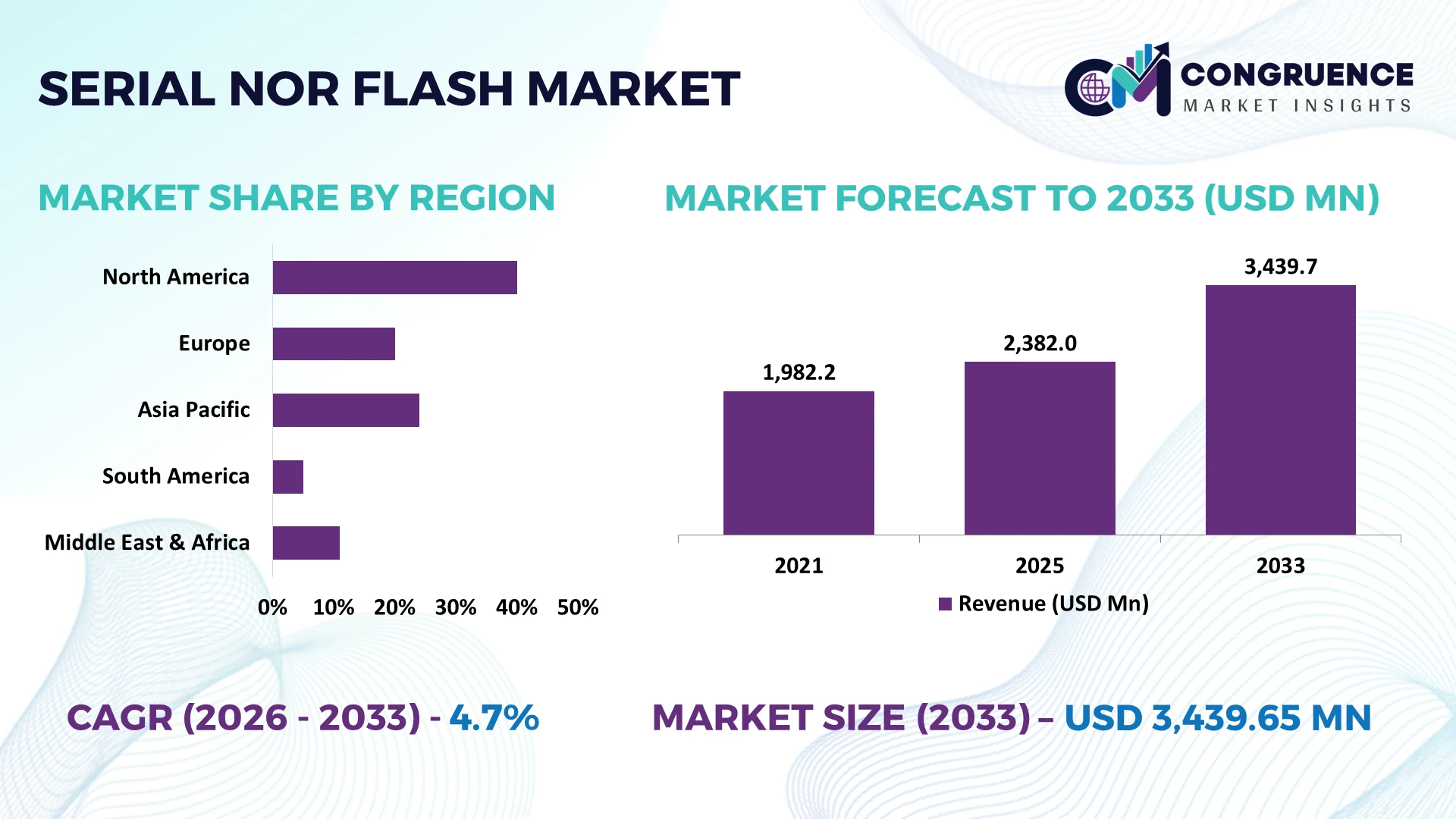
The Global Serial NOR Flash Market was valued at USD 2382 Million in 2025 and is anticipated to reach a value of USD 3439.65 Million by 2033 expanding at a CAGR of 4.7% between 2026 and 2033. Growth is driven by rising deployment of automotive ADAS, industrial controllers, edge-AI devices, and secure boot systems requiring fast, reliable non-volatile memory.
China dominates approximately 32% of global Serial NOR Flash consumption and manufacturing capacity, supported by semiconductor investment, automotive electronics, smartphones, and industrial automation. South Korea follows at roughly 15%, while Japan retains strong influence through automotive and embedded electronics. China’s advanced-node and domestic-memory expansion is accelerating amid U.S.-China technology restrictions and regional supply-chain localization.
Strategic implication: suppliers with localized capacity, automotive-grade qualification, and higher-density solutions are best positioned to capture advanced electronics demand.
Market Size & Growth: USD 2,382 million in 2025 rising toward USD 3,439.65 million by 2033 at 4.7% CAGR, driven by automotive electronics and edge computing.
Top Growth Drivers: Automotive electronics 28%, industrial automation 22%, consumer electronics 18%.
Short-Term Forecast: By 2028, advanced packaging and controller optimization are set to reduce memory-system costs by 6% while improving access efficiency by 9%.
Emerging Technologies: AI-enabled edge devices, 3D packaging, and higher-density Quad-SPI/Octal-SPI architectures are reshaping advanced NOR deployments.
Regional Leaders: Asia-Pacific approaches USD 2.0 billion, North America USD 0.75 billion, and Europe USD 0.55 billion, with automotive-grade adoption accelerating.
Consumer/End-User Trends: More than 60% of new connected automotive platforms integrate dedicated non-volatile memory for firmware, boot code, or safety functions.
Pilot/Case Example: A 2025 automotive firmware-storage deployment using Octal-SPI reduced boot-memory access latency by approximately 20%.
Competitive Landscape: Winbond leads with an estimated 20% share, competing strongly with Macronix, GigaDevice, Infineon, and Microchip.
Regulatory & ESG Impact: Automotive qualification and regional semiconductor policies are pushing localized sourcing, with supply-chain localization targets frequently exceeding 20%.
Investment & Funding: Global semiconductor expansion programs exceed USD 100 billion, supporting fabrication, packaging, and regional memory supply-chain diversification.
Innovation & Future Outlook: Next-generation NOR solutions increasingly combine higher density, secure storage, faster interfaces, and automotive-grade reliability, shifting competition toward system-level performance.
The Serial NOR Flash Market is gaining traction across automotive ADAS, industrial automation, wearables, networking equipment, and edge-AI hardware, where fast boot and reliable firmware storage remain critical. Advanced Octal-SPI architectures are improving data access by roughly 20%, while automotive-grade qualification is expanding. Regional semiconductor localization following geopolitical supply-chain disruptions is strengthening demand for diversified sourcing and strategic capacity planning.
Serial NOR Flash is becoming strategically important because firmware integrity, instant boot, and reliable code storage increasingly determine product performance in automotive, industrial, and connected-device competition. More than 60% of new automotive electronic platforms require dedicated non-volatile memory, strengthening supplier influence over design wins. Supply-chain restructuring is also pushing manufacturers toward qualified second sources and localized semiconductor procurement.
Technology migration is reshaping economics. Octal-SPI NOR delivers roughly 2x faster interface performance than conventional SPI architectures while reducing firmware-access bottlenecks, enabling tighter processor-memory integration. China is expanding domestic semiconductor capacity, whereas Japan and South Korea retain stronger positions in automotive qualification, advanced packaging, and high-reliability components. Over the next 2–3 years, automotive-grade and high-density NOR adoption is positioned to increase by approximately 8–12% annually across new platform programs.
A practical deployment example is automotive gateway firmware storage, where faster NOR access can shorten boot sequences by nearly 20%. Companies are responding through automotive qualification, multi-year supply agreements, localized production, and controller partnerships. The strategic advantage increasingly lies in combining memory density, interface speed, security features, and supply assurance rather than competing on component price alone.
Automotive electronics integration is the strongest structural driver, with ADAS, digital cockpits, gateways, and zonal controllers increasing dedicated firmware-storage requirements. Automotive applications account for roughly 25–30% of advanced NOR demand, while Octal-SPI deployments improve memory-access performance by nearly 20% versus conventional interfaces. China’s electric-vehicle manufacturing expansion is accelerating qualification cycles, while European OEMs prioritize functional safety and secure firmware. Suppliers are responding with AEC-Q100-qualified products, higher-density devices, and direct OEM partnerships. The non-obvious advantage is design-in longevity: once qualified into vehicle platforms, NOR suppliers gain multi-year demand visibility and switching barriers.
Supply concentration remains a structural constraint because advanced NOR production and packaging depend heavily on specialized semiconductor ecosystems. Automotive-grade capacity typically requires qualification periods exceeding 6–12 months, while component price volatility can affect procurement budgets by 5–10% during supply disruptions. Japan remains critical for high-reliability memory production, increasing exposure to concentrated manufacturing networks. Companies are reducing vulnerability through dual sourcing, regional inventory buffers, and long-term contracts. The sharper operational issue is qualification continuity: replacing a supplier is not equivalent to replacing a commodity component, so procurement teams increasingly prioritize lifecycle assurance over short-term unit-cost reductions.
Edge intelligence creates an underpenetrated opportunity as connected devices require larger firmware images, secure boot storage, and rapid update capability. Demand for high-density NOR solutions is increasing by an estimated 10–15% across emerging edge-AI and industrial platforms, while Octal-SPI adoption can reduce firmware-loading bottlenecks by about 20%. India’s electronics manufacturing expansion and China’s domestic AI-device ecosystem are creating new design-in opportunities. Suppliers are investing in higher-density architectures, secure memory features, and processor-memory partnerships. A key opportunity is combining NOR with MCU and edge-AI platforms, turning memory from a supporting component into a differentiated system-performance enabler.
Integration complexity is becoming a larger execution barrier as NOR devices support faster interfaces, secure boot, over-the-air updates, and increasingly sophisticated controllers. Firmware and memory-security requirements can add 10–15% to development and validation workloads, while platform teams face compatibility testing across multiple processor architectures. In the United States and Europe, evolving automotive cybersecurity expectations are increasing validation pressure. Companies must strengthen hardware-security engineering, automated testing, and ecosystem partnerships to maintain deployment consistency. The non-obvious challenge is software-memory co-optimization: higher bandwidth delivers limited value when firmware architecture cannot exploit it, making cross-functional engineering capability as important as semiconductor performance.
Octal Interface Adoption Accelerates Octal SPI deployment is expanding as automotive and industrial platforms demand higher firmware throughput, with access performance improving roughly 20% and design adoption increasing 8–12%. Companies are shifting new product roadmaps toward higher-density devices to reduce processor-memory bottlenecks and support larger software images.
Automotive Qualification Gets Stricter Automotive-grade NOR programs increasingly emphasize AEC-Q100 qualification, secure boot, and extended-temperature operation, raising qualification activity by approximately 10% while platform validation cycles remain 6–12 months. Suppliers are expanding automotive portfolios and forming OEM partnerships, making reliability documentation a stronger design-win differentiator.
Localized Supply Chains Reshape Sourcing Semiconductor procurement is shifting toward dual sourcing as geopolitical restrictions and capacity disruptions expose concentrated supply networks. Enterprises are targeting 15–20% greater supplier diversification, while regional inventory buffers increasingly cover several additional weeks. Manufacturers are responding with localized assembly, longer contracts, and capacity reservation strategies.
Higher-Density Devices Gain Priority Firmware sizes are expanding across connected controllers, pushing demand toward higher-density NOR products by roughly 10–15% in newer designs. This shift is reducing board-level memory constraints and simplifying architecture consolidation. Suppliers are investing in density upgrades and controller compatibility, while buyers increasingly evaluate lifecycle support alongside unit economics.
SPI NOR Flash remains the largest type, accounting for approximately 45% of demand because of mature tooling, low integration complexity, broad controller compatibility, and established supply chains. Quad SPI NOR Flash follows with about 30%, retaining strong adoption in embedded controllers where higher throughput is required without the complexity of newer interfaces. Parallel NOR Flash represents roughly 10% and remains relevant in legacy industrial and automotive architectures where established parallel interfaces support long product lifecycles.
Octal SPI NOR Flash is the fastest-growing type, expanding adoption by approximately 12–15% across newer automotive, networking, and edge-computing designs. Its higher bandwidth and processor compatibility are shifting investment away from legacy architectures. Companies are prioritizing Octal-SPI product families, controller partnerships, and automotive qualification to capture new design wins, while maintaining SPI and Quad-SPI portfolios for cost-sensitive platforms.
Firmware Storage leads with approximately 42% of application demand because automotive controllers, industrial systems, and connected electronics require reliable non-volatile storage for operating code and software updates. Code Storage follows at nearly 30%, supported by microcontroller-based products and embedded computing. Boot Memory represents about 18%, where rapid initialization is increasingly important for automotive gateways and edge devices, while Data Logging retains a smaller but specialized role.
Boot Memory is the fastest-growing application, with adoption increasing around 10–14% as faster processors and software-defined architectures shorten acceptable startup times. Companies are integrating higher-speed NOR interfaces directly into controller designs, improving boot responsiveness and simplifying firmware architecture. The operational shift is significant: memory is increasingly evaluated as part of system startup performance rather than as a standalone storage component.
Automotive Electronics represents approximately 38% of Serial NOR Flash demand, supported by ADAS controllers, digital cockpits, gateways, instrument clusters, and software-defined vehicle architectures. Consumer Electronics contributes around 25%, while Industrial Automation accounts for nearly 17%, reflecting established embedded-memory requirements. Telecommunications and IoT Devices maintain specialized demand, with purchasing increasingly tied to connectivity, firmware complexity, and lifecycle support.
IoT Devices are the fastest-growing end-user group, with adoption expanding approximately 12–16% as connected sensors, gateways, and edge controllers require secure firmware and rapid update capabilities. Automotive buyers prioritize qualification and reliability, whereas IoT manufacturers emphasize density, cost, and interface flexibility. Suppliers are responding with application-specific portfolios, ecosystem partnerships, and scalable density options. The competitive shift favors vendors capable of serving both high-reliability automotive programs and high-volume connected-device deployments.
Asia-Pacific accounted for the largest market share at 56% in 2025 however, South America is expected to register the fastest growth, expanding at a CAGR of 6.2% between 2026 and 2033.

Automotive software and edge-computing integration strengthen premium demand
North America contributes approximately 18% of global Serial NOR Flash consumption, supported by automotive electronics, aerospace systems, industrial automation, networking infrastructure, and high-performance embedded computing. The United States concentrates most regional demand, with automotive OEMs and semiconductor designers increasing adoption of higher-density NOR for secure boot, firmware storage, and rapid system initialization. More than 55% of newly developed connected-vehicle platforms increasingly incorporate dedicated non-volatile memory. Semiconductor reshoring is also changing procurement priorities as manufacturers diversify away from concentrated Asian supply chains. Companies are expanding qualified supplier networks, securing long-term capacity agreements, and developing automotive-grade Octal-SPI portfolios. The strategic shift is toward supply assurance and system-level performance rather than lowest component pricing.
United States Market Outlook: The United States remains North America's primary technology and purchasing center, supported by automotive electronics, cloud infrastructure, aerospace controls, and industrial automation. More than 60% of advanced embedded-system programs increasingly prioritize secure firmware storage and faster boot architectures. Domestic semiconductor investment is also strengthening packaging, testing, and supply-chain resilience.
Automotive electrification drives reliability-focused memory adoption
Europe represents roughly 15% of global Serial NOR Flash demand, with Germany, France, Italy, and the United Kingdom concentrating automotive and industrial applications. Automotive electronics account for nearly 40% of regional consumption as electrification, ADAS, digital cockpits, and software-defined architectures increase firmware requirements. EU cybersecurity and vehicle-safety requirements are strengthening qualification standards, while sustainability programs encourage longer component lifecycles and reduced electronic waste. German automotive suppliers are increasingly adopting higher-speed serial interfaces, with advanced NOR deployments rising around 10% across newer controller programs. Companies are responding through automotive-grade product expansion, OEM partnerships, lifecycle guarantees, and localized inventory planning. The competitive advantage increasingly comes from combining functional safety, cybersecurity, thermal reliability, and long-term supply continuity.
Germany Market Outlook: Germany anchors European demand through its automotive manufacturing ecosystem and dense supplier network. Automotive electronics represent more than half of the country's advanced embedded-memory applications in several vehicle-control programs. Manufacturers are prioritizing AEC-Q100-qualified NOR, secure boot capability, and higher-density interfaces to support increasingly software-intensive vehicle architectures.
Manufacturing scale and localization reinforce supply-chain leadership
Asia-Pacific commands approximately 56% of global Serial NOR Flash demand and the largest manufacturing ecosystem, supported by semiconductor fabrication, consumer electronics, automotive production, telecommunications, and industrial automation. China accounts for roughly 32% of global consumption, while Japan and South Korea remain strategically important for high-reliability memory and advanced semiconductor technologies. Regional suppliers are expanding domestic capacity as geopolitical restrictions accelerate supply-chain localization. Advanced serial-interface adoption is increasing approximately 12% in newer automotive and industrial designs. Companies are combining fabrication expansion, packaging partnerships, controller integration, and long-term customer contracts to secure design wins. The region's strongest advantage is not only production scale but the ability to connect memory manufacturing directly with large electronics assembly ecosystems.
China Market Outlook: China is the region's largest demand center, supported by electric vehicles, smartphones, industrial controllers, and connected devices. Domestic semiconductor investment is increasing local sourcing capabilities, while automotive electronics manufacturers are accelerating qualification of higher-density NOR. More than 30% of regional consumption is concentrated in Chinese applications, strengthening supplier incentives to localize production and technical support.
Connected infrastructure expands from automotive to industrial controls
South America represents a smaller share of global Serial NOR Flash consumption, estimated at approximately 5%, but Brazil provides the principal demand base through automotive manufacturing, telecommunications, industrial automation, and connected infrastructure. Brazilian automotive plants are increasing embedded-memory requirements as electronic control systems become more software intensive. Industrial automation deployments are expanding around 8–10% in selected manufacturing applications, supporting demand for firmware and boot-memory solutions. However, imported semiconductor dependence remains significant, increasing procurement sensitivity to logistics costs and currency movements. Companies are responding with distributor partnerships, multi-source procurement, and regional inventory buffers. The non-obvious opportunity is localized technical support: suppliers that shorten qualification and replacement cycles can gain share without building full fabrication capacity.
Brazil Market Outlook: Brazil provides the strongest South American platform because of its automotive production base, telecommunications infrastructure, and industrial automation footprint. Connected vehicle and factory-control deployments increasingly require reliable embedded memory, while local distributors are expanding inventory coverage to reduce import-related interruptions and improve component availability.
Digital infrastructure modernization creates targeted memory demand
Middle East & Africa accounts for approximately 6% of global Serial NOR Flash demand, with the strongest opportunities concentrated in the United Arab Emirates, Saudi Arabia, Israel, and South Africa. Smart infrastructure, telecommunications modernization, industrial automation, energy systems, and connected security equipment are increasing embedded-memory requirements. Gulf digital-transformation programs are accelerating deployment of connected controllers and edge devices, with selected infrastructure projects reporting annual equipment deployment increases above 10%. Companies are targeting the region through distributor networks, industrial partnerships, and customized lifecycle support rather than large-scale fabrication investments. The strategic shift is toward high-reliability components for infrastructure where downtime carries substantial operational costs, making secure boot and long-term firmware support increasingly important purchasing criteria.
Saudi Arabia Market Outlook: Saudi Arabia is emerging as a key demand center through smart-city infrastructure, industrial digitization, telecommunications expansion, and energy-sector automation. Large infrastructure programs are increasing connected-control deployments, while local technology partnerships improve access to embedded components. Suppliers with secure, long-lifecycle NOR products are positioned to benefit from infrastructure procurement requirements.
Winbond, Macronix, GigaDevice, Infineon, and Microchip compete directly across automotive, industrial, consumer, and communications applications, while smaller regional suppliers challenge on price and availability. The top five players collectively control approximately 65% of the market, creating a concentrated but innovation-driven structure. Competition centers on interface speed, density, automotive qualification, supply continuity, and pricing. Advanced Octal-SPI products deliver roughly 20% faster access than conventional SPI, while automotive-grade portfolios command approximately 8–12% premium positioning. Leading suppliers are expanding qualified capacity, signing OEM partnerships, and integrating security features into higher-density products. GigaDevice and Chinese suppliers emphasize localization and competitive pricing, while Japanese, American, and European vendors emphasize reliability and qualification depth. Supply-chain diversification is intensifying as customers seek second-source coverage. High qualification requirements remain the principal entry barrier. Winning requires combining technology leadership, dependable capacity, application-specific customization, and long lifecycle support rather than competing solely on unit price.
Winbond Electronics Corporation
Macronix International Co., Ltd.
GigaDevice Semiconductor Inc.
Infineon Technologies AG
Microchip Technology Inc.
ISSI (Integrated Silicon Solution, Inc.)
EON Silicon Solution Inc.
Puya Semiconductor
XMC Semiconductor
Dosilicon Co., Ltd.
Elite Semiconductor Memory Technology Inc.
Fremont Micro Devices
Current Serial NOR Flash technology is shifting from conventional SPI toward Quad-SPI and Octal-SPI interfaces for faster code execution and boot performance. Winbond’s W35T Octal NOR reaches 400 MB/s, about 5x the throughput of its standard QSPI counterpart, while adoption is strongest in automotive, industrial, and IoT designs. Higher bandwidth reduces processor-memory bottlenecks and supports faster system initialization.
Emerging 1.2V NOR architectures are targeting energy-sensitive edge devices. GigaDevice’s low-voltage GD25UF technology cuts normal-mode read power by up to 33% versus traditional 1.8V SPI NOR, with low-power operation reaching 70% lower consumption. Secure NOR integration is also expanding through ECC, CRC, hardware root-of-trust, RPMC, and protected boot functions, strengthening cybersecurity without adding separate memory components.
Disruptive development is moving toward 3D NOR, higher-density architectures, and tightly integrated memory-controller ecosystems. Macronix introduced 3D NOR technology for automotive, industrial, and medical applications, while automotive-qualified Octal solutions increasingly reach 2Gb densities and 333–400 MB/s bandwidth. Between 2026 and 2028, suppliers combining high density, low voltage, security, and xSPI compatibility will gain an advantage in software-defined vehicles and edge-AI platforms, making architecture decisions now commercially critical.
May 2025 Infineon achieved ASIL-D certification for SEMPER NOR Flash, covering 256Mb–2Gb densities and xSPI interfaces, strengthening qualification for safety-critical ADAS, gateway, and cockpit platforms. Source: infineon.com
March 2025 GigaDevice introduced dual-power SPI NOR Flash for 1.2V SoCs, cutting read power by up to 33% in normal operation and targeting edge-AI, IoT, and wearable designs. Source: gigadevice.com
May 2024 Macronix demonstrated ArmorFlash compatibility with Renesas RA8M1 Cortex-M85 MCUs, combining authentication, encryption, and secure ID with the MCU’s security engine for stronger embedded-device protection. Source: macronix.com
February 2026 Winbond approved NT$42.1 billion in 2026 capital expenditure covering NOR Flash and other memory lines, targeting approximately 30–40% higher bit shipments and strengthening capacity amid tight supply. Source: trendforce.com
The Serial NOR Flash Market Report covers SPI NOR Flash, Quad SPI NOR Flash, Octal SPI NOR Flash, and Parallel NOR Flash, assessing their roles across Firmware Storage, Code Storage, Boot Memory, and Data Logging. End-user coverage spans Automotive Electronics, Consumer Electronics, Industrial Automation, Telecommunications, and IoT Devices, with emphasis on higher-density and security-enabled deployments.
Regional analysis evaluates North America, Europe, Asia-Pacific, South America, and Middle East & Africa, including country-level manufacturing, procurement, and technology adoption patterns. The report tracks interface migration, low-voltage architectures, secure memory, advanced packaging, and emerging 3D NOR development. With leading suppliers collectively representing a substantial share of industry activity, the analysis supports supplier selection, capacity planning, localization, partnership strategy, investment prioritization, and competitive positioning through 2026–2033.
| Report Attribute/Metric | Report Details |
|---|---|
Market Revenue in 2025 | USD 2382 Million |
Market Revenue in 2033 | USD 3439.65 Million |
CAGR (2026 - 2033) | 4.7% |
Base Year | 2025 |
Forecast Period | 2026 - 2033 |
Historic Period | 2021 - 2025 |
Segments Covered | By Type
By Application
By End-User
|
Key Report Deliverable | Revenue Forecast, Growth Trends, Market Dynamics, Segmental Overview, Regional and Country-wise Analysis, Competition Landscape |
Region Covered | North America, Europe, Asia-Pacific, South America, Middle East, Africa |
Key Players Analyzed | Winbond Electronics Corporation, Macronix International Co., Ltd., GigaDevice Semiconductor Inc., Infineon Technologies AG, Microchip Technology Inc., ISSI (Integrated Silicon Solution, Inc.), EON Silicon Solution Inc., Puya Semiconductor, XMC Semiconductor, Dosilicon Co., Ltd., Elite Semiconductor Memory Technology Inc., Fremont Micro Devices |
Customization & Pricing | Available on Request (10% Customization is Free) |




